DNA and the Living Lattice
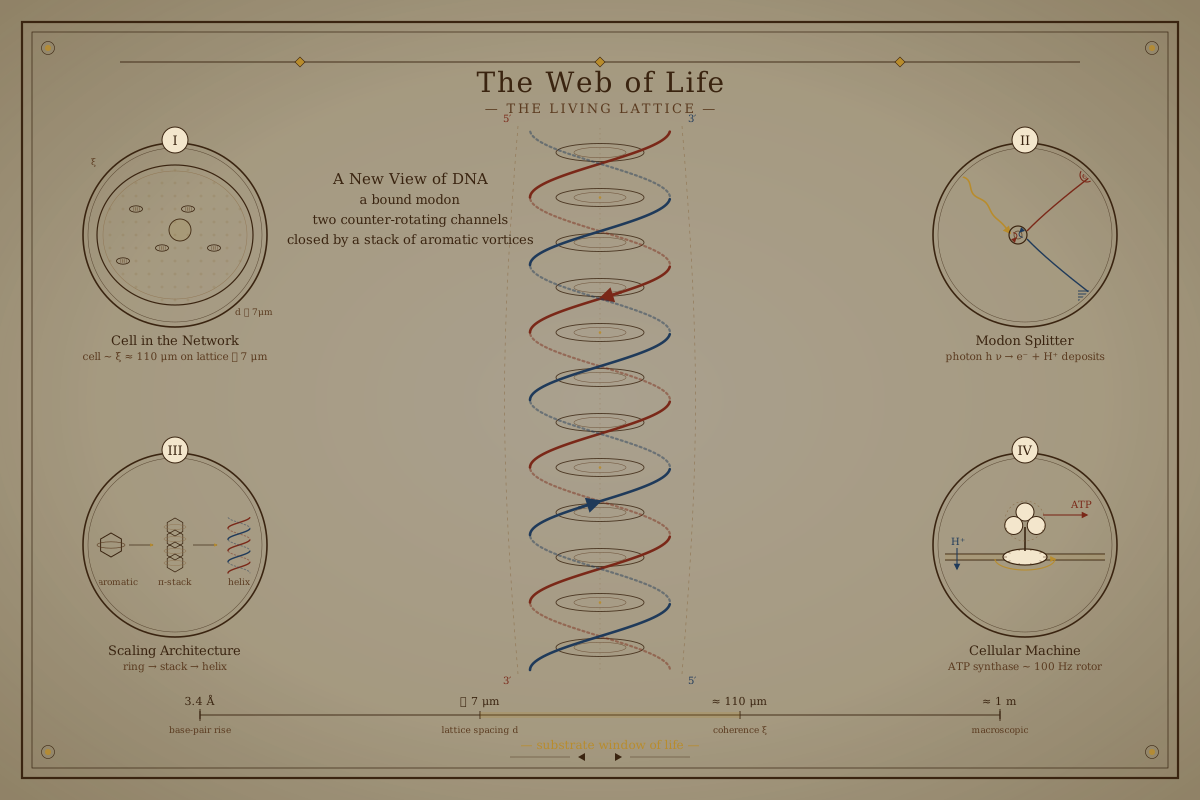
Interactive: open the helix simulation — B-DNA drawn as a counter-rotating pair: one backbone’s flow up and the other’s down, the base pairs as rungs of ring toruses (purines two lobes, pyrimidines one) tied at their two or three hydrogen-bond points, the aromatic stack as one axial channel in one sheath, and the anti-phase breath. Press Unroll and the cylinder opens into a strip: the strand becomes the hypotenuse of a right triangle with legs 2\pi r and p, \tan\alpha = f = 0.5666, which gives N = 2\pi r f/h = 10.47 base pairs per turn against the measured 10.5. Switch to A-form RNA or Z-DNA for the forms that do not sit on the lock, and to the microtubule for the same lock on a closed cylinder. Two more views follow the chapter past the geometry. The living wire draws the polar axis at the nanometre as the two-lane median it is, with two [4Fe-4S] readers bound on it: a pulse sent down the stack closes the far reader’s boundary and comes back on the other lane, and one mismatch scatters it, so the reader’s closure fails, its affinity collapses and it walks — Barton’s lesion search read as boundary closure, with the shift-on-binding prediction charted against sequence. The loop draws the gene as a four-port node with the Mediator condensate as its nose at the source port and the node ODE running live behind it: a silent store below S_c, a bursting producer above it, and — once the product represses its own locus past \beta^\star — a ring whose period the return delay sets, 2\tau_d < T < 4\tau_d. Two views then zoom in on the loop: the nose opens the condensate as a combinatorial matcher — two addresses, one pattern, and which locus it lights — and the ring draws the loop in time, one lap of a ring per \tau_d, with the period bracketed against the lap.
From Rings to Living Architecture
Aromatic rings showed how the substrate’s preference for closed surfaces explains aromaticity: a ring of 4n+2 π electrons closes into a torus, terminates no boundary, and gains the 36 kcal/mol of stabilization that makes benzene benzene. The same logic, applied recursively, organizes the rest of organic chemistry. Stack two aromatic rings face-to-face and their toroidal raceways begin to overlap. Stack a column of them and the column becomes a one-dimensional substrate channel. Twist the column into a helix and pair it with a counter-rotating partner, and you have the architecture of nucleic acid. Surround the helix with rotors, gradient-driven membranes, and a lattice-spaced array of furnaces, and you have a cell.
Atoms by themselves occupy a few cubic ångströms, sitting deep inside a single coherence volume of size \xi \approx 97\;\mu\text{m}. At those scales the substrate’s macroscopic structure is essentially uniform across the molecule. DNA strands in comparison are hundreds of nanometers long, organelles micrometers across, cells reaching the coherence length itself — span an increasing fraction of \xi, and the question of how the lattice organizes biological matter becomes unavoidable. The lattice ratio and texture in the interior of the lattice provides scaffolding for life. Cells and other structures form stationary modon structures of balanced oppositional flow to fuel the cell’s dynamo.
The substrate framework asks whether the geometry of life — the helix, the stack, the bilayer, the rotor — is constrained by the medium it operates in. Several biological length scales line up with substrate scales. Several biological architectures look like substrate-stable structures. And several puzzling efficiencies of biological energy transport become natural with organized substrate energy, not pure diffusion and chaos.
Three Substrate Effects
The lattice locks to build the cell’s machinery. Everything that assembles and runs the apparatus belongs to the ladder’s locking pole, because its job is to bind, nest, resonate. Base stacking merges shared boundary sheets (the nesting lock); the double helix is a bound, anti-phase paired breath — two counter-rotating strands, the pairing-two; the 10.5 bp/turn pitch is locked to the substrate’s cell occupancy rather than free to drift; coherent charge transport is a resonance along the column, broken precisely where the lock fails; and the [4Fe-4S] terminals and Mediator condensates are boundary-matching coherence cells. All of it is lock-pole — the substrate’s preference for parts that ring together.
The codon uses both the lock and anti-lock poles so they form a specific match. The lock for the specific match between opposites, and the anti-lock to ensure similar codons are not misread as each other.
The median in the lattice, the opposite spinning layers at ~ 2 x 8 μm, allows the regulatory loop to run both ways. It is why the loop can read the sequence and signal back. The lock builds the road; the median gives it two lanes; the anti-lock allows it to hold a specific message.
The Aromatic Stack
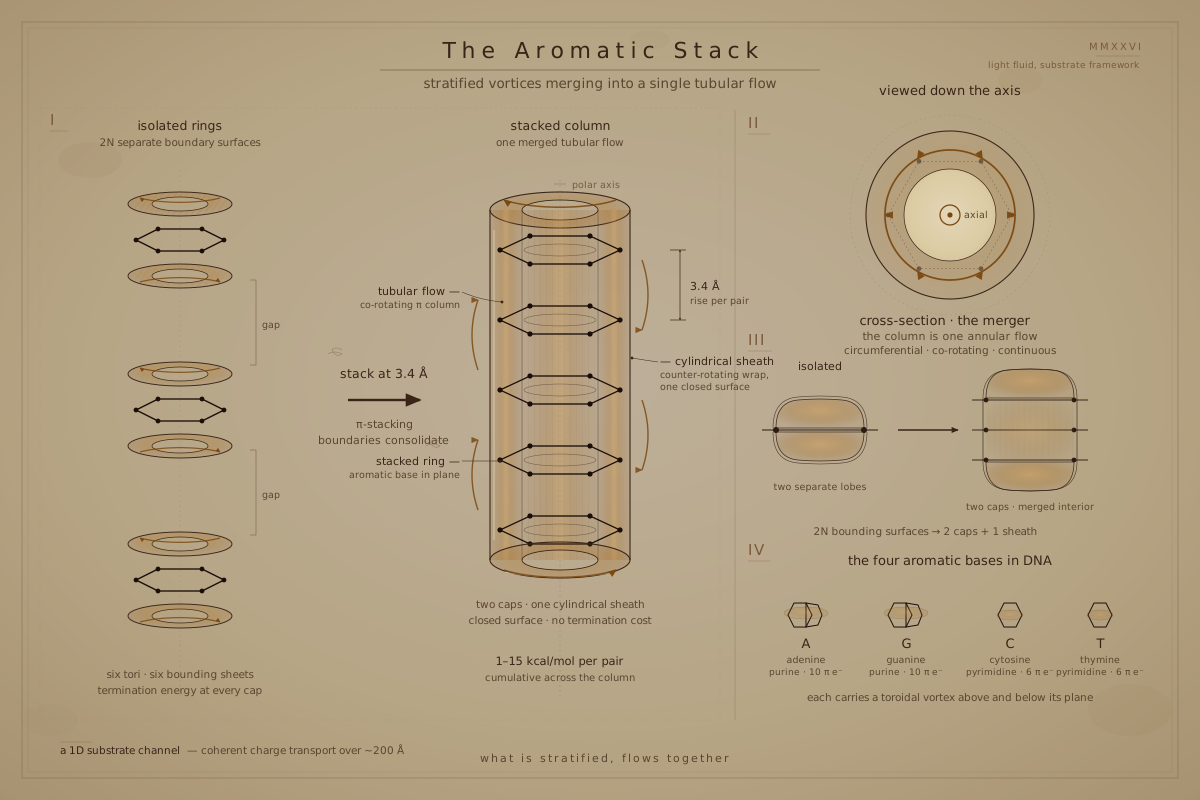
The four nucleic acid bases — adenine, guanine, cytosine, thymine (uracil in RNA) — are aromatic. Pyrimidines (cytosine, thymine, uracil) are six-membered rings with two nitrogens, supporting a 6-electron Hückel π system. Purines (adenine, guanine) are fused six-five rings with four nitrogens, supporting a 10-electron system across the fused frame. All four are among the most stable nitrogen-containing aromatic heterocycles in chemistry, and each one carries a toroidal vortex of substrate flow above and below its molecular plane in the sense developed in the previous chapter.
In B-form DNA, these bases stack on top of each other along the helix axis at a regular spacing of 3.4 Å — a distance comparable to the radial extent of a single π-orbital lobe. The stacking places two aromatic rings at that distance with their planes parallel and their π systems aligned, the toroidal raceways of the two rings begin to share boundary surfaces. The substrate sees this as another opportunity to consolidate counter-rotating layers: one shared boundary sheet between the two rings replaces the two separate ones the isolated rings would carry, in exactly the way a covalent bond replaces two separate atomic boundaries with one merged one (the mechanism developed at the end of The Hydrogen Flywheel).
The energetic gain is small per pair (1–15 kcal/mol of stacking energy depending on the bases, with purine-purine stacks the strongest) but cumulative. A column of N stacked aromatic rings has N-1 shared boundary sheets instead of 2N separate ones — a substantial total energy reduction even before accounting for the entropic costs of solvent ordering. More importantly, the column supports a continuous co-rotating substrate channel running along its axis. The toroidal raceways of the individual bases have merged into a single tubular flow.
This is the substrate explanation for π-stacking, the polar axis of the helix: a continuous one-dimensional flow channel running through the stacked bases, bounded by the cylindrical counter-rotating sheet that wraps the column. The geometry is a long, thin torus — closed in the angular direction (around each base’s ring), extended in the axial direction (along the helix). The π electrons within the column are no longer trapped in individual rings; they participate in a column-wide flow.
The Double Helix as a Counter-Rotating Pair
DNA’s defining feature is not the stack itself but the way two stacks wind around each other. The two sugar-phosphate backbones of B-DNA run antiparallel — one runs 5' \to 3' upward, the other 5' \to 3' downward — while spiraling around the central axis in the same right-handed sense. From the perspective of substrate flow, however, the two strands are counter-rotating: the energetic sense of circulation around the helix axis is opposite for the two strands, because the chemical polarities that fix the directional bias of each strand’s electron transport point in opposite directions. The base pairs bridging the interior — A:T held by two hydrogen bonds, G:C by three — are the structural connectors between two counter-rotating channels.
This is the modon topology, a balanced pair of counter-rotating vortex energy. It’s the lowest-energy way for the substrate to transport energy across distance, and hold energy in place. And it breathes, like the transient opening between DNA base-pairs. These are local, thermally driven excursions in which a pair unstacks and its hydrogen bonds part momentarily before re-closing. This could be the bound modon’s anti-phase breath: the same lossless exchange across a shared counter-rotating seam that binds Cooper electrons and runs the lattice’s own breath, here the flexing open and shut of the base-pair interior.
The energy is handed across the seam rather than lost — which is why breathing is reversible and does not unravel the helix, and why AT-rich tracts, with the weaker two-bond seam, breathe more freely than GC-rich ones.
The double-strand helix in the substrate model forms a closed boundary, it’s a stable boson, and invisible from the parity rule.
The 10.5 base pairs per helical turn — a puzzle because it is non-integer and a mismatch for the geometry is fixed by the substrate’s cell occupancy acting on the helix pitch angle, and predicts the preferred handedness, reflecting the handedness of the substrate itself.
B-DNA’s Pitch from the Cell Occupancy
The unrolled helix in the simulation draws the triangle this section computes, and re-computes N as r, h and f are dragged.
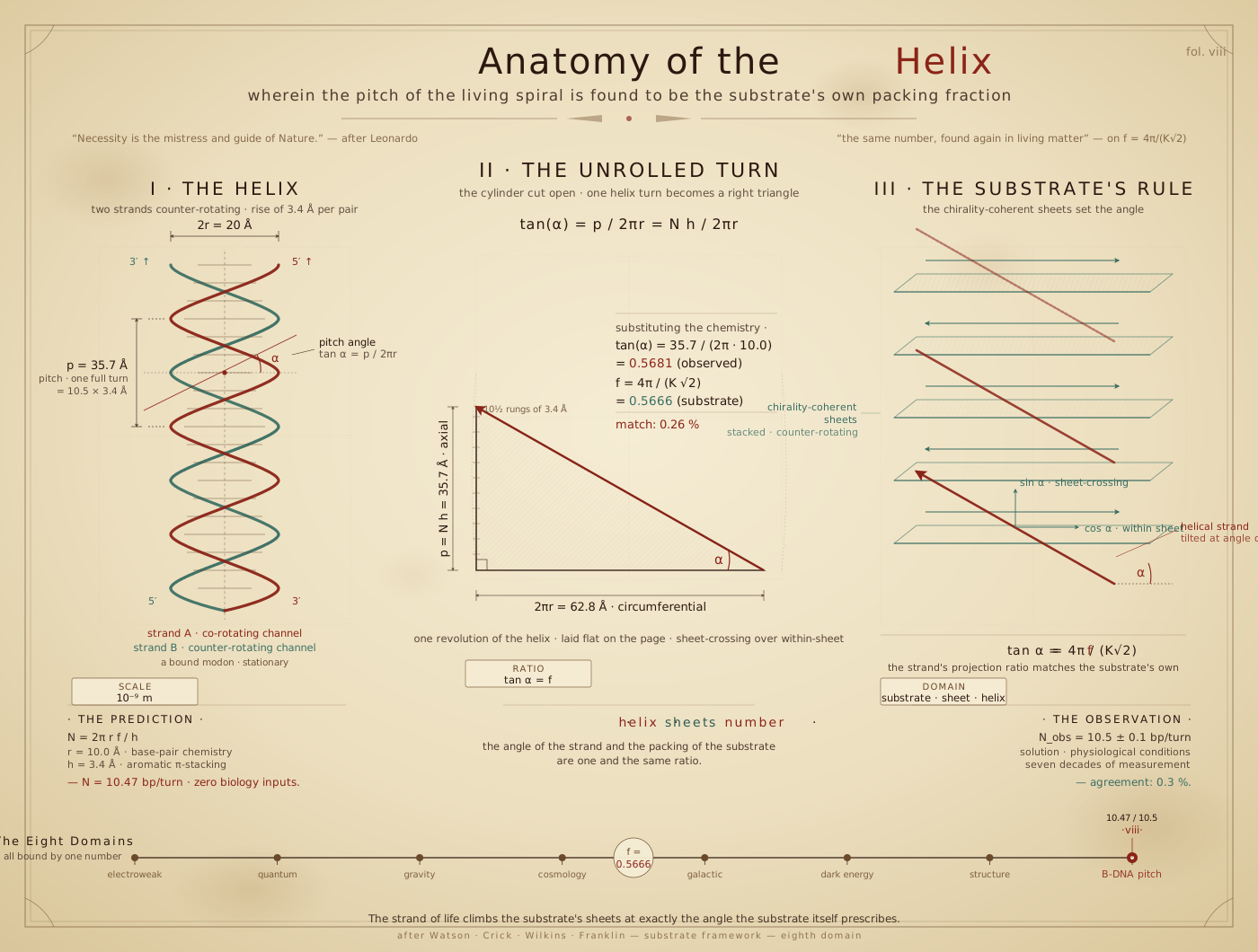
A right-handed double helix embedded in the substrate’s chirality-coherent sheet structure has its strand path partitioned per turn into two orthogonal components:
A circumferential motion of length 2\pi r, where r \approx 10.0 Å is the backbone radius from the helix axis. This is set by the isosteric length of A:T and G:C base pairs (~10.85 Å between glycosidic carbons), with the phosphate backbones tracking slightly inward. It is a chemistry parameter, fixed by base-pair geometry.
An axial motion of length p = N\cdot h, where h = 3.4 Å is the rise per base pair and N is the number of bp per turn. The rise is set by aromatic π-stacking van der Waals contact — the same parameter that fixes the inter-ring distance in graphite. It is also a chemistry parameter.
The strand’s tilt from the substrate’s preferred plane is the pitch angle \alpha_\text{pitch}, with
\tan(\alpha_\text{pitch}) = \frac{p}{2\pi r}
The conjecture is that the substrate’s chirality-coherent sheet structure locks the pitch angle of a counter-rotating duplex helix to its own cell occupancy:
\boxed{\tan(\alpha_\text{pitch}) = f = \frac{4\pi}{K\sqrt{2}}}
The cell occupancy f as the substrate’s ratio of chirality-coherent flow volume to boundary volume in a self-consistent vortex configuration. A helical strand partitions its motion the same way — \sin(\alpha_\text{pitch}) axial (across substrate sheets) and \cos(\alpha_\text{pitch}) circumferential (within them). Tilting steeper than \tan(\alpha) = f over-commits the strand to sheet-crossing and pays excess boundary energy at every turn; tilting shallower under-commits and fails to engage the substrate’s chirality preference. The equilibrium sits at \tan(\alpha) = f — structurally the same constrained-equilibrium logic that fixes the cell occupancy itself in the bridge equation.
With r = 10.0 Å and h = 3.4 Å set by chemistry, the conjecture predicts
N = \frac{p}{h} = \frac{2\pi r\, f}{h} = \frac{2\pi \cdot 10.0 \cdot 0.5666}{3.4} = 10.47\;\text{bp/turn}
Observed: N = 10.5 \pm 0.1 bp/turn in solution under physiological conditions, with canonical values in the 10.4–10.5 range across measurement methods. Agreement: 0.3%.
Equivalently, the pitch angle itself: from canonical B-DNA geometry, \tan(\alpha_\text{pitch})_\text{obs} = 35.7/(2\pi \cdot 10.0) = 0.5681 versus the substrate prediction f = 0.5666. A 0.26% match — within a factor of two of the bridge equation’s 0.16% match against \rho_\text{DM}, and well inside experimental scatter on N.
The cell occupancy f is fixed by the bridge equation with no inputs from biology. The radius r and rise h are independently determined by base-pair chemistry. The bp/turn ratio is then N = 2\pi r f/h = 10.47, with no fitted parameters. If the conjecture is correct, B-DNA’s 10.5 bp/turn — empirically known for seven decades and never derived from first principles — becomes a qualified eighth domain of the bridge equation, sitting alongside galactic dynamics, dark energy, and structure formation. The qualification is on the functional form \tan(\alpha_\text{pitch}) = f: the chiral/boundary projection argument that motivates it is plausible but is not yet a derivation from the substrate Lagrangian.
Why other helical forms are different. A-form RNA (N = 11, r \approx 9.4 Å, h \approx 2.8 Å) gives \tan(\alpha) = 0.474, not f. The framework reads this as exactly the situation it should: A-form is the substrate-suboptimal configuration adopted when reduced water activity or C3′-endo sugar pucker force a chemistry-driven deviation from the substrate-locked B-form. The accompanying prediction is that B-form is universally preferred — and indeed, hydrated DNA at physiological ionic strength settles to B-form across organisms with N converging on 10.4–10.5, while A-form and Z-form geometries vary more widely with environment.
Z-DNA (left-handed, 12 bp/turn, formed only at high salt or on alternating-purine-pyrimidine sequences) inverts the chirality preference and is expected not to match f. It is the substrate-rejected helical form, accessible only when local substrate chirality is screened. The framework’s prediction is that B-form is the locked ground state, A-form and Z-form are chemistry-forced excursions, and the width of each form’s geometric distribution across conditions should track how strongly substrate locking competes with chemistry-imposed deformation.
Base Pairing as Cross-Bridge Boundary Closure
Four observations from how base pairs behave with the substrate framework.
The Pyrimidines have a single toroidal lobe, the ring and counter-spinning tori above and below the plane. Purines have two stacked toroidal lobes. The lowest energy bond combines a single-lobe profile with the two-lobe provile across the H-bond plane, when they have complementary topology.
The distance between the head carbon atoms (C1) between base pairs are consistently \sim 10.85 Å apart, despite this being an uncomfortable fit for chemistry. This common distance allows DNA to mix and match base pairs but different pairs should be either longer or shorter. With the substrate, \sim 10.85 comes from the wavelength between the two counter-rotating backbones, fixed both by the backbone radius r \approx 10.0 Å and the cell occupancy f using the same model as the pitch.
Hydrogen bonds are formed from an electrostatic-plus-orbital interaction with a donor (N-H) and an acceptor (O or N). The substrate shows the donor has a local outflow and the acceptor local inflow, forming a tie-point of balanced flow. H-bonds form in the bridge plane, and π-stacking in the axial direction using the same boundary merge, just rotated 90 degrees.
The wobble pair between G and U - weak opposites that only bond weakly in RNA are also weak matches in the substrate. Because the pair’s vortices are laterally displaced, the vortices do not align face-to-face across the bridge the way A:T and G:C do. The wobble is allowed in the third position of the codon — not because the substrate’s grip is weaker there, but because that is where G:U has room to slide, as the codon stamp section shows. The pair view of the codon simulation draws any two bases across the bridge and takes G:U from repulsive to attractive as the slider slides it.
Charge Transport Along the Polar Axis
The stacked aromatic column in DNA forms a one-dimensional substrate channel, supporting coherent charge transport along its length. This matches observations that DNA is a charge-transport medium1: holes and electrons injected at one end of a DNA duplex propagate through the stacked bases at rates that depend exponentially on damage to the stack but only weakly on length over substantial distances.
Standard biophysics describes this as DNA-mediated charge transport, with a model in which the stacked bases act as a chain of weakly coupled electronic states — a tight-binding mini-band — through which holes either tunnel coherently or hop thermally. The substrate framework reframes this picture without contradicting it. The polar axis of B-DNA is a one-dimensional substrate channel, the same kind of co-rotating raceway that carries the electron’s pilot wave around the hydrogen atom, but rolled into a tube and threaded along the helix axis. A hole introduced at one end is a localized disruption of the channel; it propagates along the channel as a one-dimensional substrate excitation, with a propagation length set by how cleanly the channel closes against the surrounding counter-rotating sheath.
This explains several otherwise-puzzling features of DNA charge transport. The exponential sensitivity to mismatches is natural: a mismatched base pair is a discontinuity in the counter-rotating boundary that wraps the channel, and the channel’s coherence is destroyed within a few base steps of any boundary defect. The temperature insensitivity of coherent transfer at low excitations is natural: substrate channel propagation is not a thermal hopping process but a coherent matching of substrate phase along the channel. The strong distance-independence at intermediate ranges — once charge has entered the channel, it propagates with little additional cost per base — is natural: as long as the channel is intact, the substrate does not pay an energy cost per unit length. And coherent transport is itself a lock phenomenon — the column has to ring as one resonant channel — so a mismatch reads as a local patch of anti-lock dropped into a structure that needs to lock, which is exactly why a single defect kills it so sharply.
The architecture also settles the direction question a single-wire picture leaves open. A duplex is not one channel but two co-rotating strand-columns sharing the counter-rotating base-pair interior as their seam — the median-strip geometry the framework reads into every conduit that straddles a counter-rotating boundary, from the hypha to the xylem–phloem couple, here at its finest rung, \sim 2 nm. A conduit built on such a median has two oppositely-directed lanes already present in the substrate it occupies, so the polar axis is natively bidirectional for the same reason the hypha is: charge can be launched from either end, and a signal sent out and a signal returning travel the one duplex without colliding. That makes the wire a circuit, not a one-way fuse — which is what the redox signalling of the next section requires. When two DNA-bound proteins separated along the duplex scan the sequence between them by exchanging charge through the intervening stack, either partner can be the sender, and a single break on the seam stops the exchange in both directions at once. The favouring of hole over electron transport is then the two lanes running at different throughput, not a single permitted direction.
The same channel-with-wrap architecture organizes coherent transport in copper and in birefringent crystals, with a ring-down time of the boundary that controls how strongly one excitation can influence the next. The cross-domain pattern is developed in Channel with Memory; the DNA polar axis is the biological instance of it. What turns this wire into a regulator — its terminals, the scaffold that reads its output, and the signal it projects to the rest of the cell — is the subject of the next section.
The Polar Channel as Regulatory Engine
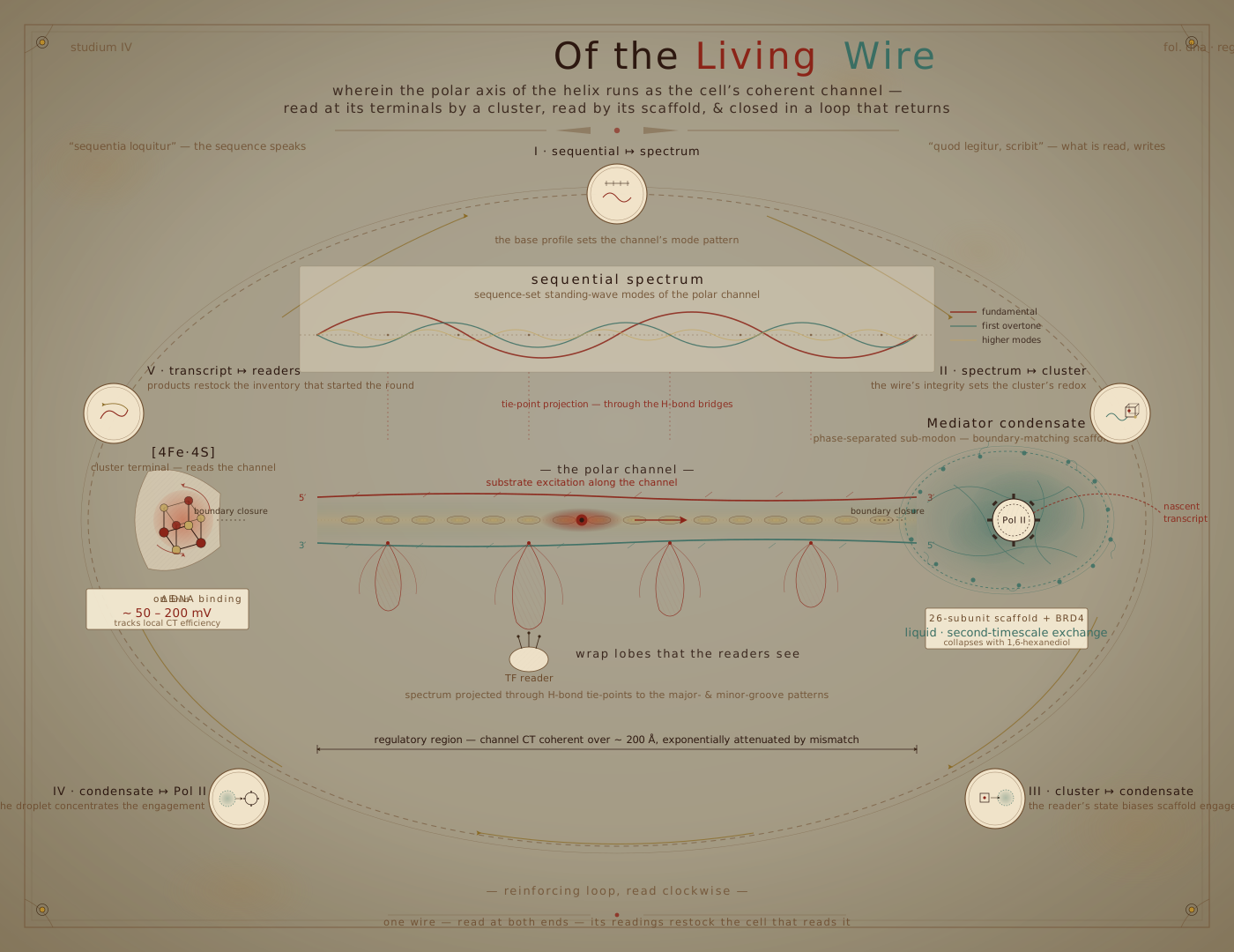
A one-dimensional substrate channel that propagates excitations cleanly over hundreds of ångströms and breaks exponentially at any defect is, by itself, only half of a regulatory mechanism. It is at most a damage detector — a wire that signals “intact” or “broken” to whoever is reading its endpoints. What turns it into a regulator is the question of what reads it, how that reading is projected back outward to the molecular machinery that acts on the genome, and how the loop closes so that what the channel says feeds back into what the channel becomes. Three lines of biology — converging from quite different directions — sketch the answer the substrate framework already needs.
Iron-Sulfur Clusters as Channel Terminals
A surprisingly large fraction of the enzymes that bind, replicate, repair, and transcribe DNA carry an [4Fe-4S] iron-sulfur cluster as a cofactor. The base-excision-repair glycosylases MutY and Endonuclease III, the XPD-family helicases involved in nucleotide-excision repair, FANCJ, DNA primase, and several subunits of the eukaryotic replicative polymerases all carry one or more [4Fe-4S]2. In each case the cluster sits within ångströms of the DNA backbone when the protein is bound. The Barton group has shown, across two decades of experiments, that the cluster’s midpoint potential shifts by roughly \sim 50–200 mV when the protein binds duplex DNA, that two such proteins separated along DNA can exchange an electron through the intervening duplex over distances limited only by the integrity of the π-stack between them, and that the redox state of the cluster controls the protein’s DNA-binding affinity3. The proposed mechanism — protein A and protein B, both bound to DNA, scan the sequence between them by completing a CT circuit; a lesion breaks the circuit and dissociates one of them, which then walks along the DNA and rebinds at a fresh location — is what the field calls redox signaling for lesion search.
The substrate framework reads this as the channel’s terminal architecture. A [4Fe-4S] cluster is a small metal-coordinated multi-orbital system — a tight toroidal vortex of substrate flow in the same sense an aromatic ring is, with iron’s d-orbital structure playing the role of carbon’s \pi system. The cluster’s redox state is the cluster’s vortex-loading, set by how well its outer boundary matches the channel it is attached to. When the cluster sits at the polar axis of an intact duplex, the channel’s substrate flow merges smoothly with the cluster’s; the boundary closes; the cluster sits at the DNA-bound midpoint, and the protein stays bound. When a lesion downstream breaks the channel, the cluster’s outer boundary no longer closes against a coherent flow; the boundary scatters; the cluster’s midpoint shifts; the protein’s affinity collapses and it walks. This is the boundary-matching principle from Cells as Nested Modons applied at the cluster-channel interface — a coherence event, signalled by a chemistry-readable observable.
A falsifiable handle follows. The midpoint-potential shift of a given [4Fe-4S] enzyme on DNA binding should scale with the local CT efficiency of the bound sequence — purine-rich tracts, which support better π-stack continuity, producing larger shifts than mixed tracts of the same length; single mismatches placed between the cluster and a downstream reporter attenuating the shift in proportion to the spectroscopically-measured CT decay across that mismatch. The proteins (MutY, EndoIII, XPD, primase), defined sequence libraries, and the electrochemical methods are all available; this is a coordinated measurement the framework predicts a specific direction for, and the cleanest near-term test of the polar-channel-as-regulator picture.
Interactive: the living wire draws this section at unit = nm. Sixty nanometres of duplex carry the median’s two lanes — the signal out along the core, the answer back around it — and two [4Fe-4S] readers sit on the backbone, each a cubane with its own ring of flow. Reader A sends a pulse down the stack on a clock; when it reaches B, B’s ring runs smooth and amber (the boundary closed, the midpoint at its DNA-bound value) and B answers on the other lane, so the segment between them is scanned. Switch on the mismatch and one wrong rung breaks the seam: the pulse scatters there, neither lane gets through, B’s ring turns coral and jittery, its affinity collapses and it lifts off and walks the duplex, rebinding at random until it lands where the circuit closes — which is on the near side of the lesion, so readers accumulate there. The readout charts the shift on binding against reader separation for a purine-rich and a mixed intervening sequence, with the live reader’s closure as a moving point on it; the decay lengths are drawing choices, the ordering is the prediction.
Mediator and the Boundary-Matching Scaffold
At the transcriptional end of the same axis, the eukaryotic Mediator complex — twenty-six subunits in humans, arranged as a flexible “head + middle + tail + kinase module” scaffold — physically bridges enhancer-bound transcription factors and the RNA polymerase II machinery at the promoter. Mediator has no enzymatic activity of its own; its function is structural and integrative. Since 2018 a substantial body of work has shown that Mediator, BRD4, and a cohort of transcription factors with intrinsically disordered activation domains form phase-separated liquid condensates at super-enhancers and active transcription sites4. These droplets concentrate hundreds of TFs, coactivators, and Pol II molecules in a sub-micrometer volume, exchange components on the second timescale, and selectively collapse super-enhancer-driven transcription when their integrity is chemically disrupted.
The framework reads a Mediator/super-enhancer condensate as a local substrate sub-modon — a coherence cell smaller than the lattice spacing, formed where the genome is densely engaging the transcriptional machinery. The condensate’s liquid character is the substrate’s signature of a coherence boundary that is structurally maintained but molecularly fluid; Mediator’s flexible scaffold is the physical structure that holds the boundary open; the disordered activation domains of the participating TFs are the chemistry by which arbitrary protein cargo can be docked into a coherence cell without committing to a rigid lattice position. Phase separation, in this picture, is what the substrate does when many independent binding events need to share a coherence interface — exactly the role that mitochondrial cristae junctions and nuclear pore complexes play at larger scales in Cells as Nested Modons, translated into a regime where the boundary is liquid rather than membrane.
Why the cell needs this is sharper in the framework’s language than in the standard one. Enhancer-to-promoter coupling at the cell scale would be diffusion-limited if it were purely chemical: a single TF searching for its target by 3-D diffusion takes minutes to hours, and the observed enhancer-promoter response times are far shorter. A condensate solves the problem by collapsing the search to a local coherence cell — participating molecules are pre-concentrated at the boundary, and exchange events propagate through the condensate at substrate speed rather than Fickian-diffusion speed. The same logic the framework applies to nested-modon signaling across organelle boundaries reappears here, one scale inward.
The Outward Signal: Sequence-Dependent Spectra
The two halves now need to be joined. A channel that can be read at its terminals by [4Fe-4S] clusters, and a transcriptional condensate that selectively engages particular promoters, are two pieces of machinery whose connection is the sequence of the intervening DNA. What does the channel project outward to the wrap that the condensate touches?
The polar channel is a one-dimensional resonator. Its substrate-mechanical properties — local flexibility, stacking-energy modulation, CT decay constant per base step — vary systematically with sequence; purine-purine stacks are stiffest and most CT-conductive, pyrimidine-pyrimidine least, and the mixed cases distribute between. In the framework’s language, the local sequence sets the channel’s index profile, and the channel supports a spectrum of axial standing-wave modes determined by that profile, in the way a varying-cross-section transmission line supports modes determined by its impedance profile. A regulatory region carries a sequence-specific spectrum of axial substrate modes. Those modes project outward through the hydrogen-bond tie-points already developed in Base Pairing as Cross-Bridge Boundary Closure, modulating the major-groove and minor-groove wrap into a sequence-specific lobe pattern that protein readers see.
Here the anti-lock pole returns, one scale up from the codon. For a reader to tell one regulatory region from another, their projected spectra have to be distinguishable: two enhancers that pushed the same lobe pattern onto the wrap would be read as the same address, and the wrong genes would fire. The sequence-dependent spectrum is the genome’s information riding the wire, and like the codon alphabet it must refuse to lock — the same anti-lock pole the codon stamp lands on, now carrying a whole regulatory region instead of a triplet. The machinery that reads the spectrum locks; the spectrum it reads does not.
This rotates the chapter’s worked-example logic onto the long axis of the genome. The aromatic-pocket recognition demonstrated in Aromatic Pockets is the transverse version of opposites-attract substrate matching — lobe-to-lobe across a binding pocket, the agonist’s vortex profile reading the cage’s, \rho(d_{\cos rc}, K_i) = +0.905 in the nAChR worked example. The metric developed in The Codon Stamp is the triplet axial version — three stacked bases producing a stamp that a tRNA anticodon reads. The polar-channel readout discussed here is the full-sequence axial version — an entire regulatory region producing a spectrum that a TF and its associated Mediator condensate read. All three are the same mechanism — substrate-wave matching at a boundary — with geometry setting which features of the spectrum get read.
The piece that is currently qualitative is the bridge from channel spectrum to wrap lobe pattern. The CT efficiency variations across sequences are measured; the sequence dependence of base-step mechanics is measured; but the projection from those onto the wrap lobes that a specific TF reads is not yet a number the framework can produce. This is the next worked example the program would attempt, and the cleanest setup is a TF whose binding affinity across a designed sequence library tracks the spectral coupling more strongly than the chemistry-of-contact baseline. The codon-stamp metric’s per-base profiles \phi_B are the inputs such a calculation would need; the rotation onto the long axis is geometric.
The Reinforcing Loop
Stack the three pieces and the regulatory loop the cell runs becomes a chain of boundary-matching events, each at a different scale:
- Sequence sets channel spectrum. A gene’s regulatory region carries a sequence-specific spectrum of polar-channel standing-wave modes — the genome’s content as a substrate-physics object.
- Cluster reads channel locally. A [4Fe-4S]-bearing protein at a defined position along the DNA closes its boundary against the local channel, and its redox state and DNA affinity register that closure.
- Cluster state biases condensate formation. The reader protein’s state controls whether it participates in (or recruits, or excludes) a Mediator condensate at the nearby super-enhancer or promoter.
- Condensate selects Pol II engagement. The condensate concentrates the components of the transcription machinery at one set of genes and not others.
- Transcribed products feed back. The transcribed proteins include the [4Fe-4S]-bearing readers themselves, Mediator subunits, and the rest of the cell’s regulatory inventory — closing the loop onto the next round.
The architecture is the Cells as Nested Modons picture run from the inside out. Each step is a coherence event at a particular scale — channel ↔︎ cluster at the ångström level, cluster ↔︎ condensate at the nanometer level, condensate ↔︎ chromatin at the tens-of-nanometers level, chromatin ↔︎ nuclear envelope at the micrometer level. The substrate provides the coherent boundary structure at every step; molecular biology provides the chemistry that implements each particular interface. Repair is the most visible manifestation because lesions break the channel cleanly and the response is binary; transcriptional regulation is the dominant manifestation, with the same machinery reading subtler sequence-dependent variations in the channel spectrum and biasing condensate formation accordingly. The two functions share machinery — [4Fe-4S] enzymes appear on both sides of the repair/transcription divide — because they are two readings of the same channel.
This sharpens the chapter’s overall thesis. DNA is not “an information-storage molecule that happens to conduct charge”; it is a stationary modon whose polar axis is simultaneously the cell’s primary substrate-coherent wire and its primary regulatory readout. The Mediator complex is not “a transcription coactivator that happens to phase-separate”; it is the substrate’s boundary-matching scaffold at the channel’s transcriptional end. The reinforcing loop that Cells as Nested Modons identifies as the canonical architecture of life runs through the genome by this mechanism, and “opposites attract” — the substrate-wave matching that drove the codon-stamp and the aromatic-pocket worked examples — operates here as the long-axis selection rule that connects sequence to expression. Read against the chapter’s three jobs, the loop is the spine bent into a cycle: lock-pole machinery — the stack, the clusters, the condensates — reading an anti-lock message, the sequence, along a median wire that can carry the answer back the way the question came. It is a loop and not a pipeline precisely because the wire has two lanes.
The Transcription Loop as a Flux Graph

The substrate’s information architecture supplies a grammar this chapter can now spend. Every modon is a node with four ports — a source it draws from, a drive it does directed work through, a dissipation it sheds as heat, and a radiation port through which it leaks a coherent modon coin with a long vector aboard — the four tied by one balance function the node’s angular-momentum disk regulates, and nesting is the flux graph in which a child’s radiation port feeds its parent’s source port. The reinforcing loop just drawn is exactly such a graph, and reading it in the grammar sharpens every step — and earns the chapter its own worked node, the genome’s, to set beside the mitochondrion, the neuron, and the galaxy.
The Gene as a Node That Slides Closed and Open
Start from the baseline the chapter has insisted on: a duplex is a bound, stationary modon, and a modon must stay coherent to hold together. In the node grammar that is the statement that the resting genome is a closed node — a store and a router, drive port near zero, holding its sequence coherently the way a Cooper pair or a resting cell holds its state. Transcription is the genome going open at one locus: the gene flips into a producer, runs its drive hard, and — because an open node cannot balance internally — must be caught by something downstream. The resting genome is a vast closed store studded with a few locally-open producers, and which loci are open at any instant is the cell’s expression state. Health, in the architecture’s reading, is the capacity to slide — to keep most of the store closed and coherent while opening exactly the loci the moment needs.
The grammar says that flip is not a dial but a bifurcation. The node ODE carries a coherence threshold E_c below which the drive and radiation ports stay shut: starve the source and the locus is a silent store; raise it past the critical S_c and the coherent ports light and the locus becomes a bursting producer. This is the substrate reading of transcriptional bursting — the long-measured fact that genes transcribe not at a smooth rate but in stochastic bursts of several transcripts separated by silent intervals. A burst is the disk crossing E_c: the locus integrates regulatory drive until it clears threshold, lights its coherent ports, fires a packet of transcripts, and relaxes back below threshold. Burst frequency and size — the two knobs single-molecule FISH and live-cell imaging actually measure — are the node’s distance above S_c and the rate it relaxes. The same closed↔︎open slide the architecture reads in a cell that rests and then divides runs here at the single-gene scale, with the Mediator condensate’s formation as the coherence onset that lights the ports.
The Mediator as the Cell’s Nose — a Hard-Coded Coherence-Match ODE
What sits at the source port and decides when the locus crosses threshold is the Mediator condensate and the array of transcription factors it concentrates. The grammar lets this be stated precisely: the Mediator is the regulatory engine that runs the gene’s node ODE as a coherence-match. Its disordered-activation-domain TF array is a combinatorial coherence-matcher in exactly the sense the nose is — where the olfactory epithelium tiles molecular-shape space with \sim 400 receptor channels and reads an odorant as the pattern lit across them, the condensate tiles signal space with its TF panel and reads the cell’s regulatory environment as the pattern of activation domains that partition into it. The Mediator is the cell’s nose: a fuzzy, high-dimensional matcher whose occupancy is a running readout of which signals are present. Phase separation is what the substrate does when many independent binding events must share a coherence interface, so the condensate is the physical coherence cell in which the match is taken, and its formation is the threshold crossing of the previous subsection.
Three things follow from reading the Mediator as a nose rather than as a switch, and each is a claim the standard picture does not make. First, the nose reads occupancy, not identity: the same condensate lit by a different docked pattern is a different address, which is why a repertoire of \sim 1{,}600 human transcription factors can address \sim 20{,}000 genes the way \sim 400 olfactory receptors address \gtrsim 10^{12} odours — the code is the pattern across the panel, and a factor that means “on” at one locus means nothing at another because the rest of the pattern differs. Second, the match is taken inside a boundary, which is what makes the readout a threshold rather than a dial: below the coherence threshold there is no condensate to take the match in, only transient puncta, and the locus stays a closed store however many factors drift past; above it the condensate forms and the ports light together. The condensate’s liquid character is the substrate’s compromise between two needs the nose has — a boundary that holds the panel together long enough to take a match, and one open enough that the panel can be re-docked on the second timescale as the environment changes. Third, the nose’s own product is part of the smell. What the locus emits is translated and re-enters the pattern the nose reads, and it does so a transport delay late — the time to finish the transcript, export it, translate it and drift back. That single fact is what turns the four-port node into a loop, and it is why the genome’s matcher, unlike the cortex’s, cannot learn: with couplings burned into sequence and chromatin, the only variable the loop has left to tune is when the product returns, and the next subsection shows that the delay, not any internal rate, sets the period at which such a loop rings.
Interactive: the nose draws the first two of those claims with two loci side by side. Each regulatory region carries an address — twelve sites, the spectrum it projects through its groove, amber where a factor can dock and coral where a docked factor closes the locus — and the environment is a pattern, the set of factors present, which drift in and dock where the address has a site for them. The occupancy read against the address is the match S that drives each locus’s node: pattern 1 lights locus A and leaves B a closed store with one lone factor docked, pattern 2 does the reverse, and Flip one factor shows the same factor as one voice of five at one address and no site at all at the other. Below S_c there are only transient puncta; above it the condensate forms and the ports light together. Add the closing factor and a fully-lit locus shuts. Then slide B’s address onto A’s: the more alike two addresses become, the more one pattern fires both — the anti-lock the genome’s addresses have to keep.
Interactive: the loop draws this subsection and the next two at unit = 10 nm, with the node ODE of the information-architecture chapter integrated live behind the picture — the same \gamma, g, \kappa, E_c as scripts/node_balance_ode.py. The resting genome is beads on a string, closed; one locus is open with the condensate at its promoter, and the condensate’s size and swirl are the node’s store: it forms as E clears E_c, and the pool molecules docked into it (gold, orbiting with the disk) are the pattern it reads, the source S. Past threshold the drive lights — Pol II convoys run the polar axis — and each run ends in a modon coin, drawn as what the transcript is, a single strand with the modon’s two halves counter-orbiting inside it, that leaves through a nuclear pore for the ribosome. The ribosome spends it as a nascent chain, extruded from the exit tunnel and folded — a helix bundle, a barrel, a coil, by turns — and the folded protein rides the dashed return edge back to the condensate, which does not swallow it: the nose’s own current, a ring of flow that runs through the condensate whether or not anything rides it, carries the protein through and lets it out the far side as one more molecule of the pool the nose samples, arriving exactly \tau_d after its coin left the gene. Either side of the open locus the closed store is drawn as it is, the duplex wound on nucleosome spools. The readout keeps the ledger P_\text{in} = P_\text{drive} + P_\text{diss} + P_\text{rad}, traces E(t) against E_c, and draws the drive port against S with its kink at S_c. Three regimes: a silent store below S_c that bursts only when the drive’s wobble carries it over threshold; a bursting producer above it, which shocked below \beta^\star settles with a damped ring; and, with the product repressing its own locus at \beta > \beta^\star, a sustained ring whose measured period the readout compares with the return delay — it lands at T \approx 2.2\,\tau_d, inside the (2, 4)\,\tau_d band the chapter predicts for Hes1, p53–Mdm2 and NF-\kappaB. Drag the delay and the period follows it; drag the gain below \beta^\star and no delay will make it ring.
This is where the chapter’s antenna conjecture becomes a port. The gene’s source port is its antenna — the condensate reading the sensed environment, including the sequence-dependent spectrum the polar channel projects through its groove wrap — and its radiation port is its emitter. The Mediator runs the same node ODE the cortical resonator runs, but in its hard-coded register: where the cortex is a plastic Stuart–Landau resonator whose couplings are learned and continuously re-tuned, the genome’s matcher has its couplings fixed in sequence and chromatin — a BIOS to the cortex’s operating system, the same coherence-match circuit with its weights burned in rather than trained. Both are fed by feedback topology and both bifurcate at a threshold; the cortex perceives and the genome expresses, but it is one ODE at two settings.
The Cascade as Drive, Coin, and Catch
With the source port read as the Mediator’s nose, the rest of the cascade is the node’s output side, and the grammar names each piece:
- Drive — the polymerase. Once the condensate lights the locus’s coherent ports, RNA polymerase II is the drive port: directed work along the polar axis, the gene’s jet, reeling the template through and laying down a nascent transcript. The condensate concentrating Pol II at one promoter and not another is the architecture’s drive port switching on at threshold.
- Radiation — the mRNA is the message. The finished transcript is the gene’s radiation port: a coherent modon coin that leaves the node and is caught downstream, carrying the long vector — energy and pattern as one packet — off the genome. This is a node’s leak is its message made as literal as it gets: the mRNA is the message, the sequence pattern handed to the world rather than kept. The genome’s worked node is the twin of the neuron’s — the spike is to the neuron what the transcript is to the gene, a radiation port that is not a defect but the entire point.
- Catch — the ribosome. The mRNA coin is caught at the source port of the ribosome, which the architecture reads as an unusually open node with three live drive ports. The ribosome spends the coin as directed work — the nascent protein threaded out its exit tunnel — and that protein re-enters the cytoplasmic environment the Mediator’s nose is reading. That is the loop closing: the emitted coin, translated, changes the pattern the matcher senses, which re-sets which loci cross threshold on the next round.
So the five-step reinforcing loop is one directed cycle in the flux graph: the Mediator’s nose reads the sensed pattern (source), the lit locus drives Pol II (drive), the transcript leaks as the coin (radiation), the ribosome catches and translates it (the nesting edge), and the new protein re-tunes the smell the nose was matching (back to source). The 4Fe-4S clusters are readers that report channel integrity into the same matcher; the sequence-dependent spectrum is the content the matcher reads off the wire. The loop is a cycle and not a pipeline precisely because the median wire has two lanes — it carries the question out and the answer back along one axis.
The Four-Part Signature, and the Ring
The architecture’s discipline is that a genuine open node shows a four-part signature — a leak that is named in its own field, measured, regulated, and caught by an identifiable parent. The transcription burst clears every line: named (transcriptional bursting), measured (burst size and frequency by smFISH and live-cell imaging), regulated (enhancers and Mediator tune burst frequency as the dominant control variable), and caught (the proteome lives on the mRNA coin). The genome takes its place beside the mitochondrion, chloroplast, neuron, and galaxy as a worked node, with the burst as its radiation port and the ribosome as its parent.
And the grammar predicts more than a burst — it predicts a ring. When an open node’s parent throttles its source through that same radiation port with a transport delay \tau_d, the node stops relaxing and oscillates, with a period locked to 2\tau_d < T < 4\tau_d — twice the loop delay near onset, four times it at strong gain, independent of every internal rate. Transcriptional autoregulation is exactly this loop: a gene whose protein product represses its own transcription after the delay of transcribing, splicing, exporting, and translating it. The prediction is concrete and falsifiable: a delayed-negative-feedback transcriptional oscillator should ring at two-to-four times its own measured maturation-plus-transport delay. The Hes1 oscillator (\sim 2 h period, with a transcription-plus-translation delay of order tens of minutes), the p53–Mdm2 loop, and the NF-\kappaB nuclear oscillation (\sim 100 min) are the candidate tests — each a regulated producer whose parent over-corrects with a lag, ringing at a period its delay should set. This is the delayed-node reading the architecture applies to Cheyne–Stokes breathing and business cycles, brought to the genome.
Interactive: the ring draws the loop in time. One lap of a ring is \tau_d: each coin the gene pays out runs the right half of the lap to the ribosome, is translated there, and the protein runs the left half back to the nose, which is throttled by what arrived a lap ago. The tape beneath plots the store E(t) with the measured period and the lap bracketed against each other — the ring lands at T \approx 2.3\,\tau_d at the chapter’s settings — and the readout sweeps the delay and the gain through the same ODE and plots T/\tau_d against the (2, 4) band: drag the delay and the period follows it, drag the gain below \beta^\star and no delay will make it ring. The candidate table lists the period each of Hes1, NF-\kappaB and p53–Mdm2 shows and the delay window, T/4 to T/2, the prediction says a measurement must land in.
Capturing Modon Energy: A Pointer Forward
The polar channel of DNA is the cell’s longest-running substrate wire — but it is not the cell’s primary site of energy capture. That role is played by a separate apparatus organized around aromatic cofactors of a different class (chlorins and porphyrins, in chlorophylls and cytochromes) and by the only macromolecular rotary engine in biology, the F₀F₁ ATP synthase that sits in the inner mitochondrial and thylakoid membranes. The architecture of the cell’s energy economy is the substrate’s modon ledger expressed at organelle scale: photons arrive as modons, the reaction center pulls their two counter-rotating halves apart on geometrically opposite sides of a membrane, the proton half is banked across the membrane and the electron half is queued on a reduced carrier, and the F₀F₁ rotor reassembles the two halves back into a small mobile chemical capacitor (ATP) one threefold turn at a time. The respiratory chain runs the same architecture without the photon, with Complex III’s Q-cycle as a second instance of the gated-bifurcation pattern. The full worked example — chlorin antenna, Rhodobacter sphaeroides reaction center cascade, Q-cycle, F₀F₁ rotor — lives in From Photon to ATP, with quantum yield \Phi = 1.02 \pm 0.04, 3 ps / 1 ps / 200 ps charge-separation cascade, and the c8–c14 c-ring impedance match as its anchor numbers.
What the rotor introduces into this chapter is a length-scale argument. ATP synthase sits at \sim 10 nm, with thousands of synthases per lattice cell and many lattice cells per mitochondrion. The cristae they cluster on sit at 0.1–1\;\mum, below the lattice spacing. A mitochondrion is 1–10\;\mum, comparable to the lattice spacing. A eukaryotic cell is 10–100\;\mum, comparable to the coherence length \xi. The mobile small-molecule energy carriers the rotor produces — ATP, GTP, NADH, the acyl-CoA family — all share a topology of “high-energy bond + readily diffusible carrier” at a few-nanometer scale, well below the lattice spacing. Carriers much larger than \sim 10 nm would couple to the lattice rather than diffusing through it; carriers much smaller would store too little energy per molecule to be useful. The cell’s energy carriers are sized to the gap between bond energies and the lattice; the next section makes that scale-matching argument explicit at cell, organelle, and lattice levels.
If a cell is roughly one \xi across, then a cell is one coherence cell of the substrate. If mitochondria are at the lattice spacing, then mitochondria sit in registry with the substrate’s internal organization, like rooms placed at the studs of a wall. If cristae are well below that scale, then the energy-generating apparatus is operating well within a single lattice cell — and a single mitochondrion can host hundreds of independent rotors, each one a tiny localized substrate-current-to-bond-energy converter. The framework calls the mitochondrion a “hot house” because it is densely packed with these converters; biology calls it the powerhouse of the cell. The two descriptions agree on what is happening and disagree only on the level of mechanism. This nesting — carrier \sim 10 nm, cristae \sim 0.1–1\;\mum, mitochondrion \sim 1–10\;\mum, cell \sim \xi — is the coarse spatial family of the substrate ladder: rungs spaced by the large steps of the nesting tower rather than the fine \sqrt{2} of the resonant family, but the same discrete-scale-invariance principle the ladder chapter argues underlies both.
The Cell as a Lattice Domain
The scale-matching above motivates a stronger conjecture: that the typical eukaryotic cell size of \sim 100\;\mum is set, at least in part, by the substrate’s coherence length. Cells are not arbitrarily-sized bags of water with biochemistry inside. They occupy a very specific size range, and that range is famously hard to explain from biochemistry alone. Diffusion limits matter, but they argue for cells much smaller than they are. Surface-to-volume ratios matter, but they argue for cells of diverse sizes that we don’t actually see in normal physiology. Typical metabolic and signaling rates of a cell don’t directly fix any particular dimension.
The framework offers a candidate constraint. A coherent cellular interior — one in which intracellular communication, organelle positioning, and substrate-mediated energy transport all work coherently — should not exceed the substrate’s coherence length. Beyond \xi, the standing-wave structure of the substrate decoheres, pilot-wave-mediated signals interfere destructively with their own reflections, and the lattice loses its single-domain organizational backbone. A cell larger than \xi would be operating as a chimeric system of multiple substrate domains and would have to spend energy fighting the substrate to maintain integration. A cell at \xi uses one coherence cell with no fight.
This conjecture immediately suggests biological observations to look at. Most eukaryotic cells fall between 10\;\mum and 100\;\mum. The largest known truly-single-celled organisms (oocytes, large neurons, some plant cells, paramecia) reach 100–1000\;\mum, but in those cases the cell is doing something specific that lets it overcome the coherence limit: oocytes stockpile material before fertilization and then divide rapidly into many normal-sized cells; neurons extend axons that are essentially specialized one-dimensional cables and not free cytoplasm; large algal and plant cells are often multinucleate and behave as multi-domain systems. The “ordinary” working cells of metazoan biology are the size of one or a few coherence cells.
A second suspicious match is at the substrate’s vertical scale. The chirality-coherent sheets repeat at the full inter-sheet period d_\text{GJO} \approx 16\;\mum, but because the stack alternates handedness a counter-rotating boundary layer falls at every half-period d_\text{GJO}/2 \approx 8\;\mum — and that boundary half-period is the scale any cell-spanning structure locks onto (see Substrate Particles § The Vertical Scale). Red blood cells are \sim 6–8\;\mum in diameter — right at d_\text{GJO}/2. Capillaries are 5–10\;\mum in diameter. Mitochondria, peroxisomes, and many vesicle classes fall in this range. These structures are not failing to form at smaller sizes; they are settling at this size, as if the substrate’s boundary layers provide a natural pinning scale for cell-spanning structures. The biconcave geometry of the red blood cell, in particular — a flexible disk just wide enough to push through a capillary that is itself sized to the boundary half-period — looks like a structure tuned to ride the lattice rather than to fight it.
That 8\;\mum counter-layer is not only a floor to rest on — it is a median to straddle, the same reading the mycorrhizal chapter gives the hypha one rung up. Because the half-period layer is one half of the substrate’s own anti-phase breathing pair, the substrate’s flow reverses across it, so a cell-spanning structure centred on the median inherits two oppositely-directed lanes already present in the vacuum it occupies. It is the same two-lane median the polar charge axis rides at \sim 2 nm, now at the cell-spanning scale: wherever a cell runs long-range logistics that go out and back along one axis — and most of them are round trips — the 8\;\mum counter-layer is the channel that lets the two directions share a corridor without colliding, the painted median of a two-way road. The cell is not only sized to the lattice; it is plumbed by it.
It might be possible to derive these scales from (d_\text{GJO}, \xi, \alpha_{mf}) but unless that’s done this section is speculative. It does identify what such a derivation would have to produce: a cell-size upper bound at \xi, an organelle-size preference near the boundary half-period d_\text{GJO}/2 \approx 8\;\mum, and possibly a finer structural rhythm at the substrate’s interior scale. If the framework eventually produces those numbers from its established parameters, a long-standing puzzle in cell biology — why are cells the size they are? — would have a non-evolutionary answer. Biology would then be free to optimize within the constraint, but the constraint itself would be set by the medium.
The cytoskeleton may be the most direct substrate-scale signature. Microtubules — hollow tubes ~25 nm in diameter that span the cell — extend across distances comparable to \xi and have a clear axial polarity (a + end and a - end), and their geometry locks to the same cell occupancy f that fixes B-DNA’s pitch, with one Gauss factor reduced for the closed-cylinder symmetry — the closed-cylinder counterpart of the helix derivation above. Actin filaments form a denser meshwork at smaller scales. Intermediate filaments fill in between. The cytoskeleton is conventionally described as the cell’s mechanical scaffold, and it certainly is one. The framework suggests an additional role: the cytoskeleton may also be the cell’s substrate scaffold — a set of organized polar channels through which substrate currents are directed, organelles are positioned, and signals propagate at speeds faster than diffusion. The motor proteins (kinesin, dynein, myosin) that walk along these tracks are then converting substrate-current-driven flows into directed motion of cargo, in a way structurally analogous to the way ATP synthase converts proton-gradient flow into rotation.
Division: One Domain Becomes Two

Interactive: open the division simulation — one cell through the whole event, from one domain to two: it grows past its ceiling and the strain seam flickers, rounds up, the two poles seed two opposite senses (watch the left half reverse), the chromosomes line up on the median plane, a fresh counter-rotating boundary, and the furrow closes on that same plane. Switch the cell to yeast (5 μm, closed mitosis, a bud) or an early blastomere (240 μm, no growth, the spindle saturating at 60 μm). The parity rule puts one, two or three poles in the same cell and counts what each cuts; the plane lets one cell of an epithelial sheet stretch, turn and tilt, with the cut area computed live — Hertwig’s rule and planar spindle orientation as one smallest-cut economy.
The argument above left a cell that has outgrown \xi in an energetically penalized state — a chimeric two-domain system that “would have to spend energy fighting the substrate to maintain integration.” Cell division is the framework’s reading of how that strain is resolved. A cell does not grow without bound and then split at random; it grows until its interior can no longer be carried as a single coherence cell, and then it partitions into two domains, each back at \sim\xi. In this reading the substrate’s energy is not only the obstacle a dividing cell must overcome — it is part of the drive: once growth carries the interior past the single-domain ceiling, the two-domain configuration the cell is forced into is exactly the configuration a clean fission relaxes. The long-known cell-size checkpoint — that cells commit to division at a critical size rather than a critical age — acquires a substrate co-cause: the critical size is set, at least in part, by the coherence length, with the biochemical sizer (a division regulator titrated against cell volume) as biology’s implementation of a ceiling the medium sets.
The apparatus the cell builds to execute the split is, structurally, the same counter-rotating pair the chapter has met at every smaller scale. The mitotic spindle is bipolar — two poles, two opposed microtubule asters organized around two centrosomes that separate to opposite ends of the cell. Read through the framework, those two poles are the centers of the two daughter coherence domains, nucleated before the cytoplasm physically divides; the spindle is the substrate seeding its second cell. The bipolarity is not incidental. A spindle with one pole or three is a catastrophe the cell actively suppresses — monopolar and multipolar spindles are hallmarks of mitotic failure — exactly as the photon is a counter-rotating dipole rather than a single vortex or a triple (The Photon as Modon) and the duplex is two strands rather than one or three. Two is the minimum configuration that closes a boundary, and the spindle obeys the same parity-two rule one tower up — the modon motif at cell-spanning scale.
The split itself falls where the chapter’s own geometry says it should. The metaphase plate, where the chromosomes align, and the cleavage furrow that follows both form at the equator — the median plane exactly midway between the two poles. This is the median-to-straddle reading of the 8\;\mum counter-layer made dynamic: where a resting cell straddles a pre-existing boundary layer, a dividing cell manufactures one, laying down a fresh counter-rotating boundary between two domains where a moment before there was a single domain. And it does so at the cell’s most spherical moment: an adherent cell that was a spread, flattened splat rounds up into a near-perfect ball as it enters mitosis — mitotic rounding, driven by a spike in cortical contractility and osmotic swelling. The planar object the framework points to is therefore not the cell body, which is at its roundest precisely here, but the division interface. A sphere, an axis nucleated through it, and a boundary plane perpendicular to that axis midway along it is the parity-two geometry the chapter has already met as the photon dipole and the duplex, now drawn in three dimensions: the cell collapses to a single clean coherence ball, separates two poles along an axis, and lays the boundary on the plane that bisects them. That the boundary appears as a plane — the metaphase plate, the cleavage plane — is the chapter’s expectation that planar organization recurs at every scale, instantiated at the one event where the cell most needs a clean two-domain partition: a plane is the minimal-area surface that separates two coherence cells, the same economy by which the substrate stores energy in flat chirality sheets rather than in arbitrary surfaces. One tower up, that same plane is set by the tissue: the cells of an epithelial sheet hold their spindle parallel to the sheet — planar spindle orientation — so the cleavage plane stays in registry with the monolayer and the daughters remain in-plane, while Hertwig’s long-axis rule orients the division across the cell’s long axis. The boundary the cell manufactures is thus not only planar but aligned, locking to whatever larger planar order the cell sits within.
This reading is the missing top of an argument the framework has already been making in pieces. The Golgi chapter reads the mitotic disassembly of the Golgi ribbon, and the nuclear-envelope chapter reads open-versus-closed mitosis, both as a single coherence domain that cannot host a single perinuclear structure while preparing to become two. Those are consequences; the domain fission described here is the cause. They also supply the reading’s first cross-check on scale: yeast, far below \xi, runs closed mitosis and divides by budding, while large animal cells run open mitosis with full envelope breakdown — the size dependence the nuclear-envelope chapter already flagged, now read as the same splitting requirement expressed differently above and below the single-cell scale. The claim stays conjectural in the chapter’s sense — it does not yet derive a division size from (d_\text{GJO}, \xi, \alpha_{mf}) — but it sharpens what such a derivation would have to produce: a division-trigger size near the single-domain ceiling, a spindle-pole separation locked to the boundary scale, and a cleavage plane that prefers the substrate’s boundary layers. The asymmetric divisions biology also runs are then the override cases — the substrate’s default is the symmetric split into two equal single-domain daughters, and a cell that wants two unequal daughters must spend regulatory effort to overrule it.
Enzymes and Orbital Recognition
Most enzymes recognize their substrates with extraordinary specificity. A typical enzyme might process 10^4 molecules of its preferred substrate per second while leaving structurally similar molecules untouched even at thousand-fold higher concentrations. The standard explanation is geometric: the active site has a shape that fits the substrate, with hydrogen-bond donors and acceptors, hydrophobic patches, and electrostatic features arranged to match the substrate exactly. Where this explanation strains is in cases of remarkable specificity for chiral substrates — a single enzyme distinguishing L-alanine from D-alanine, where the only difference is the spatial arrangement of identical atoms.
The framework offers a complementary picture. Each electron orbital in a molecule is not merely a probability distribution; it is a co-rotating channel with a direction of substrate flow. Two molecules that are mirror images of each other have orbital flows that circulate in opposite senses around any given axis. An active site whose binding pocket is itself chiral — whose electronic structure has its own preferred circulation direction — will couple favorably to a substrate of one chirality and unfavorably to its enantiomer. The “shape complementarity” of a chiral binding event is, in the framework’s language, flow complementarity: matching the direction of substrate circulation, not just the direction of atomic positions. The enzyme reads the substrate’s vortex signature, not just its profile.
This is a reframing rather than a new prediction. Enzymatic chiral specificity is well-explained by standard structural biology. What the framework adds is the insight that the chiral preference is enforced not just by van der Waals and hydrogen-bonding geometry but also by the direction of co-rotating substrate flow in the orbitals — and that the two contributions are not really separable. Chemistry is substrate flow. The framework predicts that any energy difference arising from the substrate’s intrinsic chirality preference, set by the Higgs field and ultimately by \alpha_{mf}^2, will be in the same direction across all chiral biology in our \mathcal{B}^{0} bubble. All life on Earth uses L-amino acids and D-sugars; the framework’s prediction is that this is not an accident of early evolution but an alignment with the local Higgs chirality.
The current best calculations and measurements for parity-violating energy differences in chiral molecules give magnitudes of order 10^{-19} to 10^{-14} eV per amino acid — far below thermal noise at biological temperatures. Biology should not be able to feel this directly. The framework does not currently predict a larger value. But it does predict that the sign of the preference is universal within \mathcal{B}^{0} and that across distinct \mathcal{B}^{-n} bubbles the sign could in principle differ. This is not a testable prediction in any practical sense; we list it as a conceptual consequence and a placeholder for whatever experiments might one day reach the relevant precision.
A more accessible signature is in the amplification of the chirality preference by stacked or helical structures. A single amino acid carries a chirality energy at the 10^{-15} eV level. A 100-residue α-helix should carry roughly 100 \times that energy, partially canceled by competing geometric effects but not entirely. A long supercoiled DNA, an \alpha-helical bundle, or a chiral protein cage may amplify the substrate chirality preference by orders of magnitude — still not measurable in 2025 precision, but moving in the right direction. The framework predicts that as molecular precision improves, this amplification will be detectable first in long, regularly-folded chiral structures.
Predictions and Open Problems
Photosynthetic and mitochondrial efficiencies from substrate dynamics. Photosynthetic reaction centers convert solar photon energy into stable chemical energy with quantum yield close to unity5. The mitochondrial electron transport chain achieves \sim 40\% thermodynamic efficiency from glucose to ATP. Standard biochemistry attributes these efficiencies to fine-tuning by evolution. The framework should ask whether they are bounded above by substrate-level constraints — for instance, by the geometric efficiency of separating a modon’s two counter-rotating components into spatially distinct deposits, and by the loss rate of substrate-mediated coherence at biological temperatures.
Chirality at the parts-per-trillion level. The framework predicts a parity-violating contribution to the energy of chiral biological molecules controlled by \alpha_{mf}^2. For typical amino acids the magnitude is below current experimental sensitivity; for systems where chirality is amplified (helices of helices, supercoiled DNA, ferredoxins with intrinsic chiral magnetic response) the cumulative effect could in principle be detectable.
Iron-sulfur cluster midpoint shifts versus local CT efficiency. The framework predicts that the DNA-binding midpoint-potential shift of a [4Fe-4S] enzyme should track the CT efficiency of the bound sequence — purine-rich tracts producing larger shifts than mixed tracts of the same length, single mismatches between the cluster and a downstream reporter attenuating the shift in proportion to the spectroscopically-measured CT decay across that mismatch. The proteins (MutY, EndoIII, XPD, primase), designed sequence libraries, and the electrochemical methods all already exist; the prediction is a coordinated measurement away. A positive result lifts the Polar Channel as Regulatory Engine section from integrative speculation to a worked example at the cluster-channel interface.
Transcriptional bursting and oscillation as node-ODE signatures. Reading the gene as a four-port node makes two quantitative claims from the node ODE. First, a transcriptional burst is the closed→open bifurcation — the locus is a silent store below a critical regulatory drive S_c and a bursting producer above it — so burst frequency should switch on at a threshold in activator concentration with the drive-port order-parameter form (rising from zero with a kink at S_c), rather than scaling smoothly from zero; existing dose-response bursting datasets (smFISH against titrated activators) are the test. Second, a delayed-negative-feedback transcriptional oscillator should ring at a period T bounded by two-to-four times its independently-measured maturation-plus-transport delay \tau_d, 2\tau_d < T < 4\tau_d, with the cycle appearing only above the architecture’s finite onset gain \beta^\star \approx 7.3. Hes1 (\sim 2 h), the p53–Mdm2 loop, and NF-\kappaB (\sim 100 min) are regulated producers whose delays are separately measurable; a transcriptional limit cycle whose period fell well outside [2,4]\times its loop delay would falsify the delayed-node reading. Both follow from the same node grammar that fixes the mitochondrion’s proton leak and the neuron’s spike.
Cell division as substrate-domain fission. The framework reads mitosis as one coherence domain partitioning into two, with the bipolar spindle as the cell-scale counter-rotating pair and the cleavage plane as a freshly-laid substrate boundary. The falsifiable content: the division-trigger size should cluster near the single-domain ceiling (\sim\xi-related scales) across cell types rather than being set purely by a biochemical sizer; spindle-pole separation, and the spindle-length saturation seen in large cells, should lock to the boundary half-period d_\text{GJO}/2 \approx 8\;\mum or its harmonics rather than scaling smoothly with cell size; and the metaphase/cleavage plane should preferentially fall on substrate boundary layers, testable in large early-embryo blastomeres where cell-scale and lattice-scale geometry can be imaged together. A division size or spindle length that varied smoothly with no preferred substrate scale would falsify the reading.
Putting the Section in Context
Aromaticity is a clear picture of the substrate framework in chemistry: a single closed surface enclosing a single closed-loop flow, with an energy benefit measurable in the lab. The double helix extends that picture into one dimension: a column of stacked closed surfaces, helically twisted, with a counter-rotating partner column that closes the boundary at the macromolecular scale. The cell extends it into three: a \xi-sized domain of substrate organization within which lattice-spacing organelles ride a stiff lattice of pinned vortices, while a fleet of rotors converts substrate currents into stored chemical energy. Inside that domain the polar axis runs as the cell’s substrate-coherent regulatory wire — read at its terminals by [4Fe-4S] clusters, projected outward through sequence-dependent standing-wave modes, and routed to transcriptional commitment by phase-separated Mediator condensates — closing the canonical feedback loop of Cells as Nested Modons at the level of the genome.
Life, in this picture, is not an accident of carbon chemistry that happens to occur on planets where conditions are right. It is the substrate’s natural tendency to organize matter into closed, counter-rotating, energetically efficient configurations, expressed at the only scales the substrate makes structurally available — atomic, molecular, helical, organelle, cellular. The reason DNA is shaped like that, the reason cells are sized like that, the reason mitochondria run rotors at that frequency, the reason chirality runs one direction rather than the other — all of these may turn out to be the substrate’s signature, written into living matter in the same hand as the spectrum of hydrogen.
Footnotes
Genereux, J.C. & Barton, J.K., “Mechanisms for DNA Charge Transport,” Chemical Reviews 110, 1642–1662, 2010. Holes and electrons injected at one end of a DNA duplex propagate through the stacked aromatic bases over distances of hundreds of ångströms with rates that depend exponentially on stack disruption but only weakly on length over substantial intermediate ranges.↩︎
Fuss, J.O., Tsai, C.-L., Ishida, J.P. & Tainer, J.A., “Emerging critical roles of Fe-S clusters in DNA replication and repair,” Biochimica et Biophysica Acta 1853, 1253–1271, 2015. A review of the surprisingly ubiquitous presence of [4Fe-4S] cofactors across the nucleic-acid enzyme inventory and the redox-tunability of each one on DNA binding.↩︎
Boal, A.K., Genereux, J.C., Sontz, P.A., Gralnick, J.A., Newman, D.K. & Barton, J.K., “Redox signaling between DNA repair proteins for efficient lesion detection,” Proceedings of the National Academy of Sciences 106, 15237–15242, 2009. Two repair proteins separated along DNA scan the sequence between them by exchanging electrons through the duplex; a mismatch breaks the link and dissociates the protein no longer in coherent contact, which then walks the DNA and rebinds elsewhere.↩︎
Sabari, B.R. et al., “Coactivator condensation at super-enhancers links phase separation and gene control,” Science 361, eaar3958, 2018. Mediator and BRD4 nucleate liquid condensates at super-enhancers; transcription-factor activation domains drive the same condensation; the condensates are sensitive to 1,6-hexanediol and BET-inhibitor disruption, and their collapse selectively impairs super-enhancer-driven transcription.↩︎
Cheng, Y.-C. & Fleming, G.R., “Dynamics of light harvesting in photosynthesis,” Annual Review of Physical Chemistry 60, 241–262, 2009. Coherent energy transfer in light-harvesting complexes proceeds at near-unity efficiency over distances of \sim 5 nm.↩︎