A Universe of Vortices
Existing physics, four shifts, one superfluid that underlies everything

Introduction
What we know for sure is that there was a Big Bang. Let’s assume that a tiny energetic substrate caused that event. After the nucleation phase, it would form vortices of particles too small to see as individuals, colliding elastically and frictionlessly forever — like the vortex lines of a superfluid condensate, but far faster, undisturbed by heat, hiding enormous energy in what looks like empty vacuum. Picture permanent vortex storms, particles, each oscillating waves into a stiff superfluid — holding the kinetic energy of rotation at the speed of light.
In this superfluid, seams of counter-rotating eddies form a layered flywheel around each vortex core. Then the famous equation E = mc^2 comes from an inner core that spins at 0.776c, wrapped in a counter-rotating layer that lets only 30% of that rotation leak out — what we measure as resting mass — while the rim turns at c. From flywheel physics, mass comes from leaking vortex energy. The speed of light comes naturally as the rim speed. The vacuum around it is filled with a hidden particle, about 2 meV, matching the dark matter density, but built from the same effective quantum that makes up the electron and the proton, pushing back - the silent balancing yin to matter’s yang.
That vacuum energy hides with anti-phase oscillation of stacked vortices, an enclosing envelope of counter-rotating eddies, and the honeycomb between the Abrikosov lattice. The model predicts the Higgs VEV and the relatively large envelope that catches one quantum’s leak — 97 μm, the perturbation envelope of a single free proton or electron, and the size of one vacuum lattice cell built from that hidden particle. Not coincidentally, that’s also the typical size limit of a human cell.
The math here is plain physics, pinned down and supported from multiple directions and backed by a broader investigation whose equations span boundary-layer problems at every scale. It adds an intuition and a continuity that is missing. This site is my best attempt at due diligence.
If you are open to seeing the world through a new lens, picture the shear zones of Jupiter’s vortices:
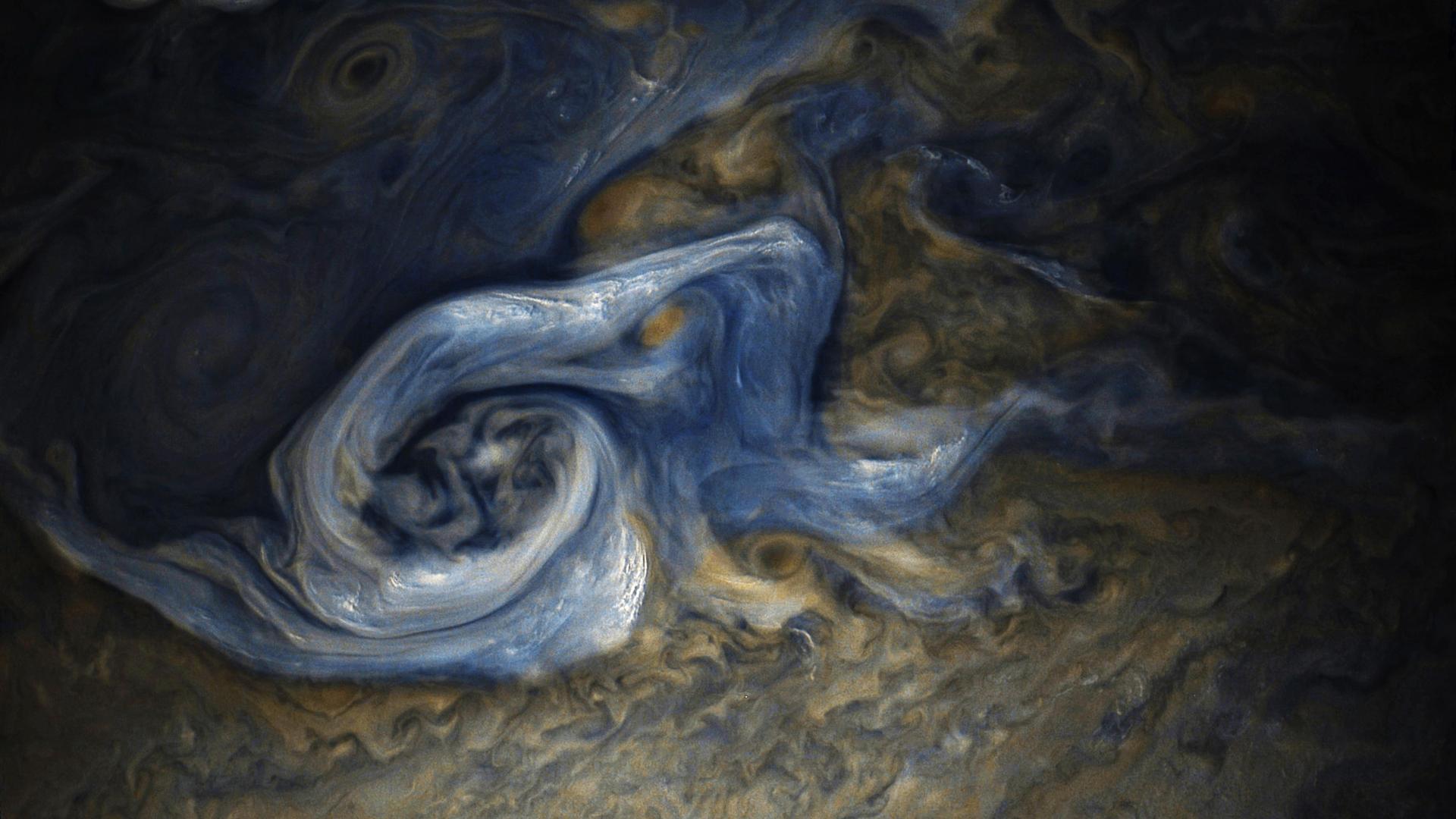
science.nasa.gov - Juno sees Jupiter’s turbulence
but speed them up a million times — and eliminate friction. It would look more like:
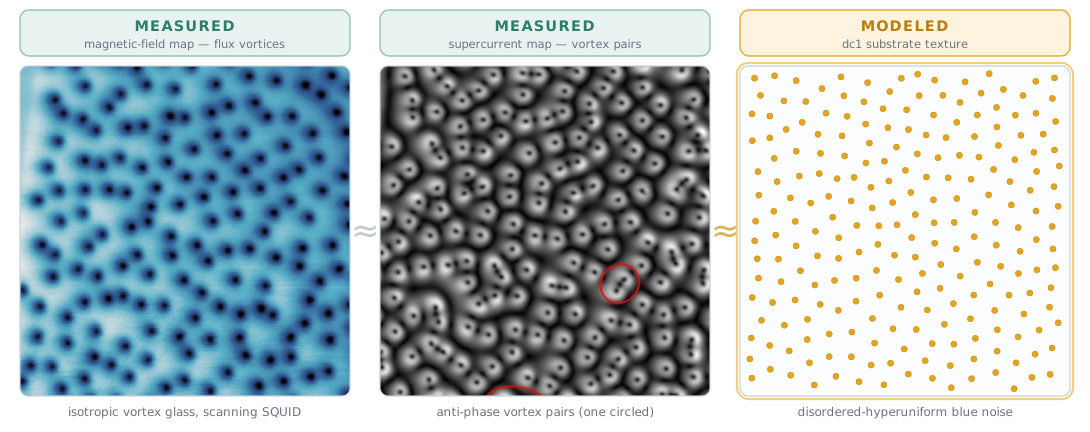
Left: isotropic vortex glass in a YBCO superconductor, individual flux quanta poking through — a visual analog to the texture of the dc1 lattice, vortex shear zones near the speed of light. Center: the same field resolved into closely-spaced anti-phase pairs and groups, one circled. Right (modeled): the disordered-hyperuniform “blue-noise” texture the dc1 substrate lattice holds from the backbone equations. Measured images by Frederick S. Wells, Alexey V. Pan, X. Renshaw Wang, Sergey A. Fedoseev & Hans Hilgenkamp - https://www.nature.com/articles/srep08677, CC BY 4.0, https://commons.wikimedia.org/w/index.php?curid=57135410
Shear zones form counter-rotating layers — seams that wrap each leak where a heavier leak is wrapped by a tighter seam. This is the mechanism behind both the Compton wavelength and the Volovik quasiparticle speed in a superfluid condensate.
HVBK mutual friction is the textbook model of superfluid boundaries showing a vortex line’s two options: take energy from the flow it meets, or turn that flow aside without taking any energy. The ratio between these terms, using the Weinberg angle, finds \alpha_{mf} = 0.3008. Bessel matching constrains the interior oscillation (J_1) to meet smoothly at the rim against the exterior decay (K_1) and finds a minimum size. Mutual friction alone shows that E = mc^2, the quantum potential as the reaction force of the shear zones at the orbital boundary, and gravity as the ebbing leak — the energetic fall in between. The Bessel constraint adds the size of the cell that fits a photon, and holds the leak of a free electron, proton, and the size of a vacuum lattice cell.
The quantum potential shows the reaction force of the boundary, gravity shows the leak, and light shows the clean passage of energy - dipole vortices, moving through anti-phase vortices, organized in a lattice as the space between everything.
It makes sense that The Big Bang created Our Big Bubble, one of many, inside a super-energetic substrate that boils. This picture then ties the atom to cosmology — and says something about how earth and life formed, and why cellular dynamics isn’t pure diffusion. Boundary layers organize into energetic topologies with a ratio and a texture, set by the six sheets that each have a chirality-reversed layer in between, powered by the energy of these vortex lines that can travel far and still reconnect. You’ll find that same circulating energy in bodies at every scale: angular momentum in a disk, polar jets, feedback loops created by vortex line interactions. And you’ll find sharper-than-expected boundaries everywhere, from the cosmic web to the gulf stream, the heliosphere, and the LAB channel and 660 km discontinuity.
Hundreds of predictions follow. The clearest signals are spectrum-free light, which covers the trifecta of sonoluminescence, black hole radiation, and lightning. The longest, most coherent thread shows how the periodic table explains the aromatic pocket, which shows how anaesthesia works.
All it takes are these four assumptions:
- Particles are vortices in the substrate rotating near the speed of light
- A new lightweight particle — dc1 — that fills the vacuum and the spaces between atoms
- The quantum potential is the reaction force of the electron orbital’s counter-rotating shear layers
- The photon is a modon: a self-propelled pair of counter-rotating vortices like those in Gulf Stream rings
From the coefficient, \alpha_{mf}, that models the energy of the shear zones:
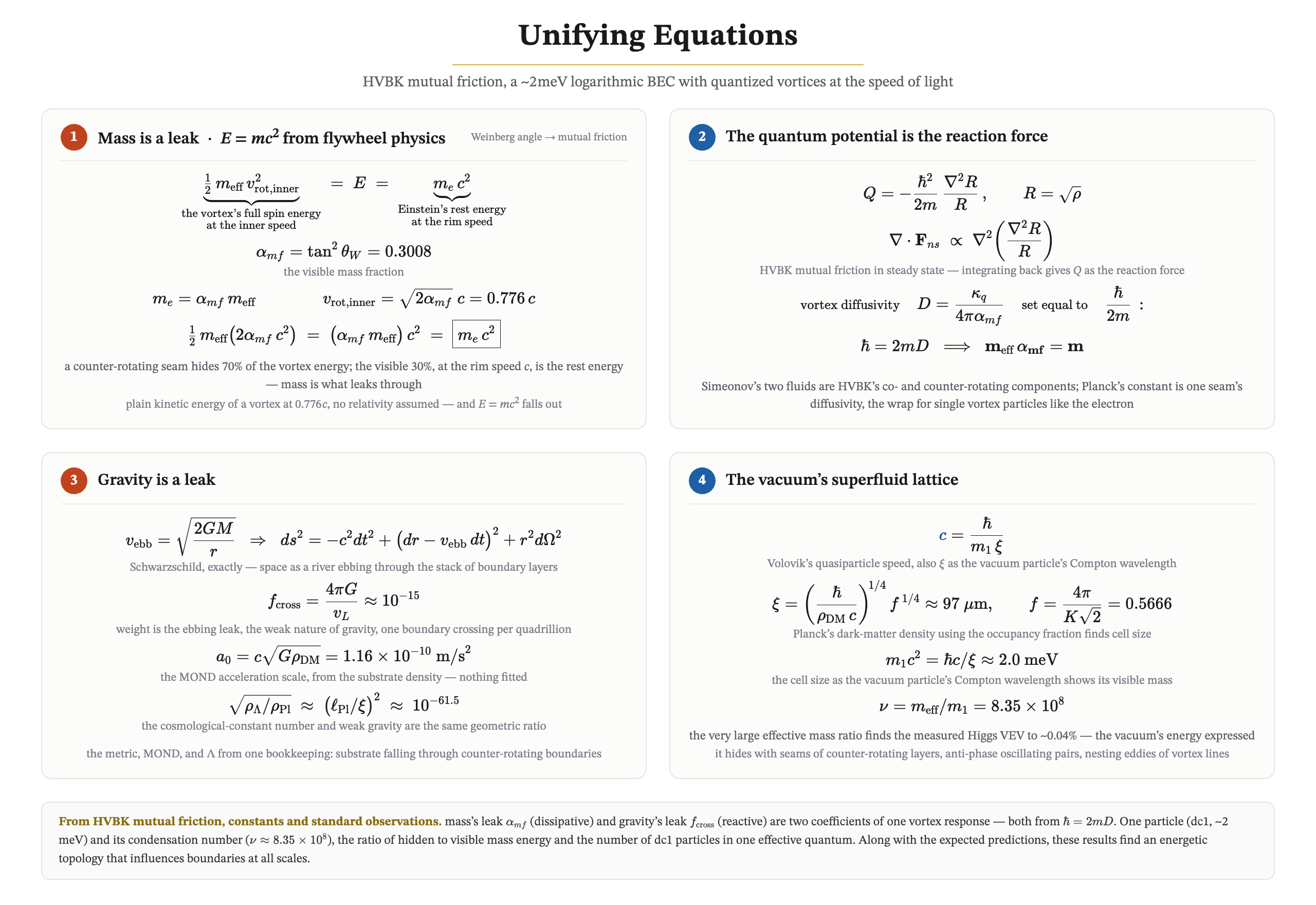
The picture behind those equations — a vortex core at 0.776c, a counter-rotating seam that shows 30% of it at the rim speed c, and the 97\ \mum envelope whose outer rim turns at 0.0025c:

One coefficient threads all four of those equations, the mutual friction \alpha_{mf} of superfluid helium:

One effective quantum of 1.70 MeV sits inside every particle; what a scale reads is how many seams it must present — and charge, the winding that escapes, counts something else:

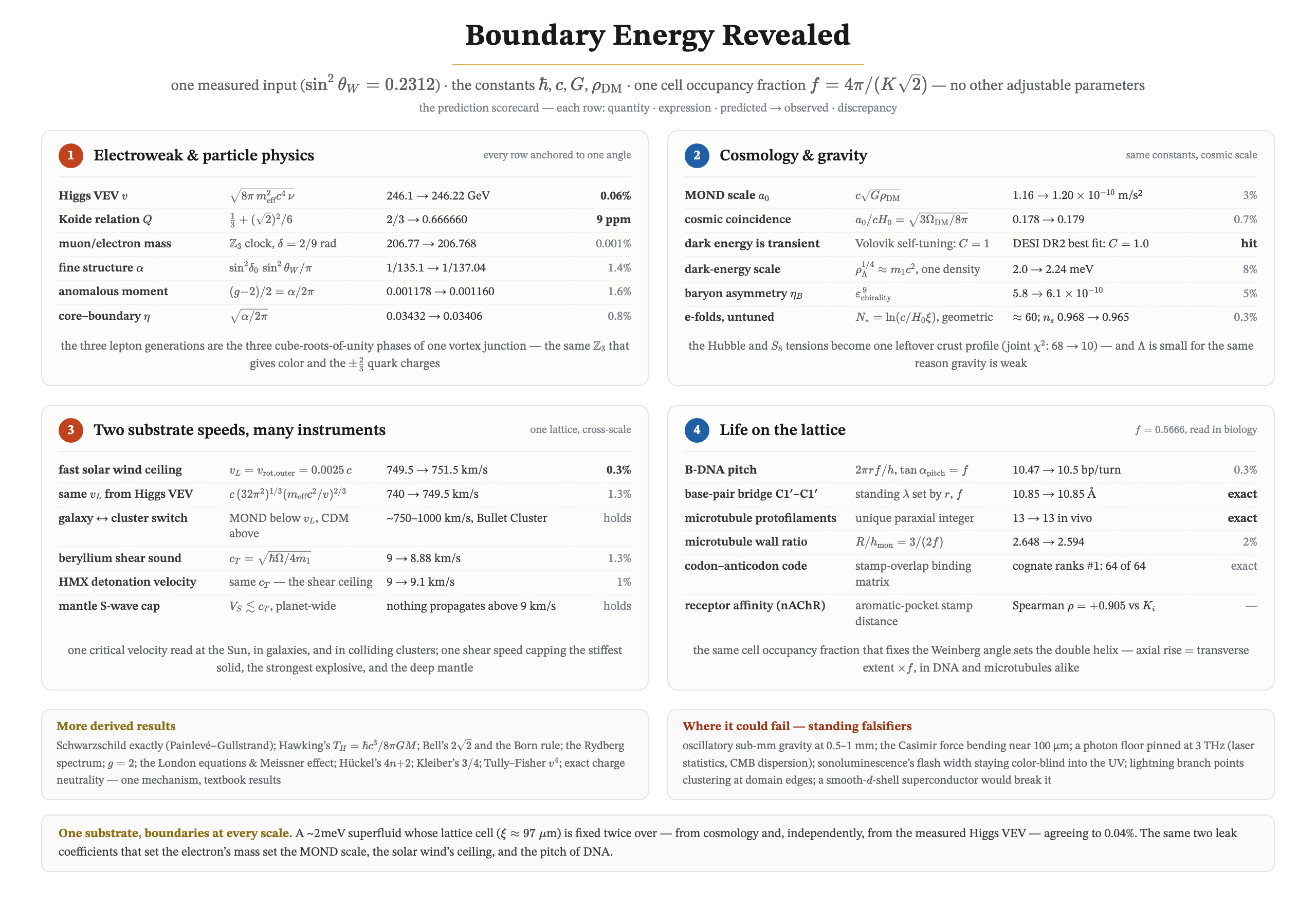
And the scorecard those equations produce — predicted against observed, across every domain:
For the longer narrative intro: Our Normal Universe, the video, or the slide show.
For the math, the paper: The Vacuum’s Superfluid Lattice, also on zenodo, or the video.
Try the interactive substrate simulations to see the equations in action.
All predictions reproduced in python, so you can check the numbers yourself.
The broader investigation includes exploratory content I created with Claude, applying the substrate model to boundary problems across the board in science. I’ve curated it for correctness and edited it for clarity, but I am not an expert in any of these areas. My goal is to help you see the substrate the way I found it, following the thread of boundary energy through the eyes of a generalist who has been reading science papers across domains for forty years. A clearer understanding of that subtle boundary energy offers a new interpretation of existing science.
I am grateful for any help you can offer in correcting mistakes, or expanding the lens.
The Highlight
Here’s how light travels at a constant speed regardless of relative motion. All spaces in between atoms are filled with a medium of vortices with a rim speed at the speed of light. A photon is a dipole vortex — a modon — two counter-rotating vortices with the same rim speed.
One forms when the two counter-rotating shear layers break off from the electron orbital’s wake to form a pair of counter-rotating vortices. They travel at their own rotational speed — matching the medium’s — until two layers of an atom’s orbital catch and absorb them. The same pair is made three ways — sung by an orbital, shed by a boundary push too fast, or re-paired from a matter knot and its antimatter twin at the Big Bang — and it ends four ways: caught by a matched orbital, copied by a primed one, cancelled by its mirror, or stretched below the modon floor. One object, every behavior of light:

The substrate properties that allow a modon lead to a geometric prediction supported by cosmology and particle physics: a superfluid lattice whose envelope is the size of a human cell. The size is not a coincidence. The substrate’s energy, spacing, and topology shape energetic boundaries at every scale, including the one life builds on.
More detail on the key concepts:
- Speed of light from the vortex rotation speed
- Mass as leaking vortex rotational energy, fighting through shear layers, with kinetic energy that shows why E = mc^2
- Quantum potential as the reaction force of a superfluid
- Gravity as an ebbing leak through shear boundaries, with the stream accelerating in between
- MOND scale as the speed above which the substrate can no longer carry photons seamlessly — the lattice shreds, and its gravitational behavior changes into what we call dark matter
The standard model equations with improved understanding:
- Protons as knots of three quark vortices
- Spin as double-wrapped shear layered particles
- Muon as a folded electron with a specific mass ratio
- The Higgs field energy precisely matched
The shape of the vacuum’s lattice:
- The vacuum’s particle: dc1 (“dark carbon” — and dark matter, once it moves past the substrate’s speed limit)
- Anti-phase Cooper pairs, ~2 meV rest mass, oscillating against each other, nesting their superfluid energy into a balanced lattice with a texture
- ~97 μm coherence envelope — the Compton wavelength of a very light particle
- Condensation number \approx8.35\times10^8: the number of dc1 cells inside one envelope, against \approx10^6 atoms for its heavier, slower mirror, \text{He-3}

The texture forms a ladder:
- Sheet spacing 16 μm, with an opposing energetic layer every 8 μm
- Lock ratio \sqrt2 — bind, nest, 120^\circ angles (in the gap) or hinge (on the tooth)
- Anti-lock ratio \varphi — avoid, diffuse, the 137.5^\circ golden angle
- Chemistry mixes the two to reach the angles in between — a scale-invariant potential
Experiments:
- Michelson-Morley (constant speed of light ensured by the acoustic geometry of modons moving through anti-phase vortex lattice regardless of relative motion)
- Double-Slit, Quantum Eraser (large envelope with even larger phase effects)
- Bell’s theorem (unexpectedly long topologically protected vortex channels from phase twist)
Or dive into deeper, clear signals: DNA, the modon split into ATP, the brain as a modon, Jason and Tuzo, the standing modon in the earth — or my forty year passion behind this discovery: understanding water.
The universe, how it began, space and time, and gravity all make sense with the acoustic metric of vortices, plus boundary layer dynamics of an energetic superfluid with counter-rotating shear layers.
The scale and accuracy leave no doubt for me. The inputs are one measured angle — the Weinberg angle — the constants \hbar, c, G and the dark matter density, and one geometric fraction, f = 4\pi/(K\sqrt2), for how full a lattice cell is. Nothing is fit to a curve. The mutual friction coefficient is the first thing anyone who knows superfluid helium would reach for, and the cell occupancy is the plainest geometry a modon in a lattice allows. From those, the cell size comes out twice — once from cosmology, once from the electroweak scale — and three instruments that share no physics, Planck, the colliders, and Ulysses, find the same condensation number to 0.04%. I spent months trying to move that lattice size with other parameters - it kept reappearing instead.
The scorecard has 16 zero-parameter matches to measured numbers, 8 of them inside 1%; about three dozen textbook results recovered from one fluid mechanism; and over thirty live predictions that name a value no one has measured yet that would falsify. The simulations show it all intuitively. Some more clear matches:
- Black holes as gravity rivers moving faster than the speed of light (reinterpretation)
- Detonation speeds clustering at ~9 km/s (1%)
- Fine structure constant from the Weinberg angle alone (1.4%)
- The nature of the cosmic microwave background and evolution of the universe (~60 e-folds, untuned; n_s to 0.3%)
- Why the fast solar wind tops out near ~750 km/s (0.3%)
- Koide’s lepton relation Q = 2/3 (9 ppm)
- The Higgs VEV (0.06%)
Or go to the complete list.
Two nested topologies of the vacuum’s energy:
- Feedback topology - unbalanced - electrons, protons, quarks, planets, stars, galaxies
- Modon topology - balanced - photons, layers of balanced energy inside things
For more information, read the longer intro: Our Normal Universe or the video, or the slide show.
Read the paper: The Vacuum’s Superfluid Lattice, or the math oriented video.
Explore: