The Hydrogen Atom as a Layered Orbital System
The Universal Boundary-Matching Pattern
The Universal Boundary-Matching Pattern
Notice how the boundary (purple line) forms a sharp kink that radiates energy, except at specific discrete values where the interior and exterior flows match perfectly.
The deepest structural parallel in this framework is between the Larichev-Reznik modon and the hydrogen atom. Both are governed by the same mathematical architecture: oscillatory solutions in the interior, exponentially decaying solutions in the exterior, and a boundary-matching condition that produces discrete eigenvalues. Quantization is not an imposed quantum rule — it is a geometric consequence of oscillatory solutions enclosed by decaying solutions, joined at a boundary.
For the Larichev-Reznik modon:
\text{Interior }(r < \xi):\quad \psi \sim J_1(pr),\;\text{oscillatory}
\text{Exterior }(r > \xi):\quad \psi \sim K_1(qr),\;\text{decaying}
\text{Constraint:}\quad p^2 + q^2 = \beta / |c|
For hydrogen, the radial wavefunction R(r) satisfies:
\text{Interior (classically allowed):}\quad R(r) \sim j_l(kr),\;\text{oscillatory}
\text{Exterior (classically forbidden):}\quad R(r) \sim \exp(-\kappa r),\;\text{decaying}
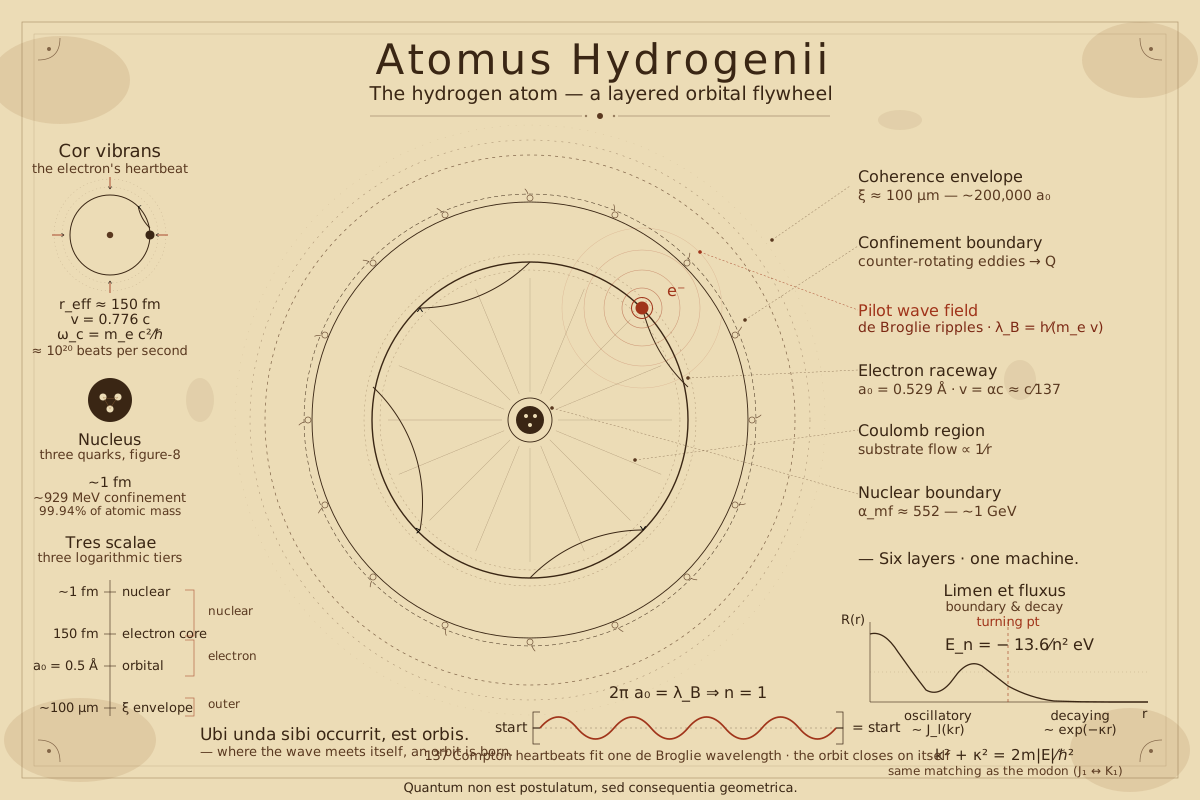
\text{Constraint:}\quad k^2 + \kappa^2 = 2m|E_\text{binding}| / \hbar^2
In both cases, matching at the boundary produces a transcendental equation whose solutions are discrete. The modon matching involves the Bessel zero j_{11} \approx 3.83 and produces the structure constant K = j_{11}^2 + 1 = 15.67 that determines the photon’s internal structure. The hydrogen matching involves the Coulomb potential and produces the principal quantum number n that determines the energy levels. Different potentials, same mechanism.
This is not an analogy. In the substrate framework, the hydrogen eigenvalue problem is a boundary-matching problem in the dc1 medium. The discrete energy levels emerge from the boundary-matching dynamics of co-rotating and counter-rotating layers, exactly as modon eigenvalues emerge from matching Bessel functions at the separatrix.
Two Scales in the Hydrogen Atom
The hydrogen atom lives at the intersection of both substrate scales.
At the inner scale, the electron is an effective quantum — approximately 8.3 \times 10^8 dc1 particles condensed into a single entity of mass m_\text{eff} = m_e/\alpha_{mf} \approx 1.70 MeV/c^2, orbiting at v_\text{rot,inner} = c\sqrt{2\alpha_{mf}} = 0.776\,c with radius r_\text{eff} \approx 150 fm and angular momentum \hbar. This is the electron’s internal structure — its “heartbeat,” oscillating at the Compton frequency \omega_c = m_e c^2/\hbar = 7.76 \times 10^{20} rad/s. The Compton oscillation shuttles the electron’s entire rest energy between two reservoirs: at peak contraction, \tfrac{1}{2}m_\text{eff}\,v_\text{rot,inner}^2 = m_e c^2 — the kinetic energy of the effective quantum equals the full electron rest mass.
At the outer scale, the electron’s coherence envelope extends to \xi \approx 110\;\mum — the same coherence length that sets the photon’s soliton size. The Bohr radius a_0 = 0.529 Å sits in the lower third of the enormous log range between r_\text{eff} and \xi, with the coherence envelope extending \sim 200{,}000 \times a_0 beyond it. This enormous reach is why the electron is a quantum object: its pilot wave field fills the entire orbital region and far beyond, providing the long-range coherence that makes interference — and therefore quantization — possible.
The proton, meanwhile, operates at a third inner scale. Its mutual friction coupling is \sim 1836 times stronger than the electron’s (\alpha_{mf}^{(N)}/\alpha_{mf}^{(e)} = m_p/m_e), confining its structure to \sim 1 fm — small enough that it acts as a nearly point-like Coulomb center for the electron’s orbital dynamics. The three tiers — outer (\xi \sim 100\;\mum), electron-inner (r_\text{eff} \sim 150 fm), nuclear-inner (\sim 1 fm) — span an enormous logarithmic range, each using the same effective quantum building block at increasing compression.
The Three-Line Derivation
The hydrogen spectrum follows from three steps, each grounded in classical fluid dynamics.
Compton vibration. The electron’s orbital system oscillates at \omega_c = m_e c^2/\hbar, pumping ripples into the dc1 substrate at the Compton wavelength \lambda_c = h/(m_e c) = 2.43 pm. This is literal — the effective quantum’s orbit expands and contracts, exchanging energy between internal rotation (at r_\text{eff} \sim 150 fm) and the surrounding substrate (out to \xi \sim 100\;\mum), launching a pressure ripple with every cycle. The electron is a tiny engine, vibrating 1.24 \times 10^{20} times per second.
Doppler pilot wave. When the electron moves at velocity v, the Doppler compression of these ripples creates a pilot wave envelope with the de Broglie wavelength:
\lambda_B = \frac{h}{m_e v} = \lambda_c \times \frac{c}{v}
At the hydrogen ground state (v = \alpha c \approx c/137), the de Broglie wavelength is \lambda_B = 137\,\lambda_c = 332 pm — the constructive interference of 137 consecutive Compton ripple wavefronts creates one de Broglie wavelength of the pilot wave. The pilot wave is not a separate entity from the Compton vibration; it is the Compton vibration viewed through a Doppler lens.
Orbital quantization. When the pilot wave wraps around a closed orbit and meets itself constructively, only circumferences 2\pi r = n\lambda_B are stable. Combined with the Coulomb force balance:
r_n = n^2 a_0 \qquad\text{and}\qquad E_n = -\frac{13.6}{n^2} \;\text{eV}
No probability amplitudes, no wavefunction collapse, no measurement postulate. A vibrating object in a wave-supporting medium with memory, orbiting a Coulomb center. The standing wave pattern self-reinforces: each orbit deepens the groove in the substrate, and the electron rides the co-rotating flow channel it has created — exactly as Bush’s walking droplet rides the crest of its own wave field.
Why This Works: the Numbers
For the ground state (n = 1, l = 0), the numbers lock together with no adjustable parameters.
The Bohr radius is a_0 = 0.529 Å. The orbital velocity is v = \alpha c \approx c/137. The de Broglie wavelength at this speed is \lambda_B = h/(m_e v) = 332 pm. The circumference of the Bohr orbit is 2\pi a_0 = 332 pm — exactly one de Broglie wavelength. The pilot wave completes one full cycle per orbit, reinforcing constructively. That is n = 1.
For n = 2, the orbit is 4\times larger, the electron 2\times slower, the de Broglie wavelength 2\times longer, and the circumference fits exactly two wavelengths. The two possible configurations — 2s (symmetric peaks, spherical) and 2p (axial peaks, dumbbell) — are different standing wave patterns of the same pilot wave mechanism. Orbital shapes are interference patterns, not probability clouds.
The fine structure constant \alpha appears here not as a mysterious dimensionless number but as the ratio v_\text{orbit}/c = \lambda_c/\lambda_B at the ground state — the number of Compton wavelengths per de Broglie wavelength, which is the number of heartbeats per orbit. The substrate framework derives \alpha from the s-wave scattering phase shift \delta_0 of the fermion boundary (see Fine Structure Constant), giving \alpha_\text{tree} = 1/135.1 — within 1.45% of the measured value, with no free parameters.
Photon Emission as Boundary Reorganization
When the electron transitions from level n+1 to level n, the standing wave pattern reorganizes. The old groove dissolves and a new one forms at a different radius. The energy difference is ejected as a modon — a counter-rotating vortex dipole that propagates through the substrate at c:
E_\text{photon} = E_{n+1} - E_n = h\nu
This connects the hydrogen atom directly to the photon chapter: the modon’s internal structure is set by the Larichev-Reznik matching at the coherence scale \xi, while its energy is set by the transition between standing wave patterns. The same boundary-matching mathematics that quantizes the atom also structures the photon it emits.
Absorption is the reverse: an incoming modon disrupts the existing standing wave pattern, and the electron’s pilot wave reorganizes around a new stable orbit at higher n. The modon must have exactly the right energy — h\nu matching the level spacing — because only that frequency produces a new standing wave that satisfies the boundary-matching condition. This is why spectral lines are sharp: the quantization of absorption mirrors the quantization of the orbits themselves.
The Quantum Potential as Boundary Physics
The substrate provides a physical mechanism for every feature of the quantum-mechanical hydrogen atom. At the edges of the electron’s co-rotating flow channel (the “raceway” it carves through the substrate), the flow must transition from co-rotating to stationary background. This velocity gradient creates counter-rotating eddies — Simeonov’s “sensor fluid” — whose reaction force on the co-rotating layer is the quantum potential:
Q = -\frac{\hbar^2}{2m}\frac{\nabla^2\sqrt{\rho}}{\sqrt{\rho}}
Interactive: the flywheel draws those edges. The raceway is a tube, so its skin is a sleeve, not a shell — counter-rotating inside, outside, above and below the groove, running against the electron all the way round. Turn Vortex lines on and the shear reads directly: amber streaks with the electron, purple streaks against it, a few dot-widths apart. The groove itself is drawn as the electron’s wake, brightest where it just passed and faintest just ahead, because the electron is what carves it. Note what the sleeve is not: a radial node. Nodes are concentric shells where the standing wave reverses phase, n counts them, and 1s has none — the cavity between Layer 2 and Layer 5 is one smooth half-wave. The sleeve is local shear on the channel; the same co-rotating-channel-plus-counter-rotating-wrap seals the proton’s Y-tube and copper’s conduction sea.
In the hydrogen atom, Q does several jobs simultaneously. Near the nucleus, where the density peaks, Q pushes outward — preventing the electron from collapsing onto the proton. At nodes (where \rho = 0, as in p and d orbitals), the quantum force points away from the node on both sides, maintaining the zero. At the classical turning point, Q creates the effective barrier that confines the electron to its orbital region. And in the classically forbidden region beyond the turning point, Q is what makes tunneling possible: the counter-rotating boundary is not a perfect wall but a dynamic, fluctuating interface whose eddies occasionally create momentary gaps.
From Foundation to Atomic Structure
The hydrogen atom is where the Foundation concepts converge into a working physical system. The speed of light c = \hbar/(m_1 \xi) sets the medium’s response speed. The quantum of circulation \kappa_q = h/m_\text{eff} discretizes the flow. The quantum potential Q provides confinement without postulates. Gravity’s boundary-layer ebbing current holds the proton in place. And the photon — the modon — carries energy between quantized states at the speed set by the substrate.
The next chapter examines the electron itself in detail: the Compton breathing cycle that powers the pilot wave, the self-propulsion mechanism that locks the electron to its de Broglie momentum, and the energy budget that accounts for every fraction of the 0.511 MeV rest mass.