Visual Introduction

This is the visual introduction, a walk through of the slides.

Go to the paper for the math, or the story for more context.

Introduction

First, an important definition: a modon is a self-sustaining dipole vortex — two opposite-spinning vortices, each one sustained by the other’s velocity field and often using it to move together. They form at vortex shear boundaries that are pressed together until they collapse into a single, self-sustaining eddy, like Gulf Stream rings.

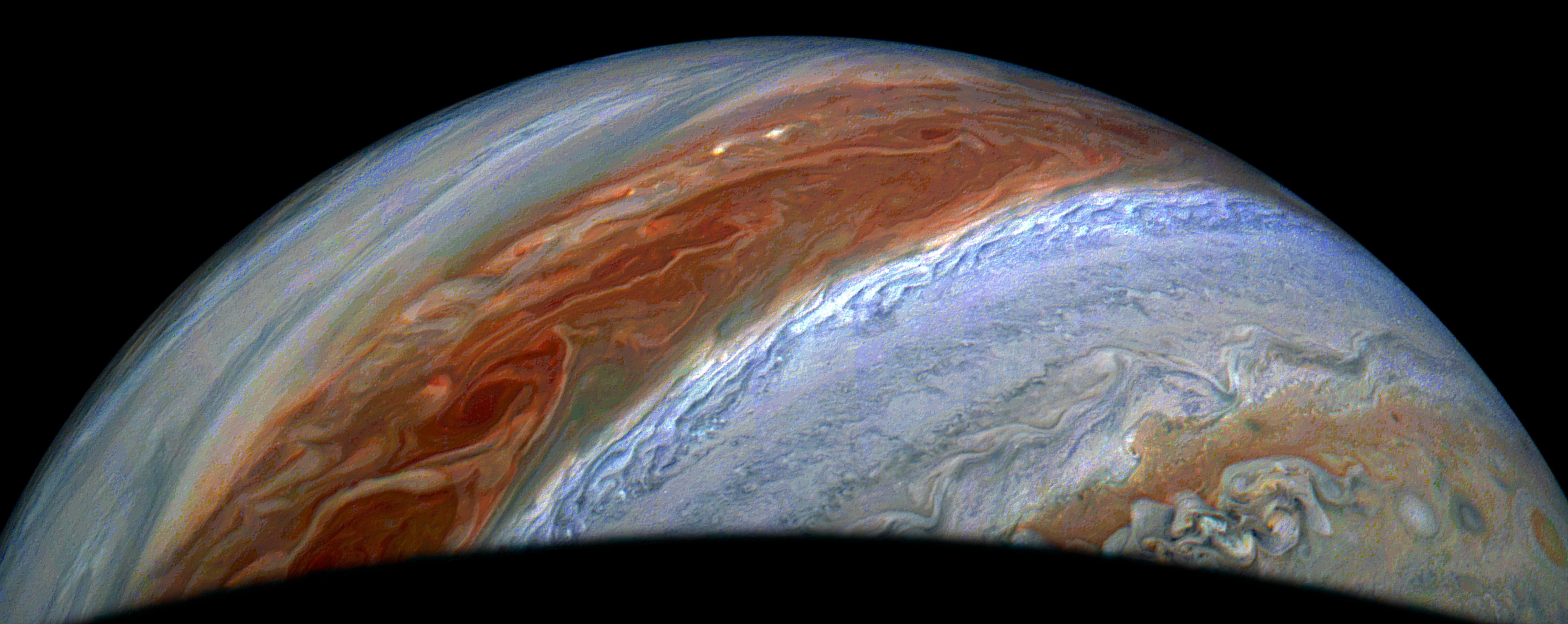
Secondly, an important concept: shear boundaries in a superfluid create an opposite-spinning layer between two same-spinning flows — the least-energy path for vortex lines that are very difficult to break. The same arrangement is visible in Jupiter’s banded atmosphere.

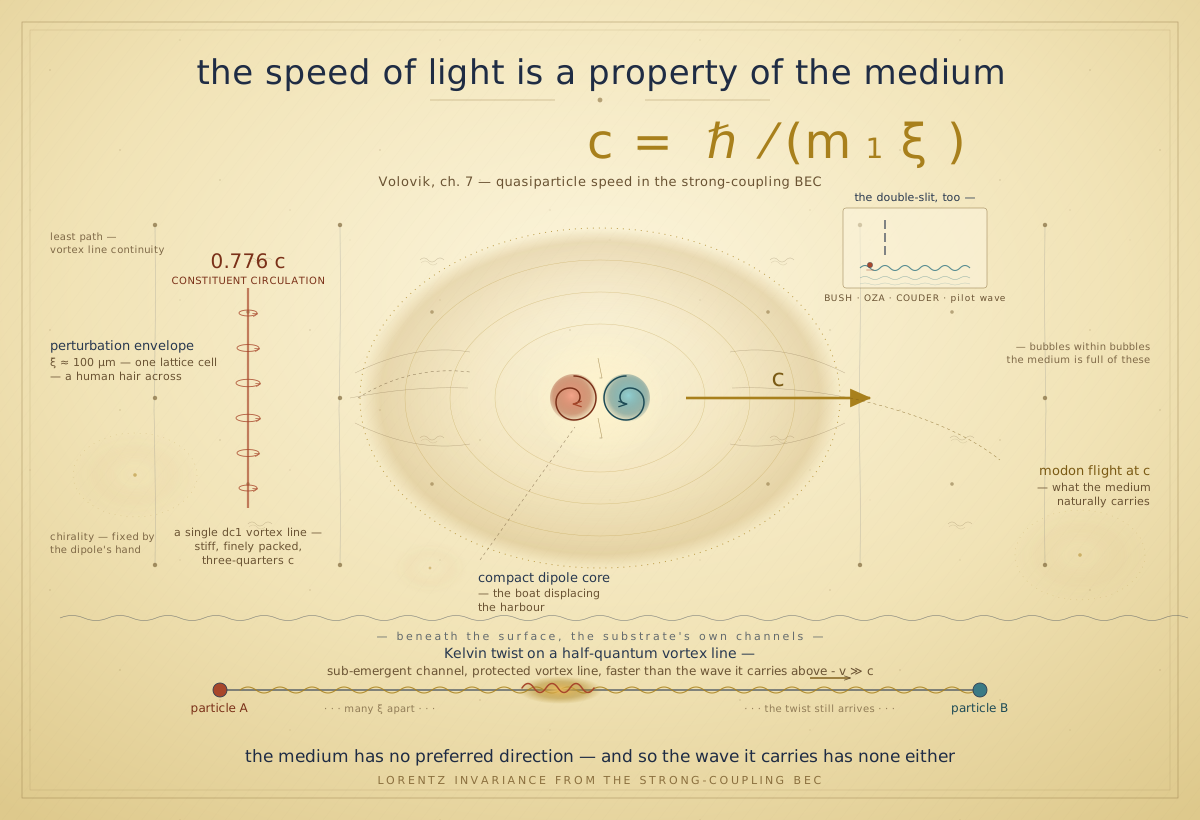
With these two concepts, the rest of the picture follows. If the universe is filled by a superfluid of vortices, then counter-rotating layers form naturally around an electron’s orbit of a proton — a standing wave, stable only at certain distances. The boundary layer carries energy: what we call the quantum potential. When two of these shear boundaries are forced together, they collapse into a modon ejected at c — a photon formed from vortices already spinning at about 0.776c.

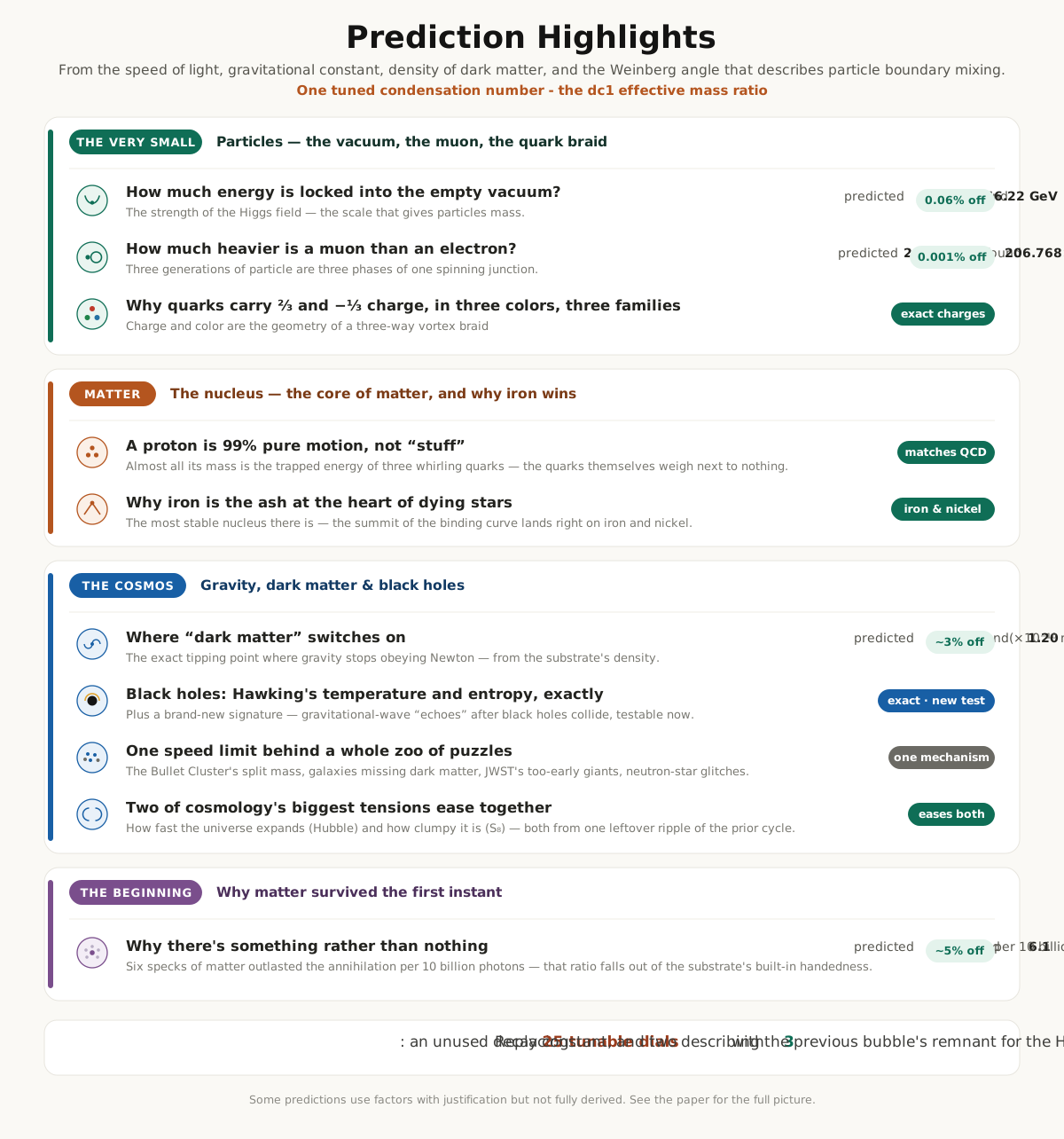
From this simple model, the bridge equation arrives at the same size for one cell of the dark-matter superfluid’s lattice — about 100\;\mum, the width of a human hair — twice, by two completely different routes.

Both routes use the speed of light c and Planck’s constant h (the smallest packet of action a photon can carry, which in this picture is the substrate’s own circulation quantum).

  • From the bottom up (small scale): the Weinberg angle measured at particle colliders sets how the superfluid’s co-rotating and counter-rotating sub-flows mix.
  • From the top down (large scale): the dark-matter density measured from the cosmic microwave background — the Planck satellite’s map of leftover heat from the Big Bang.

The two routes share no other parameters, and they land on the same lattice size to better than a percent.

From this single picture, a whole list of features falls out:

  • gravity, as a slow leak through these counter-rotating boundaries — the same boundaries everywhere
  • why electrons don’t collapse into the nucleus — held in place by the quantum-potential energy stored in their own boundary layers
  • why space appears empty but is in fact filled with an energetic superfluid
  • why clocks run slower near masses — the local superfluid leaks more, so time dilates
  • why light bends near masses — it follows the path the leaking superfluid carves through space

This is a very early stage exploration of what happens if you model the universe as a superfluid of vortices. The result paints a richer picture of life and the universe than the conventional model.

What it predicts

Two Particles and a Bang

The universe begins not as a singularity expanding into itself, but as a bubble popping in a medium that boils. Not the only bubble — one of many, nucleating wherever the pressure builds high enough, the way steam bubbles pop in a pot of water on the stove. Our big bubble — \mathcal{B}^{0} — contains everything we have ever observed.

Inside the bubble, with enormous energy, is a single kind of dark material particle sent spinning at speeds that are hard to imagine in an elastic environment. It is tiny — call it dc1, “dark carbon.”

It forms a superfluid, where the behavior is like that of supercooled helium. But instead of being fragile, this one fills the universe.

With a superfluid, individual particles effectively lose their individual identity. They become a single coherent fluid, with no viscosity and extraordinary stiffness. They are modeled as vortex lines. All we can tell is the mass-energy of an individual dc1 quantum of the substrate.

No second species is needed to hold this fluid in shape: dc1’s own self-interaction clamps every cell at one size, so the lattice binds and organizes itself (the logarithmic equation of state).

The substrate architecture. The self-bound dc1 lattice organizes itself at ~100 μm spacing — no second species pins it. Particles — electrons, photons, protons — are not objects embedded in the lattice. They are the lattice’s own excitations: vortex storms, dipole solitons, topological knots in the flow.

The lattice size of ~100 μm is derived from the bridge equation using the speed of light, the minimum amount of energy in a packet of light, and the angle that measures how electromagnetism energy mixes with atoms (measured in particle accelerators). The equation also gives us the rest energy of the dc1 quantum — ~2 meV — and the density.

This is the dark matter, the missing mass and it is the substrate that makes atoms, matter, and energy, filling the inside of Our Big Bubble.

How Fluids Build Structure

Let’s look at what fluids do when they carry energy and spin.

Jupiter’s atmosphere organizes into alternating bands — eastward jets next to westward jets, separated by turbulent shear zones. Each band is a co-rotating flow; each boundary is a counter-rotating layer where the two flows grind against each other.

Kelvin-Helmholtz instabilities along the wind-collision interface that produce vortical rolls

(By Empetrisor - Own work, CC BY-SA 4.0, https://commons.wikimedia.org/w/index.php?curid=105303125)

Kelvin-Helmholtz waves patterns form when wind blows over water, or when two cloud layers move at different speeds, an unstable shear zone that rolls into vortices. If the medium is elastic enough, they organize into persistent patterns, alternating rows of same and opposite rotation, regularly spaced.

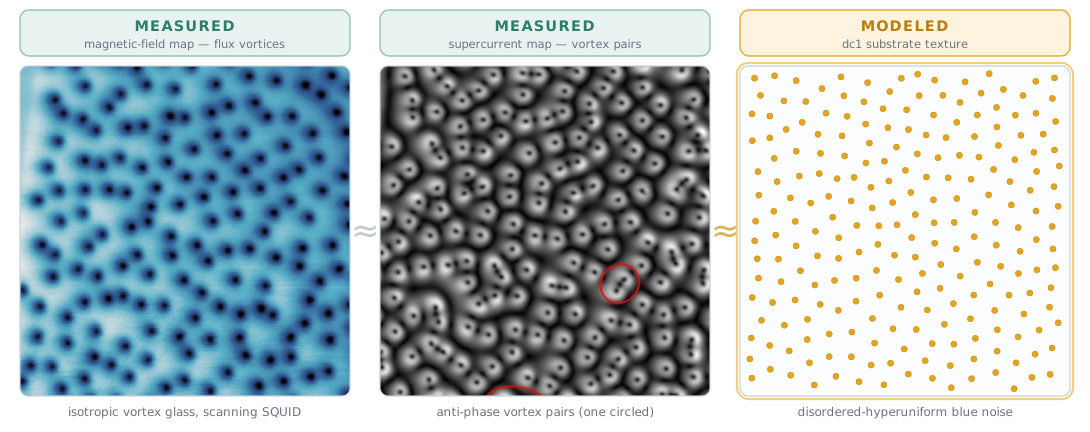
By Frederick S. Wells, Alexey V. Pan, X. Renshaw Wang, Sergey A. Fedoseev & Hans Hilgenkamp - https://www.nature.com/articles/srep08677, CC BY 4.0, https://commons.wikimedia.org/w/index.php?curid=57135410

This is a microscope image of vortices in a superconductor (Wells et al. 2015) - individual quanta of magnetic flux breaking through the electron superfluid and freezing into this glassy, six-neighbour arrangement.

The scale here happens to land near 100 micrometers - but that is genuinely a coincidence, not a match. The vortex spacing is set by the applied magnetic field (a=1.075\sqrt{\Phi_0/B}), and at an ordinary lab field these same vortices would pack down to tens of nanometres. What carries over to the substrate is the pattern - a disordered, locally six-fold vortex glass - not the number.

Now imagine this same pattern in the dark matter superfluid that fills space… the same texture, at the one scale the substrate sets for itself.

Three tiers of one fluid. Top: the vortex lattice at ~100 μm — the perturbation envelope, set by measured constants. Middle: zoom ×10⁹ to the effective quantum at 150 fm — the vortex core where ~10⁹ dc1 particles orbit collectively at 0.776c, carrying exactly ℏ of angular momentum. Bottom: zoom ×10⁵ further to the nuclear scale at ~1 fm — three interlocking vortex channels forming the proton’s Borromean topology, with 99% of its mass stored in the counter-rotating boundary energy between them.

In the substrate, due to the rotation speed of the superfluid, the elasticity, the stiffness of the lattice, a large enough disturbance becomes a topological defect.

Or in other words a big enough storm becomes a permanent feature. It could be a vortex core, or a knot formed by three vortices that lock into place.

In the substrate, these defects are the particles of physics:

On the left is the lattice. You can think of it as the perturbation envelope or the wake distance of a vortex in the substrate.

In the middle, zoom in a billion times - here’s one particle vortex core, an effective quantum: ~10⁹ dc1 particles orbiting as a single unit. These are the vortices in between boundaries.

On the right, zoom in one hundred thousand times and you see the three interlocked channels in a knot to form a proton.

Here is the electron, in the substrate.

It is a storm with a pilot wave, not a dimensionless point.

It breathes. It throws off a large rippling wake, and has two counter-spinning layers which explains the weird spin properties, where it takes 720 degress of rotation to return to it’s original state.

Now see how the electron’s pilot wave ripples around the orbit of the hydrogen atom. And when the circumference is an exact multiple of the wavelength it forms a standing wave.

The substrate locks into a self-reinforcing pattern: a co-rotating flow in the orbital channel — what I call the raceway — with counter-rotating eddies at the channel edges. The electron is surfing the groove it carved in the medium.

The wavelength ensures only certain orbits work - that’s the quantization with no uncertainty. Just a vibrating object in a wave-supporting medium with memory, orbiting the nucleus.

And the quantum potential, the mysterious Q, is the very real reaction force from those counter-rotating eddies at the channel edges.

When a photon hits a hydrogen atom, it can change orbital states in various ways. It can inflate up to the next quantum or it can fold, and when it folds it creates either a radial node or a nodal plane.

This is a fundamental substrate behavior.

Compare those nodes to polar jets - a feature of planets, stars and galaxies.

All are passing along excess angular momentum to the next layer in the substrate.

As an orbital system tilts in the lattice, the jets increase like a water skiier leaning into a turn. The jet flow causes a stabilizing pull from above and below as the lattice sheets redistribute that polar jet energy.

And the spinning mass, pulsates in the opposite phase with it’s neighbors. The angular momentum from each weave together via a counter-rotating channel in between, forming a stiffness in the plane of the lattice. The two effects combined form “a springing mattress” that works at all scales and distances to move photon/modons through a least energy path. Vortex lines act like superfluid wires to hold it together, and at the same time hide it from observation. It perfectly mimics a vacuum.

The speed of light - c - comes from the rotational velocity of the vortices in the substrate.

Three motifs appear at strongly defined boundary layers in the substrate. You’ll find:

120° angles - when organized rotation shares a boundary three ways, the substrate picks 120°, whether it’s between tectonic plates, cooling basalt, fairy circles, the junctions of the endoplasmic-reticulum tubues or the stacked plates of the chloroplast.

And sharper-than-expected boundaries between layers, the energetic counter-rotating boundary layers are more rigid and narrow than you’d expect from diffusion. Watch for the 660 km mantle discontinuity, the Gulf Stream’s edge, and the heliosphere.

Thin stacked sheets with thin counter-rotating films between them in silicate minerals, the stratified mantle, and organization of biological membranes.

The Photon, The Modon

Here’s how a photon/modon is created.

In an atom, when an electron drops from a higher orbit to a lower one, the standing wave - the two oppositional layers - with locked vortex lines - have energy that has to go somewhere.

When the boundary collapses, those two layers fold into a modon - two oppositional vortices - with an ejection and driving force. The oppositional rotation pulls it along in the lattice, each one in the velocity field of the other.

When a modon hits a boundary in the lattice. The two cores swap spins. The dipole continues — same energy, same speed, opposite handedness, nothing lost.

The modon is massless because its two halves carry equal and opposite angular momentum. The net is zero.

It travels at exactly c because that’s set by the medium - opposite spinning vortices spinning at 3/4 c.

Metals conduct electricity because they are packed closely enough together that their outer orbitals merge, creating a merged channel.

The smoother this merged channel, the more easily electrons can move and the better it conducts.

On the other hand, for metals to superconduct, they need a defect to create a disturbance that puts two electrons into an opposite breathing phase.

When this happens, they form a superconducting pair with a counter-spinning center vortex.

This shows the opposite spinning layers, and shows how a modon can spontaneously form from a different topology. It just needs balanced counter-spinning layers.

From Atoms to the Cosmos

Now zoom out. Way out.

Gravity: the boundary leaks

The counter-rotating boundary layers that wrap every particle do three things. They push back against internal flow — that’s the quantum potential. They eject photon/modons.

And — they leak.

A tiny fraction of the dc1 particles — roughly one in a quadrillion per interaction time — transits each counter-rotating boundary, carrying momentum from one massive system toward another. That trickle is gravity.

This is important: it’s the same substrate boundary layer, the same math.

Gravity’s weakness, the leak fraction, showing near perfect barriers… also explains why atoms are stable.

And the equations show that general relativity - gravitational redshift, light deflection, and GPS corrections, all emerge as properties of fluid dynamics.

Time is not dilated and space is not warped… but who knows, maybe warp drive is on the table.

Wormholes are not a thing as entanglement has been un-entangled by long distance topologically protected vortex lines.

The same stiffness that gives you a billion time scaleup from an electron to it’s wake connects the split particle even at great distances. Measuring one side is like cutting a high tension wire - it springs back faster than the speed of light.

Galaxy rotation: boundary parity strikes again

In the framework, dark energy density is not constant. It’s variability is modeled with two components. Volovik’s self-tuning is the baseline that predicts how density changes during expansion.

The 2nd component is the density of the moraine crust left by the previous Big Bubbles. I modeled this both as a dispersive shock wave energy envelope, then as a spline.

The observational data is sparse with error bars so the fit curves are not precise. Still, in each one the same shape emerged…

The universe’s fingerprint

And it’s the shape predicted by the framework when our expanding bubble wall hit the moraine, a leading soliton upstream, the recovery zone, and a chirped wave train downstream towards low redshift.

This may well be Our Big Bubble’s fingerprint.

Elements and the Earth as a Fluid Machine

Fire breaks apart molecules, but the lattice cells are not strained, except in the most dramatic explosions. Photon/modons are shed to release stored up energy, the lattice vibrates as pressure and shear waves.

The bridge equation says the maximum shear wave velocity of the substrate is 9 km/second, and here’s the detonation speed of various materials. Most cluster just below the estimate, where these two strain the lattice to move a little faster.

Earth’s shear waves are constrained by this same number and peak at just over 7 km/second.

Here are these two large low-shear-velocity-provinces - LLVSP that shape the planet’s geology - Jason and Tuzo, right where the substrate framework expects - an opposite spinning massive modon.

Here’s the 660km line, a sharper boundary that you’d expect - that rejects shear angles but allows the occasional “punch through” - all substrate boundary layer phenomena.

Here are the supercontinent formations like pangea that form from an oscillation in the substrate.

In 1867 Kelvin proposed stable knots of circulation, the Vortex Atom and Maxwell built his theory on molecular vorticies but abandoned it as scaffolding. They could not explain inertia and why the electron did not collapse into the nucleus.

They were missing the concept of a superfluid, the rotational energy built into the substrate. They had no model for topological protection due to all of that energy.

So to understand magnetism, it’s no surprise that same math that models atoms and gravity also describes the magnetic field as an organized dc1 substrate flow leaking through aligned atomic boundaries.

It’s a physical flow in the substrate you can feel.

Now let’s turn to a physical flow you can see. Science today is puzzled by the fact that clouds do not have enough energy to cause lightning.

That energy is the substrate peaking out from behind the veil when electrons are pushed passed the speed limit. Photons are ejected as gamma rays and a lightning bolt forms as a cascade of vortices in the substrate.

Life in the Substrate

In carbon, a benzene ring forms when six carbon atoms find a lower energy state sharing electrons: a toroidal vortex for all of the electrons and opposite spinning layers above and below.

When you put more than one benzene ring together, it creates an aromatic stack - multiple toroidal vortices, a columnar pattern in the substrate.

One example is the codon, three aromatic bases

When opposites base pairs align - the two toroidal vortices of the purine fit together with the one in the pyramidine. This gives you the A and T and G and C pairings.

When three bases are stacked into a codon, all three waveforms combine through a chain and match with it’s anti-codon.

The matching of a stack with it’s anti-stack - the substrate pulling in a specific opposite to close a gap in the substrate coherence.

And DNA is just a long stack of aromatic stacks. It has the modon topology.

and here’s the clear regulatory chain from the mediator, selecting transcription targets, sending messages up the polar charge transport channel in the DNA. Those messages are draw like glue towards the matching stamp to start transcription. It all forms a long energy feedback loop, building up of energy, a polar jet signal for the next transcription, the releasing of that energy back into the cell - the canonical topology of the substrate.

Here’s some more concrete evidence.

From the chemistry perspective, the microtubule - a closed cyliner should have 14 protofilaments and yet it has only 13. And no one understands why the B-DNA pitch angle is 10.5… both of these are predicted from the bridge equation based on the substrate boundary effects.

Here’s the photon/modon, received by the chlorophyll, then separated into two opposite spinning layers - a proton gradient above and a reduced electron carrier below.

The endoplasmic reticulum is the largest single membrane structure, a continuous tube network with these three-way Y junctions that slide continously with 120 degree angles - the substrate mediated control network of the cell.

Here’s the nucleus, along with the mitochrondrion - both double-wrapped boundary layers for extra coherence, with the mitochondrion an opposite spinning layer to balance the cell’s own energy to form a stable modon topology.

The cilia is the exterior facing polar jet and sensor in the substrate. It has three sensing channels: electromagnetic, mechanical, and chemical - all driven by the substrate, acting as a substrate antenna.

The photoreceptors are a counter-rotating wrap fitted to catch a photon/modon’s, then step down the signal cascade, the energy rungs formed from the substrate standing waves. After that it joins up with a mechanism similar to cilia.

The nose has a different step-down, then works the same way. Just like with enzymes, the aromatic stack substrate signature supports the diversity of smells, and accuracy of recognition. You have a super-fluid binding glue that matches with opposite’s stamp.

And here’s the cilium architecture at body scale, sensing the outside, multi-dimensional. It’s also the boundary layer for the body’s coherence layer, which is surrounded by an exterior layer in the substrate - an opposite mirror to what’s inside.

Like magnetism, a force in the substrate you may be able to feel.

Here’s the neuron, a polar jet that spans the length of the body. It has all of these wraps, substrate counter-spinning layers to hold the energy and provide the coherence channel for the signal channel.

And the synapse matches the polar jet from one neuron to the inward antenna fan - the same stamp matching to explain this subtle interface layer

Scaling this up, the brain emerges as a differential prediction-and-control engine running on a multi-scale substrate-coherent stack. It’s main primitives are variable-length cortical columns, each a substrate-standing wave basis set with polar-jet axons, and inward fans to receive and send signals based on precise stamp matches.

They are organized into topographic maps parameterized by continuous sensory and motor networks, with feedback loops.

And there are two hemispheres - balanced substrate energy, just like two giant nested modons, the yin/yang balance is structural. From this perspective, the flow state emerges as a flexible, creative, connected mind.

One chain, eight domains

Here’s the high level view of the bridge equation:

Modons require a minimum energy to form, based on their speed, the density and mutual friction of the fluid they are in.

Planck’s constant and the speed of light determine the minimum energy required to form a photon/modon in the substrate.

Mutual friction comes from the weinberg angle measured in particle colliders, describing how electromagnetism mixes with atoms.

Using the modon’s equation with these values gives us everything: the lattice size, the mass-energy of the cell-vortex core, and all of the fluid dynamics predictions based on this fluid.

Where to Go from Here

Even with the very early state of this investigation I hope you can see how it all folds together, nested, balanced substrate layers.

I’ve shown you the same topology, the feedback loops using substrate energy and the hidden counter-rotating layer, the polar jet for signaling.

For the math, see the papper.

or the story for more context.

For more info about this project, see the introduction or the deep dive into curated AI explorations of deeper subjects.