Conductors and Superconductors
Conductors and Superconductors
This section applies the substrate framework to condensed matter — from metallic conduction through the temperature regimes of resistivity down to superconductivity.
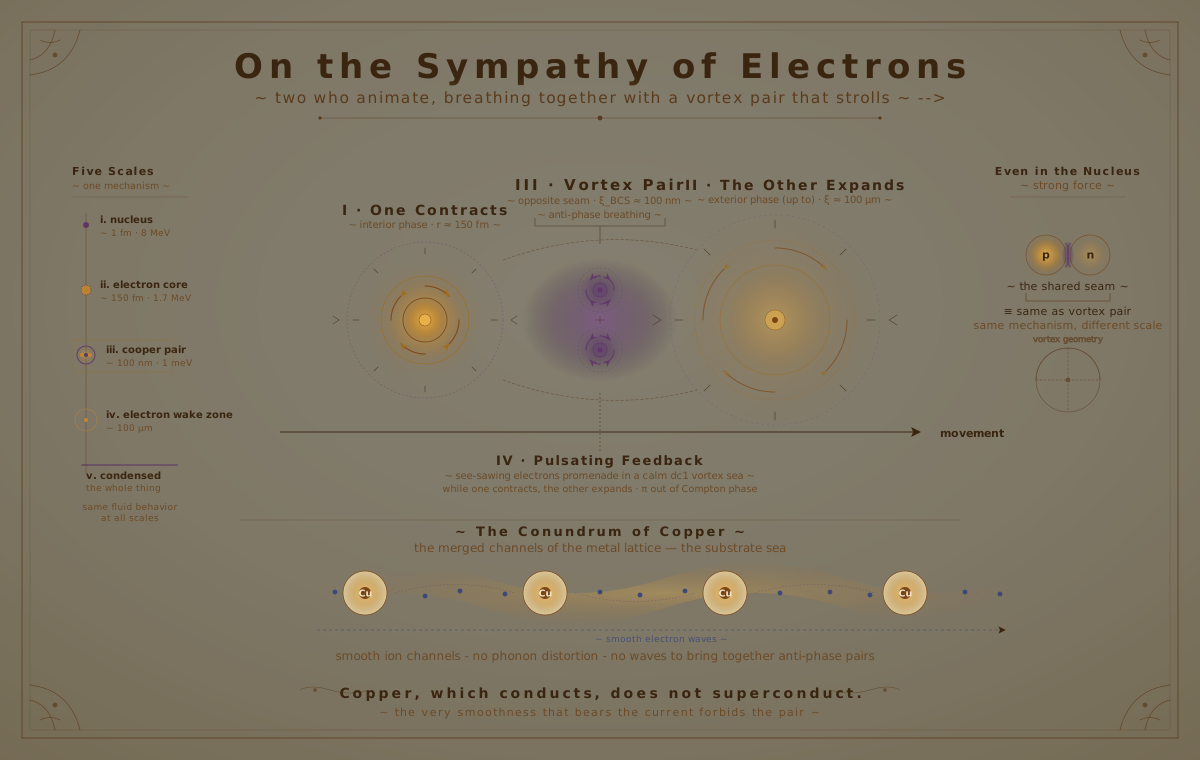
Interactive: open the conductors simulation — a patch of copper at room temperature with its sealed 3d¹⁰ cores, the outer shells dissolving into one sheath and the raceway flow running both ways down the lanes; turn the current up and both lanes bias one way while a modon wave carries the signal past at c, seal the shells again and the same atoms are an insulator, and switch to iron or niobium to see the rough inner boundary the sea rides against there. A second view puts the same patch on a temperature slider: \rho(T) by Bloch–Grüneisen with the purity as a second slider, the scatterings drawn at the Drude cadence and split by Matthiessen’s rule between rattling cores and the one impurity, the phonons going from a rattle to a long soft ripple to nothing — and the floor the impurity leaves; take niobium below its T_c and the tracers pair off on shared seams, walk past the impurity as one, and \rho drops to zero on the chart. A third draws the Cooper pair: two same-chirality electrons a coherence length apart breathing \pi out of phase, the counter-rotating seam that forms only when they do (drag the phase offset to zero and it does not), the give-and-take between them, a defect streaming past that a lone electron scatters off and the pair walks around, the seam torn above T_c, and copper, which never forms one.
Metal Lattice as Merged Boundary Architecture
In the substrate model, a metal lattice is a periodic arrangement of nuclear orbital system complexes (the ion cores) whose outer boundary layers are close enough to merge. Unlike isolated atoms — where Layer 5 forms a complete counter-rotating confinement shell (Hydrogen Atom) — in a metal the atoms are packed so tightly that the outermost counter-rotating boundaries between adjacent atoms partially dissolve, creating continuous co-rotating flow channels that span the entire crystal.
This is the substrate equivalent of the “electron sea.” The electrons are not abstractly “delocalized” — the boundary architecture literally opens shared raceways.

The core mechanism: in an isolated atom (Hydrogen Atom), Layer 5 — the outermost counter-rotating boundary — forms a complete confinement shell. In a metal lattice, the atoms are packed so tightly (typical spacing ~2–3 Å) that the outermost counter-rotating shells of adjacent atoms cannot both exist. They are squeezed into the same space and partially dissolve, leaving only weakened remnants at the midpoints between atoms. The co-rotating flows from adjacent atoms merge into continuous channels that span the entire crystal.
Those channels run along the dissolved-boundary midpoints — the counter-rotating remnants between atoms — which is the substrate’s own two-lane median (the vertical scale; the mycorrhizal hypha rides the same kind of boundary as a road). A conductor’s raceway sits on that median, and a median carries flow equally both ways: this is why metallic conduction is Ohmic and symmetric, reversing freely with the applied field. A diode’s rectifying asymmetry is then exactly what it costs to break the median’s two-lane symmetry — to wall off one lane so that current runs only one way.
This boundary dissolution is why metals conduct and insulators don’t.

The boundary-matching math from the hydrogen atom model (Hydrogen Atom) carries over directly. The boundary between oscillatory (co-rotating) and decaying (counter-rotating) solutions determines the discrete energy levels. In a metal lattice, when many atoms are packed together, their outer boundaries overlap and the matching condition changes — instead of discrete bound states, the allowed solutions become continuous bands. The co-rotating flow channels become highways rather than individual racetracks.
The substrate model provides a particularly clean answer to a classic puzzle: why do electrons in a perfect crystal experience zero resistance? In the Drude picture, this requires Bloch’s theorem and periodic potentials. In the substrate picture, a perfectly periodic lattice creates perfectly smooth co-rotating channels — the boundary architecture repeats identically, so there are no disruptions for electrons to scatter off. Resistance comes only from breaks in the periodicity: phonons (thermal vibrations that temporarily distort the channels), impurities (foreign atoms with different boundary structures), and crystal defects (grain boundaries, vacancies).
The temperature dependence follows naturally: at high T, more phonons means more frequent channel disruptions, so resistivity rises linearly. At very low T, phonons freeze out and only impurity scattering remains — giving the residual resistivity plateau. The T^5 dependence at intermediate temperatures arises because only long-wavelength phonons survive at low T, and they scatter electrons at small angles (gentle channel distortions rather than hard disruptions).
The Metal Ion Core
The metal ion core is where the substrate model becomes structurally richer than hydrogen, because multi-nucleon nuclei and inner electron shells introduce physics that hydrogen simply does not have.
In hydrogen, the proton core is a single three-quark orbital complex (see Proton Core). A metal like copper has 29 protons and 34 neutrons — 63 nucleons, each its own interlocking figure-8 system, all packed inside the nuclear confinement boundary. Between that nucleus and the outer conduction sea, 28 tightly bound inner electrons are organized into complete, rigid shell structures. These inner shells create the screening effect: they absorb most of the nuclear substrate flow before it reaches the valence region.

The multi-nucleon core contains 63 nucleons — 29 protons and 34 neutrons — packed into a dense cluster of interlocking orbital systems. In substrate terms, neutrons are electrically neutral 3-quark systems whose counter-rotating boundaries interleave with the proton boundaries, adding stability without adding charge asymmetry. This is why the nuclear binding energy per nucleon peaks around iron (Z = 26): there is a sweet spot where the interlocking counter-rotating boundaries between nucleons achieve maximum mutual reinforcement. Too few nucleons and the boundary-boundary contacts are insufficient; too many and the long-range proton repulsion overwhelms the short-range binding.
The inner shell stack — those 28 tightly bound electrons forming four groups of complete, rigid co-rotating/counter-rotating layer pairs — is what hydrogen lacks entirely. The flow alternates direction in successive shells, like counter-rotating bearings in a mechanical assembly. This alternation is why filled shells are chemically inert: each co-rotating zone is locked in place by counter-rotating boundaries above and below it. Reorganization requires breaking multiple boundary layers simultaneously.
Charge screening is the key to why metals conduct. The nuclear core radiates +29 units of co-rotating substrate flow outward (Constraint C4 gives the energy scale via the effective-quantum form: each electron is a condensate of \nu \approx 8.3 \times 10^8 dc1 particles forming an effective quantum of mass m_\text{eff} \approx 1.70 MeV/c^2 orbiting at v_\text{rot,inner} = 0.776c with radius r_\text{eff} \approx 150 fm; C5 gives the nuclear mass budget). Each inner electron absorbs one unit. By the time the flow reaches the outermost region, 28 of the 29 units have been absorbed. The valence 4s electron sees only +1 of effective substrate flow — its confinement boundary is incredibly weak (~7.7 eV for isolated copper, versus 13.6 eV for hydrogen). That weakness is what enables boundary dissolution at the 2.55 Å copper lattice spacing.
The Strong Force as Boundary Interlocking
This is where the substrate model gives a satisfying physical picture of the strong nuclear force — and where the mechanism that will reappear at the Cooper pair scale is first established.

In hydrogen’s lone proton (Proton Core), each of the three quarks has its own confinement boundary, and the whole proton is wrapped in an outer confinement shell (Layer 2). When a second nucleon approaches within ~1 femtometer, their individual confinement boundaries physically overlap. The counter-rotating eddies from each nucleon’s shell interleave and form a shared seam.
That shared seam is the strong nuclear force. It is not a “force carrier” being exchanged — it is a structural merger of two boundary layers into one interlocking counter-rotating zone. The binding energy (~8.75 MeV per nucleon in copper) is the energy stored in these shared seams.
This immediately explains the strong force’s two most distinctive properties. Short range: the seam can only exist where the nucleon orbital systems physically overlap. Pull them beyond ~1.4 fm and each nucleon closes its own confinement shell — the shared seam disappears. This is fundamentally different from electromagnetism (co-rotating substrate flow extending to infinity via 1/r^2) or gravity (leak current, also 1/r^2). The strong force is a contact force in the most literal sense. Extraordinary strength: within its range, the shared seam stores energy at nuclear densities. The inter-nucleon seams are weaker than the intra-quark boundaries (~8–9 MeV per contact versus ~929 MeV for the proton’s total internal boundary energy) because the nucleons’ confinement shells partially screen their internal structure.
Neutrons serve as boundary stabilizers: their quarks (up-down-down) produce zero net co-rotating flow (zero charge), but their confinement boundaries interlock with neighboring nucleon boundaries just as effectively as protons’. Heavy nuclei need progressively more neutrons than protons because electromagnetic repulsion (long-range co-rotating flow) accumulates across the entire nucleus, while each neutron adds only short-range binding through boundary contact with its immediate neighbors.
The binding energy per nucleon peaks around iron-56 (~8.8 MeV/nucleon) — the sweet spot of boundary geometry where each nucleon has roughly 12 nearest-neighbor contacts in nuclear close-packing. Below iron, adding nucleons increases the average contact count. Above iron, long-range proton repulsion erodes the binding gain. The Proton Core § The Binding-Energy Curve develops this contact-counting picture into a substrate mass formula: the iron peak as A_\text{peak}\approx 2a_S/a_C — boundary-seam surface tension balanced against the \alpha-set Coulomb repulsion — with the same anti-phase breathing that pairs Cooper electrons appearing here as the nuclear pairing term.
Pion exchange in the substrate picture is a boundary fluctuation: when the shared seam between two nucleons is locally stretched, the counter-rotating eddies store enough energy to eject a quark-antiquark pair — a pion — which is absorbed by the neighboring nucleon’s boundary. It is the same confinement mechanism from the proton core section operating one structural level up.
Why this matters for superconductivity: The shared counter-rotating seam between nucleons at ~1 fm and ~8 MeV will reappear as the shared counter-rotating vortex between Cooper-paired electrons at ~100 nm and ~1 meV. Same mechanism, vastly different energy scale — and the ratio of those scales traces back to the mutual friction parameter hierarchy: \alpha_\text{mf}(\text{nuclear})/\alpha_\text{mf}(\text{electron}) \approx m_p/m_e \approx 1836 (Two Fluids → Quantum Potential).
In the two-scale model (Emergent Speed of Light), each electron that enters the Cooper pair is not a point particle — it is an effective quantum of mass m_\text{eff} \approx 1.70 MeV/c^2, breathing between a contracted inner scale (r_\text{eff} \approx 150 fm, where it orbits at v_\text{rot,inner} = 0.776c) and an expanded coherence envelope (\xi \approx 100\;\mum) at the Compton frequency \omega_c = m_e c^2/\hbar. The Cooper pair vortex couples two such breathing objects. The inner scale of each electron (r_\text{eff} \approx 150 fm) is 100× larger than the nuclear seam (~1 fm) but 10^6× smaller than the Cooper pair coherence length (\xi_\text{BCS} \sim 38–100 nm). This scale hierarchy — nuclear seam \ll effective quantum \ll BCS pair vortex \ll substrate soliton — threads through the entire conductor/superconductor story.
Copper: From Nuclear Core to Conduction Sea
Copper is the ideal case study because its electron configuration has a famous anomaly that the substrate model explains with particular clarity.
The expected configuration for element 29 would be [Ar] 3d⁹4s². Copper actually adopts [Ar] 3d¹⁰4s¹ — it transfers one 4s electron to complete the 3d shell. In substrate terms, a complete counter-rotating boundary layer (full 3d shell) is so much lower in energy than a nearly-complete one that the system reorganizes to seal it, even at the cost of weakening the outermost region.

The screening cascade
The copper nucleus radiates +29 units of co-rotating substrate flow outward. Each inner shell absorbs its share: the 1s electrons see nearly +29 and are bound by ~8,979 eV; the 3d electrons see about +11 and are bound by ~75 eV; the lone 4s electron sees +1 and is bound by only 7.73 eV.
The 3d anomaly
The “expected” configuration 3d⁹4s² would leave one d-orbital lobe with an unpaired flow channel — a gap in the counter-rotating boundary, a weak spot in the shell. The system spontaneously reorganizes to 3d¹⁰4s¹ because sealing that boundary is worth more energy than keeping two 4s electrons. Three consequences follow.
First, only one electron per atom enters the conduction sea, giving copper’s free electron density: n = 8.49 \times 10^{28} m^{-3}, exactly one per atom.
Second, the sealed 3d shell creates an exceptionally smooth inner boundary. The single 4s electron rides outside a perfectly closed counter-rotating surface — no partially-filled lobes creating turbulence. The co-rotating flow channel is as clean as possible.
Third, the 3d electrons are completely locked away. Their sealed boundary is thermally inaccessible. This is why copper’s electronic specific heat is far lower than the classical Drude prediction — only one electron per atom is thermally active, not 29.
Why copper, silver, and gold are the best conductors
This is a forward prediction. The three best elemental conductors (Ag, Cu, Au — in that order) all share the same d¹⁰s¹ anomalous configuration: silver is [Kr] 4d¹⁰5s¹, gold is [Xe] 5d¹⁰6s¹. In each case, the d-shell seals completely and donates exactly one clean, weakly-bound s-electron to the conduction sea.
Compare iron ([Ar] 3d⁶4s²): four of the five d-orbital lobes have unpaired flow channels, creating boundary irregularities that scatter conduction electrons. Even though iron contributes two 4s electrons per atom (higher n), its scattering time \tau is much shorter because the inner boundary is rough. Iron’s conductivity is about 10× lower than copper’s.
The substrate model predicts: conductivity depends not just on how many electrons enter the sea, but on how smooth the inner boundary is that those electrons ride against. A sealed d-shell with one free electron beats a rough d-shell with two free electrons.
The Drude parameters in substrate language
The standard conductivity formula \sigma = ne^2\tau/m maps directly to substrate quantities. Each term has a substrate origin: n counts dissolved-boundary electrons per volume, \tau measures the average channel-disruption time (set by phonon disruption frequency), e^2 is the coupling strength to the co-rotating substrate flow, and the electron mass m is the total orbital system energy divided by c^2 (Constraint C4). At 300 K, copper’s scattering time is about 25 femtoseconds — a conduction electron rides the co-rotating channel for 25 fs before a thermally displaced ion core distorts the channel enough to scatter it. The mean free path is about 40 nm, roughly 150 lattice spacings.
Note: This is an interpretive mapping — the substrate model reproduces Drude/Sommerfeld theory in different language but does not predict new values for \sigma, \tau, or n beyond what standard theory gives. The forward-predictive content is in the boundary smoothness → conductivity correlation above.
Drude \tau is the metal’s instance of a more general substrate quantity: the ring-down time of the channel’s wrap. The same notion governs the anomalous femtosecond delay in quartz and the codon-stamp conjecture in DNA. See Channel with Memory for the cross-domain picture.
Temperature Regimes of Metallic Conduction
The substrate model creates a vivid picture of what happens microscopically as a metal is cooled. The story is about co-rotating channels getting progressively smoother until the only disruptions remaining are permanent structural defects — and why this residual scattering means copper can never reach zero resistance, setting the stage for superconductivity as a fundamentally different mechanism.

Regime 1: Room temperature (300 K) — linear in T
The ion cores vibrate with thermal amplitudes of about 0.08 Å — small compared to the 2.55 Å lattice spacing, but enough to create substantial local distortions of the co-rotating flow channels. At high temperature, phonon number is proportional to T (Bose-Einstein distribution in the classical limit), so scattering rate \propto T and resistivity scales linearly. Mean free path: ~40 nm (~150 lattice spacings).
Regime 2: Intermediate (10–77 K) — the T^5 regime
Below the Debye temperature (343 K for copper), short-wavelength phonons freeze out. Only long-wavelength modes survive, creating gentle, extended ripples in the co-rotating channels rather than sharp local kinks. A long-wavelength phonon is a collective undulation of many ion cores, producing a smooth wave-like distortion. An electron riding through this gentle ripple deflects at a small angle — many encounters are needed to randomize its momentum. The combined effect gives the Bloch-Grüneisen T^5 law: T^3 from the phonon density of states times T^2 from small-angle scattering effectiveness. Mean free path grows to micrometers.
Regime 3: Very low temperature (<10 K) — residual plateau
Phonons are essentially gone. Ion cores sit motionless at equilibrium positions. The co-rotating flow channels become perfectly straight — as clean as the crystal structure allows. Electrons travel millimeters without scattering.
But resistivity does not reach zero. It flatlines at the residual resistivity, determined entirely by permanent structural imperfections: impurity atoms with different boundary architectures, vacancies (channel dead-ends), dislocations, and grain boundaries. Each is a permanent kink that no amount of cooling can remove.
The residual resistivity ratio (RRR = \rho_{300\text{K}}/\rho_{4\text{K}}) measures crystal purity. Ultra-pure single-crystal copper can reach RRR > 50,000, meaning the channels at low temperature are 50,000 times smoother than at room temperature.
Regime 4: The fundamental limit — and the bridge to superconductivity
Copper can never reach zero resistance because individual electrons, as single orbital system complexes, must scatter off any permanent disruption they encounter. A single electron has no mechanism to avoid a channel defect.
This is the problem that Cooper pairing solves.
Superconductivity: The Shared Vortex Mechanism
The core claim: two electrons with the same circulation chirality (relative to their co-propagation axis), brought close enough together by phonon-mediated lattice distortion, form a promenading pair — they share the same rotational handedness but are anti-phase in their Compton breathing cycle, so that one is in its contracted phase (inner scale, r_\text{eff}) while the other is in its expanded phase (outer scale, \xi_\text{substrate}). This inside/outside complementarity creates a shared counter-rotating vortex between them — structurally identical to the boundary seam that binds nucleons (see The Metal Ion Core), but at vastly lower energy and vastly larger spatial extent. The shared vortex makes the pair a self-coherent object that flows around defects rather than scattering off them.
This is distinct from an orbiting pair, which would form between two electrons of genuinely opposite circulation. Orbiting pairs dance around each other; promenading pairs walk in tandem. Cooper pairs are promenaders: they translate together through the lattice, maintaining their anti-phase breathing relationship. The BCS singlet label (↑↓, “opposite spin”) maps, in the substrate picture, to opposite Compton phase rather than opposite circulation chirality — the two electrons’ internal clocks are \pi out of phase, which projects as opposite spin when measured along any axis.
The same promenading mechanism runs without charge in superfluid helium-3: a lone He-3 atom is a fermion that cannot lock to the substrate on its own, so it must first find a same-chirality partner and pair anti-phase — exactly this construction — before the composite boson can tune in to the vacuum’s breath. Where superconductivity is the charged instance, superfluid helium is the neutral one, and helium-4 skips the pairing step entirely because it is already a balanced boson. The full story is in Superfluid Helium: The Substrate’s Mirror.

Step 2: Why the pair does not scatter — topological protection
A single electron is a single orbital system: it hits a channel defect and deflects. A Cooper pair is an extended object spanning ~100 nm, bound by a coherent vortex. A point defect is ~0.3 nm — the pair is 300 times wider than the obstacle.
When the pair encounters a defect, each electron’s path deflects slightly, but they deflect in complementary ways due to their spatial separation. The shared vortex acts as a restoring force: any perturbation that pushes one electron out of correlation with its partner is counteracted by the vortex pulling them back into phase. The net momentum transfer to the defect is zero — the pair as a whole passes through unscattered.
Breaking the pair would require a disruption spanning the entire coherence length simultaneously. No single-site defect can do this. This is topological protection: the shared vortex is a coherent, extended counter-rotating structure that local perturbations cannot destroy.
Step 3: The Cooper pair vs. the photon — why one propagates and the other doesn’t
The photon (The Photon as Modon) and the Cooper pair are both modon-like structures — counter-rotating vortex dipoles. But their physics is fundamentally different:
A photon-modon is a solitonic excitation of the free substrate itself. Its two counter-rotating components are balanced, carry zero net angular momentum, and self-propel at c. It has no rest mass because it involves no net mass transport — only energy propagation through the medium.
A Cooper-pair vortex binds two massive fermions embedded in a crystal lattice. The paired electrons are not excitations of the substrate — they are orbital system complexes riding within the lattice’s periodic boundary architecture. Their shared vortex is a standing structure: a persistent counter-rotating seam between two co-rotating electron orbital systems, localized within the material. The pair moves through the lattice at drift velocity (not c), and its binding energy is a tiny fraction of each electron’s rest mass.
The photon-modon is the signal; the Cooper-pair vortex is the bond. One propagates freely because the substrate is its medium. The other is bound because the fermions are its anchors.
The beautiful irony of copper
The same sealed 3d¹⁰ shell that makes copper the world’s best normal conductor — by creating perfectly smooth co-rotating channels — also makes it impossible for copper to superconduct.
This is a forward prediction. Superconducting pairing requires strong electron-phonon coupling: the passing electron must distort the lattice enough to create a significant channel compression that pulls a second electron into pairing range. In copper, the sealed 3d boundary creates such smooth channels that the electron barely disturbs the lattice — phonon distortion is negligible, and the resulting vortex pairing energy is immeasurably small.
Niobium (T_c = 9.3 K) has the configuration [Kr] 4d⁴5s¹ — four of five d-orbital lobes are only partially filled, creating a rough, irregular inner boundary. Electrons moving through niobium’s channels push hard against these boundary irregularities, creating strong lattice distortions (strong electron-phonon coupling), which produce robust phonon-mediated attractions, bringing electron pairs close enough to form stable shared vortices.
The prediction generalizes: plot T_c against the number of unfilled d-orbital lobes across transition metals, and the substrate model predicts a positive correlation. Rough d-shells (Nb, V, Ta) superconduct; smooth d-shells (Cu, Ag, Au) do not. This matches experiment.
Mapping to BCS Quantities
Every BCS parameter has a substrate equivalent. The following mappings are interpretive — they show consistency between the substrate picture and established BCS theory, not independent derivations.
Tc = 9.3 K
counter-rotating seam
vF = Fermi velocity
Δ = vortex energy
in one vortex oscillation
ns = pair density
Nb: λL ≈ 39 nm
depth of pair condensate
κ = 1/√2 → boundary
κ > 1/√2 → Type II
screening depth ratio
The energy gap \Delta is the vortex binding energy — the energy stored in the shared counter-rotating seam between the paired electrons. For niobium, \Delta \approx 1.5 meV.
The BCS gap \Delta_\text{BCS} \sim 1–3 meV across conventional superconductors is intriguingly close to the dc1 particle rest energy m_1 c^2 \approx 2 meV (from the two-scale model, Emergent Speed of Light). If this is not accidental, it suggests that the Cooper pair binding energy is set by the substrate’s fundamental mass scale — the energy cost of one dc1 quantum in the shared vortex. This would make the BCS gap a direct window onto dc1 physics: \Delta_\text{BCS} \sim m_1 c^2. The relationship deserves quantitative investigation: does the HVBK formalism with \alpha_\text{mf} = 0.3008 and the dc1 mass predict the correct gap magnitude? If so, the open derivation #2 (below) would not just connect \Delta to \alpha_\text{mf} but to the substrate’s microscopic mass m_1.
The coherence length \xi_\text{BCS} is the spatial extent of the shared vortex — how far apart the two electrons can sit while maintaining vortex coherence. For niobium, \xi_\text{BCS} \approx 38 nm. In BCS theory, \xi_\text{BCS} = \hbar v_F/(\pi\Delta). In the substrate picture, \hbar derives from the diffusivity of the counter-rotating layer (Constraint C2: D = \hbar/2m), v_F is the Fermi velocity of the co-rotating flow, and \Delta is the vortex binding energy. The coherence length is therefore the distance a paired electron travels (at Fermi velocity) during one oscillation period of the shared vortex. Dimensional analysis: [\hbar v_F/\Delta] = [\text{J·s} \times \text{m/s} \;/\; \text{J}] = \text{m}. ✓
The symbol \xi is overloaded between BCS theory and the substrate model. In this section, \xi_\text{BCS} = \hbar v_F/(\pi\Delta) \sim 10–10^3 nm denotes the Cooper pair coherence length (the shared vortex extent). The substrate coherence length \xi_\text{substrate} \approx 100\;\mum (\xi = (\hbar/(\rho_{DM}c))^{1/4}, from Emergent Speed of Light) is the individual electron’s soliton/modon radius — a completely different quantity, \sim 10^3× larger. The two are connected through the effective quantum’s breathing range. Where context is clear, bare \xi refers to \xi_\text{BCS} in the superconductivity sections; elsewhere in the paper it refers to \xi_\text{substrate}.
The London penetration depth \lambda_L is the distance over which external co-rotating flow (magnetic field) penetrates the pair condensate before being screened. In BCS, \lambda_L = \sqrt{m/(\mu_0 n_s e^2)}. In substrate terms, n_s is the density of paired electrons in the co-rotating condensate, and the screening arises because the pairs generate counter-currents that cancel the external flow.
The Ginzburg-Landau parameter \kappa = \lambda_L/\xi determines the Type I/Type II distinction (see Type I vs Type II Superconductors).
The critical temperature T_c = \Delta/(1.76\, k_B) is the temperature at which thermal energy tears the shared vortex apart. Below T_c, thermal fluctuations jostle the pair but cannot break the vortex. Above T_c, the vortex is destroyed and electrons revert to independent orbital systems that scatter normally.
The Cooper pair as a boson. The pair is a boson in the substrate picture because the anti-phase breathing relationship creates a composite object with even boundary parity (Spin-Statistics). Both electrons share the same circulation chirality, but their \pi-offset Compton phases mean the pair’s net effect on the substrate is symmetric: the contracted electron’s inward pull and the expanded electron’s outward push average to a balanced, non-chiral disturbance. The pair carries zero net spin angular momentum — not because two opposite rotations cancel, but because the anti-phase breathing creates a time-averaged substrate signature that has the same symmetry as the background (two phase-flips = even parity). This is why the pair can occupy the same quantum state as every other Cooper pair in the condensate: no Pauli exclusion, because the pair’s boundary parity is even.
Connecting to the HVBK Machinery
Click any node to see how it connects to \alpha_\text{mf}. The three green branches are completed derivations; the amber dashed branch is the open derivation that would unify superconductivity with the Standard Model parameters.
The mutual friction formalism developed in Two Fluids → Quantum Potential — the HVBK equations that underpin the Weinberg angle (Weinberg Angle, Constraint C8) and the fine structure constant (Constraint Summary, Constraint C6) — should also govern the Cooper pair interaction. This connection has not yet been fully derived, but the framework demands it, and the dimensional analysis is suggestive.
In the derivation, the effective diffusivity of vortex-mediated transport is:
D_\text{sf} = \frac{\kappa_q}{4\pi \cdot \alpha_\text{mf}}
where \kappa_q = h/m_\text{eff} is the quantized circulation and \alpha_\text{mf} is the dimensionless mutual friction parameter. The constraint m_\text{eff} \cdot \alpha_\text{mf} = m (Two Fluids → Quantum Potential) gives \alpha_\text{mf} its physical meaning: it measures how strongly the co-rotating and counter-rotating layers are coupled at a given energy scale.
For the electron regime, \alpha_\text{mf} = 0.3008 — the same value that generates \sin^2\theta_W = 0.2312 via Constraint C8. The Cooper pair interaction operates in the electron regime (binding energy ~1 meV, governed by electron-mass physics), so \alpha_\text{mf} \approx 0.3008 should apply. This is a consistency requirement: the same mutual friction parameter that determines the electroweak mixing angle should set the coupling strength in the Cooper pair’s shared vortex.
Two-scale context. In the effective-quantum picture, each electron in the Cooper pair is a condensate of \nu \approx 8.3 \times 10^8 dc1 particles with collective mass m_\text{eff} = m_e/\alpha_\text{mf} \approx 1.70 MeV/c^2. The quantum of circulation \kappa_q = h/m_\text{eff} therefore encodes the effective quantum’s mass, not the bare electron mass m_e or the dc1 mass m_1. This creates a notable tension with the superconducting flux quantum \Phi_0 = h/(2e), which involves the Cooper pair charge 2e rather than any mass. In the substrate picture, flux quantization arises from the pilot wave standing-wave condition for the pair (same math as hydrogen Bohr quantization, The Photon as Modon), which couples to the co-rotating flow (electromagnetic sector) via charge. Circulation quantization arises from the vortex topology (superfluid sector) and couples via mass. That these yield the same Planck’s constant h is a consistency requirement of the framework, but the factor of 2 (pair vs single) and the relationship m_\text{eff} = m_e/\alpha_\text{mf} \neq 2m_e deserve careful tracking: the flux quantum knows about electron charge, while the circulation quantum knows about the effective quantum mass. Whether \Phi_0 can be re-expressed purely in terms of \kappa_q and \alpha_\text{mf} is an open question.
The open derivation: starting from the HVBK mutual friction force with \alpha_\text{mf} = 0.3008, derive the BCS gap equation \Delta = 2\hbar\omega_D \exp(-1/N(0)V) from substrate parameters. The Debye frequency \omega_D sets the phonon energy scale; N(0) is the density of states at the Fermi level; V is the pairing potential. In the substrate picture, V should be expressible in terms of \alpha_\text{mf} and the electron-phonon coupling strength (which depends on inner-boundary roughness — the d-shell filling fraction). If this derivation succeeds, it would connect the BCS gap to the same geometric parameter that gives the Weinberg angle. The \Delta_\text{BCS} \sim m_1 c^2 coincidence (Mapping to BCS Quantities) suggests the pairing potential may have a particularly simple form in terms of the dc1 rest energy.
Type I vs Type II Superconductors
In the substrate picture, quantized vortex lines are fundamental objects — they are the counter-rotating structures that appear wherever co-rotating flows collide. The Type I/Type II distinction has a natural substrate interpretation in terms of two competing length scales.
Type II: Nb (κ ≈ 1.1), NbTi (κ ≈ 60), YBCO (κ ≈ 95)
Drag the \kappa slider through the critical value 1/\sqrt{2} \approx 0.71 and watch the transition: from complete flux exclusion to vortex lattice penetration. The left panel shows how the two length scales change relative to each other; the right panel shows the consequence for magnetic flux.
Type I (\kappa < 1/\sqrt{2}): The coherence length \xi exceeds the penetration depth \lambda_L. The shared vortex between paired electrons is spatially larger than the screening distance. When an external magnetic field (external co-rotating flow) approaches the material, it would need to penetrate a region smaller than the pair vortex to insert a flux line — but doing so would disrupt the vortex, destroying the pair. The condensate therefore excludes all flux (complete Meissner effect) until the field overwhelms the entire condensate at once (single critical field H_c). Examples: lead, mercury, tin.
Type II (\kappa > 1/\sqrt{2}): The penetration depth exceeds the coherence length. The screening distance is larger than the pair vortex. An external field can insert a quantized flux line into the material without disrupting the nearest pairs — the flux tube is narrow enough to thread between the vortex structures. Above H_{c1}, individual flux quanta punch through the pair condensate, each surrounded by a screening current eddy. These flux tubes repel each other and self-organize into an Abrikosov lattice — a triangular array that minimizes the free energy, with geometry identical to the packing of co-rotating orbital systems separated by counter-rotating boundaries. Complete flux penetration occurs at H_{c2} when the flux tubes merge. Examples: niobium, YBCO.
The substrate model predicts that the Type I/Type II distinction maps to a material-dependent ratio of two substrate quantities: the pair vortex spatial extent (set by Fermi velocity and binding energy) versus the cooperative screening depth (set by pair density and coupling strength). Materials with dense, tightly-bound pairs and weak screening are Type I. Materials with extended pairs and strong screening are Type II.
There is a \sqrt{2} already sitting in this threshold, and it is the framework’s own. The self-dual value \kappa = 1/\sqrt{2} is precisely the condition \xi_\text{BCS}^2 = 2\,\lambda_L^2 — one characteristic length squared equal to twice the other — which is structurally the same pairing-two that fixes the substrate’s \xi^2 = 2\,\xi_\text{GP}^2 (the lattice breathes in pairs) and that the substrate ladder names as its fundamental rung. The two \sqrt{2}’s relate different length pairs — core-to-pair-spacing in one, coherence-to-penetration in the other — so this is a structural parallel, not yet a derivation; but it sharpens open derivation #3 below into a concrete target: show that the normal/superconductor interface energy vanishes exactly where the pairing-two reappears as a length-squared doubling.
The Abrikosov lattice deserves special emphasis. The main document’s Visual Context section cites Type II vortex lattices as a visual analog for the substrate itself. The mapping table below closes this loop: the Abrikosov lattice is not just an analog for substrate physics — it is substrate physics made visible. Each flux vortex is a channel where external co-rotating flow punches through the pair condensate, with counter-rotating screening eddies circling each tube. The triangular lattice geometry is the minimum-energy packing — identical to the self-organization seen at every other scale in the framework. This is the same triangular geometry that Tkachenko (1966) proved is the unique stable configuration for doubly-infinite 2D vortex arrays — Pillar 1 of the five-pillar argument establishing the substrate lattice geometry (The Bridge Equation). The Abrikosov lattice in a Type II superconductor is a laboratory-scale demonstration of the lattice structure that the bridge equation requires at the substrate scale.
The Meissner Effect
The Meissner effect — complete expulsion of magnetic flux below H_c — is the most physically vivid superconducting phenomenon, and the substrate picture provides a clear qualitative mechanism. The quantitative derivation from the substrate’s two-fluid equations (Two Fluids → Quantum Potential) remains an open problem.
Toggle between Above T_c (field penetrates) and Below T_c (field expelled) to see the Meissner mechanism in action. Click the annotation cards below for details on vortex protection, screening depth, and the London equations.
The qualitative mechanism: A magnetic field is a co-rotating substrate flow (The Photon as Modon). Inside a superconductor, the Cooper pairs’ shared counter-rotating vortices are the energetically dominant structures. An external magnetic field imposes additional co-rotating flow that would perturb these delicate vortex seams. The pairs collectively respond by generating screening currents — cooperative co-rotating flows that exactly cancel the external field within the bulk, protecting their shared vortices.
The screening penetrates to a depth \lambda_L before the pair condensate fully cancels the external flow. Below \lambda_L, the interior is field-free — not because of an abstract boundary condition, but because the pair vortices have actively expelled the incompatible co-rotating flow.
The London equations (\partial\mathbf{J}/\partial t = (n_s e^2/m)\,\mathbf{E} and \nabla \times \mathbf{J} = -(n_s e^2/m)\,\mathbf{B}) should be derivable from the substrate’s two-fluid model (Two Fluids → Quantum Potential) with the identifications: the superfluid component → the Cooper pair condensate (co-rotating channels carrying zero-resistance current), the normal component → unpaired electrons and phonons (dissipative flow). The first London equation states that the pair condensate accelerates frictionlessly under an applied field — consistent with the topological protection that prevents pair scattering. The second London equation states that curl of the screening current is proportional to the local magnetic field — the substrate’s counter-rotating response to co-rotating perturbation.
Open derivation: Starting from the HVBK mutual friction equations (Two Fluids → Quantum Potential), with the superfluid component identified as the pair condensate and the normal component as the unpaired electron gas, derive the two London equations. The key step is showing that the mutual friction coupling in the paired state reduces to a purely reactive (non-dissipative) response — the B term vanishes for the condensate while B' generates the screening current. If successful, this would connect superconductivity directly to the same formalism that generates the Weinberg angle.
Dimensional consistency. The London penetration depth \lambda_L = \sqrt{m/(\mu_0 n_s e^2)} uses the bare electron mass m = m_e and the superfluid density n_s (number of superconducting electrons per unit volume). In the two-scale model, each superconducting electron is an effective quantum of mass m_\text{eff} = m_e/\alpha_\text{mf} \approx 1.70 MeV/c^2, but the London formula involves m_e, not m_\text{eff}. This is consistent because \lambda_L derives from the electromagnetic response (coupling via charge e), which sees the electron’s inertial mass m_e — the mass of the whole orbital system complex, not its internal effective quantum structure. The effective quantum mass m_\text{eff} enters the circulation quantum \kappa_q = h/m_\text{eff} (superfluid sector), not the flux quantum \Phi_0 = h/(2e) (electromagnetic sector). The two are connected through \alpha_\text{mf}: m_\text{eff} \cdot \alpha_\text{mf} = m_e.
One Mechanism, Five Scales
The superconductivity story reveals the same counter-rotating boundary physics operating across five scales — from the nuclear seam through the effective quantum’s inner orbital, the Cooper pair vortex, the substrate coherence soliton, to the macroscopic condensate:
and synchronizing a macroscopic condensate
Binding energy ratio: 8 MeV / 1 meV = 8 × 10⁹ · Length scale ratio: 100 nm / 1 fm = 10⁸
Click each panel to see the full substrate physics at that scale. The logarithmic scale bar at the bottom spans 13 orders of magnitude — and the same purple counter-rotating seam appears at every one.
This is the substrate ladder’s central thesis made concrete in a single material: one self-similar motif — the paired counter-rotating breath — tiled across a tower of scales, exactly as the ladder tiles it from the vortex core to the cell. The same motif appears in a neutral superfluid when liquid helium is cooled until its atoms tune in to the vacuum’s breath (Superfluid Helium: The Substrate’s Mirror) — the cleanest case where the breath becomes a macroscopic, pourable fluid. These five rungs are not a \sqrt{2} comb, though: they are set by different physics — nuclear binding, electron mass, BCS pairing, the substrate cutoff — so they belong to the ladder’s coarse family, a row of mechanism-set rungs rather than evenly log-spaced teeth. What recurs across them is the motif, not the spacing.
Nuclear scale (~1 fm): The shared counter-rotating seam between nucleons is the strong nuclear force. Binding energy ~8 MeV per contact. The seam can only exist where orbital systems physically overlap — short range. The mutual friction parameter operates in the nuclear regime: \alpha_\text{mf}(\text{nuclear}) \approx 1836 \times \alpha_\text{mf}(\text{electron}).
Effective quantum inner scale (~150 fm): Each conduction electron is an effective quantum — a condensate of \nu \approx 8.3 \times 10^8 dc1 particles with collective mass m_\text{eff} \approx 1.70 MeV/c^2, orbiting at v_\text{rot,inner} = 0.776c with radius r_\text{eff} \approx 150 fm and angular momentum \hbar. This is the electron’s “contracted phase” — its peak internal rotation. The scale is 150× larger than the nuclear seam (r_\text{eff}/1\;\text{fm} \approx 150) but 2.5 \times 10^5× smaller than the Cooper pair vortex extent. When two such effective quanta form a Cooper pair, the pairing vortex lives at \xi_\text{BCS} \sim 10^2 nm — vastly larger than either electron’s inner orbital.
Cooper pair scale (~100 nm): The shared counter-rotating vortex between anti-phase breathing electrons is the pairing interaction. Binding energy ~1 meV (intriguingly close to m_1 c^2 \approx 2 meV — see Mapping to BCS Quantities). The vortex extends across the BCS coherence length — the spatial envelope of the give-and-take between two anti-phase Compton cycles. It is vastly larger than the nuclear seam because the electrons are much lighter, the coherence dress spans nine orders of magnitude (r_\text{eff} to \xi_\text{substrate}, though the per-cycle breath is bounded at \bar\lambda_C), and the substrate environment is much softer. The mutual friction parameter operates in the electron regime: \alpha_\text{mf}(\text{electron}) \approx 0.3008.
Substrate coherence scale (~100 μm): Each electron’s coherence soliton — its static pilot-wave dress, accumulated over many Compton cycles rather than reached in a single breath — extends to \xi_\text{substrate} \approx 100\;\mum. The Cooper pair vortex at \sim 100 nm sits well inside this envelope. The macroscopic condensate forms when the coherence solitons of all paired electrons overlap and phase-lock.
Macroscopic scale (entire sample): All pair vortices phase-lock into a coherent array — a Bose-Einstein condensate of synchronized counter-rotating seams. This collective synchronization is what makes the macroscopic wavefunction physically real in the substrate model: \psi = \sqrt{\rho}\,\exp(iS/\hbar), where S is the phase of the collective vortex oscillation — not an abstract probability amplitude, but the literal oscillation phase of the condensate, directly measurable via SQUID interference.
Superconductivity Substrate Mapping
The following table ties the major superconductivity phenomena back to substrate mechanics and classifies each as a core mechanism, an interpretive mapping, or a testable prediction.
| Phenomenon | Standard physics | Substrate model |
|---|---|---|
| Meissner effect | Superconductor expels magnetic flux below Tc. Surface screening currents cancel B in bulk. | Cooper pair vortices collectively refuse external co-rotating flow that would disrupt their shared seams. Surface currents create counter-flow to cancel the field. Cheaper than breaking all pair vortices. core mechanism |
| London penetration depth | Characteristic depth over which B field decays exponentially inside surface. Depends on superfluid density. | Depth of cooperative screening flow. More pair vortices = denser counter-flow = shorter penetration. Grows as T approaches Tc because pairs break. core mechanism |
| BCS energy gap | Minimum energy to break a Cooper pair. Creates gap in excitation spectrum. Vanishes at Tc. | Energy stored in the shared counter-rotating vortex seam. To break the pair, must tear this vortex apart. Strongest at T = 0, vanishes at Tc when thermal energy overwhelms vortex binding. core mechanism |
| Flux quantization | Trapped flux in a ring = integer multiples of Φ₀ = h/(2e). Factor of 2 from pair charge. | Pair pilot wave must complete integer cycles around the ring — boundary-matching quantization, same math as hydrogen orbitals and modon eigenvalues. Factor of 2e because the circulating object is a pair. core mechanism prediction: same math as Sec. 7 |
| Isotope effect | Tc proportional to M⁻¹ᐟ². Heavier isotopes suppress Tc. Proves phonon-mediated pairing. | Heavier nuclear core = harder to displace = weaker channel compression = weaker pairing vortex = lower Tc. Connects nuclear mass directly to pair vortex binding strength. prediction confirmed |
| Type I vs type II | Determined by κ = λ/ξ. Type I: complete flux expulsion or full breakdown. Type II: allows partial flux penetration via vortex tubes. | Ratio of screening depth to pair vortex extent. Type I: vortices too wide to coexist with flux — all or nothing. Type II: compact vortices survive between flux tubes, creating a mixed state. observable |
| Abrikosov vortex lattice | Flux penetrates type II as quantized vortex lines that self-organize into triangular lattice. | Flux tubes are channels where external co-rotating flow threads through. Screening eddies around each tube repel, self-organizing into minimum-energy triangular packing — a visible, macroscopic echo of substrate boundary physics. observable visual analog from Sec. 10 |
| Josephson effect | Cooper pairs tunnel through thin insulating barrier. DC: supercurrent at zero voltage. AC: oscillating current at frequency 2eV/h. | Pair vortex (100 nm) bridges a 1-2 nm barrier — vortex eddies thread through gap maintaining coherence on both sides. Voltage shifts phase across the bridge, oscillating pairs back and forth. core mechanism |
| Critical current | Maximum supercurrent before superconductivity breaks down. Related to gap and geometry. | High drift velocity shears the shared pair vortex — upstream electron leads, downstream trails. At Jc the shear exceeds vortex binding energy and pairs tear apart, cascading into normal state. prediction |
| Critical field (Hc, Hc1, Hc2) | Magnetic field thresholds for destroying superconductivity. Type I: single Hc. Type II: Hc1 (first flux entry) to Hc2 (full breakdown). | External co-rotating flow overwhelms pair vortex binding. Hc1: first flux channel punctures pair lattice. Hc2: channels so dense that normal cores merge and no pairs survive. observable |
| Coherence length | Spatial extent of Cooper pair. Sets vortex core size. ξ = ℏv_F / (πΔ). | Extent of the shared counter-rotating vortex. Fast channel flow stretches it; strong binding tightens it. Sets Abrikosov vortex core diameter and determines type I vs II. core mechanism |
| Macroscopic coherence | All pairs share one wavefunction. Phase θ is macroscopically observable. Enables SQUIDs and quantum computing. | All pair vortices phase-lock — a Bose-Einstein condensate of synchronized counter-rotating seams. Phase θ = collective vortex oscillation. Phase gradients drive supercurrents. Nothing abstract — it is synchronized fluid dynamics. core mechanism prediction: phase is physical |
Key predictions embedded in the table
Several entries contain genuinely testable substrate-model predictions that go beyond translating standard physics:
The copper prediction (strongest): the sealed 3d¹⁰ boundary that makes copper the best normal conductor is precisely what prevents superconductivity. Generalizes to a testable rule — T_c correlates inversely with inner boundary smoothness (d-shell filling fraction) across transition metals.
The Abrikosov lattice identification: the vortex lattice in Type II superconductors is not merely an analog for substrate physics — it is substrate boundary physics made directly visible in experiment. The triangular geometry, the quantized flux per vortex, the inter-vortex repulsion are all manifestations of the same self-organization that operates at every other scale.
The macroscopic phase claim: the superconducting phase \theta is the literal oscillation phase of synchronized counter-rotating vortex eddies spanning the material — not an abstract mathematical object. This is consistent with the framework’s philosophy that \psi = \sqrt{\rho}\,\exp(iS/\hbar) decomposes into two physically real quantities, and here S is directly measurable via SQUID interference.
The isotope effect: heavier nuclear cores (higher isotope mass) create weaker lattice distortions for a given electron-phonon coupling — weaker channel compression, lower pairing energy, lower T_c. The BCS prediction T_c \propto M^{-1/2} follows from the substrate picture because the phonon frequency (channel distortion rate) scales as \omega_D \propto M^{-1/2}.
Open Derivations and Next Steps
This section has established the qualitative substrate picture for conductivity and superconductivity, identified the key forward predictions, and shown consistency with BCS theory. The two-scale model has introduced the effective quantum picture and the \xi_\text{BCS} vs \xi_\text{substrate} hierarchy. The London equations have been derived from the HVBK mutual friction formalism (London Equations from HVBK), demonstrating that the pair vortex topology naturally produces non-dissipative dynamics and that \lambda_L uses m_e consistently with the mass relation. Several quantitative derivations remain open:
London equations from HVBK — ✅ DERIVED. Starting from the HVBK mutual friction equations (Two Fluids → Quantum Potential), both London equations follow with the Cooper pair condensate as the superfluid component. The key result: the pair vortex topology — even boundary parity from anti-phase Compton breathing (Spin-Statistics) — suppresses the dissipative mutual friction channel (B \to 0), leaving only the reactive channel (B'), which generates non-dissipative screening currents. The first London equation (frictionless acceleration) follows directly; the second (field expulsion / Meissner effect) follows from the condensate’s irrotationality — the same boundary-matching condition that quantizes hydrogen orbitals (Hydrogen Atom). The London penetration depth \lambda_L = \sqrt{m_e/(\mu_0 n_s e^2)} uses the bare electron mass m_e (not m_\text{eff}), consistent with the mass relation m_\text{eff} \cdot \alpha_\text{mf} = m_e: the EM sector couples to the full Compton oscillation energy m_e c^2 = \frac{1}{2}m_\text{eff}v_\text{rot,inner}^2, not the internal substructure. The derivation connects the Meissner effect to the same B/B' decomposition that gives the Weinberg angle — the superconductor is the B \to 0 limit of electroweak physics. One potential forward prediction remains open: the HVBK temperature dependence B(T) may predict corrections to the Gorter-Casimir \lambda_L(T) form near T_c. Full derivation: London Equations from HVBK.
BCS gap from \alpha_\text{mf} and m_1. Using \alpha_\text{mf} = 0.3008 and the electron-phonon coupling strength (parameterized by d-shell filling), derive the BCS gap equation \Delta = 2\hbar\omega_D \exp(-1/N(0)V). If successful, this connects T_c to the same parameter that gives the Weinberg angle. The coincidence \Delta_\text{BCS} \sim 1–3 meV \approx m_1 c^2 \approx 2 meV (Mapping to BCS Quantities) suggests the pairing potential V may be expressible directly in terms of the dc1 rest energy. If V \sim m_1 c^2 / N(0) (one dc1 quantum per state at the Fermi surface), the gap equation simplifies dramatically. This would make the BCS gap a direct probe of the substrate’s microscopic mass scale. Note: With the London derivation now closed, this becomes the strongest open path — the one that would unify superconductivity with the Standard Model parameters.
Length scales from substrate parameters. Derive the BCS coherence length \xi_\text{BCS} and the London penetration depth \lambda_L explicitly in terms of dc1 quantities (n_1, m_1, v_\text{rot,inner}, v_\text{rot,outer}, \alpha_\text{mf}), verify dimensional consistency, and check that the Type I/Type II boundary (\kappa = 1/\sqrt{2}) maps to a physically meaningful substrate condition (the Type I vs Type II section now flags the candidate: \kappa = 1/\sqrt{2} \Leftrightarrow \xi_\text{BCS}^2 = 2\lambda_L^2, the pairing-two reappearing as a length-squared doubling). Deriving that condition from substrate parameters is the explicit promotion target: it would move the match from the scorecard’s Tier 3 (a structural match) to Tier 2a (a known law re-derived from the fluid mechanism). The three-scale hierarchy r_\text{eff} \ll \xi_\text{BCS} \ll \xi_\text{substrate} must be respected: \xi_\text{BCS} is the pair vortex extent, \xi_\text{substrate} is the individual electron’s perturbation envelope. The inner-scale velocity v_\text{rot,inner} = 0.776c enters through m_\text{eff} and the effective quantum orbital dynamics; the outer-scale velocity v_\text{rot,outer} = \omega_0 \xi \approx 0.0025c enters through the lattice-scale flow and gravitational coupling.
Quantitative boundary roughness → T_c correlation. Using the d-shell filling fraction as a proxy for inner boundary roughness, compute the electron-phonon coupling constant \lambda_\text{ep} across the transition metals and predict T_c. Compare against the McMillan equation and experimental data.
High-temperature superconductors. The section has treated only conventional (phonon-mediated) superconductors. Cuprate high-T_c superconductors (YBCO, BSCCO) likely involve a different pairing mechanism — possibly direct boundary-boundary interaction in the CuO₂ planes without phonon mediation. The substrate framework should have something to say about why the CuO₂ plane geometry is critical, and whether the pairing vortex in cuprates has different spatial characteristics than in conventional BCS superconductors. In the two-scale picture, the CuO₂ planes may provide a 2D geometry where the effective quantum’s breathing dynamics are confined to a plane, enhancing the pair vortex interaction.
Flux quantization and circulation quantization. The superconducting flux quantum \Phi_0 = h/(2e) involves the Cooper pair charge, while the substrate circulation quantum \kappa_q = h/m_\text{eff} involves the effective quantum mass. Since m_\text{eff} = m_e/\alpha_\text{mf} \neq 2m_e, these encode different physics. The London derivation (Phase C3) shows their ratio \Phi_0/\kappa_q = m_e/(2e\,\alpha_\text{mf}) involves \alpha_\text{mf} explicitly. If the flux quantum and circulation quantum could be measured independently in the same system, their ratio would provide a direct measurement of the mutual friction parameter at the electron scale.
Compton-phase synchronization in the condensate. If the macroscopic phase \theta is the literal oscillation phase of synchronized counter-rotating seams (One Mechanism, Five Scales), does it connect to the Compton breathing phase of the constituent effective quanta? In the two-scale model, each electron pumps energy between r_\text{eff} and \xi_\text{substrate} at \omega_c = 7.76 \times 10^{20} rad/s (Electron). The London derivation’s B5 section (London Equations from HVBK) argues that the condensate’s irrotationality requires the pilot wave phases of all Cooper pairs to be mutually consistent — i.e., the anti-phase Compton breathing of all pairs is phase-locked into a single macroscopic clock. If so, the SQUID-measurable phase \theta is ultimately the phase of \sim 10^{22} effective quanta breathing in concert. This now has a concrete mechanism (pilot wave self-reinforcement at the BCS scale) rather than just a suggestive analogy.
\lambda_L(T) from HVBK temperature dependence (NEW — from London derivation). The London derivation (Phase C2) identifies a potential forward prediction: the HVBK framework with temperature-dependent B(T) \propto \exp(-\Delta/k_BT) and B'(T) may predict corrections to the phenomenological Gorter-Casimir form \lambda_L(T) = \lambda_L(0)/\sqrt{1-(T/T_c)^4} near T_c. The standard Gorter-Casimir form assumes n_s(T)/n = 1-(T/T_c)^4 without microscopic justification; BCS gives linear vanishing n_s \propto (1-T/T_c). The HVBK framework’s specific B/B' decomposition might predict a distinguishable form. This requires numerically solving the HVBK equations with the substrate identifications and comparing against precision \lambda_L(T) measurements on clean superconductors.
The strongest path forward remains derivation #2: if the BCS gap can be expressed in terms of \alpha_\text{mf} (and, speculatively, m_1 c^2), the framework achieves a remarkable unification — the same geometric parameter governing electroweak mixing, the fine structure constant, and the anomalous magnetic moment also governs the Cooper pair binding energy. This would make superconductivity not an independent phenomenon but a low-energy manifestation of the same boundary physics that determines the Standard Model parameters.