The Photon as Modon
Structure
A photon is a modon — a counter-rotating vortex dipole propagating through the dc1 substrate. Two orbital systems of opposite chirality, bound together as a solitonic pair, self-propel through the medium at exactly the speed of light.
The modon has zero rest mass because it is an excitation of the substrate, not a localized concentration of substrate material. The two counter-rotating systems carry equal and opposite angular momentum perpendicular to the propagation direction, so the net mass flow along the direction of travel is zero. The energy is entirely kinetic — stored in the rotational motion of the vortex pair. This is structurally identical to a Lamb-Chaplygin dipole in an ideal fluid, which carries momentum and energy but involves no net mass transport.
The two counter-rotating cores are the same anti-phase pair the substrate keeps everywhere else. In Conductors two electrons bind by breathing in anti-phase about a shared counter-rotating seam, and the lattice itself breathes in pairs, each vortex shadowed by a counter-rotating partner. The Cooper pair is that pairing held standing; the photon is the same pairing set propagating — the lattice’s breath let loose to travel. It is why the smallest modon carries exactly one full breath of a single cell, E_\text{min} = 2\pi m_1 c^2: a propagating breath cannot carry less than the standing one it is made of.
This same balanced co/counter dipole is what a matter–antimatter annihilation re-pairs into: one matter-lobe co-rotating with the background, one antimatter-lobe against it, locked together and set travelling. So the boil’s vanished antimatter is not destroyed but conserved — its circulation survives as the counter-rotating half of the light (Why Matter Won).
In the substrate, this explains why photons are massless: the two lobes’ spins cancel, leaving no rest-frame rotation to weigh and only the translational energy E = h\nu propagating at speed c. That cancellation is about one axis only — the normal to the dipole’s plane, perpendicular to the motion. It does not leave the photon without angular momentum: the \hbar of circular polarization lives about the direction of travel, carried by the orientation of the pair itself (Spin and Orbit).
Why Photons Travel at c
In the strong-coupling BEC regime (\Delta_0 \gg E_F), the quasiparticle spectrum is automatically Dirac-like:
E^2 = \mu^2 + c^2 p^2
with a single isotropic speed c = \hbar/(m_1 \xi) set by the dc1 mass and the coherence length, the perturbation envelope. All low-energy excitations — scalar (phonons), vector (modons/photons), and tensor (gravitational wave metric perturbations) — inherit this speed from the BEC medium. The speed of light is not a postulate. It is the maximum group velocity of organized disturbances in a superfluid with particle mass m_1 \approx 2 meV/c^2 and coherence length \xi \approx 110\;\mum.
This makes a concrete prediction: gravitational waves and electromagnetic waves travel at exactly the same speed. GW170817 confirmed |c_\text{GW}/c - 1| < 6 \times 10^{-15}; the substrate predicts exact equality, since both are quasiparticle excitations of the same medium.
The Modon Matching Condition
The internal structure of a photon is governed by the Larichev-Reznik modon solution — the same boundary-matching mathematics that governs the entire framework. Inside the modon (r < \xi), the streamfunction is oscillatory, built from Bessel functions J_1. Outside (r > \xi), it decays exponentially via modified Bessel functions K_1. Matching at the boundary r = \xi produces a discrete spectrum:
\text{Interior:}\quad \psi \sim J_1(pr), \qquad \text{Exterior:}\quad \psi \sim K_1(qr)
The matching condition at the separatrix involves j_{11} \approx 3.83, the first zero of J_1, and determines the modon structure constant K = j_{11}^2 + 1 = 15.67. Requiring the modon to propagate at c against the substrate’s background vorticity gradient is the modon existence condition; written honestly — the dipole riding the dc1-circulation gradient \kappa_1 = 2\pi\hbar/m_1 — it collapses to the Volovik speed c = \hbar/(m_1\xi), an identity that carries no \omega_0 (see Emergent Speed of Light).
The outer-scale lattice rotation \omega_0 \approx 7.8 \times 10^9 rad/s is instead fixed in the gravity sector; its velocity v_\text{rot,outer} = \omega_0 \xi \approx 0.0025\,c is orders of magnitude below the inner-scale orbital velocity v_\text{rot,inner} = c\sqrt{2\alpha_{mf}} = 0.776\,c that governs particle physics. Photon propagation is an outer-scale phenomenon: the modon rides on the lattice, not on the inner orbital dynamics.
Propagation Through the Layered Lattice
The substrate’s vortex lattice is not a uniform 3D gas — it is organized into chirality-coherent 2D sheets stacked along a perpendicular axis, with counter-rotating intermediate vortex layers between them. Yet the photon propagates freely in all three dimensions. The mechanism is the modon’s self-propulsion: its energy is entirely internal, carried by the counter-rotating vortex pair, and the substrate neither injects nor extracts energy during transit.
Self-propulsion. A modon is not pushed by the medium — it pulls itself through it. The two counter-rotating vortices advect each other forward: each vortex sits in the velocity field of the other, and their mutual induction drives the pair at a speed determined by the medium’s equation of state. The substrate provides the confinement (the exponential decay at scale L_R = c/f_0) but the propulsion is internal. This is why the modon’s speed is c regardless of direction: the EOS P = \rho c^2 has a single characteristic speed, and any steadily propagating localized disturbance in this medium travels at that speed.
Boundary crossing by flip-flop. When a modon encounters the boundary between adjacent chirality sheets, its two lobes exchange roles to match the local chirality — the “flip-flop” mechanism. (This is a relabelling of which lobe turns with the sheet, not a reversal of the photon’s spin: the core-to-core axis that carries the helicity is untouched, so circular polarization survives every boundary — see Spin and Orbit.) The counter-rotating topology of the modon is always opposite to the local substrate flow, so it always finds a propulsion channel. What changes at each boundary is which lobe runs with the sheet; what is preserved is the topological relationship between the modon and its medium. The energy cost of the flip is zero: the modon’s two vortices simply exchange roles (the one that was co-rotating with the sheet becomes counter-rotating, and vice versa), and the total energy is unchanged. This is the lowest-energy transit path — any other trajectory would require the modon to fight the substrate flow.
Why energy is conserved in transit. The modon displaces the substrate as it passes: the dc1 fluid is pushed aside by the vortex pair, flows around it, and returns to its equilibrium position behind it. The net energy transfer is zero — the substrate acts as an elastic medium that deforms and recovers. This is fundamentally different from a sound wave, which is a collective oscillation that gradually dissipates. The modon is a topological excitation: its vortex structure is protected by the same boundary-matching mathematics (Bessel interior, exponential exterior) that makes it stable. In free flight, the only thing that can destroy a modon is encountering an anti-modon — a vortex pair with the opposite topology whose vorticity destructively interferes. In matter there is one more exit: a resonant atomic boundary can capture the modon whole — absorption, the time-reverse of the ejection mechanism below — the one situation in which the circulation is taken up rather than merely borrowed and returned (see The Laser § One Coupling, Three Regimes).
The matching condition holds in any plane. The L-R modon matching operates in a 2D plane — but this plane is defined by the modon’s own propagation direction and dipole axis, not by the lattice planes. A modon moving perpendicular to the sheets satisfies the same Bessel boundary condition (K = j_{11}^2 + 1 = 15.67) as one moving parallel to them, because the medium is isotropic at the modon’s scale \xi \gg d (where d is the inter-sheet spacing). The scale separation ensures that the modon cannot resolve the layered microstructure — it sees only the effective homogeneous BEC. This is the same dimensional crossover identified by Blatter et al. (1994) for layered superconductors: 2D behavior at short wavelengths, 3D isotropic behavior at long wavelengths, with the crossover at the inter-layer spacing.
These four properties — self-propulsion, flip-flop boundary crossing, elastic transit, and plane-independent matching — are the substrate’s complete account of why photons travel at c in all directions without losing energy. Lorentz invariance is not imposed; it emerges from the combination of an isotropic BEC spectrum and a modon topology that is compatible with every layer it enters.
Interactive: light crossing the lattice draws all four at once. The curves the tracers ride are the L-R solution’s own level sets — J_1(j_{11}r/a) inside the separatrix, matched potential flow outside — so the dipole advects itself: nothing pushes it. One lobe turns with the sheet it is in (amber), the other against it (purple), and their angular momenta cancel. At every chirality layer the pair flash teal and come out with their roles exchanged: the flip-flop, the same circulation relabelled, costing nothing. Approach angle sets how much grain it has to cross — at 0^\circ it glides along the gap between two layers and never hands off once, at 80^\circ it goes down through all twelve; same modon, same speed. And Lattice response lets the near field move the substrate, so the vortex lines bow ahead of it and close behind and are back where they started once it has gone: elastic transit, drawn.
Spin and Orbit: Where the Photon’s Angular Momentum Lives
Light carries two kinds of angular momentum, and the modon has to account for both. Spin is circular polarization: \pm\hbar per photon, never more, first weighed by Beth in 1936 as a torque on a quarter-wave plate. Orbital angular momentum (OAM) is a helical phase front e^{i\ell\phi} wound around the beam axis: \ell\hbar per photon, with \ell any integer (Allen et al. 1992). In a beam much wider than its wavelength the two separate cleanly; under tight focusing they mix. And of the many uses of twisted light, only two are genuinely about angular momentum rather than mode shape — the torque on an absorber, \Gamma\omega/P=\ell, and the rotational Doppler shift \Delta\omega=\ell\Omega (reviewed by Emile & Emile, Encyclopedia 5, 152, 2025). The substrate places spin and orbit in different parts of the modon.
Transversality comes from self-propulsion. A counter-rotating vortex pair always travels perpendicular to the line joining its cores: each core is carried by its partner’s flow, and that flow is perpendicular to their separation. So the core-to-core axis is locked perpendicular to \mathbf{k}. A pair lined up along its direction of motion does not self-propel at all, which is why there is no longitudinal photon: light has two transverse polarization states because a vortex dipole can only travel broadside. Linear polarization is a fixed orientation of the core-to-core axis in the transverse plane.
Spin is the pair turning about its own path. Circular polarization is the core-to-core axis rotating once per period about the direction of travel. This is a different axis from the one on which the lobes’ spins cancel (Structure): those point along the normal to the dipole’s plane, perpendicular to the motion, and sum to zero. Helicity is about \mathbf{k}, and it belongs to the orientation of the pair as a whole. Because the two lobes are distinct — one co-rotating, one counter-rotating — the pair returns to itself only after a full 2\pi turn, never after \pi, so about \mathbf{k} it carries m=\pm1 and nothing else. The photon is spin-1 because it is a dipole: exactly one unit, matching the single-cover 360° return of even boundary parity. (A quadrupole, which returns after \pi, would carry m=\pm2 — the + and \times polarizations of the tensor mode.)
Orbit is the pair’s path around the beam axis. OAM is not a property of the modon’s body at all. In a beam with phase e^{i\ell\phi} the energy flow spirals around the axis at skew angle \ell/kr, and each modon rides that spiral: the “orbital” in orbital angular momentum is a literal orbit of the photon about the beam axis. Because it belongs to the path and not the body, \ell is unbounded while spin is capped at one. The modon’s own structure has zero net winding in a precise sense: the L-R interior J_1(pr)\sin\theta is the equal superposition of the two Bessel vortices J_1(pr)\,e^{\pm i\theta} — the same two-petal pattern that interfering \ell=+1 and \ell=-1 beams draw in the laboratory. “The lobes’ spins cancel” is the statement that a dipole is \ell=+1\oplus\ell=-1. (Here \theta is measured in the modon’s plane of motion, not the transverse plane, so this is shared algebra, not the same object.)
Why they separate, and when they mix. Spin and orbit separate when body and path sit at different scales — a modon of size \sim\lambda riding a beam of waist w_0\gg\lambda, the paraxial limit. Focus the beam until w_0\sim\lambda and it becomes a cone of wavevectors. Each modon’s core-to-core axis stays locked perpendicular to its own \mathbf{k}, and turning about a tilted \mathbf{k} projects onto the beam axis partly as orbital motion. That is the spin–orbit conversion seen in tightly focused beams and metasurfaces: the body–path distinction failing exactly where the body stops being small.
Below the floor. Radio OAM (Tamburini et al. 2012, at 2.4 GHz; Emile et al.’s microwave torque on a copper ring, 2014) and radio polarization both live below the modon floor, where a quantum is the delocalized winding rather than a compact pair. Every antenna shows that the winding keeps exactly two transverse polarization states and obeys the \Gamma\omega/P=\ell bookkeeping, which a scalar, longitudinal sound mode cannot do — an exclusion of the collective branch independent of the FRB bound. (The torque ratio is itself classical, so it tests the bookkeeping, not quantization.) Nor does \ell open a hidden channel: radio OAM multiplexing adds no capacity beyond ordinary MIMO (Edfors & Johansson 2012; Tamagnone et al. 2012), because OAM modes are one orthogonal basis of the transverse field among many. The substrate agrees — sub-floor, OAM is structure in the phase front of many stretched quanta, not a new property of any one of them.
Why the vacuum does not amplify twisted light. The rotational Doppler shift \Delta\omega=\ell\Omega turns into amplification — Zel’dovich rotational superradiance — once \ell\Omega>\omega. A rotor of radius R couples only to partial waves with \ell\lesssim kR, so the condition reduces to a rim moving faster than light, \Omega R>c. No substrate rotor outside an ergoregion comes close: the lattice cell’s rim turns at 0.0025\,c, and even the inner-scale orbit that sets the electron’s mass runs at 0.776\,c (Speed Limit). At the floor a single cell could couple to \ell\lesssim k\xi=2\pi but would need \ell\gtrsim\omega_\text{floor}/\omega_0\approx2500. The speed limit is what keeps the vacuum from amplifying twisted light; only where the substrate flow itself reaches c — the ergoregion — does rotational superradiance switch on, as black-hole superradiance requires.
None of this is a new number. It is the modon’s account of what optics already measures, and it closes a gap: the framework had said where the photon’s angular momentum cancels without saying where the measured \hbar lives.
Vertical Lattice Dynamics: Motion Across the Grain
The flip-flop mechanism above handles a modon propagating perpendicular to the chirality sheets without net energy cost. A separate question — and one WIP-15 needs in order to close — is how the lattice itself responds to perpendicular forcing: what equation governs vertical mass motion in the substrate, what sets the vertical period d of the chirality-coherent stack, and under what conditions the lattice can be deformed up or down. Two classical results in superfluid vortex dynamics — now woven into the framework’s foundations (the stacking geometry and the spacing d_\text{GJO} are introduced in Substrate Particles § The Vertical Scale) — supply the missing pieces.
Saffman bending modes — the vertical analogue of Tkachenko. In the 2D triangular cross-section of co-rotating vortex lines, the lowest-frequency shear mode is the Tkachenko wave (1966). Out-of-plane, where the five-pillar argument requires the lattice to be a fiber bundle of parallel filaments, each filament can bend, and the array supports a long-wave bending mode whose dispersion follows from Saffman’s local induction approximation (Vortex Dynamics, 1992):
\omega_\text{bend}^2(k_\perp) \;\sim\; \frac{\kappa_q^2}{4\pi^2}\,k_\perp^4\,\ln\!\frac{1}{k_\perp a_c}
The k_\perp^4 scaling is the key feature. The bending mode is much softer than the Tkachenko wave (\omega_\text{Tk}\propto k_\parallel) and far softer than modon propagation (\omega_\text{modon}\propto k). At astronomical L_\text{system}, the gap to the bending branch is vanishingly small — which is why the substrate can adapt to local mass distributions (planets, stars, galaxies) without measurable resistance, and why a modon traversing the grain decouples from the bending branch cleanly (the modon sits orders of magnitude above it in frequency). Tkachenko and LIA together form the substrate’s complete linear response of the vortex lattice: in-plane shear within each chirality sheet, out-of-plane bending across them. The LIA branch is the substrate’s vertical mass-motion equation — classical fluid dynamics applied to a lattice geometry the framework already requires.
The GJO wavelength sets the inter-sheet spacing. The Glaberson-Johnson-Ostermeier instability (Glaberson, Johnson & Ostermeier 1974; Sonin, Dynamics of Quantized Vortices in Superfluids, §3.10) shows that axial superflow along vortex lines becomes unstable above a Landau-like critical velocity v_\text{cr} = 2\sqrt{2\Omega\nu}, with the unstable Kelvin mode at critical wavenumber
k_c \;=\; \sqrt{2\Omega/\nu}
— the wavelength 1/k_c is the natural vertical scale picked out by the dispersion. Substituting the in-sheet rotation \Omega_\text{sheet} = \Omega_F = \kappa_q/(2\xi^2) (Feynman’s relation at one in-plane vortex per coherence cell, n_v^{(2D)} = 1/\xi^2) and the Saffman vortex-line-tension parameter \nu_s = (\kappa_q/4\pi)\ln(\xi/\xi_\text{GP}), the quantum of circulation cancels and the inter-sheet spacing reduces to a purely geometric ratio:
\boxed{\;d_\text{GJO} \;=\; \frac{1}{k_c} \;=\; \xi\sqrt{\frac{\ln(\xi/\xi_\text{GP})}{4\pi}} \;\approx\; 0.166\,\xi\;}
For \xi \approx 100\;\mum this gives d_\text{GJO} \approx 16–19\;\mum — derived from three independent classical-fluid results (GJO Eq. 4, Feynman’s vortex density, Saffman cut-off) with no fitted coefficient. The substrate locks the inter-sheet period to the GJO unstable-mode wavelength because any other spacing would leave the kelvon mode either above or below the natural axial-flow threshold; only at d = 1/k_c does the geometry self-consistently pin the lattice. This is the substrate acting like a self-organizing superfluid (helium-like) rather than an imposed-layer superconductor: the spacing is carved by an instability, not minimized into a pre-existing layer structure — which is why the GJO wavelength sets d in place of the Lawrence-Doniach energy saddle (whose \approx 7\;\mum extremum is an unstable maximum, not a well). That comparison is developed in Substrate Particles § The Vertical Scale; see WIP-15 § 3 for the full derivation and downstream consequences.
What this picture answers. With the LIA bending mode named and d_\text{GJO} now in closed form, four open questions about vertical lattice behavior collapse into a single derivation:
- The vertical mass-motion equation is the LIA bending dispersion \omega^2 \propto k_\perp^4 \ln(1/k_\perp a_c).
- The vertical range of the lattice is d_\text{GJO} = \xi\sqrt{\ln(\xi/\xi_\text{GP})/(4\pi)} — the chirality-coherent stack inherits its period from the GJO Kelvin-wave dispersion at the Feynman vortex density.
- The conditions for vertical motion separate cleanly by frequency: high-frequency modons take the flip-flop channel (above) and decouple from the bending branch; slow lattice deformations couple to the bending branch and feel its k_\perp^4 stiffness. A photon crossing the grain and a planet sitting in a gravitational well belong to different parts of the same dispersion landscape.
The LIA cross-check Evaluating the bending dispersion with the canonical \kappa_q = h/m_\text{eff} = 2.19 \times 10^{-4}\;\text{m}^2/\text{s}, the LIA frequency sits far below every current measurement bound. At 1 cm scale \omega_\text{LIA} \approx 24 rad/s; at 1 m, \approx 4 \times 10^{-3} rad/s; at Earth-Moon, T_\text{LIA} \approx 4 \times 10^{12} yr; at 1 AU, \approx 6 \times 10^{17} yr. The branch carries a hard ceiling — modes exist only for wavelengths above 2\pi a_c \approx 440\;\mum and top out at \approx 340 Hz — so there is no high-frequency LIA. Modes that ring in LIGO’s band have sub-millimeter wavelengths, sub-resolution against the 4 km arms; Eöt-Wash sub-millimeter tests probe scales below the LIA validity floor entirely. Because the inter-sheet spacing d_\text{GJO} \approx 16\;\mum is below the core cutoff a_c \approx 70\;\mum, the self-bound lattice is rigid at the inter-sheet scale. See WIP-15 §3.5 for the full cross-check.
Ejection Mechanism

Photons are emitted when an orbital system reorganizes across a boundary layer. During an atomic transition:
- A boundary layer between orbital levels becomes unstable
- One co-rotating and one counter-rotating orbital system are ejected as a pair
- The pair forms a modon that propagates at c through the substrate
- The energy of the pair equals the energy difference between atomic levels
E_\text{photon} = E_{N+1} - E_N = h\nu
The frequency \nu is set by the energy released in the boundary reorganization. The modon’s internal structure — its size, shape, and rotational profile — is determined by the Larichev-Reznik matching condition at the coherence scale \xi. What varies between photons of different energy is the amplitude and tightness of the internal rotation, not the overall soliton envelope.
This ejection, as written, is spontaneous — the boundary tips on its own schedule (in substrate terms, tipped by the lattice’s own per-mode breath). The same boundary can instead be tipped by an arriving resonant modon, and then it sheds into the driver’s wake, producing an exact phase-locked copy — stimulated emission, the mechanism of every laser. That triggered channel, and why the copy is exact, is the subject of The Laser.
The atomic transition above is the bound case: a boundary between orbital levels reorganizes and sheds one modon. The same ejection mechanism runs in a free case when an electron is driven to the inner-rim speed v_\text{rot,inner} = 0.776\,c — there the electron’s own counter-rotating boundary can no longer complete its paired handoff inside the light cone, and it sheds a gamma modon. Standard physics calls that free-case emission the (dipole-forbidden, pair-mediated) electron–electron bremsstrahlung channel switching on at the electron rest-mass scale; the substrate reads it as the paired breath beginning to fail. That is the subject of The Inner Rim Spectrum.
Minimum Modon Energy and the Infrared Cutoff
The minimum-energy modon has wavelength equal to the coherence length \xi:
\boxed{E_\text{min} = \frac{hc}{\xi} = 2\pi \cdot m_1 c^2 \approx 13\;\text{meV}}
The minimum modon energy is exactly 2\pi times the dc1 rest energy. Below this energy, modons cannot form — the soliton envelope would be larger than the lattice cell, and the boundary-matching condition has no solution. This creates a natural infrared cutoff at \sim 13 meV, corresponding to a wavelength of \sim 100\;\mum and a frequency of \sim 3 THz — deep in the infrared/terahertz.
For \lambda \gg \xi, the naive expectation is that excitations become collective lattice modes — phonons of the vortex lattice, which in the substrate framework are gravitational waves — so that the crossover at \lambda \sim \xi would be a change from “photon” (solitonic, localized) to “gravitational wave” (collective, delocalized). The FRB test below rules that reading out; what actually carries light below the floor is taken up in the next section.
The prediction tested from below. If light below the floor rode the substrate’s collective (Bogoliubov) branch, its group velocity would exceed c by 3\nu^2/8\nu_1^2 (\nu_1 = m_1c^2/h = 484 GHz) — a fast radio burst at z \sim 0.5 would arrive roughly 4,500 years early at 600 MHz, with a +\nu^2 spectral signature opposite in both sign and shape to the plasma \nu^{-2} delay (and, unlike a photon mass, degenerate with nothing astrophysical). A refit of the second CHIME/FRB catalog’s full-resolution dynamic spectra — 896 one-off bursts, 425 of them with per-burst scattering marginalized — bounds the soft-branch participation of sub-floor light at \varepsilon < 6.5\times10^{-16} (95%; derivation, pipeline, and robustness battery in sessions/frb-nu2-advance-1.md). So whatever exists below the floor still propagates at c, exactly as the modon does: the naive reading of the crossover — sub-floor electromagnetic energy simply becoming the gravitational-wave phonon, with that branch’s dispersion — is excluded by more than fifteen orders of magnitude. The infrared cutoff is therefore a boundary in the quantization character of light (solitonic and countable above, delocalized and collective below), not a step in its speed. What the delocalized sub-floor mode is microscopically — why it keeps the modon’s exact c — was left open here (the “radio-photon placement” of sessions/svt-11-gate2.md §5) and is answered in What Carries Light Below the Floor. Observationally, the place the crossover can still show itself is in-band: the $$0.3–10 THz window, which is precisely the terahertz gap no time-domain instrument has ever watched.
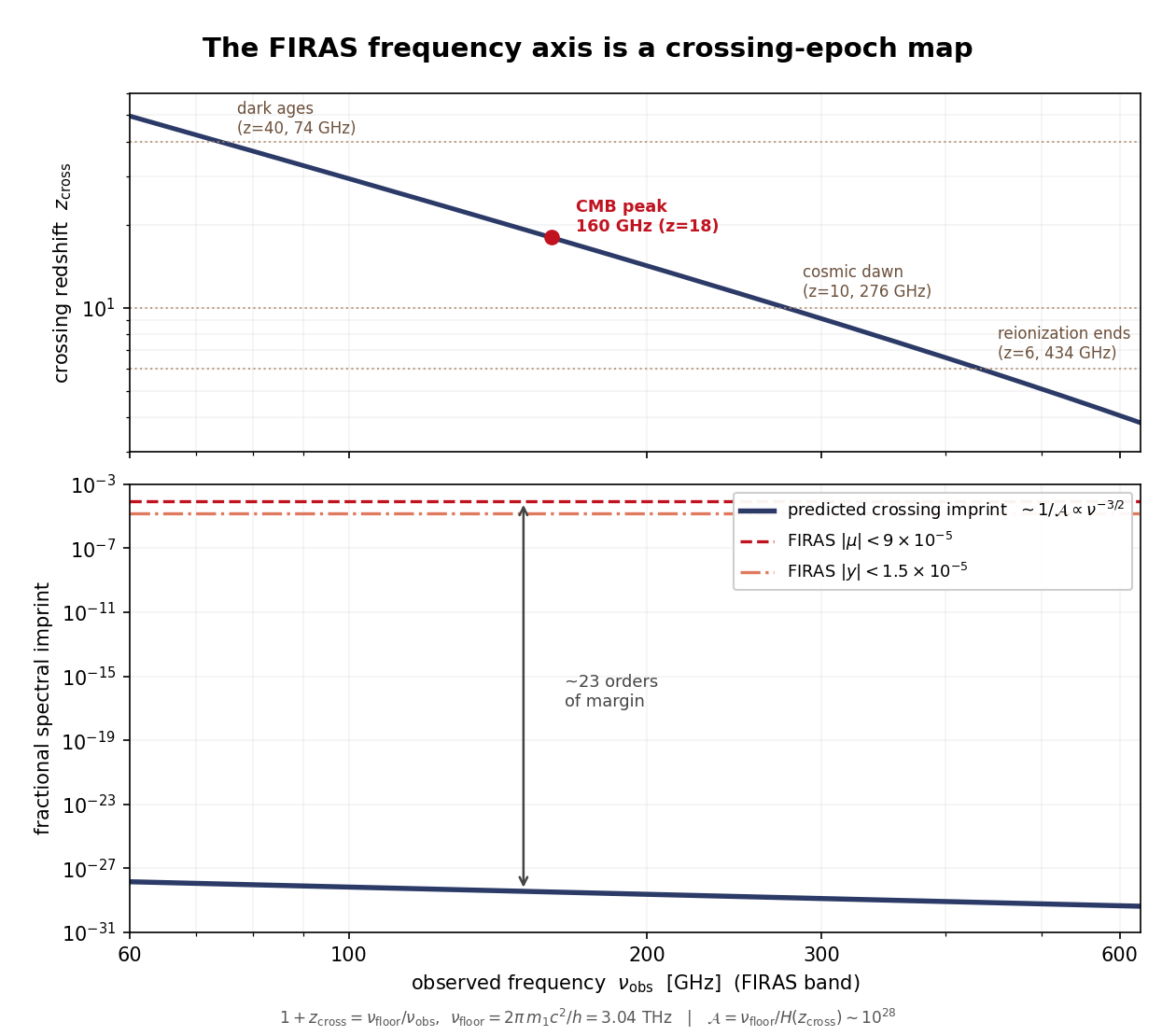
And tested at the crossing, by the CMB. Because the floor sits at a fixed local frequency \nu_\text{floor} = 2\pi\nu_1 \approx 3 THz, and a photon’s local frequency was higher in the past (\nu_\text{local} = \nu_\text{obs}(1+z)), every cosmic-microwave-background photon we see today below 3 THz was a modon at recombination and crossed the floor in flight, at 1+z_\text{cross} = \nu_\text{floor}/\nu_\text{obs}. The COBE/FIRAS frequency axis is thus secretly a crossing-epoch map: 600 GHz photons crossed at z\approx4, 60 GHz photons at z\approx50 — the whole crossing band falls in the clean, late, matter-dominated universe. If the soliton-to-collective conversion at the floor were non-adiabatic it would shake energy loose and scar the blackbody, with an imprint that grows toward low frequency (those photons crossed when the universe expanded faster). But the crossing is adiabatic by an enormous margin: the dispersion relation changes by order unity over a Hubble time while the mode oscillates at the cell scale, giving an adiabaticity \mathcal{A} = \nu_\text{floor}/H(z_\text{cross}) \sim 10^{28}. The resulting fractional distortion is \sim 1/\mathcal{A} \sim 10^{-28}, with the predicted shape \propto \nu^{-3/2} (steepest in FIRAS’s cleanest Rayleigh–Jeans channel) — twenty-three orders of magnitude below FIRAS’s spectral-distortion limits (|\mu| < 9\times10^{-5}, |y| < 1.5\times10^{-5}). So FIRAS’s 50-ppm blackbody, read across crossing-epochs z = 4–50, confirms the band edge is non-dissipative for redshifting light: the floor is transparent both below it (the FRB bound) and at the crossing (this one), from two orthogonal observables. A laboratory probe — crystal-optics band edges, terahertz time-domain spectroscopy — would see the same 3 THz edge as a sharp feature at fixed local frequency; the cosmological redshift smears that sharp edge into the smooth \nu^{-3/2} distortion, which is why a broadband CMB instrument, not a line search, is the right place to look from the sky (calculation in scripts/firas_crossover_adiabaticity.py, sessions/firas-crossover-1.md).
What Carries Light Below the Floor
Both confrontations above leave one question open: if a localized modon needs \lambda \le \xi, what is a radio photon, whose wavelength is meters and whose single-quantum energy h\nu is millions of times below E_\text{min}? It cannot be one modon — it lacks the energy for a single breath. Yet the FRB refit shows it travels at c to a few parts in 10^{16}. The resolution sharpens the modon picture into a falsifiable, mechanism-level statement.
Three excitations meet at the floor. Start from the framework’s own modon dispersion, U_{LR} = -\beta/(p^2 + \kappa_\text{ext}^2) with ground state p = j_{11}/\xi, \kappa_\text{ext} = 1/\xi (Emergent Speed of Light). The exterior decays over the healing length \kappa_\text{ext}^{-1} = \xi — a property of the medium — while the interior oscillates on the core scale a. A localized object needs its core to fit inside its own decay length, a \le \xi; the marginal, largest, lowest-energy modon is a = \xi, which is exactly the floor. There is no localized solution for a > \xi — not by fiat, but because the core and healing scales have collided and scale separation is gone. So below the floor, three things are possible, and the data choose between them:
- A localized modon — ruled out, as just shown: it cannot exist for \lambda > \xi.
- The collective Bogoliubov (sound / gravitational-wave) mode — its group velocity runs above c as a power law, \delta_g = \tfrac{3\pi^2}{2}(\nu/\nu_\text{floor})^2. This is the “+\nu^2” branch the FRB refit was built to detect, and excluded as the carrier of light: at 600 MHz it would give \delta_g = 5.8\times10^{-7}, fifteen orders above the FRB sensitivity floor.
- The delocalized winding — the modon’s conserved circulation quantum, spread over \lambda = c/\nu \gg \xi. This is what survives.
The stretched photon. A sub-floor photon is the modon’s winding let loose from its soliton core and smeared across many cells — a stretched photon. Its speed comes from the circulation quantum over the healing length, c = \kappa_1/2\pi\xi = \hbar/m_1\xi, in which the core size a does not appear. Stretching the winding changes nothing about its speed: there is no leading dispersion, and sub-floor light sits at exactly c for the same reason the modon does — the Volovik identity never mentioned the soliton’s size. The winding is topologically quantized and conserved (Kelvin’s theorem; the emergent U(1) of London electrodynamics), and the sound mode carries no circulation, so the two cannot mix — which is precisely why the FRB refit finds no leakage into the collective branch.
The residual is exponential, not power-law — and that is testable. The winding can disperse or dissipate only by a core-scale reconnection that locally unwinds it, an event costing the full gap energy E_\text{min}. A sub-floor photon carries less than that (h\nu < E_\text{min}), so it can reach the core scale only by tunneling, and the residual deviation is suppressed as \delta_g(\nu) \sim \exp\!\big(-E_\text{min}/h\nu\big) = \exp\!\big(-\nu_\text{floor}/\nu\big). This is the substrate’s exact analogue of BCS / Mattis–Bardeen sub-gap absorption: a photon below the superconducting gap cannot break a Cooper pair, and its residual response is exponentially — not power-law — suppressed. Here E_\text{min} is the gap and a modon-core reconnection is the pair-breaking event. The mathematical payoff is decisive: \exp(-\nu_\text{floor}/\nu) is non-analytic at \nu = 0, so it has no \nu^2 term at all. The collective branch has one; the protected winding does not. Since the FRB observable is the coefficient of \nu^2, the null result does more than confirm “c” — it selects topological protection over a generic emergent photon. A photon that were merely the Goldstone/gauge mode of the condensate would still permit a dimension-six (k\xi)^2 = \nu^2 Lorentz-violating term at order unity; FRB bounds that coefficient at \alpha_6 < 2.4\times10^{-16}, excluding it by fifteen orders. Only a topologically protected winding forbids the term outright.
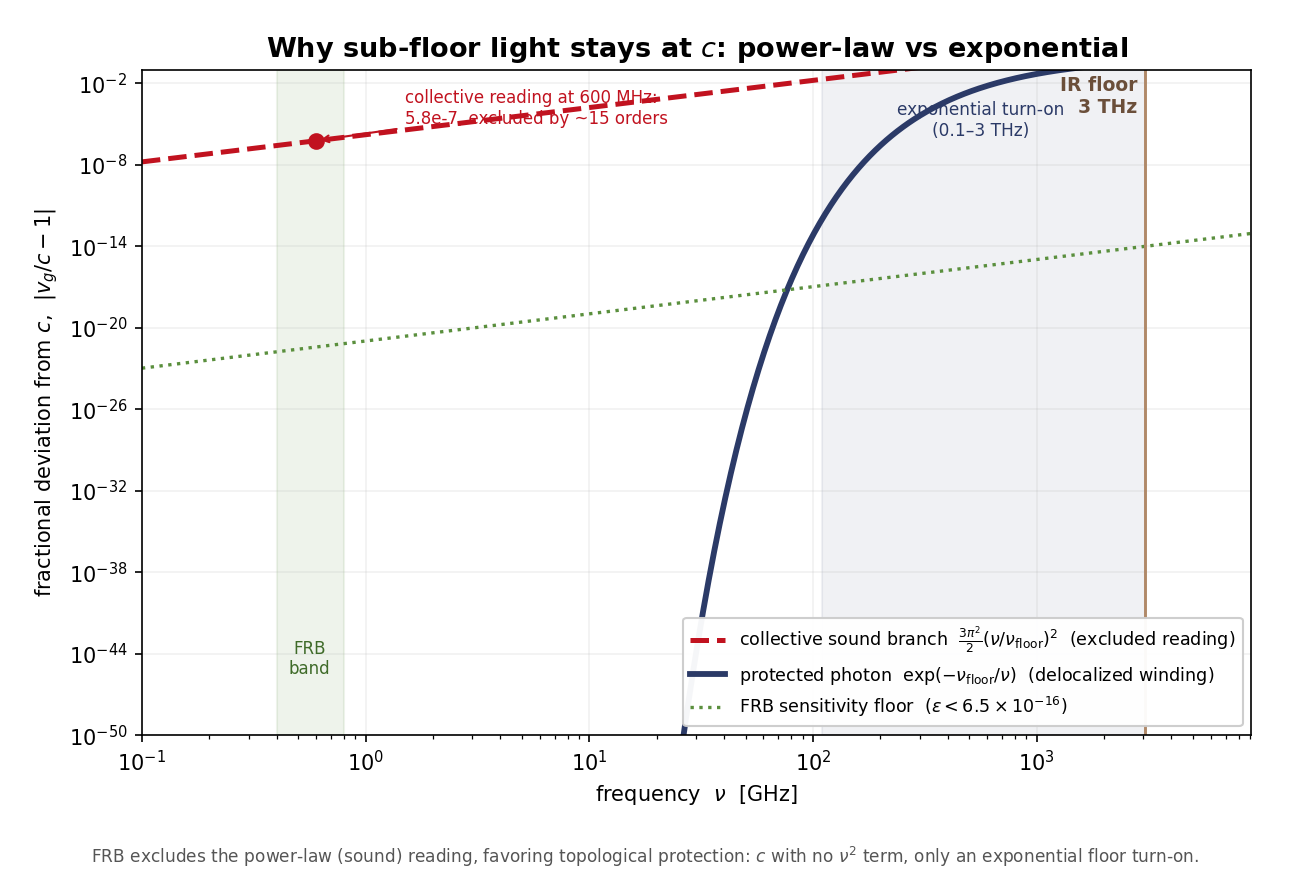
This closes the “radio-photon placement” question with a mechanism, not just a bound: below the floor, light is the modon’s winding stretched thin, held at c by the same topological conservation that quantizes circulation, with anomalous dispersion exponentially locked away until one reaches the floor itself. The three floor probes are then one phenomenon seen three ways — FRB from below (excludes the power law), FIRAS at the crossing (the adiabatic suppression is this protection, caught in flight), and a laboratory terahertz band-edge measurement at the floor. What theory owed here — the modon-core reconnection action that fixes the exponential’s coefficient — has now been computed at barrier level (2026-07-05): the winding-change saddle is a Gross–Pitaevskii phase slip (a black soliton / vortex nucleation), giving \alpha = S_\text{rec}/E_\text{min} \approx 0.2–0.6, an O(1) that confirms the mechanism and places the turn-on in the lower part of the 0.1–3 THz band (the \alpha=1 figures above are illustrative; the computed value shifts the onset toward $$0.1–0.3 THz). See scripts/reconnection_barrier_from_above.py, sessions/reconnection-barrier-phase1.md (and the original derivation in scripts/below_floor_dispersion.py, sessions/below-floor-dispersion-1.md).
Planck’s Constant from Substrate Properties
The quantum of circulation in the substrate is:
\kappa_q = \frac{h}{m_\text{eff}} = \frac{2\pi\hbar}{m_\text{eff}}
where m_\text{eff} = m_e / \alpha_{mf} \approx 1.70 MeV/c^2 is the effective quantum mass — a substrate property, not a particle property. Combined with the Volovik relation c = \hbar/(m_1 \xi) and the condensation number \nu = m_\text{eff}/m_1 \approx 8.3 \times 10^8:
h = m_\text{eff} \cdot \kappa_q = \nu \cdot m_1 \cdot \kappa_q
Planck’s constant is not fundamental — it is the circulation quantum of a superfluid with particle mass m_1 and condensation number \nu. The discreteness of quantum mechanics traces to the discreteness of vortex circulation in the dc1 medium.
The Harmonic Resonance
The two-scale structure produces an exact relationship between the coherence length and the effective Compton wavelength:
\frac{\xi}{\lambda_C(m_\text{eff})} = \frac{\nu}{2\pi}
The coherence length contains exactly \nu/(2\pi) effective Compton wavelengths. This is not a coincidence — it is the resonance condition that allows the outer-scale lattice structure and the inner-scale particle physics to coexist in the same medium. The modon, as the carrier of energy between scales, must satisfy both boundary conditions simultaneously.
The Photon’s Place in the Framework
The photon completes the Foundation section of this framework. Gravity (Gravity as Boundary-Layer Ebbing) is the macroscopic leak current through counter-rotating boundaries. The quantum potential (Two Fluids → Quantum Potential) is the reaction force of those same boundaries on co-rotating flow. And the photon is the solitonic excitation emitted when those boundaries reorganize — a modon that carries energy between orbital systems at the speed set by the medium itself.
All three phenomena arise from the same substrate physics operating at the outer scale \xi \approx 110\;\mum. What happens at the inner scale — where the effective quantum orbits at v_\text{rot,inner} = 0.776\,c with radius r_\text{eff} = 150 fm — is the subject of the next section: how these modons are absorbed and emitted by the layered orbital systems that constitute atoms.