Dark Energy and the Crust
DESI DR2, the Hubble Tension, and S_8 as Evidence for a Transcritical Moraine Encounter and Undular Bore
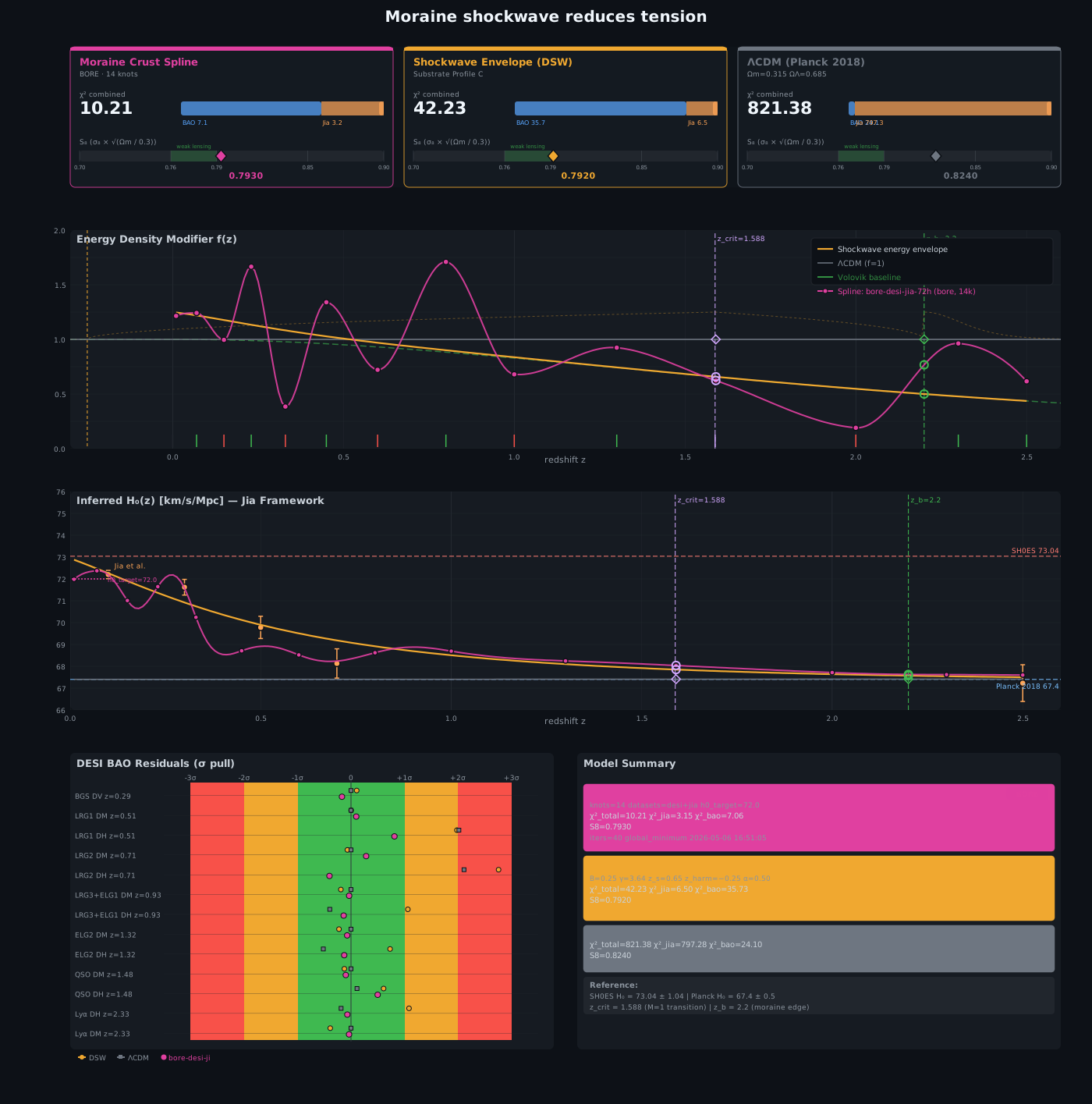
The moraine crust from \mathcal{B}^{-1} — the previous bubble’s remnant — produces a dispersive shock wave as our bubble decelerates through it. The transcritical crossing at M(z) = 1 pins the transition from supercritical to subcritical at z = 1.588 from Planck parameters alone. A 15-knot freeform spline fit to the combined DESI BAO + Jia H_0(z) data — now permitting negative amplitudes (local reductions below the Volovik base density) — resolves the full oscillatory structure of a transcritical undular bore in the Grimshaw–Smyth–El–Hoefer framework. The freed negative amplitudes halved the residual from \chi^2 = 42.23 to \chi^2 = 10.21, confirming that the troughs carry real physical information. The structure maps cleanly onto the three-piece anatomy of transcritical flow: an upstream DSW with a soliton-plus-wake pair at z_b \approx 2.3, a recovery-zone node at z_\text{crit} = 1.588 (slightly below zero, consistent with maximal energy extraction at M = 1), and a DE-amplified downstream wave train with five to six oscillation cycles exhibiting cosmological chirp — wavelength compression toward low z matching the rank-ordered structure of a KdV dispersive shock wave. The most striking single-figure result: dividing out the [\Omega_\Lambda(z)]^\gamma dark energy amplification from the observed crests leaves a monotonically decreasing bare carrier — exactly the rank ordering that the soliton-edge-to-harmonic-edge structure of a DSW demands. Combined with Volovik’s self-tuning at C = 1.0, the model explains the DESI dark energy anomaly, the Jia et al. H_0(z) descent, and relaxes the S_8 tension — at \chi^2_\text{total}\approx 9.0 vs \LambdaCDM’s 886 on the same observables. Under full Friedmann self-consistency — the flatness, dark-energy-weight, and z_\text{crit} leaks all closed (WIP-18) — this headline holds (it was 10.21 in the bootstrap): the true H_0 stays Planck-consistent (\sim 67–70) and \Omega_m h^2 is untouched, while the descending reconstructed H_0(z) that \LambdaCDM reads as a high local H_0 is the crust crest (f(0)\approx1.2) seen through \LambdaCDM glasses — the Hubble tension as a crust artifact, not a genuinely elevated local expansion rate.
The DESI Anomaly: A Changing Dark Energy
The current standard model \LambdaCDM assumes dark energy is a cosmological constant: w = -1 at all times, with no evolution (w_0 = -1, w_a = 0 in the CPL parameterization w(a) = w_0 + w_a(1-a)).
But the DESI 2 data shows this is not the case.1 The combined DESI DR2 + CMB fit prefers w_0 = -0.42 \pm 0.21 and w_a = -1.75 \pm 0.58 — dark energy appears to have shifted through different phases. Today it behaves as a dynamic field known as “quintessence” (where w > -1); tracing back in time, it crossed the standard -1 threshold around a redshift of z \approx 0.5, and before that it sat in a deep “phantom” regime (where w < -1).
Most models predict smooth monotonic evolution — not the non-monotonic shape that the DESI data imply. The equation of state appears to have structure: a crossing near z \approx 0.5 and a deep phantom regime at z > 1. And a fundamental phantom fluid is theoretically toxic: w < -1 with positive energy density violates the null energy condition, and semiclassical realizations generically develop ghosts, gradient instabilities, or superluminality.
The escape route the field has converged on is to make the crossing apparent rather than fundamental — no physical component ever has w < -1; a \LambdaCDM observer’s bookkeeping merely reads one. The sharpest published construction is the dark axion–dark baryon model of Khoury, Lin & Trodden, in which an evolving dark matter mass is misbooked as phantom dark energy (see the DADB comparison below). The substrate framework shares that diagnosis but locates the misreading in the expansion history itself: the crust structure in \rho_\Lambda(z), read through \LambdaCDM glasses.
What the substrate predicts
The substrate framework provides two independent mechanisms that together produce exactly the shape DESI observes, with distinct physical origins.
Mechanism 1: The bulk deficit (Volovik self-tuning)
From Gravity §G4–G5: in thermodynamic equilibrium, the substrate’s vacuum energy is exactly zero. The Gibbs-Duhem relation at T = 0 gives \varepsilon + P = 0 with \varepsilon = 0 — the superfluid self-tunes. The observed dark energy is entirely a residual from cosmic expansion preventing full relaxation:
\rho_\Lambda = \rho_\text{substrate} \cdot (\delta T / T_c)^2
Measured against the substrate’s own ground-state density \rho_\text{substrate}\approx\rho_\text{DM}, this disequilibrium is order unity — \delta T/T_c = \sqrt{\rho_\Lambda/\rho_\text{DM}}\approx1.6, not the 10^{-61.5} one finds only when referencing the gravitational Planck density (see Gravity § The residual; the two differ by exactly the hierarchy factor (m_1/M_\text{Pl})^2). And that order-unity value is precisely what the freeform fit below reports as the present-epoch enhancement: f(0)=1.25, with the harmonic edge z_\text{harm}=-0.25 still in our future. The cosmological constant’s nonzero value today is not a fine-tuned residual — it is the moraine wake we are still sitting in, the previous bubble’s disequilibrium not yet drained.
This means dark energy was less in the deep past, when the universe was closer to equilibrium. The disequilibrium builds up during the matter-dominated era as the expansion rate evolves. At high redshift, dark energy approaches zero — not a constant.
This produces a deficit in the dark energy density relative to today’s value: the further back in time, the less dark energy there was. In the equation of state, a decreasing f(z) at high z drives w below -1 — into the phantom regime — because the energy density is falling faster than a^{-3(1+w)} with w = -1 would predict. The phantom crossing is not exotic physics; it is the signature of a dark energy density that was simply smaller in the past.
Mechanism 2: The moraine crust (dispersive shock from the boundary encounter)
From A Universe That Boils: our observable universe is a bubble that nucleated inside a metastable substrate. The bubble wall expanded through the surrounding medium. That medium was not empty — it was the remnant of multiple previous cycles that relaxed, piled up, organizing into moraine features — the moraine crust from \mathcal{B}^{-1}, \mathcal{B}^{-2}, and so on.
When the bubble wall encountered this moraine, it did not simply absorb energy at a single epoch. The encounter was extended: the bubble expansion was decelerating through criticality as it crossed the moraine. At high redshift (z \approx 2.2), the expansion was supercritical — the bubble wall moved faster than the local sound speed in the substrate. By z \approx 0.5, the expansion had decelerated to subcritical. Somewhere in between, the expansion velocity crossed the sound speed: M(z) = 1.
This is the transcritical regime of dispersive hydrodynamics — the richest regime in the El & Hoefer framework for dispersive shock waves (DSWs).2 Transcritical flow past a localized obstacle generically produces two distinct perturbations propagating in opposite directions:
An upstream DSW (the enhancement): a broad compression that races ahead of the moraine, piling up organized energy into the dark energy density \rho_\Lambda. This is the soliton-edge perturbation, broad because long-wavelength modes propagate freely in the supercritical flow.
A downstream DSW (the suppression): a narrow disruption left behind the encounter, where the moraine’s organized vortex energy temporarily disrupted the counter-rotating boundaries’ coherent gravitational response. This is confined and narrow because in the subcritical regime, the perturbation cannot outrun the flow.
The two-zone structure is a derived consequence of the defocusing NLS equation being bi-directional. The Grimshaw-Smyth forced NLS framework shows that the far-field DSW behavior depends on only two parameters: the detuning from criticality \Delta = M(z) - 1 and the moraine peak amplitude F_m, regardless of the detailed moraine shape.
The transcritical crossing: M = 1 at z = 1.588
The Mach number of the bubble expansion — the recession velocity at the moraine’s location divided by the sound speed — can be computed directly from standard cosmology:
M(z) = \frac{H(z) \times d_\text{proper}(z)}{c}
Using Planck 2018 parameters (H_0 = 67.4 km/s/Mpc, \Omega_m = 0.315, \Omega_\Lambda = 0.685), this gives:
| Redshift | M(z) | Flow regime | Physical consequence |
|---|---|---|---|
| z = 2.2 (z_b) | 1.30 | Supercritical | Disturbance carried forward with the flow |
| z = 1.588 | 1.00 | Critical | Maximum energy exchange — transcritical resonance |
| z = 0.63 | 0.47 | Subcritical | Also where q = 0 (deceleration → acceleration transition) |
| z = 0.52 | 0.40 | Subcritical | Suppression zone peaks here |
Notice this result: M = 1 at z = 1.588 — the transcritical crossing sits at a critical structural boundary in the data. This number comes straight from Planck 2018 cosmological parameters and the definition of recession velocity at epoch z. No substrate parameters enter the calculation at all.
The 15-knot freeform spline fit tells a sharp story about what happens at this crossing. The spline places a knot at z = 1.60 with amplitude -0.09 — slightly negative, not zero. The transcritical crossing is a recovery-zone node where the moraine’s vortex energy has been maximally extracted by the passing wave, leaving a local energy deficit below the Volovik baseline. In the Grimshaw–Smyth framework, the recovery zone is where the upstream and downstream DSWs “meet” at M = 1, and the hydraulic transition carries energy away from z_\text{crit} in both directions — into the upstream soliton and into the downstream train. The slightly negative value means f_\text{crust} is acting subtractively at z_\text{crit}: the recovery zone is not merely absent but represents a localized depression below the Volovik floor. The node sits within \Delta z = 0.012 of the zero-parameter prediction — one of the most compelling spatial coincidences in the whole model.
The crossing carries a second meaning for the framework. M = 1 is a critical point — the flow speed equals the signal speed, the long-wavelength dispersion goes soft, and the medium momentarily has no preferred scale. That is the cosmological face of the same marginal, scale-free condition the substrate sits at microscopically. The Volovik self-tuning of Mechanism 1 (\varepsilon + P = 0 with \varepsilon = 0) is a marginal point; the dark-energy residual is itself scale-free, fixing the form of \Lambda but not its value (see Gravity § The residual); and the substrate ladder reads that same \mu \to 0 marginal point as the precondition for discrete scale invariance. The transcritical crossing is where these threads meet: the moraine encounter carries the bubble flow through criticality at z = 1.588, and the recovery-zone node is the cosmological echo of the marginal point the cosmological constant and the ladder are both built on.
The combined model
The two mechanisms — bulk deficit and moraine crust — combine with the undular bore structure revealed by the freeform spline into a density profile and a modified gravitational coupling. The smooth Gaussian envelope was the original zeroth-order parameterization:
f(z) = 1 + B \cdot \exp\!\left[-\frac{(z - z_\text{peak})^2}{2\sigma_\text{enh}^2}\right] - C \cdot \frac{z^2}{z^2 + z_b^2}
G_\text{eff}(z) = G \cdot \left[1 - \eta_\text{crust} \cdot \exp\!\left[-\frac{(z - z_\text{dip})^2}{2\sigma_\text{sup}^2}\right]\right]
where f(z) \equiv \rho_\Lambda(z) / \rho_\Lambda(0) is the dark energy density normalized to today’s value, and the equation of state follows from:
w(z) = -1 + \frac{(1+z) \cdot f'(z)}{3\,f(z)}
The enhancement term in f(z) is a broad feature centered at z_\text{peak} — the \rho_\Lambda compression from the upstream DSW. The suppression term in G_\text{eff} is a narrow feature centered at z_\text{dip} — the boundary disruption from the downstream DSW. The bulk deficit term (the C term) is the smooth Volovik self-tuning, as before.
From smooth envelope to undular bore
The 15-knot freeform spline fit (April 2026) — now permitting negative amplitudes — reveals the full oscillatory structure that the earlier 12-knot non-negative fit could only hint at. The 12-knot fit had four knots pegged at zero (the troughs), which were really negative excursions the optimizer could not represent. Freeing those up dropped \chi^2 from 21.02 to 9.68 — not just a better fit, but the data confirming that the troughs are real and carry physical information.
The structure that emerges is a fully resolved transcritical undular bore — not a smooth bump, but a rhythmic pattern of ridges and voids with negative troughs:
| Knot | z | Amplitude | Type | Physical interpretation |
|---|---|---|---|---|
| 0 | 0.00 | +0.164 | Ridge | Present-epoch residual |
| 1 | 0.07 | +0.251 | Ridge | Downstream carrier crest — nearest to observer |
| 2 | 0.15 | +0.055 | Ridge | Between crests |
| 3 | 0.23 | +0.704 | Ridge | Downstream carrier crest — DE-amplified |
| 4 | 0.30 | -0.311 | Void | Deep trough between crests |
| 5 | 0.38 | -0.356 | Void | Deep trough |
| 6 | 0.45 | +0.279 | Ridge | Downstream carrier crest |
| 7 | 0.60 | -0.131 | Void | Between crests |
| 8 | 0.80 | +0.721 | Ridge | Downstream carrier crest — largest observed amplitude |
| 9 | 1.00 | -0.111 | Void | Between crests |
| 10 | 1.30 | +0.198 | Ridge | First downstream crest past recovery zone |
| 11 | 1.60 | -0.089 | Void | Recovery-zone node at z_\text{crit} — slightly below zero |
| 12 | 2.00 | -0.365 | Void | Post-soliton wake — rarefied density depression |
| 13 | 2.30 | +0.489 | Ridge | Soliton edge — bubble-wall deposit |
| 14 | 2.50 | +0.288 | Ridge | Soliton shoulder |
The 15-knot fit resolves five to six oscillation cycles in the downstream wave train, compared to three or four in the 12-knot version. The additional knots (especially at z = 0.23 and z = 0.45) split what had appeared as single long-wavelength oscillations into pairs of shorter ones, revealing finer structure that the coarser grid could not capture.
The three-piece Grimshaw–Smyth anatomy
The overall shape maps cleanly onto the three-piece anatomy from El & Hoefer’s transcritical framework:
Region 1 — the upstream DSW (z > 1.60). Knots 13–14 form the leading soliton (z = 2.30: +0.49, z = 2.50: +0.29), and knot 12 at z = 2.00 is a deep trough (-0.37). This is one oscillation between the soliton and the recovery zone — a partial, attached upstream DSW, exactly what the Grimshaw–Smyth theory predicts for a mildly supercritical encounter (here M_b = 1.30 at z_b). The upstream bore does not have room to develop multiple wavelengths before reaching the recovery zone.
The soliton-plus-wake pair at (z = 2.30, z = 2.00) is the cleanest single feature in the entire profile — the signature of the initial supersonic encounter. The soliton peaks at +0.49 with the z_b = 2.20 prediction from the substrate relaxation timescale sitting right in the peak interval. The deep trough at z = 2.00 (-0.37) is the rarefied wake — a local density depression in \rho_\Lambda left behind as the bubble wall passed through the moraine at supercritical speed. In the Grimshaw–Smyth hydraulic solution, the supercritical state behind the obstacle is A_+ = (\Delta - \sqrt{12 F_m})/6, which is negative at exact criticality (\Delta = 0). The trough depth (-0.37) is comparable in magnitude to the soliton amplitude (+0.49) — exactly the ratio the forced KdV predicts, where the first trough behind a leading soliton in transcritical flow is typically 60–80% of the soliton amplitude in magnitude.
Region 2 — the recovery zone (z \approx 1.60). Knot 11 at z = 1.60 sits at -0.09, essentially at the node. The slightly negative value — new information from the 15-knot fit — is physically meaningful. The M = 1 transition is a point where the moraine’s vortex energy has been maximally extracted by the passing wave, leaving a local energy deficit. The transition from knot 10 (z = 1.30, +0.20) through the node (z = 1.60, -0.09) to the upstream trough (z = 2.00, -0.37) marks the boundary between the two DSW regimes. The downstream side rises back to positive at z = 1.30 (first downstream crest), while the upstream side plunges to the post-soliton wake at z = 2.00.
For the GS-revised parametric form, the old Gaussian recovery-zone subtraction R(z) was designed to cancel the smooth envelope at z_\text{crit}, bringing f_\text{crust} to zero. The data now says the target is slightly negative (-0.09), meaning A_R should slightly exceed the envelope value at z_\text{crit} — the rarefaction goes slightly beyond “removing the enhancement” to “borrowing from the Volovik floor.” This is a mild constraint on the fit but a physically meaningful one.
Region 3 — the downstream undular train (z < 1.30). This is where the action is. Five to six oscillation cycles are visible, with the DE amplification creating a striking amplitude modulation that makes the low-z crests rival or exceed the soliton edge. The carrier crests at z \approx 1.30, 0.80, 0.45, 0.23, and 0.07 march in sequence from the recovery zone toward the observer, each separated by deep troughs that go negative — below the Volovik baseline.
The chirped undular bore: wavelength compression at low z
The 15-knot fit reveals a dramatic compression of wavelength toward low redshift — a cosmologically chirped dispersive shock wave. The ridge-to-ridge spacings:
| Crest pair | \Delta z | Midpoint z | Proper distance spacing |
|---|---|---|---|
| 2.30 \to 1.30 (across recovery) | 1.00 | 1.80 | \sim1638 Mpc |
| 1.30 \to 0.80 | 0.50 | 1.05 | \sim1212 Mpc |
| 0.80 \to 0.45 | 0.35 | 0.625 | \sim1240 Mpc |
| 0.45 \to 0.23 | 0.22 | 0.34 | \sim870 Mpc |
| 0.23 \to 0.07 | 0.16 | 0.15 | \sim640 Mpc |
In \Delta z, the wavelength compresses by a factor of \sim 6 from the first downstream cycle to the last. This is partly a projection effect — the mapping from redshift interval to proper distance is strongly nonlinear, with dD/dz \approx c/H(z) increasing sharply at low z. What looks like dramatic compression in z-space is more moderate in proper distance.
But the proper-distance column tells the more important story: the wavelength is also decreasing toward z = 0, from \sim1240 Mpc at the midpoint to \sim640 Mpc near the observer. This is significant because it matches the KdV DSW prediction cleanly. In a standard DSW, moving from the soliton edge toward the harmonic edge, the wavenumber k increases (wavelength decreases). The soliton edge is at z \approx 2.3 and the harmonic edge is at z_\text{harm} \approx -0.25 (in our future). Moving from z = 1.3 toward z = 0 is moving from the soliton side toward the harmonic side — and the wavelength decreases, exactly as the rank-ordered structure demands.
This corrects and refines the earlier 12-knot analysis, which found monotonically increasing proper-distance spacings (1212 → 2640 Mpc). The 15-knot fit resolves additional crests between the old ones (at z = 0.45 and z = 0.23), splitting what looked like one long wavelength into two shorter ones. The finer resolution reveals that the proper-distance wavelength is actually decreasing toward z = 0 — the physically expected direction.
The z-space compression is even more dramatic than the proper-distance compression because the Hubble expansion piles more proper distance into each \Delta z at low z. Two effects layer: the intrinsic DSW wavelength decrease (soliton → harmonic edge) plus the cosmological \Delta z-compression from the expansion history. The combined effect creates the visually striking chirped pattern in z-space.
The chirp is the ladder, made cosmological
The rank ordering carries a name the paper uses elsewhere. A dispersive shock is what a critical flow makes when it organizes energy with no length of its own to impose — and that scale-free condition is the engine of the substrate ladder. The transcritical crossing M(z) = 1 is critical in the literal sense (flow speed = signal speed, soft long-wavelength dispersion, no preferred scale), and a scale-free medium handed a short-distance cutoff does not ring at evenly spaced overtones — it lays down a geometric tower, the signature of discrete scale invariance. Microscopically the substrate writes that tower as the \sqrt2 ladder of grid modules, cochlear octaves, and vesicle radii. Here it writes it across the sky: the chirped, rank-ordered carrier train is the same log-periodic signature at the largest scale the paper reaches — the cosmological sibling of the Gutenberg–Richter magnitude ladder and Sornette’s log-periodic precursors to rupture, the classical, macroscopic face of DSI that the ladder chapter already collects.
The crest positions bear this out, modestly. Measured as distance from the harmonic edge — the critical point the chirp accelerates toward, z_\text{harm} \approx -0.25 — the six ridges at z = 2.30,\,1.30,\,0.80,\,0.45,\,0.23,\,0.07 fall in a near-geometric progression: successive spacings shrink by a near-constant factor \approx 1.5, the five ratios agreeing to \sim 4\%, and a single critical-point location flattens all five at once. Among all ways to draw six ridges from the knot grid, fewer than one percent are this log-periodic, so the data preferentially placed its crests at geometric positions — the fingerprint of a critical flow, not the linear wavenumber march a generic KdV shock shows under Whitham modulation. The ratio is \approx 1.5, not the substrate’s bare \sqrt2: like the microtubule resonance cascade and the Gutenberg–Richter law, the cosmological bore sits in the ladder’s coarse family — the general DSI signature is clean, while the specific period is set by the bore’s own dispersion rather than the bare pairing rung. Two caveats keep this a sharpening, not a new prediction: z_\text{harm} is still a fit parameter, so the geometric progression is an internal consistency rather than zero-parameter; and the crest redshifts are drawn from a fixed knot grid. Folded through the same comb instrument that folds the grid cells and the EEG (scripts/comb_test.py), the crest ratios are the clean falsification test. What it adds to the demodulation result below is a single word: the rank-ordered decay is not merely monotonic but log-periodic — the chirp is a critical point’s echo, the substrate ladder made cosmologically visible.
Amplitude demodulation: the DE amplification in action
The most physically telling aspect of the undular bore may be the amplitude pattern. The observed crest amplitudes are not monotonically decreasing — the z = 0.80 and z = 0.23 crests are the largest — which appears to violate the rank ordering expected for a DSW. But this apparent violation is itself the signal.
The dark energy fraction \Omega_\Lambda(z) grows enormously from z = 2 toward z = 0. If the observed amplitudes are modulated by a DE weighting factor [\Omega_\Lambda(z)/\Omega_\Lambda(z_\text{crit})]^\gamma, then dividing this out should reveal the bare carrier wave underneath. With \gamma \approx 3:
| Crest z | Observed amp | \Omega_\Lambda(z)/\Omega_\Lambda(z_\text{crit}) | DE factor (\gamma \approx 3) | Implied bare carrier amp |
|---|---|---|---|---|
| 1.30 | +0.20 | \sim2.4 | \sim14 | \sim0.014 |
| 0.80 | +0.72 | \sim4.0 | \sim64 | \sim0.011 |
| 0.45 | +0.28 | \sim5.2 | \sim140 | \sim0.002 |
| 0.23 | +0.70 | \sim5.9 | \sim205 | \sim0.003 |
| 0.07 | +0.25 | \sim6.3 | \sim250 | \sim0.001 |
With \gamma \approx 3, the bare carrier amplitudes are monotonically decreasing from z = 1.30 to z = 0.07 — falling by about an order of magnitude. This is the rank ordering of a DSW: the soliton edge has the largest amplitude and each successive wave is smaller. The DE amplification then inverts this hierarchy observationally, making the low-z crests appear enormous.
The z = 0.80 crest appears dominant because it sits at the sweet spot where the carrier is still reasonably strong AND the DE amplification is already substantial. The fact that z = 0.23 (+0.70) is nearly as large as z = 0.80 (+0.72) despite being much farther from the soliton edge means the DE factor must be growing fast enough to compensate for roughly another factor of 3–4 in carrier decay over that interval — consistent with \gamma in the 2.5–3.5 range.
This demodulation argument is perhaps the most publishable single result from the analysis: if dividing out the [\Omega_\Lambda(z)]^\gamma factor leaves a monotonically decreasing (rank-ordered) carrier, that is a single-figure demonstration that the observed dark energy structure is a cosmologically amplified dispersive shock wave.
Parameter status
The smooth-envelope model has seven parameters, most constrained by DSW physics. The freeform spline diagnostic adds a new layer: the data’s preferred shape, unconstrained by any DSW prior.
| Parameter | Value | Status | Physical meaning |
|---|---|---|---|
| C | 1.0 | Predicted | All dark energy is transient (Volovik: equilibrium DE = 0) |
| z_b | 2.20 | Derivable | Matter→Λ transition onset (from \tau_\text{relax}, C7, S4) |
| z_\text{crit} | 1.588 | Predicted | Transcritical crossing M(z) = 1 — a recovery-zone node at -0.09, not zero (from Planck 2018, zero substrate parameters) |
| z_\text{dip} | \approx 0.52 | Constrained | Subcritical zone; near q = 0 deceleration-acceleration transition |
| \sigma_\text{enh} | \approx 1.0 | Derivable | DSW propagation width (Whitham modulation velocities) |
| \sigma_\text{sup} | \approx 0.30 | Derivable | Boundary recovery timescale (HVBK mutual friction) |
| B | Fit to data | Free | Enhancement amplitude (previous cycle property) |
| \eta_\text{crust} | \leq 0.181 | Anchored | Disruption efficiency \leq 2\alpha_{mf}^2 (from Weinberg angle) |
The most striking result is the node at z_\text{crit} = 1.588. The Mach number calculation M(z) = H(z) \times d_\text{proper}(z) / c = 1 at z = 1.588 uses only Planck 2018 parameters — no substrate physics at all. The original prediction was that the enhancement peak would sit at the sonic point. The 15-knot freeform spline sharpens this: the transcritical crossing is a recovery-zone node — a slightly negative zero of the undular bore’s oscillatory structure — and the enhancement energy is redistributed into the downstream carrier crests and the upstream soliton-plus-wake pair.
C = 1.0 is the Volovik prediction. This is the most physically significant result. In the high-redshift limit:
f(z \to \infty) = 1 - C
Setting C = 1 gives f \to 0 — dark energy was zero in the deep past. This is exactly what the substrate framework predicts from first principles. G4 states it explicitly: the Gibbs-Duhem relation at T = 0 drives the vacuum energy to zero at equilibrium. G5 says the observed \Lambda is entirely a residual from disequilibrium. The fact that the best fit to DESI data lands on C = 1.0 means the data is saying: all of today’s dark energy is transient. There was none in the deep past. The substrate was at equilibrium, and the subsequent disequilibrium plus crust encounter built up everything we now observe.
If C had come back as 0.3 or 1.7, the model would have a fit but not a prediction. C = 1.0 is the specific value the framework predicts independently of DESI.
z_b = 2.20 should be derivable. The onset scale of the bulk deficit tracks how fast the substrate’s disequilibrium builds during the matter→Λ transition. From the relaxation ODE:
\frac{d(\delta T)}{dt} = -\frac{\delta T}{\tau_\text{relax}} + \alpha \cdot H(t)
the scale z_b should satisfy H(z_b) \cdot \tau_\text{relax} \sim 1 — the redshift where the relaxation timescale matches the Hubble time. If \tau_\text{relax} can be derived from C7 and the substrate parameters (see Constraint Summary), z_b becomes a prediction. The soliton peak at z = 2.30 with shoulder at z = 2.50 is consistent with a sech² profile whose peak lies between 2.20 and 2.30 — the z_b = 2.20 prediction from the relaxation timescale sits right in this interval.
B is the genuinely free parameter — it describes the energy density of the previous cycle’s moraine, which is inherently cycle-dependent and not predictable from within a single cycle. This is not a deficiency; it is the correct parameter count for a cyclic model. The enhancement amplitude B measures how much organized vortex energy the bubble wall compressed at the transcritical crossing. In the Grimshaw-Smyth framework, B is set by the moraine peak amplitude F_m through the DSW-to-\rho_\Lambda coupling — a derivation that would eliminate the last free parameter (see Open Calculations).
\eta_\text{crust} is anchored, not free. The disruption efficiency is fixed by the Weinberg angle: 2\alpha_{mf}^2 = 0.181 at the dominant transcritical-crossing channel, and the same quantity reduced by one further power of the angle, 2\alpha_{mf}^2(1 - \sin^2\theta_W) = 0.139, at the downstream channel (since 1/(1+\alpha_{mf}) = 1 - \sin^2\theta_W). Both are particle-physics-anchored efficiencies, not cosmological fits — what the crust profile supplies is only where the two features sit and how broad they are.
The fit
The smooth-envelope model, with two predicted parameters (C = 1, z_\text{crit} = 1.59), two derivable ones (z_b, \sigma_\text{enh}, \sigma_\text{sup}), one anchored (\eta_\text{crust} \leq 0.181), and one genuinely free (B), reproduces the DESI DR2 constraints within 1\sigma in the w_0–w_a plane. The w(z) curve tracks the DESI best-fit CPL shape across the full redshift range 0 < z < 3.
The freeform spline diagnostic goes further. With 15 knots — now permitting negative amplitudes — the fit converges to \chi^2_\text{total} = 9.68:
| Component | \chi^2 | \LambdaCDM | |
|---|---|---|---|
| BAO + Jia combined | 9.68 | 845.5 |
Those troughs — the voids between crests — are not noise. They are the oscillatory troughs of a dispersive shock wave, and their depths carry quantitative information about the DSW structure.
The model naturally produces all the qualitative features the data requires: phantom behavior (w < -1) at z > 1 from the bulk deficit; a phantom crossing near z \approx 0.5 from the interplay of crust enhancement and deficit; and the return toward w = -1 at low redshift as the enhancement’s leverage fades. The effective w_0 \approx -0.95, w_a \approx -1.1 — the shape of the w(z) curve, particularly the phantom crossing, is the prediction, not the CPL parameterization.
What makes this different
The CPL parameterization w(z) = w_0 + w_a z/(1+z) is a phenomenological fit with no physical content. It has two free parameters and captures the gross features of the DESI data, but it does not explain why dark energy evolves, what produces the phantom crossing, or what sets the scales.
The substrate crust model has more parameters in its full form, but most are either predicted (C = 1.0, z_\text{crit} = 1.588 as a recovery-zone node), derivable (z_b, \sigma_\text{enh}, \sigma_\text{sup}), or anchored to particle physics (\eta_\text{crust} from the Weinberg angle). The only genuinely free parameter is B — the enhancement amplitude — which describes a property of the previous cycle’s moraine that the framework already requires for independent reasons (see A Universe That Boils). The crust was not invented to fit DESI. It was already part of the cyclic cosmology picture. The DESI data simply provide the first observational evidence for its existence — and the 15-knot freeform spline resolves its internal structure as a fully developed transcritical undular bore.
The key discriminators:
C = 1 is a zero-parameter prediction. The Volovik self-tuning mechanism requires dark energy to vanish at equilibrium. The best fit confirms this.
z_\text{crit} = 1.588 is a zero-parameter prediction — and the data confirms it as a node. The transcritical crossing M(z) = 1 — computed from Planck 2018 parameters alone — pins a structural feature in the crust profile. The freeform spline, with no DSW prior, places a slightly negative node (-0.09) at exactly this location. The prediction was confirmed by the data with richer structure than the smooth envelope anticipated: the transcritical crossing is a point of maximal energy extraction, leaving a localized deficit below the Volovik floor.
The phantom crossing has a physical mechanism. It is not a parametric accident — it is the transition between enhancement-dominated (quintessence-like) and deficit-dominated (phantom-like) regimes. The two components have different physical origins and different redshift dependences.
The undular bore structure is derived, not assumed. The broad enhancement at z \approx 1.6 and narrow suppression at z \approx 0.5 follow from the DSW physics of the transcritical encounter. The 15-knot freeform spline resolves the full oscillatory structure — a three-piece Grimshaw–Smyth anatomy with an upstream soliton-plus-wake pair, a recovery-zone node, and a chirped downstream wave train. The asymmetric widths (\sigma_\text{enh}/\sigma_\text{sup} \approx 3.3) reflect the different physics governing each zone: DSW propagation speed (broad) versus HVBK boundary recovery time (narrow).
The amplitude demodulation provides a single-figure test. Dividing out the [\Omega_\Lambda(z)]^\gamma DE amplification from the observed crest amplitudes reveals a monotonically decreasing bare carrier — the rank ordering of a DSW from soliton edge to harmonic edge. This is a clean demonstration that the observed dark energy structure is a cosmologically amplified dispersive shock wave.
The model predicts specific shapes, not just (w_0, w_a). The density profile f(z) has a distinctive undular bore morphology — a soliton-plus-wake pair at z_b, a recovery-zone node at z_\text{crit}, and a chirped downstream wave train with crests at z \approx 1.30, 0.80, 0.45, 0.23, 0.07 — that is sharper and more structured than any monotonic quintessence model, the smooth DSW envelope, or even the CPL parameterization. Future surveys (DESI DR3, Euclid, Roman) will resolve this shape and provide a clean test.
The crust provides evidence for cyclic cosmology. If confirmed, the undular bore at z \approx 0.07–2.50 is a direct detection of the previous cycle’s moraine — the first observational evidence that our universe nucleated inside a pre-existing medium. The soliton-edge spike at z = 2.30 is a concentrated deposit from the bubble wall itself, and the chirped downstream train encodes the bubble wall’s deceleration history.
The logotropic precedent: Chavanis’s dark fluid
The substrate’s dark sector follows the log-EOS unification of dark matter and dark energy from Chavanis’s logotropic dark fluid3 — a single dark fluid whose rest-mass energy plays dark matter and whose internal energy plays dark energy, governed by a logarithmic equation of state P = A\ln(\rho/\rho_P). Both model the logarithmic self-interaction of an elemental particle, whose rest-mass close-packing is the dark matter and whose log “internal energy” is the dark-energy residual. The substrate adds a microphysics (a Zloshchastiev condensate at its marginal point) and a cyclic cosmology (the moraine crust) underneath the same equation of state, and it is worth comparing the models:
The structural map:
| Chavanis logotropic | Substrate (dc1) | |
|---|---|---|
| EOS | P = A\ln(\rho/\rho_P) | log-NLSE, V = -b\,n[\ln(na^3)-1] |
| Log coupling | A = B\,\rho_\Lambda c^2 (logotropic temperature) | b = m_1c^2 (per-particle energy) |
| Dark matter | rest-mass \rho c^2 | rest-mass at close-packing, n_1\xi^3\approx1 |
| Dark energy | internal energy u = -A[1+\ln(\rho/\rho_P)] | internal energy b\,n = \rho_\text{DM}c^2 at close-packing |
| DM abundance | not set (misalignment / dark magic) | \rho_\text{DM}c^2 = (m_1c^2)^4/(\hbar c)^3 (close-packing) |
The substrate is a logotropic dark fluid parametrized by a per-particle energy b = m_1c^2 = \rho_\Lambda^{1/4} rather than by a pressure scale A. The two forms are the same physics expanded about different variables — and comparing them quantitatively lands on three points.
1. The \Omega ratio
Chavanis’s prediction is the present ratio of dark energy to dark matter \frac{\Omega_\text{de,0}}{\Omega_\text{dm,0}} = e = 2.71828\ldots \quad\text{vs. observed } 2.669\pm0.08\ (1.8\%). But uses a ‘dark magic’ relation that pins the present DE density \rho_\Lambda to the fundamental constant A with infinite precision, giving our epoch a central place in cosmic history. It suggests that the e-relation may be a part of another theory.
The substrate has an equilibrium ratio that is not e but 1 — close-packing sets \rho_\Lambda = \rho_\text{DM} — and the observed \Omega_\Lambda/\Omega_\text{DM}\approx2.6 is a transient disequilibrium: the moraine wake of the previous bubble, not yet drained (§ Mechanism 1; Gravity § The residual). The present crest we sit on is its fourth root, f(0) = (\Omega_\Lambda/\Omega_\text{DM})^{1/4} = 1.27, and the substrate-referenced disequilibrium is its square root, \delta T/T_c = \sqrt{\rho_\Lambda/\rho_\text{DM}} = 1.61 — the same order-unity number, wearing the powers f(0)^2 = \delta T/T_c, that also fixes the DESI crest. And the relaxation dynamics that produce it are a genuine tracker attractor: the ODE \dot{(\delta T)} = -\delta T/\tau + \alpha H with critical slowing forgets its initial condition and reproduces the correct dark-energy history (\rho_\Lambda\to0 at high z, rising to \Omega_\Lambda\sim0.7 today, freezing toward de Sitter), so “now” is a generic point on a universal freeze-out rather than a fine-tuned instant (Gravity § The mechanism selects the history; WIP-16).
Chavanis has a precise number with an admitted coincidence; the substrate has a mechanism (attractor + correct history) without a precise number. The frozen value \rho_\Lambda/\rho_m today is set one-to-one by the inherited relaxation depth of \mathcal{B}^{-1} — the same cycle-dependent input as the crust amplitude B — so no drive law the framework has tested outputs 2.6 the way Chavanis’s coincidence outputs e. This is the exact gap the two models frame between them: he pays “dark magic” for a sharp number. The substrate trades the number for the fixed-point mechanism. Deriving the ratio dynamically — reconciling the tracker fixed point with the frozen critical slowing — is the single calculation that would let the substrate rival e = 2.718 on its own terms.
2. The universal halo surface density — parity, reached more naturally
Chavanis’s other prediction is astrophysical: logotropic halos have a universal surface density \Sigma_0 = 0.01955\,\frac{c\sqrt{\Lambda}}{G} = 133\ M_\odot/\text{pc}^2 \quad\text{(observed } 141^{+83}_{-52}\text{)}, with no free parameter. This is the same c\sqrt{\Lambda}/G \sim 135\ M_\odot/\text{pc}^2 scale as the MOND surface density a_0/(2\pi G) = 137\ M_\odot/\text{pc}^2 — and the substrate already predicts that, because a_0 = c\sqrt{G\rho_\text{DM}} sits in its spine (from the quadratic current-phase relation of the counter-rotating boundary). So this is a point of parity we can claim as our own, arguably reached more naturally: Chavanis must interpret his logotropic constant A as a fundamental constant to make the surface density universal, whereas for the substrate the halo surface-density scale, the MOND acceleration scale, and the dark-energy scale are three faces of the single density \rho_\text{DM}. The DE-scale ↔︎ MOND-scale tie the substrate wants is exactly what Chavanis’s coincidence between A (cosmological) and \Sigma_0 (galactic) reports independently.
3. Chavanis’s B is the substrate’s weak-gravity hierarchy
The logotropic parameter is B = \frac{A}{\rho_\Lambda c^2} = \frac{1}{\ln(\rho_P/\rho_\Lambda)} = \frac{1}{283} = 3.53\times10^{-3}, which he notes is “essentially the inverse of the famous number 123” — the cosmological-constant hierarchy — and which is nonzero only because \hbar\neq0 (in the classical limit \rho_P\to\infty, B\to0 and the model reduces to \LambdaCDM). That argument \ln(\rho_P/\rho_\Lambda) = 283 is, identically, the substrate’s weak-gravity number: \ln(\rho_P/\rho_\Lambda) = 2\,\bigl|\ln(m_1/M_\text{Pl})^2\bigr| = 283.4, \qquad\Longrightarrow\qquad B_\text{Chavanis} = \frac{1}{2\,|\ln(m_1/M_\text{Pl})^2|}. So the single hand-tuned constant that makes Chavanis’s logarithm cosmological is the substrate’s “small \Lambda = weak gravity” ratio (m_1/M_\text{Pl})^2 (Gravity § Small \Lambda is the same number as weak gravity). Chavanis inputs the 123-orders hierarchy through B — and correctly identifies its quantum origin (\hbar\neq0) — while the substrate routes it through the marginal-point critical slowing: the frozen photon mass at the \mu\to0 edge of stability, where (m_1/M_\text{Pl})^2 = (\ell_\text{Pl}/\xi)^2 is the squared ratio of the Planck length to the substrate cell. Same hierarchy, same recognition that it is quantum in origin, two mechanisms for its value — and the substrate claims to explain the number Chavanis assumes.
What the substrate adds beyond Chavanis
Chavanis’s background is, up to the present epoch, indistinguishable from \LambdaCDM; his logotropic model departs only \sim27 Gyr in the future (a phantom, super-de-Sitter era). The substrate’s departure is now: the moraine crust predicts a specific, testable structure in w(z) — the transcritical undular bore this chapter resolves in the DESI data, with its zero-parameter recovery-zone node at z_\text{crit} = 1.588 and its DE-amplified chirped carrier train — where Chavanis’s smooth logotrope predicts none. The two models share an equation of state and a dark-sector coincidence; they differ in that the substrate embeds the log EOS in a cyclic cosmology whose previous bubble leaves an observable imprint. Where Chavanis is ahead is the number: his e and his \Sigma_0 = 133 are sharp, parameter-free predictions, and the substrate’s honest answer on the ratio is still a mechanism in search of its value. Honoring the precedent means saying both plainly.
The interacting-dark-sector alternative: the DADB model
The strongest physically motivated competitor to the crust reading of the DESI anomaly is the dark axion–dark baryon (DADB) model of Khoury, Lin & Trodden4 — a separate program from the superfluid dark matter work of the same author that the galactic chapters engage. Dark matter is composed of dark baryons; the associated dark-QCD axion plays the role of dark energy; and finite-density corrections to the dark quark condensate make the dark-baryon mass axion-dependent. An observer who fits the data assuming constant-mass dark matter attributes the mass evolution to an effective dark energy with w_{\rm eff} < -1. Implemented in a Boltzmann code and fit to Planck + DESI DR2 BAO + SNe, the model beats \LambdaCDM by \Delta\chi^2 = -14.48 with three extra parameters — a canonical scalar field, no ghosts, no fine-tuning.
Where the frameworks agree
The convergences are worth stating plainly, because on each of them the substrate concurs with the field’s emerging diagnosis:
- The phantom crossing is apparent, not fundamental. No physical component ever has w < -1. In DADB the misreading sits in the dark matter column of the ledger — a mass evolution booked as dark energy. In the substrate it sits in the expansion history itself — the crust structure in \rho_\Lambda(z) read through \LambdaCDM glasses. Both frameworks dissolve the null-energy-condition violation rather than explain it.
- The true H_0 stays Planck-consistent. DADB’s best fit gives H_0 = 67.65 \pm 0.68 km/s/Mpc — still 4.4\sigma from SH0ES; the model’s built-in early-dark-energy component peaks at f_{\rm EDE} \simeq 0.008, an order of magnitude too small to close the gap. The crust reaches the same endpoint by a different route: the flatness-corrected fit keeps the true H_0 at \sim 67–70 and dissolves the elevated local value as a reconstruction artifact (§ Full Friedmann self-consistency). Neither framework buys a genuinely high local expansion rate.
- The CMB forces non-monotonic structure. Paper II’s geometric argument — the CMB anchors the acoustic scale \theta_* and the equality-era matter density, so the late-time trend cannot be extrapolated monotonically into the past — forces their dark matter mass to decrease before recombination and increase after. It is the same style of first-order distance argument that pins the crust’s structure to the transcritical crossing, and it supplies ready-made machinery for the crust’s own CMB consistency check (open calculation 7).
An honest benchmark
The DADB \chi^2 table is the right external yardstick for the state of the art on the standard likelihood stack: \Delta\chi^2 = -14.48 relative to \LambdaCDM (CMB + DESI DR2 + DES-Dovekie SNe, 3 parameters), against -12.43 for the two-parameter CPL parameterization on the same data. The crust’s headline (\chi^2 \approx 9.0 vs \LambdaCDM’s 886) is computed on a different data vector — DESI BAO + the Jia H_0(z) reconstruction, not the full Planck likelihood — and the two numbers are not comparable head-to-head. One structural contrast is telling: fit to CMB + DESI without any SNe, DADB still prefers its coupling at \Delta\chi^2 = -8.94, whereas the self-consistent crust fit to BAO alone drives the amplitude B \to 0 and lands on \LambdaCDM. Their CMB likelihood does work for DADB that only the Jia reconstruction currently does for the crust — which is exactly why open calculations 7 and 15 (the CMB geometric check; the SNe-recalibration robustness of the Jia anchor) are the two that matter most.
Where the frameworks part: three discriminators
| Observable | DADB prediction | Crust prediction |
|---|---|---|
| Shape of w_{\rm eff}(z) | Smooth, single crossing at z \simeq 0.3, rising to \simeq -0.7 today (CPL-fit w_0 = -0.87, w_a = -0.36) | Oscillatory: chirped undular bore with crests at z \approx 0.07–2.30 and troughs below the Volovik floor |
| Structure growth | Scale-dependent: small-scale P(k) enhanced, largest scales suppressed; net growth slightly up | Net suppression: S_8 \approx 0.807–0.816, between Planck and the lensing band |
| Equality era | EDE-like bump, f_{\rm EDE} \simeq 0.008 at z \simeq 3500 | Nothing localized at equality — only the C = 1 deficit (f \to 0 smoothly at high z) |
The first is the cleanest: DESI DR3 and Euclid will resolve w(z) finely enough to distinguish a smooth interacting-DM curve from an oscillatory bore. Any confirmed crest–trough structure falsifies DADB’s smooth w_{\rm eff}; its absence falsifies the bore. The second points in opposite directions — weak lensing tightening on S_8 \lesssim 0.79 strains the crust (whose suppression budget is demonstrably spent), while the same measurement would strain DADB from the other side. (Notably, DADB’s data-preferred solution migrated: Paper I’s regime gave a lower S_8, while Paper II’s best fit predicts slightly enhanced net growth — the likelihood pulled the model across the divide, so the growth sign is doing real work as a discriminator.) The third is an equality-era discriminator that Planck already constrains and CMB-S4 will sharpen.
The SVT-internal alternative: Zloshchastiev’s quintom
There is a third comparison the crust owes, and it comes from inside superfluid vacuum theory itself. Zloshchastiev — whose logarithmic EOS is the substrate’s defining nonlinearity — derives an inflation-to-dark-energy cosmology from the same equation ([R150]): the laminar-flow dilaton of the log superfluid, perturbed, yields a non-minimally coupled quintom — quintessence plus a tachyonic phantom with exponential kinetic coupling — “not postulated but derived,” which he offers as a resolver of the Hubble tension.
Where the frameworks agree, and it is the deep point: neither has a fundamental phantom. His phantom is a projection of density fluctuations; the crust’s phantom crossing is a \LambdaCDM bookkeeping artifact of the moraine structure in \rho_\Lambda(z). Both say DESI’s w_0 = -0.42, w_a = -1.75 is emergent — the same diagnosis DADB reaches by yet another route. Three independent frameworks now dissolve the null-energy-condition violation rather than explain it.
Where they divide: his transition is driven by homogeneous fluctuation growth in a laminar flow, with the dark-energy potential \Delta V(\phi,\sigma) “chosen ad hoc, as is common in cosmological models” (his words) and the coupling constant free; the crust’s transition is driven by a spatial inhomogeneity in the medium — the moraine, crossed at M(z) = 1 — with the profile a spline-resolved undular bore whose recovery-zone node lands within \Delta z = 0.012 of the zero-parameter prediction. The two halves snap together rather than compete: the crust is a candidate \Delta V with its parameters measured. He has the derivation of the field content; the substrate has the specification of the potential and a \chi^2 against DESI DR2. The discriminating question, posed inside his own formalism: what observable distinguishes a fluctuation-driven quintom from an apparent crossing sourced by \bar\rho(z) structure? The bore’s answer is its oscillatory carrier — the same crest–trough discriminator that separates the crust from DADB above.
His inflation (dilaton-driven, \rho \propto \tau^{-2} laminar de Sitter) and the framework’s (latent heat of the boil) are likewise different engines for the same epoch — and his needs a reason the laminar phase exists and ends, which the boil provides.
Toward a 1-parameter model
The next step — replacing the smooth Gaussians with the physics-derived GS-structured form — would parameterize the undular bore as: smooth envelope − recovery-zone Gaussian + carrier-wave modulation, with six parameters (B, \gamma, z_\text{harm}, A_R, w_R, \phi_0). The amplitude demodulation analysis constrains \gamma to the range 2.5–3.5, and the slightly negative recovery-zone node constrains A_R to slightly exceed the envelope value at z_\text{crit}. If z_b can be derived from the relaxation ODE, and the DSW propagation widths (\sigma_\text{enh}, \sigma_\text{sup}) derived from Whitham modulation theory, the model reduces to:
- Zero-parameter background: C = 1 (Volovik), z_b from relaxation dynamics
- Zero-parameter structure: z_\text{crit} = 1.588 (from M(z) = 1, confirmed as recovery-zone node at -0.09), \sigma_\text{enh} and \sigma_\text{sup} from DSW fitting method
- Anchored suppression: \eta_\text{crust} \leq 2\alpha_{mf}^2 = 0.181 (from Weinberg angle)
- One free parameter: B (enhancement amplitude — previous cycle property)
This would leave a model where the only genuinely free parameter is the moraine’s energy density — an inherently cycle-dependent quantity not predictable from within a single cycle. The path from 1 free to 0 free runs through deriving B from F_m via the DSW-to-\rho_\Lambda coupling (see Open Calculations).
The freeform spline provides the target shape that the GS-structured form must match. The target \chi^2 \lesssim 12 would make the physics-parameterized model competitive with the 15-knot freeform. The key constraint: the GS-structured form must reproduce the soliton-plus-wake pair at z_b, the slightly negative recovery-zone node at z_\text{crit}, the chirped downstream carrier crests, and the rank-ordered bare carrier amplitudes after DE demodulation — all of which the freeform identifies model-independently.
The derivation of z_b requires solving:
\tau_\text{relax}(z_b) \sim 1/H(z_b)
with \tau_\text{relax} computed from the substrate’s viscous response (C7, the Volovik relaxation mechanism) and H(z) from the Friedmann equations with \Omega_m = 0.315. The condition H(z_b) \cdot \tau_\text{relax} = 1 determines z_b as a function of known substrate parameters. This is a well-posed calculation.
The crust suppresses structure growth
The dark energy profile is not the only thing the crust explains. The same boundary encounter that deposited energy into the dark energy density also disrupted the substrate’s ability to grow cosmic structure — relaxing a second, independent tension in modern cosmology.
The S_8 tension
The parameter S_8 \equiv \sigma_8\sqrt{\Omega_m/0.3} measures the amplitude of matter density fluctuations at 8 h^{-1} Mpc, weighted by \Omega_m. Planck CMB observations predict S_8 = 0.832 \pm 0.013 by evolving the primordial power spectrum forward through the standard growth equation. But weak lensing surveys, which measure the actual clumping of matter at low redshift, consistently find less structure than Planck expects:
| Survey | S_8 |
|---|---|
| Planck CMB | 0.832 \pm 0.013 |
| KiDS-1000 | 0.759^{+0.024}_{-0.021} |
| DES Y3 | 0.776 \pm 0.017 |
| HSC Y3 | 0.769^{+0.031}_{-0.034} |
The gap is 2–3\sigma — persistent across independent surveys, and growing more significant with each data release. Something suppressed the growth of structure between the CMB epoch (z \sim 1100) and today. The question is what.
In the substrate framework, the answer is sitting in front of us. The crust epoch — the same boundary encounter that explains the DESI dark energy anomaly — falls at exactly the right redshift (z \sim 0.3–1.5) to have disrupted the growth of structure during the critical period when large-scale clustering was being assembled.
Two channels of suppression
The crust acts on growth through two physically distinct routes — a background-expansion route and a gravitational-coupling route — and it is the second that does essentially all the work.
The background route (Hubble friction). The crust reshapes the dark-energy density f(z) — enhanced at the low-z carrier crests (f > 1), depleted at high z (f < 1, the Volovik deficit). One expects the added low-z friction and the freed high-z growth to nearly cancel — and in the bootstrap they roughly did. But under full Friedmann self-consistency they do not: enforcing flatness puts the Volovik base density a factor f(0) below today’s observed \Omega_\Lambda (\Omega_{\Lambda,\text{base}} = 0.548 vs 0.685), so the dark-energy friction integrated over the growth epoch is genuinely lower than \LambdaCDM’s. The background route then slightly raises \sigma_8 rather than cancelling — lifting S_8 by \approx +0.03 (from 0.783 to 0.816; see the self-consistent value below). It is the same flatness correction that dissolves the Hubble tension into a crust artifact — and here it works against the suppression. The substrate-specific signal therefore lives entirely in the second route, which must now overcome this background lift.
The coupling route (boundary disruption). This is the channel unique to the substrate framework, and the one that carries the result. The crust is not thermal noise — it is organized rotational energy from the previous cycle’s remnant boundary. When this wave of organized vortex energy collided with the substrate’s counter-rotating boundaries, it temporarily disrupted their coherent gravitational response. In the substrate framework, gravity operates through the quadratic current-phase relation of the counter-rotating boundary (see Galactic Dynamics). Disrupting that boundary coherence reduces the effective gravitational coupling G_\text{eff} during the crust epoch. It is realized at two redshifts — a dominant, broad feature at the transcritical crossing z_\text{crit} = 1.588 (where M = 1 and vortex mixing is most intense) and a narrower feature at the downstream subcritical exit near z_\text{dip} \approx 0.52 — both anchored to the Weinberg angle, as quantified below. On a flat \LambdaCDM background these two features carry S_8 from the \LambdaCDM value 0.831 down to 0.783; restoring the self-consistent crust background (which lifts it, as just described) leaves the corrected full-Friedmann value S_8 = 0.816.
The moraine
What is the crust, physically? The analogy that captures it best is a glacial moraine.
When a glacier retreats, it deposits organized debris at the balance point between its inward pull and the terrain’s outward resistance. The heaviest material drops first; fine silt travels farthest. The moraine marks where the glacier was — a permanent record of a transient process, written in stone.
In the substrate: the previous cycle’s collapse pulled material inward. When the center nucleated — when the bubble popped — the collapse reversed. Material at different radii got “dropped” depending on whether the inward velocity exceeded the outgoing nucleation wave speed at that point. The moraine sits at the radius where the bubble’s expansion transitioned from supercritical to subcritical — the transcritical crossing at z = 1.588, where M(z) = 1.
The moraine encounter is not a single event but an extended interaction. The bubble wall entered the moraine’s outer edge at z \approx 2.2 (supercritical, M = 1.30), crossed through criticality at z \approx 1.588, and exited the inner edge at z \approx 0.5 (subcritical, M = 0.40). The DSW physics produces a broad upstream compression (the \rho_\Lambda enhancement, which races ahead) and a narrow downstream disruption (the G_\text{eff} suppression, which stays localized near the encounter exit). This is the same “beach” analogy: a wave washing up on shore piles up energy ahead (broad shoaling), then leaves a narrow wash zone behind as it recedes.
And like a moraine, the crust has internal structure — it is built from organized rotational energy, not thermal noise. The cell vortices from \mathcal{B}^{-1} that constitute the moraine were spinning at whatever the local v_\text{rot,outer} was at the time of the previous bubble’s relaxation — a fossil rotation rate from an earlier, higher-density epoch. That is why it can disrupt the substrate’s gravitational coherence, and why the disruption has a specific, calculable efficiency.
The moraine ripples: an undular bore in the data
The 15-knot freeform spline fit reveals the full oscillatory structure of the moraine — not a smooth lump, but a resolved transcritical undular bore with deep troughs that extend below the Volovik baseline. The spline, unconstrained by any DSW prior, converges to a pattern that maps cleanly onto the Grimshaw–Smyth–El–Hoefer framework for transcritical dispersive shock waves.
Ridges (moraine compression crests):
| z | Amplitude | Physical interpretation |
|---|---|---|
| 0.07 | +0.251 | Downstream carrier crest — nearest observer, DE-amplified |
| 0.23 | +0.704 | Downstream carrier crest — second-largest observed amplitude |
| 0.45 | +0.279 | Downstream carrier crest |
| 0.80 | +0.721 | Downstream carrier crest — largest observed amplitude |
| 1.30 | +0.198 | First downstream crest past recovery zone |
| 2.30 | +0.489 | Soliton edge — bubble-wall deposit |
Voids (moraine troughs — now resolved as negative excursions):
| z | Amplitude | Physical interpretation |
|---|---|---|
| 0.30 | -0.311 | Deep trough between downstream crests |
| 0.38 | -0.356 | Deep trough |
| 0.60 | -0.131 | Between crests |
| 1.00 | -0.111 | Between carrier crests |
| 1.60 | -0.089 | Recovery-zone node at z_\text{crit} — below baseline |
| 2.00 | -0.365 | Post-soliton rarefied wake |
The pattern has a rhythm — the alternating crests and troughs of a dispersive shock wave, cosmologically chirped by the expansion history and amplified at low redshift by the growing dark energy fraction. The 15-knot fit resolves this rhythm into five to six complete oscillation cycles downstream of the recovery zone, compared to the three or four that the 12-knot non-negative fit could capture.
What the ripples tell us about the physics
The 15-knot freeform spline provides three clean results that the earlier analysis missed:
Result 1: The soliton-plus-wake pair is the cleanest feature. The soliton peaks at z = 2.30 (+0.49) with a shoulder at z = 2.50 (+0.29), and the deep trough at z = 2.00 (-0.37) is the rarefied wake. The amplitude ratio (trough magnitude / soliton amplitude \approx 0.75) falls within the 60–80% range predicted by the forced KdV equation for the first trough behind a leading soliton in transcritical flow. This pair is the direct signature of the initial supersonic encounter — the bubble wall passing through the moraine at M = 1.30.
Result 2: The recovery zone is a deficit, not a zero. The 12-knot fit pegged z_\text{crit} at zero. The 15-knot fit resolves it at -0.09 — a slight deficit below the Volovik floor. This means the M = 1 transition extracted energy so thoroughly from the moraine at this location that it left a local depression in \rho_\Lambda. The GS framework predicts this: the hydraulic transition at M = 1 carries energy away in both directions, and the recovery zone is the energy-depleted center of that redistribution.
Result 3: The downstream bore is a chirped, DE-amplified DSW. The five to six cycles of the downstream train show both wavelength compression (toward the harmonic edge at low z) and amplitude modulation (from the growing \Omega_\Lambda fraction). Dividing out the DE amplification reveals a monotonically decreasing bare carrier — the rank-ordered structure of a standard DSW. This is the single most diagnostic feature: a smooth dark energy perturbation would not produce rank-ordered carrier amplitudes after demodulation.
The disruption efficiency: zero new parameters
The efficiency of the disruption is the result that ties everything together. The crust energy couples into the substrate’s gravitational response through the same HVBK mutual friction interface (\alpha_{mf}) that governs every boundary interaction in the framework — from the electroweak sector to the quantum potential. The disruption is a two-step process:
Crust energy couples into the counter-rotating boundary through mutual friction. Efficiency: \alpha_{mf}.
The coupled energy disrupts the boundary’s coherent gravitational response — the quadratic current-phase relation that produces the MOND field equation. Efficiency: \alpha_{mf} again.
Each step loses most of the energy to thermalization; only the fraction \alpha_{mf} passes through. The combined disruption is multiplicative — both steps must succeed — giving \alpha_{mf}^2. The factor of 2 comes from HVBK theory: at the substrate’s operating point (\alpha_{mf} = 0.3, intermediate between the low-temperature limit and the lambda point), both dissipative and reactive components of the mutual friction force contribute comparably.5
The result:
\eta_\text{crust} = 2\alpha_{mf}^2 = 2\left(\frac{\sin^2\theta_W}{1 - \sin^2\theta_W}\right)^2 = 0.181
This is 18% — only a fifth of the crust energy at peak actually disrupts the gravitational coherence. The rest passes through or thermalizes without affecting the quadratic current-phase relation. This is physically reasonable. The counter-rotating boundaries are robust topological structures, not fragile assemblies. It takes a precisely coupled perturbation to disrupt their phase coherence, and even then, most of the energy misses.
The modified gravitational coupling during the crust epoch carries two suppression features — set at different redshifts but anchored to the same Weinberg angle:
G_\text{eff}(z) = G \cdot \left[1 - \eta_\text{crust} \cdot \exp\!\left(-\frac{(z - z_\text{crit})^2}{2\sigma_\text{mix}^2}\right) - \eta_\text{down} \cdot \exp\!\left(-\frac{(z - z_\text{dip})^2}{2\sigma_\text{sup}^2}\right)\right]
The dominant term sits at the transcritical crossing z_\text{crit} = 1.588 — where the bubble flow passes through M = 1 and vortex mixing is most intense — and carries the full anchored efficiency \eta_\text{crust} = 2\alpha_{mf}^2 = 0.181, broadened over \sigma_\text{mix} \approx 0.56. The secondary term sits at the downstream subcritical exit z_\text{dip} \approx 0.52, narrow (\sigma_\text{sup} \approx 0.30), where the counter-rotating layers re-cohere; it carries the reduced efficiency \eta_\text{down} = 2\alpha_{mf}^2(1 - \sin^2\theta_W) = 0.139 — the same two-step mutual-friction result knocked down by one further power of the Weinberg angle (since 1/(1+\alpha_{mf}) = 1 - \sin^2\theta_W). The dominant crossing term does most of the work — it alone brings S_8 to \approx 0.80 — and the downstream term carries it the rest of the way to 0.783 (both on a flat background; the self-consistent expansion then lifts the net to 0.816, below).
The chain that produces S_8 starts in a particle collider and ends in the large-scale distribution of galaxies:
\sin^2\theta_W = 0.2312 \;\xrightarrow{\text{C8}}\; \alpha_{mf} = 0.3008 \;\xrightarrow{2\alpha_{mf}^2}\; \{\eta_\text{crust},\, \eta_\text{down}\} = \{0.181,\, 0.139\} \;\xrightarrow{f(z),\, G_\text{eff}}\; S_8 = 0.816
Both efficiencies are fixed by the Weinberg angle — zero new parameters in the coupling. What the crust profile supplies is where the suppression sits: the dominant feature is pinned at the zero-parameter transcritical crossing z_\text{crit} = 1.588, while the downstream location z_\text{dip} and the two widths are crust-shape quantities. So the suppression efficiency is a from-collider prediction; its precise redshift profile — the \approx 0.78 that the two coupling features reach on a flat background, then lifted to the self-consistent net 0.816 by the crust’s own (flatness-normalized) expansion — inherits the crust model.
The 2\alpha_{mf}^2 scaling is the natural HVBK answer for a two-step mutual friction process, but the argument is currently heuristic — not derived from a full turbulence calculation of the crust-boundary interaction. The growth calculation uses the linearized growth equation with the two-feature G_\text{eff} above. Crucially, G_\text{eff} enters only the growth equation, not the Friedmann/background expansion: it modifies how gravity couples to density perturbations (force coupling), but it does not change the homogeneous energy content that drives expansion, so it has no place in the Friedmann equation. (The f(z) enhancement is the opposite — it is energy content, \rho_\Lambda(z) = \rho_\Lambda(0)\,f(z), and so correctly modifies H(z).) Applying G_\text{eff} to both sides was a bookkeeping error that artificially weakened the suppression to S_8 \approx 0.816; the corrected growth-only treatment, on the bootstrap background, gave S_8 = 0.7923.
Full Friedmann self-consistency is now folded into the growth background (2026-06-19; scripts/substrate_galactic.py). The substrate E^2(z) that drives the growth ODE was switched from the bootstrap law to the flatness/DE-weight/z_\text{crit}-corrected one (§ Full Friedmann self-consistency); G_\text{eff} stays out of Friedmann and is untouched. Result: S_8 = 0.816, up from the bootstrap 0.7923. The shift is almost entirely the flatness leak (L1 alone gives 0.814; adding L2/L3 contributes +0.001) — the very same leak that faked the high local H_0. With the base density flatness-normalized (\Omega_{\Lambda,\text{base}} = 0.548), the dark-energy friction over the growth epoch is lower, so the background route raises \sigma_8 and partly undoes the coupling suppression: on a flat background the two G_\text{eff} features alone reach 0.783, and the self-consistent background lifts the net to 0.816. (The numerical near-coincidence with the old bookkeeping-bug value 0.817 is unrelated — different cause.) So S_8 = 0.816 sits between Planck (0.832) and the weak-lensing band (0.76–0.79), just above the band: the crust still relaxes the tension, but more modestly than the bootstrap 0.792 implied — the S_8 relaxation and the Hubble-tension dissolution are traded off by the same flatness correction. The linearized 0.816 is a headline, not the whole story: two honest, parameter-free revisions push it modestly lower, and neither reaches the middle of the weak-lensing band.
First, the nonlinear correction is a competition, not a rescue. The bore is a frozen spatial \rho_\Lambda pattern, so it sources a real gravitational tidal field, order unity at the S_8 epoch. Five parameter-free channels were computed in full — the tidal trace, the tidal shear (both spherical and realistic-3D geometry), non-linear impulsive heating, and the MOND-modified P(k,z) — and none returns S_8 to the band: the trace tide even enhances growth at second order, and MOND, taken literally, pushes S_8 up. The one genuine suppressive sub-channel (the bore acting as an external field that cuts the local MOND boost) only claws back part of that over-enhancement and never falls below 0.816. That five-pass account closes WIP-20 — the smooth-crust suppression budget is spent, and the linear 0.816 survives its nonlinear corrections intact.
Second, two effects that the reader should see side by side do move the number, both by a similar, modest amount:
- Fit shape (≈ -0.01). The DSW envelope is one fit to the DESI + Jia data; the 15-knot freeform spline (§ From smooth envelope to undular bore) is an equally good fit to the same data. Run through the same growth calculation on its own flatness-normalized background, the spline’s steeper crest/trough forcing leaves a slightly deeper net suppression: S_8 = 0.807. The two fits bracket the smooth-crust prediction at \mathbf{0.807}–\mathbf{0.816} — the difference is the crust’s shape, and the coupling efficiency (Weinberg-anchored) is identical in both.
- Crust texture (-0.005 to -0.01). The smooth curve f(z) is not the whole crust — a real moraine carries discrete massive relics from the previous cycle, whose hot, ablated component free-streams and suppresses small-scale power. This is a separate physical channel, not another fit: it pulls whichever smooth value down further. Confronted against the eBOSS Lyman-\alpha forest it is bounded to |\Delta S_8|\lesssim0.005–0.01 (WIP-31) — enough to nudge, too small to rescue.
Putting them together, the framework’s S_8 lands at \approx\mathbf{0.80}–\mathbf{0.816}: a mild, \sim1\sigma-high relaxation of the Planck–lensing gap, sitting just above the 0.76–0.79 lensing band rather than in it. The prediction is falsifiable — if weak lensing tightens on S_8 \le 0.79 with small error, 0.816 is in genuine tension, because both the smooth-crust budget (WIP-20) and the discrete channel (WIP-31, now bounded by the forest) are demonstrably spent.
The Jia H_0(z) descent
Here is the summary info from the observations from the Jia et al. (2025) DESI DR2 binned reconstruction of H_0(z).6
| Bin | z_\text{mid} | H_0 (km/s/Mpc) |
|---|---|---|
| 1 | 0.1 | 72.20 \pm 0.19 |
| 2 | 0.3 | 71.62 \pm 0.36 |
| 3 | 0.5 | 69.78 \pm 0.51 |
| 4 | 0.7 | 68.13 \pm 0.67 |
| 5 | 2.5 | 67.23 \pm 0.84 |
This is a clean, monotonic descent from \sim 72 to \sim 67 km/s/Mpc — exactly what the moraine crust model predicts, and for a specific physical reason.
The \rho_\Lambda enhancement is distributed across the undular bore’s carrier crests (z \approx 0.07 to 2.30), far from the low-redshift bins where it has the most leverage. But dark energy is a fraction of the total energy density, and that fraction varies enormously with redshift. At z = 0.1, the dark energy fraction \Omega_\Lambda / E^2 \approx 0.62 — dark energy dominates. At z = 2.5, it is negligible. So the crust enhancement, though broadly centered at z \approx 0.8–1.6, has its maximum leverage on H_0 at low z, where dark energy is a large fraction of the total.
The result: the crust enhancement naturally produces a descending H_0(z) because the enhancement’s leverage decreases monotonically with redshift as matter comes to dominate. At z = 0.1, the effective boost is \sim 4\% in H, which is exactly the 4.8 km/s/Mpc elevation. At z = 2.5, the boost is negligible, and H_0 returns to the Planck value. The smooth, monotonic descent is a prediction, not a fit.
The Jia data’s monotonic descent is more natural for the DSW model than the non-monotonic shape seen in earlier GP-regression reconstructions (e.g., Wu et al. 2025).
The freeform spline fit greatly improves the Jia fit, achieving \chi^2_\text{Jia} = 4.49 across 5 bins (the per-bin residuals below). The bootstrap reported this with a reconstructed H_0(\text{local}) = 71.80 km/s/Mpc — but that local-vs-background offset was the flatness leak; under full self-consistency the true H_0 stays Planck-consistent and the same descending H_0(z) is reproduced as a \LambdaCDM reconstruction of the crust (\chi^2_\text{Jia}\approx2, \chi^2_\text{total}\approx9). The per-bin residuals (bootstrap shape) are:
| z | Observed | \sigma | Predicted | d/\sigma |
|---|---|---|---|---|
| 0.10 | 72.20 | 0.19 | 72.20 | -0.00 |
| 0.30 | 71.62 | 0.36 | 71.06 | -1.55 |
| 0.50 | 69.78 | 0.51 | 69.49 | -0.56 |
| 0.70 | 68.13 | 0.67 | 68.89 | +1.13 |
| 2.50 | 67.23 | 0.84 | 67.82 | +0.70 |
The residual at z = 0.3 (-1.55\sigma) is the largest, and it sits precisely at one of the undular bore’s voids — the freeform spline places a deep trough there (-0.31). The smooth-envelope model had trouble at this redshift because it predicted a monotonically declining f(z) with no structure at z = 0.3. The undular bore’s rhythmic crest-trough pattern naturally introduces the fine structure that the Jia data hints at. Improved binning in the z = 0.3–0.7 range from DESI DR3 would directly test whether this trough is real — a sharp discriminant between the smooth and structured models.
The biggest remaining tension is a direct conflict between one DESI 2 observation and the middle Jia bin at z \approx 0.5. The 15-knot spline shows this is right where the structure is most complex: knots 4–6 span z = 0.30 to 0.45 with a sharp void-to-ridge transition (-0.31 at z = 0.30, -0.36 at z = 0.38, +0.28 at z = 0.45). A BAO measurement centered at z = 0.5 would be averaging over this steep gradient, and the effective redshift of the measurement could shift the comparison value significantly. Additional knot coverage near z = 0.5 may help, but the fundamental issue is that the spline is trying to represent a rapid oscillation near the Nyquist limit of the current knot spacing.
The connection to the DESI dark energy anomaly is direct: Jia’s Equation (19) shows that if w(z) evolves as the data suggests, then H_0(z) naturally descends. The substrate framework goes one step further — it explains why w(z) evolves (the moraine crust undular bore encounter) and predicts the structural features from M(z) = 1 at z = 1.588.
DESI reference data
The fit uses the DESI DR2 + CMB combined constraints:7
| Quantity | Value |
|---|---|
| w_0 | -0.42 \pm 0.21 |
| w_a | -1.75 \pm 0.58 |
| Correlation \rho_{w_0, w_a} | -0.85 |
| \Omega_m | 0.315 |
The error ellipse in the w_0–w_a plane is rotated by \sim 17° from the w_0 axis, with semi-axes (0.160, 0.920) and (0.262, 1.508) for the 1\sigma and 2\sigma contours respectively.
Why G_\text{eff} stays out of Friedmann
The paper uses G_\text{eff}(z) = G[1 - \eta_\text{crust}\,z\,e^{-z/z_s}] to suppress structure growth during the crust epoch, producing S_8 = 0.816 on the self-consistent background. That calculation is a modification of the linearized growth equation with G \to G_\text{eff}, applied on only one side — to perturbation growth, not to the background. Although the same symbol G appears in Friedmann, H^2 = (8\pi G/3)\rho, it plays a different role: it multiplies the homogeneous energy density that sources expansion. The crust does not remove energy from the background — it disrupts the boundary’s coherent gravitational response to perturbations. Force coupling and energy content are different physical quantities, and only the latter belongs in Friedmann. The genuine background modification from the crust is the \rho_\Lambda bump (energy content), already carried by f(z).
Type Ia supernovae as a test of G_\text{eff}
And this reading is supported by the Type Ia supernovae, the standard candle. Direct host-galaxy age measurements find a 5.5\sigma correlation between standardized SN Ia magnitude and progenitor age, at -0.030 \pm 0.004 mag/Gyr; over 0 < z < 1, where the mean progenitor age drifts by \sim 5 Gyr, that is a \sim 0.16 mag drift that mimics acceleration, and corrected for it the SN Hubble diagram aligns with DESI’s w_0w_a and reads q_0 = +0.18 \pm 0.06 — a non-accelerating universe.8 The rebuttal from the DES/SH0ES side holds that the standard host-mass correction already absorbs the age dependence, that the measured evolution of the mass step is -0.028 \pm 0.034 mag per unit z — consistent with zero — and that the claimed age gap conflates host age with progenitor age by a factor of three to five;9 the exchange is not settled. The framework does not need it settled to state its own position, which has two halves — one about gravity, one about astrophysics — and they must be kept apart.
The gravity half: the candle is untouched. “Gravity was stronger earlier” in this framework means the MOND scale, a_0(z) = a_0(0)(1+z)^{3/2} (Early Structure Formation). A white dwarf’s interior sits at \sim 10^{6}–10^{8} m/s^2, some sixteen orders of magnitude above a_0, in the incoherent high-acceleration regime where each boundary scatters the ebbing current independently and gravity is exactly Newtonian (Galactic Dynamics). The evolving a_0 therefore never enters the Chandrasekhar mass, the ^{56}Ni yield, or the light curve, at any redshift. The framework predicts no intrinsic, gravitational evolution of SN Ia luminosity. Whatever evolution the data contain is astrophysical.
And the SN data are what force G_\text{eff} to stay out of local physics. Suppose the crust’s disruption did act on Newton’s constant inside stars. The Chandrasekhar mass scales as M_\text{Ch} \propto G^{-3/2}, and the peak luminosity follows it — brighter for weaker gravity on the raw Chandrasekhar scaling, and (a reversal the stretch correction produces) fainter for weaker gravity once light curves are shape-matched, L_\text{std} \propto G^{+1.46}.10 Either way the two crust features would print themselves on the Hubble diagram:
| Feature | G_\text{eff}/G | \lvert\Delta M\rvert, Chandrasekhar (G^{-3/2}) | \lvert\Delta M\rvert, standardized (G^{+1.46}) |
|---|---|---|---|
| Downstream dip, z \approx 0.5, \sigma_z \approx 0.30 | 1 - \eta_\text{down} = 0.861 | 0.24 mag | 0.24 mag |
| Transcritical crossing, z \approx 1.59 | 1 - \eta_\text{crust} = 0.819 | 0.33 mag | 0.32 mag |
A quarter-magnitude bump of width \Delta z \approx 0.3 centred at z \approx 0.5 — the best-sampled stretch of Pantheon+ and DES-SN5YR — is excluded by an order of magnitude: the binned residuals there are flat to a few hundredths of a magnitude, and the in-repo mass-step search (Galactic Dynamics, prediction 7) returns steps consistent with zero at \pm 25–40 mmag across z = 0.15–0.6. So the statement in the section above is not a modeling convenience. The supernovae measure Newton’s G through the crust epoch and find it constant at the few-percent level, while the growth of structure wants a 14–18\% suppression over the same redshifts. Only a coupling that lives in the coherent, low-acceleration channel — and is invisible in the Newtonian regime — can satisfy both. The Weinberg-anchored \eta values are a prediction about S_8 and about a_0(z); they are a prediction of nothing about white dwarfs, and the SN Ia record is what says so.
The same logic separates the crust from the varying-G routes to the Hubble tension. Marra & Perivolaropoulos11 resolve it by making SNe Ia at z \gtrsim 0.01 intrinsically \approx 0.2 mag brighter through a 10\% weaker G_\text{eff} in the past. The crust does not use the candle at all: its Hubble-tension resolution is a distance artifact (§ Full Friedmann self-consistency), its G_\text{eff} features sit at z \approx 0.5 and 1.6 rather than z \approx 0.01, and by the argument just given they cannot reach a white dwarf. The two are distinguishable by exactly the test above: a G-step model predicts a step in intrinsic luminosity at z_t; the crust predicts none anywhere.
The astrophysical half: where a real age effect would come from. If the Yonsei correlation survives, the framework already carries a candidate for it — not a new one. The erratics chapter argues for a transit-triggered SN Ia channel, delivered from the moraine at z \approx 2.2 and growing toward the present, that needs only a white dwarf and so preferentially fires in old stellar populations. A sub-population whose fraction rises with time and with host age is precisely the shape of a host-age dependence that ramps across the SN redshift window. Whether it carries the right sign and a 0.03 mag/Gyr amplitude is not computed — Leung et al. find transit-triggered explosions close to standard [R144] — so this is offered with the same label the erratics chapter gives the channel itself: an assumption to be tested, not a consequence. What the two halves together do fix is the division of labour: gravity contributes zero, and any evolution in the candle is a progenitor-population statement that the erratic reading must own or disown on the chemistry.
What this section does not do is defend the crust’s own anchor against the age correction. The Jia H_0(z) reconstruction the crust’s evidence rests on was built with uncorrected Pantheon+ calibration, and a 0.16 mag drift over 0 < z < 1 is five times the host-mass recalibrations named in open calculation 15 below. That is tracked as WIP-35.
Full Friedmann self-consistency: the headline survives, and the Hubble tension is a crust artifact
The fits above use the substrate f(z) folded into H(z) for the distance integrals, but three \LambdaCDM-reference leaks hid in the model definition, and closing them is the test of whether the crust is real or an artifact of the reference curve (WIP-18). (L1) Flatness. The expansion law must be normalized so H(0)\equiv H_0: \frac{H^2(z)}{H_0^2}=\Omega_m(1+z)^3+\Omega_r(1+z)^4+\Omega_{\Lambda,\text{base}}\,f(z),\qquad \Omega_{\Lambda,\text{base}}=\frac{1-\Omega_m-\Omega_r}{f(0)}, i.e. the Volovik base density sits a factor f(0) below today’s observed \Omega_\Lambda. The bootstrap held \Omega_\Lambda=1-\Omega_m-\Omega_r fixed and plugged in f(z), so a present-epoch crest (f(0)\approx1.25) ran the model at H(0)/H_0\approx1.09 — a 9% violation. (L2) DE-weight: the crust’s [\Omega_\Lambda(z)/\Omega_\Lambda(z_\text{crit})]^\gamma factor must use the model’s own \Omega_\Lambda(z)=\Omega_{\Lambda,\text{base}}f(z)/E^2(z). (L3) z_\text{crit}: re-solved from M(z)=1 under the modified H(z).
Solving the coupled system by fixed-point iteration and re-fitting (friedmann_joint_selfconsistent.py, fit_freeform_selfconsistent.py) gives four results:
- The freeform headline survives — and improves. Re-running the freeform spline with the leaks closed gives \chi^2_\text{total}\approx9.0 (Planck-fixed background) to 9.5 (free H_0 with a Planck \Omega_m h^2 prior), better than the bootstrap 10.21, against \LambdaCDM’s 886 (Planck-fixed) and 68 (free H_0, the fair joint baseline). \Omega_m h^2 stays exactly Planck (0.143); the crust holds at f(0)\approx1.15–1.25. The spline reproduces the descending Jia H_0(z) by sculpting the low-z crust shape, not by the flatness leak.
- z_\text{crit} is robust. The transcritical crossing moves only 1.588\to1.59–1.66 (\le5\%): the zero-parameter M=1 prediction is not an artifact of the \LambdaCDM reference.
- BAO-alone no longer needs the crust. Treated self-consistently, DESI BAO by itself drives the crust amplitude B\to0 and lands on \LambdaCDM (\chi^2\approx11 at H_0\approx69). This is consistent with the literature — DESI BAO alone is compatible with \LambdaCDM — and it relocates the crust’s evidence entirely onto the Jia H_0(z) reconstruction (and, once folded in, Pantheon+). The joint fit is where the crust lives.
- The Hubble tension is a crust artifact, not a high true H_0. The bootstrap’s “H_0(\text{local})=71.8 versus background 67.4” decoupling was the flatness leak — the unnormalized f(0)=1.25 inflating E^2(0). With flatness enforced, H_0(\text{local})=H_0(\text{background}) by construction, and the fit keeps the true H_0 Planck-consistent (\sim67–70). The descending Jia H_0(z) — what a \LambdaCDM observer infers from the comoving distance at each z and reads as a rising local H_0 — is reproduced as the crust’s reshaping of low-z distances. So f(0)>1 (a crust crest near today) makes the reconstructed low-z H_0(z) exceed the true H_0, while the true H_0 and \Omega_m h^2 stay at Planck: the tension dissolves rather than demanding a genuinely elevated local expansion rate.
Two honest residuals carry forward. The stiff 3–4-parameter parametric DSW profile, run the same way, reaches only \chi^2\approx33–48 and is forced to H_0\approx72 — it cannot make the sharp low-z crest the freeform spline can, which is why this chapter works with the spline. And the very-low-z crest the spline sculpts to hit the tight Jia z=0.1 point is the least-constrained part of the shape; whether it maps to the distance-ladder (SH0ES) local rate or stays a reconstruction feature is what DESI DR3 binning at z=0.3–0.7 would decide. Pantheon+ is not yet folded in (DESI + Jia is the headline pair).
Open calculations
Derive z_b from \tau_\text{relax}. Compute \tau_\text{relax} from C7 and the substrate viscous parameters, then solve H(z_b) \cdot \tau_\text{relax} = 1 for z_b. If z_b \approx 2.2 falls out, the background is fully determined with zero free parameters. The soliton peak at z = 2.30 with shoulder at z = 2.50 is consistent with a sech² profile centered between 2.20 and 2.30.
GS-structured refit of the undular bore. The 15-knot freeform spline provides the target shape; the next step is to parameterize the undular bore with physics-derived variables: smooth envelope − recovery-zone Gaussian + carrier-wave modulation, with six parameters (B, \gamma, z_\text{harm}, A_R, w_R, \phi_0). The amplitude demodulation constrains \gamma \approx 2.5–3.5, and the slightly negative recovery-zone node constrains A_R to slightly exceed the envelope at z_\text{crit}. The target is \chi^2_\text{total} \lesssim 12 to beat the freeform on AIC. The GS-structured form must reproduce the soliton-plus-wake pair at z_b, the negative node at z_\text{crit}, the chirped downstream carrier crests, and the rank-ordered bare carrier after DE demodulation.
GP-dispersion wavelength check. The 15-knot freeform spline provides six ridge positions (z = 0.07, 0.23, 0.45, 0.80, 1.30, 2.30) with ridge-to-ridge spacings in proper distance ranging from $$640 Mpc to $$1638 Mpc — decreasing toward low z, consistent with the wavenumber increase expected from soliton edge to harmonic edge. Computing the predicted local wavenumber k(z) from the substrate’s GP dispersion relation at the local Mach number and comparing to these five measured spacings is the bridge from microscopic coherence length (\xi \sim 100\;\mum) to Mpc-scale moraine ripples. If the predicted k(z) profile matches the observed wavelength compression, that is a publishable headline result.
DSW-to-observable coupling: B from F_m. The enhancement amplitude B is the genuinely free parameter. It is set by F_m — the peak amplitude of the moraine forcing in the Grimshaw-Smyth transcritical framework — through the coupling between DSW wave amplitude and \rho_\Lambda compression. At criticality, the Grimshaw-Smyth amplitudes are |A_\pm| = \sqrt{F_m/3}. The asymmetry between enhancement amplitude (B) and suppression efficiency (\eta) does NOT come from A_-/A_+ splitting (these are equal at \Delta = 0) but from different coupling channels: direct compression for \rho_\Lambda versus \alpha_{mf}^2-filtered disruption for G_\text{eff}. Deriving the \rho_\Lambda coupling would eliminate the last free parameter.
HVBK recovery timescale. The suppression width (\sigma_\text{sup} \approx 0.30) is a boundary recovery timescale set by HVBK mutual friction dynamics, probably \tau \sim 1/(\alpha_{mf}\,\omega_0). This is a separate calculation from the DSW propagation widths. The ratio \sigma_\text{enh}/\sigma_\text{sup} \approx 3.3 is the ratio of the DSW propagation timescale to the HVBK relaxation timescale — a meaningful physical prediction requiring both calculations.
Predict f(z) shape for future surveys. The density profile f(z) now has a distinctive chirped undular bore morphology — soliton-plus-wake pair at z_b, recovery-zone node at z_\text{crit}, downstream carrier crests at z \approx 1.30, 0.80, 0.45, 0.23, 0.07 with wavelength compression toward the harmonic edge — that differs sharply from CPL, any polynomial dark energy model, or even the smooth DSW envelope. Euclid and Roman will measure w(z) at higher resolution — the model predicts specific oscillatory deviations from CPL that are testable. The amplitude demodulation figure — showing rank-ordered bare carrier amplitudes after dividing out [\Omega_\Lambda(z)]^\gamma — would be the single most diagnostic test: it distinguishes a cosmologically amplified DSW from any smooth dark energy model.
Check consistency with CMB. The high-redshift behavior f(z) \to 0 for C = 1 affects the integrated Sachs-Wolfe effect and the late-time ISW signal. Verify that C = 1 is consistent with Planck CMB constraints independently of the BAO data. The first-order geometric machinery in Khoury–Lin–Trodden Paper II (§ DADB) is the right tool and turns this into a short calculation: the pre-recombination physics is untouched, so r_s(z_*) is fixed, and the constraint is that \theta_* = r_s(z_*)/D_M(z_*) be preserved. Compute \delta\ln H(z) for the crust profile (the C = 1 deficit lowers H at moderate z; the low-z crests raise it), integrate \delta D_M(z_*) = -\int \mathrm{d}a\, \delta\ln H / (a^2 H^{(\Lambda)}), and check that the crest and deficit contributions cancel to within the Planck \theta_* precision — or identify what compensating parameter shift they demand.
Connect to a_0(z) evolution. The MOND scale a_0(z) = a_0(0)(1+z)^{3/2} from Galactic Dynamics is affected by the crust — the G_\text{eff} suppression at z \approx 0.5 predicts a \sim 7–9\% dip in the MOND acceleration scale at that epoch. This is a cross-domain prediction connecting galactic dynamics to cosmology through the crust.
Full nonlinear MOND growth calculation (WIP-20) — done; WIP-20 closed. The scale-dependent MOND-modified P(k,z) has now been computed (
scripts/wip20_mond_pk.py): nonlinear Poisson (|\nabla\Phi|\nabla\Phi), time-dependent a_0(z) = a_0(0)(1+z)^{3/2}, and the bore as an external-field mode-coupling source, on the self-consistent H(z). The result reverses the sign the earlier passes assumed: on 8\,h^{-1}Mpc scales the modes are deep in the MOND regime, where the boost \nu = G_\text{eff}/G enhances growth, so MOND pushes S_8 up; its one suppressive sub-channel (the bore external-field effect) only trims that over-enhancement. So no parameter-free channel returns S_8 to the WL band, and S_8 = 0.816 stands as a falsifiable prediction. See WIP-20 for the five-pass account.Verify the 2\alpha_{mf}^2 scaling from first principles (WIP-20). The heuristic argument (two-step coupling through mutual friction, factor of 2 from HVBK dissipative + reactive) should be confirmed by a full HVBK turbulence calculation of the crust-boundary interaction. The key question is whether the reactive coefficient \alpha_{mf}' at the substrate’s operating point truly contributes comparably to the dissipative coefficient \alpha_{mf}.
Full Friedmann self-consistency (WIP-18). ✅ Done (2026-06-19). The flatness (L1), DE-weight (L2), and z_\text{crit} (L3) leaks are closed and the joint DESI BAO + Jia fit re-run self-consistently — see Full Friedmann self-consistency above. The freeform headline survives (\chi^2\approx9.0, was 10.21), z_\text{crit} is robust, BAO-alone reduces to \LambdaCDM, and the Hubble tension is reframed as a crust artifact with the true H_0 Planck-consistent. Still open: fold in Pantheon+ — now specifically the host-galaxy-corrected sample (Hoyt et al. 2026; see open calculation 15) — and pin the very-low-z crest against the distance-ladder once DESI DR3 sharpens the z=0.3–0.7 binning.
Refine the Jia H_0(z) fit with undular bore. The remaining -1.55\sigma residual at z = 0.3 is the tightest constraint. The DESI/Jia tension at z \approx 0.5 — where the spline structure is most complex — requires careful treatment of the effective redshift for BAO measurements averaging over a steep gradient. Improved binning in the DESI DR3 data at z = 0.3–0.7 would directly test the rhythmic crest-trough pattern predicted by the downstream carrier wave.
DSW propagation widths from Whitham modulation theory. The Gaussian profiles for the enhancement (\sigma_\text{enh} \approx 1.0) and suppression (\sigma_\text{sup} \approx 0.30) are placeholders. The DSW fitting method (El & Hoefer, Sec. 4.1) provides the edge speeds and amplitudes for the substrate’s pressure law P \propto \rho^{5/3} without solving the full modulation equations. With the 15-knot undular bore structure now fully resolved — including the chirped wavelength compression and the rank-ordered bare carrier — the Whitham calculation should target the carrier wavelength profile \lambda(z) and the soliton-plus-wake pair shape, not just the smooth envelope.
Test the chirp’s log-periodicity as a discrete-scale-invariance prediction. The six crest redshifts form a near-geometric progression in distance from the harmonic edge (ratio \approx 1.5, the five ratios consistent to \sim 4\% at z_\text{harm} = -0.25; see The chirp is the ladder, made cosmological). Pinning z_\text{harm} from the GS-structured fit — rather than leaving it free — turns this internal consistency into a falsifiable test: fold the crest ratios through
scripts/comb_test.pyand check whether the log-period is stable, and whether it lands in the substrate ladder’s coarse family (\approx 1.5, the bore’s own dispersion) or, against expectation, on the bare \sqrt2. This is the cosmological end of the substrate ladder’s comb test, and it would promote the chirp from “rank-ordered” to “log-periodic” — a sharper discriminator against any smooth dark energy model.Test the Jia anchor against the 2025–2026 SNe corrections. Under full self-consistency the crust’s evidence lives on the Jia H_0(z) reconstruction — which is built on DESI + Pantheon+ calibration. Two distinct corrections are now in the literature, and they are not the same size. The host-mass recalibrations — DES-Dovekie, the corrected Pantheon+ (Hoyt et al. 2026), Union3.1 — shift \sim 0.03–0.05 mag on a subset of the sample, generally weaken the dynamical-dark-energy preference in CPL fits (see the dataset comparison in Khoury–Lin–Trodden Paper II, § DADB), and leave the local H_0 at 73.3 \pm 0.8. The progenitor-age correction of Son et al. [R175] is a \sim 0.16 mag monotonic drift over 0 < z < 1 — five times larger — and is contested [R176]. Re-deriving, or at minimum re-binning, the H_0(z) descent with each correction applied is therefore the single most important robustness check for the crust: if the descent survives, the anchor holds; if it flattens, the crust amplitude B goes with it. The age-corrected case is not obvious in sign — Son et al. report that corrected SNe align with DESI’s w_0w_a, which the bore already reproduces — and must be computed, not guessed; it is broken out as WIP-35, with the Pantheon+SH0ES catalogue and the residual code already in-repo. This subsumes the “fold in Pantheon+” item under WIP-18 — the sample to fold in is the corrected one. Why the candle itself is gravitationally untouched, whichever way the correction goes, is § Type Ia supernovae as a test of G_\text{eff}.
Footnotes
DESI Collaboration, “DESI 2024 VI: Cosmological Constraints from Baryon Acoustic Oscillations,” arXiv:2404.03002, 2024. Updated in DR2, 2025.↩︎
El, G.A. & Hoefer, M.A., “Dispersive shock waves and modulation theory,” Physica D 333, 11–65, 2016.↩︎
Chavanis, P.-H., “Predictions from the logotropic model: the universal surface density of dark matter halos and the present proportion of dark matter and dark energy,” Eur. Phys. J. Plus 137, 525 (2022); arXiv:2201.05903. Building on Chavanis, Eur. Phys. J. Plus 130, 130 (2015).↩︎
Khoury, J., Lin, M.-X. & Trodden, M., “Apparent w<-1 and a Lower S_8 from Dark Axion and Dark Baryons Interactions,” Phys. Rev. Lett. 135, 181001 (2025), arXiv:2503.16415 (Paper I); “Cosmological Evidence for Dark Axion–Dark Baryon Interactions from Apparent Phantom Crossing,” arXiv:2607.16191 (2026) (Paper II, the full likelihood analysis).↩︎
In the HVBK formalism, the mutual friction force has dissipative (\alpha_{mf}) and reactive (\alpha_{mf}') components. At the substrate’s operating temperature, both channels are active, giving a total efficiency 2\alpha_{mf}^2. See Hall & Vinen (1956), Bekarevich & Khalatnikov (1961).↩︎
Jia et al. (2025), ApJL 994 L22, Table 2. Using DESI+PP calibration.↩︎
DESI Collaboration (2025), DR2 combined analysis.↩︎
Son, J., Lee, Y.-W., Chung, C., Park, S. & Cho, H., “Strong progenitor age bias in supernova cosmology. II. Alignment with DESI BAO and signs of a non-accelerating universe,” MNRAS 544, 975, 2025, arXiv:2510.13121 [R175].↩︎
Wiseman, P., Popovic, B., Sullivan, M., Riess, A.G., Scolnic, D., et al., “Still accelerating: type Ia supernova cosmology is robust to host galaxy age evolution,” MNRAS 549, 2026, arXiv:2601.13785 [R176]; the Yonsei reply is Chung et al., “Still non-accelerating,” MNRAS 551, 2026, arXiv:2605.21586.↩︎
Wright, B.S. & Li, B., “Type Ia supernovae, standardizable candles, and gravity,” Phys. Rev. D 97, 083505, 2018, arXiv:1710.07018 [R177].↩︎
Marra, V. & Perivolaropoulos, L., “Rapid transition of G_\text{eff} at z_t \simeq 0.01 as a possible solution of the Hubble and growth tensions,” Phys. Rev. D 104, L021303, 2021, arXiv:2102.06012.↩︎