A Universe That Boils
Cosmology Without a Single Origin

The history of \mathcal{B}^0, left to right — the familiar timeline of the universe, redrawn for a universe that boils. The left half is the standard story wearing the substrate’s names: “the Big Bang” is the pop — a nucleation event inside \mathcal{B}^{-1} — whose latent heat thermalizes into the soup. Inside the soup sit the boil’s two settlements: the annihilation fog, where matter and antimatter burn each other to light and six knots in ten billion survive — the vacuum’s handedness to the ninth power, \eta_B \approx \varepsilon_\text{chirality}^9, a 4–5% match with no knobs — and the lock, where three quarks knot into every proton and each spins off one free electron, balancing the charge books to zero, exactly. Recombination is the wall’s afterglow, released as the CMB; then the dark ages, and structure forming early and fast — the faint declining ramp across the strip is effective gravity itself, a_0(z) = a_0(1+z)^{3/2}, forty-four times further-reaching at z = 11.4, which is why JWST’s “impossible” galaxies arrive on schedule — then reionisation, ending in the fully ionised universe of galaxies we live in, drawn from the Vera Rubin Observatory image on the home page. The cyan trace along the bottom is the moraine wash — the dispersive shock wave from \mathcal{B}^0’s wall crossing the remnant boundary of \mathcal{B}^{-1}, fitted to DESI below — beginning at moraine contact (z \approx 2.2), where the mixing with \mathcal{B}^{-1}’s remnant begins, with the soliton crest and wake, the recovery dip at the transcritical crossing (M = 1 at z = 1.588, computable from Planck cosmology with no substrate inputs), and a ringing tail whose crests grow toward the present as dark energy comes to dominate. The trace does not end at the frame: the harmonic edge sits at z_\text{harm} = -0.25, in our future, which is why the present day carries f(0) = 1.25 — we are still standing in the surf. Below the axes, the racetrack follows the boil’s four populations down the same timeline, one lane each: antimatter, which dies at the fog yet rides on as the counter-spinning lobe of every photon; matter, cut to the thin \varepsilon^9 survivor line that swells into everything you can see; the light, born as the fog’s gravestones, released at recombination, and slipping below the modon floor at z \approx 18 to be carried by the lattice ever since; and the vacuum — the quiet majority, 2.5\times10^{12} quanta per baryon, never wound up, its counter-spinning sheets stacked in anti-phase so the hum cancels — the dark matter, the metric, the medium everything above it rides on. Both axes are the standard ones — years after the pop above, 1+z (logarithmic) below — because inside the bubble, the substrate’s universe and the observed one are the same place.
The question that dissolves
Modern cosmology says that the universe expanded everywhere, all at once, where space itself is expanding. The math is consistent, but a strange idea not consistent with ordinary physics. There is no point you can travel to. There is no echo from beyond. There is no edge. The universe expands into itself, from no center, into nothing, and we are asked to accept this as the deepest description of reality.
The substrate, a superfluid of vortices, a medium with free energy and a phase diagram, it can be metastable. It can sit, for arbitrarily long times, in a state that is locally stable but globally not the lowest available. Then, somewhere, a fluctuation crosses a nucleation barrier and a bubble of the other phase appears. The bubble grows. Its wall releases latent heat. The energy radiates into the new phase as a hot, thermalized soup of modons and orbital complexes. From inside such a bubble, looking outward, you would see exactly what we see: a hot beginning, an isotropic afterglow, structure forming as the medium cools.
You would also fail to find a center. Not because the bubble has no center — it does — but because every point inside the bubble is equally far from the wall in every direction that matters. The wall is in the past, not in some other part of space. The “expansion” is the bubble growing into the metastable parent phase, while the inside of the bubble runs its own slower clock because pressure and density set the local rate at which things happen.
This is the inflation mechanism described in Spacetime Dynamics — the universal first-order superfluid transition with N_\text{bubble} \sim e^{60} nucleation sites — read at face value, without the artificial constraint that there be a unique t = 0. Drop the constraint, and the cosmology that falls out is not the Big Bang. It is bangs, plural. What we call the Big Bang is the most local one. The one we are still inside of.
How the bubbles are made
What sets the kettle boiling?
Black holes. In this framework they are not graves and not singularities — the model forbids singularities explicitly. They are compactors. Bulk dc1 flows inward as the ebbing current; the central region accumulates substrate at densities far above the ambient. As density rises, the boundary systems that hold the orbital structure together weaken — the containment is built from the same substrate that is now being squeezed past its operating regime. Energy piles up inside; the wall that holds it in thins. Eventually the configuration is no longer stable against the substrate’s other phase, and a bubble nucleates.
The black hole pops.
When it does, the latent heat released drives the same kind of explosive expansion the framework already uses to replace inflation. Locally, this is a bang. And it does not happen alone. The surrounding substrate has been sitting in the doldrums — low density, slow internal clock, weak gravity, weak everything, because c \propto \rho^{1/3} in this framework and the dilute regions carry signals slowly. A single pop next door loads the neighboring stressed regions over their own thresholds. The kettle does not boil one bubble at a time. It boils in clusters. A cascade of pops, locally correlated, surrounded by an indefinitely large reservoir of substrate that has not yet boiled and may not for a very long time.
Anyone inside such a cluster of pops will, if they look outward in any direction, see the inside walls of their own cluster and nothing beyond. The substrate between clusters carries information so slowly that signals from neighboring clusters either never arrive, or arrive so attenuated and so refracted that they cannot be distinguished from the local thermal background. The isotropy of our cosmic microwave background is not evidence that there is only one bang. It is evidence that we are deep inside one cluster of bangs and well-shielded from the rest.
The Big Bang is a local weather event in a universe that has weather.
The boil has an independent telling, and it comes from inside superfluid vacuum theory itself. Zloshchastiev’s genesis paper ([R151]) derives the formation of the superfluid vacuum as a quantum-information event: a pre-vacuum condensate in superposition (a “geometrical multiverse”), a primordial measurement that breaks the superposition, information transfer that switches on the logarithmic nonlinearity, mass generation from the log Mexican-hat potential, and a laminar de Sitter epoch. Line by line, that is this chapter’s boil — pre-transition disordered substrate, first-order nucleation, latent heat organizing the superfluid as the log EOS switches on, latent heat minted into modons and matter, $$60 e-folds — with the physics carried by formal quantum information instead of hydrodynamics. Each account holds the half the other is missing. His has the theorem (environment-induced decoherence generates the nonlinearity, via his own open-systems formalism [R152]) but no physical apparatus and no numbers: he asks explicitly who performed the measurement. The boil answers: the parent phase. \mathcal{B}^{-1} — the previous cycle’s remnant, the moraine this chapter fits to DESI data — is the environment that decoheres the new condensate. No observer needed; the moraine is the measuring device. And his singularity exclusion (normalization forbids \rho = 0 or \infty for the full theory) is a one-line ally for the framework’s max-density ceiling.
Our place in the landscape
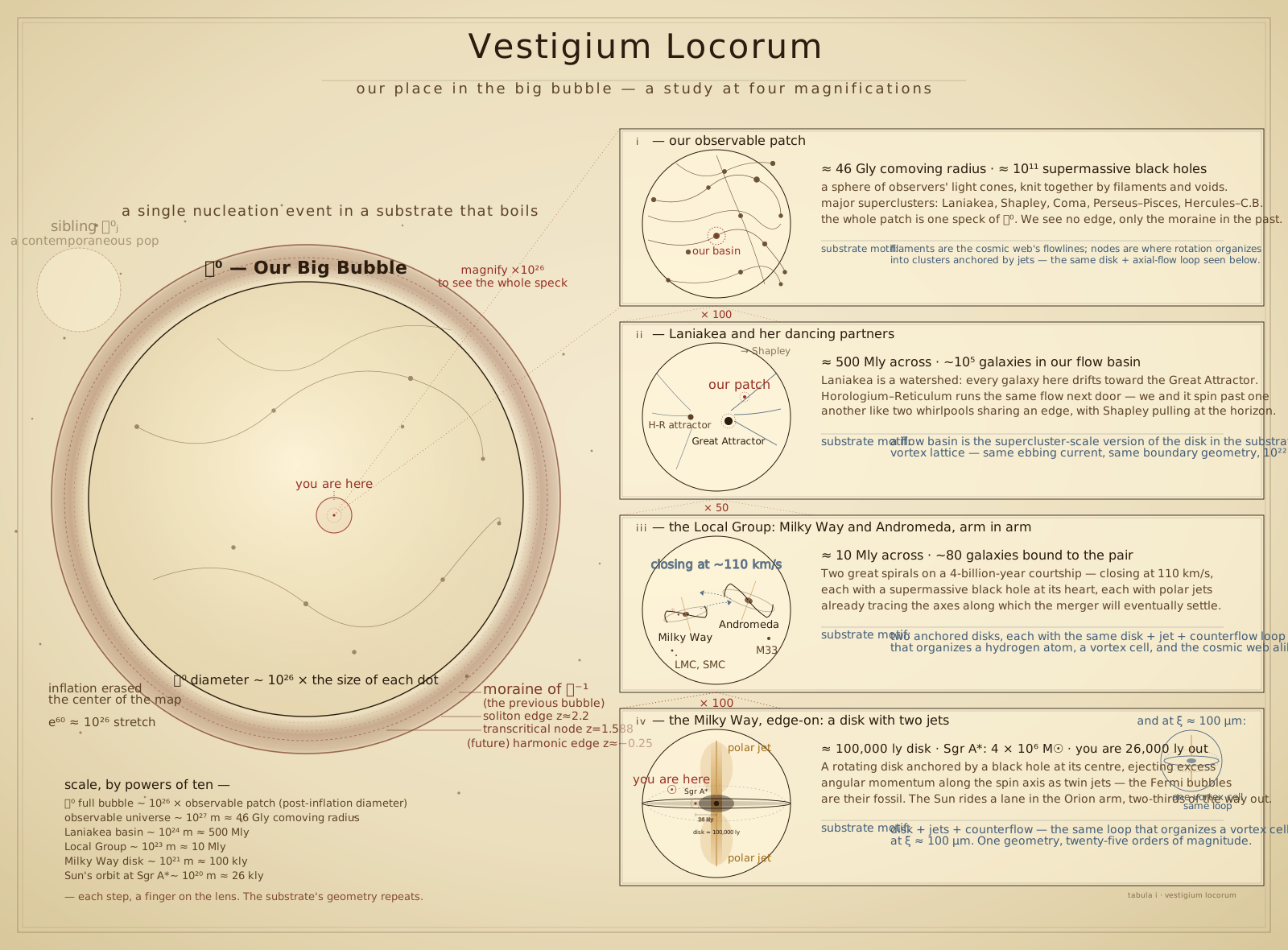
We write \mathcal{B}^0 for our bubble — the nucleation event we are inside. \mathcal{B}^{-1} is the parent bubble whose moraine we are currently passing through. \mathcal{B}^{-2} is the grandparent whose crust \mathcal{B}^{-1} encountered. \mathcal{B}^{+1}_k is any future nucleation event within \mathcal{B}^0. The superscript traces our causal ancestry — our lineage — not a universal clock. There may be billions of contemporaneous bubbles elsewhere in the substrate that are not in our genealogical chain. We index siblings in the same cluster cascade by subscript: \mathcal{B}^0_j for our neighboring pops.
If the universe boils, and we are inside one of the bubbles, the natural question is: where, exactly? What does the landscape look like from inside \mathcal{B}^0? What can we see, what can we infer, and what is hidden from us?
The answer is a peculiar mix of clarity and blindness. We are exquisitely well-informed about one structure in the landscape — the moraine of \mathcal{B}^{-1}, whose imprint DESI may have already detected — and we appear to still be inside it. And we are profoundly ignorant about everything else. The reason for both is the same: inflation.
Why you cannot find the center
\mathcal{B}^0 nucleated at a specific point in the substrate. In the framework’s picture, that point was probably a black hole interior in \mathcal{B}^{-1} — a compactor that accumulated enough density to cross the nucleation barrier and pop. The nucleation center is real. It has definite substrate coordinates. It is a physical place.
Then inflation happened. The \sim 60 e-folds of expansion stretched the nucleation region by a factor of \sim e^{60} \approx 10^{26}. Every trace of the original geometry — the location of the center, the shape of the initial bubble, any anisotropy from being off-center within \mathcal{B}^{-1} — was diluted to homogeneity within the inflated interior. The center is still out there in substrate coordinates, but it has been stretched so far beyond the observable universe that no measurement from inside can locate it.
Our observable universe — the \sim 46 Gly comoving sphere we can see out to — is a microscopic patch of \mathcal{B}^0. The full bubble is \sim 10^{26} times larger in each direction. We are like bacteria on the surface of a balloon that was inflated from a pinpoint: the pinpoint exists, but we cannot find it because every part of the surface looks the same.
This is why the CMB is isotropic to one part in 10^5. Not because the universe has no center. Because inflation erased the map.
Sagittarius A* is not the center
A natural temptation is to look at the Milky Way’s supermassive black hole — Sagittarius A*, \sim 4 \times 10^6\,M_\odot, the gravitational anchor of our galaxy — and wonder whether it marks something cosmologically special. It does not.
Sgr A* formed through normal galactic evolution within \mathcal{B}^0, billions of years after nucleation. It is one of roughly 10^{11} supermassive black holes scattered across the observable universe. It occupies no privileged position. The “center of the Milky Way” is not the “center of the universe” in any framework, standard or substrate.
But Sgr A* is something else in this picture: a seed. Every SMBH in \mathcal{B}^0 is a compactor — substrate flowing inward, density rising, containment thinning. Given enough time and enough inflow, any one of them could cross the nucleation barrier and pop, spawning a \mathcal{B}^{+1} event. Sgr A* is not where \mathcal{B}^0 began. It is a candidate for where some future \mathcal{B}^{+1} might begin. It is modest by SMBH standards — 4 million solar masses, compared to TON 618’s 66 billion or Phoenix A’s 100 billion. It is in the queue, but not near the front.
What we can see: the moraine of \mathcal{B}^{-1}
If inflation erased everything about \mathcal{B}^0’s origin, how do we know anything about the landscape at all?
Because the moraine encounter happened after inflation — and it is not over yet.
The \mathcal{B}^0 bubble wall expanded through the substrate for \sim 8 billion years after nucleation before it reached the remnant boundary of \mathcal{B}^{-1} — the moraine. That encounter began around z \approx 2.2, when the wall first contacted the moraine’s outer edge at supersonic speed. It has been unfolding ever since. The bubble wall decelerated through the moraine, passing through the critical speed at z = 1.588, and the resulting dispersive shock wave — the substrate’s response to a transcritical encounter — has been washing through the interior of \mathcal{B}^0 from high redshift down toward the present.
The key finding of the combined DESI BAO and Jia H_0(z) analysis is that the DSW harmonic edge has not yet reached us. The best-fit parameter z_\text{harm} = -0.25 places it in our future — meaning that at this moment, we are still inside the moraine’s downstream tail. The local dark energy density is \sim 25\% above its asymptotic equilibrium value, a lingering effect of the organized energy the moraine deposited into the substrate during the transcritical crossing. We are not looking back at the crust as a past event. We are sitting in it.
The wave hits the sandbar
The encounter was not a simple collision. It was a wave washing up on a beach, or over a mountain range — and the wash has not yet fully receded.
Think of an ocean wave approaching a sandbar. Far offshore, the wave moves fast — faster than the shallow-water wave speed over the bar. It is supercritical: disturbances cannot propagate ahead, so energy piles up in front of the wave, building a broad compression zone. As the wave reaches the bar and the water shallows, it decelerates. At some point it crosses the critical speed — the wave speed equals the local sound speed. This is the moment of maximum energy exchange, the transcritical resonance, where the wave couples most strongly to the obstacle. Then the wave passes over the bar and slows further, now subcritical: the wash extends outward from the bar, thinning and spreading, but it takes time to drain.
This is exactly what happened — and is still happening — as \mathcal{B}^0’s expanding bubble wall encounters the moraine crust of \mathcal{B}^{-1}.
The bubble wall’s effective Mach number — the ratio of the expansion velocity at the moraine’s location to the speed of light — was M > 1 when it first reached the moraine’s outer edge at z \approx 2.2. The wall was supersonic relative to the crust. Disturbances were carried forward, piling up organized energy ahead of the contact zone as a broad enhancement in \rho_\Lambda. Then the expansion decelerated. At z = 1.588, the Mach number crossed unity — exact criticality, maximum energy exchange, the transcritical resonance. As the wall continued to decelerate into the subcritical regime, the downstream response — a dispersive shock wave tail — propagated forward through the bubble interior, carrying the moraine’s imprint toward lower and lower redshift.
The combined fit to DESI BAO distance ratios and the Jia et al. (2025) H_0(z) data places the harmonic edge of this tail at z_\text{harm} = -0.25 — in our future. The downstream wash has not yet drained. At z = 0, the DSW tail gives f(0) = 1.25: the local dark energy density is 25% above the asymptotic equilibrium value. We are standing in the surf.
The remarkable thing is where M = 1 falls. You can compute it yourself from standard cosmology: M(z) = H(z) \times d_\text{proper}(z) / c, using nothing but Planck 2018 parameters (H_0 = 67.4 km/s/Mpc, \Omega_m = 0.315, \Omega_\Lambda = 0.685). No substrate parameters enter. The answer is z = 1.588 — right where the model, fitted independently to the DESI dark energy data, places the transcritical resonance peak. The sandbar is where standard cosmology says it should be.
A broad phenomenon, not a single barrier
The moraine encounter is a broad, structured phenomenon spanning from z \approx 2.2 to at least z = 0, described by the dispersive shock wave envelope \mathcal{E}_\text{DSW}(z) from the El–Hoefer/Grimshaw–Smyth transcritical framework:
| Redshift | M(z) | What is happening |
|---|---|---|
| z \approx 2.2 | 1.30 | Soliton edge. Bubble wall first contacts moraine. Supercritical — energy piles up ahead. Sharp \text{sech}^2 onset. |
| z = 1.588 | 1.00 | Transcritical crossing. Maximum energy exchange. The DSW envelope peaks here. |
| z \approx 0.63 | 0.47 | Deceleration → acceleration. The expansion begins to accelerate. A cosmological milestone, not the crust boundary. |
| z \approx 0.3 | — | Effective enhancement peak. The product of the DSW envelope and the dark energy fraction weighting peaks here — because dark energy dominates at low z, amplifying even the tail of the DSW. |
| z = 0 (now) | — | We are here — inside the tail. f(0) = 1.25: local \rho_\Lambda is 25% above equilibrium. |
| z_\text{harm} = -0.25 | — | Harmonic edge — in the future. The DSW tail terminates here. The moraine’s downstream influence ends. |
The DSW envelope alone peaks at z_\text{crit} = 1.588. But the dark energy fraction \Omega_\Lambda(z) is large at low z and small at high z. The product — DSW envelope \times dark energy fraction raised to the power \gamma \approx 3.6 — peaks at z \approx 0.3, far below the transcritical crossing. This is not a numerical coincidence. It is the physical statement that dark energy modifications matter most when dark energy dominates the expansion. A 25% local enhancement in \rho_\Lambda is invisible at z = 2 (where matter provides 95% of the energy budget) but transformative at z = 0 (where dark energy provides 68%).
The crust’s two channels
The moraine encounter affects the universe through two distinct physical channels, operating on different equations:
Channel 1: Dark energy enhancement (f(z) > 1). The organized vortex energy from the moraine, swept up and compressed during the transcritical encounter, deposits excess energy into \rho_\Lambda. This enters the Friedmann equation directly — it changes the expansion rate H(z). The enhancement profile f(z) is shaped by the DSW envelope and amplified by the dark energy fraction weighting. It is responsible for the Hubble tension and the DESI dark energy evolution.
Channel 2: Gravitational coupling suppression (G_\text{eff} < G). The moraine’s organized energy disrupts the counter-rotating boundary layers that mediate gravity, reducing the effective gravitational coupling to density perturbations. This enters only the growth equation — it changes how fast structures grow, without changing the expansion rate. The disruption efficiency is a zero-parameter prediction from the Weinberg angle through the mutual friction parameter, \eta_\text{crust} = 2\alpha_{mf}^2 = 0.181 — a two-step coupling (crust energy → boundary via \alpha_{mf}, boundary → gravitational response via \alpha_{mf}, with the factor of 2 from the HVBK dissipative and reactive components). This is the dominant transcritical-crossing channel; a downstream channel at the Weinberg-reduced 2\alpha_{mf}^2(1 - \sin^2\theta_W) = 0.139 adds to it, together suppressing structure growth to S_8 = 0.816, just outside the weak-lensing band.
The separation between the two channels is crucial: f(z) controls H_0; \eta_\text{crust} controls S_8. The two tensions are resolved by different mechanisms that do not fight each other.
What we learn about \mathcal{B}^{-1}
What the data resolves now is a textbook transcritical undular bore: a soliton-and-wake pair at the upstream edge, a recovery-zone depression at the transcritical crossing, and a multi-cycle oscillating train extending downstream past us into the future. From that structure, a remarkable amount about \mathcal{B}^{-1} falls out:
It was large. \mathcal{B}^{-1}’s remnant boundary enclosed the region that would become \mathcal{B}^0’s interior. Our bubble wall had to travel outward through \mathcal{B}^{-1}’s boundary to reach the crust — not the other way around. The parent was bigger than the child.
It left organized debris, not thermal noise. The crust energy was structured rotational energy, ordered enough to disrupt the substrate’s gravitational coherence with a coupling efficiency set by the mutual friction parameter. A thermal remnant would not couple to the substrate’s boundaries with such specificity. The crust was a moraine — organized debris deposited at the balance point between inward collapse and outward nucleation. The cell vortices constituting the moraine would have been spinning at whatever the local v_\text{rot,outer} was at the time of \mathcal{B}^{-1}’s relaxation — a fossil rotation rate from the previous cycle’s equilibrium density.
It carried erratics, not just a profile. This last point runs deeper than the fit shows, because what DESI resolves is only the relaxed density curve f(z) — the substrate smoothed. But a glacial moraine is never only a density curve: it is studded with erratics, the boulders the ice carried and dropped. \mathcal{B}^{-1} would not have relaxed to a featureless fluid before we nucleated inside it — its own massive objects, the collapsed cores and compact remnants and shaved husks of the previous cycle, would survive as a discrete population caught up near the outer reaches of our expanding wall, where the nucleation no longer simply swallows everything into raw forming energy but passes a threshold at which bits of the old layer remain to be absorbed and to perturb the dispersion. And the transcritical wash sorts them. The same crossing that wrung the vortex energy out of the crust ablates a hot component to high velocity dispersion — the shards still circulating between the galaxies, why an interstellar visitor like ʻOumuamua arrives shaved down as if it had been through a bath of energy that millions of miles of empty space could never supply (solar-system-boundaries) — while the densest cores survive cold and intact — late-arriving seeds, bowling-pins for structure assembled after the moraine contact at z \approx 2.2, never for the first galaxies, which predate any possible delivery by ten billion years and are seeded instead by the substrate’s own instability (early-structure-formation). The texture is exactly what the smooth profile omits; whether the hot component’s dispersion suppresses small-scale growth enough to matter for S_8 is a two-sided calculation the framework owes rather than a picture it can assert (WIP-31). That is the statistical reading of the erratics — do they, as a population, move structure growth. The complementary individual reading — could we catch a single erratic and prove it is a survivor of \mathcal{B}^{-1} by its composition — is developed in Erratics: Catching a Piece of the Previous Cycle.
Its edge was sharp enough that we see the wake. The cleanest single feature in the entire profile is a soliton crest at z \approx 2.3 (f_\text{crust} = +0.49) paired with a deep trough at z = 2.00 (-0.37) — the substrate’s record of a wave breaking against a sharp obstacle at supersonic speed. The trough is the wake: a localized rarefaction trailing the supersonic encounter, a depression in \rho_\Lambda where the bubble wall’s transit drained the moraine of organized vortex energy. The amplitude ratio of trough to crest (~75%) is exactly what the Grimshaw–Smyth forced-KdV equation predicts for the first wake behind a leading soliton in transcritical flow (60–80%). We are not just inferring a sharp edge; we are seeing the signature it carved into the wave it broke against.
The crossing wrung it out. At z = 1.588 — the redshift where the bubble wall’s Mach number passes through unity, computable from Planck cosmology with no substrate inputs — the data does not show zero. It shows a slight depression (-0.09). The recovery zone, where the upstream and downstream wave trains hand off, sits below the equilibrium baseline. This is the substrate’s bookkeeping: at exact criticality, the moraine’s vortex energy was maximally pumped out into the surrounding wave trains, leaving a local deficit at the transition point. The transcritical crossing was an act of substrate withdrawal — organized energy banked in the crust, drawn down at resonance, and redistributed forward and back as wave energy. That the deficit appears within \Delta z = 0.012 of the zero-parameter prediction continues to be one of the most compelling spatial coincidences in the analysis.
Its passage set the substrate ringing. The downstream tail is not a smooth decay. It is an oscillating wave train: five to six cycles visible between z = 1.3 and z = 0, with crests at z \approx 1.30,\,0.80,\,0.45,\,0.23,\,0.07 and troughs interleaved between them. The cycles are not evenly spaced — the wavelength compresses toward low redshift, the chirp pattern a Korteweg–de Vries dispersive shock produces as it evolves from soliton edge toward harmonic edge. And when you strip away the dark energy amplification — the [\Omega_\Lambda(z)]^\gamma weighting that makes the low-z crests appear loudest — what remains underneath is a rank-ordered carrier: each successive crest smaller than the last from soliton edge outward, exactly the amplitude hierarchy Whitham modulation theory predicts for any KdV undular bore. The substrate is ringing with the moraine’s structure, and the ringing obeys textbook rules.
We are still passing through its influence. The harmonic edge at z_\text{harm} = -0.25 means the moraine’s downstream disturbance has not yet fully swept past us. This is not surprising in retrospect — the DSW propagation speed in the substrate is finite, and the moraine was thick enough that the downstream tail extends well beyond the present epoch. The 25% local enhancement of \rho_\Lambda is the lingering signature of this passage. The visually dominant crest in the data sits not at the transcritical peak but at z \approx 0.8 (+0.72) — far inside the soliton edge, where the bare carrier is already fading but the dark energy amplification is rising fast enough to make the late ringing the loudest part of the chord.
Its center was elsewhere. The crust is roughly isotropic in our sky — DESI sees it as a redshift-dependent signal, not a directional one.1 This means \mathcal{B}^{-1}’s boundary was much larger than our observable patch — we see only a small section of it, and from our vantage it looks the same in every direction, just as a large enough sphere looks flat to an ant on its surface.
Beyond this, we genuinely do not know much. How old was \mathcal{B}^{-1}? Did it develop galaxies, structure, observers? What caused it to collapse or decay? The crust tells us about the boundary, not the interior. These are questions about the previous cycle’s full history, and the moraine is all that survives.
What might be next door: cluster siblings
If the substrate boils in cascading clusters — one pop loading neighboring stressed regions over their thresholds — then \mathcal{B}^0 did not nucleate alone. There should be sibling bubbles, the other pops in the same cluster cascade, labeled \mathcal{B}^0_j.
Their walls would appear as large-angle features in the CMB or in the large-scale distribution of matter, depending on their distance and the degree to which their wall signals penetrate the intervening substrate. Candidate signatures already exist. The CMB hemispherical asymmetry — a persistent, unexplained \sim 7\% power difference between two hemispheres of the sky — has the right morphology for a nearby sibling’s wall creating a slight temperature gradient. The CMB Cold Spot — an anomalous \sim 10° underdensity in the Eridanus constellation — could be the imprint of a neighboring \mathcal{B}^0_j whose wall created a local void in the substrate.
The angular scale of the Cold Spot (~10°) would place a sibling wall at roughly the right comoving distance for a cluster-cascade neighbor. The substrate framework predicts something morphologically similar to Penrose’s “Hawking points” but with a different mechanism — a partially transmitted wall signal from a contemporary sibling, not a remnant from a previous aeon. The angular size, polarization signature, and spatial statistics would differ from CCC’s predictions and are in principle distinguishable with existing CMB polarization data.
Status: honestly speculative. But the predictions are specific enough to test with the right template, and if a sibling’s wall signal were confirmed, it would be direct evidence for the cluster-cascade nucleation picture.
What lies ahead: the seeds of \mathcal{B}^{+1}
Every supermassive black hole in \mathcal{B}^0 is a compactor that could, in principle, cross the nucleation barrier and spawn a child bubble. There are \sim 10^{11} of them in the observable universe alone — and the observable universe is a negligible fraction of \mathcal{B}^0.
The largest known SMBHs are the ones closest to the barrier — the most compressed, the most likely to pop first:
| Object | Mass | Status |
|---|---|---|
| Phoenix A | \sim 100 \times 10^9\,M_\odot | Largest known SMBH; nearest to barrier (if barrier is mass-dependent) |
| TON 618 | \sim 66 \times 10^9\,M_\odot | Distant quasar; extreme accretion history |
| Holm 15A* | \sim 40 \times 10^9\,M_\odot | Central cluster galaxy; cored profile suggests merger history |
| Sgr A* | \sim 4 \times 10^6\,M_\odot | Our galaxy’s center; modest by SMBH standards |
Whether any SMBH must pop above a critical mass, or whether the trigger is always thermally activated and Poisson-distributed at any mass, is an open question — Breadcrumb 2 below. If there is a critical mass, Phoenix A is the canary. If the process is stochastic, then every SMBH is a lottery ticket, and the largest ones simply have better odds.
None of these events is imminent on human timescales. The nucleation barrier, whatever it turns out to be, involves substrate densities far beyond what current accretion rates can reach in any astronomically short time. But on cosmological timescales — billions of years — the population of SMBHs in \mathcal{B}^0 constitutes a standing crop of nucleation sites. The kettle is always simmering — and that is now a derived statement, not an asserted one: Volovik’s two-fluid de Sitter thermodynamics shows that a vacuum with a temperature is never absolutely stable — even a single proton immersed in it triggers thermally activated decay chains ([R154]). A metastable substrate carrying embedded matter must eventually relax; the only question the framework owes is the rate. The second half of the cycle — what the expansion does to \mathcal{B}^0 while the compactors fill, the islands that keep their lattice, and the floor of \sim5\times10^{14} years the framework’s own numbers put under the first pop — is walked through in The Winding Down.
Why there is no map
By now the reader has earned an objection. The bubble has a center. It has a wall. We sit at some particular, unremarkable point inside it. So why does the sky look the same in every direction? Why is there no “that way to the center” and no “that way to the edge”?
This is not a naive question. It is the question — the one whose answer built modern cosmology. The observed isotropy is the same in both pictures; what differs is the step taken next. Standard cosmology adds the Copernican principle — we are not special, so everyone sees isotropy — and isotropy from every point forces homogeneity everywhere, which is why the standard universe has no center and no edge and expands “into itself.” It is worth saying plainly that the standard model never put the Big Bang at a point in space; the popular image of an explosion spreading out from somewhere is a misreading of a picture that has no somewhere. The substrate keeps the Copernican modesty — we occupy a generic point, nothing marks it — but drops the leap to infinite homogeneity. The bubble is finite. It has a center. And it still looks the same in every direction from where we sit, for two reasons that stack.

Scale. Our horizon is \gtrsim 10^{26} times smaller than \mathcal{B}^0. Whatever gradient our off-center position produces across 46 Gly is of order 10^{-26} — homogeneity is not an assumption in this picture, it is what e^{60} of stretch does to any geometry. The center survives in substrate coordinates; the direction to it does not survive inflation.
Time. Every edge we can actually detect — the wall’s afterglow, which is the CMB, and the moraine encounter, which is the DESI signal — happened in time, everywhere inside the bubble at once, not at a place. And lookback time is a sphere around whoever is looking. So each time-stamped event arrives as a shell centered on the observer: the CMB at z \approx 1100, the moraine contact at z \approx 2.2, the transcritical crossing at z = 1.588, the acceleration onset at z \approx 0.63, and the harmonic edge at z_\text{harm} = -0.25, which is not on the sky at all because it lies in our future. Move the observer, and every shell moves with them. Isotropy is simply what a finite, centered bubble looks like from any generic point inside it.
That is why there are two maps of the same place, and why only one of them can be drawn. The substrate’s map — the one an outside observer would hold, with \mathcal{B}^0’s center marked, our patch a speck somewhere off-center, the moraine of \mathcal{B}^{-1} a band around the wall, and the sibling pops \mathcal{B}^0_j scattered nearby — is real, and nobody stands outside to draw it. Our map, the one the data draws for us, is a stack of concentric redshift shells with us at the middle, and it would be the same stack for any observer anywhere in the bubble. The map we wanted is the first one. The data only ever gives us the second.
The one hard number on either map is the transcritical crossing: M(z) = 1 at z = 1.588, derivable from Planck 2018 cosmological parameters with no substrate inputs. From it flows the DSW crust imprint — the enhancement peaking near z \approx 0.3 (after dark energy amplification), the gravitational suppression centered at two redshifts — and from these flow the resolutions of the S_8 tension and the partial resolution of the Hubble and DESI tensions. Everything else — the size of \mathcal{B}^{-1}, the distance to the nearest sibling, the location of the nucleation center — is either constrained only qualitatively or hidden behind the veil of inflation. We know more about the boundary of the previous cycle than about the center of our own.
The framework does not, however, predict perfect isotropy — and this is where a finite bubble differs testably from an infinite one. Both reasons above have a residue: an off-center nucleation within \mathcal{B}^{-1} would make the moraine contact slightly non-simultaneous across the sky (breadcrumb 5 below), and a sibling’s wall close enough to reach us at all would leave a large-angle feature, not a redshift shell (breadcrumb 4). The CMB hemispherical asymmetry and the Cold Spot are the natural candidates. If the bubble picture is right, the sky is isotropic to one part in 10^5 because the map was erased — not because there was never a map.
This is the Sagan moment for the substrate framework. Voyager 1 turned around at the edge of the solar system and photographed Earth as a pale blue dot — a mote of dust suspended in a sunbeam.2 Here, the “pale blue dot” is the entire observable universe — 46 billion light-years of galaxies, clusters, and voids — and it is a mote inside a bubble, sitting inside the fading wake of the previous bubble’s moraine, inside a substrate that extends indefinitely and boils occasionally and locally, wherever the pressure builds up enough.
We are not surveying the aftermath of a unique creation. We are inside one of the substrate’s normal relaxations, looking outward at the moraine of \mathcal{B}^{-1} — whose last ripple has not yet passed us — and inward at the seeds of the cycles to come.
What survives a cycle, and what is minted fresh
A reader who has followed the story this far — bubbles nucleating inside black holes, walls blooming outward, the moraine of the last cycle washing past us — will arrive at a question, and it deserves a direct answer rather than an inference scattered across five chapters. If the old universe’s light mostly stretches away, and the hourglass shows the black holes drink only 10^{-21} of it per Hubble time, where does the next bubble’s energy come from? The question has a distinguished pedigree: it is Tolman’s classic objection to cyclic cosmology — in a closed oscillating universe, radiation and entropy accumulate from cycle to cycle, each bounce inherits a degraded budget, and the cycles decay.3 Any cyclic picture owes an account of what crosses the seam between cycles, what does not, and why the budget does not run down. The substrate’s account is short, and its parts are already on the paper’s books.
The backpressure is already on the books too. Start with the intuition that usually accompanies the question: a bubble blooming outward must eventually meet something — a wall, a limit, some interaction with the outside; backpressure has to form. It does, and this chapter has already fit it to data. The moraine encounter is the backpressure event: \mathcal{B}^0’s wall, expanding since nucleation, ran into the remnant boundary of \mathcal{B}^{-1} at z \approx 2.2, decelerated through the transcritical crossing at z = 1.588, and the wash of that collision is the 25% dark-energy enhancement we are sitting in right now, harmonic edge still ahead of us. We are inside a seed still in its blooming phase, and the bloom has already registered its first contact with the outside. The abstract question and the DESI fit are the same physics met from two directions.
The inheritance ledger. Three things cross the seam from one cycle into the next, and the paper reads each of them somewhere:
| What crosses | Carrier | Where it is read |
|---|---|---|
| Organized boundary energy | the moraine — the relaxed rim of \mathcal{B}^{-1} | the DSW fit above; f(0) = 1.25, we are in the wash |
| Compact matter | the erratics — cores dense enough to survive the wall cold | Erratics; the supernova channel |
| Circulation number | the old windings, stretched into the lattice | Quiet Majority; n_1/n_\gamma conserved |
What is not on the list is the one thing intuition puts there first: the old universe’s radiation energy. The previous cycle’s light is not fuel-in-waiting. Its photons crossed the modon floor long ago and ride the lattice as delocalized windings, stretching as a^{-1} without limit — their number never dies, but their energy asymptotes to zero as each winding spreads across ever more cells, relaxing back into the texture of the medium that made them. The substrate reabsorbs its own light — not through black holes, but through infinite stretching. And the energy shed on the way down is not lost either: in the framework’s mechanical reading, radiation pressure does P\,dV work on the expansion — the old light spends itself pushing its own bubble’s wall outward. By the time a cycle ends, its radiation has done its job and gone to ground. Nothing about the next cycle waits on it.
The mint. The next bubble’s light is manufactured, not inherited. Breadcrumb 3 below has carried this in one line since the chapter was written — the CMB is the thermalized remnant of \mathcal{B}^0’s wall — and the hourglass now supplies the deposit side: a compactor spends \gtrsim 10^4 Hubble times banking ambient dc1 through the valveless ebbing current, the pop converts the banked compression into latent heat, and the wall thermalizes the latent heat into a fresh hot soup of modons. A brand-new CMB, minted from the reservoir. And the minting is topologically free, which is the quiet reason every cycle can afford it: a modon is a counter-rotating dipole — its net circulation is zero — so light can be created from raw compression energy without touching the winding ledger. Matter cannot. Net winding has to be won the expensive way, through the chirality war, which is why every boil’s output is almost entirely light and only 6\times10^{-10} matter. The two ledgers were balanced within one cycle; this is the same bookkeeping run across cycles: the energy ledger refills from the reservoir, the winding ledger barely moves.
Why the cycles do not decay. Tolman’s objection has two prongs, and the framework answers each with machinery it already carries. The energy prong assumes the cycles are a closed system passing a fixed budget down a lineage — each bounce running on its parent’s output, hence the decay. The substrate’s cycles are not that. They are repeated discharges of a metastable reservoir: each compactor banks from the ambient substrate, not from its parent’s radiation, so the lineage is not a Russian doll of shrinking inheritances but a budding tree — one bubble hosts \sim10^{11} compactors, each independently gathering from a reservoir indefinitely larger than any single bubble, each a potential child. A child’s size is set by its seed’s gathering time and local density (t_* \propto 1/M\rho), not by its parent’s size; some children will be smaller than their parents and some larger, and nothing is monotone. (The earlier statement that “the parent was bigger than the child” is an at-birth fact — a bubble must nucleate inside its parent — not a law of the generations.) The entropy prong is answered at the seed itself: the arrow of time needs each fresh epoch to begin from maximal pairing coherence, and the saturated core delivers exactly that — the compactor does not inherit its parent’s disorder; it squeezes the substrate back to the coherent, maximally-packed pre-boil state, and the arrow starts over. The hourglass is also an entropy press.
The ledger rows are each read elsewhere in the paper at their own (stated) strengths; what is new here is only the assembly. Two claims are load-bearing assumptions, not derivations. The reservoir is effectively unlimited — this is a statement about the extent and metastable depth of the substrate beyond our cluster, and nothing in the framework computes it; if the reservoir were locally exhaustible, cycles would decay locally, and the honest form of the claim is “no decay for as long as the ambient supply lasts.” The wall’s ultimate fate is open — whether \mathcal{B}^0’s wall runs indefinitely, dissipates into the parent phase, or stalls against the next structure out is not calculated, and it is the same open physics as the nucleation barrier (breadcrumb 1) and the hourglass coefficient (WIP-34). The child-size distribution of the budding tree is a natural reading of t_* \propto 1/M\rho, not a computed population.
The story, in one sentence
The Big Bang as classically conceived is a singular event with no place to be. The substrate framework’s bang is a local kettle event in a universe that boils, occasionally and locally, wherever the pressure has built up enough to nucleate a pocket of the other phase. There is no contradiction between this and what we observe. There is, instead, a different relationship between the observer and the cosmos: we are not surveying the aftermath of a unique creation. We are inside \mathcal{B}^0 — one of the substrate’s normal relaxations — still sitting inside the fading wake of \mathcal{B}^{-1}’s moraine, and looking inward at the seeds of the cycles to come.
It came from the substrate boiling. That is the whole story. The rest is hydrodynamics.
Footnotes
A slight anisotropy in the crust is possible if \mathcal{B}^0 nucleated off-center within \mathcal{B}^{-1}’s remnant. Different parts of our bubble wall would have reached the crust at slightly different times, producing a gradient in the crust energy. The CMB hemispherical asymmetry is a candidate for this kind of signal — but the connection is speculative and the signal, if present, is subtle.↩︎
Sagan, C., Pale Blue Dot: A Vision of the Human Future in Space, Random House, 1994.↩︎
Tolman, R. C., Relativity, Thermodynamics, and Cosmology, Oxford University Press, 1934. The entropy form of the objection — each cycle starts with the last cycle’s disorder — is the standard reason oscillating models fell out of favor.↩︎
Penrose, R., Cycles of Time, Bodley Head, 2010; Gurzadyan, V.G. & Penrose, R., “CCC-predicted low-variance circles in CMB sky and LCDM,” arXiv:1302.5162, 2013.↩︎