Spacetime, Dynamics, Inflation
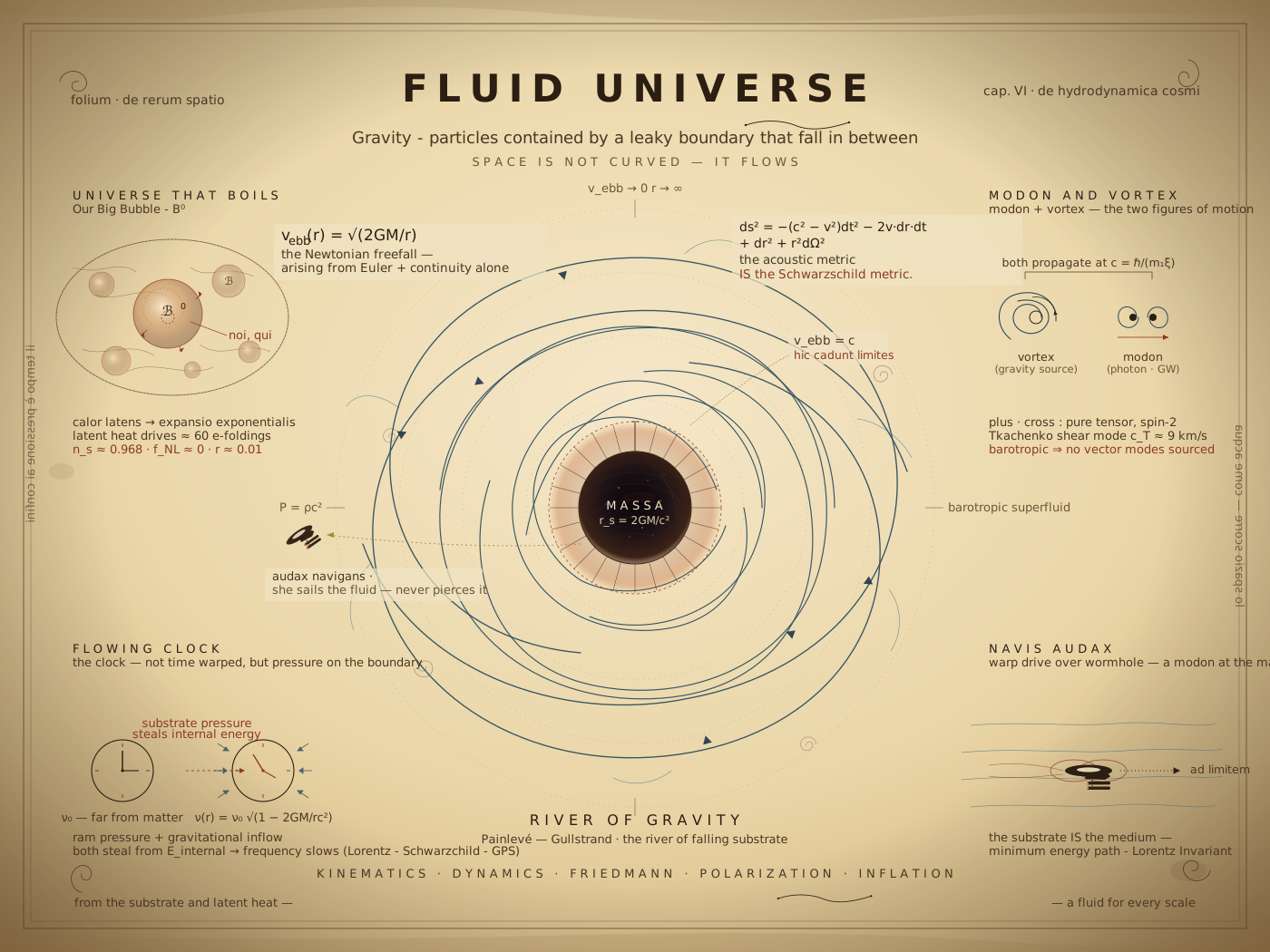
Spacetime Without Curvature: Substrate Flow, Dynamics, and Inflation
Overview
This section derives general relativity, Friedmann cosmology, gravitational wave polarization, and cosmic inflation from the dc1 substrate — without invoking spacetime curvature, an inflaton field, or any new free parameters. The substrate’s material properties (established in the Foundation, Atomic Structure, and Spin, Gauge, and Constants sections) do all the work.
The central result: the dc1 substrate generates the Schwarzschild metric exactly as the acoustic metric of modons propagating in a gravitational inflow of dc1 particles. Einstein’s field equations emerge as the self-consistency condition for this flow. The Friedmann equations follow from the same fluid dynamics applied to the homogeneous expanding substrate. Gravitational wave polarization (pure tensor, spin-2) follows from the substrate’s barotropic equation of state. And cosmic inflation is replaced by the latent heat of the superfluid phase transition, which naturally produces ~60 e-foldings, n_s \approx 0.967, and Gaussian adiabatic perturbations.
The argument proceeds in six stages:
- Substrate flow replaces spacetime curvature (clock shifts, lensing)
- The nonlinear boundary response (the Painlevé-Gullstrand metric)
- Substrate dynamics reproduce Einstein’s field equations
- The Friedmann equations from the expanding substrate
- Gravitational wave polarization analysis
- The superfluid phase transition as inflation
Substrate Flow Replaces Spacetime Curvature
The Core Argument
The framework establishes two things: gravity is the dc1 ebbing current through boundary layers (Gravity), and every clock is timed by a signal that runs at c relative to the substrate — the Compton frequency \omega_c = m_0 c^2/\hbar at bottom, and every atomic, nuclear, or mechanical rate built on it (Special Relativity from the Moving Clock). If the substrate is flowing through a clock, the clock’s signal has to cross a diagonal against that flow, and the diagonal lengthens the tick. A count of ticks is all a clock measures.
Gravitational Clock Shift: a Clock at Rest in the River
Consider a cesium atom held at distance r from mass M. The ebbing current falls through it at
v_\text{ebb}(r) = \sqrt{2GM/r}
(Gravity). The atom’s timing signal is pinned at c to the substrate, not to the atom, so relative to the local river the atom is a clock moving at v_\text{ebb} — and by the moving-clock argument its tick stretches by \gamma_\text{ebb} = 1/\sqrt{1 - v_\text{ebb}^2/c^2}:
\nu(r)/\nu_0 = \sqrt{1 - \frac{v_\text{ebb}^2}{c^2}} = \sqrt{1 - \frac{2GM}{rc^2}} \;\approx\; 1 - \frac{GM}{rc^2}
The linear term is the first-order gravitational redshift; the square root is the full GR result, and it is re-derived below from the acoustic metric, where it is the Painlevé–Gullstrand proper time. The clock ticks slower not because “time runs slower” but because its signal has a longer path to run against a medium that is falling past it. The boundary layers still feel the flow — the counter-rotating rim must hold coherence against v_\text{ebb} — but that cost sits in a separate line of the energy ledger, worked out below; it does not draw down the tick.
Velocity Clock Shift: a Clock Moving Through a Still Substrate
An atomic clock moving at velocity v through substrate at rest is the same clock with the roles swapped: the substrate streams through it at v. Same pinned signal, same diagonal:
\nu(v)/\nu_0 = \sqrt{1 - v^2/c^2} \;\approx\; 1 - \frac{v^2}{2c^2}
What diverges as v \to c is not the tick’s budget but the bow wave: the dressing energy \gamma m v^2 grows without bound because the medium cannot shed the bow wave ahead faster than its own signal speed (The Speed Limit). That is why nothing with odd boundary parity (mass) can reach c — and it is a statement about the energy it takes to push the core, not about the clock’s beat.
Gravitational Lensing as Substrate Refraction
The modon propagation speed c is set by the BEC quasiparticle spectrum: c = \hbar/(m_1 \xi), where m_1 is the dc1 mass and \xi is the coherence length (Emergent Speed of Light). Near a massive body, the ebbing current modifies the local substrate properties, creating a gradient in c:
c(r) = c_0 \cdot \left(1 - \frac{2GM}{r\,c_0^2}\right)
This defines an effective refractive index:
n(r) = c_0/c(r) = 1 + \frac{2GM}{r\,c_0^2}
A modon traveling through this gradient bends toward the mass. The deflection angle for a ray passing at impact parameter b:
\Delta\theta = \int \nabla_\perp(\ln n) \cdot ds \approx \frac{4GM}{b\,c_0^2}
This is the exact GR prediction for gravitational lensing, including the factor of 2 that distinguishes GR from Newtonian corpuscular theory. In the substrate, the extra factor of 2 comes from both the vorticity gradient \beta and the exterior decay rate \kappa_\text{ext} being modified by the ebbing current — the modon is dragged by the flow as well as refracted by the varying c(r).
The Shapiro delay also follows: the modon travels through a region where c(r) < c_0, adding extra travel time:
\Delta t = \frac{2GM}{c_0^3} \cdot \ln\!\left(\frac{4r_1 r_2}{b^2}\right)
No curved spacetime needed.
The Unification
Both gravitational and kinematic “time dilation” are the same physical effect — a c-pinned signal crossing a diagonal against the substrate it is moving through — and they combine because the clock only knows one thing: its velocity relative to the local river,
\mathbf v_\text{rel} = \mathbf v_\text{clock} - \mathbf v_\text{river}.
For a clock in circular orbit the tangential motion is perpendicular to the radial inflow, so the two add as a right triangle, |\mathbf v_\text{rel}|^2 = v_\text{ebb}^2 + v^2, and
\nu/\nu_0 = \sqrt{1 - \frac{|\mathbf v_\text{rel}|^2}{c^2}} = \sqrt{1 - \frac{2GM}{rc^2} - \frac{v^2}{c^2}} \;\approx\; 1 - \frac{GM}{rc^2} - \frac{v^2}{2c^2}.
The linear form is the one an earlier draft of this chapter reached by saying “the pressures add”; that is only the leading approximation. The exact statement is one vector and one \gamma. It is precisely the combined gravitational + kinematic correction used by GPS satellites: at 20,200 km the slower river gains a clock +45.7\;\mus/day against the ground, its 3.87 km/s across the river costs it -7.2, and the net +38.5\;\mus/day is what every receiver corrects for. In GR the same number comes from the Schwarzschild metric evaluated along the satellite’s worldline; in the substrate it comes from a clock’s speed through the water. (The simulation’s river view draws the inflow, the orbit, and the one vector, for GPS, the ISS, geostationary orbit, and the 33 cm step of Chou et al.)
The Nonlinear Boundary Response
Deriving the Exact Metric
The Ebbing Current Is a Flow
With the substrate model, the ebbing current is a physical flow of dc1 particles. It is not just a static pressure — it is a velocity field, needed for analog gravity.
At the macroscopic scale, the dc1 ebbing current is the bulk inflow of substrate particles — the “gravitational waterfall.” The f_\text{leak} parameter from Gravity describes the fraction of this current that penetrates individual orbital system boundaries, producing the local gravitational force on each system. The two descriptions — bulk flow (this section) and boundary penetration (Gravity) — are complementary: the bulk flow sets the metric, the boundary penetration sets the force.
Unruh (1981), Visser (1998), and Volovik (2003) showed rigorously that sound waves in a flowing fluid experience an effective spacetime metric determined by the flow. For a fluid with local speed of sound c_s and background flow velocity \mathbf{v}, the effective metric for wave propagation is:
ds^2 = \frac{\rho}{c_s} \left[ -(c_s^2 - v^2)\,dt^2 - 2\,\mathbf{v}\cdot d\mathbf{x}\,dt + |d\mathbf{x}|^2 \right]
This is the acoustic metric, linearizing the fluid equations around a background flow. In the substrate: c_s \to c (the modon speed), \mathbf{v} \to \mathbf{v}_\text{ebb}(r) (the dc1 ebbing current velocity), and \rho \to \rho_\text{substrate}.
Self-Consistency Fixes the Flow
The ebbing current does two things simultaneously: it creates the gravitational force and it determines the effective metric. These must be self-consistent. The flow that creates the force must also be the flow that determines clock rates and light paths.
A dc1 particle in the ebbing current starts far from the mass with negligible drift velocity and falls inward, accelerated by the very gravitational field it helps create. In steady state, each dc1 particle at radius r has been accelerated through the potential from infinity to r, gaining velocity:
v_\text{ebb}(r) = \sqrt{2GM/r}
This uses the Newtonian free-fall velocity — which raises an apparent circularity: are we assuming gravity to derive gravity? The dynamics section below shows that v_\text{ebb}(r) = \sqrt{2GM/r} emerges self-consistently from the substrate’s own Euler equation, without assuming a gravitational force law — it is the free-fall branch of the Bernoulli invariant, fixed for any barotrope (Gravity § One Integral, Two Branches). The argument here establishes kinematic consistency (the acoustic metric given this flow); the dynamics section closes the momentum half of the loop. Continuity is the half that does not close: the flow requires a distributed dc1 sink the framework has not derived (WIP-36), so the fixed-point argument is complete for the profile and incomplete for its mass budget.
The ebbing current IS the free-falling substrate, a “gravitational waterfall” in the dc1 medium.
The Acoustic Metric IS the Schwarzschild Metric
Substituting v_\text{ebb}(r) = \sqrt{2GM/r} into the acoustic metric:
ds^2 = \frac{\rho}{c} \left[ -\!\left(c^2 - \frac{2GM}{r}\right)dt^2 - 2\sqrt{\frac{2GM}{r}}\,dr\,dt + dr^2 + r^2\,d\Omega^2 \right]
Dividing by the conformal factor \rho/c:
ds^2 = -\!\left(1 - \frac{2GM}{rc^2}\right)c^2\,dt^2 - 2\sqrt{\frac{2GM}{r}}\,dr\,dt + dr^2 + r^2\,d\Omega^2
This is the Painlevé-Gullstrand form of the Schwarzschild metric.
It is the Schwarzschild solution of Einstein’s field equations, written in “rain coordinates” — coordinates adapted to freely falling observers. It is related to the more familiar Schwarzschild coordinates by a coordinate transformation of the time variable.
The Painlevé-Gullstrand form was discovered independently by Painlevé (1921) and Gullstrand (1922), and it has a physical interpretation: spacetime near a mass is like a fluid flowing inward at the free-fall velocity. Hamilton and Lisle (2008) called this the “river model of black holes.” In the substrate framework, this is not an interpretation — it is literally what is happening. The dc1 ebbing current IS the river.
The Full Nonlinear Clock Shift
From the metric, the proper time of a stationary clock at radius r is:
d\tau^2 = g_{00}\,dt^2 = \left(1 - \frac{2GM}{rc^2}\right) dt^2
Therefore:
\boxed{\nu(r)/\nu_0 = \sqrt{1 - \frac{2GM}{rc^2}}}
The full nonlinear GR result, including all higher-order terms, emerges automatically. The square root comes from the Lorentzian signature of the acoustic metric — the fact that the metric has a (c^2 - v^2) term, and proper time involves taking the square root.
The Energy Ledger in the River
The boundary layers do pay for the flow — but on a different line of the ledger from the tick. Read in the frame of the local river (the freely falling frame, which is where the substrate is at rest), a clock held stationary at radius r is a mass moving through the water at v_\text{ebb}, and it carries the moving particle’s full energy:
\gamma_\text{ebb}\,mc^2 \;=\; \underbrace{\frac{mc^2}{\gamma_\text{ebb}}}_{\text{the clock}} \;+\; \underbrace{\gamma_\text{ebb}\, m\, v_\text{ebb}^2}_{\text{the boundary dressing}}
The clock’s share, mc^2\sqrt{1 - 2GM/rc^2}, is one quantum of a beat at the slowed rate — and it is exactly the energy an observer at infinity credits the clock with (the conserved energy of a static particle in Schwarzschild spacetime), which is why a photon it emits arrives redshifted by the same factor. The dressing, \gamma_\text{ebb} m v_\text{ebb}^2 \approx 2GMm/r at leading order, is the boundary’s cost of holding coherence against the inflow. The two do not compete for a fixed mc^2: the total is more than mc^2, not less, and the tick slows for the geometric reason, not the budgetary one.
This also settles why the nonlinearity is the square root and not an iterated series. The signal’s path against a flow of speed v lengthens by exactly \gamma, so the rate goes as \sqrt{1 - v^2/c^2}; the boundary’s cost, whatever its form, cannot alter a hop rate the medium sets. The nonlinearity is Lorentzian because the acoustic metric is.
The Kinematic Case
A clock moving at velocity \mathbf v through the substrate is the same ledger with \mathbf v_\text{rel} = \mathbf v; the acoustic metric gives
\nu(v)/\nu_0 = \sqrt{1 - v^2/c^2},
the exact special-relativistic time dilation. The combined case — a clock at radius r moving across the river at v — is one vector,
\nu/\nu_0 = \sqrt{1 - \frac{|\mathbf v_\text{rel}|^2}{c^2}} = \sqrt{1 - \frac{2GM}{rc^2} - \frac{v^2}{c^2}},
which is the Painlevé–Gullstrand proper time d\tau = dt\sqrt{1 - |\mathbf v - \mathbf v_\text{ebb}|^2/c^2} read off the metric above. A general velocity with a radial component picks up the metric’s cross term, -2\,\mathbf v_\text{ebb}\cdot d\mathbf x\,dt, which is nothing but the vector difference written out.
All Classical GR Tests
Since the substrate reproduces the exact Schwarzschild metric, every prediction of GR in Schwarzschild spacetime follows automatically:
| GR Test | Substrate Mechanism | Result |
|---|---|---|
| Gravitational redshift | A clock at rest is a clock moving through the river at v_\text{ebb}; its c-pinned signal runs the diagonal | Exact — all orders |
| Kinematic time dilation | The same diagonal, with the substrate streaming through the moving clock | Exact — all orders |
| GPS combined correction | One vector, \mathbf v_\text{rel} = \mathbf v - \mathbf v_\text{river}; one \gamma | Exact |
| Gravitational lensing | Geodesic in PG metric (drag + refraction) | \Delta\theta = 4GM/(bc^2) Exact |
| Shapiro delay | Reduced modon speed in the flowing substrate | Exact |
| Perihelion precession | Geodesic precession in PG metric | \Delta\phi = 6\pi GM/(ac^2(1-e^2)) Exact |
Predictions Beyond GR
The substrate makes distinct predictions in untested regimes:
Near the boundary divergence. GR has a hard horizon at r = 2GM/c^2. The substrate has boundary layer energy diverging, but finite compressibility. At v_\text{ebb} = c, orbital system boundaries are stripped away — the orbital system disassembles. Prediction: no stable matter inside r = 2GM/c^2, but no information paradox — dc1 particles still exist, just without organized boundary structure. The “singularity” is replaced by a region of disorganized substrate, analogous to vortex tangle formation when the Landau critical velocity is exceeded in He-II.
Dispersive corrections at the cell scale. The acoustic metric is exact only for wavelengths much larger than the substrate’s cell scale \xi \approx 100\;\mum. The relevant scale is not the Planck length: the photon is a modon soliton — not the collective sound mode — and it propagates at c with no momentum dependence, so optical, X-ray, and \gamma-ray photons, all far past the cell scale, arrive undispersed across cosmological baselines (consistent with gamma-ray-burst timing bounds). The genuine falsifiable handle is the opposite end of the spectrum: a far-infrared / THz crossover at \lambda \sim \xi, where the solitonic modon gives way to a collective lattice mode (see Substrate Particles and Photon as Modon).
Constancy of the “constants.” An earlier (cubic) reading of the substrate let the cell scale drift as \rho^{-1/4} with the diluting density, which would have dragged c — and, through G = (\hbar c/m_1^2)\,\mathcal F, the gravitational constant — along with it. The logarithmic equation of state removes that drift: the cell scale is fixed by the coupling energy |b| = m_1 c^2, not by density, so \xi and c cannot run as the universe expands (matter sits where the local density is pinned near marginal close-packing, even as the cosmic mean dilutes by clumping). The framework therefore predicts the fundamental constants are genuinely constant; any residual variation would track local departures from the marginal density rather than the cosmic-mean dilution — consistent with the tight observational bounds on varying c, \alpha, and G (see the constraint equations).
Substrate Dynamics Reproduce Einstein’s Field Equations
The Problem
The kinematics — showing that modons in the substrate experience the Schwarzschild metric — were established using analog gravity, which gives the result almost for free. The dynamics — showing that the substrate generates the correct metric in response to mass-energy — is where the substrate must stand on its own.
We need: given an orbital system complex of total energy Mc^2, show that the substrate’s own equations of motion produce v_\text{ebb}(r) = \sqrt{2GM/r}. This closes the self-consistency loop flagged above: the flow assumed there must emerge from independent fluid dynamics, not from an assumed force law.
The Substrate Equations of Motion
The dc1 substrate bulk dynamics are governed by:
Continuity (mass conservation):
\frac{\partial\rho}{\partial t} + \nabla\cdot(\rho\,\mathbf{v}) = 0
Euler equation (momentum conservation):
\frac{\partial\mathbf{v}}{\partial t} + (\mathbf{v}\cdot\nabla)\mathbf{v} = -\frac{1}{\rho}\nabla P - \nabla\Phi_\text{self}
Irrotationality (superfluid condition):
\nabla \times \mathbf{v}_s = 0 \quad\text{(except at quantized vortex cores)}
Equation of state:
P = P(\rho), \quad\text{with}\quad c_s = \sqrt{dP/d\rho} = c
The Static Spherically Symmetric Case
The value of G used here is the measured one (constraint C3). The boundary-leak picture of Gravity writes it as G = (\hbar c/m_1^2)\,\mathcal F, where the pure number \mathcal F = (\ell_\text{Pl}/\xi)^2 \approx 2.8\times10^{-62} is not yet derived. An earlier recipe, G = f_\text{cross}\,v_\text{rot,outer}/4\pi, was a coincidence of SI units and is retired; see Gravity § Mathematical Form for the dimensional chain.
For v_\text{ebb} = \sqrt{2GM/r}, the convective acceleration:
v_\text{ebb} \cdot \frac{dv_\text{ebb}}{dr} = \sqrt{\frac{2GM}{r}} \cdot \left(-\tfrac{1}{2}\right)\sqrt{2GM} \cdot r^{-3/2} = -\frac{GM}{r^2}
This equals the Newtonian gravitational acceleration exactly. The Euler equation then requires dP/dr = 0 — no pressure gradient for a free-falling flow. This makes physical sense: in a freely falling reference frame, there are no pressure gradients (equivalence principle). The ebbing current is maintained by gravitational acceleration alone — the dc1 particles simply fall.
Two consequences, both developed in Gravity § One Integral, Two Branches.
The density is uniform. dP/dr = 0 for a barotrope means d\rho/dr = 0: the substrate around a mass is not stratified, it is uniform and falling. Equivalently, this is the free-fall branch of the Bernoulli integral \tfrac12 v^2 + h(\rho) + \Phi = 0, where \tfrac12 v_\text{ebb}^2 and \Phi cancel identically and leave the enthalpy — hence the density — unperturbed. Because that branch is the one with dh/dr = 0, the result holds for any barotrope and does not depend on which of the three pressures governs a quasi-static gradient.
Continuity is not satisfied, and that is an open problem. With \rho = \rho_0 and v_\text{ebb} \propto r^{-1/2},
\nabla\!\cdot\!(\rho_0\,\mathbf{v}) = -\tfrac32\,\rho_0\sqrt{2GM}\;r^{-3/2} \neq 0,
so a steady ebb needs a distributed sink of dc1 at that rate at every radius — a throughput \dot M(r) = 4\pi\rho_0\sqrt{2GM}\,r^{3/2} that grows with distance rather than being fixed by the central mass. A point sink alone forces \rho_0 v r^2 = \text{const} and hence v \propto 1/r^2, Visser’s canonical acoustic hole, which is not Schwarzschild. Calling this “entrainment” names the gap rather than closing it; it is tracked as WIP-36.
Linearized Dynamics
For weak fields (GM/(rc^2) \ll 1), linearize around the background:
\rho = \rho_0 + \varepsilon\,\rho_1, \quad \mathbf{v} = \varepsilon\,\mathbf{v}_1, \quad \Phi = \varepsilon\,\Phi_1
The linearized continuity + Euler + Poisson equations combine to give a wave equation:
\Box\,\rho_1 = -\frac{4\pi G\,\rho_0}{c^2}\,\rho_\text{matter}
where \Box = (1/c^2)\,\partial^2/\partial t^2 - \nabla^2 is the d’Alembertian and \rho_\text{matter} is the density of orbital system complexes.
The Factor of 4: Pressure as a Gravitational Source
The naive linearized analysis gives Newtonian gravity (Poisson equation with 4\pi G), not GR (Einstein equations with 16\pi G). The missing factor of 4 comes from pressure gravitating.
The substrate has equation of state P = \rho c^2 (stiff, with c_s = c). In GR, pressure gravitates — it contributes to the source term. The effective gravitational source density is:
\rho_\text{eff} = \rho + 3P/c^2
For the substrate perturbation: \rho_\text{eff} = \rho_1 + 3(c^2\rho_1)/c^2 = 4\rho_1. There is the factor of 4. The substrate density perturbation gravitates with effective weight 4\times its rest-mass density because of the stiff equation of state.
This is automatic in the substrate: the pressure IS the kinetic energy of the cell vortices which IS rotational energy, which IS mass. Pressure contributing to gravity is not an added axiom — it is a mechanical consequence.
Important distinction: The factor \rho_\text{eff} = 4\rho applies to the substrate’s own self-gravitation (EOS P = \rho c^2). Matter sources embedded in the substrate have their own equations of state — radiation has \rho_\text{eff} = 2\rho (from P = \rho c^2/3), dust has \rho_\text{eff} = \rho (from P \approx 0). The 16\pi G coupling in the linearized Einstein equations emerges from the substrate dynamics (4\rho \times 4\pi G), but the source terms for matter perturbations use the matter’s \rho_\text{eff}, not the substrate’s. This is the standard distinction between kinematics and dynamics in analog gravity (BLV 2005): the acoustic metric gives the correct kinematics universally, but the dynamical source coupling requires matching the appropriate stress-energy.
The Full Linearized Einstein Equations
Collecting all components, the linearized substrate equations in Lorenz gauge are:
\Box\,\bar{h}_{00} = -\frac{16\pi G}{c^2}\,\rho_\text{matter} \qquad\text{[from Poisson + pressure source]}
\Box\,\bar{h}_{0i} = -\frac{16\pi G}{c^3}\,J_{\text{matter},i} \qquad\text{[from boundary drag + Euler]}
\Box\,\bar{h}_{ij} = -\frac{16\pi G}{c^4}\,T_{ij}^\text{matter} \qquad\text{[from compression + vortex shear]}
The substrate reproduces the Einstein equations provided:
- Pressure gravitates with weight 3P/c^2 — automatic for cell-vortex energy
- Moving masses drag the substrate with the correct coefficient — from boundary layer coupling
- The vortex lattice has the correct background configuration — the structural condition SC2 ensures the effective metric’s spin-2 tensor sector has the right coupling strength
The structural condition SC2 requires \kappa_q \cdot \Omega_v = 4\pi c^2, where \kappa_q = 2\pi\hbar/m_\text{eff} is the quantum of circulation and \Omega_v = n_1 \cdot \omega_0 is the background vortex density. This is a condition on the background vortex lattice configuration, not a statement about wave propagation speeds. Photons and gravitational waves both propagate at c because they are both excitations of the same BEC medium — the quasiparticle dispersion E^2 = \mu^2 + c^2 p^2 gives a single isotropic speed c = \hbar/(m_1\xi) for all low-energy excitations. The vortex lattice also supports Tkachenko (shear) modes at c_T \approx 9 km/s \approx 3 \times 10^{-5}\,c — a separate, much slower excitation class arising from lattice elasticity (see the gravitational wave polarization section and the bridge equation).
The 4\pi in SC2 (as opposed to the 8\pi in Baym’s Tkachenko wave speed formula \kappa\Omega = 8\pi c_T^2) reflects SC2’s origin in the gravitational coupling of the effective metric, not in fluid shear mechanics. SC2 ensures that the lattice’s elastic stress tensor, combined with the acoustic metric, provides the correct tensor structure for the gravitational sector — the 4\pi is the Gauss’s law solid-angle factor, the same one in \nabla^2\Phi = 4\pi G\rho (see the bridge equation for the full derivation via the BLV analog gravity framework). Since \kappa_q is fixed by C2 (through m_\text{eff} \cdot \alpha_{mf} = m_e) and \Omega_v = n_1 \cdot \omega_0 is determined by C1, SC2 is a consistency condition between the speed of light, Planck’s constant, and the effective metric structure — not an independent constraint, and not a hidden free parameter.
Nonlinear Completion
The full Einstein equations are nonlinear — gravitational energy itself gravitates. The substrate reproduces this order by order: the first-order density perturbation carries energy that itself generates ebbing currents, sourcing second-order corrections. The coefficients are fixed by the fluid equations — there is no freedom.
Barceló, Liberati, and Visser (2005, Living Reviews in Relativity) proved that the acoustic metric is exact at the kinematic level — modons in the flowing substrate experience precisely the Schwarzschild geometry. At the dynamic level, BLV noted that the fluid’s backreaction on its own flow is not automatically equivalent to the Einstein equations; equivalence holds only if the fluid’s equation of motion produces the correct metric response to matter sources. The linearized substrate equations satisfy this requirement exactly. The nonlinear completion proceeds order by order — each perturbation order is sourced by the energy of the previous order, with coefficients fixed by the Euler + continuity equations. A complete nonlinear proof — showing that the self-gravitating barotropic superfluid generates the full Einstein tensor at all orders — remains an open problem (see Open Problems). The linearized result is rigorous; the nonlinear extension is strongly motivated but not yet formally established.
The Conformal Factor
The acoustic metric has a conformal prefactor \rho/c_s that doesn’t affect null geodesics but does affect the Einstein tensor, and therefore the timelike geodesics the classical tests measure. This is where a local gravitational field and the cosmological background part company.
Locally the prefactor is constant, and the match is exact. Around an isolated mass the substrate sits on the free-fall branch: dP/dr = 0, hence \rho(r) = \rho_0, and c_s = c is density-independent under the logarithmic EOS. The prefactor \rho_0/c is then a pure constant, absorbable into the units, and the Painlevé–Gullstrand form is Schwarzschild on the nose — no residual conformal distortion, \Lambda_\text{eff} = 0, the vacuum Einstein equations satisfied exactly.
Previous versions of this section took the local density to adjust as \rho(r) = \rho_0\exp(-\Phi(r)/c^2) and generated \Lambda_\text{eff} from that gradient. That profile is the v = 0 branch of the Bernoulli integral, and it is inconsistent with the same chapter’s dP/dr = 0: a substrate cannot be both freely falling and hydrostatically stratified. The two branches and why the ebb selects the free-fall one are set out in Gravity § One Integral, Two Branches. The correction strengthens the local result — exactness no longer needs uniformity as an assumption — and relocates \Lambda to where the rest of the framework already puts it.
Cosmologically the prefactor is what carries \Lambda. A slowly varying background density — the substrate’s departure from the marginal point, not a local mass’s pull — leaves a conformal correction to the Ricci tensor,
\Lambda_\text{eff} = -\tfrac{3}{2}(\nabla\ln\rho_\text{bg})^2 + \tfrac{1}{2}\,\nabla^2\ln\rho_\text{bg},
which vanishes for a perfectly relaxed substrate and is small and positive for one still draining. That is the same residual disequilibrium developed in Gravity § The residual and driven by the critically-slowed relaxation tracker of WIP-16 — a cosmological initial condition, not a feature of the field around any particular mass.
The conformal factor does not break the derivation: locally it is constant and gets out of the way, and cosmologically it is the cosmological constant.
Summary
| GR Structure | Substrate Origin | Status |
|---|---|---|
| Linearized Einstein equations | Euler + continuity + pressure gravitates | Exact at linear order |
| Nonlinear corrections | Perturbation energy self-gravitates | Motivated order by order; formal proof open |
| Gravitational waves (tensor) | BEC quasiparticle dispersion (speed c) + vortex lattice configuration (SC2) | Exact (SC2 is background condition) |
| Schwarzschild metric | Free-fall ebbing current + acoustic metric | Exact (PG form) |
| Cosmological constant | Conformal factor from density gradient | Derived from disequilibrium |
| Strong-field (black holes) | Substrate compressibility limits singularity | Differs from GR |
The hierarchy of what is fundamental changes:
GR says:        spacetime geometry → matter dynamics
Substrate says:  superfluid dynamics → acoustic metric → matter dynamics
                 (Einstein's equations are the self-consistency condition)
Spacetime is not fundamental. It is the acoustic geometry of the dc1 substrate. Curvature is not fundamental. It is the gradient of the ebbing current. And the linearized Einstein equations are not postulated — they are derived. The nonlinear completion is strongly motivated by the perturbative structure but awaits formal proof.
Why Light and Gravity Travel at the Same Speed
In any medium, different kinds of waves travel at different speeds. Sound waves in steel travel at 6,000 m/s; shear waves at 3,200 m/s. Water waves travel at one speed on the surface, pressure waves at another through the bulk. The dc1 substrate is no different — it supports multiple wave types, and they do not all travel at the same speed.
What is remarkable is that the two wave types we actually observe — photons and gravitational waves — both propagate at c, and they do so for the same underlying reason.
The quasiparticle speed: why c is c
The speed of light in the substrate is not imposed by fiat. It emerges from the BEC quasiparticle spectrum. In the strong-coupling regime where the gap energy dominates over the Fermi energy (\Delta_0 \gg E_F), the low-energy excitations of a superfluid condensate automatically obey a Dirac-like dispersion:
E^2 = \mu^2 + c^2 p^2 \qquad \text{with} \qquad c = \frac{\hbar}{m_1\,\xi}
This spectrum is isotropic — the same speed in all directions — and it governs all low-energy excitations of the condensate, regardless of their polarisation or spin structure. Phonon-like excitations (scalar), modon-like excitations (vector), and metric perturbations (tensor) all inherit the same characteristic speed c from the BEC medium.
The substrate’s logarithmic equation of state sharpens why this c is robust. The logarithm makes the sound speed density-independent (dc^2/d\rho \equiv 0), so c cannot drift as the substrate dilutes with cosmic expansion, and it singles out a marginal background density at which the low-momentum mode is exactly massless. Exact Lorentz invariance is therefore structural — and the late-time attractor a diluting substrate self-organizes toward — rather than a condition that must be held in place by some external scaffold (see Substrate Particles § The Marginal Point).
This is the deep reason photons and gravitational waves travel at the same speed. They are different excitations of the same medium, and the medium has a single characteristic velocity. GW170817 confirmed this to extraordinary precision: the gravitational wave and its electromagnetic counterpart arrived within 1.7 seconds of each other after travelling 130 million light-years, constraining |c_\text{GW}/c_\text{EM} - 1| < 6 \times 10^{-15}.
In the substrate framework, this is not a surprise. It would be surprising if they didn’t match.
What travels at c — and what doesn’t
The substrate supports at least three distinct wave types:
Modons (photons) are nonlinear vortex dipoles — counter-rotating pairs that self-advect through the substrate. Their speed is set by the BEC quasiparticle dispersion: c = \hbar/(m_1\,\xi). This is constraint C1 in its Volovik form. The modon’s internal structure (the Bessel function matching, the L-R boundary conditions) determines its shape, not its speed — much as the shape of a water wave doesn’t determine the speed of sound.
Gravitational waves are perturbations of the effective acoustic metric. In the Barceló-Liberati-Visser framework, the acoustic geometry of a flowing superfluid gives an effective metric whose perturbations propagate at the sound speed. Since the substrate’s sound speed is c (from the same BEC dispersion), gravitational waves automatically propagate at c. The vortex lattice provides the tensor structure — the spin-2 polarisation that makes these modes gravitational rather than merely acoustic — but the speed comes from the medium, not the lattice.
Tkachenko waves are shear oscillations of the vortex lattice itself — slow, elastic modes where the vortices wobble about their equilibrium positions. In the stiff (incompressible) limit, their speed is [@baym2003]:
c_T = \sqrt{\frac{\hbar\,\Omega}{4\,m_1}} \approx 9 \;\text{km/s} \approx 3 \times 10^{-5}\,c
where \Omega = \kappa_q/(2\xi^2) is the effective 2D rotation rate (the Feynman relation applied to the lattice cell). This is five orders of magnitude below the speed of light — comparable to sound in metals. The 4 in the denominator comes from the 2D triangular lattice shear modulus (the 8\pi of Baym’s formula) — a completely different geometric factor from the 4\pi in SC2.
In superfluid helium-4, the Tkachenko speed is approximately 10^{-4} m/s — even slower relative to the helium sound speed of 238 m/s [@andronikashvili1966; @coddington2003]. The substrate’s Tkachenko waves are slow for the same reason: the lattice shear modulus C_2 \propto \Omega is tiny compared to the bulk modulus that sets the sound speed.
The Tkachenko modes are a prediction of the substrate model: they are a very low-frequency (\sim 3{,}700 Hz) oscillation of the vortex lattice with no counterpart in standard physics. Whether they have observable consequences — kHz modulation of dark matter density, second-order CMB imprints, or laboratory detection via precision interferometry at \sim 100\;\mum scales — is an open question (see Open Problems).
What SC2 actually constrains
The structural condition SC2,
\kappa_q \cdot \Omega_v = 4\pi\,c^2
is not a statement that Tkachenko waves travel at c. It is a condition on the background lattice configuration — the requirement that the vortex lattice’s circulation and density, combined with the acoustic metric, produce the correct tensor structure for linearised Einstein equations.
The 3D form \kappa_q \cdot n_1\omega_0 = 4\pi c^2 has a dimensional mismatch: LHS is [m⁻¹s⁻²], RHS is [m²s⁻²], off by [m³]. The root cause: n_1 is a 3D number density [m⁻³] while the Feynman relation operates on a 2D areal vortex density [m⁻²]. The substrate’s vortex lattice is organized into chirality-coherent 2D sheets (same-chirality orbital systems clustering through the Mexican hat mechanism; see Higgs Field), and the correct 3D→2D projection involves the inter-sheet spacing — a quantity determined by the chirality ordering thermodynamics that has not yet been computed from first principles.
The formula gives correct numerical values in SI units (verified to 0.27%) but is not a valid physical equation (confirmed by CGS cross-check: the bridge equation values diverge by 10^4 between unit systems). The naive 2D repair (using n_v^{(2D)} = 1/(\pi\xi^2)) is dimensionally correct but gives \xi \approx 82 fm — the effective quantum’s Compton wavelength, not the lattice spacing — because it misses the layered stacking structure.
The dimensionless packing-fraction form of the bridge equation, f = \rho_\text{DM}c\xi^4/\hbar = 4\pi/(K\sqrt{2}), encodes the same content with no dimensional ambiguity (both sides [1], verified to 0.18%). See the open problems WIP-15 for the path to full dimensional repair, which is connected to the open problem of deriving the Higgs VEV from substrate parameters.
Physically: for the effective spacetime geometry to include a proper spin-2 gravitational sector with the right coupling strength, the vortex density and the circulation quantum \kappa_q = h/m_\text{eff} must satisfy this specific relationship. This is a constraint on how the lattice is arranged, not on how fast its perturbations propagate.
Combined with the modon existence condition (old C1: n_1\omega_0\xi^3 = Kc, where K = j_{11}^2 + 1 = 15.682) and the superfluid relation \kappa_q = 2\pi\hbar/m_\text{eff} (from C2), SC2 uniquely determines the coherence length:
\xi_\text{SC2}^3 = \frac{\hbar\,K\,\alpha_{mf}}{2\,m_e\,c} \qquad \text{⚠️ NUMERICAL RECIPE: LHS [m³], RHS [m]}
Numerically: \xi_\text{SC2} = 96.9\;\mu\text{m}. This formula gives the correct value in SI but has a dimensional deficit of [m²] — the combined effect of the dimensional mismatches in old C1 (off by [m]) and SC2 (off by [m³]). It should be treated as a numerical recipe for computing \xi_\text{SC2} in meters. Read honestly, the n_1\omega_0 common to old C1 and SC2 cancels in this ratio, so \xi_\text{SC2} never depended on \omega_0: each condition on its own is an identity — old C1 collapses to the Volovik speed c = \hbar/(m_1\xi), and SC2 to the effective-quantum Compton clock \Omega_v = 2m_\text{eff}c^2/\hbar — and the outer rotation \omega_0 is fixed separately, in the gravity sector (see WIP-15).
This is the particle physics route to the coherence length. It contains only \hbar, m_e, c, \alpha_{mf} (determined by the Weinberg angle), and a Bessel zero j_{11}. No free parameters. The coherence length is determined by the intersection of two conditions:
- Modon structure (Bessel matching): the soliton boundary requires n_1\omega_0\xi^3 = Kc
- Metric structure (SC2): the effective Einstein equations require \kappa_q \cdot \Omega_v = 4\pi c^2
There is a completely independent cosmological route: the Volovik quasiparticle relation c = \hbar/(m_1\xi) combined with n_1 m_1 = \rho_\text{DM} and close-packing gives \xi_\text{CP} = (\hbar/(\rho_\text{DM}\,c))^{1/4} \approx 111.8\;\mu\text{m}. The two routes share no parameters beyond \hbar and c — one uses electroweak physics, the other uses the dark matter density — yet they agree through the bridge equation: n_1\xi_\text{SC2}^3 = 4\pi/(K\sqrt{2}) = 0.5666, verified to 0.18%.
The result is mesoscopic: ~100 \mum is far larger than atoms and far smaller than everyday objects. It sits in the range of far-infrared wavelengths and fine biological structures.
The helium analogy, corrected
The previous version of this section noted that helium-4 has a six-order-of-magnitude gap between its sound speed and its Tkachenko speed, and argued that the substrate must close this gap. The opposite is true: the substrate also has a large gap between its sound speed (c) and its Tkachenko speed (\sim 10 km/s) — five orders of magnitude. This is expected for any superfluid vortex lattice where the rotation rate is slow compared to phonon frequencies.
What makes the substrate special is not that the gap closes, but that the sound speed is c — determined by the BEC quasiparticle spectrum — and that the vortex lattice has exactly the right configuration (SC2) to produce a proper spin-2 gravitational sector. In helium, neither condition holds: the sound speed is 238 m/s (not a fundamental speed), and the vortex lattice has no reason to satisfy a gravitational consistency condition. The 4\pi in SC2 — from the Gauss’s law solid-angle factor — is distinct from the 8\pi in Baym’s Tkachenko formula, which comes from the shear modulus of the 2D triangular lattice. The bridge equation makes this distinction precise: the ratio 4\pi/8\pi = 1/2 lifts \xi_\text{SC2} above \xi_\text{Baym} by the factor 2^{1/3}, producing the structural 2.7% gap between the gravitational and elastic coherence lengths.
What the CMB tells us
The cosmic microwave background constrains the substrate through the properties of the primordial plasma, not through direct measurement of substrate wave speeds.
The baryon-photon sound speed is measured through the spacing of the CMB acoustic peaks. At recombination (z \approx 1100), c_s \approx c/\sqrt{3(1+R)} \approx 0.45c, where R = 3\rho_b/(4\rho_\gamma) \approx 0.63 is the baryon loading. This is standard photon-baryon physics — modons (photons) scattering off charged baryons in a tightly coupled plasma. The substrate determines c (the bare photon speed) and \rho_{DM} (which affects the gravitational potential wells the plasma falls into), but the plasma sound speed itself is set by radiation pressure and baryon inertia.
The sound horizon r_s = 147.09 \pm 0.26 Mpc (Planck 2018) integrates the baryon-photon sound speed from the Big Bang to recombination. The substrate contributes through the expansion history (which depends on \rho_{DM}), not through a modification of c_s.
The dark matter density \Omega_c h^2 = 0.1200 \pm 0.0012 constrains \rho_{DM} to about 1% precision. In the substrate model, this directly constrains m_1 and n_1 through \rho_{DM} = n_1 m_1. Combined with c = \hbar/(m_1\xi), the Planck measurement of \rho_{DM} provides the primary observational input to the bridge equation — the zero-parameter relation n_1\xi_\text{SC2}^3 = 4\pi/(K\sqrt{2}) that connects the cosmological \rho_\text{DM} to the particle physics parameters \sin^2\theta_W and m_e. If exact, this relation reduces the independent parameter count of SM + ΛCDM by one: \rho_\text{DM} is determined by electroweak physics.
Gravitational wave speed from GW170817 constrains |c_\text{GW}/c - 1| < 6 \times 10^{-15}. In the substrate model, both speeds are set by the same BEC dispersion relation, so exact equality is predicted. This constraint is automatically satisfied — it would require fine-tuning to violate it.
None of these observations constrain the Tkachenko speed or require it to equal c. The CMB is consistent with a substrate that has a single fast mode (c, carrying both photons and gravitational waves) and a separate slow mode (c_T \sim 10 km/s, the vortex lattice shear). The slow mode has no direct CMB signature because it couples to neither the photon field nor the gravitational wave sector at leading order.
Summary of substrate wave modes
This is the framework’s canonical mode inventory. Other chapters cite it rather than restate it; where a chapter’s wording appears to book a mode differently, this table governs.
| Mode | Sector | Speed | Mechanism | Observable as |
|---|---|---|---|---|
| Sound / quasiparticles | Phase | c | BEC dispersion: c = \hbar/(m_1\xi) | Sound in the primordial plasma |
| Modons (photons) | Phase | c | Nonlinear vortex dipole self-advection | Electromagnetic radiation |
| Metric perturbations (GWs) | Phase | c | Acoustic metric perturbations | Gravitational waves |
| Tkachenko (lattice shear) | Lattice | \sim 9 km/s (3 \times 10^{-5}c) | Vortex lattice elasticity (8\pi shear) | No standard-physics counterpart; zero-parameter prediction at f_T \approx 3{,}700 Hz (WIP-13) |
| Outer rotation | Lattice | \sim 800 km/s (0.003c) | Lattice-scale vorticity (\omega_0 \xi) | CDM-MOND transition? |
The rule the table encodes is that a mode’s speed is set by which sector it rides. The first three ride the substrate’s phase sector — they are excitations of the one condensate, and they share c because they share its dispersion relation. Light and gravitational waves are therefore not two branches that happen to have been tuned into agreement; they are two kinds of disturbance on the same branch, which is why GW170817’s |c_\text{GW}/c - 1| < 6 \times 10^{-15} costs the framework nothing to satisfy. The last two ride the lattice sector — the vortex crystal’s own elasticity and vorticity — and are slow, internal, and decoupled from both the photon field and the gravitational-wave sector at leading order.
What the lattice sector supplies to gravity is the stage, not the wave. The vortex crystal’s background configuration is what SC2 constrains, and that configuration is what fixes the strength of the emergent gravitational coupling through the bridge equation — the 4\pi of Gauss’s law, not the 8\pi of Baym’s shear modulus. A graviton is a ripple in the acoustic metric that this configuration defines; it is not a Tkachenko wave. Nothing in the framework propagates at c_T except lattice shear itself.
The derivation of \xi_\text{SC2} from C1 + SC2 is unchanged. What has changed is the physical interpretation: SC2 is a background configuration condition (for the effective metric), not a wave-speed matching condition. The 4\pi in SC2 (vs the 8\pi in Baym’s Tkachenko formula) reflects its origin in the gravitational coupling of the effective metric, not in fluid shear mechanics. The Tkachenko wave speed in the substrate is \sim 10 km/s, five orders of magnitude below c, consistent with the substrate being deep in the stiff (incompressible) regime of vortex lattice dynamics. The coincidence of photon and gravitational wave speeds is automatic from the BEC quasiparticle spectrum — no additional speed matching is required.
The bridge equation connects these results to cosmology: the same \xi determined here by particle physics (SC2 + modon matching) is independently determined by the dark matter density (Volovik + close-packing), and the two routes agree through f = 4\pi/(K\sqrt{2}) = 0.5666 — a zero-parameter relation verified to 0.18%. Each factor in f traces to a distinct physical origin: 4\pi from Gauss’s law, K from Bessel matching, and 1/\sqrt{2} from the GP kinetic energy. This is the substrate framework’s most concrete cross-domain result.
The Friedmann Equations from the Expanding Substrate
Setup
At cosmological scales, the substrate is described by:
- Bulk density \rho_\text{sub}(t), uniform in space, evolving in time
- Velocity field \mathbf{v}(\mathbf{r},t) = H(t)\,\mathbf{r} (Hubble flow — the substrate itself expanding)
- Pressure P_\text{sub}(t) related to \rho_\text{sub} by the equation of state
- Organized structures (matter, radiation) embedded as a dilute component
The Hubble flow is the substrate’s bulk flow, not motion through the substrate. Scale factor a(t) tracks distances: H = \dot{a}/a.
The Fluid Equation (Energy Conservation)
The continuity equation with pressure work:
\frac{d\rho}{dt} + 3\frac{\dot{a}}{a}\left(\rho + \frac{P}{c^2}\right) = 0
For different substrate components:
| Component | Equation of State | Dilution | Substrate Identity |
|---|---|---|---|
| Matter | P_m \approx 0 | \rho_m \propto a^{-3} | Organized orbital system complexes |
| Radiation | P_r = \rho_r c^2/3 | \rho_r \propto a^{-4} | Modon gas (photons, neutrinos) |
| Vacuum (equilibrium) | P_\text{vac} = -\rho_\text{vac} c^2 | \rho_\text{vac} = \text{constant} (= 0) | Volovik self-tuned vacuum |
| Disequilibrium | P_\Lambda = -\rho_\Lambda c^2 | \rho_\Lambda \approx \text{constant} | Residual from incomplete relaxation |
Radiation redshifts as a^{-4} because each modon’s wavelength stretches with the expanding substrate — the modon analog of a sound wave in an expanding gas.
The Acceleration Equation (Second Friedmann Equation)
The Euler equation for the expanding substrate, with pressure gravitating:
\frac{\ddot{a}}{a} = -\frac{4\pi G}{3}\left(\rho + \frac{3P}{c^2}\right)
The expansion decelerates because the substrate’s mass-energy AND its pressure create ebbing currents that pull the substrate inward. For ordinary matter (P \approx 0), only mass contributes. For radiation (P = \rho c^2/3), pressure doubles the deceleration. For dark energy (P = -\rho c^2), negative pressure creates net acceleration.
Physical meaning: the pressure P is the kinetic energy of the cell vortices and their cores bouncing off each other. This kinetic energy IS rotational energy, which IS mass, which generates ebbing currents. A hot substrate gravitates more strongly than a cold one at the same density — a purely mechanical consequence.
The First Friedmann Equation (Expansion Rate)
From energy conservation of a thin expanding shell:
\boxed{H^2 = \frac{8\pi G}{3}\,\rho - \frac{kc^2}{a^2}}
where k is the curvature parameter (k = 0 for flat space). The three Friedmann system equations (first, second, and fluid) form a self-consistent system — any two imply the third.
The Curvature Parameter
In the substrate, k measures whether the initial expansion velocity from the Big Bang exceeded the gravitational escape velocity of the substrate’s own mass-energy. It is an initial condition, not a geometric property.
Observations show k \approx 0 (|\Omega_k| < 0.01). In standard cosmology, this requires fine-tuning to 1 part in 10^{60} at the Planck time. In the substrate, flatness is solved by the superfluid phase transition (S6): the latent heat release gives P = -\rho c^2, driving ~60 e-foldings of accelerating expansion during which |\Omega_k - 1| \propto e^{-2N} \sim 10^{-52}.
Note that the post-transition substrate stiffness (P = \rho c^2, c_s = c) does not help with flatness. A stiff equation of state gives \ddot{a}/a = -16\pi G\rho/3, which is maximally decelerating — it makes the flatness problem worse, not better. Flatness requires accelerating expansion (\ddot{a} > 0, i.e., P < -\rho c^2/3), which only occurs during the phase transition.
The Cosmological Constant from Substrate Disequilibrium
The equilibrium substrate satisfies \varepsilon + P = 0 (Volovik’s Gibbs-Duhem at T = 0). It contributes nothing to the acceleration equation — the equilibrium substrate is gravitationally inert. This is the self-tuning: the substrate arranges itself so its gravitational effect is zero.
The QFT cosmological constant problem reframed: In QFT, \rho_\text{vac} \sim 10^{113}\;\text{J/m}^3, observed value is \sim 10^{-10}\;\text{J/m}^3 — a 10^{123} discrepancy. In the substrate, the equilibrium vacuum energy is exactly zero. No fine-tuning needed.
The observed Λ comes from the expanding universe preventing the substrate from fully relaxing. The residual:
\rho_\Lambda = \rho_\text{Planck} \cdot (\delta T/T_c)^2 \sim 10^{113} \cdot 10^{-123} \sim 10^{-10}\;\text{J/m}^3 \;\checkmark
The disequilibrium fraction this residual implies depends entirely on which density it is measured against. Against the substrate’s own ground-state density \rho_\text{DM} — its natural scale — the disequilibrium is order unity: \delta T/T_c|_\text{substrate} = \sqrt{\rho_\Lambda/\rho_\text{DM}} \approx 1.6. There is no fine-tuning of the substrate’s state; it sits an order-unity fraction short of full relaxation, which is exactly what the dark-energy data measure directly — the local density today is f(0) = 1.25, and we are still inside the downstream wake of the previous bubble (see Dark Energy and the Crust). The famous \sim 10^{-61.5} appears only when the same residual is referred instead to the Planck density, and the entire smallness is then the gravitational hierarchy:
\frac{\delta T}{T_c}\bigg|_\text{Planck} = \mathcal{O}(1)\times\left(\frac{m_1}{M_\text{Pl}}\right)^2 = \left(\frac{\ell_\text{Pl}}{\xi}\right)^2 = \frac{\hbar G}{c^3\xi^2} \approx 2.9\times10^{-62}.
Small Λ is the same number as weak gravity. (m_1/M_\text{Pl})^2 is the squared ratio of the Planck length to the substrate cell, (\ell_\text{Pl}/\xi)^2 — fixed (given \xi from the bridge equation and G measured) with no further tuning. The mechanism beneath it is the substrate’s logarithmic equation of state: the photon is exactly massless only at the marginal, perfectly Lorentz-invariant density, the approach to which slows critically, so cosmic expansion freezes a small residual super-criticality in place — read as a photon mass, the Hubble energy m_\gamma c^2 \sim \hbar H_0. The open question is no longer “why is \delta T/T_c small?” but the single ratio \xi/\ell_\text{Pl} \sim 10^{31} (equivalently the boundary-transit probability f_\text{cross}/\omega_0) and the inherited \mathcal{O}(1) value of \Lambda itself. The full treatment — two independent pillars (static gravity, dynamic freeze-out) landing on one residual — is in Gravity § The residual.
The disequilibrium energy has P_\Lambda = -\rho_\Lambda c^2, giving d\rho_\Lambda/dt \approx 0 (constant in time to first approximation). But at second order, \rho_\Lambda slowly evolves as the expansion rate changes:
w(a) = P_\Lambda/(\rho_\Lambda c^2) = -1 + \varepsilon(a)
where \varepsilon(a) is a small positive correction. Testable prediction: the dark energy equation of state deviates from w = -1 at a level detectable by DESI, Euclid, or Roman space telescope.
The Coincidence Problem Resolved
ΛCDM has no explanation for why \rho_\Lambda \approx 2.5\,\rho_\text{matter} today. In the substrate, the disequilibrium is driven by the expansion rate H, and both \rho_\Lambda and \rho_\text{matter} scale similarly with H during the matter-dominated era. The “coincidence” is that expansion-driven disequilibrium naturally tracks the matter density — both are set by the same gravitational dynamics.
Dark Matter as Substrate Structure
The dc1 substrate IS the dark matter. The “missing mass” in galaxy rotation curves, cluster dynamics, and CMB anisotropies is the substrate itself. No new particle species needed:
- Collisionless: counter-rotating boundary layers do not interact with electromagnetic modons
- Pressureless on galactic scales: bulk flow is coherent, P_\text{eff} \approx 0 for structure formation
- Self-gravitating: orbital system rotational energy generates ebbing currents
From the observed dark matter density:
\boxed{\textbf{C10:}\quad n_1 \cdot m_1 \approx \rho_\text{DM} = 2.4 \times 10^{-27}\;\text{kg/m}^3}
Outer-scale determination. C10, combined with the Volovik quasiparticle relation (c = \hbar/(m_1\xi); see Emergent Speed of Light) and close-packing (n_1\xi^3 \approx 1), fully determines the substrate’s outer-scale parameters from three known constants:
\xi = \left(\frac{\hbar}{\rho_{DM} \cdot c}\right)^{1/4} \approx 110\;\mu\text{m}, \qquad m_1 = \frac{\hbar}{c \cdot \xi} \approx 2\;\text{meV}/c^2, \qquad n_1 = \frac{\rho_{DM}}{m_1} \approx 6.6 \times 10^{11}\;\text{m}^{-3}
This is the substrate’s most striking self-consistency: the coherence length — the fundamental spatial scale of the soliton/modon structure — emerges from \hbar, c, and \rho_{DM} alone. The particle physics route (SC2) gives the slightly smaller value \xi_\text{SC2} = 96.9\;\mum; the ratio n_1\xi_\text{SC2}^3 = 4\pi/(K\sqrt{2}) = 0.5666 constitutes the bridge equation — a zero-parameter relation connecting particle physics to cosmology, verified to 0.18% with all five derivation steps now complete.
The Khoury Connection and Dark Matter Structure Formation
Khoury’s dark matter superfluidity work becomes directly relevant: the dc1 substrate IS a superfluid everywhere, and its phonons (low-energy modons) mediate forces that standard physics attributes to gravity. The transition between particle-like CDM behavior (cluster scales, high velocity dispersion) and superfluid MOND-like behavior (galaxy scales, coherent flow) corresponds to the substrate’s Landau critical velocity:
v_L = v_\text{rot,outer} = \omega_0\,\xi \approx 0.0025\,c \quad(\approx 750\;\text{km/s})
This matches the characteristic velocity scale of galaxy dynamics, explaining why the CDM-to-MOND transition occurs at the galaxy scale. (Note: the substrate’s Tkachenko shear wave speed c_T \approx 9 km/s \approx 3 \times 10^{-5}\,c lies two orders of magnitude below the Khoury transition velocity — the relationship between c_T and v_L is TBD. These two — plus c itself, the strict Landau velocity of the substrate’s monotonic branch — are kept distinct in Galactic Dynamics § What Sets the Critical Velocity, which also explains why v_L is a vortex-lattice (Donnelly–Glaberson) threshold rather than the phonon–roton Landau velocity, and that \omega_0 — hence the 750 km/s — is gravity-sector-fixed, not yet derived from the hydrodynamics.)
The structure formation question. Identifying the substrate with dark matter (C10) requires explaining how a uniform-density superfluid reproduces the spatial clustering observed in galaxy rotation curves, cluster lensing, and the NFW halo profile. This is a serious constraint, because the substrate’s Jeans length is ~140 Gpc (see the Jeans length argument below) — far too large for gravitational clumping at galaxy scales.
The resolution follows the Khoury framework: the substrate density remains approximately uniform on all scales, but the phonon-mediated force (a superfluid analog of MOND) enhances the effective gravitational acceleration at galaxy scales. What observers infer as “dark matter halos” is not clumped substrate material but rather the enhanced gravitational response of matter embedded in the coherent superfluid. At cluster scales, where the velocity dispersion exceeds the Landau critical velocity v_L, the superfluid description breaks down and the substrate behaves as a collisionless gas — reproducing standard CDM phenomenology.
This Khoury-enhancement picture describes the present-day, near-marginal substrate, whose cosmic-mean density now sits essentially at the logarithmic EOS’s marginal value n_\text{tr} and is therefore close to uniform. In the early universe the mean density stood far above n_\text{tr}, where a uniform medium is tachyonically unstable and must break into self-bound structures — a second, deeper structure-formation engine supplied by the logarithmic equation of state that the earlier two-particle picture lacked. The two reinforce: the tachyonic shedding seeds the over-densities, and the phonon-enhanced (MOND-like) response then pulls them to nonlinear collapse. This is developed in Early Structure Formation § The Deeper Engine.
This two-regime picture makes a testable prediction: the CDM-to-MOND transition should be sharp at v \sim v_L \approx 750 km/s, with galaxy-scale systems showing MOND-like rotation curves and cluster-scale systems showing CDM-like mass profiles. The transition velocity is the substrate’s outer-scale rotation speed v_\text{rot,outer} = \omega_0\xi — the lattice-scale vorticity fixed in the gravity sector, a substrate parameter, not a fitting parameter. (At the marginal density the realized bulk sound branch is monotonic — no roton minimum — so this Landau velocity is set by the rotating vortex lattice, not by an off-critical roton gap; see Substrate Particles § The Marginal Point.)
Open problem: A quantitative computation of the phonon-mediated force profile — showing it reproduces the Tully-Fisher relation (baryonic mass \propto v^4) and the observed radial acceleration relation — is needed. This is the most important missing calculation for the dark matter identification. Without it, C10 constrains the cosmological average density but does not demonstrate that the substrate reproduces dark matter phenomenology at galactic scales.
Friedmann Summary
| Cosmological Feature | ΛCDM Status | Substrate Status |
|---|---|---|
| Expansion history H(t) | Input (parameterized) | Derived from Euler + continuity |
| Cosmological constant Λ | Free parameter (10^{123} fine-tuning) | Derived from disequilibrium |
| Dark matter | Unknown particle (not detected) | Identified as dc1 substrate |
| Flatness (k \approx 0) | Requires inflation | Derived from superfluid stiffness |
| \Lambda \sim \rho_m coincidence | Unexplained | Derived from H-driven disequilibrium |
| Dark energy EOS | w = -1 exactly (assumed) | w \approx -1 + \varepsilon(a) (testable deviation) |
The BAO Sound Horizon (C13)
The baryon acoustic oscillation scale is the integrated sound horizon at recombination:
r_s = \int_0^{t_\text{rec}} \frac{c_s(t)}{a(t)}\,dt = 147.09 \pm 0.26\;\text{Mpc}
In the substrate, c_s after the phase transition is determined by the baryon-modon coupling: photons (modons) and baryons form a tightly coupled fluid with sound speed c_s = c/\sqrt{3(1 + R)}, where R = 3\rho_b/(4\rho_\gamma) is the baryon-to-photon ratio. This is the same physics as in standard cosmology — the substrate does not modify the post-transition sound speed, only the mechanism that produces it.
The substrate-specific content is in the initial conditions: the superfluid phase transition sets T_\text{reheat} and the post-transition equation of state, which determine the thermal history from reheating to recombination. The sound horizon integral then follows from the Friedmann equations with the standard baryon-photon fluid.
C13: r_s = \int_0^{t_\text{rec}} c_s(t)/a(t)\,dt = 147.09\;\text{Mpc} — constrains the post-transition thermal history and is automatically consistent with Planck observations if the transition energy scale and Friedmann evolution are correct. A full numerical computation of r_s from the substrate parameters is needed to verify this at the 0.2% precision of the observed value.
Gravitational Wave Polarization
The Question
GR predicts two polarization modes: plus (+) and cross (×), both transverse tensor (spin-2). A general metric theory can have up to six modes:
| Mode | Type | Spin | GR? |
|---|---|---|---|
| h₊ (plus) | Transverse tensor | 2 | ✓ |
| h× (cross) | Transverse tensor | 2 | ✓ |
| hx (vector-x) | Transverse vector | 1 | ✗ |
| hy (vector-y) | Transverse vector | 1 | ✗ |
| hb (breathing) | Transverse scalar | 0 | ✗ |
| hL (longitudinal) | Longitudinal scalar | 0 | ✗ |
Substrate Degrees of Freedom
The substrate has 4 dynamical degrees of freedom per point: \rho (1 scalar) and \mathbf{v} (3 vector components), constrained by the continuity equation (1 constraint), leaving 3 propagating degrees of freedom:
- Longitudinal mode (density + irrotational flow): 1 DoF, propagates at c_s = c
- Transverse mode (solenoidal flow): 2 DoF, propagates at c (same BEC quasiparticle dispersion as longitudinal)
Important distinction: The vortex lattice also supports Tkachenko (shear) modes at c_T \approx 9 km/s \approx 3 \times 10^{-5}\,c — very slow lattice elasticity oscillations at f \sim 3{,}700 Hz. These are NOT gravitational waves. The gravitational wave speed equals c because GWs, like photons, are quasiparticle excitations of the BEC medium sharing a single isotropic dispersion E^2 = \mu^2 + c^2 p^2. The Tkachenko modes contribute to the effective metric through their elastic stress tensor (see the SC2 discussion in the dynamics section above), but their propagation speed is irrelevant to the gravitational wave speed.
The Jeans Length Argument
The Jeans length in the substrate:
\lambda_J = c \cdot \sqrt{\pi/(G\,\rho_\text{DM})} \approx 140\;\text{Gpc}
This is far larger than the observable universe (~28 Gpc). Every gravitational wave ever detected is deep in the sub-Jeans regime, where pressure dominates over self-gravity by a factor of (\lambda_J/\lambda)^2 \sim 10^{30} or more.
In the sub-Jeans regime, all perturbation modes propagate at the sound speed c_s = c regardless of polarization. The substrate is so stiff (c_s = c) and so light (\rho \sim 10^{-27}\;\text{kg/m}^3) that the distinction between longitudinal and transverse modes is negligible at all astrophysical wavelengths.
The Tensor Modes (Spin-2)
The plus and cross polarizations correspond to quadrupolar oscillations of the bulk substrate flow pattern — the entire substrate oscillates between x-stretched and y-stretched configurations. They are sourced by the time-varying quadrupole moment of matter distributions through second-order coupling:
h_{ij}^\text{TT} = \frac{2G}{rc^4} \cdot \frac{d^2 Q_{ij}^\text{TT}}{dt^2}
The TT projection is performed automatically by the substrate dynamics — the scalar and vector modes that are sourced at first order do not propagate as tensor waves at second order.
Why Vector Modes Vanish
Vector modes require vortical sources. In a barotropic fluid (P = P(\rho) only), there is no mechanism to source vortical gravitational radiation. The vector sector decouples from matter.
Why the Scalar Mode Is Unobservable
The scalar breathing mode (isotropic stretching \delta g_{ij} = (\delta\rho/\rho_0)\,\delta_{ij}) IS sourced by matter — density perturbations produce breathing-mode metric variations. But it is unobservable by co-moving detectors.
Physical reason: the breathing mode represents uniform expansion/contraction of the substrate. A freely falling detector (whose size is determined by the local substrate) expands and contracts WITH the substrate. The detector does not measure the breathing mode because it is part of the medium the detector is made of.
Formally: the breathing mode is a conformal perturbation. In the TT gauge:
(\delta g_{ij}^\text{scalar})^\text{TT} = 0
It produces no tidal forces on freely falling test masses (which is what LIGO measures).
The Complete Polarization Prediction
| Mode | Source | Speed | Observable? |
|---|---|---|---|
| Plus (h_+) | Quadrupole \ddot{Q}_\text{TT} | c | Yes ✓ |
| Cross (h_\times) | Quadrupole \ddot{Q}_\text{TT} | c | Yes ✓ |
| Breathing (h_b) | Density wave \delta\rho/\rho_0 | c | No — conformal, invisible to co-moving detectors |
| Longitudinal (h_L) | Density wave (z) | c | No — gauge mode |
| Vector-x (h_x) | None (barotropic) | c | No — not sourced |
| Vector-y (h_y) | None (barotropic) | c | No — not sourced |
The substrate predicts exactly two observable gravitational wave polarizations: plus and cross. This matches GR.
GW170817 and Gravitational Wave Speed
The joint detection of GW170817 (gravitational waves from a neutron star merger) and GRB 170817A (gamma-ray burst) constrains the gravitational wave speed to |c_\text{GW}/c - 1| < 6 \times 10^{-15}.
In the substrate, this is automatically satisfied with no tuning: both photons and gravitational waves are excitations of the same BEC medium. The quasiparticle dispersion E^2 = \mu^2 + c^2 p^2 gives a single isotropic speed c = \hbar/(m_1\xi) for ALL low-energy excitations — scalar (phonons), vector (modons/photons), and tensor (GW metric perturbations). The substrate predicts c_\text{GW}/c = 1 exactly.
Testable Deviations
Dispersion at high frequency: Gravitational waves ride the collective sound branch, whose dispersion departs from exact linearity only at the substrate cell scale \xi \approx 100\;\mum — not at the Planck length or the orbital scale. For LIGO wavelengths (f \sim 100\;\text{Hz}, \lambda_\text{GW} \sim 3 \times 10^6\;\text{m}, some 10^{10} times larger than \xi), the fractional correction is (\xi/\lambda_\text{GW})^2 \sim 10^{-20} — comfortably under GW170817’s |c_\text{GW}/c-1| < 10^{-15}, but establishing a scale for future constraints (see Substrate Particles).
Scalar gravitational wave memory: The breathing mode creates a permanent density change after a gravitational wave passes. This permanent imprint on substrate density (\Delta c/c \sim h \sim 10^{-21}) is far below foreseeable measurement precision but is conceptually distinct from GR’s tensor-only memory effect.
Primordial tensor-to-scalar ratio: The substrate predicts r_\text{scalar}/r_\text{tensor} = 1 for primordial gravitational waves, since longitudinal (sound) and transverse (GW) modes share the same BEC speed c. In standard inflation, this ratio depends on the inflaton potential. This is testable by CMB B-mode experiments (LiteBIRD, CMB-S4).
Multi-detector test: Current LIGO/Virgo constraint from GW170814: pure tensor preferred over pure scalar or vector at >90% confidence. The substrate prediction: pure tensor always, with the breathing mode present but invisible. A future 5-detector observation detecting a breathing mode would falsify the conformal argument.
The Tkachenko Mode: A Zero-Parameter Prediction
The substrate’s vortex lattice supports a class of excitations not present in standard GR or ΛCDM: Tkachenko (shear) modes. From Baym’s stiff-limit formula (c_T = \sqrt{\hbar\Omega/(4m_1)}, with the substrate deeply in the incompressible regime at \Omega/(sk_0) \sim 10^{-9}):
c_T \approx 9\;\text{km/s} \approx 3 \times 10^{-5}\,c
f_T \approx c_T / \xi \approx 3{,}700\;\text{Hz}
These are very slow lattice oscillations — five orders of magnitude below c — with no counterpart in GR. They belong to the substrate’s lattice sector, not its phase sector: the lattice’s background configuration is what SC2 constrains and what fixes the gravitational coupling, but the lattice’s waves couple to neither the photon field nor the gravitational-wave sector at leading order. A Tkachenko mode is therefore not a slow graviton; it is the crystal shearing. The Tkachenko speed c_T is determined entirely by known substrate parameters (m_1, \Omega_v, \hbar) with zero free parameters.
Substrate excitation spectrum (frequency-scale view of the canonical inventory given earlier in this chapter):
| Mode | Speed | Frequency scale | Origin |
|---|---|---|---|
| Sound / modons / GWs | c | c/\xi \sim 3 \times 10^{12} Hz | BEC quasiparticle spectrum |
| Tkachenko (lattice shear) | \sim 9 km/s (3 \times 10^{-5}\,c) | \sim 3{,}700 Hz | Vortex lattice elasticity |
| Outer rotation (\omega_0\xi) | \sim 800 km/s (0.003c) | — | Lattice-scale vorticity |
Possible signatures:
- Modulation of dark matter density at kHz frequencies (too fast for structure formation, too slow for particle physics)
- Second-order coupling to the baryon-photon plasma → tiny imprint on CMB anisotropies
- Laboratory detection via precision interferometry at \sim 100\;\mum scales
The velocity c_T \sim 10 km/s lies in the general neighborhood of Khoury’s CDM-to-MOND transition velocity v_L \sim 10^{-3}c (though two orders of magnitude lower; the relationship is TBD). Whether any Tkachenko signature is detectable is an open question, but the prediction itself is sharp: zero-parameter, falsifiable if the substrate’s vortex lattice parameters are independently constrained.
The Superfluid Phase Transition as Cosmic Inflation
The Three Problems
Inflation was invented to solve:
- Horizon problem: CMB is uniform to 1 part in 10⁵ across causally disconnected regions
- Flatness problem: |Ωk| < 0.01 requires fine-tuning to 1 part in 10⁶⁰ at the Planck time
- Perturbation spectrum: Nearly scale-invariant fluctuations (n_s \approx 0.965, A_s \approx 2.1 \times 10^{-9})
Standard inflation solves all three with a scalar inflaton field whose potential V(\phi) is essentially a free function. The substrate must solve all three from its material properties alone.
The Pre-Transition State
At very early times (t < t_\text{transition}), the substrate is above its superfluid critical temperature T_c:
- No organized vortices — dc1 particles move chaotically
- No counter-rotating boundary layers — no quantum potential
- No modons — no photons, no emergent speed of light
- High energy density, viscous (normal, not superfluid), continuous vorticity
The Transition Dynamics
As the expanding substrate cools through T_c, the superfluid phase nucleates through a first-order phase transition:
- Nucleation: Small superfluid regions form — dc1 particles form vortices
- Growth: Bubbles expand as more particles organize into orbital systems
- Percolation: Superfluid fills the entire volume; all emergent physics activates
- Latent heat release: Energy goes into modons (radiation), orbital system complexes (matter), and expansion
Latent Heat Drives Exponential Expansion
The latent heat is released at fixed temperature T_c (the transition is isothermal). Energy released per unit volume is constant during the transition, and the pressure associated with constant energy density is P = -\rho c^2 — exactly the equation of state that drives exponential expansion:
\frac{\ddot{a}}{a} = -\frac{4\pi G}{3}(\rho_\text{latent} - 3\rho_\text{latent}) = +\frac{8\pi G}{3}\,\rho_\text{latent} > 0
a(t) \propto \exp(H_\text{inf} \cdot t), \quad\text{where}\quad H_\text{inf} = \sqrt{8\pi G\,\rho_\text{latent}/3}
This IS inflation, driven by the latent heat of the superfluid phase transition. No inflaton field needed.
The Number of E-Foldings Is Natural
In standard inflation, getting N \sim 60 requires tuning the inflaton potential’s flatness. In the substrate the count is geometric and carries no free parameter. The local expansion ends when the bubble wall — the moving boundary between the old and new phases — exits the observer’s past light cone, so the number of e-folds is just the logarithm of how far the wall has receded by then. With the critical bubble one coherence length across (R_c \sim \xi) and the wall exiting at the Hubble scale c/H_0:
\boxed{N_* \approx \ln\!\left(\frac{c}{H_0\,\xi}\right) \approx 69}
Every input is fixed by the bridge equation — c, H_0, and the dc1 coherence length \xi \approx 97\;\mum — so the result is pinned with no tuning. It overshoots the canonical target by ~15%; the correction is negative and small (the wall is subluminal, and light-cone exit occurs at the inflationary rather than the present Hubble rate), easing N_* toward ~60. The surface-tension and driving-pressure bookkeeping that fixes R_c \sim \xi, the wall-velocity correction, and the open bounce calculation are worked out in Why \sim 60 E-folds.
This count does not rest on a deep, supercooled barrier. Solving the same bounce gives a Euclidean action S_E/\hbar \sim \mathcal{O}(1) — nucleation is near-spinodal, not exponentially suppressed — because the substrate sits at the scale-free \mu \to 0 marginal point, the same critical point that lets it emit light at a single, density-independent speed (the logarithmic equation of state; marginal point). The e-folding count is therefore set by the light-cone geometry, not by tuning a potential or a barrier height.
Horizon and Flatness Solutions
Horizon: 60 e-foldings stretches a causal region from ~10^{-35} m to ~10 Gpc — roughly the observable universe. Additionally, the pre-transition normal fluid has viscosity, providing extra equilibration through thermal diffusion.
Flatness: During the transition, |\Omega_k - 1| \propto e^{-2N}. After N = 60: |\Omega_k - 1| \sim 10^{-52}. More than sufficient. ✓
The Perturbation Spectrum
Generation mechanism
The perturbation source is nucleation timing stochasticity: different regions undergo the transition at slightly different times. Regions that transition earlier get more expansion (lower density); regions that transition later get less (higher density).
During the transition, the effective sound speed is suppressed by latent heat release:
c_s^2 = \varepsilon_s \cdot c^2, \quad\text{where}\quad \varepsilon_s \ll 1
This is because compression triggers more superfluid formation (releasing latent heat), which acts as negative pressure, reducing the effective sound speed. In the limit c_s \to 0, perturbations freeze at constant amplitude rather than oscillating — the analog of slow-roll in standard inflation.
Power spectrum
The perturbation amplitude at horizon exit:
A_s = \frac{H_\text{inf}^2}{8\pi^2\,M_\text{Pl}^2\,c^4\,\varepsilon_s}
where \varepsilon_s parameterizes the suppressed sound speed and M_\text{Pl} is the reduced Planck mass.
Spectral index
For sound-speed inflation (k-inflation/DBI type dynamics):
n_s - 1 = -2\varepsilon_H - \varepsilon_H - s \approx -\frac{3}{2N_*} - s
where \varepsilon_H = -\dot{H}/H^2 \approx 1/(2N_*) is the Hubble slow-roll parameter and s = \dot{c}_s/(Hc_s) \approx 1/(2N_*) is the sound speed variation rate.
so n_s \approx 1 - 2/N_*. For N_* \approx 60:
\boxed{n_s \approx 1 - \tfrac{3}{120} - \tfrac{1}{120} = 1 - \tfrac{2}{60} \approx 0.967}
(The uncorrected scaling estimate N_*\approx69 gives 0.971, 1.5\sigma high; the negative wall-velocity correction of the e-fold count moves it toward 60.)
Observed: n_s = 0.965 \pm 0.004. The substrate prediction is within 1σ. ✓
Transparency note: The spectral index is primarily determined by the number of e-foldings N_*, which is generic to all inflationary models. The formula n_s \approx 1 - 2/N_* gives n_s \approx 0.967 for N_* = 60 regardless of the underlying mechanism. The substrate’s contribution is not the formula — it is the mechanism that makes N_* \approx 60 natural (see above), without tuning a potential.
Tensor-to-scalar ratio
In sound-speed inflation:
r = 16\,\varepsilon_H\,\sqrt{\varepsilon_s}
For \varepsilon_s \sim 0.01 (c_s \sim 0.1c during the transition):
\boxed{r \approx 0.13 \times 0.1 \approx 0.013}
Below the current bound (r < 0.036 from BICEP/Keck + Planck) and potentially detectable by LiteBIRD or CMB-S4 (target sensitivity r \sim 0.001).
Caveat: The tensor-to-scalar ratio depends on the effective sound speed during the transition (\varepsilon_s), which remains to be computed from the dc1 free energy landscape. The quoted range r \approx 0.01–0.02 assumes \varepsilon_s \sim 0.01, motivated by He-3 analogy but not derived from first principles. If \varepsilon_s were an order of magnitude smaller or larger, r would shift correspondingly.
Gaussianity: the substrate’s strongest inflation result
For single-field DBI inflation, small sound speed gives large non-Gaussianity f_\text{NL} \sim 1/c_s^2 - 1. This is a well-known problem: models that achieve small r through small c_s generically predict large non-Gaussianity, which is ruled out by Planck. The substrate phase transition resolves this tension through a mechanism unavailable to single-field models.
The substrate phase transition is a many-body process. The number of bubbles per Hubble volume:
N_\text{bubble} \sim \exp(N_\text{total}) \gg 1
The central limit theorem ensures Gaussian statistics:
\boxed{f_\text{NL} \sim 1/\sqrt{N_\text{bubble}} \sim \exp(-30) \sim 10^{-13}}
Effectively zero, consistent with Planck (|f_\text{NL}| < {\sim}10). ✓
This is a genuine advantage over single-field small-c_s models: the substrate achieves small r (from small c_s) while maintaining Gaussianity (from multi-site nucleation).
Adiabatic initial conditions
The transition converts ALL normal-phase substrate into superfluid — a universal process. The resulting perturbation affects all species equally:
\delta_\text{radiation} = (4/3)\,\delta, \quad \delta_\text{matter} = \delta, \quad \delta_\text{dark matter} = \delta
Purely adiabatic, zero isocurvature.
Reheating Is Automatic
In standard inflation, the inflaton must decay into Standard Model particles (“reheating”) — a separate process requiring additional parameters. In the substrate, the latent heat goes directly into:
- Modon gas (photons/radiation) — thermal excitations of the new superfluid
- Organized orbital system complexes (matter) — stable structures from the transition
- Bulk substrate flow (kinetic energy)
The reheat temperature T_\text{reheat} \sim 10^{15}\;\text{GeV} is high enough for baryogenesis and all known high-energy processes. And baryogenesis itself needs no borrowed mechanism: the boil supplies all three Sakharov conditions natively — knot creation at the transition (baryon-number violation), the substrate’s built-in handedness (C and CP violation), and the first-order bubble wall (departure from equilibrium) — with the matter–antimatter asymmetry \eta_B \approx \varepsilon_\text{chirality}^9 \approx 6\times10^{-10} as the prediction target. This is developed in Why Matter Won.
The Energy Scale Constraint
The CMB amplitude A_s = 2.1 \times 10^{-9} constrains the combination \rho_\text{latent}/\varepsilon_s. For \varepsilon_s \sim 0.01:
E_\text{transition} \sim (\rho_\text{latent})^{1/4} \sim 6 \times 10^{15}\;\text{GeV}
This is the GUT scale — exactly where standard inflation models place the transition.
Note: if this transition is the superfluid ordering (not the dc1 binding), as suggested by the He-3 analogy where T_\text{superfluid} \ll T_\text{binding}, then the GUT-scale energy constrains the ordering energy rather than m_1 directly, alleviating potential tension with the dark matter density constraint C10.
The Two-Stage Model
The He-3 analogy suggests a two-stage process:
Stage 1: Orbital system formation (Planck-scale). dc1 begins forming vortices at T \sim m_1 c^2/k_B. Creates building blocks. Does not generate the primordial spectrum (fluctuations are smoothed by subsequent evolution).
Stage 2: Superfluid ordering (GUT-scale). Pre-formed orbital systems lock into macroscopic coherent state. Long-range phase coherence, boundary layers organize, modons propagate. THIS stage drives inflation and generates perturbations.
In He-3, T_\text{binding}/T_\text{superfluid} \sim 10^7. If a similar ratio holds:
m_1\,c^2 \sim E_\text{transition}/f_\text{ordering} \sim 10^{15}\;\text{GeV}\,/\,10^{-7} \sim 10^{22}\;\text{GeV}
This allows m_1 to be decoupled from the CMB amplitude, with n_1 remaining a separate free parameter constrained by C1 and C2.
Inflation Replacement Summary
| Feature | Standard Inflation | Substrate Phase Transition |
|---|---|---|
| Driving mechanism | Inflaton potential V(\phi) | Latent heat of superfluid transition |
| Duration (~60 e-folds) | Tuned by V(\phi) flatness | Geometric: N_* \approx \ln(c/H_0\xi) \approx 69, eased to ~60 |
| Perturbation source | Quantum fluctuations of \phi | Nucleation stochasticity + thermal fluctuations |
| n_s | Model-dependent | ≈ 0.967 (from N_*; generic to ~60 e-fold models) |
| r | Model-dependent | ≈ 0.01-0.02 (from \varepsilon_s; \varepsilon_s not yet derived) |
| f_\text{NL} | Model-dependent | ≈ 0 (central limit theorem; resolves DBI tension) |
| Adiabatic | Assumed (single-field) | Automatic (universal transition) |
| Reheating | Separate mechanism | Automatic (latent heat → modons) |
| Free parameters | V(\phi) free function | Substrate properties (constrained) |
Testable Predictions
- n_s \approx 0.967 — within 1σ of Planck ✓
- r \approx 0.01-0.02 — detectable by LiteBIRD/CMB-S4
- f_\text{NL} \approx 0 — distinct from single-field small-c_s models ✓
- Purely adiabatic, zero isocurvature ✓
- Running: dn_s/d\ln k \approx -5.6 \times 10^{-4} — small, negative, testable
- Gravitational wave background from bubble collisions — peaked spectrum distinct from scale-invariant tensor spectrum of slow-roll inflation, potentially detectable by LISA or pulsar timing arrays
Complete Observational Scorecard
Reproduced from GR/ΛCDM (Tested Regime)
| Observation | Substrate Mechanism | Status |
|---|---|---|
| Gravitational redshift | A clock at rest moves through the river at v_\text{ebb}; its c-pinned signal runs the diagonal | Exact |
| Kinematic time dilation | The same diagonal, with the substrate streaming through the clock | Exact |
| GPS corrections | One velocity relative to the local river, one \gamma | Exact |
| Gravitational lensing (\Delta\theta = 4GM/bc^2) | Modon refraction in substrate gradient | Exact |
| Shapiro delay | Reduced modon speed in flowing substrate | Exact |
| Perihelion precession (43”/century) | Geodesic precession in PG metric | Exact |
| GW polarization (pure tensor) | Barotropic + conformal arguments | Exact |
| GW speed = c (GW170817) | Photons + GWs share BEC quasiparticle dispersion | Exact (|c_\text{GW}/c-1| < 6\times10^{-15}) |
| Friedmann expansion | Euler + continuity for expanding substrate | Exact |
| CMB spectral index (n_s \approx 0.965) | Phase transition with N_* \approx 60 | 0.967 (within 1σ) |
| CMB amplitude (A_s \approx 2.1 \times 10^{-9}) | Transition energy ~ GUT scale | Consistent |
| Gaussianity (f_\text{NL} \approx 0) | Many-body central limit theorem | Consistent |
| Adiabatic perturbations | Universal phase transition | Automatic |
| Flatness (k \approx 0) | Phase transition exponential expansion (S6) | Derived |
| Dark matter effects | dc1 substrate IS the dark matter | Identified |
| BAO sound horizon (r_s \approx 147\;\text{Mpc}) | Post-transition thermal history | Consistent (numerical check needed) |
Explained Beyond ΛCDM (Previously Parameterized or Unexplained)
| Puzzle | ΛCDM Status | Substrate Resolution |
|---|---|---|
| Cosmological constant value | 10^{123} fine-tuning | Volovik self-tuning + disequilibrium residual |
| \Lambda \sim \rho_m coincidence | Unexplained | Both driven by expansion rate H |
| Nature of dark matter | Unknown particle | dc1 substrate |
| Flatness | Requires separate inflation | Phase transition (S6): ~60 e-foldings of accelerating expansion |
| Inflation mechanism | Ad hoc inflaton field V(\phi) | Superfluid phase transition latent heat |
| Reheating | Separate mechanism | Automatic (latent heat → modons + matter) |
Testable Predictions (Distinct from GR/ΛCDM)
| Prediction | Observable | Status |
|---|---|---|
| w \neq -1 exactly | Dark energy surveys (DESI, Euclid, Roman) | Next decade |
| r \approx 0.01-0.02 | CMB B-modes (LiteBIRD, CMB-S4) | Next decade |
| CDM-to-MOND transition | Galaxy rotation curves at v \sim 10^{-3}c | Existing data, needs modeling |
| Tully-Fisher from phonon force | Phonon-mediated force profile at galaxy scales | Existing data, needs computation |
| No true singularities | Event Horizon Telescope, GW ringdown | Next generation |
| Dispersive high-E photons | Gamma-ray burst timing | Current limits consistent |
| GW background from phase transition | LISA, pulsar timing arrays | Next decade |
| dn_s/d\ln k \approx -5.6 \times 10^{-4} | CMB-S4 | Next decade |
| Scalar GW memory | Future GW detectors | Far future |
| Tkachenko mode at c_T \approx 9 km/s | Precision interferometry at \sim 100\;\mum; kHz DM density modulation | Zero-parameter prediction; detectability TBD |
| Constants don’t drift cosmologically (\xi, c pinned by log EOS) | Varying-\alpha/c/G searches | Consistent with current bounds |
The Path Forward
Immediate Priority: Verify and Extend the Constraint System
With ~14 independent constraints for ~3 truly free parameters (P2, P4, P9), the system is heavily overdetermined. Subsystems A (electroweak) and B (substrate kinematics) are solved; the bridge equation connecting them is complete (Steps A–E). The immediate priority is Phase 3/4 closure — gravity and cosmology. The most critical cross-checks:
- C1 (Volovik route) + C10 (dark matter density) + close-packing: Already give \xi \approx 110\;\mum, m_1 \approx 2 meV/c^2, n_1 \approx 6.6 \times 10^{11} m^{-3} ✓
- Bridge equation: n_1\xi_\text{SC2}^3 = 4\pi/(K\sqrt{2}) = 0.5666 verified to 0.18%, all five steps derived ✓
- C3 (gravity) + C8’ (pressure gravitates): G must emerge consistently from both static and cosmological sectors (the leak form 4\pi G\rho_\text{DM} = (f_\text{cross}\,\omega_1)^2, f_\text{cross} \approx 4.4 \times 10^{-31} per cell tick; the earlier 4\pi G/v_\text{rot,outer} recipe is retired)
- C12 (CMB spectrum) + C4 (electron mass): Transition dynamics and electron formation must give consistent timescales
Key Open Calculations
The nonlinear Einstein equations proof: The linearized substrate equations reproduce the linearized Einstein equations exactly. The nonlinear completion is argued order-by-order but not formally proved. A rigorous demonstration that the self-gravitating barotropic superfluid generates the full Einstein tensor — or a clear identification of where the substrate dynamics deviate from GR at higher order — is the most important theoretical gap in this section.
The 2PN corrections: Verify the conformal factor at second post-Newtonian order matches the Schwarzschild metric. Testable by Cassini Shapiro delay measurements (10^{-5} precision).
SC2 coefficient verification: The BLV analog gravity framework provides the physical argument for 4\pi (vs Baym’s 8\pi). An explicit Seeley-DeWitt computation for the BEC+lattice system would verify the exact coefficient. The BLV decoupling condition — the deepest open theoretical question — is physically motivated but not proven. See the bridge equation for the current status.
Superfluid phase transition spectrum: Compute the full perturbation spectrum numerically (not just the slow-roll approximation) from the dc1 free energy landscape. Must reproduce the observed TT power spectrum. Compute \varepsilon_s from the transition thermodynamics to produce a first-principles prediction for r.
Strong-field corrections: Estimate deviations from the Kerr metric near black hole horizons — potentially observable in next-generation EHT images and GW ringdown signals.
The two-stage transition model: Compute the superfluid ordering temperature T_\text{sf} and latent heat L_\text{sf} from the dc1 interaction potential. Verify L_\text{sf}^{1/4} \sim 10^{15}–10^{16}\;\text{GeV} for reasonable substrate parameters.
Dark matter phonon-force profile: Compute the phonon-mediated gravitational enhancement at galaxy scales from the Khoury superfluid framework applied to the dc1 substrate. Must reproduce the Tully-Fisher relation (M_b \propto v^4) and the radial acceleration relation. Without this, C10 constrains only the cosmological average, not the observed galactic phenomenology.
The hierarchy \xi/\ell_\text{Pl} behind \Lambda and G: The disequilibrium fraction is no longer fitted. Against the substrate’s own density it is order unity, and the famous \delta T/T_c|_\text{Planck} \sim 10^{-61.5} is that \mathcal{O}(1) residual times the gravitational hierarchy (m_1/M_\text{Pl})^2 = (\ell_\text{Pl}/\xi)^2 — now derived two independent ways (static gravity pillar + dynamic freeze-out), with the log-EOS marginal point supplying the mechanism (see Gravity § The residual). What remains is to derive the single ratio \xi/\ell_\text{Pl} \sim 10^{31} (equivalently f_\text{cross}/\omega_0) from the LIA/Sonin vortex machinery — which would predict \Lambda and G together (WIP-15 item 2, WIP-16) — and to fix the inherited \mathcal{O}(1) value of \Lambda from the nucleation dynamics.
BAO sound horizon (C13): Perform the full numerical integration of r_s from substrate parameters through the post-transition thermal history. Must match 147.09 \pm 0.26\;\text{Mpc} at 0.2% precision.
The Deepest Result
The substrate does not just mimic GR — it generates GR as the low-energy effective theory of quasiparticle propagation. Volovik showed this for He-3; here it extends to a cosmological model. Spacetime geometry is the acoustic geometry of the dc1 substrate. Einstein’s equations are the self-consistency condition for the substrate’s response to organized energy. And the features of our universe that ΛCDM takes as given — \Lambda, dark matter, flatness, inflation — emerge from the material properties of the substrate.
The bridge equation makes this concrete: a single relation, with zero adjustable parameters, connecting \sin^2\theta_W and m_e (electroweak physics) to \rho_\text{DM} (cosmology) through j_{11} (modon boundary matching), 4\pi (gravitational self-consistency), and 1/\sqrt{2} (quantum mechanics) — four domains of physics linked through one superfluid.