Spin-Statistics and the Dual-Spin Gyroscope
Spin-Statistics from Counter-Rotating Boundary Topology
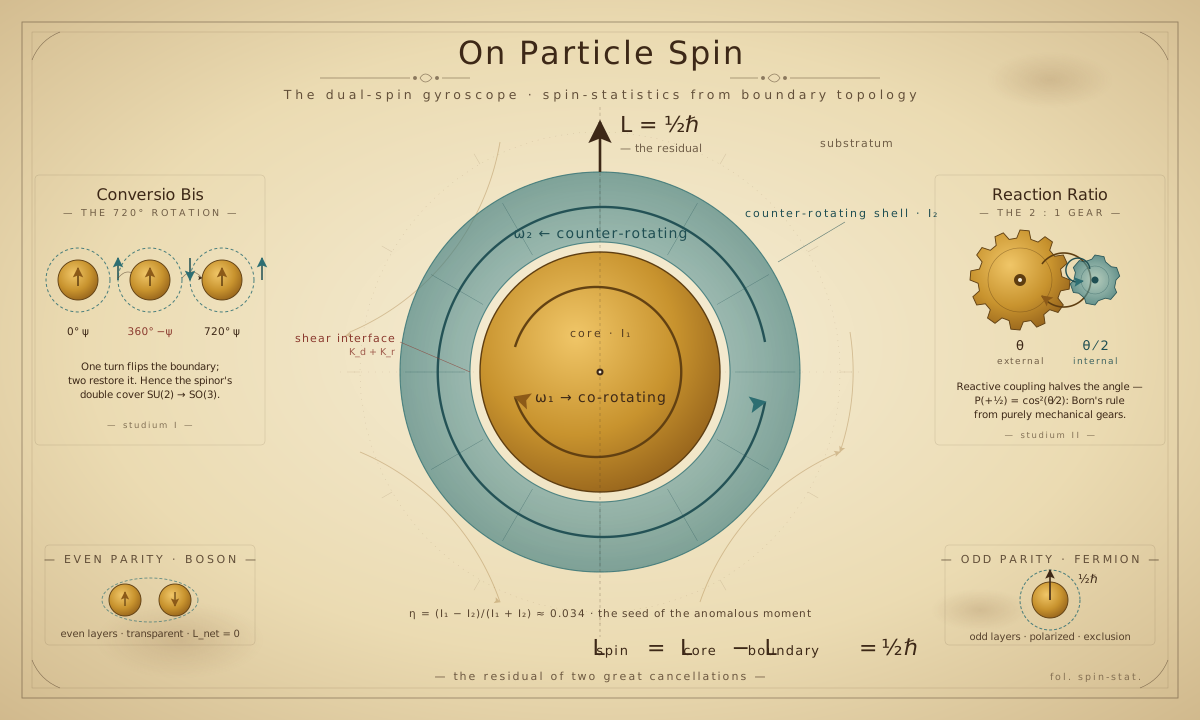
Spin-statistics in the substrate model appears naturally as a topological consequence of how many counter-rotating boundary layers separate a particle’s internal co-rotating flow from the external substrate. The fermion/boson distinction, the Pauli exclusion principle, and the 720° rotation property all emerge from a single geometric fact about nested counter-rotating shells in a superfluid.
The key insight: odd vs. even boundary parity
Consider an orbital system embedded in the substrate. It has some number of counter-rotating boundary layers between its internal co-rotating core and the external co-rotating substrate field. Call this the boundary parity of the system.
Even boundary parity — the co-rotating flow inside the system rotates in the same sense as the background substrate (because an even number of sign-flips returns you to the original chirality). These systems are bosons. The modon is the simplest example: two counter-rotating vortices locked together, the internal flow of each cancels the other, and the whole structure has zero net angular momentum relative to the background. It passes through the substrate transparently — no net polarization, no exclusion.
Odd boundary parity — the co-rotating flow inside rotates opposite to the background substrate (an odd number of sign-flips inverts the chirality). These systems are fermions. The electron is the key example: its internal orbital system has a definite chirality that opposes the background at the outermost boundary. It’s polarized — it creates a persistent asymmetry in the local substrate that other fermions of the same state cannot occupy without creating an irreconcilable boundary conflict.
This is the Pauli exclusion principle: two same-state fermions would require two opposite-chirality cores to share the same co-rotating channel. But a single co-rotating channel can only support one chirality direction. The second fermion’s boundary layer would have to share the first’s outermost counter-rotating layer, and two opposite cores trying to use the same counter-rotating buffer creates a shear instability that forces one of them into a different state — different energy, different angular momentum, different orbital.
Boundary Parity: Counting the Layers
The fermion/boson distinction reduces to a single geometric fact: how many counter-rotating boundary layers separate the particle’s internal co-rotating flow from the external substrate.
Each counter-rotating layer inverts the chirality of the flow passing through it. An odd number of inversions means the internal flow opposes the background — the particle is polarized relative to the substrate. An even number returns the chirality to match the background — the particle is transparent.
Odd boundary parity (fermions): The electron has one counter-rotating boundary shell. Its internal co-rotating core has opposite chirality to the background substrate. This persistent asymmetry is what the external world “sees” as charge, spin, and exclusion. Every fermion in the Standard Model — electrons, quarks, neutrinos — has an odd number of counter-rotating layers in its orbital system structure.
Even boundary parity (bosons): The modon (photon) has two counter-rotating vortices locked together. The internal flow of each cancels the other, so the pair carries no net circulation relative to the background — the lobes’ spins, which point along the normal to the dipole’s plane, sum to zero. It passes through the substrate transparently — no net chirality against the background, no exclusion. This is not zero angular momentum: the photon’s \pm\hbar is about its direction of travel, carried by the orientation of the pair as a whole, and it is exactly one unit because a two-lobed dipole returns to itself only after a full 360° turn (Photon as Modon § Spin and Orbit). The Cooper pair (Mapping to BCS Quantities) is another example: two fermions with opposite chirality form an orbital system complex whose combined boundary parity is even. The pair behaves as a boson — Bose-condensable, carrying supercurrent without dissipation — because the two odd-parity boundaries merge into an even-parity whole.
This definition is not a metaphor mapped onto the standard classification. It is a claim about the physical origin of that classification: the fermion/boson distinction, the Pauli exclusion principle, and the 720° rotation property all follow from boundary parity. The rest of this section derives each consequence.
The 720° Rotation from Boundary Topology
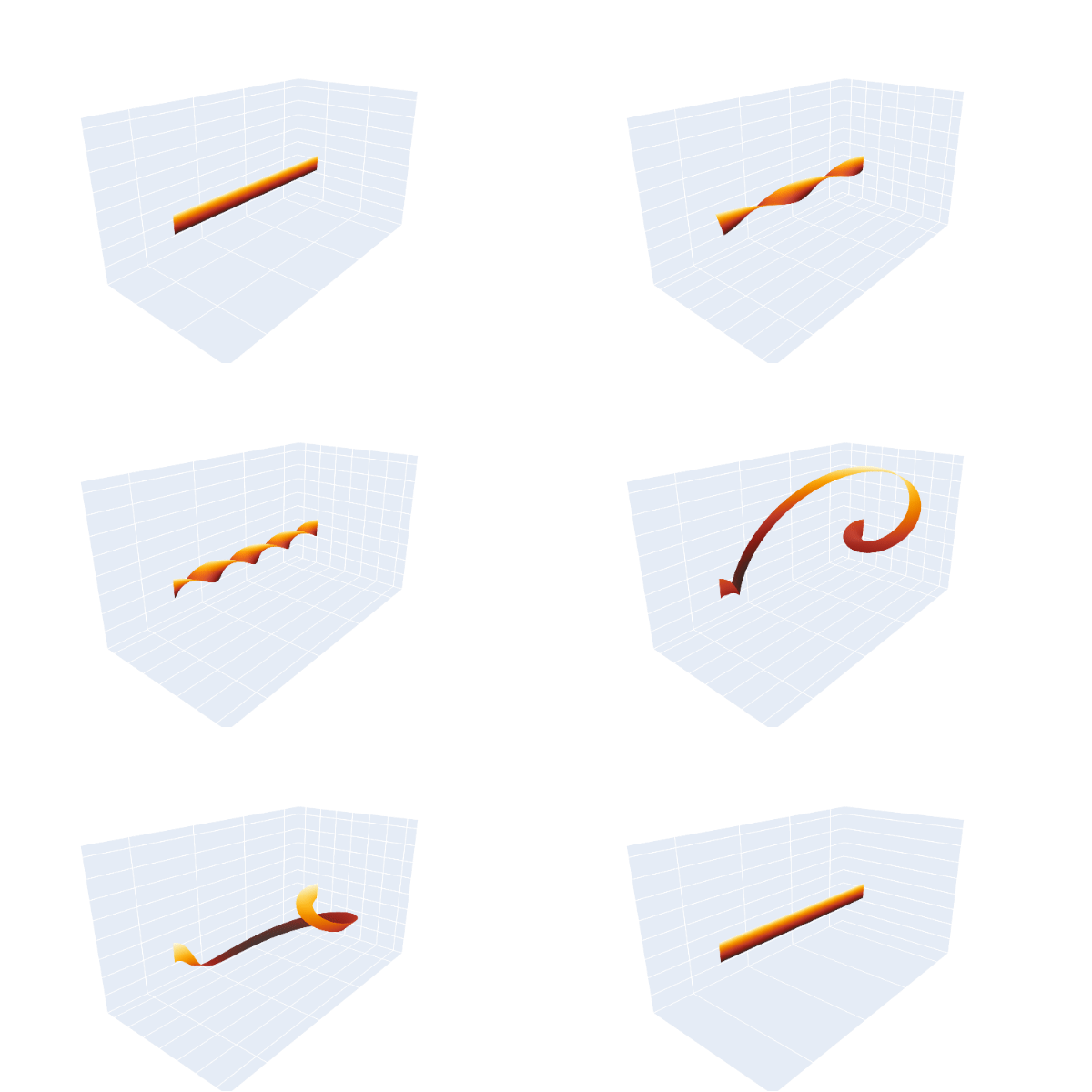
By Empetrisor - Own work, CC BY-SA 4.0, https://commons.wikimedia.org/w/index.php?curid=109647423
The Dirac belt trick shows an inner sphere connected to the external frame by ribbons. A 360° rotation tangles the ribbons. Only a second 360° rotation — 720° total — untangles them and restores the original configuration.
In the substrate picture, the “ribbons” are the counter-rotating boundary layers. Here is the physical mechanism:
When the co-rotating core rotates by 360°, it returns to its own original state — it has gone all the way around. But the counter-rotating boundary layer, spinning against the core and dragged along by shear coupling, has completed only a half-turn of its own phase cycle relative to the background. One full core rotation brings the counter-rotating layer to the anti-phase configuration: the “ribbons are tangled.”
A second 360° rotation (720° total) brings the counter-rotating layer through its full phase cycle, re-synchronizing it with the background substrate. The system is restored.
This maps directly onto the mathematics. In SU(2), a 360° rotation of a spinor multiplies it by -1 (phase inversion). In the substrate, that -1 is the physical state of the counter-rotating boundary being anti-aligned with the background after one full core rotation. The double-cover relationship SU(2) \to SO(3) is the statement that the counter-rotating layer has half the rotational periodicity of the co-rotating core.
For a boson (even boundary parity), the even number of counter-rotating layers means their phase shifts cancel in pairs. A 360° rotation returns everything — core and all boundaries — to the original configuration. No tangling. Spin-1, single-cover, SO(3) statistics.
Status: This is a geometric derivation. The half-periodicity of a single counter-rotating layer relative to the co-rotating core is a physical fact about coupled counter-rotating systems, demonstrable in any two-fluid experiment. It is the physical content of why SU(2) — not SO(3) — is the correct rotation group for fermions.
Pauli Exclusion as Boundary Conflict
Two same-state fermions would require two same-chirality cores to occupy the same co-rotating channel in the substrate. Each core needs a counter-rotating boundary to interface with the background. But a single co-rotating channel can sustain only one such boundary configuration — the standing-wave solution at that energy level has a unique counter-rotating flow pattern (this is the same boundary-matching uniqueness that quantizes hydrogen orbitals in Hydrogen Atom).
A second same-state fermion would need to share the first’s outermost counter-rotating layer. Two same-chirality cores trying to use the same counter-rotating buffer demand contradictory shear orientations from the shared interface. The result is a shear instability that forces one core into a different state — different energy, different angular momentum, different orbital.
This is Pauli exclusion from boundary topology: not a postulate, but a consequence of the fact that a single counter-rotating boundary layer has a unique steady-state flow pattern for each quantized energy level.
The Cooper pair loophole. Two fermions with opposite chirality (opposite spin) can share a co-rotating channel because their boundary demands are complementary, not contradictory. The counter-rotating layer between them serves as the outer boundary for one and the inner boundary for the other, with consistent shear orientation throughout. The result is an even-parity complex that behaves as a boson — this is the BCS Cooper pair of Conductors, and it is why superconductors carry lossless current: paired fermions form bosons that Bose-condense into a single macroscopic state. With the two-scale model, Cooper pairing gains a concrete physical picture: anti-phase Compton breathing between r_\text{eff} and \xi (Connection to Cooper Pairs).
The Dual-Spin Gyroscope Model
The three consequences above — 720° rotation, Pauli exclusion, and the fermion/boson distinction — follow from boundary parity as pure topology. The rest of this section builds the dynamical model: how a fermion’s internal counter-rotating structure responds to external fields, and why that response produces the exact measurement predictions of quantum mechanics.
The physical model
Strip away everything except the essential moving parts. A substrate fermion has:
Body 1 — the co-rotating core. A rotor with moment of inertia I_1 and angular velocity \boldsymbol{\omega}_1. This is the electron’s internal vortex core, spinning at the electron-inner-scale velocity (v_\text{rot,inner} = 0.776c, not the outer lattice rotation). Angular momentum: \mathbf{L}_1 = I_1\boldsymbol{\omega}_1.
Body 2 — the counter-rotating boundary shell. A second rotor surrounding Body 1, with moment of inertia I_2 and angular velocity \boldsymbol{\omega}_2 \approx -\boldsymbol{\omega}_1. Angular momentum: \mathbf{L}_2 = I_2\boldsymbol{\omega}_2.
The coupling interface. The shear layer between Body 1 and Body 2 transmits torque through dc1 particles crossing the boundary — the same mutual friction mechanism that generates gravity (Gravity), but operating at the internal orbital-system scale where the crossing fraction is much higher (the mutual friction parameter \alpha_{mf} from the Weinberg angle derivation, Weinberg Angle).
From the HVBK mutual friction formalism, the coupling torque has two components:
\boldsymbol{\tau}_\text{coupling} = -K_d\,(\boldsymbol{\omega}_1 - \boldsymbol{\omega}_2) - K_r\,\hat{\mathbf{s}} \times (\boldsymbol{\omega}_1 - \boldsymbol{\omega}_2)
where K_d is the dissipative coupling coefficient (the B term — transfers energy between core and boundary), K_r is the reactive (gyroscopic) coupling coefficient (the B' term — redirects flow without energy transfer), and \hat{\mathbf{s}} is the unit vector along the net spin axis.
The reactive term K_r does all the interesting work. It is the term that makes this a gyroscope rather than a damped rotator. In superfluid helium, B' is typically comparable to or larger than B — reactive coupling dominates. We keep both.
Spin-½ as a net angular momentum
The total spin angular momentum measured externally is:
L_\text{spin} = L_\text{core} - L_\text{boundary} = \hbar/2
This is the first key result: spin-½ is the residual — the difference between the co-rotating core and counter-rotating boundary. The individual angular momenta of core and boundary are both much larger than \hbar/2, but they nearly cancel. The tiny residual is the measured spin.
This is structurally identical to how the framework handles mass: the proton’s mass is 938 MeV, but the quark rest masses are only ~9 MeV — the rest is the net result of enormous co-rotating and counter-rotating energies nearly canceling. Spin works the same way. The electron is not “barely spinning” — it is spinning violently in both directions, and the residual is \hbar/2. With the two-scale model, the individual angular momenta can be estimated: L_\text{core} \approx 7.6\,\hbar and L_\text{boundary} \approx 7.1\,\hbar (counter-rotating), with most of the rotating mass being substrate material entrained by the electron’s effective quantum.
Reduction to spin variables
Define the net spin vector \mathbf{S} = \mathbf{L}_1 + \mathbf{L}_2 and the relative angular momentum \boldsymbol{\Delta} = I_1\boldsymbol{\omega}_1 - I_2\boldsymbol{\omega}_2.
In an external magnetic field \mathbf{B} = B\hat{z}, the equations of motion separate cleanly:
Net spin (external dynamics):
\frac{d\mathbf{S}}{dt} = -\gamma\,\mathbf{S} \times \mathbf{B}
Standard Larmor precession. The net spin precesses around \mathbf{B} at the Larmor frequency \omega_L = \gamma B. This is what a detector sees from outside.
Relative dynamics (internal):
\frac{d\boldsymbol{\Delta}}{dt} = -\frac{2K_d}{I_\text{eff}}\,\boldsymbol{\Delta} - \frac{2K_r}{I_\text{eff}}\,\hat{\mathbf{s}} \times \boldsymbol{\Delta} + \eta \cdot \boldsymbol{\tau}_\text{ext}
where I_\text{eff} = I_1 I_2/(I_1 + I_2) is the reduced moment of inertia and \eta = (I_1 - I_2)/(I_1 + I_2) is the asymmetry parameter — the ratio by which the core and boundary moments of inertia differ.
Three terms:
Dissipative (-2K_d\boldsymbol{\Delta}/I_\text{eff}): damps the relative motion. If alone, the core and boundary would synchronize and the internal degree of freedom would die.
Reactive (-2K_r\,\hat{\mathbf{s}} \times \boldsymbol{\Delta}/I_\text{eff}): makes \boldsymbol{\Delta} precess around \hat{\mathbf{s}} at the internal precession frequency \omega_\text{internal} = 2K_r/I_\text{eff} — comparable to the Compton frequency \omega_c = m_0 c^2/\hbar = 7.76 \times 10^{20} rad/s.
External coupling (\eta \cdot \boldsymbol{\tau}_\text{ext}): the external field reaches the internal dynamics through the asymmetry. If I_1 = I_2 exactly, \eta = 0 and measurement cannot reach in. The finite asymmetry is what allows measurement to change the internal state.
Measurement: Phase-Locking to Discrete States
Where discreteness emerges
The equations above are continuous — \Delta_z can take any value, and the transverse nutation damps smoothly. The two discrete spin outcomes come from the boundary-matching condition at the core-boundary interface.
The counter-rotating dc1 particles crossing the interface carry quantized vorticity \kappa_q = h/m_\text{eff}. The coupling coefficients K_d and K_r are not constants — they depend on the vortex line density in the counter-rotating layer, which self-regulates through the Vinen equation until the counter-rotating layer satisfies the boundary-matching conditions.
For a spherical shell with a single counter-rotating layer, the angular matching condition gives:
p \cdot \frac{J_{l+1/2}(p \cdot R_1)}{J_{l-1/2}(p \cdot R_1)} = -\kappa_\text{ext} \cdot \frac{K_{l+1/2}(\kappa_\text{ext} \cdot R_2)}{K_{l-1/2}(\kappa_\text{ext} \cdot R_2)}
For the spin degree of freedom, l = 1/2 (half-integer because of the single counter-rotating layer — the same reason SU(2) gives half-integer representations). This matching condition has exactly two solutions for the z-component of angular momentum:
m_l = +1/2 \qquad\text{and}\qquad m_l = -1/2
No intermediate values. Configurations with other \Delta_z values create velocity-field discontinuities at the interface that are unstable and relax (via modon emission) to one of the two allowed states. The matching condition acts as a discrete filter on the continuous nutation dynamics.
The measurement process
Phase 1 — Approach. The electron enters the magnetic field region. The core-boundary system has an arbitrary orientation of \boldsymbol{\Delta} relative to the field, with internal precession at \omega_\text{internal} ongoing.
Phase 2 — Field onset. The substrate flow pattern from the magnet reaches the outer boundary. The external torque begins driving the boundary. The asymmetry \eta couples this drive to the internal dynamics.
Phase 3 — Nutation. The transverse component \Delta_+ oscillates at \omega_\text{internal} while the axial component \Delta_z is pushed by the external drive. The counter-rotating boundary’s vortex density adjusts through the Vinen equation, searching for a state that satisfies boundary matching.
Phase 4 — Phase-locking. The nonlinear coupling drives \Delta_z toward one of the two allowed values. Which one depends on the instantaneous precession phase \varphi_0 at the moment of field onset — set by the electron’s history, the local substrate flow, and the exact field geometry. All of these are deterministic but practically unknowable: contextual determinism, not randomness.
The locking timescale
\tau_\text{lock} \approx 1/(2\alpha_{mf} \cdot \omega_c) \approx 6.4 \times 10^{-21}\;\text{s}
One Compton period. Faster than any lab timescale, any Larmor precession period, any transit time through the magnet. This is why spin measurement appears instantaneous — the nonlinear relaxation operates at the Compton frequency, far below experimental time resolution.
Non-commuting measurements
After the first measurement (z-axis), the counter-rotating boundary has reorganized into a new steady-state flow pattern with axial symmetry around z. The transverse nutation has damped. All information about the pre-measurement orientation perpendicular to z has been erased by the boundary reorganization.
A second measurement along x now depends on the phase of the z-symmetric pattern relative to x. But z-aligned axial symmetry means all x-phases are equally present — the outcome is 50/50 regardless of the first result. This is the physical content of non-commuting observables: measuring spin-z reorganizes the boundary into a z-symmetric configuration, destroying x-information.
The \cos^2(\theta/2) Law from Reactive Gear Reduction
This is the central quantitative test. Prepare an electron with spin +\hbar/2 along z, then measure along an axis \hat{\mathbf{n}} tilted by angle \theta from z.
After the z-measurement, the internal state has \Delta_z locked to its m = +1/2 value and \Delta_+ \approx 0 (transverse nutation damped, with small residual substrate fluctuations). The counter-rotating boundary’s vortex lines are arranged in circles around the z-axis, forming a distribution \rho_\text{vortex}(\theta') \propto \sin(\theta').
When the second field is applied along \hat{\mathbf{n}}, the core and boundary respond differently to the tilt. The core (Body 1, spinning at +\omega) sees the tilt as angle \theta. The boundary (Body 2, spinning at -\omega) sees it as -\theta relative to its own angular momentum. But they are not independent — the reactive coupling K_r\,\hat{\mathbf{s}} \times \boldsymbol{\Delta} forces them to track each other.
The reactive coupling introduces a 90° phase shift between the external tilt and the internal response. When the net spin \mathbf{S} precesses around the new field axis by angle \theta, the relative variable \boldsymbol{\Delta} precesses by only \theta/2. The counter-rotating layer acts as a 2:1 gear reduction for angular information.
Physically: the eigenfrequencies of the coupled core-boundary system are \omega_\pm = \omega_L \pm \omega_\text{internal}/2. After the external axis has precessed through angle \theta, the internal state has accumulated phase \theta/2. This is the dual-spin gyroscope version of the belt trick — the counter-rotating coupling creates a 2:1 ratio between external and internal angular evolution.
The probability of locking to +\tfrac{1}{2} along \hat{\mathbf{n}} is then proportional to the square of the +\tfrac{1}{2} component’s amplitude:
\boxed{P(+\tfrac{1}{2}) = \cos^2(\theta/2)}
\boxed{P(-\tfrac{1}{2}) = \sin^2(\theta/2)}
These sum to 1 and reproduce the exact quantum mechanical prediction. The half-angle is not a mathematical artifact — it is a mechanical consequence of two counter-rotating bodies coupled through a reactive (gyroscopic) interface.
The g-Factor and the Anomalous Magnetic Moment (C9 Setup)
In a magnetic field B, the energy splitting between spin-up and spin-down is \Delta E = g_e \cdot \mu_B \cdot B. The g-factor has a direct mechanical origin in the dual-spin model.
Why g \approx 2
The external field couples to both the co-rotating core and the counter-rotating boundary, but with opposite signs (because they spin opposite ways). The net coupling is proportional to 2L_\text{spin} = 2 \times \hbar/2 = \hbar, giving g = 2. The factor of 2 is not mysterious — it is the geometric consequence of measuring the difference between two counter-rotating contributions to the magnetic moment.
Why g \neq exactly 2
The core and boundary do not have identical moments of inertia. The core is the tightly bound co-rotating dc1 flow around the phase singularity (slightly more massive). The boundary is a thinner shell of counter-rotating eddies (slightly less massive). This asymmetry is the parameter \eta:
\eta = (I_1 - I_2)/(I_1 + I_2)
The asymmetry modifies the effective coupling between the external field and the internal state (it is the same \eta that appears in the equations of motion in the dual gyroscope model). The anomalous magnetic moment emerges from this:
g_e = \frac{2}{1 - \eta^2} \approx 2(1 + \eta^2) \quad\text{for}\quad \eta \ll 1
(g - 2)/2 = \eta^2
The measured anomalous moment \alpha/(2\pi) \approx 0.00116 constrains:
\eta = \sqrt{\alpha/2\pi} \approx 0.034
Why the asymmetry equals \sqrt{\alpha/(2\pi)}. This is not a coincidence or a phenomenological fit — it has a physical mechanism. The electron’s own electromagnetic field perturbs its boundary structure. The co-rotating core generates a charge-associated substrate flow that radiates and reabsorbs virtual modons (photons) from the coherence dress. This modon cloud exerts a radiation pressure on the counter-rotating boundary shell, slightly redistributing substrate mass between core and boundary — inflating the co-rotating core at the expense of the counter-rotating shell.
The coupling between the electron’s charge flow and its own modon field is electromagnetic, so the leading self-energy correction to the moment of inertia scales as \alpha. The geometric factor comes from averaging this perturbation over the counter-rotating boundary shell: for a single spherical shell, the angular integration introduces a factor of 1/(2\pi) (the leading Fourier component of the self-energy perturbation on the shell has l = 1, and the angular normalization supplies the 2\pi denominator). The result:
\eta^2 = \frac{\alpha}{2\pi}
The numerator is the electromagnetic coupling strength — the same \alpha derived from \sin^2\theta_W via the C6/C8 chain. The denominator is the geometric factor from shell averaging. Together they reproduce the Schwinger correction because both describe the same physics: the leading electromagnetic self-energy correction to the electron’s magnetic moment, expressed in substrate language as a perturbation to the core-boundary mass ratio.
This also resolves a puzzle from the detailed computation (spin-stats-body-equations.qmd SS14c): the naive estimate of \eta using only the effective quantum’s mass gives \eta_\text{naive} = 1/3 — ten times too large. The discrepancy disappears once the entrained substrate mass is included: the modon cloud organizes \sim\!93\% of the total rotating moment of inertia into a nearly symmetric distribution between co- and counter-rotating regions. The residual asymmetry \eta^2 = \alpha/(2\pi) is the electromagnetic perturbation on top of this nearly symmetric background.
The core and boundary moments of inertia differ by about 3.4%. This is constraint C9 — the same boundary geometry that explains why fermions are fermions also constrains the electron’s anomalous magnetic moment.
The C6/C8/C9 constraint triangle
The connection between \eta and \alpha/(2\pi) is not an isolated result. It locks into the constraint web through a single geometric parameter — the s-wave scattering phase shift \delta_0 = 18.48° at the half-quantum vortex boundary:
- C8 (Weinberg angle): \sin^2\theta_W = \alpha_{mf}/(1 + \alpha_{mf}), where \alpha_{mf} = \tfrac{1}{2}\sin 2\delta_0 (Weinberg Angle)
- C6 (fine structure constant): \alpha = g^2\sin^2\theta_W/(4\pi), where g^2 = 4\sin^2\delta_0 (Fine Structure Constant)
- C9 (anomalous magnetic moment): (g-2)/2 = \eta^2 = \alpha/(2\pi) — the dual-spin asymmetry equals the electromagnetic self-energy correction because the electron’s modon cloud perturbs the boundary MOI at O(\alpha) with geometric factor 2\pi
One phase shift determines all three. The Weinberg angle is the input that fixes \delta_0. The fine structure constant and anomalous magnetic moment are then predictions — both within ~1.5% of measured values at tree level. The C9 result is now physically grounded: the Schwinger correction \alpha/(2\pi) is not merely identified with \eta^2 but explained by the same electromagnetic self-energy mechanism that QED computes perturbatively, expressed here as a moment-of-inertia perturbation from the electron’s own modon cloud.
The muon as an electron with an internal fold
The C9 mechanism was built for the electron, but it makes a sharp statement about the other charged leptons — and helps explain a precision anomaly in particle physics, the muon’s g-2. The key observation is structural: the \eta^2 = \alpha/(2\pi) term carries no explicit mass. It is a pure shell-averaging result — the electron’s own modon cloud perturbs the boundary moment of inertia at O(\alpha), with the 2\pi coming from angular integration over the counter-rotating shell. Nothing in that derivation knows the electron’s mass. So the substrate predicts, with no extra work, that the leading anomaly is universal across e, μ, τ:
\left(\frac{g-2}{2}\right)^\text{leading}_\ell = \eta^2 = \frac{\alpha}{2\pi}\qquad\text{for every charged lepton }\ell .
This is exactly the QED Schwinger term, which is famously lepton-independent at leading order. The substrate reproduces its universality from geometry rather than positing it.
Why the muon is the sensitive probe. The muon is not a different object — it is the same dual-spin gyroscope read at a 120^\circ turn of the \mathbb Z_3 generation clock (Fermion Generations), carrying one internal fold — an extra counter-rotating boundary layer — where the electron has none (Higgs Field). That extra fold has its own moment-of-inertia asymmetry, and because the muon is 206.8\times heavier its Compton scale is 206.8\times smaller, so its boundary probes the substrate closer to its own internal structure — the vortex-core / chirality-condensate scale E_\text{core}\sim TeV that the framework already carries (Higgs Field). A granularity correction to \eta from that layer therefore scales as (m_\ell/E_\text{core})^2:
\boxed{\;\Delta\!\left(\frac{g-2}{2}\right)_\ell^\text{substrate} \;\sim\; \kappa\left(\frac{m_\ell}{E_\text{core}}\right)^2\;}
with \kappa a boundary coupling of order \alpha/\pi (a loop-order dressing) up to \alpha_{mf}\approx0.30 (a boundary-order dressing). This is the substrate’s own derivation of the standard effective-field-theory statement \Delta a_\ell \propto (m_\ell/\Lambda)^2 — and it is why the muon is (m_\mu/m_e)^2 \approx 4.3\times10^4 times more sensitive to new short-distance physics than the electron. The framework recovers the well-known sensitivity hierarchy from its geometry, with \Lambda identified as a specific substrate scale rather than left free.
What the scaling law predicts. Taking E_\text{core}\sim1 TeV:
| Lepton | (m_\ell/E_\text{core})^2 | \Delta a_\ell (loop-order \kappa\sim\alpha/\pi) | Status |
|---|---|---|---|
| electron | 2.6\times10^{-13} | \sim6\times10^{-16} | invisibly small — consistent with a_e matching QED to 10^{-12} |
| muon | 1.1\times10^{-8} | \sim\mathbf{3\times10^{-11}} | small; sits inside the current residual band |
| tau | 3.2\times10^{-6} | \sim7\times10^{-9} | (m_\tau/m_\mu)^2\approx283\times the muon shift; not yet measurable |
The hard, falsifiable content is the ratio law: whatever residual survives in the muon, the substrate ties the electron and tau residuals to it by m_\ell^2, with no freedom. A measured \Delta a_e or \Delta a_\tau that broke the m_\ell^2 scaling would falsify the fold-correction picture directly.
Consistency with the 2026 data — and what the data selects. The clean 5σ muon anomaly of 2021 has largely dissolved: the final Fermilab measurement (0.14 ppm) and the 2025 Theory Initiative white paper — which adopted a lattice-QCD consensus for hadronic vacuum polarization — now agree to about 0.5σ (CERN Courier; Muon g-2 Theory Initiative White Paper 2025; Fermilab final result, arXiv:2606.17323; overview), with the remaining tension migrated into the data-driven-vs-lattice HVP disagreement. This is a good outcome for the substrate: the framework predicts the muon residual is small, not large. It also lets the data pick the coupling — the loop-order \kappa\sim\alpha/\pi end lands \Delta a_\mu\sim3\times10^{-11}, comfortably inside the current |\Delta a_\mu|\lesssim10^{-9} window, while a boundary-order \kappa\sim\alpha_{mf} would give \sim3\times10^{-9}, now in mild tension with the near-agreement. The 2026 near-null result therefore selects the loop-order dressing within the framework.
Breadcrumb — the scale fork. {#g2-scale-fork} The estimate above takes the correction’s UV scale to be the vortex-core scale E_\text{core}\sim TeV. There is a second candidate, and the two give physically different regimes. The WIP-5 \alpha-closure runs its loop between two far lower scales — the CdGM minigap \omega_0 = \tfrac14\alpha_{mf}m_ec^2 \approx 38 keV in the infrared and the doublet bandwidth E_F = m_\text{eff}c^2 = 1.70 MeV in the ultraviolet (the same doorway that closes the \alpha, (g-2), and Lamb-shift gaps together; note E_F is not E_\text{core} — see the scale glossary). If the fold correction is controlled by that doorway rather than by E_\text{core}, the (m_\ell/\Lambda)^2 \ll 1 expansion does not merely weaken — it fails outright for the two heavy leptons:
\frac{m_e}{E_F} = \alpha_{mf} = 0.301, \qquad \frac{m_\mu}{E_F} = 62.2, \qquad \frac{m_\tau}{E_F} = 1046 .
The electron sits inside the doorway band — and not by accident, since m_e = \alpha_{mf}m_\text{eff} makes m_e/E_F = \alpha_{mf} an identity, not a coincidence. Both the muon and the tau sit far above it, where a (m_\ell/\Lambda)^2 perturbation is meaningless and the correction would have to be an O(1) resummed effect.
So the two forks remain distinguishable, but the second horn has moved and sharpened. The E_\text{core} reading gives the clean m_\ell^2 ratio law across all three leptons. The doorway reading predicts a break between the electron and the muon — not, as an earlier draft of this breadcrumb had it, a break at the muon. That earlier version rested on a pre-resolution estimate putting \omega_0 in the tens of MeV, which would have had m_\mu\approx106 MeV straddling the minigap; WIP-5 has since derived \omega_0 = \Delta^2/E_F \approx 38 keV, and nothing straddles anything. Resolving which scale enters is the same boundary-cross-section calculation the Yukawa program already owes — and it would turn the order-of-magnitude \Delta a_\mu here into a number. This thread should not be lost: it is the one place the framework’s two internal scales make opposite predictions for a measured quantity, and the corrected version makes the contrast starker, since the doorway reading now forbids the ratio law for \mu and \tau outright rather than bending it.
The puzzle moved to the hadron: HVP and the two-fold seam
The section above tracks the muon anomaly’s leptonic side, where the framework’s claim is that the residual is small. But between 2021 and 2026 the anomaly did not vanish so much as relocate, and where it landed is a place the framework has something specific to say.
Where it went. The Standard Model prediction for a_\mu hinges almost entirely on the leading hadronic vacuum polarization, a_\mu^\text{LO-HVP}, and two determinations of it disagree: the data-driven dispersive route through measured e^+e^-\to hadrons cross sections gives 6931(40)\times10^{-11}, while the BMW lattice gives 7075(55)\times10^{-11} — a 2\% gap ([R141]). Three results then framed the puzzle sharply:
- New physics is excluded. Di Luzio et al. ([R141]) showed that any light Z' hiding in \sigma_\text{had} needs |\epsilon|\approx10^{-2} and is killed — irrespective of its mass — by at least two independent bounds among LEP-II \sigma_{q\bar q}, BaBar Z'\to e^+e^-, the electron g-2, and the m_{\pi^+}^2-m_{\pi^0}^2 isospin constraint.
- CMD-3 measures the pion channel high. With 34\times10^6 events and 0.7\% systematics at the \rho peak, CMD-3 ([R139]) finds a_\mu^{\pi\pi,LO}(0.6\text{–}0.88\ \text{GeV}) = (379.35\pm0.30\pm2.95)\times10^{-10}, standing 2.5–5\% above every prior measurement (CMD-2 366.5, KLOE 360.6, BaBar 370.1, BESIII 361.8) — moving the data-driven number toward the lattice.
- The needed shift is localized to the \rho. Davier et al. ([R140]) found that a common \sim5\% increase confined to [0.63, 0.92] GeV reconciles a_\mu^\text{LO-HVP}, the intermediate-window observable, and the running of \alpha simultaneously — while rescaling below 0.63 GeV does not work at all.
So the live question is no longer “does the muon see new physics.” It is: why do independent measurements of the pion form factor at the \rho peak disagree at the few-percent level, and why does the lattice want that one region higher?
The framework has a stake in this, and it points somewhere specific. The fold correction above predicts the muon’s own residual is small, so the framework needs the discrepancy to live on the hadronic side. It does not get to leave it there as a hope: it makes a structural claim about which hadronic ingredient is wrong.
In the substrate, a meson is a two-fold junction — a quark and an antiquark interlocked with a single counter-rotating seam between them (Proton Core § Antiquarks and mesons) — as against the baryon’s three-fold Borromean knot. And the framework’s central hadronic claim is that essentially all of a hadron’s mass is counter-rotating boundary energy, not core: 99% of the proton’s 938 MeV lives in the seam (Mass as Leaking Rotational KE). Treating a pion as a point scalar therefore discards precisely the structure that carries the energy — and the framework predicts the error surfaces first in the virtual sector, where a loop momentum probes inside the seam rather than scattering off the object as a whole.
This is measured, not conjectured. CMD-3’s forward-backward charge asymmetry ([R139]) is a direct test of exactly that approximation. Conventional scalar QED — the point-like-pion treatment used for radiative corrections throughout this field — misses the measured asymmetry by
\delta A_\text{sQED} = (-105 \pm 2.3)\times10^{-4},
while generalized vector-meson dominance, which carries the pion’s extended structure into the loop integral, lands at \delta A_\text{GVMD} = (-2.9\pm2.3)\times10^{-4}. CMD-3 localizes the failure precisely: it “comes from the virtual corrections, when M_{\pi\pi}\simeq\sqrt s,” and traces to “the calculation of the box like diagrams within the sQED assumption.” That is a model-independent statement that the pion’s internal boundary structure matters inside a virtual loop, at the percent level, at the \rho peak — the framework’s claim, measured.
Three consequences follow, and each matches a feature the puzzle actually has:
- The sign is right. The point-scalar treatment under-counts the seam. Restoring it raises the effective coupling in the resonance region — data-driven moves up, toward the lattice.
- The localization is right. On the \rho, the two-fold seam is resonant: the counter-rotating boundary sits at its matched standing-wave condition and its stored energy is maximal. Near the 2m_\pi threshold the two pions are nearly free and a point treatment is much closer to correct. The framework therefore predicts a structure correction peaked at the resonance and dying toward threshold — which is the shape Davier’s interval scan selects, including its failure below 0.63 GeV.
- It survives the exclusion. This is a systematic in the Standard Model’s own radiative corrections, not a new state, so every bound Di Luzio erects — all of which constrain new mediators — passes straight through it.
There is a reflexive point worth recording. The lattice computes the Euclidean current–current correlator, which is structure-inclusive by construction; the dispersive route must correct measured cross sections to “bare” using a model of the pion — CMD-3’s own extraction applies final-state radiation “in the pointlike approximation.” And the framework’s WIP-5 \alpha-closure borrows this same dispersive machinery for its \Pi(0), where it found it could not borrow QED’s threshold constant -5/3 and had to compute C_\text{sub} = -1.85 from the exact BdG lineshape, with the resonance carrying 20\% of the total. Same lesson in two sectors: the resonance region is where the few-percent action hides, and a borrowed point-like constant is where it hides.
Honest assessment. This is a direction-and-shape claim, and nothing more. The framework has no calculation of the pion form factor, no derivation of m_\rho, and no prediction of the 5\% coefficient — the vector-meson sector is essentially undeveloped here. It should also be said plainly that CMD-3 presents its asymmetry result as a validation of its fiducial-volume systematics, not as an explanation of its high cross section; the asymmetry finding does not by itself account for the 5\%. What it establishes is that the mechanism class — point-pion failure in the virtual sector at the \rho — is real, measurable, and sitting exactly where the reconciliation has to happen.
What would settle it. The framework’s reading is falsifiable in a way the new-physics readings are not. If the \rho-peak discrepancy is a structure systematic in the radiative corrections, then (i) MUonE’s spacelike \mu e determination of \Delta\alpha_\text{had}, which never passes through a point-pion FSR correction, should land on the lattice side; and (ii) recomputing the C-odd and FSR corrections for the older \pi^+\pi^- datasets with GVMD-class structure in the loops should move them up, and move them further the closer they sit to the \rho. If instead the older measurements are confirmed at their published values with structure-corrected radiative corrections, or if MUonE lands on the data-driven side, this reading is wrong and the discrepancy is detector systematics after all.
Status: What Is Derived, What Is Open
| Claim | Substrate mechanism | Status |
|---|---|---|
| Fermion/boson distinction | Odd vs. even boundary parity | Definition — the thesis of this section |
| 720° rotation | Counter-rotating layer has half the rotational periodicity of core | Geometric derivation — follows from boundary topology |
| Pauli exclusion | Same-state fermions create irreconcilable boundary shear | Physical argument — follows from boundary-matching uniqueness |
| Spin-½ as L_\text{core} - L_\text{boundary} | Net residual of counter-rotating angular momenta | Derived — same cancellation mechanism as proton mass |
| Two discrete outcomes | Boundary-matching quantization at l = 1/2 | Derived — from Bessel matching at counter-rotating interface |
| \cos^2(\theta/2) statistics | 2:1 reactive gear reduction from counter-rotation | Derived — purely mechanical result from coupled gyroscopes |
| Non-commuting measurements | Boundary reorganization erases transverse phase | Derived — from axial symmetry of locked state |
| \tau_\text{lock} \sim 10^{-21} s | Compton-frequency internal dynamics | Derived — from HVBK coupling parameters |
| g \approx 2 | Counter-rotating charge coupling geometry | Derived — follows from opposite-sign contributions |
| (g-2)/2 = \alpha/(2\pi) | Core-boundary moment asymmetry \eta \approx 0.034 | Physically argued — EM self-energy mechanism identified; GP confirmation in progress |
| Universal leading (g-2)/2 across e, μ, τ | \eta^2 carries no explicit mass — pure shell average | Derived — reproduces QED’s lepton-independent Schwinger term |
| Muon-sensitive residual \Delta a_\ell \sim \kappa\,(m_\ell/E_\text{core})^2 | Internal-fold correction at the vortex-core scale | Scaling argued — recovers EFT (m_\ell/\Lambda)^2; coefficient open, scale fork unresolved |
| HVP discrepancy sits in the \rho-peak radiative corrections | Point-scalar pion discards the two-fold counter-rotating seam that carries the energy | Direction argued — sign, localization, and new-physics-immunity all match; no number, no form factor (§ HVP) |
| Cooper pair as even-parity boson | Anti-phase Compton breathing → promenading pair | Interpretive mapping — concrete breathing range now known |
| Nuclear spin-½ (proton) | Same gyroscope, same m_\text{eff}, same per-seam \alpha_{mf}=0.3008 over N\approx1836 seams | Structural consistency — topological results apply; dynamical regime differs |
| Background chirality → weak force | Left-handed fermions have extra boundary stress | Plausible — needs derivation of SU(2)_L coupling constants |
| Full spin-statistics theorem (CPT) | Not yet attempted | Open — connecting to CPT requires full Lorentz group derivation |
The strongest results are topological: 720° rotation and Pauli exclusion follow from boundary parity without free parameters. The measurement dynamics (two outcomes, \cos^2(\theta/2), non-commutativity) are derived from HVBK-coupled gyroscope equations with quantized boundary matching.
Computing \eta. The weakest link — \eta \approx 0.034 — has advanced from “future work” to “physically argued.” The electromagnetic self-energy mechanism identifies why the asymmetry equals \sqrt{\alpha/(2\pi)}: the electron’s own modon cloud perturbs the core-boundary mass distribution at O(\alpha), with a geometric factor of 2\pi from averaging over the counter-rotating shell. Three exact structural identities now hold (see spin-stats-body-equations.qmd SS14b): (1) \omega_\text{orb} = 2\omega_c, (2) m_\text{eff}\,r_\text{eff}^2 = \hbar/(2\omega_c), and (3) I_1 - I_2 = \tfrac{1}{2}m_\text{eff}\,r_\text{eff}^2. The remaining quantitative step — computing I_1 + I_2 from the substrate density profile — is a well-posed calculation with all parameters known. If \eta can be derived from the GP equation to match \sqrt{\alpha/(2\pi)} to \sim 1\%, the anomalous magnetic moment upgrades from “physically argued” to a zero-parameter prediction.
Nuclear Spin and the Universal Effective Quantum
The proton is also spin-½. The dual-spin mechanism applies at the nuclear scale with the same building block: the effective quantum is a substrate property (m_\text{eff} \approx 1.70 MeV/c^2), not specific to the electron (see Mass as Leaking Rotational Kinetic Energy). The per-boundary mutual friction coupling is the same in both sectors — \alpha_{mf} = 0.3008, capped at \tfrac12 by the Kopnin relation — and the nuclear figure \alpha_{mf}^{(N)} \approx 552 is a seam count times that coupling, N\alpha_{mf} with N\approx1836 (Mass as Leaking Rotational Kinetic Energy). What places the nuclear sector in a different regime is therefore not coupling strength but seam multiplicity and confinement density.
The topological spin-statistics results carry over unchanged: odd boundary parity → fermion → spin-½ → 720° rotation → Pauli exclusion. These are geometric consequences of how many counter-rotating layers separate internal from external flow, independent of coupling strength.
The dynamical results (EOM, locking timescale, \cos^2(\theta/2) law) require regime-appropriate treatment. Note that the superluminal velocity earlier attributed to “nuclear coupling” was an artifact of substituting the count-product 552 into v_\text{rot,inner} = c\sqrt{2\alpha_{mf}}, a formula whose \alpha_{mf} is the per-boundary leak; with the correct \alpha_{mf} = 0.3008 the rim speed is the same 0.776\,c in both sectors. The nuclear sector still needs relativistic extension of the non-relativistic HVBK framework, but for the ordinary reason — the energy density, not a runaway coupling. This is consistent with the proton mass budget (Mass as Leaking Rotatinal Kinetic Energy): 99% of the proton’s 938 MeV is counter-rotating boundary energy — the nuclear gyroscope is dominated by its boundary, not its core.
Where Baryon Spin Lives: the Λ and the Proton
If spin is a residual, the core minus its counter-rotating boundary, then a composite’s spin does not have to sit in its constituents’ cores. It sits wherever the boundary ledger is left open. That turns two measurements that look contradictory into one rule.
The proton spin puzzle. Polarized deep-inelastic scattering finds that the quarks’ own spins carry only about 35% of the proton’s \hbar/2. STAR’s polarized-jet program attributes about half of the rest to gluon spin, and the remainder is orbital ([R217] summarises the status). In the substrate this is the expected outcome, not a crisis. The proton’s 938 MeV is about 99% counter-rotating sheath (Mass as Rotational Energy). Its \hbar/2 is the small difference between a very large core angular momentum and a very large boundary one, and the boundary is a web of seams that the framework identifies with the gluons (Standard Model § Bosons). Nothing in that structure requires the residual to sit on the three cores. Angular momentum held in seam geometry is measured as gluon spin plus orbital angular momentum.
The Λ is different, and STAR has just seen it. Spin-aligned \Lambda\bar\Lambda pairs at RHIC ([R217]) favour the plain SU(6) quark model, in which the strange quark carries all of the \Lambda’s spin, and disfavour the Burkardt–Jaffe model, which carries the proton’s puzzle over to the \Lambda by flavour symmetry (Spin Pairs From the Vacuum). Boundary parity explains why. In the \Lambda (uds) the u and d are in isospin 0, which forces their pair into spin 0. Their two odd-parity boundaries merge into an even-parity, closed whole, as a Cooper pair’s do (Connection to Cooper Pairs). A closed seam has remainder zero, so the strange quark’s boundary is the \Lambda’s only open seam and the only place its \hbar/2 can live. The proton (uud) cannot do this completely. Two identical u quarks can only pair in spin 1, so in the SU(6) wavefunction the proton is half in a closed spin-0 ud pair and half in open spin-1 pairs, whose seams share angular momentum with the junction’s sheath.
The rule, and what it predicts. A baryon’s quark-spin fraction tracks whether its non-spin-carrying pair can close. \Lambda, \Lambda_c and \Lambda_b, each with a closed ud scalar pair, should look SU(6)-like. \Sigma, \Xi and the nucleon, whose pairs are forced into spin 1, should show proton-like reduced quark fractions. For the heavy \Lambda_Q this agrees with heavy-quark symmetry and does not discriminate. For the light \Lambda it departs from the flavour-SU(3) expectation, and the data side with it. This is a postdiction plus an ordering. The number that would make it a derivation, the proton’s 35% computed from the open-pair share and the seam/core split of the residual, is open (WIP-37).
Connection to Cooper Pairs and Conductors
The promenading pair mechanism that explains Cooper pairing (Conductors) originates in the spin-statistics framework. Two electrons with the same circulation chirality but anti-phase Compton breathing — one contracted at r_\text{eff} \approx 150 fm while the other is in its expanded phase — create complementary boundary demands. One pulls substrate inward while the other pushes outward; their combined flow averages to zero. The pair is a neutral flow system, invisible to scatterers.
With the two-scale model, the coherence dress spans nine orders of magnitude (r_\text{eff} to \xi) — though the per-cycle heartbeat is bounded at \bar\lambda_C \approx 386 fm (WIP-12) — and the anti-phase oscillation is explicit: the BCS “opposite spin” label maps to opposite Compton phase, not opposite circulation. The shared counter-rotating seam at the BCS coherence scale (\xi_\text{BCS} \sim 100 nm) is the visible manifestation of the same boundary-matching physics that operates throughout this section.
Summary
This derivation connects to:
The Compton vibration (Electron). The internal precession frequency \omega_\text{internal} should be identifiable with the Compton frequency \omega_c = m_0 c^2/\hbar. This makes sense: the Compton oscillation is the electron’s internal core-boundary energy exchange, oscillating at the frequency set by the counter-rotating coupling. The dual-spin gyroscope equations tell us that \omega_\text{internal} = 2K_r/I_\text{eff}, so:
K_r = \tfrac{1}{2}\,I_\text{eff} \cdot \omega_c = \tfrac{1}{2}\,I_\text{eff} \cdot m_0 c^2/\hbar
This constrains the reactive coupling coefficient in terms of known quantities.
The Zitterbewegung (Electron). Schrödinger’s trembling motion at the Compton frequency is the transverse nutation \Delta_+(t) — the core wobbling relative to the boundary. In the free electron (no external field), this nutation persists indefinitely (no damping in the inviscid substrate). In a measurement field, it damps and locks. The Zitterbewegung amplitude (Compton wavelength) is \Delta_+/\omega_c, giving \lambda_c = \hbar/(m_0 c) — consistent.
The g-factor. The gyromagnetic ratio \gamma = g_e\, e/(2m_e) emerges from the dual-spin dynamics. The external field couples to the total charge distribution (both core and boundary carry charge-associated substrate flow). The net coupling involves the asymmetry parameter \eta:
g_e = \frac{2}{1 - \eta^2}
For \eta \ll 1 (core and boundary moments nearly matched), g_e \approx 2(1 + \eta^2), giving the anomalous magnetic moment:
(g - 2)/2 = \eta^2
The anomalous moment \alpha/(2\pi) \approx 0.00116 gives:
\eta = \sqrt{\alpha/2\pi} \approx 0.034
This means the core and boundary moments of inertia differ by about 3.4% — the core is slightly more massive than the boundary shell. The physical origin of this specific value is the electron’s electromagnetic self-energy: the modon cloud perturbs the core-boundary mass distribution at O(\alpha), with a geometric factor of 2\pi from averaging over the counter-rotating shell (see The g-Factor and the Anomalous Magnetic Moment for the full argument).
The Complete Measurement Prediction
Putting it all together, the dual-spin gyroscope model predicts:
Two discrete outcomes for spin measurement along any axis — from the boundary-matching condition that allows only m = \pm 1/2 for a single counter-rotating layer (l = 1/2 matching).
\cos^2(\theta/2) statistics for sequential measurements — from the 2:1 angular gear reduction of the reactive coupling between counter-rotating bodies.
Instantaneous locking (\tau_\text{lock} \sim 10^{-21} s) — from the Compton-scale internal frequency, far below any experimental time resolution.
Non-commutativity of sequential measurements — from the boundary reorganization that erases transverse phase information when locking to a new axis.
g \approx 2 — from the counter-rotating geometry where both core and boundary contribute to the magnetic coupling with opposite signs.
Anomalous magnetic moment — from the finite asymmetry \eta between core and boundary moments, computable from the substrate parameters.
These are the exact predictions of quantum mechanics for spin-½. The dual-spin gyroscope reproduces them from classical mechanics plus one non-classical ingredient: the boundary-matching quantization condition that restricts the core-boundary coupling to discrete states. And that quantization condition is the same one that appears everywhere else in the framework — hydrogen orbitals, modon speeds, photon energies. It’s the universal boundary matching of the substrate, applied to the internal structure of the fermion.
Summary: What the dual-spin model buys you
| Quantum prediction | Dual-spin mechanism | Status |
|---|---|---|
| Two discrete outcomes | Boundary-matching quantization at l = 1/2 | Derived |
| \cos^2(\theta/2) probability | 2:1 reactive gear reduction from counter-rotation | Derived |
| \tau_\text{lock} \sim instant | Compton-frequency internal dynamics | Derived |
| Non-commuting measurements | Boundary reorganization erases transverse phase | Derived |
| g \approx 2 | Counter-rotating charge coupling geometry | Derived |
| g - 2 anomaly | Core-boundary moment asymmetry \eta \approx 0.034 | Physically argued (EM self-energy mechanism); needs GP confirmation |
The strongest result is the \cos^2(\theta/2) derivation from the reactive coupling half-angle. That’s a purely mechanical result — two counter-rotating coupled gyroscopes with quantized boundary matching — and it gives the exact quantum prediction without any probability axioms. The measurement outcomes are deterministic (set by initial phase), the statistics are probabilistic (because the phase is unknown), and the discreteness is topological (boundary matching at a counter-rotating interface).