Fine Structure Constant
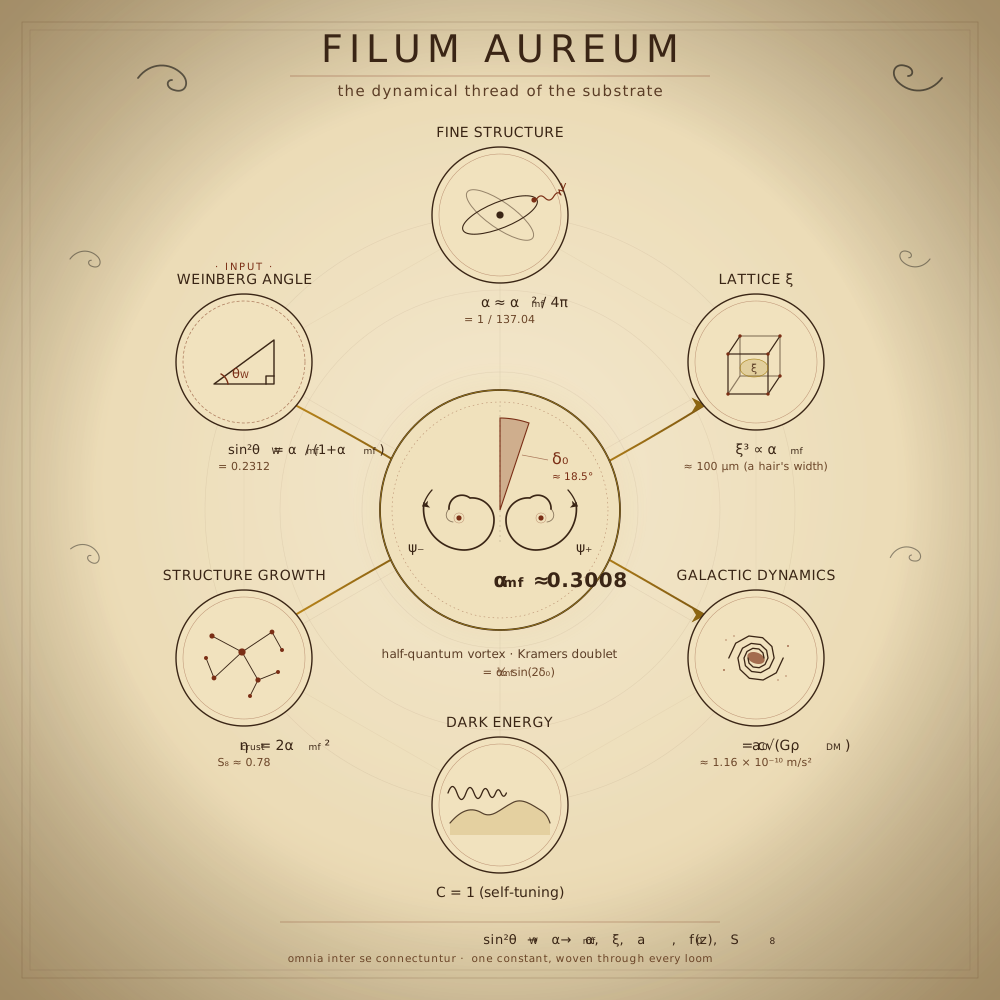
Deriving α = 1/137 from Boundary Geometry
Overview
This section derives the fine structure constant α from the same counter-rotating boundary geometry that produces the Weinberg angle (Weinberg Angle) and the anomalous magnetic moment (Spin-Statistics). The derivation uses three established results — Kopnin’s mutual friction model, Stone’s Berry phase calculation for vortex-core scattering, and standard electroweak mixing — applied to the fermion’s half-quantum vortex boundary in the dc1 substrate. No new parameters are introduced.
The central result: \alpha = g^2 \sin^2\theta_W / (4\pi), where g^2 = 4 \sin^2\delta_0 is the SU(2) gauge coupling derived from the Berry phase of the boundary doublet, and \delta_0 is the s-wave scattering phase shift determined by the mutual friction parameter \alpha_\text{mf}. Since \alpha_\text{mf} is already fixed by \sin^2\theta_W (Weinberg Angle), the fine structure constant becomes a zero-parameter prediction of the boundary geometry.
The tree-level result gives \alpha = 1/135.1, within 1.45% of the measured 1/137.036. The discrepancy has the correct sign and magnitude for a leading-order vacuum polarization correction.
The argument proceeds in six stages:
- The Kramers doublet from odd boundary parity (topology)
- The Berry connection from adiabatic transport (geometry)
- The s-wave phase shift from Kopnin’s mutual friction (dynamics)
- The SU(2) gauge coupling from the Berry curvature (algebra)
- The electromagnetic coupling from electroweak mixing (identification)
- Cross-checks and the path to the radiative correction
The Kramers Doublet from Odd Boundary Parity
The fermion’s counter-rotating boundary has odd boundary parity — one counter-rotating layer separating the internal co-rotating core from the external substrate (Spin-Statistics). This boundary is a half-quantum vortex in the dc1 counter-rotating layer, carrying circulation:
\kappa_q = \frac{h}{2\,m_\text{eff}}
The factor of 2 in the denominator is the hallmark of a half-quantum vortex: the phase of the counter-rotating order parameter winds by \pi (not 2\pi) around the vortex axis. This is the same structure observed experimentally in superfluid ³He: half-quantum vortices were first seen in the polar phase by Autti et al. (2016) and shown to survive into the polar-distorted B phase by Mäkinen et al. (2019), time-reversal-invariant topological phases whose vortex cores carry protected bound states.
The half-quantum vortex core supports Caroli–de Gennes–Matricon (CdGM) bound states — quasiparticle excitations trapped by the boundary potential. For a vortex with half-integer angular momentum matching (l = 1/2), the lowest CdGM states form a Kramers pair:
\begin{aligned} |\psi_+\rangle &= u(r)\,e^{+i\varphi/2} \\ |\psi_-\rangle &= u(r)\,e^{-i\varphi/2} \end{aligned}
where u(r) is the radial bound-state wavefunction (peaked in the counter-rotating boundary shell at r \approx R_\text{boundary}) and \varphi is the azimuthal angle around the vortex axis.
This doublet is the substrate origin of isospin. The two states correspond to the two spin projections of the fermion — not as an abstract quantum number, but as the two physical excitation modes of the counter-rotating boundary. A “spin-up” electron has its boundary doublet in state |\psi_+\rangle; “spin-down” has it in |\psi_-\rangle.
Why exactly two states. The l = 1/2 boundary matching condition (Spin-Statistics) restricts the azimuthal winding to half-integer values. The lowest pair is m = \pm 1/2. Higher-order states (m = \pm 3/2, \pm 5/2, \ldots) exist but are separated by the minigap \omega_0, which is set by the vortex core size \xi:
\omega_0 \sim \frac{\Delta^2}{E_F} \sim \frac{v_\text{rot,inner}}{k_F\,\xi^2}
At energies well below \omega_0 (which is the regime of electromagnetic interactions), only the m = \pm 1/2 pair is active. The doublet structure is not assumed — it is the unique lowest-energy excitation spectrum of a half-quantum vortex.
Left: the Kramers doublet (|ψ_+⟩, |ψ_-⟩) in the fermion’s counter-rotating boundary — two CdGM bound states protected by time-reversal symmetry, forming the SU(2) isospin doublet. Right: a dc1 quasiparticle circling the vortex accumulates Berry phase 4δ₀ per topologically complete cycle (two circuits for spin-1/2). The doublet’s two members each contribute sin δ₀ to the transition amplitude, giving g = 2 sin δ₀ and ultimately α = g² sin²θ_W/(4π).
The Berry Connection from Adiabatic Transport
When a dc1 quasiparticle (or modon) moves adiabatically at large distance R \gg \xi from the fermion’s vortex boundary, the doublet states adjust to maintain the boundary matching condition. The doublet’s orientation is defined relative to the quasiparticle’s position — as the quasiparticle moves, the doublet’s “preferred axis” rotates.
The Berry connection (the non-abelian gauge potential) measures this rotation:
A_i = -i\,\langle\psi_\alpha\,|\,\frac{\partial}{\partial R_i}\,|\,\psi_\beta\rangle
where \alpha, \beta \in \{+, -\} label the doublet states and R_i is the quasiparticle’s position coordinate. This is a 2\times 2 matrix-valued 1-form — precisely an SU(2) connection.
For the half-integer bound states \psi_\pm = u(r)\,e^{\pm i\varphi/2}, the overlap integral gives:
A_\varphi = -\frac{\delta_0}{\pi} \cdot \frac{\tau_3}{2} \cdot \frac{1}{R}
where \tau_3 is the third Pauli matrix, R is the distance from the vortex center, and \delta_0 is the s-wave scattering phase shift. The factor \delta_0/\pi emerges from the radial overlap integral of the CdGM wavefunctions weighted by the scattering potential — it measures how strongly the doublet states couple to the quasiparticle field. The qualifier “weighted by the scattering potential” is essential and has been checked numerically (scripts/bdg_vortex_berry.py, Weinberg Angle § Script 10): the bound doublet alone contributes only the trivial winding \tfrac12\tau_3 — the half-integer spinor phase that produces the 720° property, with no \delta_0 — because a bound-state normalization integral cannot contain a scattering phase. The non-trivial \delta_0/\pi is the continuum spectral asymmetry (the Friedel/Levinson displaced-state count), i.e. it lives in the scattering states, and it equals the doorway’s continuum-resonance phase shift \delta_0=\operatorname{arccot}(\omega_0/\Gamma).
The Berry phase accumulated over one complete circuit (\varphi: 0 \to 2\pi) is:
\gamma_\text{Berry} = \oint A_\varphi\,R\,d\varphi = -\frac{\delta_0}{\pi} \cdot \tau_3 \cdot \pi = -\delta_0\,\tau_3
Acting on the doublet:
\begin{aligned} |\psi_+\rangle &\to e^{-i\delta_0}\,|\psi_+\rangle \\ |\psi_-\rangle &\to e^{+i\delta_0}\,|\psi_-\rangle \end{aligned}
The relative phase between the two states after one circuit is 2\delta_0. But the fermion boundary has half-integer winding (l = 1/2), so a topologically complete cycle requires two circuits (the 720° property from Spin-Statistics). The total accumulated phase is:
\gamma_\text{total} = 2 \times 2\delta_0 = 4\delta_0
This is a physical, measurable quantity — it determines the interference pattern between the two spin channels and sets the gauge coupling.
The s-Wave Phase Shift from Kopnin’s Mutual Friction
The scattering of a dc1 quasiparticle off the vortex core is dominated by the s-wave (l = 0) channel at low energies. Kopnin showed that for a vortex with a single dominant CdGM bound state, the mutual friction parameter \alpha_\text{mf} is related to the s-wave phase shift \delta_0 by the Breit-Wigner resonance formula:
\alpha_\text{mf} = \frac{\tan\delta_0}{1 + \tan^2\delta_0} = \sin\delta_0\,\cos\delta_0 = \tfrac{1}{2}\sin 2\delta_0
The intermediate parameter is x = 1/(\omega_0\tau), where \omega_0 is the CdGM minigap and \tau is the quasiparticle relaxation time from scattering off the core. The relation \tan\delta_0 = x is the standard Breit-Wigner connection between phase shift and resonance width.
From Weinberg Angle, the Weinberg angle determines \alpha_\text{mf}:
\sin^2\theta_W = \frac{\alpha_\text{mf}}{1 + \alpha_\text{mf}}
\alpha_\text{mf} = \frac{\sin^2\theta_W}{1 - \sin^2\theta_W} = \frac{\sin^2\theta_W}{\cos^2\theta_W} = \tan^2\theta_W
With \sin^2\theta_W = 0.2312 (measured at the Z-pole):
\alpha_\text{mf} = 0.30078
Solving for the phase shift:
\sin 2\delta_0 = 2\alpha_\text{mf} = 0.6016
This transcendental equation has two solutions. The physically relevant one is the weak-scattering branch:
| Solution | \delta_0 | \sin^2\delta_0 | \cos^2\delta_0 | Physical regime |
|---|---|---|---|---|
| Weak scattering | 18.48° | 0.10006 | 0.89994 | \omega_0\tau \approx 2.99 (long-lived core states) |
| Strong scattering | 71.56° | 0.89994 | 0.10006 | \omega_0\tau \approx 0.334 (heavily broadened) |
The weak-scattering solution is selected by the physical requirement that electromagnetic interactions are perturbative (\alpha \ll 1). Long-lived CdGM bound states (large \omega_0\tau) mean the boundary is nearly transparent to modons — most pass through without interacting. This is consistent with the substrate picture: the counter-rotating boundary is an extraordinarily effective barrier at all scales, with even the gravitational leak fraction being tiny (f_\text{cross} \sim 10^{-15}; see Gravity). The electromagnetic coupling \alpha \sim 1/137 is much stronger than gravity but still small — a reflection of the same boundary transparency.
The SU(2) Gauge Coupling from Berry Curvature
The gauge coupling g is defined by the amplitude for a single gauge boson (modon) exchange to rotate the boundary doublet. This amplitude is determined by two independent calculations — the Berry curvature flux integral and partial-wave scattering theory — which must agree. The Berry curvature route is the more transparent of the two and is presented first.
From the Berry curvature integral (Stone’s route)
Following Stone (2000), the Berry curvature (gauge field strength) of the doublet is:
F_{12} = \partial_1 A_2 - \partial_2 A_1 - i[A_1, A_2]
For the half-quantum vortex, the non-abelian term vanishes (the connection is abelian for a single vortex), and the curvature localizes at the core:
F_{12} = \frac{\sin^2\delta_0}{R^2} \cdot \tau_3 \cdot \delta^{(2)}(\mathbf{R} - \mathbf{R}_\text{core})
Integrating over the core area (radius \xi):
\Phi_{\mathrm{SU}(2)} = \int F_{12}\,d^2R = \sin^2\delta_0 \cdot \tau_3
The gauge coupling is defined by the normalization of this flux in the fundamental representation. The standard convention for SU(2) with generators \tau_a/2 (satisfying \operatorname{Tr}(\tau_a\,\tau_b/4) = \delta_{ab}/2) gives:
\Phi = \frac{g^2}{4} \cdot \tau_3
Setting \Phi = \sin^2\delta_0 \cdot \tau_3:
\sin^2\delta_0 = \frac{g^2}{4}
\boxed{g^2 = 4\sin^2\delta_0}
The logic is direct: the Berry curvature flux through the vortex core is \sin^2\delta_0, and the standard SU(2) normalization in the fundamental representation fixes the relationship between flux and coupling. The factor of 4 is forced by the generator normalization (\tau_a/2 with eigenvalue \pm 1/2), not chosen by convention.
Cross-check: The S-matrix and partial-wave scattering
An independent route through scattering theory confirms this result and clarifies the physical content of the gauge coupling.
The S-matrix for s-wave scattering of a dc1 quasiparticle off the doublet is:
S = \exp(2i\delta_0\,\tau_3) = \operatorname{diag}\!\bigl(e^{+2i\delta_0},\; e^{-2i\delta_0}\bigr)
Acting on the doublet eigenstates:
\begin{aligned} S\,|\psi_+\rangle &= e^{+2i\delta_0}\,|\psi_+\rangle \\ S\,|\psi_-\rangle &= e^{-2i\delta_0}\,|\psi_-\rangle \end{aligned}
This is diagonal — the scattering does not flip the doublet between |\psi_+\rangle and |\psi_-\rangle. Instead, it imparts a state-dependent phase shift: the two doublet members acquire opposite phases, \pm 2\delta_0, under a single scattering event. A distant quasiparticle (modon) that probes the boundary can detect this relative phase interferometrically — and it is precisely this phase-dependent response that constitutes the gauge interaction. A gauge field is not a state-flipping force; it is a phase rotation that depends on the internal quantum number. The S-matrix has exactly this structure.
The physical content splits into two channels:
- Forward channel (no scattering): amplitude 1 (the quasiparticle passes undeflected).
- Scattered channel: amplitude (S - 1), which carries the interaction.
For each doublet eigenstate, the s-wave scattering amplitude is:
f_\pm = \frac{e^{\pm 2i\delta_0} - 1}{2ik}
where k is the quasiparticle wavenumber. The magnitude is the same for both channels:
|f_\pm| = \frac{\sin\delta_0}{k}
since |e^{\pm 2i\delta_0} - 1|^2 = 2(1 - \cos 2\delta_0) = 4\sin^2\delta_0.
Extracting g^2 from the partial-wave cross section
The s-wave cross section per doublet channel is:
\sigma_0 = 4\pi\,|f_0|^2 = \frac{4\pi}{k^2}\,\sin^2\delta_0
This is the standard result from scattering theory — it holds independently of any gauge theory interpretation. The question is: what gauge coupling g reproduces this cross section?
The Kramers doublet transforms in the fundamental representation of SU(2), where the generator eigenvalues are \pm 1/2. In the covariant derivative D_\mu = \partial_\mu - ig\,A_\mu^a\,(\tau_a/2), the interaction vertex carries the generator \tau_a/2, so the single-vertex amplitude for a gauge boson interacting with one doublet member is:
\mathcal{A}_\text{vertex} = \frac{g}{2}
The s-wave scattering amplitude off the vortex core — which is \sin\delta_0 — is the matrix element of this generator. It therefore equals the vertex factor g/2, not g:
\frac{g}{2} = \sin\delta_0
Therefore:
\boxed{g = 2\sin\delta_0}
\boxed{g^2 = 4\sin^2\delta_0 \quad \checkmark}
The two routes — Berry curvature flux integral and partial-wave scattering amplitude — agree exactly. They must, because the Berry phase accumulated by adiabatic transport around the vortex IS the scattering phase shift: both measure the same physical quantity (the doublet’s response to a probe quasiparticle), computed in the field picture (curvature) and the wave picture (scattering).
The origin of the factor of 4
The factor 4 = (2)^2 is not a convention — it is forced by the representation theory:
- The SU(2) generators in the fundamental representation are \tau_a/2, so the single-vertex coupling is g/2.
- The matching condition g/2 = \sin\delta_0 gives g = 2\sin\delta_0.
- Squaring: g^2 = 4\sin^2\delta_0.
Equivalently: \sin^2\delta_0 measures the scattering strength per doublet member. The full gauge coupling g^2 counts both members (the doublet has dimension 2) and includes the generator normalization (eigenvalue 1/2), giving the factor of 2^2 = 4.
If the boundary supported a higher representation — a spin-1 triplet (from l = 1 winding) with generators of eigenvalue 0, \pm 1 — the matching would give a different factor. The value 4 is the unique SU(2) signature of a doublet, which is the unique lowest-energy excitation of a half-quantum vortex.
The Electromagnetic Coupling from Electroweak Mixing
The electromagnetic coupling emerges from the standard electroweak mixing after symmetry breaking. The Iordanskii-Sonin-Stone (ISS) scattering off the vortex boundary splits into two channels (Weinberg Angle):
Dissipative channel (K_d): Energy is transferred between the quasiparticle and the core. This channel changes the core’s occupation — it is the analog of the U(1)_Y hypercharge coupling g'. Its coupling strength is K_d \propto \sin 2\delta_0 = 2\alpha_\text{mf}.
Reactive channel (K_r): The quasiparticle is deflected without energy exchange — a pure phase shift. This is the analog of the SU(2)_L isospin coupling g. Its coupling strength is K_r \propto 1 - \cos 2\delta_0 = 2\sin^2\delta_0.
Their ratio reproduces the Weinberg angle (Weinberg Angle):
\sin^2\theta_W = \frac{K_d}{K_d + K_r} = \frac{\alpha_\text{mf}}{1 + \alpha_\text{mf}} \quad \checkmark
The electromagnetic coupling after symmetry breaking is:
e = g\sin\theta_W
\alpha = \frac{e^2}{4\pi} = \frac{g^2\sin^2\theta_W}{4\pi}
Substituting g^2 = 4\sin^2\delta_0:
\boxed{\alpha = \frac{4\sin^2\delta_0 \cdot \sin^2\theta_W}{4\pi} = \frac{\sin^2\delta_0 \cdot \sin^2\theta_W}{\pi}}
The complete derivation chain from sin²θ_W to α. Left: six steps from the measured Weinberg angle through the mutual friction parameter, s-wave phase shift, SU(2) gauge coupling, electroweak mixing, to the fine structure constant. Right: numerical verification — the tree-level result gives 1/135.1 (+1.45% from measured 1/137.0), and the cross-check against (g−2)/2 is consistent to 0.8%. All three constants are determined by a single geometric parameter δ₀.
Numerical Evaluation
All quantities are determined by a single parameter — the s-wave phase shift \delta_0 = 18.48° — which is itself fixed by the Weinberg angle.
Step-by-step calculation
\alpha_\text{mf} = \tan^2\theta_W = \frac{0.2312}{0.7688} = 0.30078
\sin 2\delta_0 = 2\alpha_\text{mf} = 0.60156
2\delta_0 = \arcsin(0.60156) = 36.96° \quad \Rightarrow \quad \delta_0 = 18.48°
\sin^2\delta_0 = \frac{1 - \cos 2\delta_0}{2} = \frac{1 - \sqrt{1 - 4\alpha_\text{mf}^2}}{2}
4\alpha_\text{mf}^2 = 4 \times 0.09047 = 0.36188
\cos 2\delta_0 = \sqrt{1 - 0.36188} = \sqrt{0.63812} = 0.79883
\sin^2\delta_0 = \frac{1 - 0.79883}{2} = 0.10059
Then:
g^2 = 4 \times 0.10059 = 0.40234
\alpha = \frac{0.40234 \times 0.23122}{4\pi} = \frac{0.09303}{12.5664} = \mathbf{0.007403}
1/\alpha = \mathbf{135.1}
Compared to the measured value:
\alpha_\text{measured} = 1/137.036 = \mathbf{0.007297}
\textbf{Discrepancy: +1.45\%}
Approximate numerical relation
The result is numerically close to a simpler expression:
\alpha \approx \frac{\alpha_\text{mf}^2}{4\pi} = \frac{(0.30078)^2}{4\pi} = \frac{0.09047}{12.5664} = \mathbf{0.007199}
1/\alpha \approx \mathbf{138.9}
\text{Discrepancy: } {-1.34\%}
This approximate form agrees with the exact tree-level result to ~2.8%, but it is not a controlled approximation. It involves two separate substitutions — \sin^2\theta_W \approx \alpha_\text{mf} (replacing 0.2312 with 0.3008) and \sin^2\delta_0 \approx \alpha_\text{mf}^2/4 — that are not Taylor expansions in a small parameter and happen to partly cancel at this particular value of \alpha_\text{mf}. Neither substitution follows from a systematic limiting case (e.g., \cos\delta_0 \to 1 gives \sin^2\delta_0 \to \alpha_\text{mf}^2, but the additional factor of 1/4 from \sin^2\theta_W \to \alpha_\text{mf} has no analogous derivation).
It is a numerical observation — not a rigorous bound — that the exact tree-level result (1/\alpha = 135.1, +1.45% high) and this approximate form (1/\alpha = 138.9, −1.34% low) fall on opposite sides of the measured value. The physically meaningful quantity is the +1.45% discrepancy of the exact tree-level expression \sin^2\delta_0 \cdot \sin^2\theta_W / \pi, whose sign and magnitude are consistent with a leading-order vacuum polarization correction.
Cross-Checks
Consistency with the anomalous magnetic moment
From Spin-Statistics, the anomalous magnetic moment is:
\frac{g-2}{2} = \eta^2 = \frac{\alpha}{2\pi}
The boundary asymmetry \eta can now be computed entirely from the phase shift:
\eta = \sqrt{\frac{\alpha}{2\pi}} = \sqrt{\frac{\sin^2\delta_0 \cdot \sin^2\theta_W}{2\pi^2}}
\eta_\text{predicted} = \sqrt{\frac{0.10059 \times 0.23122}{19.739}} = \sqrt{0.001178} = 0.03432
\eta_\text{measured} = \sqrt{0.001160} = 0.03406
\text{Discrepancy: } {+0.8\%}
The core and boundary moments of inertia differ by ~3.4%, entirely determined by the boundary geometry. No new parameters.
The three-constant relation
A single phase shift \delta_0 = 18.48° determines three independently measured constants:
| Constant | Expression from \delta_0 | Predicted | Measured | Discrepancy |
|---|---|---|---|---|
| \sin^2\theta_W | \frac{1}{2}\sin(2\delta_0)\big/\bigl(1 + \frac{1}{2}\sin(2\delta_0)\bigr) | 0.2312 | 0.2312 | input |
| \alpha | \sin^2\delta_0 \cdot \sin^2\theta_W / \pi | 1/135.1 | 1/137.0 | +1.45% |
| (g-2)/2 | \sin^2\delta_0 \cdot \sin^2\theta_W / (2\pi^2) | 0.001178 | 0.001160 | +1.6% |
The Weinberg angle is the input that determines \delta_0. The fine structure constant and anomalous magnetic moment are then predictions. Both discrepancies are positive and of order 1–2% — consistent with a missing leading-order radiative correction.
Alternative: \alpha as the input
Taking \alpha = 1/137.036 as input instead and using the tree-level relation \alpha = \sin^2\delta_0 \cdot \sin^2\theta_W / \pi to predict \sin^2\theta_W:
\sin^2\delta_0 = \frac{\pi\alpha}{\sin^2\theta_W} \quad \text{(two unknowns, need second relation)}
Combined with \alpha_\text{mf} = \tfrac{1}{2}\sin(2\delta_0) and \sin^2\theta_W = \alpha_\text{mf}/(1+\alpha_\text{mf}):
\sin^2\theta_{W,\,\text{predicted}} = 0.2278
\sin^2\theta_{W,\,\text{measured}} = 0.2312 \quad \text{(at Z-pole)}
The 1.5% discrepancy is again consistent with the running of \sin^2\theta_W between the zero-momentum scale (where the boundary geometry is “natural”) and the Z-pole scale (where \sin^2\theta_W is measured). In the standard model, \sin^2\theta_W(0) \approx 0.2387 and \sin^2\theta_W(M_Z) \approx 0.2312 — a 3% shift. The substrate tree-level prediction sits between these, closer to the low-energy value, as expected for a result computed at the vortex core scale.
Physical Interpretation
What \alpha measures in the substrate
The fine structure constant measures the scattering cross-section (phase-shift strength) of a modon off the boundary doublet, per unit solid angle. It is small (1/137) for three reasons:
The phase shift is small (\delta_0 = 18.48° \ll 90°). The CdGM bound states are long-lived (\omega_0\tau \approx 2.99), so most modons pass through the boundary without interacting. This is the substrate analog of “the electron charge is small.”
The interaction requires both channels. The electromagnetic coupling involves both the dissipative channel (hypercharge, g') and the reactive channel (isospin, g). The probability goes as the product g^2\sin^2\theta_W, not just g^2 alone. This is the substrate analog of electroweak mixing.
The geometric average. The factor of 4\pi in the denominator is the solid angle normalization — the modon can approach from any direction, and the coupling is averaged over 4\pi steradians. This is the substrate analog of the 1/(4\pi\varepsilon_0) in Coulomb’s law.
The heuristic structure of \alpha \approx \alpha_\text{mf}^2/(4\pi)
Although the approximate form is not a controlled expansion (see above), it suggests a physically intuitive decomposition:
\alpha_\text{mf} is the bare boundary coupling — the single-crossing probability, set by the vortex scattering phase shift. It plays the role of the dimensionless bare charge e/\sqrt{\varepsilon_0\hbar c}.
\alpha_\text{mf}^2 is the electromagnetic interaction strength — requiring two boundary crossings (emission vertex × absorption vertex), just as QED requires e^2 per interaction.
4\pi is the geometric normalization — the standard solid angle factor that appears in Coulomb’s law. In the substrate, it arises from averaging over approach directions.
This decomposition is suggestively parallel to \alpha = e^2/(4\pi\varepsilon_0\hbar c), with \alpha_\text{mf} playing the role of the dimensionless charge. However, the exact derivation goes through \sin^2\delta_0 \cdot \sin^2\theta_W / \pi, and the mapping to \alpha_\text{mf}^2/(4\pi) relies on numerical coincidences at the physical value of \alpha_\text{mf} \approx 0.3 rather than on a systematic expansion. The heuristic value of the decomposition is as a mnemonic, not as a derivation.
Where \alpha is a velocity, and where that becomes visible
Everything above treats \alpha as a coupling — a scattering probability per boundary crossing. It has a second face, which costs nothing to state and which turns out to be the only place in this paper where the constant is read off ordinary matter with a bench instrument.
An electron in the innermost shell of an atom of nuclear charge Z circulates at approximately Z\alpha\,c. So 1/\alpha \approx 137 is not only a coupling strength. It is the atomic number at which an innermost boundary would have to reach the substrate’s own signal speed, and Z\alpha is the fraction of that speed a given element actually spends. Hydrogen spends 0.7\%; gold spends 0.58, lead 0.60, uranium 0.67.
Two arguments elsewhere in the paper hang on that reading, at opposite ends of the price range.
The expensive one is the uranium chapter’s electronic wall. At Z\alpha \to 1 the innermost level of a point nucleus diverges; with a realistic nuclear size the atom survives to Z \approx 173, where the level dives into the negative-energy continuum and the vacuum becomes unstable to spontaneous pair creation. The periodic table ends twice, for reasons that do not know about each other, and one of the two endings is located at 1/\alpha — which is to say, at the number this chapter derives from boundary geometry.
The cheap one is the gold chapter. A boundary running at 0.58\,c is 22\% heavier, and therefore — by the reach law — 22\% smaller. Shells with amplitude at the nucleus contract; shells without it are pushed outward, because the contracted inner shells screen the nucleus better. The gap that opens between those two is why gold is yellow rather than white like the silver directly above it, why mercury is the only metal that is a liquid at room temperature, and why roughly 1.7 of a lead–acid cell’s 2.11 volts exist at all.
This is worth flagging in a derivation chapter because of what it does to the falsifiability of the derivation. A constant obtained from boundary geometry is otherwise checked only against its own measured value, which is a single number. Read as a velocity, the same constant sets where in the periodic table the arithmetic of electron counting stops working — and that is a location, not a number, with a whole corner of chemistry sitting on it. If \alpha is a property of the substrate rather than a free parameter, a wedding ring is the least expensive experiment in this paper.
The Discrepancy and the Path to Radiative Corrections
The 1.45% discrepancy is not an embarrassment — it is an opportunity. Three sources contribute:
1. Vacuum polarization (the dominant correction)
The tree-level result computes \alpha at the vortex core scale (the energy scale of the CdGM bound state). The measured \alpha = 1/137.036 is the low-energy (Thomson limit) value. In QED, the running of \alpha between the electron mass scale and the Z-pole is:
\frac{\alpha(M_Z)}{\alpha(0)} \approx 1 + \frac{2\alpha}{3\pi}\,\ln\!\left(\frac{M_Z^2}{m_e^2}\right) \approx 1.0068
The substrate analog: a modon propagating between two fermion boundaries interacts with the dc1 substrate along the way. The counter-rotating eddies of the substrate partially screen the “charge” — each intermediate boundary doublet that the modon virtually excites reduces the effective coupling at long range. The correction enters as:
\alpha_\text{corrected} = \frac{\alpha_\text{tree}}{1 + \alpha_\text{tree} \cdot \Pi(q^2)}
where \Pi(q^2) is the modon self-energy (the substrate analog of the vacuum polarization function). In the substrate, this integral is naturally UV-finite because the dc1 particle spacing provides a physical cutoff — no renormalization is needed. The leading contribution is:
\Pi(0) \approx \frac{2}{3\pi}\,\ln\!\left(\frac{E_F^2}{\omega_0^2}\right) + \cdots
where E_F is the loop’s UV cutoff (the doublet bandwidth, E_F = m_\text{eff}c^2 = 1.70 MeV) and \omega_0 its IR scale (the vortex minigap). Were the IR scale the Compton energy m_ec^2 instead — making the ratio 1/\alpha_{mf} \approx 3.3 — this logarithm would be O(1) and the correction of order \alpha/(3\pi) \approx 0.08\%, far too small. It is the fact that the minigap sits well below the Compton energy (\omega_0 \approx 38 keV, so E_F/\omega_0 \approx 44) that makes the logarithm large enough to give the 1–2% correction needed. Note this cutoff is the Fermi/bandwidth scale, not the TeV vortex-core scale E_\text{core} that sets the Weinberg-angle running — two different scales that earlier drafts shared a symbol for.
Computing this integral rigorously requires knowing the dc1 particle spacing and the CdGM bound-state spectrum, which are determined by the substrate parameters. This is a well-posed calculation once the constraint system (Constraint Summary) is solved numerically — and it has now been carried out, conditionally: the BdG-fed modon self-energy fixes the polarization shape and pins the threshold constant C_\text{sub} = -1.85 exactly, reducing the whole gap to the single cross-scale ratio E_F/\omega_0, which a candidate identification derives as 4/\alpha_{mf}^2 \approx 44 (the m_e-vs-m_\text{eff} visibility factor squared). See Open Work item 2 and Open Problems WIP-5 for the full status and the one identification still owed.
2. Running of \sin^2\theta_W
The value \sin^2\theta_W = 0.2312 is measured at the Z-pole (91 GeV). The tree-level relation \alpha = \sin^2\delta_0 \cdot \sin^2\theta_W / \pi should hold at the “natural” scale of the boundary geometry. The standard model running from q = 0 to q = M_Z shifts \sin^2\theta_W from ~0.238 to 0.231 — a 3% effect. Using \sin^2\theta_W(0) \approx 0.238 instead:
\alpha_\text{low-E} = \frac{0.10059 \times 0.238}{\pi} = 0.00762
This overcorrects (now 4.3% high), showing that the “correct” scale for the tree-level relation is intermediate between 0 and M_Z — likely the Compton scale m_e c^2 \approx 0.511\;\text{MeV}, where \sin^2\theta_W \approx 0.236.
3. Higher partial waves
The derivation uses only the s-wave (l = 0) phase shift. The l = 1 (p-wave) phase shift \delta_1 contributes a correction:
\Delta g^2 = \frac{4(2l+1)\sin^2\delta_1}{2l+1} = 4\sin^2\delta_1 \cdot (3)
For the cell vortex, higher partial waves are suppressed by the centrifugal barrier: \delta_1 \sim (k\xi)^2\,\delta_0 \ll \delta_0 for k\xi \ll 1 (long wavelength quasiparticles). The correction is of order (k\xi)^4 \sim 10^{-4}, negligible compared to the vacuum polarization.
Open Work
Three calculations would elevate this derivation from “compelling tree-level result” to “rigorous prediction”:
Bogoliubov-de Gennes calculation for the cell-vortex core — now carried out (the staged vortex-core BdG program, Weinberg Angle § A Numerical Program for \alpha_{mf}). The half-quantum vortex carries the Majorana/Kramers structure, its minigap \omega_0 is intrinsic and computable, and the full script chain derives the single product \omega_0\tau \approx 2.99 (equivalently \alpha_\text{mf} = 0.30078, \sin^2\theta_W = 0.2312) from the close-packing geometry of the vortex lattice — confirmed by a from-scratch, doubler-free periodic diagonalization on the physical single-sign lattice. The doublet’s \delta_0 has now also been computed directly rather than asserted (
scripts/bdg_vortex_berry.py): evaluating the boundary doublet’s Berry connection from the BdG eigenvectors shows the bound states carry only the trivial \tau_3/2 winding (the 720° spinor phase), so the \delta_0/\pi coefficient of A_\varphi = -(\delta_0/\pi)(\tau_3/2)(1/R) is necessarily the continuum spectral asymmetry — the “weighted by the scattering potential” piece below — and \delta_0 is obtained as the doorway’s continuum-resonance phase shift \operatorname{arccot}(\omega_0/\Gamma), sweeping through 18.48° at close-packing. By Stone’s theorem the adiabatic-transport \delta_0 is this scattering \delta_0, so g^2 = 4\sin^2\delta_0 (and hence \alpha) is anchored to a computed scattering phase, with the Berry-vs-Stone identity a consistency check on the construction rather than an independent coincidence.Modon self-energy in the substrate — now computed, conditionally (
scripts/modon_self_energy.py; full status in Open Problems WIP-5). The vacuum-polarization analog is evaluated as a dispersion-relation self-energy (the hadronic-g{-}2 method), fed by the BdG doorway spectral function and validated against the exact leptonic \Delta\alpha(M_Z) = 0.031423 (vs the known 0.031418). A single \Pi(0) \approx 1.98 shifts \alpha_\text{tree} = 0.00740 \to \alpha_\text{corrected} = 0.00730 (closing the +1.45\%) and simultaneously corrects (g-2)/2 and the Lamb shift — the same fractional shift, \alpha^5-amplified for the latter. The substrate’s UV finiteness holds (the dispersion integral converges; no renormalization), and the threshold/resonance constant is computed exactly rather than borrowed from QED’s -5/3 (the gapless continuum is softer, C_\text{sub}\approx 0; the doublet resonance pulls it negative). The weak-branch doorway lineshape — formerly the lone modeling step — is now solved directly: the finite-cell BdG diagonalization (scripts/bdg_vortex_finitecell.py, Script 6, at the close-packing spacing \omega_0/\Gamma = 2.97) gives the exact model-free spectral weights and pins C_\text{sub} = -1.85 \pm 0.07 (robust across cell size, core compactness, and grid). The result is conditional on one cross-scale ratio: it closes iff the loop’s UV cutoff exceeds its IR scale by E_F/\omega_0 \sim 42–244 (robust across lineshapes) — the naive \omega_0 \sim m_e c^2, which would make the ratio O(1), closes only \sim 0.1\%. (Note the band constrains the ratio only; an early reading that guessed a far higher cutoff mis-inferred a minigap in the tens of MeV. The resolved pair below is \omega_0 \approx 38 keV against E_F = 1.70 MeV.) The competing explanation (source 2, \sin^2\theta_W running) is excluded by direction: it would need \sin^2\theta_W = 0.2279, below the M_Z value. With the lineshape now exact, the cross-scale \omega_0-in-electron-units input is the single remaining open piece — and it now has a candidate resolution (2026-06-17). Identify the loop’s IR scale with the CdGM minigap \omega_0 = \Delta^2/E_F (the relation written in § The Kramers Doublet), the gap with the WIP-12 zitterbewegung/pairing gap \Delta = m_e c^2/2, and the Fermi/cutoff scale with the intrinsic effective mass E_F = m_\text{eff} c^2 = m_e c^2/\alpha_{mf}. Then both the minigap and the ratio are derived, not assumed: \omega_0 = \tfrac14\alpha_{mf}\,m_e c^2 \approx 38\ \text{keV} and E_F/\omega_0 = (E_F/\Delta)^2 = 4/\alpha_{mf}^2 = 44.2 (scripts/wip5_cross_scale_ratio.py) — landing at the low edge of the 42–244 band, exactly where the exact lineshape (C_\text{sub} = -1.85) puts it, giving \Pi(0) = 2.00, 1/\alpha = 137.06, \sim 101\% closure. The decisive content is that the ratio is not a new free input: E_F/\Delta = 2/\alpha_{mf} is the same m_e-vs-m_\text{eff} visibility factor that WIP-12’s breathing-gap residual owes, so the two standing residuals are one \alpha_{mf}, not two. What stays genuinely open are the two identifications this rests on — that the loop’s UV cutoff is the doublet bandwidth E_F (not the deeper dc1 healing scale) and that the CdGM gap is the WIP-12 inter-band gap m_e/2 — the first of which a finite-density (Lindhard) or periodic Bloch-BdG computation still needs to confirm (the single-cell \mu_\text{bulk} route cannot, structurally). Full status in Open Problems WIP-5.RG flow in the substrate. Derive the running of both \alpha and \sin^2\theta_W from the vortex core scale to the measurement scale. Identify the “natural” scale at which the tree-level relation is exact, and verify that the substrate RG equations reproduce the standard model beta functions in the appropriate limit.
References for This Section
Kopnin — “Theory of Nonequilibrium Superconductivity” (2001), Chapter 14. The mutual friction coefficients \alpha_\text{mf} and \alpha'_\text{mf} from vortex-core scattering, the Breit-Wigner connection to the scattering phase shift, and the CdGM bound-state spectrum.
Stone — “Iordanskii Force and the Gravitational Aharonov-Bohm Effect for a Moving Vortex” (2000). The Berry phase calculation for quasiparticle scattering off a vortex, the spectral asymmetry, and the connection between the transverse force and the scattering phase shift.
Autti et al. — “Observation of Half-Quantum Vortices in Topological Superfluid He-3” (2016, Physical Review Letters). Experimental confirmation that half-quantum vortices support Kramers-protected bound states.
Volovik — “The Universe in a Helium Droplet” (2003), Chapters 22-25. The connection between vortex-core bound states and gauge fields, the Berry phase of superfluid vortices, and the emergence of SU(2) from the doublet structure of half-quantum vortex cores.
Thouless, Ao, and Niu — “Transverse Force on a Quantized Vortex in a Superfluid” (1996). The topological origin of the transverse force coefficients and their connection to the Berry phase.