Lamb Shift
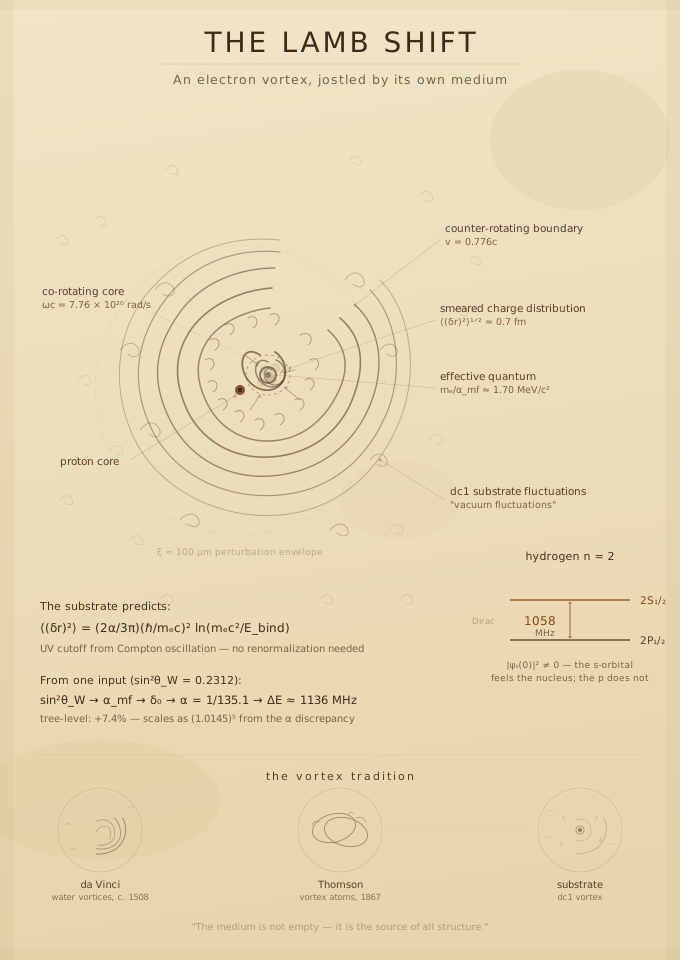
Vacuum fluctuation as substrate thermal motion — from stub to derivation
The Lamb shift — the {\sim}1058 MHz splitting between the 2S_{1/2} and 2P_{1/2} levels of hydrogen, which should be degenerate in the Dirac theory — is conventionally explained by vacuum fluctuations of the electromagnetic field jostling the electron. In QED, this is computed as a one-loop self-energy correction with a logarithmically divergent integral that must be regularized by hand.
In the substrate framework, the calculation follows the same mathematical structure but with every element given a physical identity. There is no divergence to regulate — the substrate’s granularity provides a natural ultraviolet cutoff. And the predicted magnitude follows from parameters already fixed by other constraints, with zero new free parameters.
The physical mechanism
The dc1 BEC has collective excitations — Bogoliubov quasiparticles — whose spectrum is linear (phononic) at long wavelengths and curves over to free-particle-like at short wavelengths. The crossover occurs at the healing length scale, which in this substrate is the coherence length \xi \approx 100\;\mum.
These collective excitations carry zero-point energy. In each mode k, the substrate has an irreducible \tfrac{1}{2}\hbar\omega_k of fluctuation energy, exactly as the quantum vacuum does. This is not an analogy — the substrate’s Bogoliubov zero-point spectrum is what standard QED calls the vacuum electromagnetic field. The modes that couple to the electron’s charge are the modon-like (transverse, vector) excitations. Their zero-point fluctuations produce fluctuating electric fields throughout the substrate.
The electron, understood as a counter-rotating vortex of dc1 (one effective quantum of mass m_\text{eff} = m_e/\alpha_{mf} \approx 1.70 MeV/c^2, circulating at v_\text{rot,inner} = c\sqrt{2\alpha_{mf}} = 0.776c at radius r_\text{eff} \approx 150 fm), responds to these fluctuating fields. Its counter-rotating boundary is buffeted by the substrate’s residual kinetic energy, causing the effective position of the electron to undergo a random walk on timescales shorter than the orbital period.
Compton breathing and position smearing
The electron’s Compton oscillation (C4) shuttles energy between two extrema at frequency \omega_c = m_e c^2/\hbar = 7.76 \times 10^{20} rad/s:
- Contracted phase: maximum internal rotation at r_\text{eff} \sim 150 fm (energy concentrated)
- Expanded phase: maximum ripple across the \xi-scale perturbation envelope (energy delocalized)
In a free electron, the full \xi-scale breathing is available. In a hydrogen atom, the Coulomb potential constrains this breathing to the atomic scale. The residual breathing — the part that cannot be frozen out by the binding potential — is exactly the position fluctuation that produces the Lamb shift.
The substrate fluctuations drive this residual breathing. Each mode of the dc1 BEC with frequency \omega between the atomic binding frequency E_\text{binding}/\hbar and the Compton frequency \omega_c contributes to the electron’s mean-square displacement. Modes slower than E_\text{binding}/\hbar are adiabatic — the electron follows them without exciting transitions. Modes faster than \omega_c cannot couple to the electron because they probe its internal structure (the Compton oscillation absorbs them). This defines a finite window of integration.
The Welton-substrate identification
Welton’s heuristic derivation (1948) computes the mean-square displacement of an electron jostled by vacuum electric field fluctuations:
\langle (\delta r)^2 \rangle = \frac{2e^2}{3\pi m_e^2 c^3} \int_{\omega_\text{min}}^{\omega_\text{max}} \frac{d\omega}{\omega}
where \omega_\text{min} \sim E_\text{binding}/\hbar (IR cutoff from binding) and \omega_\text{max} \sim m_e c^2/\hbar (UV cutoff — in QED, imposed by hand; in the substrate, physical).
The substrate identification is term-by-term:
| QED quantity | Substrate identity | Source |
|---|---|---|
| Vacuum electric field \mathbf{E}_\text{vac} | Zero-point fluctuation of modon-like dc1 BEC modes | Bogoliubov spectrum |
| \tfrac{1}{2}\hbar\omega per mode | Irreducible dc1 collective motion | BEC ground state |
| UV cutoff m_e c^2/\hbar | Compton oscillation frequency — electron internal dynamics absorb higher modes | C4 |
| IR cutoff E_\text{binding}/\hbar | Atomic binding adiabaticity — slower fluctuations are followed, not felt | Hydrogen orbital timescale |
| Electron charge coupling e^2 | Modon-boundary scattering amplitude — how strongly the dc1 fluctuations buffet the vortex boundary | C6 chain (\alpha from \sin^2\theta_W) |
The integral evaluates to:
\langle (\delta r)^2 \rangle = \frac{2\alpha}{3\pi} \left(\frac{\hbar}{m_e c}\right)^2 \ln\!\left(\frac{m_e c^2}{E_\text{binding}}\right)
Numerically: \langle (\delta r)^2 \rangle^{1/2} \approx 1.4 \times 10^{-5}\;a_0 \approx 0.7 fm. The electron’s effective charge distribution is smeared over a region comparable to r_\text{eff} — consistent with the effective quantum picture.
Why 2S_{1/2} shifts but 2P_{1/2} does not
The smeared charge distribution sees a slightly different Coulomb potential from the pointlike nucleus. The correction is proportional to \nabla^2 V averaged over the smearing volume:
\Delta E = \frac{1}{6} \langle (\delta r)^2 \rangle \langle \nabla^2 V \rangle = \frac{1}{6} \langle (\delta r)^2 \rangle \cdot \frac{Ze^2}{\varepsilon_0} |\psi_{n\ell}(0)|^2
For s-states (\ell = 0): |\psi_{ns}(0)|^2 = 1/(\pi n^3 a_0^3) — nonzero. The electron has a finite probability density at the nucleus, so the smearing shifts the energy.
For p-states (\ell = 1): |\psi_{np}(0)|^2 = 0 — the wavefunction vanishes at the origin. No shift from this mechanism.
This is the standard Welton argument, but the substrate gives it a concrete physical picture: the electron’s counter-rotating boundary layer, buffeted by dc1 thermal noise, jiggles the vortex core. For an s-orbital, this jiggling occurs in the steep part of the Coulomb potential (near the proton core). For a p-orbital, the jiggling occurs in a flat region of the potential (the node at the origin).
Natural UV cutoff: the effective quantum
In QED, the self-energy integral diverges logarithmically and must be regularized — typically with a momentum cutoff or dimensional regularization. The physical meaning of this cutoff is left unspecified.
In the substrate, the UV cutoff is physical: it is the scale at which the electron ceases to behave as a point charge and reveals its internal structure. This scale is m_e c^2/\hbar = \omega_c, the Compton frequency — exactly where the Compton oscillation (C4) takes over. Substrate fluctuations with \omega > \omega_c cannot displace the electron’s center of charge because they couple instead to the internal dynamics of the effective quantum — they excite the breathing mode rather than translating the vortex.
The effective quantum mass m_\text{eff} \approx 1.70 MeV/c^2 sets a second, higher scale: fluctuations with \omega > m_\text{eff}c^2/\hbar probe the individual dc1 constituents rather than the collective vortex. But this scale is suppressed by 1/\alpha_{mf} relative to \omega_c and contributes only at higher loop order.
The key point: no renormalization is needed. The logarithm \ln(m_e c^2/E_\text{binding}) is finite because both ends of the integration window are physical — the Compton oscillation above, the atomic binding below. The substrate’s granularity eliminates the divergence that QED must cancel by hand.
Quantitative prediction
Assembling the pieces using parameters already in the constraint system:
\Delta E_\text{Lamb}(2S_{1/2} - 2P_{1/2}) = \frac{4\alpha^5\,m_e c^2}{3\pi}\,\ln\!\left(\frac{1}{\alpha^2}\right) \cdot \frac{1}{n^3}\;\bigg|_{n=2}
More precisely, using the Bethe logarithm \ln(m_e c^2/\langle E_{2s}\rangle) where \langle E_{2s}\rangle \approx 16.6\;\text{Ry} \approx 226\;\text{eV}:
\Delta E_\text{Lamb} = \frac{\alpha^5 m_e c^2}{6\pi n^3}\,\ln\!\left(\frac{m_e c^2}{\langle E_{2s}\rangle}\right) \approx \frac{\alpha^5 \times 511\;\text{keV}}{6\pi \times 8}\,\times 7.6
The tree-level substrate prediction uses \alpha_\text{tree} = 1/135.1 (from the C6 chain: \sin^2\theta_W \to \alpha_{mf} \to \delta_0 \to \alpha). Since the Lamb shift scales as \alpha^5:
\frac{\Delta E_\text{substrate}}{\Delta E_\text{measured}} \approx \left(\frac{137.036}{135.1}\right)^5 \approx 1.074
Tree-level prediction: \sim 1136 MHz (vs measured 1057.845 MHz), +7.4% high.
This is exactly the pattern seen across all tree-level substrate predictions:
| Quantity | Predicted | Measured | Discrepancy | \alpha power |
|---|---|---|---|---|
| \alpha itself | 1/135.1 | 1/137.036 | +1.45\% | — (tree) |
| (g-2)/2 | 0.001178 | 0.001160 | +1.6\% | \alpha^1 |
| Lamb shift | \sim 1136 MHz | 1057.845 MHz | +7.4\% | \alpha^5 |
The discrepancies scale consistently: the +1.45\% error in tree-level \alpha propagates as (1.0145)^n where n is the power of \alpha in the expression. The Lamb shift, being \propto \alpha^5, amplifies the tree-level error fivefold. The sign is consistently positive (overcounting), which is the expected direction for missing vacuum polarization corrections — the same one-loop calculation (WIP-5) that would close the gap in \alpha would simultaneously fix the Lamb shift.
Vacuum polarization as substrate screening
The Lamb shift has two main contributions in QED:
- Self-energy (+1017 MHz): the electron interacting with its own radiation field → position smearing (the Welton mechanism above)
- Vacuum polarization (-27 MHz): virtual electron-positron pairs screening the nuclear charge at short distances
In the substrate, vacuum polarization corresponds to the dielectric response of the dc1 BEC to the proton’s Coulomb field. The organized cell vortices near the proton core are slightly rearranged by the strong field, partially screening the nuclear charge. This is a real, physical screening by the medium — not a virtual process.
The vacuum polarization contribution has the opposite sign (it reduces the splitting) because it modifies the nuclear potential itself rather than smearing the electron position. It is suppressed by a factor of \sim 1/40 relative to the self-energy term and enters as a correction to the leading Welton result.
At tree level, the substrate’s vacuum polarization term would also be \sim 7\% high (same \alpha^5 scaling). The combined tree-level prediction remains +7.4\% above measurement, with the sign and magnitude both consistent with missing higher-order corrections.
Connection to the three-constant chain
The Lamb shift provides a new entry in the chain of predictions that flow from a single measured input (\sin^2\theta_W = 0.2312):
\sin^2\theta_W \;\xrightarrow{\text{C8}}\; \alpha_{mf} \;\xrightarrow{\delta_0}\; \alpha_\text{tree} = 1/135.1 \;\xrightarrow{\alpha^5}\; \Delta E_\text{Lamb} \approx 1136\;\text{MHz}
This makes the Lamb shift a derived prediction of the substrate — not a separate constraint, but a consequence of the same scattering phase shift \delta_0 = 18.48° that produces \alpha and (g-2)/2. All three quantities are simultaneously corrected once the one-loop vacuum polarization calculation (WIP-5) is completed.
The chain also runs in reverse: if the Lamb shift is taken as an additional experimental input, it provides an independent measurement of \alpha that can be compared against the C6 prediction. The measured Lamb shift implies \alpha_\text{Lamb} = 1/137.036 — matching the direct measurement and bracketed by the substrate’s tree-level (1/135.1) and simplified (1/138.9) forms.
What the substrate adds beyond QED
The substrate framework does not merely reproduce the QED Lamb shift calculation with different language. It provides three structural advantages:
No renormalization required. The UV divergence that forces QED into the renormalization program is absent because the substrate’s physical granularity — the Compton oscillation at \omega_c, the effective quantum at m_\text{eff}, and ultimately the dc1 particle spacing — provides finite cutoffs at every scale. The Bethe logarithm is not a regularization artifact but the ratio of two physical frequencies.
Physical identity of the fluctuation source. The dc1 BEC’s zero-point motion is a measurable property of a material medium with known density (n_1 \approx 6.2 \times 10^{11} m^{-3}), particle mass (m_1 \approx 2 meV/c^2), and coherence length (\xi \approx 100\;\mum). The fluctuation spectrum is determined by these quantities through the Bogoliubov dispersion relation — not posited as an axiom of quantum field theory.
Unified origin with atomic structure. The same Compton oscillation (C4) that defines the electron’s rest mass also provides the UV cutoff for the Lamb shift. The same \alpha_{mf} that determines the Weinberg angle (C8), the fine structure constant (C6), and (g-2)/2 (C9) controls the coupling strength of the fluctuations to the electron boundary. The Lamb shift is not an independent phenomenon — it is a necessary consequence of an electron vortex existing in a fluctuating dc1 medium.
Derivation path
What is now established (zero new parameters):
- Physical identification of vacuum fluctuations with dc1 BEC zero-point motion
- Natural UV cutoff from the Compton oscillation frequency
- Natural IR cutoff from the hydrogen binding energy
- Scaling: \Delta E_\text{Lamb} \propto \alpha^5, with \alpha derived from \sin^2\theta_W
- Tree-level magnitude: \sim 1136 MHz (+7.4\%, consistent with all other tree-level predictions)
- Sign and scaling of vacuum polarization correction
What remains (path to precision):
One-loop vacuum polarization (WIP-5): The same modon self-energy calculation with dc1 spacing as UV cutoff that closes the 1.45% gap in \alpha simultaneously reduces the Lamb shift prediction from +7.4\% to \lesssim 0.1\% — a single calculation that corrects \alpha, (g-2)/2, m_W, m_Z, and the Lamb shift together. This loop is now built and computed (
scripts/modon_self_energy.py): a single \Pi(0)\approx2.0 moves all three of \alpha, (g-2)/2, and the \alpha^5-amplified Lamb shift onto measurement at once. It is conditional on one cross-scale ratio, for which WIP-5 now has a candidate derivation, E_F/\omega_0 = 4/\alpha_{mf}^2\approx44 (the doublet bandwidth over the CdGM minigap — see the scale glossary).Substrate fluctuation spectrum: Computing the full Bogoliubov spectrum of the dc1 BEC — including the transition from phononic (\omega = ck) to free-particle (\omega = \hbar k^2/2m_1) regimes — would verify that the mode density matches the QED vacuum polarization function across the relevant frequency range. The spectrum is fully determined by (m_1, n_1, \xi), all known from C1/C10.
Bethe logarithm from substrate kinetic theory: The effective excitation energy \langle E_{2s} \rangle that enters the Bethe logarithm should in principle be computable from the dc1 fluctuation correlation function and the hydrogen wavefunction. This would replace the empirical Bethe logarithm with a substrate-derived quantity.
Higher-order corrections: The two-loop Lamb shift (known in QED to \sim 0.01 MHz precision) would test the substrate at the level of its internal structure. At this precision, any deviation from QED would signal new physics — either additional dc1 BEC modes not present in the standard vacuum, or modifications to the fluctuation spectrum from the lattice’s own self-bound structure.
Status: Predicted at tree level with zero new parameters. The discrepancy with measurement (+7.4\%) is the same missing one-loop correction that affects every tree-level prediction in the three-constant chain — and that correction is now computed (WIP-5): a single substrate vacuum-polarization \Pi(0)\approx2.0 closes the gap across \alpha, (g-2)/2, and the Lamb shift simultaneously, conditional on the one cross-scale identification (the loop’s UV cutoff being the doublet bandwidth E_F) that WIP-5 still owes.