Thermal Dynamics in the Substrate
Two energy budgets, three heat channels, and where the substrate stops hiding
The Claim
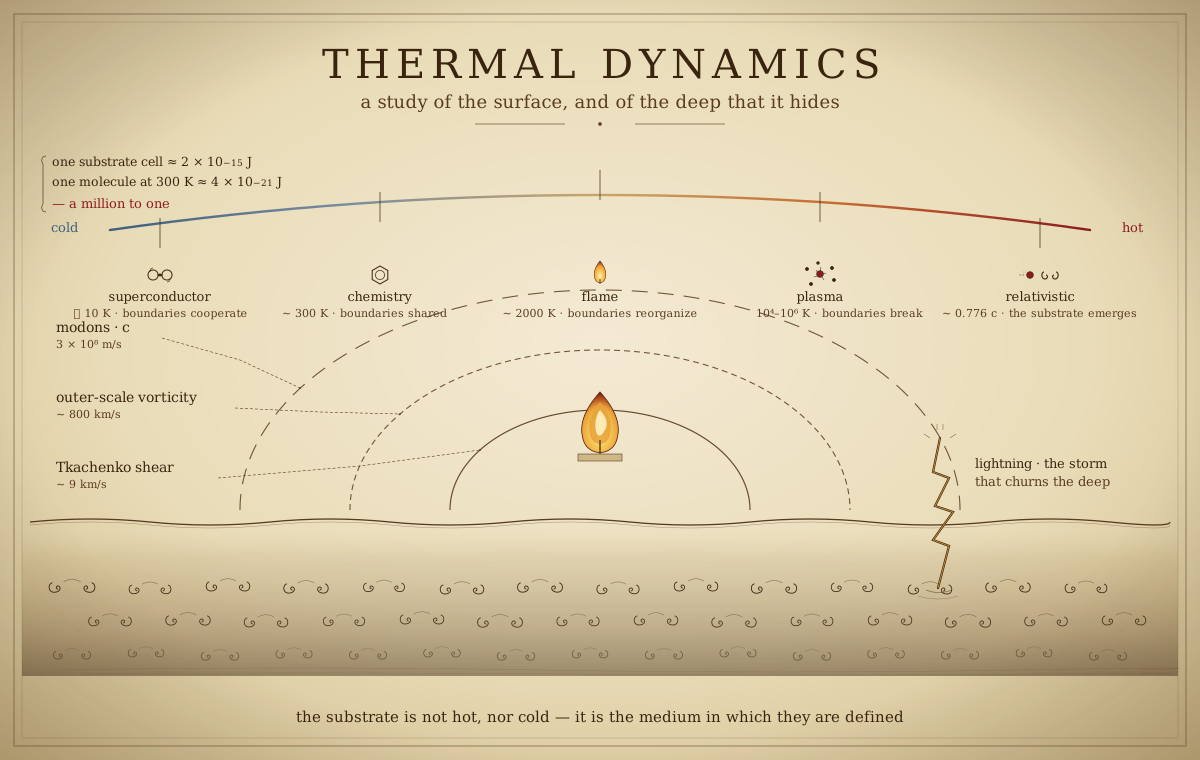
Thermodynamics works as well as it does because the substrate’s internal energy dwarfs anything atoms are doing thermally. The sea of cell vortices holds a rotational energy budget at 0.776\,c — a floor so far beneath ordinary temperatures that atomic kinetic energy is a small perturbation riding on top of it. Temperature, as we measure it, is a surface phenomenon. The substrate’s own energy is the deep ocean underneath.
This separation is not just a curiosity — it is why statistical mechanics closes. The substrate acts as a universal heat bath whose capacity is effectively infinite on atomic scales. Boltzmann’s assumption of ergodic molecular chaos succeeds because the molecules are perturbations in a medium, and that medium’s internal degrees of freedom are inaccessible at thermal energies. The substrate supplies the reservoir that thermodynamics always assumed was there but never identified.
\boxed{E_\text{substrate} \sim \rho_\text{DM}\,c^2\,\xi^3 \approx 2 \times 10^{-15}\;\text{J/cell} \qquad \gg \qquad k_B T \approx 4 \times 10^{-21}\;\text{J at 300 K}}
Six orders of magnitude. A single lattice cell of the substrate stores a million times more energy than a room-temperature molecule carries as thermal kinetic energy. This is why heating a gas does not disturb the substrate in any detectable way — and why the substrate has remained invisible to thermometry.
Two Energy Scales That Thermodynamics Blurs Together
Standard thermodynamics recognizes one energy scale: the kinetic energy of atoms and molecules — vibrations, rotations, translations of orbital system complexes moving within the substrate. The measured temperature T is a statistical statement about this energy.
The substrate holds a second energy scale: the rotational energy of the cell-vortex lattice, with inner-scale circulation at v_\text{rot,inner} = c\sqrt{2\alpha_{mf}} \approx 0.776\,c (see Emergent Speed of Light). This energy is not thermal. It is topological — locked in the winding numbers and boundary configurations of the vortex lattice. You cannot heat your way to it. You can only stress the substrate hard enough that its boundary structure starts reorganizing, as lightning demonstrates.
The hierarchy looks like this:
| Regime | Energy scale | Substrate behavior |
|---|---|---|
| Room temperature (300 K) | \sim 25 meV | Substrate invisible. Counter-rotating boundaries perfectly balanced. Atoms are perturbations on a calm sea. |
| Flame (\sim 2000 K) | \sim 170 meV | Boundary reorganization between molecular orbital systems. Substrate mediates energy transfer through three channels. |
| Plasma (\sim 10^4–10^6 K) | \sim 1–100 eV | Electron vortex defects liberated from bound configurations. Substrate responds to free topological charges. |
| Relativistic (T_e \sim 300 keV) | \sim 0.3 MeV | Electron vortices cross 0.776\,c. Substrate boundary destabilizes; modon shedding begins. The lightning regime. |
| Substrate floor | \rho_\text{DM}c^2\xi^3 \sim MeV/cell | Rotational energy of the lattice itself. Not thermally accessible. |
The gap between the top of the thermal column and the substrate floor is the reason thermodynamics never needed to know about the medium it was operating in. The statistical framework closes because the perturbation and the bath are separated by six orders of magnitude — and because the bath’s degrees of freedom (vortex topology, winding number, chirality) are invisible to temperature.
That column of regimes — room temperature, flame, plasma, relativistic, the floor — is itself a ladder, but a coarse one in the substrate ladder’s sense: its rungs are set by distinct physical mechanisms (thermal, chemical, ionization, relativistic, topological), not by the \sqrt{2} pairing factor that spaces the resonant tower. It is the energy-domain cousin of the conductors chapter’s “one mechanism, five scales” — a real and ordered hierarchy, honestly not a \sqrt{2} comb.
Three Channels of Heat Transfer
When energy moves through matter — conduction, convection, radiation — the substrate is the carrier that standard physics attributes to “the vacuum” or “the electromagnetic field.” In the substrate framework, each channel has a concrete identity and a characteristic speed.
Underneath the three channels is a single currency. The substrate ladder reads every exchange of energy with the substrate as the coin: the paired anti-phase breath of a vortex and its counter-rotating partner, a handoff that is complete and lossless precisely because it is paired (the breath is the ladder). The three channels are three ways that coin changes hands. Radiation spends it outright — a quantum of breath ejected from a reorganizing boundary as a modon. Conduction passes it along — the breath handed from one boundary system to the next through the lattice, without any matter moving. Convection lets matter keep the coin and carry it bodily, riding the lossless channel below the Landau velocity while the substrate gets out of the way. Heat, read this way, is the coin in motion; temperature is how much of it the surface is holding at once. This is the same answer the ladder gives biology — a structure on a rung is one plugged into the lossless channel — now read for energy rather than for size.
Channel 1 — Modons (radiation). When an orbital system reorganizes — an electron drops between bound states, a molecular bond rearranges — the boundary collapse ejects a counter-rotating vortex dipole into the dc1 sea. This is a modon. It propagates at c. It carries quantized energy set by the boundary matching condition. It is the photon. The color of a flame directly encodes which boundary transitions are happening: C₂ Swan bands, CH emission, the blue cone of complete combustion versus the yellow luminous zone of soot incandescence. Each color is a different modon topology shed from a different boundary reorganization.
Channel 2 — Substrate perturbations (conduction). When boundaries reorganize, not all the energy leaves as modons. Some couples into the cell-vortex lattice as collective perturbations — ripples that propagate through the lattice and couple to neighboring orbital systems. This is conductive heat transfer, and the substrate adds structure that the standard picture misses.
The perturbations propagate at three well-separated speeds, set by the three mode families of the vortex lattice:
| Mode | Speed | Physical origin |
|---|---|---|
| Modons | c = 3 \times 10^8 m/s | Quasiparticle excitations of the BEC |
| Outer-scale vorticity | v_\text{rot,outer} \approx 800 km/s | Collective lattice rotation (Emergent Speed of Light) |
| Tkachenko shear | c_T \approx 9 km/s | Transverse lattice oscillations |
Heat transfer through the substrate is not a single diffusion process — it is a cascade across three channels with three timescales. The fast channel (modons, c) carries the radiation. The intermediate channel (outer-scale vorticity, \sim 800 km/s) couples to collective rearrangements of the lattice around the heat source — this is the same outer-rotation speed v_L = \omega_0\xi that sets the galactic MOND↔︎CDM threshold, here carrying heat rather than sorting gravity. The slow channel (Tkachenko shear, \sim 9 km/s) governs how the lattice relaxes back to equilibrium.
The Tkachenko speed — \sim 9 km/s — invites comparison to the speed of sound in dense materials. The following section develops that comparison carefully, correcting for mode type and surveying the elements.
The Tkachenko–Phonon Coincidence in Beryllium
The original framing — that the speed of sound in dense materials sits “intriguingly close” to c_T \approx 9 km/s — needs a sharper comparison to be a real prediction. The Tkachenko mode of a vortex lattice is transverse; it is a shear wave. Comparing c_T to a longitudinal sound speed v_L is mixing modes. The apples-to-apples comparison is to the transverse (shear) sound speed v_T, which is also a shear wave.
When we make that comparison, the result becomes much more striking — and it tells us something the original paragraph missed.

What the data shows:
Beryllium hits c_T on the nose. v_T(\text{Be}) = 8.88 km/s versus the predicted c_T = 9 km/s — a 1.3% match. Be is the lightest dense solid with strong directional bonding; its shear modulus per density G/\rho \approx 71\;(\text{km/s})^2 is the highest of any pure metallic element. The substrate framework would say this is the natural place where the atomic boundary network and the substrate’s slowest mode co-stiffen.
Diamond exceeds c_T. v_T = 12 km/s. The 3D covalent C–C network is stiffer than the dc1 sea’s free Tkachenko mode. The substrate framework’s interpretation: when the atomic boundary network is so rigid that its shear stiffness exceeds the substrate’s, the network — not the substrate — sets the propagation speed. Materials in this regime should be those built from light atoms in fully-bonded 3D covalent networks: carbon, boron carbide, silicon carbide, beryllium oxide, boron nitride.
All metals fall well below c_T. Even tungsten (v_T = 2.89 km/s) and chromium (v_T = 4.00 km/s) — both very dense and stiff — sit well below the substrate’s Tkachenko speed. The substrate framework’s reading: in metallic solids, the delocalized electron sea makes the atomic boundary network “loose” relative to the substrate. Phonons travel through atomic dynamics, not through the dc1, and the dc1 sea acts as a passive medium.
Lead is the outlier. v_T(\text{Pb}) = 0.7 km/s — a factor of 13 below c_T. Soft metals with large atomic spacing and weak bonds approach the limit where atomic phonons and substrate modes essentially decouple.
Refining the spacing intuition
The original guess — denser lattice should be a little faster, stretched lattice a little slower — needs to be split into two questions, because “denser” has two meanings:
| Sense of “denser” | What it controls | Effect on v_T = \sqrt{G/\rho} |
|---|---|---|
| Smaller nearest-neighbor distance d | Stiffer bonds (force scales as 1/d^n, large n) | v_T increases |
| Higher mass density \rho | More inertia per unit volume | v_T decreases |
Within a single bond chemistry, smaller d wins: the stiffening dominates the mass increase, and v_T rises. Across bond chemistries, neither quantity alone predicts v_T — the bond chemistry dominates. Lead is dense but soft; tungsten is dense and moderately stiff; beryllium is light and stiff; diamond is light and very stiff.
So: the intuition is right for d (atomic spacing), backwards for \rho (mass density). What’s missing in the simple picture is the bond stiffness, which is what the substrate framework actually wants to talk about. In substrate language, “stiff bonds” means the atomic boundary network shares vortex topology efficiently with the dc1 sea — which is exactly the condition for the atomic phonon to couple to the substrate’s Tkachenko mode rather than ride passively on top of it.
A sharper testable prediction
The substrate framework now makes a concrete claim that the original paragraph did not quite reach:
There should be a pile-up of light, stiff-bonded solids near v_T = c_T. The substrate’s natural shear speed sits at \sim 9 km/s. Atomic-lattice shear speeds saturate near it from below for the lightest, most tightly-bonded metals (Be) and exceed it from above only for full 3D covalent networks (C, plausibly B, B_4C, SiC, BeO, BN). A comprehensive survey of v_T for compounds in this range — light atoms with high G/\rho — should reveal a “shoulder” in the distribution at \sim 9 km/s that has no analog in the standard Debye picture, where the shear speed is set entirely by atomic-scale stiffness with no preferred value.
Roughly: G/\rho = c_T^2 \approx 81\;(\text{km/s})^2, equivalently G/\rho \approx 8.1 \times 10^{10} m²/s². Materials with G/\rho near this value — Be (71), B (\sim 85), B_4C (\sim 79) — are the predicted hits. Diamond (G/\rho \approx 152) and the diamond-cubic carbides exceed it; ordinary metals fall well short.
This is a prediction that lives or dies on a finer survey of the elastic constants of stiff-bonded compounds. If the histogram of v_T values for light, hard solids shows a knee or pile-up at 9 km/s, the substrate’s slowest mode is leaving a fingerprint in atomic-scale physics. If it doesn’t, the closeness of v_T(\text{Be}) to the predicted c_T is a coincidence — but a striking one, given how tightly Be’s elastic ratio is fixed by its bonding.
Data summary
| Element | v_L (km/s) | v_T (km/s) | d (pm) | \rho (g/cm³) | v_T / c_T |
|---|---|---|---|---|---|
| C (diamond) | 17.50 | 12.00 | 154 | 3.52 | 1.33 |
| Be | 12.89 | 8.88 | 225 | 1.85 | 0.99 |
| Si | 8.43 | 5.84 | 235 | 2.33 | 0.65 |
| Cr | 6.61 | 4.00 | 250 | 7.15 | 0.44 |
| Mo | 6.25 | 3.35 | 272 | 10.28 | 0.37 |
| Fe | 5.95 | 3.24 | 248 | 7.87 | 0.36 |
| Ti | 6.07 | 3.13 | 295 | 4.51 | 0.35 |
| Mg | 5.77 | 3.05 | 320 | 1.74 | 0.34 |
| Al | 6.42 | 3.04 | 286 | 2.70 | 0.34 |
| Ni | 6.04 | 3.00 | 249 | 8.91 | 0.33 |
| W | 5.22 | 2.89 | 274 | 19.25 | 0.32 |
| Zn | 4.21 | 2.44 | 266 | 7.14 | 0.27 |
| Cu | 4.76 | 2.33 | 256 | 8.96 | 0.26 |
| Pt | 3.83 | 1.68 | 277 | 21.45 | 0.19 |
| Sn | 3.32 | 1.67 | 302 | 7.26 | 0.19 |
| Ag | 3.65 | 1.61 | 289 | 10.49 | 0.18 |
| Au | 3.24 | 1.20 | 288 | 19.30 | 0.13 |
| Pb | 2.16 | 0.70 | 350 | 11.34 | 0.08 |
Sound speeds: CRC Handbook (Wikipedia compilation, room temperature). Nearest-neighbor distances d = 2 r_\text{metallic} (Slater 1964), except C and Si (covalent radii).
Channel 3 — Kinetic energy of product molecules (convection). When boundaries reorganize violently — combustion, detonation, ablation — the orbital system complexes (molecules) themselves are flung outward. This is convective heat transfer. The molecules carry their thermal kinetic energy through the substrate the way boats move through water. Below the Landau critical velocity (v_\text{rot,outer} \approx 0.0025\,c), they move frictionlessly. The substrate gets out of the way. This is why convective heat transfer follows the Navier-Stokes equations so precisely — the dc1 is invisible to subsonic molecular motion.
Combustion as Boundary Topology Reorganization
Combustion maps onto the substrate framework with surprising clarity, and the aromatic rings section provides the launching pad.
When a hydrocarbon burns, what happens in substrate language is: the shared counter-rotating boundaries between C-H and C-C bonds reorganize into the lower-energy boundary configurations of CO₂ and H₂O. Each bond is a boundary merger — two orbital systems (atoms) sharing a counter-rotating vortex layer (see Hydrogen Flywheel). Combustion reshuffles which boundaries are shared, releasing the energy difference as modons and substrate perturbations.
The aromatic ring makes this especially vivid. Benzene’s toroidal vortex raceway is 36 kcal/mol more stable than the equivalent set of localized bonds, precisely because the torus has no termination energy — no boundary ends, no free edges. Combustion destroys that torus. Breaking benzene’s aromatic ring requires overcoming 36 kcal/mol of topological stability, which is why aromatic compounds need high ignition temperatures but then burn hot — once the torus tears, all that boundary energy is released at once. The latent heat of aromaticity is topological.
The energy released flows through the three channels:
Modons — the light of the flame. Color directly encodes the boundary transitions: blue for CH and C₂ radical boundaries reforming, yellow for soot particles (carbon cluster boundaries) radiating a broad thermal modon spectrum.
Substrate perturbations — coupling to neighboring orbital systems through the three-speed cascade. This is how the flame heats the pot even before the convection plume reaches it.
Molecular kinetic energy — products flung outward. The hot exhaust.
The flame front itself — the reaction boundary propagating through a fuel-air mixture — is a dispersive phenomenon in the substrate. The thermal energy released at the front creates a cascade of substrate perturbations that heat the next layer of fuel past its ignition threshold. The flame speed is related to the rate at which substrate perturbations can reorganize boundary topologies, which connects to \alpha_{mf} and the mutual friction coupling.
The distinction between deflagration (subsonic flame) and detonation (supersonic) may have a substrate-level interpretation. In deflagration, the flame front propagates slower than the Tkachenko speed — the lattice has time to relax ahead of the front, and the reorganization is orderly. In detonation, the front outruns the lattice’s ability to prepare — the reorganization is a shock, and the substrate responds with a dispersive shock wave structurally similar to the undular bores modeled in the DESI crust analysis. Same physics, vastly different scale.
Phase Transitions as Boundary Topology Changes
Melting, boiling, and solidification are topological reorganizations of shared boundaries between orbital systems — the same physics as aromatic-versus-antiaromatic stability, operating at the inter-molecular scale instead of the intra-molecular.
Solids. In a crystalline solid, atoms share boundaries in a rigid lattice of merged raceways. The crystal structure is set by which boundary topologies minimize total vortex energy at the inter-atomic spacing — and this is why crystal symmetries exist. The substrate’s own vortex lattice has hexagonal symmetry; the crystals forming within it have symmetries constrained by what the dc1 sea can support. The 32 crystallographic point groups are the set of atomic boundary arrangements compatible with the substrate’s own topology.
Melting. Melting occurs when thermal perturbations in the substrate become large enough to break shared boundaries faster than they can reform. The latent heat of fusion is the boundary energy difference between the ordered and disordered configurations. This is the same physics as the aromatic/antiaromatic distinction — a topologically ordered boundary arrangement (the crystal lattice, or the benzene torus) versus a disordered one (the liquid, or localized bonds) — with the energy gap set by the boundary reorganization cost.
Boiling. Vaporization is the more violent reorganization: not just disordering the shared boundaries but severing them entirely. Each molecule becomes an isolated orbital system complex, no longer sharing counter-rotating layers with its neighbors. The latent heat of vaporization is always larger than the latent heat of fusion because it costs more energy to sever a boundary than to disorder it — a fact that standard thermodynamics records but doesn’t explain. The substrate provides the mechanism: severed boundaries leave free vortex ends that must either reconnect or radiate their excess energy as substrate perturbations.
Superconductivity as the opposite extreme. At the cold end of the temperature spectrum, superconductors represent a phase where the substrate’s own boundary structure becomes directly visible in material behavior. The Cooper pair is two electron vortices sharing a counter-rotating boundary through the dc1 — a molecular-scale analog of what every covalent bond already is, but now between vortex defects rather than orbital systems. In the language of the substrate ladder, this cold end is the locking pole carried to its limit: a whole ensemble locked breath-for-breath into a single clock, the coin circulating without loss across the entire sample (worked out in conductors). Plasma, at the hot end, is the same axis run the other way — boundaries shattered and the breath running free as liberated defects. The BCS gap is the boundary energy of this shared configuration. The superconducting transition is a boundary topology change in the dc1, which is why it is sharp, why it is accompanied by a latent heat (second-order, but with a specific heat jump), and why magnetic flux is quantized — the vortex topology of the substrate enforces it.
Phase transitions, from superconductivity at millikelvins to plasma at megakelvins, are all the same substrate event: reorganization of shared counter-rotating boundaries between things living in the dc1 sea. The temperature axis is a journey through boundary topology space.
Blackbody Radiation and the Natural Infrared Cutoff
The Planck spectrum is the modon emission statistics of the sea of cell vortices in thermal equilibrium with its boundaries.
The ultraviolet catastrophe — the classical prediction that radiated energy should pile up at short wavelengths without limit — was historically solved by Planck’s quantization postulate, which in the substrate framework is not a postulate but a geometric consequence of modon boundary matching. Modons exist only in discrete states set by the Bessel matching condition at the cell boundary (see Photon as Modon). There is no continuum of states for energy to pile into. The UV catastrophe is avoided because the substrate’s topology does not support it.
But the substrate adds something that standard quantum mechanics does not: a natural infrared cutoff. The minimum modon energy is set by the lattice cell size:
\boxed{E_\text{min} = \frac{hc}{\xi} \approx 13\;\text{meV} \qquad (\lambda_\text{max} \approx 100\;\mu\text{m})}
Below this energy, a disturbance in the dc1 cannot form a self-sustaining vortex dipole — there is not enough room within a single cell for the interior Bessel oscillation to complete. Perturbations below E_\text{min} propagate as collective lattice excitations — Tkachenko modes, sound-like ripples in the vortex array — rather than as individual modons. They are not photons; they are substrate weather.
This floor is the long end of the substrate ladder. That ladder is a tower of discrete preferred scales tiled between two cutoffs — the vortex core \xi_\text{GP} at the short end, the cell \xi at the long end — and the modon is the tower’s dweller in the energy domain: a discrete, boundary-matched excitation that can sit on a rung only while a cell can still host the self-similar breath. At E_\text{min} = hc/\xi a disturbance falls off the bottom of the ladder, and what lies below is not a longer-wavelength rung but continuous lattice weather — Tkachenko ripples, off the tower entirely. (Here \xi is the ladder’s cutoff, not one of its \sqrt{2} rungs; the two are set by different physics, a distinction the ladder chapter’s honest accounting is careful to keep.)
Standard QFT handles this with a manual infrared cutoff — an arbitrary low-energy scale inserted to regularize integrals, with the promise that physical results don’t depend on it. The substrate predicts the cutoff. It is not arbitrary; it is hc/\xi, set by the same lattice cell size that the bridge equation pins down from both particle physics and cosmology.
A testable prediction. The substrate predicts a subtle deviation in the blackbody spectrum at very long wavelengths (\lambda \gtrsim 100\;\mum). Below E_\text{min}, the density of available modon states drops to zero — not gradually (as in a smooth cavity mode calculation) but with a characteristic edge set by the lattice geometry. The standard Planck formula assumes a continuum of modes at all frequencies; the substrate replaces this with a discrete lattice mode spectrum that has a hard floor. At wavelengths much shorter than \xi, the two descriptions agree — many lattice cells contribute, and the continuum limit is excellent. At wavelengths approaching or exceeding \xi, the substrate spectrum should deviate downward from Planck.
The predicted transition wavelength (\sim 100\;\mum) falls in the far-infrared / sub-millimeter band — the same band where CMB measurements are made. Existing CMB spectral data from COBE/FIRAS confirmed the Planck shape to \sim 50 parts per million, but the measurement bandwidth extends only to \lambda \approx 1 cm, well above \xi. A dedicated far-infrared spectral measurement — perhaps with a successor to FIRAS operating at \lambda = 50–500\;\mum with enough spectral resolution to see the lattice edge — would test this prediction directly.
One subtlety sharpens what this test is, and is not. The downward edge above describes the locally emitted spectrum — the modes a body in equilibrium with the substrate today can radiate below E_\text{min}. It is not a prediction that the CMB monopole is truncated at 100\;\mum, because the long-wavelength CMB we observe is not locally emitted: those photons were emitted far above the floor at recombination and redshifted down through it in flight. A photon now at \nu_\text{obs} < 3 THz crossed the floor at 1+z_\text{cross} = \nu_\text{floor}/\nu_\text{obs} (z\approx4 at 600 GHz, z\approx50 at 60 GHz), so the FIRAS frequency axis is secretly a crossing-epoch map, and that crossing is adiabatic to $$1 part in 10^{28} — which is precisely why FIRAS sees an unbroken blackbody down to its band edge rather than a truncation (Photon as Modon; sessions/firas-crossover-1.md). The hard floor is therefore best tested at the crossing (done — clean) and in the laboratory band edge (a static source emitting at $$3 THz, where no redshift smears the edge), not as a deficit in the redshifted CMB monopole.
The infrared cutoff connects directly to Volovik’s argument about the cosmological constant. In standard QFT, the vacuum energy calculation sums zero-point modes down to arbitrarily long wavelengths, producing the infamous 10^{120} discrepancy. The substrate’s natural IR cutoff at E_\text{min} = hc/\xi eliminates the deepest IR modes from the sum, while the UV cutoff from the lattice cell size eliminates the shortest. Both boundaries are physical — set by the same \xi — and together they constrain the vacuum energy to a finite value that the Volovik self-tuning mechanism then drives to near-zero (see DESI Dark Energy Crust). The Planck spectrum and the cosmological constant are two faces of the same lattice geometry.
Plasma: The Substrate’s Excitations Running Free
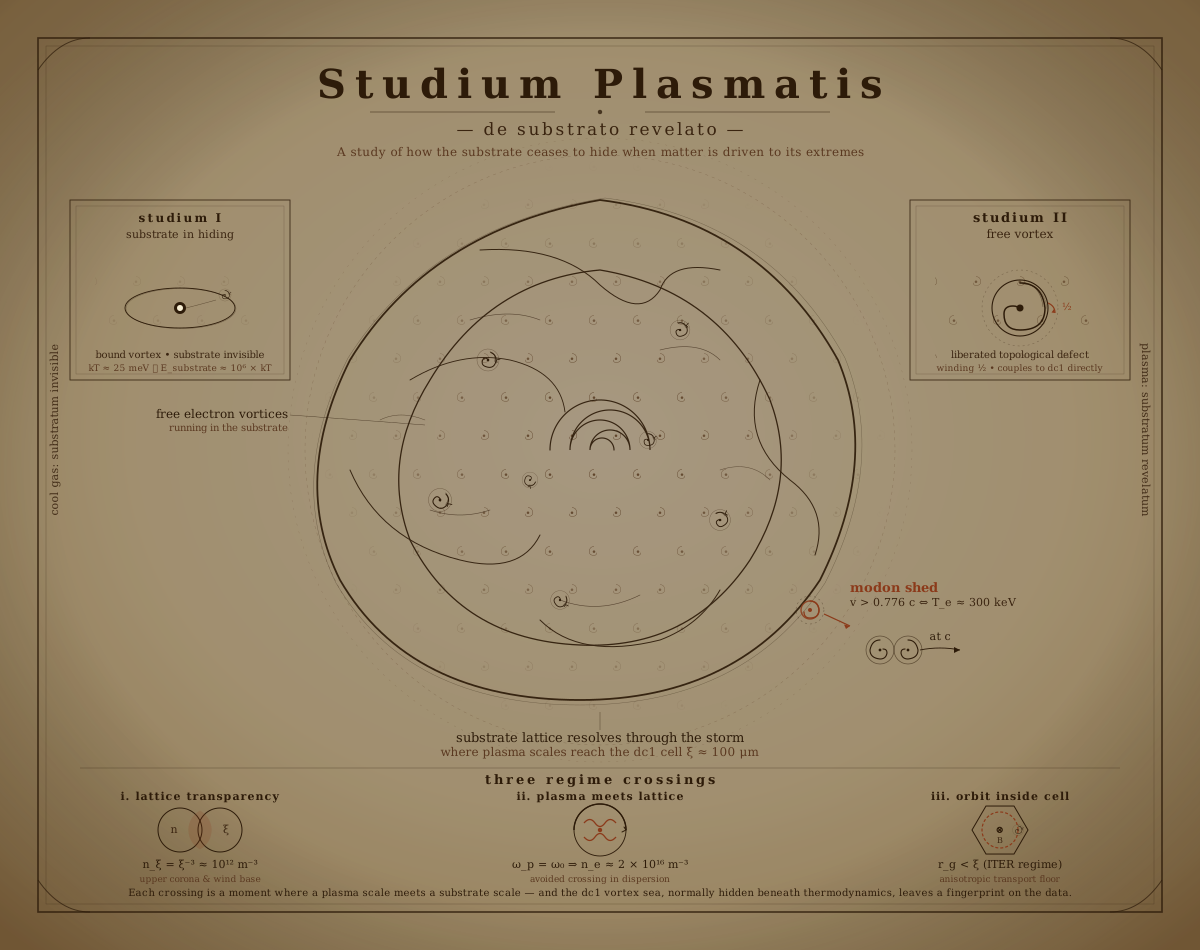
At extreme temperatures, electrons are liberated from their bound orbital configurations — topological vortex defects (spin-½, protected by winding number; see Electron) freed from the shared boundary systems that constitute atoms and molecules.
In a plasma, the substrate is no longer hidden behind organized boundary systems. Free electron vortices and bare nuclear junction complexes both interact directly with the dc1 sea rather than through the mediation of shared molecular boundaries. This is why plasma behaves so differently from gases — it is not just “hot gas.” It is a state where the substrate’s own excitations (vortex defects) are running free in the substrate, interacting with each other through the same medium that created them.
This is also where the substrate stops hiding. The masking mechanisms that keep the dc1 invisible at room temperature (Lightning section) — exact counter-rotation, ξ-scale lattice averaging, sub-relativistic electrons riding along — fail one by one as plasma conditions push toward extremes. Plasma physics is, in the substrate framework, a sequence of regime crossovers where specific substrate scales meet specific plasma scales, and each crossover predicts a specific anomaly.
The qualitative picture (plasma as liberated topological defects in the dc1, magnetic confinement as boundary topology management, the 300 keV modon-shedding threshold) is a core framework claim. The three regime crossovers below are derived directly from substrate scales meeting plasma scales — the locations of the crossovers are firm, but the magnitudes of the predicted anomalies need more work. The reconnection rate ceiling once stated here (\sim\tfrac13 of the Landau velocity) is retired (see the note above): reconnection is the rim’s over-driven masking-failure channel, not a flow capped at v_L. What survives is the onset speed v_L itself and the flare-onset timescale \tau\sim L/v_L it sets. The Tkachenko-branch QPP prediction is robust as “an additional oscillation family should exist”; identifying which observed events sit on it is a data analysis project. The cross-domain 300 keV prediction (lightning + solar + tokamak) is the strongest claim — same physics, three independent measurements.
Three Regime Crossovers Where the Lattice Becomes Visible
The substrate is normally invisible because plasma scales sit far below substrate scales. As you push density, temperature, or field, plasma scales reach substrate scales at three distinct places — and each is a place where standard plasma physics should acquire an additional substrate-mediated term.
Crossover 1 — Lattice transparency: n_\xi = \xi^{-3} \approx 10^{12}\,\text{m}^{-3}. Below this density the mean inter-particle spacing exceeds the lattice cell, so individual charged particles propagate through resolved lattice structure rather than averaging over it. Above it, you have many particles per cell and the substrate looks like a smooth continuum. This is exactly where the solar atmosphere’s behavior changes character:
| Region | n_e (m⁻³) | n_e / n_\xi |
|---|---|---|
| Photosphere | 10^{23} | 10^{11} — substrate fully averaged |
| Chromosphere | 10^{17}–10^{20} | 10^5–10^8 |
| Transition region | 10^{15} | 10^3 |
| Lower corona | 10^{14} | 10^2 |
| Upper corona / wind base | 10^{12}–10^{13} | 1–10 — lattice resolved |
| Solar wind at 1 AU | 10^7 | 10^{-5} — particles widely separated |
The framework predicts that non-MHD anomalies should onset where n \to n_\xi from above — non-Maxwellian distributions, anisotropic transport, persistent flux-tube structures that survive thermalization. This is exactly the region where coronal heating mechanisms struggle and the solar wind acquires its famous structure (kappa distributions, ion beams, persistent flux tubes). The substrate framework is not claiming to be the coronal heating mechanism — wave heating and nanoflare reconnection do most of the work. It claims an irreducible additional channel that turns on at n_\xi, contributing a substrate-mediated anomaly to whatever the leading mechanism delivers. Test: transition-region brightenings and coronal-hole boundaries should show statistical structure (correlation length, oscillation modes) that scales with \xi, not with the local Coulomb mean free path.
Crossover 2 — Plasma frequency meets lattice rotation: n_e^{(\omega_0)} \approx 2 \times 10^{16}\,\text{m}^{-3}. Setting \omega_p = \omega_0 = 7.8\times 10^9 rad/s gives this density (to within 10%):
\omega_p = \sqrt{\frac{n_e e^2}{m_e \epsilon_0}} = \omega_0 \quad \Rightarrow \quad n_e = \frac{\omega_0^2 m_e \epsilon_0}{e^2} \approx 2 \times 10^{16}\,\text{m}^{-3}
Below this density, the substrate’s lattice rotation is faster than charge oscillations — the dc1 acts as the “rigid neutralizing background” that the textbook derivation of \omega_p assumes. Above it, the plasma is oscillating faster than the substrate can respond, and the substrate’s own modes should mix with the plasma response. Prediction: the dispersion relation \omega(k) for Langmuir waves should show an extra branch or anti-crossing near \omega \sim \omega_0 that the standard Bohm-Gross dispersion does not contain. This density is right in the upper-corona regime and within reach of dense flare loops.
Crossover 3 — Gyroradius equals cell size: r_g = \xi. For ITER-class plasmas (10 keV electrons, 5 T), the electron gyroradius is
r_g = \frac{m_e v_\text{th}}{eB} \approx 68\;\mu\text{m}
— below \xi = 100\;\mum. The entire electron orbit fits inside a single substrate cell. The framework prediction: cross-cell transport (perpendicular to lattice domain alignment) and intra-cell transport (within a cell) become physically distinct processes with different scaling. Standard neoclassical theory averages over them. The substrate framework predicts an anisotropic floor on \chi_\perp that does not appear in tokamak transport codes. This shows up as residual stiffness in transport scaling at small \rho^* — the “rho-star scan” experiments at DIII-D and JET would be the natural place to look for it. ITER will run squarely in this regime.
The claim that r_g < \xi produces a transport anomaly assumes the substrate’s domain orientation matters for cross-field transport — i.e., that the lattice has macroscopic chirality-coherent regions that the gyrating electron either samples (when r_g > \xi) or doesn’t (when r_g < \xi). The lightning section’s Pillar-5 argument supports the existence of such domains, but their size and sharpness in a tokamak environment have not been calculated. If domains are sub-mm, the anomaly is likely already absorbed into edge transport empiricism. If they are cm-scale, the anomaly should be visible.
Plasma Oscillations as Substrate Resonance
The conventional derivation of the plasma frequency \omega_p = \sqrt{n_e e^2 / (m_e \epsilon_0)} treats the electron sea as oscillating against a rigid neutralizing background of ions. The substrate framework gives the rigid background a name: it is the dc1 sea, and its rigidity comes from the lattice’s own organized rotation at \omega_0.
In substrate language, plasma oscillation is the electron vortex population displacing the surrounding condensate, with the condensate’s rotational stiffness providing the restoring force. The plasma frequency is a substrate resonance. This is why plasma is opaque below \omega_p and transparent above: below the resonance, the substrate’s response is fast enough to screen the incoming modon; above it, the modon outruns the collective response and passes through. Maxwell’s wave equation in a plasma is not a special quirk of charged matter — it is the substrate being interrogated at a frequency where its own response time matters.
The new prediction enters when \omega_p approaches \omega_0. The standard Bohm-Gross dispersion \omega^2 = \omega_p^2 + 3 k^2 v_\text{th}^2 assumes the background is infinitely stiff. In the substrate picture, when \omega_p \sim \omega_0, the lattice can no longer supply the assumed rigid response, and a second branch — the substrate’s own collective mode — should mix in. The signature is an avoided crossing, not a smooth dispersion. Dense laboratory plasmas and the upper transition region of stellar atmospheres are the natural places to look.
Magnetic Containment as Substrate Topology Battle
Confining a plasma in a tokamak is, in substrate language, trying to keep free vortex defects (electrons) and junction complexes (ions) within a region of the dc1 sea using external magnetic fields — which are themselves organized substrate configurations. The notorious plasma instabilities — kinks, sausages, tearing modes — are the substrate’s vortex topology trying to find lower-energy configurations against the imposed magnetic constraint. They are the same reconnection physics that lightning exhibits at atmospheric pressure, with the same outcome: the substrate finds a way to reorganize, and stored magnetic energy converts to particle energy plus modon emission.
What the substrate framework adds — and what is genuinely new — is a characteristic speed at which this reorganization turns dissipative: the outer-rim Landau velocity v_\text{rot,outer} \approx 750 km/s, the speed below which the substrate carries organized flow losslessly (Emergent Speed of Light). At that speed vortex reorganization couples to dissipation — heat, particle acceleration, modon shedding — and reconnection is that dissipative reorganization. So reconnection is the substrate operating above the onset, not a flow held at it.
An earlier version of this section read v_\text{rot,outer} as a hard ceiling on the reconnection rate, V_R^\text{flare} \lesssim \tfrac13 v_\text{rot,outer} \approx 250 km/s, with the \tfrac13 a placeholder. That reading does not survive the data and is withdrawn. Reconnection outflow jets are measured from $$100 to $$3500 km/s (Yohkoh/SXT $$100–200 km/s; impulsive coronal outflows to $$3500 km/s; magnetotail earthward jets above 1500 km/s) — they straddle v_L rather than stopping below it. And the famous near-universal reconnection rate $$0.1 is a geometrical MHD factor normalized to the local Alfvén speed (Cassak & Liu 2017; flare v_A ranges $$380–8000 km/s, median $$1700, Aschwanden 2020), not a fraction of v_L. The correct reading — reconnection as the outer rim’s masking-failure channel, an over-driven boundary blasting through the dissipation onset and paying the excess as the tear, the outer-rim twin of the lightning gamma — is worked out in The Outer Rim Onset. What the substrate genuinely contributes is the onset speed itself, not a cap on the outflow.
The onset speed v_L still does real work: it is the scale at which a coronal flow crosses from lossless to dissipative, and that scale sets a characteristic reorganization timescale. This has two corollaries.
Why fast reconnection works at all. Sweet-Parker reconnection is famously too slow to explain solar flares. Petschek and plasmoid mechanisms patch the gap by changing the geometry of the diffusion region. The substrate framework adds a third ingredient: at scales of L \sim 10^7 m (a coronal active region), the substrate’s outer rotation traverses the region in \tau \sim L/v_\text{rot,outer} \sim 12 s. This is exactly the timescale of impulsive flare onset. The substrate provides a topology-reorganization channel that is macroscopically fast but bounded — fast enough to flare, slow enough not to disrupt the corona globally.
Why the corona has the structure it does. Coronal loops persist for hours despite continuous footpoint shuffling. In the substrate picture, this is because the substrate carries the shuffling losslessly below v_L, protecting the loop’s topology from rapid dissolution — the footpoints can shuffle faster than the substrate goes dissipative. Flares are the events where accumulated topological stress finally drives a boundary past the onset. The flare timescale is set by L/v_\text{rot,outer}; the inter-flare timescale is set by how fast stress accumulates to threshold.
Test: not an outflow-speed cap — outflows exceed v_L, as the retired-ceiling note above records. The surviving falsifiable claim is the onset-timescale scaling: impulsive-flare onset times should track \tau \sim L/v_\text{rot,outer} (a few seconds to tens of seconds for active-region scales L\sim10^7 m), set by the fixed substrate speed v_L rather than by the local Alfvén speed, which varies by an order of magnitude across the same events. A flare-onset-time vs. loop-length scaling whose slope returns v_L\approx750 km/s — and is flatter against the local v_A than against L — would support the onset reading; onset times scaling cleanly with v_A instead would not. The companion signature is at the inner rim: where a flow does cross v_L and the substrate goes dissipative, the 300 keV modon-shedding feature should appear in the same events.
The Tkachenko Branch in Plasma Oscillations
Oscillating coronal structures — quasi-periodic pulsations (QPPs) in flares, slow-mode loop oscillations, decaying transverse oscillations — are catalogued in the thousands and modeled with MHD wave theory. The standard fit is that period T scales with structure size L and characteristic speed (Alfvén speed \sim 10^3 km/s for fast modes, sound speed \sim 200 km/s for slow modes):
T = \frac{2L}{v_A} \quad \text{or} \quad T = \frac{2L}{c_s}
The substrate framework predicts an additional family of oscillations on the lattice’s own slow shear branch:
\boxed{T_\text{Tk} = \frac{2L}{c_T} \quad \text{with} \quad c_T \approx 9\;\text{km/s}}
A 1000 km loop on the substrate Tkachenko branch oscillates with T \sim 220 s; a 100 km thread with T \sim 22 s; a 10 km filamentary structure with T \sim 2 s. These periods are slow by MHD standards but well within the observed QPP catalog.
This is a harmonic relation — the period is fixed by a structure’s length L — and that is exactly right here, for the reason the substrate ladder makes precise: a coronal loop has a length, so it rings in overtones of that length the way a string or a bounded cavity does. The ladder’s \sqrt{2} tower is the complementary case — the spacing a critical medium falls into when it has no length of its own, only a preferred ratio. A loop oscillating on the Tkachenko branch and the \sqrt{2} rungs of the lattice are two different things; it is the loop’s length, not the substrate’s, that sets T_\text{Tk}.
Test: a scatter plot of catalogued QPP T vs. measured oscillating-structure size L should show two populations — the dominant Alfvénic ridge at L/T \sim 10^3 km/s and the slower acoustic ridge at L/T \sim 200 km/s, with a third substrate ridge at L/T \sim 9 km/s. The substrate ridge would be invisible to MHD modeling and is a clean discriminator. A statistical analysis of the existing Nakariakov QPP catalog and SolO/EUI observations should suffice to find or rule it out.
Not every QPP rides the substrate’s slow mode. The framework predicts that some fraction of catalogued events should cluster at L/T \sim 9 km/s — those where the lattice itself is the ringing element rather than the magnetic field or thermal pressure. We do not yet have a selection rule that says which observed events should and shouldn’t be on this branch. The empirical signature (a ridge at 9 km/s in L-vs-T space) is what to look for; deriving which physical conditions favor exciting the Tkachenko branch over the Alfvén or acoustic branch is open work.
The 300 keV Threshold Across Plasma Domains
In a thermal plasma, most electrons have speeds well below 0.776\,c. But the high-energy tail of the distribution extends to relativistic speeds, and those electrons cross the modon-shedding threshold derived in the Lightning section:
v_\gamma^\text{onset} = c\sqrt{2\alpha_{mf}} \approx 0.776\,c \quad \Leftrightarrow \quad T_e \approx 300\;\text{keV}
This is the same threshold, in the same substrate, in three very different host plasmas. The framework predicts that the spectral signature should appear in all three:
| Domain | Source | Detector | Status |
|---|---|---|---|
| Atmospheric plasma | Thunderstorm runaway electrons | TGF instruments, ALOFT | Predicted in Lightning section |
| Solar/stellar plasma | Coronal flare runaways, supernova remnants | RHESSI, STIX, NuSTAR | Re-analyze archival hard X-ray spectra |
| Laboratory plasma | Tokamak runaway electrons in disruptions | DIII-D, JET, FTU, COMPASS HXR cameras | Re-analyze runaway gamma data |
In each case the signature is the same: a spectral break or shoulder at T_e \approx 300 keV, sitting on top of the full bremsstrahlung continuum — including the dipole-forbidden electron–electron channel, which itself turns on near the electron rest-mass scale and is the correct baseline to compare against (see The Inner Rim Spectrum, which supplies the mechanism, the breath-set shoulder width, and the discriminators). The angular distribution should be different too — bremsstrahlung peaks forward in the electron’s direction of motion, while modon shedding from a destabilizing vortex boundary should be more isotropic in the electron’s rest frame, producing a fatter angular distribution at the lab-frame source.
If the same \sim 300 keV threshold appears in atmospheric, solar, and laboratory plasmas with comparable spectral character, that is three independent confirmations of one substrate scale. All three datasets exist already — but they are not equally clean reads, and the honest version of the test is graded by how much sits between the rim and the instrument (What the Archives Already Show). In the solar archive the feature is already observed — the upward break near 400 keV attributed to e–e bremsstrahlung (Kontar et al. 2007; Kong, Li & Chen 2013) — which both anchors the energy scale and warns that its mere existence is not evidence, since the measured breaks vary with acceleration. The tokamak domain, with a controlled, repeatable runaway population measured across the 200–500 keV band, is the cleanest place to isolate a fixed rim component from a variable break, and is genuinely untested. The TGF channel reads the rim only through atmospheric and spacecraft Compton scattering that smears the sub-MeV band (Fitzpatrick et al. 2014), so it wants a near-source platform (ALOFT), not orbit. So this is a re-analysis program rather than a single re-analysis exercise — run solar, tokamak, TGF in that order of cleanness.
Most of the framework’s predictions are tied to a single domain (galaxy rotation, dark energy, lightning, etc.). The 300 keV threshold is unusual in that the same substrate parameter (\alpha_{mf}, via the inner-scale rotation 0.776\,c) controls the same observable phenomenon in three host environments separated by twelve orders of magnitude in density and ten orders of magnitude in scale. If the threshold appears at a noticeably different energy in each domain — or doesn’t appear in some — the framework is in trouble. If it appears at \sim 300 keV in all three, it is hard to explain by anything except a shared underlying mechanism, and the substrate is the leading candidate for what that mechanism is.
Plasma as the Substrate’s Tabletop
The deeper point connects this section to Lightning and pulls the entire arc of Thermal Dynamics together: plasma is the regime where the substrate’s normally-cooperative behavior fails on multiple axes simultaneously. Density crosses n_\xi and the lattice resolves; electron orbits shrink below \xi and gyromotion becomes intra-cellular; flows cross v_\text{rot,outer} and the substrate goes dissipative — reconnection spending its coin as the tear; tail electrons cross 0.776\,c and modon shedding turns on; lattice oscillations get excited and contribute extra QPP frequencies.
Each of these failures of substrate invisibility produces a specific anomaly relative to standard plasma physics. Each anomaly is testable with existing instruments. None requires new fundamental physics — only a willingness to read the data through a framework where the medium is participating.
The unified picture: solar flares, tokamak disruptions, and thunderstorm gamma flashes are the same kind of event at very different scales. Each is the substrate finding a way to reorganize a vortex topology that has been driven past its quiet regime. Each emits a characteristic gamma-ray signature at 300 keV. Each goes dissipative as the relevant flow crosses the substrate’s Landau velocity v_L — spending its coin as the tear, not stopping there. Each shows oscillatory residuals on the Tkachenko branch. The three together constitute a tabletop laboratory for substrate physics, distributed across atmospheric, stellar, and engineering scales.
The Superconductor-to-Plasma Arc
The substrate framework gives a unified view of the entire temperature axis as a single narrative: the progressive disruption of shared counter-rotating boundaries.
At the cold end: superconductivity. Cooper pairs share boundaries through the dc1. The pair wavefunction is a substrate object. Magnetic flux is quantized because vortex topology in the dc1 demands it. The material is in its most substrate-cooperative state — organized boundaries, no free defects, zero resistance because the boundary network conducts without dissipation.
At room temperature: chemistry. Atoms share boundaries in molecules. The aromatic ring is a topological masterpiece — zero boundary termination energy. The covalent bond is a shared counter-rotating layer. Thermal energy is a perturbation on the boundary network, too weak to disrupt it but strong enough to make the molecules jiggle.
At flame temperatures: combustion. Thermal energy approaches the boundary reorganization threshold. Boundaries rearrange into lower-energy configurations. The substrate mediates the energy release through three channels at three speeds. The flame front is a dispersive wave in the dc1.
At plasma temperatures: free defects. Electrons are liberated — the boundary network is shattered. The substrate deals with free topological charges directly. Plasma physics is the substrate’s own excitations running loose.
At relativistic energies: modon shedding. Electron vortices cross 0.776\,c. The substrate’s boundary structure destabilizes. Gamma rays are shed. The substrate stops hiding.
It is the same physics at every point on this arc — the same counter-rotating boundaries, the same dc1 sea, the same mutual friction coupling \alpha_{mf}. What changes is the ratio of thermal energy to boundary energy. Thermodynamics is the statistics of perturbations on a substrate floor, and the floor is the cell-vortex lattice, spinning at 0.776\,c, carrying the energy that everything else rides on.
What This Section Predicts (Summary Table)
| Prediction | Substrate origin | Test |
|---|---|---|
| Thermal conductivity floor in insulators at ultralow T | Tkachenko channel independent of phonon temperature | Precision conductivity vs. T \to 0 in crystalline insulators |
| Transverse sound speed pile-up near v_T = c_T \approx 9 km/s | Tkachenko shear mode sets substrate floor for atomic shear phonons | Survey of v_T for light, stiff-bonded compounds; look for shoulder at 9 km/s |
| Anomalous conductivity onset at pressure-induced topological transitions | Boundary overlap strengthens dc1 coupling | Thermal conductivity vs. pressure through metallization transitions |
| Second-sound modulations in He-4 at \lambda \sim \xi | dc1 lattice structure imprinting on secondary BEC | Acoustic resonator measurements in He-4 near T_\lambda |
| Spectral sharpening of X-ray emission at T_e \approx 300 keV in hot plasmas | Same 0.776\,c modon-shedding threshold as lightning | Spectral analysis of stellar coronae and supernova remnants |
| Deflagration-to-detonation maps onto sub/supercritical Tkachenko cascade | Flame front as dispersive shock in dc1 lattice | Flame speed vs. Tkachenko predictions in controlled detonation experiments |
| Lattice-transparency boundary in solar atmosphere at n \sim 10^{12} m⁻³ | n^{-1/3} = \xi | Statistical scaling of coronal-hole boundary structure with \xi, not Coulomb \lambda_\text{mfp} |
| Anti-crossing in Langmuir dispersion at \omega_p \sim \omega_0 | Lattice rotation can’t keep up with charge oscillation | High-density plasma wave spectroscopy |
| Anisotropic transport floor when r_g < \xi | Electron gyroradius fits inside one cell | Rho-star scan in fusion devices; deviation from neoclassical |
| Flare-onset timescale \tau \sim L/v_L (reconnection is the rim’s masking-failure, not a rate ceiling — outflows straddle v_L) | Substrate Landau velocity is the dissipation onset, not an outflow cap | Flare onset-time vs. loop-length scaling whose slope returns v_L \approx 750 km/s |
| Tkachenko branch in QPPs at L/T \sim 9 km/s | Substrate slow shear mode contributes to coronal oscillations | Scatter plot of catalogued QPP period vs. structure size |
| 300 keV gamma shoulder in tokamak runaway spectra | Same modon-shedding threshold as lightning | Re-analysis of DIII-D / JET / FTU runaway HXR spectra |
| 300 keV signature in solar/stellar HXR | Same threshold in coronal/SNR plasmas | Re-analysis of RHESSI / STIX / NuSTAR archives |
Connections
This section ties together threads currently distributed across the paper:
- The aromatic ring section provides the intra-molecular version of boundary topology (benzene’s 36 kcal/mol is topological stability); this section extends the same physics to inter-molecular boundaries and the macroscopic temperature scale.
- The conductors section gives the cold end (superconductivity as substrate-cooperative boundary sharing); this section gives the hot end (plasma as substrate-defect liberation).
- The superfluid helium section is the coldest end of all — ordinary matter cooled until it tunes in to the substrate’s anti-phase breath. The second-sound He-4 prediction below is developed there as the cleanest tabletop probe of the dc1 lattice: the one piece of ordinary matter cold and free enough to mirror the vacuum.
- The lightning section shows what happens when the substrate is driven past its quiet regime by relativistic electrons; this section places that event in the context of the full thermal arc from superconductivity to plasma.
- The bridge equation’s \alpha_{mf} controls the coupling between all thermal channels and the substrate — the same parameter that appears in the electroweak sector, gravity, and structure formation now governs heat transfer.
- The DESI crust analysis modeled dispersive shock waves at cosmological scales; the deflagration/detonation distinction may be the same dispersive physics at the scale of a flame front.
- The Volovik self-tuning mechanism connects the blackbody IR cutoff to the cosmological constant problem — both are set by \xi, both are consequences of the substrate having a finite lattice cell rather than a continuum of modes.
What Lightning and Thermodynamics Together Reveal
The deepest point may be this: if the substrate’s energy floor is real — if the sea of cell vortices holds \sim 10^6 times more energy per cell than a room-temperature molecule — then every thermal process in the universe is a surface event on a deep, cold, fast-spinning ocean. We have built an exquisitely successful science of the surface (thermodynamics, statistical mechanics, kinetic theory) without ever needing to see the ocean. Lightning is the storm that churns deep enough to bring a little of the ocean into view.
The framework predicts exactly where to look for more ocean: in the far-infrared spectrum where the Planck curve should bend; in the thermal conductivity of insulators where phonons have frozen out but the substrate has not; in the second sound of He-4 where the dc1 should leave its fingerprint; in the X-ray spectra of astrophysical plasmas where the 0.776\,c threshold should sharpen the emission. Each measurement is a different window into the same floor.
The substrate is not hot. It is not cold. It is the medium in which hot and cold are defined — and thermodynamics is the science of what happens on its surface.