Tidal Dwarf Galaxies
Why ‘Dark-Matter-Free’ Galaxies Still Obey MOND
The Puzzle
Tidal dwarf galaxies (TDGs) form from gas and stars torn out of interacting galaxies during mergers and close encounters. They are born from disk material — baryonic tidal debris — not from the gravitational collapse of primordial density perturbations. This origin makes them a uniquely powerful test of dark matter theory, because in \LambdaCDM, the dark matter should stay behind.
The reasoning is straightforward.1 During a galaxy interaction, tidal forces and gravitational torques pull gas and stars from the thin, kinematically cold disk into elongated tidal tails. The dark matter halo, by contrast, is dynamically hot (v_\text{disp} \sim 200 km/s) and gravitationally bound in a deep potential well. It does not follow the tidal debris. Simulations consistently confirm this: TDGs formed in tidal tails contain negligible non-baryonic dark matter.2 The escape velocity from a forming TDG (\sim 30–50 km/s) is far too low to capture halo dark matter particles moving at \sim 200 km/s.
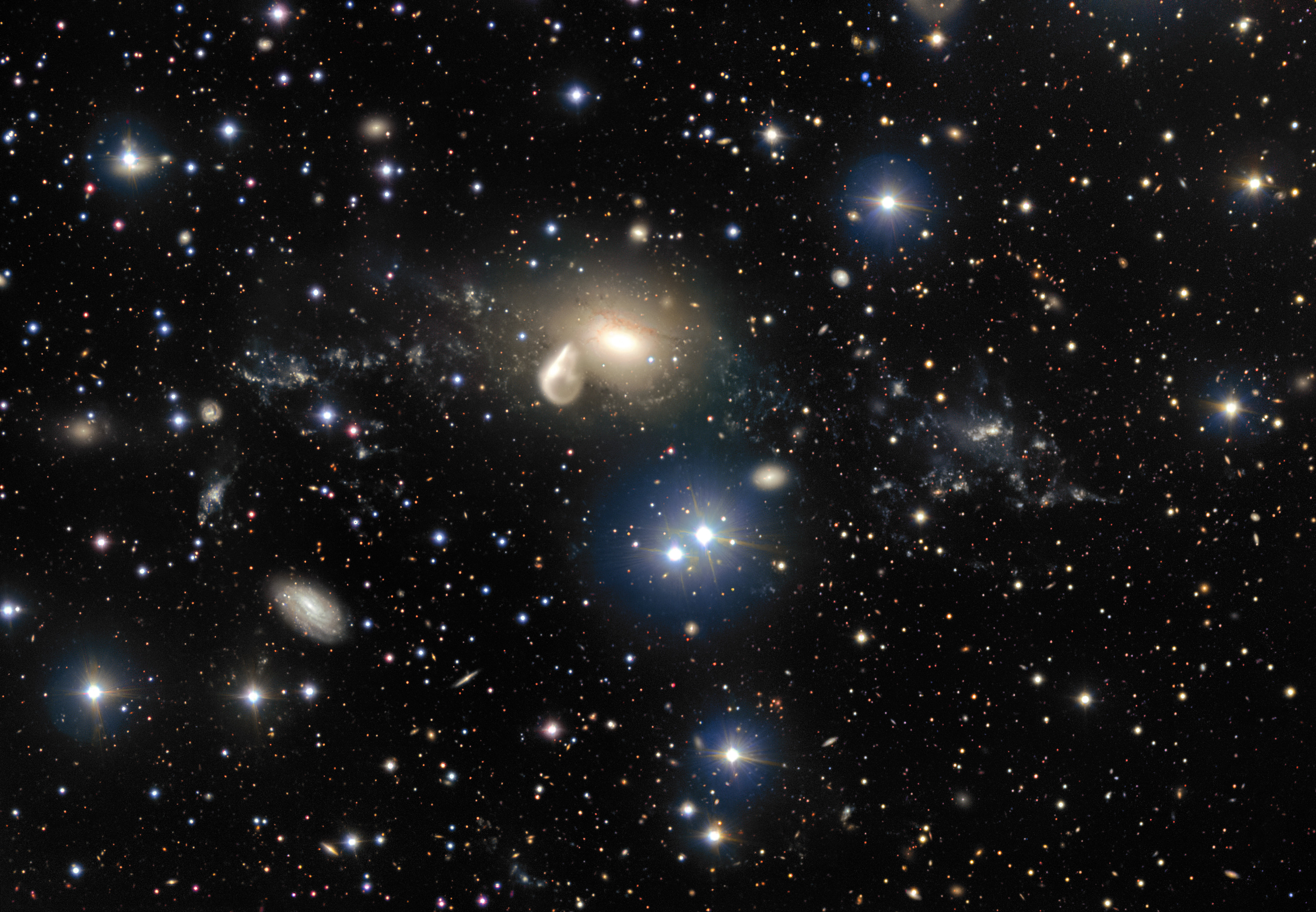
ESO: https://www.eso.org/public/images/eso1547a/
The collisional ring of elliptical galaxy NGC 5291 (center) collided with another galaxy ~360 Myr ago
And yet, TDGs appear to show “missing mass.”
Bournaud et al. (2007) used VLA observations of three TDGs in the collisional ring around NGC 5291 — a system formed by a galaxy collision \sim 360 Myr ago — and found dynamical masses 2–3 times their visible baryonic mass.3
Their rotation curves were surprisingly flat — the rotation velocity remained high far from the center, as in normal galaxies. This is the hallmark of “dark matter” in standard analyses.
Lelli et al. (2015) revisited these observations and extended the analysis to six TDGs around three different systems (NGC 5291, NGC 7252 “Atoms for Peace,” and VCC 2062 near NGC 4694), finding M_\text{dyn}/M_\text{bar} consistent with unity — i.e., no dark matter — but with TDGs systematically deviating from the standard baryonic Tully-Fisher relation.4 The discrepancy with Bournaud et al. traces partly to different assumptions about gas extent and inclination angles.
Gentile et al. (2007) showed that MOND naturally explains the NGC 5291 TDG rotation curves with zero free parameters, providing an alternative to both the “missing dark matter” and “dark baryons” interpretations.5
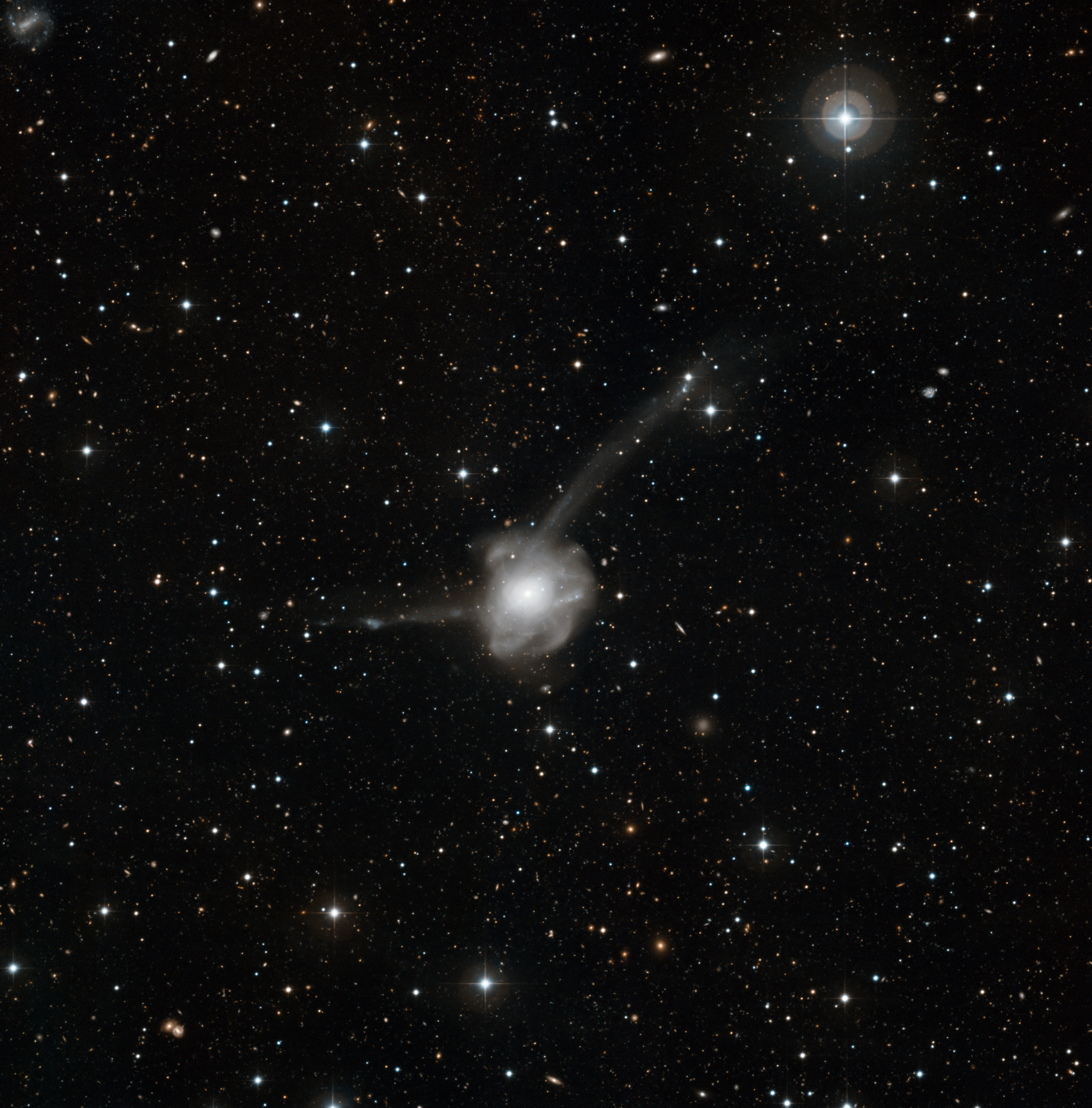
ESO: https://www.eso.org/public/images/eso1044a/
NGC 5291 and its collisional ring system, observed with the VLA — the TDGs studied by Bournaud et al. (2007) and Gentile et al. (2007) formed along this ring
The situation creates a three-way tension:
| Framework | Prediction for TDGs | Status |
|---|---|---|
| \LambdaCDM | No dark matter → purely baryonic dynamics | Unclear: M_\text{dyn}/M_\text{bar} debated (1.0 vs 2–3) |
| \LambdaCDM + dark baryons | Unseen molecular gas in disks | Ad hoc; not confirmed by CO surveys |
| Standard MOND | Same RAR/BTFR as all galaxies | Fits rotation curves; BTFR offset debated |
| Superfluid DM (Khoury) | MOND-like only inside the host’s superfluid core; Newtonian outside | Untested; tail-tip TDGs marginal at best |
The fourth row makes TDGs a discriminator between the substrate and Khoury’s superfluid dark matter [R116]: in SDM the phonon-mediated MOND force exists only where the condensate is coherent, and a TDG at the tip of a tidal tail sits at or beyond the edge of any plausible superfluid core. The substrate’s boundary response is unconditional — the same everywhere — so TDGs must land on the BTFR regardless of position (see Galactic Dynamics § The 2025 Physics Reports review).
The substrate framework resolves this cleanly, and adds predictions that none of the above can make.
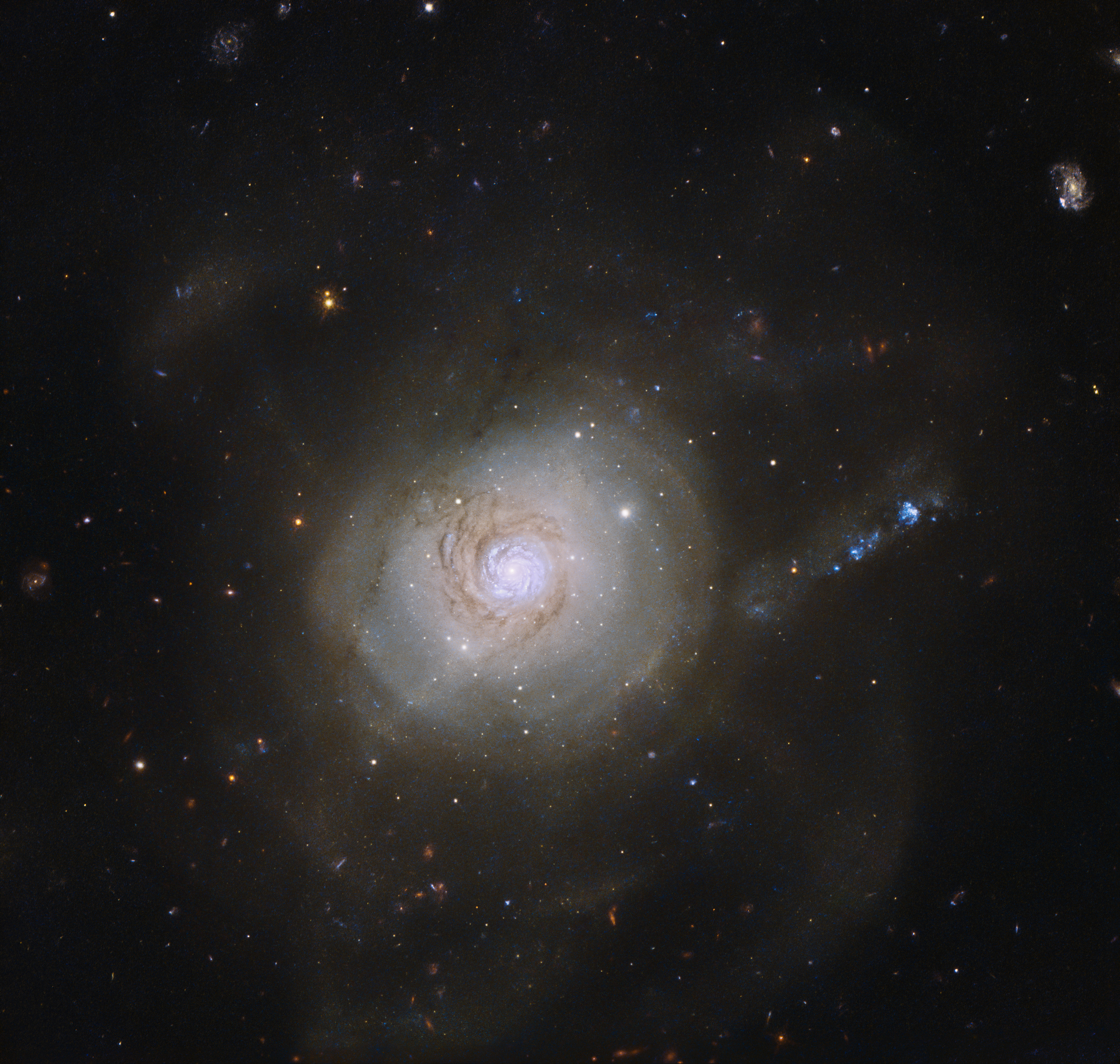
ESO: https://esahubble.org/images/potw1549a/
a late-stage merger ~700 Myr old with two prominent tidal tails
The Substrate Resolution
Dark matter is everywhere
In \LambdaCDM, dark matter is a separate particle species that forms gravitationally bound halos. When a tidal tail strips baryonic material from a galaxy, the dark matter stays in the halo. A TDG inherits baryons but not dark matter.
In the substrate framework, this picture is fundamentally different. The dc1 substrate IS dark matter (n_1 m_1 = \rho_\text{DM}, C10). It is not a separate particle species bound in halos — it is the medium that fills all of space. A TDG born from tidal debris does not need to “carry along” its dark matter or “capture” it from a halo. It forms within the substrate, surrounded by it on all sides, just like every other self-gravitating structure in the universe.
There is no dark matter to be “missing” from a TDG — because the dark matter was never in a halo to begin with.
Boundary parity is universal
The MOND phenomenology in the substrate arises from the counter-rotating boundary’s parity symmetry forcing a quadratic current-phase relation (GD2–GD4 in Galactic Dynamics). This mechanism depends on:
- The local baryonic mass distribution (which sources the ebbing current)
- The local substrate density \rho_\text{DM} (which sets a_0)
- The boundary physics parameters (\alpha_{mf}, v_\text{rot,outer}, \xi) — universal substrate properties
It does not depend on:
- How the baryonic mass assembled (tidal stripping vs hierarchical merging vs primordial collapse)
- Whether a dark matter halo was ever present
- The formation history or age of the system
The quadratic CPR responds to any gravitational perturbation threading through counter-rotating boundaries. A TDG at the tip of a tidal tail, with 10^8\,M_\odot of gas and young stars, sources an ebbing current through the same substrate lattice as the Milky Way. The boundary physics is identical. The MOND response is identical.
This is not an adjustment. It is an automatic consequence of the substrate being the medium, not the halo.
Read through the substrate ladder, that universality has a sharper name. The counter-rotating boundary whose parity forces the quadratic CPR is the framework’s anti-phase breath — a circulation and its counter-rotating partner trading energy across a shared seam — and galactic gravity sits on the ladder’s locking pole: one tooth, the single paired-breath boundary, occupied identically at every radius in every galaxy, because a galaxy’s job is to bind, and binding is a locking job (the boundary is the breath). A TDG is the cleanest test that single tooth has. Every other galaxy blends formation channels; a tidal dwarf sets formation history to its limit — pure baryonic debris, no halo ever, kinematically cold and deep in the superfluid regime — and the paired-breath reading insists it lands on the same tooth regardless. The Dual Dwarf Galaxy Theorem asks whether nature keeps two kinds of dwarf; the breath answers that there is one tooth, hence one kind, and the tidal dwarf is the system where that answer is most exposed to falsification.
Predictions
Prediction 1: TDGs follow the radial acceleration relation
The RAR (Galactic Dynamics, GD8) is a universal relationship between observed gravitational acceleration g_\text{obs} and baryonic gravitational acceleration g_\text{bar}:
g_\text{obs} = \frac{g_\text{bar}}{1 - e^{-\sqrt{g_\text{bar}/a_0}}}
The substrate predicts that TDGs obey the same RAR as all other galaxies, with the same a_0 = c\sqrt{G\rho_\text{DM}} = 1.16 \times 10^{-10} m/s², the same functional form, and the same negligible intrinsic scatter. No offset. No separate population.
This is a strong prediction because \LambdaCDM predicts two populations:
- Type A (primordial): dark-matter-dominated dwarfs that follow the RAR (if it exists at all in CDM) because their halos produce the missing acceleration
- Type B (tidal): dark-matter-free dwarfs that should show purely baryonic dynamics — g_\text{obs} = g_\text{bar} with no enhancement
Kroupa (2012) formalized this as the Dual Dwarf Galaxy Theorem: if CDM is correct, these two populations must be observationally distinguishable on the BTFR and in the radius-mass plane.6 The observation that only one population exists — all dwarfs lie on the same scaling relations — is evidence against CDM halos as the source of missing mass.
The substrate explains this immediately: there is only one type of dwarf galaxy because there is only one gravitational mechanism. The substrate boundary physics operates identically on all baryonic systems.
Prediction 2: TDGs follow the baryonic Tully-Fisher relation
The BTFR from boundary parity (GD5):
\boxed{v^4 = a_0\,G\,M_b}
applies to any self-gravitating baryonic system in the deep-MOND regime. The normalization is fixed by a_0, which is a substrate property, not a galaxy property. TDGs, with their low circular velocities (v_\text{circ} \sim 20–80 km/s \ll v_L \approx 750 km/s), are deep in the superfluid phase (GD1) and firmly in the MOND regime.
The substrate therefore predicts that TDGs lie on the same BTFR as normal galaxies, with the same slope (v \propto M_b^{1/4}) and the same normalization. This matches the Gentile et al. (2007) finding that MOND naturally accounts for TDG rotation curves, and it addresses the Lelli et al. (2015) observation of a systematic BTFR offset by noting that this offset may reflect non-equilibrium dynamics rather than a genuinely different gravitational response (see Equilibrium and Open Questions below).
Prediction 3: No NFW profile needed or expected
In \LambdaCDM, galaxy rotation curves are explained by NFW dark matter halo profiles — a specific density distribution with a characteristic scale radius and central cusp. For a TDG, there is no mechanism to generate an NFW profile: the galaxy formed from tidal debris, not from the gravitational collapse of a dark matter overdensity.
In the substrate framework, galaxy dynamics do not require NFW profiles at any scale. The gravitational enhancement arises from the quadratic CPR operating at each boundary layer crossing between the baryonic source and the test point. The density profile of the “dark matter” at the TDG’s location is simply the local substrate density \rho_\text{DM} — smooth, uniform on galactic scales (modulo small perturbations from the local gravitational potential via the hydrostatic adjustment SC3: \rho(r) = \rho_0 \exp(-\Phi/c^2) — the bound, no-throughput branch). There is no “cusp-core problem,” no “too big to fail” problem, and no need to invoke baryonic feedback to reshape a halo that was never there.
Prediction 4: TDGs are pure MOND laboratories
TDGs are exceptionally clean test cases for the substrate framework because they eliminate several complicating factors:
| Complication | Normal galaxies | TDGs |
|---|---|---|
| Dark matter halo (CDM) | Present (assumed) | Absent (by formation) |
| Formation history | Complex (mergers, feedback) | Simple (tidal stripping) |
| Velocity dispersion | Varies widely | Low (\ll v_L) |
| Dynamical regime | Mixed (Newton + MOND) | Pure MOND |
| Age | Billions of years | Hundreds of Myr |
Because TDGs are young, gas-rich, and kinematically cold, they sit firmly in the deep-MOND (superfluid) regime where the quadratic CPR dominates without contamination from the Hubble-induced linear term (GD6). They are the purest available laboratories for testing whether the boundary parity mechanism produces the correct gravitational response.
The substrate predicts that detailed, high-resolution rotation curves of equilibrated TDGs — when they become available — will match the deep-MOND prediction g_\text{eff} = \sqrt{a_0\,g_N} with no free parameters, using the same a_0 measured for normal galaxies.
Prediction 5: The external field effect
MOND — and by extension the substrate framework — predicts an external field effect (EFE): the internal dynamics of a system are affected by the external gravitational field in which it is embedded.7 In the substrate picture, this arises because the parent galaxy’s ebbing current imposes a DC phase bias on all boundaries within its influence, partially breaking the parity symmetry even in the deep-MOND regime (same mechanism as GD6 but from a galactic rather than cosmological source).
In the ladder’s language the EFE is the boundary breath being partially un-paired: the parent’s static phase bias singles out a direction the symmetric +\omega_0/-\omega_0 pair did not have, and that is the very same parity-breaking that — sourced instead by the cosmic expansion — is the Newtonian limit (the boundary is the breath). It is the static-bias cousin of the kinetic un-pairing that switches the breath off entirely past v_L in a merging cluster. So the external field effect is not a sixth, independent prediction but the single environmental knob the paired-breath reading allows — the one thing that may slide a TDG off the universal RAR tooth, and the whole of what may. Any residual dependence of a TDG’s dynamics on formation history, gas fraction, or age that survives after the external field is regressed out would mean the tooth is not universal and the breath reading is wrong — the galactic one-knob falsifier run in its cleanest laboratory.
For TDGs orbiting their parent galaxy at projected distances D_p \sim 30–100 kpc, the external field from the parent (in the deep-MOND regime) is:
g_\text{ext} \approx \frac{\sqrt{a_0\,G\,M_\text{parent}}}{D_p} = \frac{(a_0\,G\,M_\text{parent})^{1/2}}{D_p}
where the square root reflects the MOND gravitational field g = \sqrt{a_0\,g_N} rather than the Newtonian g_N = GM/D_p^2.
For NGC 5291 (M_\text{parent} \sim 10^{11}\,M_\odot) at D_p \sim 50 kpc: g_\text{ext} \sim 0.1–0.2\,a_0. This is small enough to not dominate but large enough to be measurable with sufficiently precise rotation curves. Gentile et al. (2007) explored this for the NGC 5291 TDGs and found the EFE contribution consistent with expectations.
The substrate predicts that the EFE scales with the parent galaxy’s baryonic mass and the TDG’s distance, with no free parameters beyond those already fixed by the galactic dynamics sector.
Prediction 6: Redshift-dependent formation efficiency
From Early Structure Formation, the MOND acceleration scale evolves as:
a_0(z) = a_0(0)\,(1+z)^{3/2}
This has implications for TDGs formed at different cosmic epochs. Galaxy interactions and mergers are more common at higher redshift (z \sim 1–3), where the merger rate is several times higher than today. TDGs formed during these earlier interactions experienced a different gravitational environment:
| Formation epoch | z | a_0(z)/a_0(0) | Effect on TDG |
|---|---|---|---|
| Local (z \sim 0) | 0 | 1.0 | Standard MOND dynamics |
| Peak merger rate | 1–2 | 2.8–5.2 | Enhanced gravitational binding during formation |
| Early mergers | 3 | 8.0 | Strong MOND enhancement → more stable TDGs |
A TDG that condensed from tidal debris at z \sim 2 experienced a_0 \approx 5.2 \times a_0(0). The MOND Jeans mass was \sim 5\times lower, the collapse timescale \sim 3\times shorter, and the effective potential well \sim 2.3\times deeper. These conditions make TDG formation more efficient and the resulting objects more gravitationally bound — potentially explaining why some TDGs survive as long-lived satellite galaxies, a result that \LambdaCDM simulations have difficulty reproducing without invoking dark matter halos.
The formation-epoch effect is a qualitative prediction from the a_0(z) evolution. Quantifying it requires coupling the tidal stripping dynamics (which depend on the parent galaxy interaction geometry) with the MOND-enhanced collapse — a numerical calculation that has not been performed.
The Satellite Plane Connection
TDGs connect to another persistent anomaly in \LambdaCDM: the planes of satellite galaxies observed around the Milky Way, Andromeda, and Centaurus A.8 In \LambdaCDM, satellite galaxies are accreted from random directions along dark matter filaments and should be distributed roughly isotropically. Instead, they form thin, kinematically coherent planes — exactly as expected if many satellites are tidal in origin, having formed from material ejected during a single interaction event.
If the Milky Way’s satellites are (mostly) ancient TDGs formed during a past interaction, \LambdaCDM faces a double problem: they should be dark-matter-free AND they should be scattered isotropically. They are neither. Their high inferred mass-to-light ratios (often cited as evidence for dark matter halos) and their planar, phase-space-correlated distribution are both naturally explained by the substrate framework:
- High M/L: MOND-enhanced dynamics from the substrate produce the observed velocity dispersions without any dark matter halo.
- Planar distribution: Tidal origin naturally produces phase-space-correlated satellites — they formed from a single tidal event and retain the orbital memory.
The substrate does not need two types of dwarf galaxies (Kroupa’s Dual Dwarf Galaxy Theorem). It predicts one type: baryonic systems in a universal substrate, all obeying the same boundary parity physics regardless of formation history.
Comparison of Frameworks
| Feature | \LambdaCDM | Standard MOND | Substrate framework |
|---|---|---|---|
| Dark matter in TDGs | Absent (by formation) | N/A (no DM) | Substrate everywhere (DM = medium) |
| RAR for TDGs | Should differ from normal galaxies | Same as normal galaxies | Same as normal galaxies |
| BTFR for TDGs | Different normalization expected | Same normalization | Same normalization |
| “Missing mass” in TDGs | Requires dark baryons | Not needed | Not needed |
| Two types of dwarfs | Required (Dual Dwarf Theorem) | Not required | Not required |
| Satellite planes | Unlikely (p \sim 0.04\%) | Natural (tidal origin) | Natural (tidal origin) |
| NFW profile needed | Yes (but absent for TDGs) | No | No |
| Formation epoch dependence | No a_0 evolution | No a_0 evolution | a_0(z) = a_0(0)(1+z)^{3/2} |
| EFE prediction | No | Yes (calculable) | Yes (from DC phase bias) |
| Free parameters for TDGs | At least 1 (dark baryon fraction) | 0 | 0 |
Young TDGs are still settling, so vcirc underestimates the equilibrium value — points drift below the RAR at low gbar where dynamical times are longest.
The Equilibrium Question
A persistent complication in TDG studies is whether these young objects have reached dynamical equilibrium. The TDGs around NGC 5291 (collision \sim 360 Myr ago) and NGC 7252 (merger \sim 700 Myr ago) have HI discs that have undergone less than one full rotation since formation. Lelli et al. (2015) noted this explicitly: the observed rotation patterns may not trace the gravitational potential reliably.
Flores et al. (2016) re-examined the NGC 5291 TDGs with higher-resolution 3D spectroscopy and found them kinematically unvirialized, with complex morphologies that make rotation velocity measurements uncertain.9
The substrate framework addresses this in two ways:
First, the equilibrium timescale is different in the MOND regime. In Newtonian gravity, virialization requires several dynamical times. In the deep-MOND regime, the enhanced gravitational acceleration g_\text{eff} = \sqrt{a_0\,g_N} produces a shorter dynamical time:
t_\text{dyn,MOND} \sim \frac{R}{v_\text{circ}} = \frac{R}{(a_0\,G\,M_b)^{1/4}}
For a TDG with M_b \sim 10^8\,M_\odot and R \sim 3 kpc: t_\text{dyn,MOND} \sim 200 Myr. The NGC 5291 TDGs (\sim 360 Myr old) have had roughly 1.5 dynamical times to relax — marginal but not negligible. Numerical simulations by Lelli et al. (2015) suggest that gas-dominated TDGs achieve approximate equilibrium within \sim 200 Myr, consistent with this estimate.
Second, the substrate predicts that even non-equilibrium TDGs should exhibit MOND-like gravitational enhancement. The quadratic CPR is a property of the substrate boundary physics, not of the test mass’s dynamical state. A gas cloud that is still collapsing or settling into a disc experiences the enhanced gravitational acceleration at every stage. The rotation velocity at any given radius reflects the local MOND-enhanced gravity, whether or not the global system has virialized.
The BTFR (v^4 = a_0\,G\,M_b) applies strictly to virialized systems with flat rotation curves. For non-equilibrium TDGs, the substrate still predicts MOND-enhanced dynamics, but the comparison to the BTFR requires care. The correct test is the local RAR — g_\text{obs} vs g_\text{bar} at each radius — which does not assume global equilibrium.
Observational Tests
Test 1: RAR universality for TDGs
Prediction: Resolved rotation curves of mature, equilibrated TDGs (age \gtrsim 500 Myr, at least 2–3 orbital times) will follow the same RAR as normal galaxies with identical a_0 and negligible intrinsic scatter.
Method: Target detached TDGs — systems that have separated from their parent galaxy and are dynamically isolated. Recent surveys are identifying such objects.10 High-resolution HI observations (VLA, MeerKAT, SKA) combined with multi-band photometry for stellar mass. Plot g_\text{obs} vs g_\text{bar} and compare to the McGaugh et al. (2016) RAR.
Distinguishing power: If TDGs lie on the same RAR as normal galaxies → consistent with substrate and MOND, inconsistent with CDM. If TDGs show g_\text{obs} = g_\text{bar} (no enhancement) → inconsistent with substrate, consistent with CDM.
Test 2: No two populations in the BTFR
Prediction: There is no systematic offset between primordial dwarfs and tidal dwarfs on the BTFR. Both types lie on the same relation with the same scatter.
Method: Assemble a complete census of baryonic mass and rotation velocity for (a) isolated dwarf irregulars, (b) confirmed TDGs, (c) candidate tidal-origin satellites. Statistical comparison of slopes, normalizations, and scatter between populations.
Distinguishing power: CDM’s Dual Dwarf Galaxy Theorem requires two distinguishable populations. The substrate requires one.
Test 3: External field effect in TDG rotation curves
Prediction: TDGs closer to their parent galaxy show a slightly reduced MOND enhancement (due to the parent’s external field partially breaking the boundary parity). The effect is calculable from the parent galaxy’s baryonic mass and the TDG’s orbital distance.
Method: Compare rotation curves of TDGs at different projected distances from the same parent galaxy. The inner TDG should have slightly higher g_\text{obs}/g_\text{bar} deficit (weaker MOND enhancement) than the outer TDG.
Distinguishing power: CDM predicts no such effect (there is no halo to source the external field). Standard MOND predicts the EFE. The substrate makes the same prediction with a specific physical mechanism (DC phase bias on boundaries).
Test 4: TDG survival rates vs formation epoch
Prediction: TDGs formed at higher redshift (during earlier merger events) are more gravitationally bound and have higher survival rates than predicted by CDM N-body simulations, because the enhanced a_0(z) during their formation epoch deepened their effective potential wells.
Method: Compare the observed frequency of old, detached TDGs (identified by low metallicity, old stellar populations, or phase-space correlation with a past merger event) against CDM predictions for TDG disruption timescales. The substrate predicts more survivors than CDM.
Distinguishing power: CDM predicts rapid TDG destruction (shallow potential wells, no dark matter halo for protection). The substrate predicts enhanced survival (MOND-deepened wells, especially at earlier epochs).
Open Calculations
Required to sharpen predictions
MOND perturbation theory for TDG formation. Model the gravitational collapse of a tidal debris cloud in a MOND potential with the external field from the parent galaxy. This produces the predicted rotation curve profile, equilibrium timescale, and mass threshold for TDG formation. Priority: high.
EFE magnitude for specific systems. Compute the external field for each observed TDG system (NGC 5291, NGC 7252, NGC 4694) using the parent galaxy’s baryonic mass model and the TDG’s projected distance. Compare to the Gentile et al. (2007) estimates. Priority: medium.
TDG survival in evolving a_0 background. N-body simulation of TDG formation and disruption in a MOND potential with a_0(z) = a_0(0)(1+z)^{3/2}. Compare survival fractions to CDM predictions. Priority: medium (requires numerical infrastructure).
Non-equilibrium MOND dynamics. Derive the expected RAR scatter for systems that have not yet virialized, as a function of age/dynamical-time ratio. This is needed to interpret observations of young TDGs (< 500 Myr). Priority: high for current data interpretation.
Summary
Tidal dwarf galaxies are among the sharpest available tests of the substrate framework because they eliminate the central ambiguity of galactic dynamics: the unknown dark matter halo. In \LambdaCDM, TDGs should be dark-matter-free by construction, yet they show MOND-like dynamics. This forces CDM to invoke ad hoc explanations (dark baryons, modified star formation physics) or to dismiss the observations as non-equilibrium artifacts.
The substrate framework resolves all of this with zero new parameters:
- TDGs have “dark matter” — the substrate itself — because it is the medium, not a halo
- TDGs obey the same RAR and BTFR as all galaxies, because boundary parity is universal
- No NFW profile is needed or expected — dynamics arise from substrate boundary response
- Only one type of dwarf galaxy exists — falsifying the Dual Dwarf Galaxy Theorem is a prediction, not an anomaly
- Formation-epoch a_0(z) effects enhance TDG survival and binding — a prediction unique to the substrate among MOND-like theories
The prediction is:
- Quantitative: same a_0, same RAR, same BTFR normalization, calculable EFE
- Zero free parameters: follows from boundary parity + substrate = dark matter
- Falsifiable: the RAR test distinguishes substrate/MOND from CDM cleanly
- Distinguishing: standard MOND shares the same-RAR prediction but lacks a_0 evolution; CDM predicts two populations; the substrate predicts one population with epoch-dependent formation efficiency
- Timely: directly connected to the ongoing debate about NGC 5291, NGC 7252, satellite planes, and the Kroupa challenge to CDM
The most powerful observational test is the RAR for a well-studied sample of mature, detached TDGs. If they lie on the same relation as the Milky Way, normal spirals, and gas-rich dwarfs — with the same a_0, same slope, same scatter — the case that gravity’s “missing mass” is a property of the medium, not of halos, becomes very difficult to dismiss.
References specific to this section
- Barnes & Hernquist (1992): Tidal segregation of baryons from dark matter halos
- Bournaud, Duc, Brinks et al. (2007): Missing mass in NGC 5291 TDGs, Science 316, 1166
- Bournaud & Duc (2006): Long-lived TDGs in simulations
- Gentile, Famaey, Combes et al. (2007): MOND fits to TDG rotation curves, A&A 472, L25
- Lelli, Duc, Brinks et al. (2015): Gas dynamics in six TDGs, disc formation at z = 0, A&A 584, A113
- Flores, Hammer, Fouquet et al. (2016): Young TDGs not virialized, MNRAS 457, L14
- Milgrom (2007): MOND prediction for TDGs, ApJ 667, L45
- Kroupa (2012): Dual Dwarf Galaxy Theorem, PASA 29, 395
- Pawlowski & Kroupa (2020): Milky Way disc of satellites, MNRAS 491, 3042
- McGaugh, Lelli & Schombert (2016): RAR measurement, 153 galaxies
- Cross-references: Galactic Dynamics, Early Structure Formation, Gravity
Footnotes
Barnes, J.E. & Hernquist, L., “Formation of dwarf galaxies in tidal tails,” Nature 360, 715, 1992. First demonstration that tidal forces segregate baryonic disk material from dynamically hot dark matter halos. [R70]↩︎
Bournaud, F. & Duc, P.-A., “From tidal dwarf galaxies to satellite galaxies,” A&A 456, 481, 2006; Wetzstein, M. et al., “Do dwarf galaxies form in tidal tails?” A&A 471, 899, 2007. Both show that high-resolution simulations produce TDGs with very low dark matter fractions. [R71, R72]↩︎
Bournaud, F., Duc, P.-A., Brinks, E. et al., “Missing mass in collisional debris from galaxies,” Science 316, 1166, 2007. Three TDGs around NGC 5291 show M_\text{dyn}/M_\text{bar} \sim 2–3 with flat rotation curves extending well beyond the visible matter. [R73]↩︎
Lelli, F., Duc, P.-A., Brinks, E. et al., “Gas dynamics in tidal dwarf galaxies: Disc formation at z = 0,” A&A 584, A113, 2015. Six TDGs studied with 3D disc models; M_\text{dyn} \approx M_\text{bar}; TDGs deviate from the BTFR; dynamical equilibrium questionable (less than one full rotation). [R74]↩︎
Gentile, G. et al., “Tidal dwarf galaxies as a test of fundamental physics,” A&A 472, L25, 2007. MOND fits TDG rotation curves naturally, eliminating the need for any unseen matter component. [R75]↩︎
Kroupa, P., “The dark matter crisis: falsification of the current standard model of cosmology,” PASA 29, 395, 2012. The Dual Dwarf Galaxy Theorem: CDM requires two observationally distinct types of dwarf galaxies — DM-dominated and DM-free — but only one type is observed. [R76]↩︎
Milgrom, M., “MOND and the mass discrepancies in tidal dwarf galaxies,” ApJ 667, L45, 2007. Prediction that TDGs obey MOND including the external field effect from the parent galaxy. [R65]↩︎
Pawlowski, M.S. & Kroupa, P., “The Milky Way’s disc of classical satellite galaxies in light of Gaia DR2,” MNRAS 491, 3042, 2020. The disc of satellites is kinematically coherent and extremely unlikely in \LambdaCDM (p \sim 0.04\%). [R77]↩︎
Flores, H. et al., “Young tidal dwarf galaxies cannot be used to probe dark matter in galaxies,” MNRAS 457, L14, 2016. Higher-resolution data show NGC 5291 TDGs are not virialized; only one sub-component lies within 1\sigma of the BTFR. [R78]↩︎
See e.g., detection and characterization of detached TDGs in galaxy interaction systems, enabling dynamical studies free from tidal contamination.↩︎