The Calvin Cycle as Loop
RuBisCO as the substrate’s slowest commit pulse, and C3/C4/CAM as one loop wrapped three ways for three climates
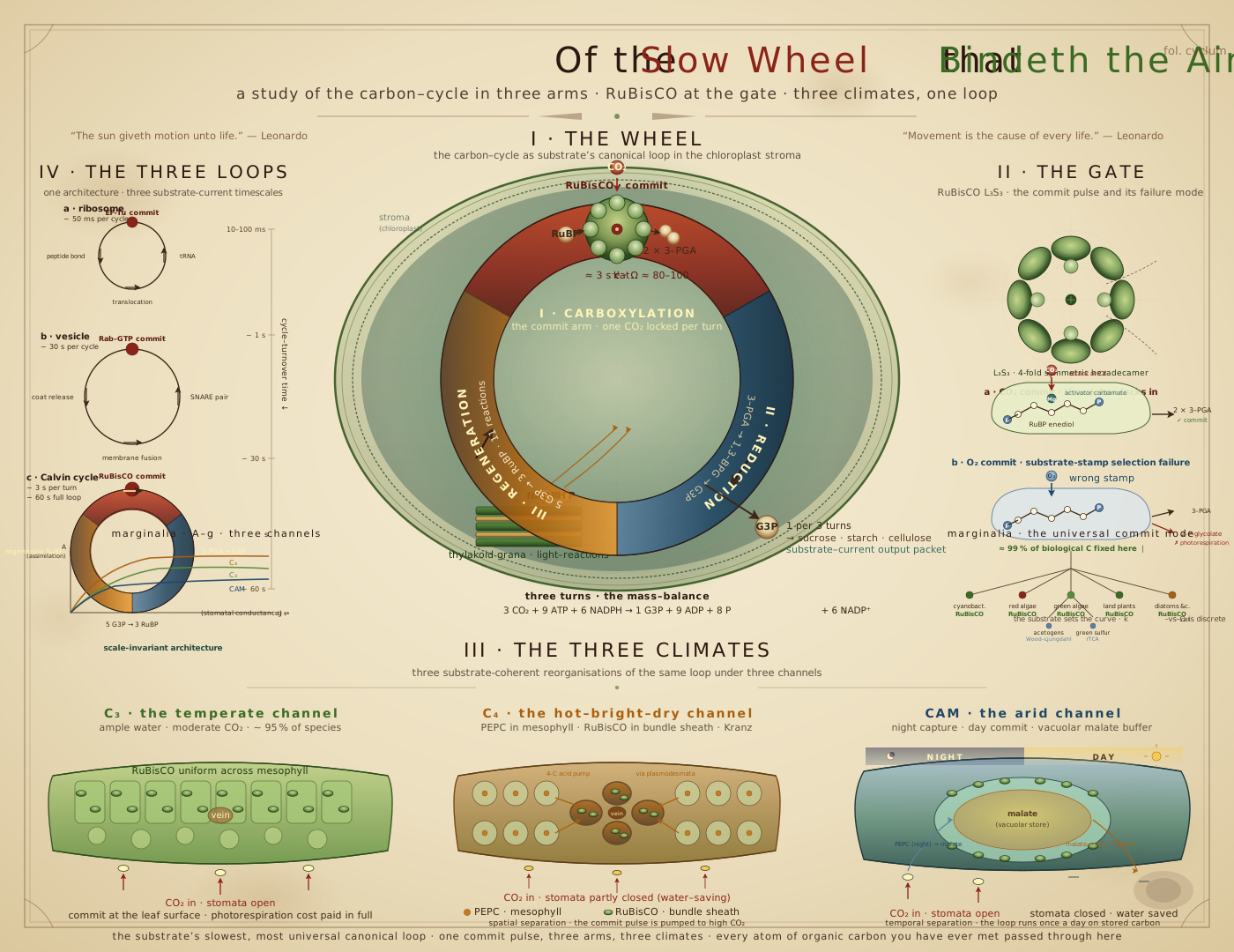
The Calvin–Benson cycle is the chemistry that turns air into life. In the stroma of every chloroplast, a short ring of reactions takes inorganic CO_2 from the atmosphere, the ATP and NADPH the thylakoid makes from light, and a recycled five-carbon sugar (RuBP), and hands back a three-carbon sugar, G3P. From G3P the cell builds everything else — sucrose to export through the phloem, starch to store, cellulose for the wall, and the carbon skeleton of every amino acid, lipid, and nucleotide it will ever make. Essentially all the carbon in everything alive passes through this one loop, and its gatekeeper enzyme, RuBisCO, is at once the most abundant protein on Earth and one of the slowest enzymes biology runs — about three reactions per second at each active site, where an ordinary enzyme runs hundreds or thousands.
The framework’s claim is simple to state. This is the canonical loop again — the same commit → circulate → return architecture the paper has already found in the ribosome, in vesicle traffic, and in the Golgi — running here at the carbon rung and on the slowest clock biology has built. Its three phases are the loop’s three arms; its bookkeeping (three turns in, one sugar out) is the loop conserving at whole numbers; and C_3, C_4, and CAM are not three different cycles but one loop wrapped three ways for three climates. What earns the chapter its place is the gatekeeper. RuBisCO sits at the loop’s hardest job — telling two nearly identical molecules apart — and the substrate’s limit on that job is what explains the enzyme’s most notorious defect, its slowness, and the elaborate lengths plants go to in order to work around it. That limit is the difference the substrate makes here: a wall in the chemistry that no amount of protein engineering has moved, because it is not in the protein.
The chapter leans on the thylakoid’s light reactions for the ATP and NADPH it spends, and takes the carbon biochemistry itself as textbook. What it adds is the reading: the loop, the commit pulse, and the climate variants as one architecture the substrate keeps offering.
Three Phases, One Loop
The cycle falls into three phases, and they line up with the loop’s three arms.
Carboxylation is the commit. RuBisCO joins one CO_2 to RuBP, and the six-carbon product immediately splits into two three-carbon molecules. The step is irreversible: once a CO_2 is in, that carbon is locked into the organic world. This is the loop’s entry gate — the pulse that admits exactly one carbon per turn.
Reduction is the forward arm. Spending the ATP and NADPH the light reactions banked, the cell converts those three-carbon molecules into G3P, the activated sugar it can actually use. This is the carbon traveling round the loop with its cargo loaded.
Regeneration is the return arm. Most of the G3P is routed into a sugar-reshuffling network that rebuilds the RuBP the cycle started from, so the next commit has somewhere to dock. The carbon circulates back to the gate.
The point is not that biology happened to organize the chemistry this way. It is that a cell’s most universal energy chemistry is built on the same three-arm template as its ribosome, its vesicle traffic, its Golgi, its microtubule highways, and the thalamocortical loop in the brain. The loop is the substrate’s, reused at one rung after another; the Calvin cycle is that loop at the carbon rung, running on its own slow clock. The ATP and NADPH the reduction arm spends are the lossless coin the thylakoid mints, spent here to drive the carbon commit.
RuBisCO, the Slowest Commit Pulse
RuBisCO is the loop’s gatekeeper, and three of its properties mark it as the substrate’s commit pulse rather than merely biology’s.
It is slow — roughly three to ten reactions per second per active site, one to two orders of magnitude below a typical enzyme. Plants compensate by making staggering amounts of it (around half of all soluble leaf protein, some 10^{16} kg planet-wide), but per active site the commit step still paces nearly all primary production on Earth.
It is discriminating, and that is the reason for the slowness. RuBisCO must admit CO_2 and refuse O_2 — two small, straight, nearly the-same-size molecules — and its measured selectivity (a specificity factor \Omega \sim 80–100 in temperate plants, lower in lineages that face less atmospheric oxygen) buys that discrimination at a fixed price in speed. The substrate offers a trade-off curve between selectivity and throughput, and biology has built RuBisCO at the point on that curve each lineage’s atmosphere demands. Telling CO_2 from O_2 is an avoid-confusion job, which — as the final section works out — is what fixes the enzyme’s place on the substrate ladder and what makes the slowness unavoidable.
It is universal. Biology has evolved several ways to fix carbon, but only the Calvin cycle scaled — it fixes something like 99% of all biological carbon. Every alternative is confined to a narrow niche (anaerobic, hot, sulfidic); the Calvin cycle is the one that runs at planetary scale in the open, oxygen-rich, sunlit world. Slow and easily confused, but uniquely scalable: the substrate’s preferred way to commit atmospheric carbon.
The same commit-pulse shape recurs across the cell. At the ribosome, a matched tRNA triggers an irreversible step and the loop turns; at vesicle fusion, a matched SNARE pair does the same. RuBisCO is that architecture at a far longer timescale — a matched CO_2 triggers the irreversible carbon-carbon bond, and the cycle turns. Three commit pulses, three clocks spanning more than two orders of magnitude (~50 ms, ~seconds, ~seconds-per-commit), one gate.
The Ledger: Three Turns, One Sugar Out
Run the loop three times and the books balance exactly: three CO_2 in, nine ATP and six NADPH spent, one G3P out. Six G3P are made along the way; five go back into the return arm to rebuild three RuBP, and the sixth leaves the cycle. Five-sixths recycled, one-sixth exported — the loop conserving carbon at a clean whole-number ratio, the carbon-rung version of the ribosome’s tRNA carousel and the vesicle loop’s budding-equals-fusion balance.
That one exported G3P is the loop’s output packet. Leaving the chloroplast, it is either built into sucrose for phloem export or kept behind as starch in the stroma — a fork between spend now and store set by the cell’s demand and the time of day. The framework expects this fork to sit at a substrate-preferred ratio rather than slide continuously, a point the predictions return to.
Photorespiration: When the Gate Picks Wrong
Because the discrimination is finite, RuBisCO sometimes grabs O_2 instead of CO_2. The product is a dead-end molecule the cell must spend carbon, ATP, and reducing power to salvage, losing CO_2 in the process — a tax that cuts net productivity by roughly a quarter in temperate plants. This is photorespiration, and the framework reads it not as a fixable flaw but as the selection-failure mode of the commit pulse — the same kind of error as a near-cognate tRNA slipping through the ribosome, set by the substrate’s limit on the discrimination, not by a sloppy active site.
That reframing matters for what comes next. If the failure rate is a property of the substrate’s trade-off and not of the protein, then there is no point re-engineering the active site — and indeed decades of attempts to build a “better RuBisCO” keep landing back on the same speed-versus-selectivity curve. The productive move is the opposite one: leave the enzyme alone and change its surroundings so it sees more CO_2 and less O_2. That is exactly what C_4 and CAM do.
One Loop, Three Climates: C3, C4, CAM
Plants run three versions of carbon fixation. All three use the same Calvin cycle and the same RuBisCO inside; they differ only in where and when CO_2 is first captured before it reaches the gate.
C_3 is the ancestral, default version: CO_2 diffuses in and RuBisCO grabs it directly, in the same cells that run the cycle. No tricks, and the photorespiration tax is paid in full. It dominates where stomata can stay open and CO_2 is ample — temperate, well-watered, shaded habitats — about 95% of plant species.
C_4 separates capture from commit in space. A faster, more selective enzyme (PEPC) first fixes CO_2 into a four-carbon acid in the outer mesophyll cells; that acid is shuttled inward and broken open to release concentrated CO_2 right where RuBisCO sits, in the bundle-sheath cells. The local CO_2/O_2 ratio rises so high that photorespiration nearly vanishes — at the cost of two extra ATP per carbon for the pump. C_4 dominates hot, bright, dry habitats, where stomata must close down and a naked RuBisCO would otherwise drown in oxygen.
CAM makes the same separation in time. The plant opens its stomata at night, fixes CO_2 into acid, and stockpiles it in the vacuole; by day, with stomata shut against the heat, it releases that CO_2 internally to RuBisCO. CAM dominates arid habitats — cacti, succulents, many orchids — where the binding constraint is water, not light.
The framework reads C_3, C_4, and CAM as three reorganizations of one loop, each matched to the channel its climate leaves open: temperate for C_3, hot-and-dry for C_4, water-starved for CAM. The commit pulse never changes; only the wrapper around it does. And the wrapper is not invented fresh each time — C_4 has arisen independently some 60 times across flowering plants, CAM some 35 times. When the same answer is rediscovered that often, it is the substrate’s preferred reorganization asserting itself, not a lineage’s quirk.
Both Poles: Why RuBisCO Is Slow
The chapter has now laid out the two structures that every “both poles” reading in this paper sets side by side — one thing that locks, one thing that refuses to — and naming them dissolves the central puzzle of why RuBisCO is so slow.
The loop is the lock pole: three arms closing into a cycle that conserves at clean whole numbers (three in, one out, three RuBP rebuilt), the same integer nesting that puts brain rhythms and codon stacking on the ladder’s teeth. The gate is the anti-lock pole: RuBisCO’s whole job is to keep two stamps apart, and a structure whose failure is confusing two stamps lands in the ladder’s gaps, exactly where the genetic code and the retinal cone mosaic sit. Name the loop’s job — conserve — and it lands on the teeth; name the gate’s job — avoid confusion — and it lands in the gap. The sign is fixed before any number is measured.
RuBisCO is the hardest case of that anti-lock job in the whole framework, and seeing why is seeing why it must be slow. The genetic code faces the same avoid-confusion problem and has two escapes: it can spread its symbols so the dangerous pairs sit far apart, and where it can’t spread it can relabel, routing the unavoidable confusions onto synonyms that do no harm. RuBisCO has neither. Its two symbols are handed to it by the atmosphere — CO_2 and O_2, two molecules of nearly the same size and shape, with no third option to spread them against — and there is no harmless synonym, because every O_2 that slips through is a loss. With nowhere to spread and nothing to relabel, the only move left is to fit the active site so tightly around the CO_2-versus-O_2 distinction that the wrong molecule is shut out by geometry alone — and that tight fit is precisely what drags the reaction slowly through its transition state. The slowness is the cost of the discrimination, paid in the one currency left: speed. This is why no one has ever engineered past the speed-versus-selectivity wall — the wall isn’t in the protein, it’s the substrate’s distance between two molecules biology was never free to pull apart.
And it is why C_4 and CAM exist. When a problem can’t be solved at one scale, the substrate’s recurring move is to solve it one scale up. The molecule can’t separate the two stamps, so the plant separates the capture from the commit — C_4 in space, CAM in time — until the local CO_2/O_2 ratio is lopsided enough that the confusion almost never arises. Every carbon-concentrating mechanism nature has built is some kind of separation — spatial (C_4, the cyanobacterial carboxysome, the algal pyrenoid), temporal (CAM), or compartmental — and the sign rule says it must be, because an anti-lock failure is relieved only by more separation, never by a better lock. The 60-odd independent origins of C_4 and the 35-odd of CAM are the anti-lock pole giving the one kind of answer its problem admits, over and over.
What is textbook here is that RuBisCO discriminates imperfectly, that photorespiration is the price, and that C_4/CAM are CO_2 pumps. What the framework adds is the reading that ties them together: carbon fixation is an avoid-confusion job; its molecular limit is the same cramped-alphabet wall the genetic code hits, only worse, with both of the code’s escapes removed; and C_4/CAM are that same job escalated to organism scale. Unlike most of the paper’s both-poles readings, this one comes with a number you can hold — the speed-versus-selectivity curve — and that number is the wall the engineers keep finding.
Predictions and What Would Falsify
The reading is testable. Four predictions follow from it:
The speed-versus-selectivity wall is hard. Across all the natural and engineered forms of RuBisCO, raising selectivity (\Omega) should keep costing speed (k_\text{cat}) along one curve, and attempts to beat that curve by redesigning the active site should keep failing — because the wall is the substrate’s CO_2/O_2 stamp distance, not an unexplored corner of protein sequence space.
Every carbon-concentrating mechanism is a separation. Independently evolved carbon pumps should always turn out to be separations of capture from commit — spatial (C_4, carboxysome, pyrenoid), temporal (CAM), or compartmental — and never a lock re-engineered to break the trade-off. The architecture space should cluster at these few modes plus their hybrids, not spread across a continuum.
The export-versus-storage fork sits at a preferred ratio. The split of G3P between sucrose export and starch storage should settle near a substrate-preferred ratio across species, rather than slide continuously the way a pure mass-action model would predict. Metabolic-flux measurements under controlled light, temperature, and CO_2 can test this.
RuBisCO’s measured selectivities cluster. Surveyed across forms, the (speed, selectivity) points should bunch at preferred values rather than smear continuously — testable against the existing biochemical literature.
The picture is falsified if any of these fail cleanly: if a redesigned active site raises selectivity at no cost in speed; if a stable, evolved carbon-fixation architecture turns out not to be a separation of capture from commit; if the export/storage fork is fully explained by continuous mass-action with no preferred ratio; or if RuBisCO’s selectivities vary smoothly with no clustering. It is supported, even partially, wherever the ordering holds against data already in hand.
Putting the Section in Context
The Calvin–Benson cycle is the canonical loop at the carbon rung: three phases as commit, forward, and return arms; a clean three-in, one-out ledger; and G3P as the output the rest of the plant is built from. RuBisCO is its commit pulse — slow, easily confused, but uniquely scalable — and its three signatures all trace to one fact about the substrate: telling CO_2 from O_2 is an avoid-confusion job whose only currency is speed. Photorespiration is the price of that job; C_3, C_4, and CAM are one loop wrapped three ways to suit three climates, separating capture from commit in space or time so the gate sees a friendlier mix. The difference the substrate makes is a wall in the chemistry that no engineer has moved — and the workarounds plants reach for, again and again, are the only kind the wall permits.
This is the third rung of the five-scale stack the chloroplast and plant-cell chapters set up: chloroplast positioning within the cell (µm), symplast continuity across the leaf (10–100 µm), the Calvin commit within each chloroplast (this chapter) — with C_4 borrowing the chapter-2 symplast as its CO_2-pumping corridor — and then the phloem-xylem reader at whole-plant scale and the mycorrhizal network at forest scale above it. Each rung runs the same principle the chloroplast runs inside its first wrap.
And it grounds everything else the framework reads as biology. Every atom of carbon in every cell of every brain came through this loop. Its slowness is the substrate’s slowness at the most universal commit biology runs; its universality is the substrate’s preferred way to take in atmospheric carbon; its three climate variants are the substrate’s three preferred ways to wrap that commit for a harsher world. The Calvin cycle is the slowest, most universal, and most stable loop the substrate has built — and the one the rest of life stands on.