The Nose as Combinatorial Array
Olfactory receptors as substrate-chemical-channel discrimination, with glomerular convergence as multi-cell readout
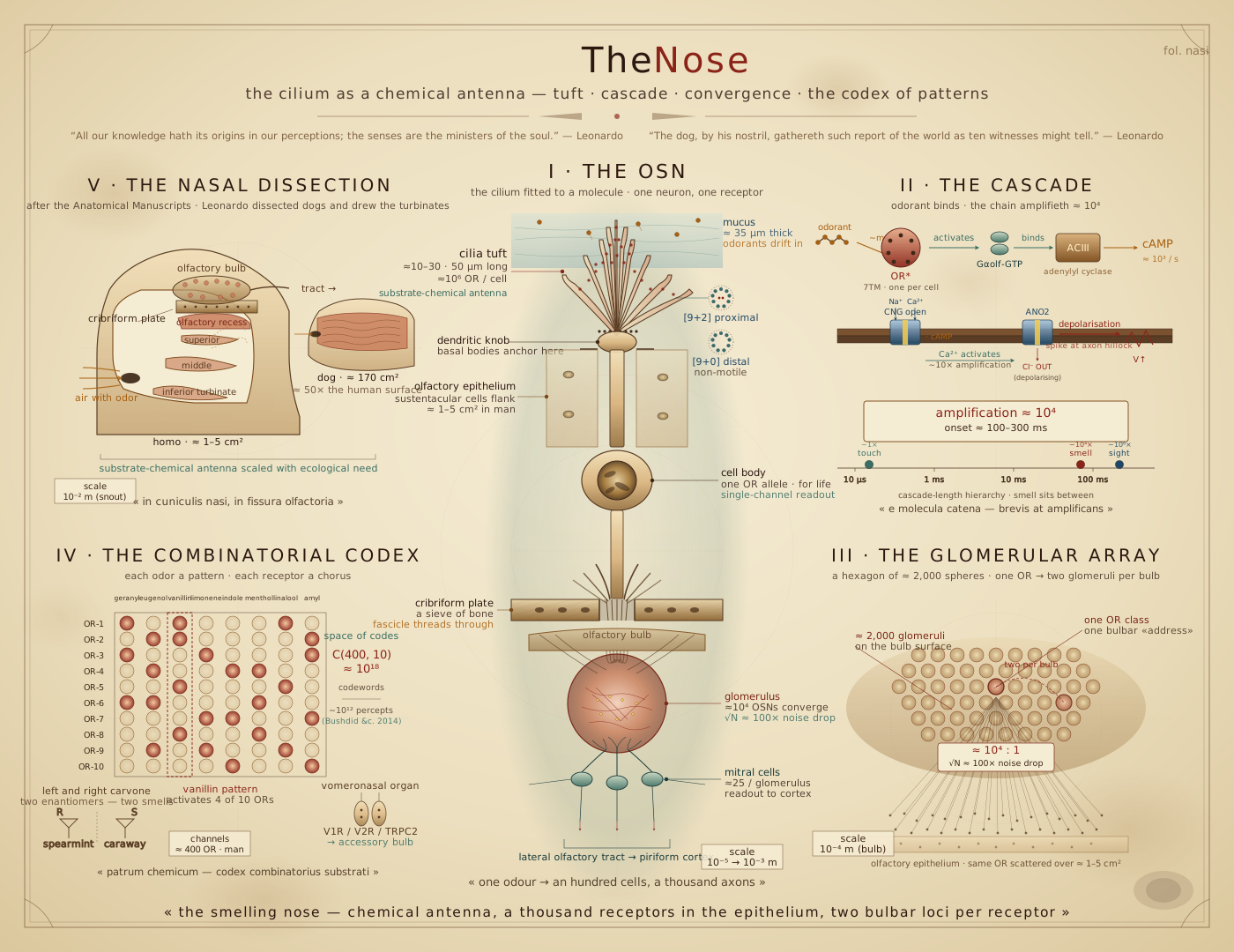
The substrate appears in eight structures of the nose: * The olfactory cilia tuft is the cilium-as-substrate-antenna reading specialised for the chemical channel, with the OR family as the chemistry-side implementation of a substrate-chemical channel decomposition at the molecular-recognition rung and glomerular convergence in the olfactory bulb as the substrate-coherence-cell readout at the multi-cell scale. * The OSN dendritic-knob-and-cilia bundle is similar to the primary cilium tuft. * The \sim 400-member OR family in humans (the largest single gene family in the genome) is the substrate’s chemical-channel spectral decomposition at \sim 400 molecular-recognition channels. * The one-OR-per-OSN expression rule is the substrate’s preference for single-channel readout at the cell scale. * The OR→G_{\alpha\textrm{olf}}→ACIII→cAMP→CNG cascade is the canonical loop’s substrate-current-amplification arm run from a chemical input, with cascade length intermediate between mechanotransduction’s direct coupling and phototransduction’s deep enzymatic chain exactly as the ear chapter’s cascade-hierarchy prediction required. * The combinatorial odorant coding is the substrate’s high-dimensional chemical-channel readout assembled from \sim 400 scalar OR samples. * Glomerular convergence at \sim 10^4{:}1 is substrate-pattern noise-averaging at the bulb. * The mitral- and tufted-cell circuitry of the olfactory bulb is the canonical loop’s forward computational arm at the bulbar scale. * The vomeronasal organ’s V1R/V2R/TRPC2 sub-system is substrate-chemical signalling between organism modons rather than between substrate and organism.
The Olfactory Cilia Tuft as Modified Primary Cilium
A vertebrate OSN is a polarised bipolar neuron with a slender axon descending from its basal pole and a single dendrite ascending from its apical pole. The dendrite terminates at the epithelial surface in a swollen dendritic knob \sim 1–2\;\mum in diameter, anchored at the tight-junction belt that seals the OSN’s apical face to the surrounding sustentacular (supporting) cells. From the knob’s apical surface project \sim 10–30 olfactory cilia, \sim 0.2\;\mum in diameter and \sim 50\;\mum long in mature mammalian OSNs, splayed laterally across the mucus layer that sits atop the epithelium. Each cilium has a \sim 200 nm basal body at the knob serving as the modified centriole anchor (the same nine-triplet basal body the cilia-flagella chapter developed), a proximal [9+2] axoneme over the first \sim 5–10\;\mum of length, and a distal [9+0] segment that tapers along the remaining \sim 40–45\;\mum. The axoneme is non-motile in mature mammalian OSNs (no dynein arms, no beating); the cilia drift passively in the mucus, with mucociliary clearance provided by neighbouring multiciliated cells on the respiratory epithelium below the olfactory patch.
The olfactory cilium’s role is receptive surface. The cilium membrane, continuous with the dendritic-knob plasma membrane but compositionally distinct, is densely populated by olfactory receptors at \sim 10^4 molecules per \mum^2; the tuft as a whole presents \sim 10^6 OR molecules to the mucus per OSN, distributed across \sim 1{,}000\;\mum^2 of ciliary surface area. Where the photoreceptor outer segment amplifies absorbing surface area \sim 10^3\times over a smooth wrap by stacking \sim 1{,}000 membrane discs, and the hair-cell stereocilia staircase amplifies mechanically-deflectable surface area \sim 100\times over a flat apical face by erecting \sim 50–100 actin-cored protrusions, the OSN cilia tuft amplifies chemically-accessible surface area \sim 50\times over the dendritic-knob’s external geometric cross-section by extending \sim 10–30 filamentous protrusions \sim 50\;\mum into the mucus. One architecture — the modified cilium as outward antenna for the substrate’s selected channel — three chemistry-side surface-area amplification idioms, three substrate channels, three quantum-floor sampling regimes.
The olfactory cilium tuft is like the cilium, an antenna for the substrate sensing on the chemical-coherence rung, with the [9+2] proximal / [9+0] distal hybrid axoneme reflecting the receptor’s structural inheritance from a motile ancestor (some non-mammalian vertebrate and invertebrate olfactory cilia are motile and contribute to mucus mixing through their beating) reassigned in the mammalian lineage to a pure-receptive role. The basal-body anchor and the transition zone above it deliver the substrate-coherent corridor between the knob and the cilium that the cilia transition-zone reading developed; the chemistry-side machinery populating the cilium (the OR, G_{\alpha\textrm{olf}}, ACIII, the CNG channel, ANO2) is the substrate-chemical-channel transducer assembled inside that coherent corridor. The tuft architecture — many cilia rather than one disc stack or one stereocilia staircase — reflects the chemical channel’s diffusion-limited signal arrival: odorant molecules reach the receptor by random walks in the mucus, and a splayed multi-cilium geometry presents a larger capture cross-section to the diffusive flux than a single elongated projection would.
The OR Family as Substrate-Chemical Channel Decomposition
The Buck-and-Axel discovery of 1991 was a single PCR experiment with degenerate primers targeting the GPCR seven-transmembrane motif on rat olfactory epithelium cDNA; the result was a family of \sim 18 distinct sequences, extrapolating by hybridisation to a family of hundreds. Two decades of comparative genomics have completed the count. The human genome contains \sim 400 functional OR genes plus \sim 600 OR pseudogenes (genes with disabling mutations no longer translated to functional receptor), distributed across most chromosomes but clustered into \sim 50 gene clusters with multiple ORs each. The mouse genome contains \sim 1{,}000 functional ORs plus \sim 400 pseudogenes; the elephant genome the largest known at \sim 2{,}000 functional ORs; the dog \sim 800; teleost fish have far fewer (\sim 100–200) but a comparable count of additional chemosensory-receptor families (V1R, V2R, TAAR) the mammalian lineage has reduced. The OR family is, by a substantial margin, the largest single gene family in the vertebrate genome; in humans it constitutes \sim 2\% of all protein-coding genes.
A single OSN expresses exactly one OR allele from this family — the textbook one neuron, one receptor rule, first established by mRNA in-situ hybridisation in mouse olfactory epithelium and since confirmed by single-cell RNA-seq across vertebrates. The mechanism enforcing monogenic expression involves heterochromatic clustering of all unexpressed OR loci into a few constitutive-heterochromatin foci per nucleus, with a single OR locus selected for active expression by a poorly-understood stochastic process and an OR-encoded feedback signal that locks the choice once made. The cell therefore commits to a single chemical channel for its lifetime; the epithelium as a whole, with \sim 6–10 million OSNs each picking one of \sim 400 ORs, expresses each OR class on \sim 15{,}000–25{,}000 OSNs scattered roughly uniformly across the epithelial surface.
The OR family is the substrate’s chemical-channel spectral decomposition at the molecular-recognition rung, with \sim 400 ORs in humans corresponding to \sim 400 substrate-distinguishable molecular-recognition channels. The chemical channel is fundamentally different from the electromagnetic and mechanical channels in dimensionality: an EM signal is sampled on \sim 3 wavelength channels (cone trichromacy at the substrate’s three-fold rung); a mechanical signal is sampled on \sim 3{,}500 frequency channels along the cochlea’s basilar membrane (essentially continuous tonotopic place coding); a chemical signal is sampled on \sim 400 molecular-recognition channels with no underlying continuum to discretise. Substrate-chemical signal lives in the high-dimensional space of molecular shape, polarity, hydrogen-bond donor/acceptor pattern, and charge distribution — and the chemistry-side decomposition into \sim 400 scalar receptor channels is the substrate’s chemical-channel coordinate frame at the molecular-recognition rung, with each OR responding to molecules occupying a particular sub-volume of that space.
The one-OR-per-OSN rule is the substrate-physics structural identification’s single-channel readout at the cell scale. The substrate’s preference for single-channel readout — visible across the framework in the cell modon’s single nucleus, the cilium’s single basal body, the rod photoreceptor’s single connecting cilium, the hair cell’s single kinocilium-polarised bundle, and the F_1 rotor’s single \gamma-shaft axis — extends here to the single-OR commitment per OSN. The cell does not multiplex many ORs onto one neuron with downstream demultiplexing; each cell is one channel of the chemical spectral decomposition, and the multi-channel readout is achieved by populations of neurons rather than by individual cells. This single-channel-per-cell architecture is the substrate’s preference at the cell-modon-as-coherence-domain rung.
OR family-size variation across vertebrates is chemistry-explicable: pseudogene fractions track ecological dependence on olfaction (humans and other primates have \sim 60\% pseudogenisation; mice and dogs have \sim 30\%). The framework’s prediction — that functional-OR counts cluster on substrate-friendly ratios across vertebrate lineages rather than vary smoothly with selection pressure — is testable against the now-extensive OR-genomics literature.
Olfactory Transduction as Cascade-Length-Intermediate Substrate Coupling
An odorant molecule reaching the olfactory cilium membrane partitions from the aqueous mucus into the bilayer (or is delivered there by an odorant-binding protein (OBP) — a small extracellular lipocalin abundant in olfactory mucus that may concentrate hydrophobic odorants) and binds an OR’s seven-helix transmembrane binding pocket. OR-odorant binding affinity ranges from sub-\muM to mM dissociation constants depending on the OR-odorant pair; binding is fast and reversible, with residence times \sim 1 ms. Bound OR activates G_{\alpha\textrm{olf}}, a heterotrimeric G-protein \alpha-subunit specialised in OSNs (related to but distinct from G_{\alpha\textrm{s}}, the standard cyclic-AMP-stimulating \alpha); the activated G_{\alpha\textrm{olf}}-GTP binds and activates adenylyl cyclase III (ACIII), an olfactory-specialised AC isoform packing the cilium membrane at \sim 10^3 molecules per \mum^2, which converts cytoplasmic ATP to cAMP at \sim 10^3 molecules per second.
Cyclic AMP, the second messenger, binds the olfactory cyclic-nucleotide-gated channel — a heterotetramer of CNGA2 (2 subunits), CNGA4 (1 subunit), and CNGB1b (1 subunit) — that gates open at \sim 10\;\muM cAMP. The opened channel admits Na^+ and Ca^{2+} in roughly equal flux, depolarising the ciliary membrane. Intracellular Ca^{2+} rises and activates a calcium-gated chloride channel, ANO2 (TMEM16B), which now opens. Unusually for vertebrate neurons, OSNs maintain a high intracellular Cl^- concentration (\sim 50 mM) via active accumulation by the Na-K-2Cl cotransporter NKCC1, so the opened ANO2 channel produces an outward Cl^- flux (chemically and by membrane convention, this is a depolarising current — Cl^- leaving the cell raises the membrane potential just as Na^+ entering does). The ANO2 contribution amplifies the cAMP-CNG depolarisation by a further factor of \sim 10\times, raising the cascade’s end-to-end amplification from \sim 10^3 to \sim 10^4. The depolarisation propagates passively down the dendrite to the cell body and triggers action potentials at the axon hillock; the axon descends through a cribriform-plate foramen, joins one of the olfactory-nerve fascicles, and synapses in an olfactory-bulb glomerulus.
The cascade’s onset latency — from odorant binding to peak ciliary depolarisation — is \sim 100–300 ms in mammalian OSNs, with the \sim 100 ms end of the range driven by the most-tightly-coupled OR-odorant pairs and the \sim 300 ms end by slower or weaker pairs. The cascade’s amplification — \sim 10^4 end-to-end — sits an order of magnitude below phototransduction’s \sim 10^5–10^6 and many orders of magnitude above mechanotransduction’s essentially-unity coupling.
The ear chapter’s cascade-length-hierarchy prediction is therefore confirmed at the chemical channel. Mechanical-to-ionic coupling is direct (\sim 10\;\mus, no cascade, no amplification) because the substrate’s mechanical channel shares its physical mode with ion-permeability machinery. Chemical-to-ionic coupling requires a short cascade (\sim 100 ms, 3–4 enzymatic steps, \sim 10^4 amplification) because the substrate’s chemical channel partially shares its physical mode with ion-permeability — the odorant binding is a chemistry-side event already, and only the intermediate signal amplification needs cascading. EM-to-ionic coupling requires a long cascade (\sim 100 ms, 4–5 enzymatic steps, \sim 10^5–10^6 amplification) because the substrate’s EM channel does not share a physical mode with ion-permeability — the photon absorption is a sub-femtosecond electronic event, and the chemistry-side cascade is doing the entire conversion from coherent EM to ionic flux. The cascade-length hierarchy is the substrate’s coupling-mode-match hierarchy, and olfaction sits exactly where the substrate reading predicts. The striking parallel between olfactory and visual transduction at the chemistry-side level — both use 7TM GPCRs, both use heterotrimeric G-proteins, both use cyclic-nucleotide-gated channels as the final cation gate — reflects shared chemistry-side machinery lifted from one channel to the other, but the cascade-length and amplification-factor differences reflect substrate-side coupling-mode differences that the chemistry-side machinery has to bridge.
The framework’s prediction here is that the olfactory cascade’s onset-latency distribution across OR-odorant pairs should cluster at substrate-preferred values rather than vary smoothly with binding-affinity kinetics. Single-cell electrophysiology of mouse OSN cilia (Restrepo, Reisert, and others) provides the existing assay.
Combinatorial Coding as Substrate-Coherent Multi-Channel Readout
The Malnic-Hirono-Sato-Buck 2000 paper established the combinatorial-coding principle by single-cell calcium-imaging of dissociated mouse OSNs exposed to single odorants and to mixtures. The result was clear: each odorant activates a pattern of multiple ORs rather than a single uniquely-tuned receptor; each OR responds to multiple odorants rather than a single uniquely-recognised ligand; and the combinatorial pattern across the OR population is what encodes the odorant’s identity to the brain. Subsequent work (Mainland, Vosshall, Matsunami, and others) has profiled \sim 100 human ORs against \sim 100 odorants and confirmed the picture: typical odorants activate \sim 5–30 ORs with detectable affinity, and typical ORs respond to \sim 5–50 structurally-related odorants.
The combinatorial space is vast. With \sim 400 ORs in humans, the binary on/off patterns alone span 2^{400} \approx 10^{120} — many more states than there are atoms in the observable universe. Realistic constraints — typical activations of \sim 10 ORs per odorant out of the 400 available — drop the codeword space to C(400, 10) \approx 10^{18}, still enormous. The 2014 Bushdid–Magnasco–Vosshall–Keller estimate placed the number of olfactory stimuli humans can discriminate at \gtrsim 10^{12}; the estimate was later contested on methodology (Meister 2015) and the true number may be smaller, but the order-of-magnitude conclusion that human olfaction is high-dimensional and supports millions to billions of discriminable percepts survives.
The framework reads combinatorial coding as the substrate’s chemical-coherence channel decomposed into \sim 400 scalar receptor samples, with substrate-coherent pattern-level integration done downstream. The single-OR scalar — the activation level of one OR class in response to an odorant — is a low-dimensional readout of the substrate-chemical signal; the population pattern across all 400 ORs is a high-dimensional readout. The substrate’s chemical channel does not have a natural one-dimensional ordering (no analogue of wavelength for EM or frequency for sound); its native dimensionality is the dimensionality of molecular shape and charge space, which is high. The OR family’s spectral decomposition matches that high dimensionality: \sim 400 ORs sample \sim 400 orthogonal-enough directions in chemical space to support \sim 10^4-to-10^{12}-state discrimination at the population readout.
The substrate-coherence-cell concept lifts to the population scale here. A substrate chemical-coherence cell is a region of chemical-space within which the substrate’s chemical signal maintains a definite identity; the OR family’s \sim 400 classes are biology’s chemistry-side tiling of chemical-space into \sim 400 such coherence cells, with each OSN reporting which cell its bound odorant occupies and the population activity reporting the cell-by-cell occupancy distribution. The OR family’s evolutionary expansion in macrosmatic vertebrates and contraction in microsmatic ones is biology’s chemistry-side allocation of more or fewer coherence cells to the chemical channel, paying for the resolution with genome real estate.
Glomerular Convergence as Substrate-Pattern Noise Averaging
OSN axons descend through the cribriform-plate foramina, bundle into the \sim 20 olfactory-nerve fascicles, and enter the olfactory bulb — a paired, ovoid, \sim 5–8 mm-long structure on the ventral surface of the frontal lobe. The bulb’s outermost layer, the glomerular layer, is studded with \sim 2{,}000 glomeruli in humans (and \sim 1{,}800 in mice) — small (\sim 100–200\;\mum diameter) spherical neuropil structures, each a tangle of OSN axon terminals, mitral- and tufted-cell apical dendrites, and periglomerular-cell processes.
The crucial wiring rule is one OR class, two glomeruli per bulb: all OSNs expressing the same OR allele, distributed across the epithelium and numbering \sim 10{,}000 per allele in mice (a few thousand per allele in humans), project their axons to exactly two glomeruli on each olfactory bulb — one medial and one lateral, in stereotyped locations conserved across individuals. With \sim 1{,}000 ORs in mice and \sim 2{,}000 glomeruli per bulb, the count works out exactly: 2 glomeruli per OR class per bulb. With \sim 400 ORs in humans and \sim 2{,}000 glomeruli per bulb, there are \sim 5 glomeruli per OR class — more than 2, with the surplus likely reflecting greater glomerular redundancy in the OR-reduced human lineage. The wiring is enforced by axonal-guidance cues that the OR itself participates in producing (OR proteins on the axon’s growth cone, plus a panel of axon-guidance receptors), so that the receptor a neuron commits to also specifies the bulbar address where its axon will land.
The framework reads glomerular convergence as substrate-pattern noise averaging at the chemistry-side population scale. With \sim 10^4 OSNs converging on a single glomerulus per OR class, the glomerulus’s effective signal-to-noise ratio is improved over a single OSN’s by \sqrt{10^4} = 100\times — the canonical \sqrt{N} noise reduction of independent-sample averaging, lifted from the cell scale to the bulb scale. A single OSN, with \sim 10^6 OR molecules on its cilia tuft and the stochasticity of single-molecule odorant binding plus G-protein-cycle noise, has substantial trial-to-trial variability; the glomerulus, summing across \sim 10^4 such independent samples, delivers a far cleaner population estimate of the OR-class activation level to the mitral and tufted cells reading it.
The count of glomeruli per OR class — typically 2 in mammals — is substrate-friendly: the cilia-flagella chapter’s deviation discussion placed 2-fold variants alongside 3-fold preferences as accessible counts within the substrate’s preferred set. Two glomeruli per OR provides geographic redundancy — one signal duplicated across medial and lateral bulbar locations — at modest cost, and gives the brain bilateral comparison through the symmetric pair of olfactory bulbs (one on each side of the head) without requiring a tonotopic-style continuous map. The framework’s prediction here is that the glomerulus-per-OR count should cluster at substrate-friendly small integers across vertebrates: 2 dominant in mammals, with 3 and 4 in some other lineages and 1 in those with severely reduced bulbar architecture, rather than vary smoothly with bulbar volume.
The mitral and tufted cells reading each glomerulus — \sim 25 mitral cells with apical dendrites tufting into the glomerulus (one mitral cell, one glomerulus, as a rule), plus \sim 50 tufted cells reading the same glomerulus at the inner-and-middle-tufted layer — are the canonical loop’s forward computational arm at the bulbar scale, parallel to the retina’s bipolar-and-ganglion stack. Lateral inhibition through granule cells (axonless inhibitory interneurons that form reciprocal dendrodendritic synapses with mitral-cell lateral dendrites) gives the bulb a centre-surround-style readout at the multi-glomerulus level: an active glomerulus inhibits its lateral-dendrite neighbours through granule-cell reciprocal inhibition, sharpening the spatial olfactory pattern much as horizontal-cell lateral inhibition sharpens the retinal centre-surround pattern. The eye chapter’s centre-surround reading lifts here directly: the olfactory bulb’s mitral-cell receptive field across glomerular space is a substrate-coherence-cell readout at the multi-glomerular scale, with granule-cell-mediated lateral inhibition implementing the Mexican-hat profile in odorant-space rather than visual-space.
The Vomeronasal Sub-System as Inter-Modon Chemical Signalling
A second chemosensory organ — the vomeronasal organ (VNO), a paired tubular structure at the base of the nasal septum — runs in parallel with the main olfactory epithelium in most mammals and many reptiles. The VNO is lined with sensory neurons that express different GPCR families: the V1Rs (\sim 150 in mice) and V2Rs (\sim 120 in mice), with smaller contributions from FPRs (formyl-peptide receptors) and TAARs (trace-amine-associated receptors). The transduction cascade differs from main-olfactory: V1R or V2R activation triggers PLC$2 rather than ACIII, generates DAG and IP_3$ rather than cAMP, and opens the TRPC2 cation channel rather than the CNG channel. VNO axons project to the accessory olfactory bulb (AOB), an adjacent but distinct bulbar region with its own glomerular layer, mitral-cell layer, and downstream projections to the medial amygdala, bed nucleus of the stria terminalis, and hypothalamus — the limbic/neuroendocrine axis rather than the cortical-cognitive axis the main olfactory system feeds.
The VNO is specialised for pheromones — molecules emitted by conspecifics that carry information about sex, reproductive state, identity, and social-hierarchy position — and other body-fluid chemicals (urinary lipocalin-bound peptides, MHC-derived peptides, sulfated steroids). Pheromone-triggered behaviours in mice (male-male aggression on detection of male-specific urinary peptides, female lordosis in response to male pheromones, the Bruce effect’s pregnancy block on exposure to unfamiliar-male urine) are absent or severely diminished in TRPC2-knockout mice, confirming that the VNO-TRPC2 path mediates them. In humans the VNO is vestigial: TRPC2 is a pseudogene, the AOB is absent in adults, and most V1R/V2R genes are pseudogenised — though some pheromone-like effects on human physiology are reported, presumably mediated by the main olfactory system reading residual signal.
The framework reads the VNO sub-system as substrate-chemical signalling between organism modons rather than between substrate and organism. The main olfactory system reads chemical signals from the substrate-chemical environment — food cues, predator cues, environmental odours, the general chemistry of the world — and reports them to the cortex for cognitive evaluation. The VNO reads chemical signals between organism modons — one organism’s pheromonal output to another organism’s pheromonal input — and reports them directly to the limbic and neuroendocrine systems for fast behavioural and physiological response without cortical mediation. This is inter-modon substrate-chemical communication at the organism scale, structurally parallel to the gap-junction direct cell-to-cell coupling at the cell-modon scale: a privileged short-path channel for substrate-coherent signal between coherence-domain instances at the same organisational level, distinct from the main sensory pathway that reads the substrate at large.
The VNO’s reduction-and-loss in primates (and especially humans) is the chemistry-side reading of a substrate-level reallocation: when language and visual face-recognition take over the inter-organism-signalling load, the chemical inter-modon channel becomes evolutionarily redundant and pseudogenises. The substrate-architecture remains available in many mammalian lineages; the chemistry-side machinery has been switched off in ours.
Predictions and What Would Falsify
Four predictions extend the architectural reading beyond the structural anchors.
Functional OR family size clusters on substrate-preferred ratios across vertebrate lineages. The distribution of functional-OR counts across vertebrates — \sim 400 in humans, \sim 800 in dogs, \sim 1{,}000 in mice, \sim 2{,}000 in elephants, \sim 100–200 in teleost fish — should cluster on substrate-friendly count rungs (likely 400, 800, 1{,}600, 3{,}200 as a base-2-friendly ladder, with \sim 100, 200 as a low-count branch) rather than vary as a smooth log-linear function of olfactory-system metabolic investment. Existing OR-genomics across \sim 100 sequenced vertebrate genomes provides the test; the framework predicts preferred-rung clustering distinct from chemistry-side metabolic-allocation expectations.
Glomeruli-per-OR-class clusters at substrate-friendly small integers. The number of glomeruli a single OR class projects to in each olfactory bulb should cluster at small substrate-friendly integers: 2 dominant in mammals, with 3 and 4 in some lineages, 1 in lineages with severely reduced bulbar architecture, rather than vary smoothly with bulbar volume or with OR-class abundance. Existing OR-tagged-axon mapping in mouse, rat, zebrafish, and several other model systems provides the test; the framework predicts integer-valued clustering distinct from smooth bulbar-volume-dependent expectations.
Olfactory cascade onset latency clusters at substrate-preferred values between mechanotransduction and phototransduction speeds. OR-odorant-pair onset latencies across the mammalian OSN repertoire should cluster at substrate-preferred logarithmic positions between the \sim 10\;\mus mechanotransduction floor and the \sim 100 ms phototransduction floor, likely at \sim 10, 30, 100 ms substrate rungs, rather than vary smoothly with OR-odorant binding kinetics alone. Single-OSN patch-clamp data across many OR-odorant pairs (Reisert, Restrepo, Matsunami) provides the test; the framework predicts cascade-onset clustering on substrate-preferred logarithmic intervals.
Combinatorial-pattern dimensionality saturates at substrate-preferred ORs-per-odorant counts. The typical number of ORs activated by a single odorant — currently observed at \sim 5–30 — should saturate at substrate-preferred counts (\sim 3, 6, 9, 12 at low end, \sim 18, 27 for stronger ligands) across odorants and OR repertoires, rather than vary smoothly with odorant lipophilicity, polarity, or size. Existing combinatorial-coding datasets (Malnic, Mainland, Vosshall) provide the test; the framework predicts ORs-per-odorant clustering on substrate-friendly small-integer rungs distinct from chemistry-side-property-dependent expectations.
The picture is falsified if (a) OR family sizes vary smoothly with phylogenetic distance and ecological dependence on olfaction without preferred-rung clustering, (b) glomeruli-per-OR varies continuously with bulbar volume without preferred-integer clustering, (c) cascade onset latencies vary smoothly with binding kinetics without preferred-rung clustering, or (d) the ORs-per-odorant distribution varies smoothly with odorant properties without preferred-small-integer clustering. It is supported, even partially, if any of the four ordering predictions hold against existing data.
Putting the Section in Context
The vertebrate nose is the substrate’s chemical-channel sensor, built by specialising one of the cell’s standard architectures — the modified primary cilium tuft, \sim 10–30 cilia per OSN with proximal [9+2] and distal [9+0] segments — for chemical recognition at the molecular-architecture rung. The OR family is the chemistry-side implementation of a substrate-chemical channel decomposition at \sim 400 molecular-recognition channels in humans and \sim 1{,}000 in mice, with the one-OR-per-OSN rule expressing the substrate’s preference for single-channel readout at the cell-modon scale. The OR→G_{\alpha\textrm{olf}}→ACIII→cAMP→CNG→ANO2 cascade is the canonical loop’s substrate-current-amplification arm run from a chemical input, with cascade length and amplification factor sitting between mechanotransduction’s direct coupling and phototransduction’s deep enzymatic chain exactly where the ear chapter’s cascade-hierarchy prediction placed them. Combinatorial coding is the substrate’s chemical-coherence channel decomposed into \sim 400 scalar receptor samples with substrate-coherent pattern-level integration done downstream, delivering the high-dimensional olfactory discrimination space evolution has exploited. Glomerular convergence at \sim 10^4{:}1 delivers \sqrt{N} \sim 100\times noise averaging at the bulbar scale, with two glomeruli per OR class as the substrate-friendly small-integer count and granule-cell-mediated lateral inhibition implementing the centre-surround-style readout in odorant-space that the retina implements in visual-space. The vomeronasal sub-system is substrate-chemical inter-modon signalling between organisms, structurally parallel to the gap-junction direct-coupling channel at the cell-modon scale and reduced or lost in human evolution as language and vision took over the inter-organism communication load.
The Perception walk now has three of its four chapters. The eye took the electromagnetic channel; the ear took the mechanical channel; this chapter took the chemical channel. The substrate’s three external sensory channels — light, sound, smell — each receive a dedicated modified-cilium antenna, each with its own chemistry-side specialisation (disc stack, stereocilia staircase, cilia tuft), each with its own cascade-length-versus-amplification trade-off determined by the channel’s coupling-mode match to ion-permeability machinery, and each with its own population-level downstream processing architecture (retinal layered cascade, cochlear tonotopic readout, bulbar glomerular convergence). The next chapter takes the substrate’s mechanical channel at the body-internal layer — Pacinian corpuscles as onion-layered substrate-pressure resonators, Meissner-Merkel-Ruffini variants as frequency-tuned mechanoreceptors at different rungs, muscle spindles and Golgi tendon organs as the body’s substrate-mechanical self-model, and proprioception as the substrate-aware body sensing itself — closing the peripheral perception walk before the brain arc lifts the readings into central representation.
What the nose does that the eye and ear do not is to sample the substrate’s chemical channel at a dimensionality high enough to discriminate astronomical numbers of distinct percepts from a finite receptor repertoire — the substrate-chemical channel’s native dimensionality is the dimensionality of molecular shape space, and the OR family is biology’s chemistry-side tiling of that space into \sim 400 coherence cells. The combinatorial readout assembled from those \sim 400 scalar samples is the substrate’s high-dimensional chemical-signal report delivered as a population activity pattern across the olfactory bulb’s glomerular array. Linnaeus tried seven classes; Amoore tried a small set of stereochemical primaries; Buck and Axel identified the \sim 400-channel receptor decomposition; the substrate-physics reading places the whole assembly as the cell’s outward chemical antenna lifted to organism-scale at the substrate’s preferred coherence-cell tiling rung, with combinatorial integration delivering the discrimination dimensionality the chemical channel’s high native dimensionality demands. The nose is the substrate sniffing itself through chemistry-side machinery the body has fitted to the substrate’s molecular-recognition geometry; the touch chapter that closes the walk takes the substrate’s body-internal mechanical channel in turn.