Fire in the Substrate
Boundary collapse made visible — flame color as topology signature, detonation at the Tkachenko speed, and firestorms that rotate themselves
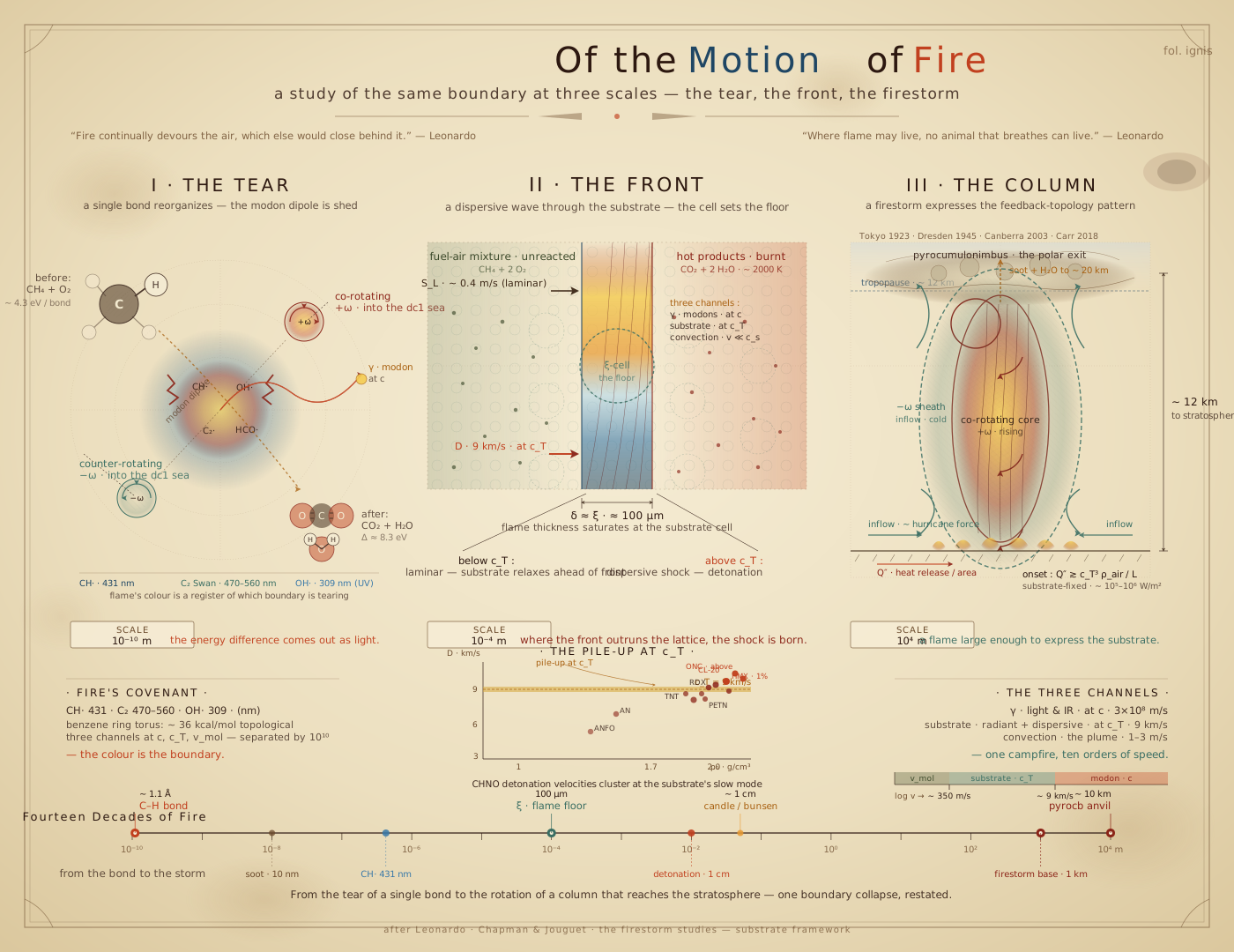
Of the Motion of Fire — the same boundary collapse at three scales. The tear: a single C–H bond reorganizes into CO₂ and H₂O, ejecting a counter-rotating modon dipole into the dc1 sea while shedding a photon at c (10^{-10} m). The front: a laminar premixed flame, ~0.1 mm thick, propagates through fuel-air mixture as a dispersive wave whose thickness saturates at the substrate coherence length \xi \approx 100\;\mum (10^{-4} m). The column: a firestorm with a rising co-rotating core, counter-rotating inflow sheath, and stratospheric pyrocumulonimbus exit — the feedback-topology pattern asserted at atmospheric scale (10^4 m). Below the triptych, the central testable prediction: detonation velocities for CHNO chemical explosives pile up at the substrate’s slow Tkachenko mode c_T = 9 km/s, with only strained-cage networks (CL-20, octanitrocubane) crossing above.
A Candle in the Dark
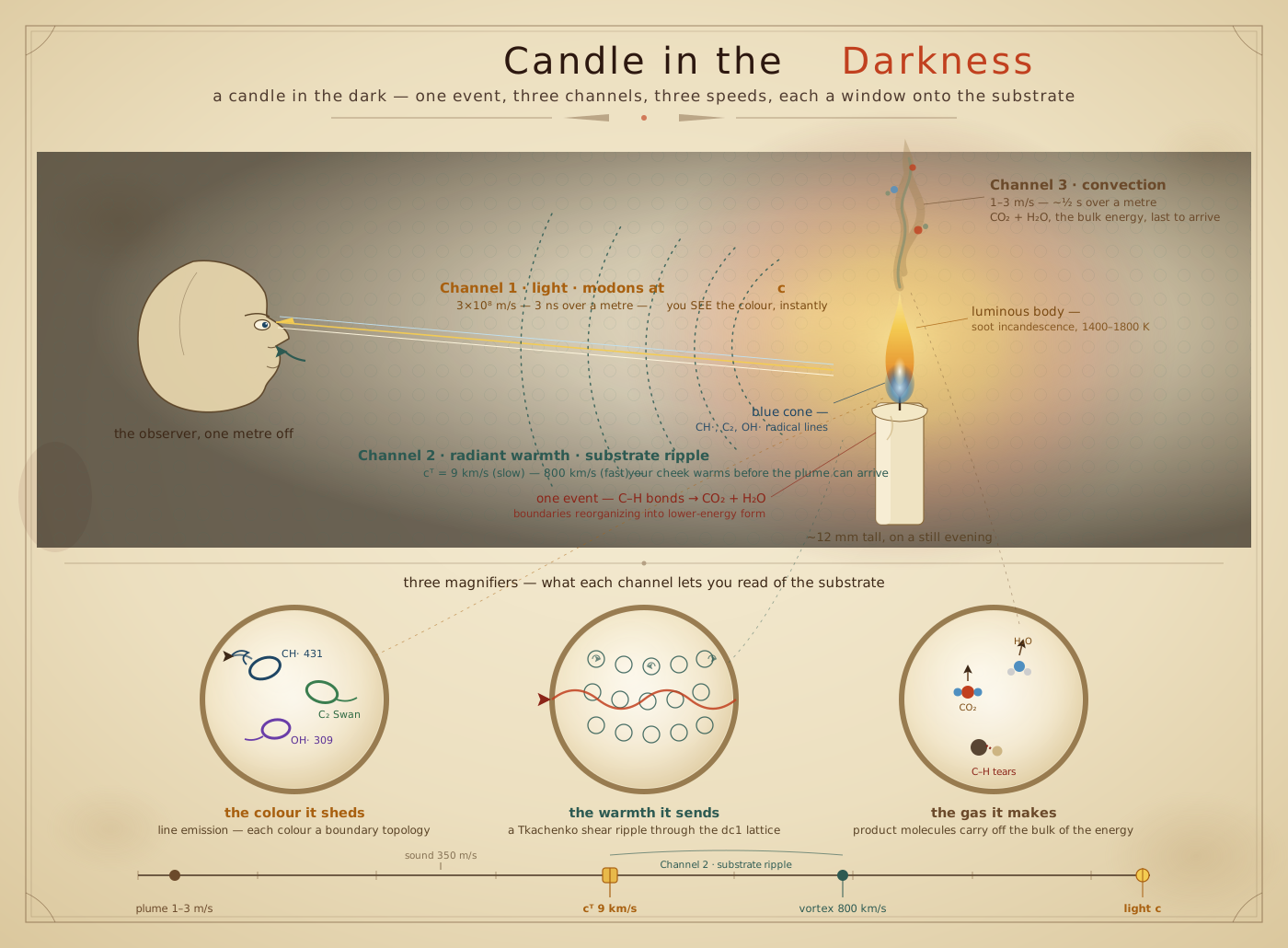
A candle flame on a still evening — perhaps twelve millimeters tall, conical, blue at the base and luminous yellow above. Look at it long enough and three different things are happening at once. The light reaches your eye instantly, at c. The side of your face warms more quickly than rising air could explain — a radiant heating that travels faster than the convection plume. And then, a moment later, you feel the plume itself, hot gas rising past you. Three channels, three speeds, one event: the reorganization of carbon-hydrogen bonds in melted paraffin into the more stable boundary configurations of carbon dioxide and water vapor.
This chapter is about fire as the substrate’s most accessible window. At room temperature the substrate is invisible — every smooth condition the thermal dynamics chapter lays out (rotational kinetic energy at 0.776\,c dwarfing k_B T, ξ-scale lattice averaging hiding the discrete cells, counter-rotating boundaries perfectly balanced) holds without exception. At plasma temperatures the substrate stops hiding — electron vortex defects run free, the lattice resolves, the 300 keV modon-shedding threshold turns on. Fire sits between. The substrate floor is still vastly above flame energies (\sim 0.2 eV at 2000 K versus \sim MeV per substrate cell). The lattice itself is calm. What is busy is the surface: the shared counter-rotating boundaries between molecules, reorganizing visibly into lower-energy configurations and shedding the energy difference into the three channels.
Fire is the cleanest classroom demonstration of substrate physics available to the unaided eye. Color encodes which boundaries are reorganizing. Flame shape encodes the dispersive wave structure of the front. Firestorm rotation encodes the substrate’s feedback-topology architecture asserting itself at atmospheric scale. And — the prediction this chapter centers on — the velocities at which the most violent boundary collapses propagate cluster at exactly the slowest mode the substrate supports.
Flame Color as Boundary Signature
The visible spectrum of a flame is not a continuum. It is a superposition of discrete emission features, each one a signature of a specific boundary transition between specific molecular fragments. Standard combustion chemistry has catalogued these features in exquisite detail. The substrate framework reads them as the modon spectrum of the boundary reorganization in progress.
The blue cone at the base of a clean hydrocarbon flame — a candle’s, a Bunsen burner’s, a gas stove’s — is the spectral signature of three radicals:
| Emitter | Band | Wavelength | Boundary transition |
|---|---|---|---|
| CH· | A²Δ → X²Π | \sim 431 nm | C–H radical’s bound orbital pair re-forming |
| C₂ | Swan bands (d³Π → a³Π) | \sim 470–560 nm | C=C double-bond boundary, two-electron flywheel (aromatic-rings) |
| OH· | A²Σ → X²Π | \sim 309 nm (UV) | O–H boundary completing, with extra rotational fine structure |
Each emitter is a transient species — formed during boundary reorganization, lasting microseconds, decaying back to ground state with the emission of a single modon at quantized energy. The blue color of clean combustion is the colour of a flame where the boundary cascade is proceeding cleanly: each broken C–H or C–C bond hands off through a sequence of small radical intermediates that emit their excess boundary energy quickly enough that no carbon clusters survive to grow into soot.
In the substrate ladder’s terms, each shed modon is a quantum of the lattice’s own paired breath set free. The emission is native, not manufactured: the flame releases the breath its boundaries were already holding, the same release lightning makes violent and a candle makes gentle. Each colour is a denomination of that breath — one boundary topology handing it off at one fixed energy.
The luminous yellow flame — a candle’s main body, a campfire, a guttering lantern — is a different physics. Where combustion is incomplete (oxygen-starved), the cascade produces large carbon clusters before they can finish oxidizing. Each cluster, \sim nm scale, contains hundreds to thousands of atoms in a hot, partially-bonded boundary network. Its thermal modon emission follows the Planck spectrum at the cluster’s local temperature, which for typical sooting flames sits at 1400–1800 K — peaking in the near-infrared but with enough visible tail to look luminous yellow-orange. The yellow flame is thermal radiation from condensed-matter boundaries; the blue flame is line emission from molecular-radical boundaries. Both are modons. Different topologies.
A handful of metal salts dropped into the flame add their own boundary signatures:
| Salt | Color | Wavelength | Boundary transition |
|---|---|---|---|
| Na | yellow-orange | 589 nm (D lines) | 3p \to 3s in atomic sodium |
| K | violet | \sim 770 nm | 4p \to 4s in atomic potassium |
| Cu | green | \sim 510–525 nm | 4p \to 4s in atomic copper (and CuOH bands) |
| Sr | red | \sim 605–685 nm | atomic Sr, SrO, SrOH emission |
| Ba | green | \sim 524 nm | atomic Ba, BaCl bands |
| Li | crimson | 670.8 nm | 2p \to 2s in atomic lithium |
Each is a different orbital boundary transition — a different vortex topology shedding a different modon energy. A flame test is, in substrate language, a reader’s handbook of orbital boundary energies, written in light.
The framework does not require oxygen for “fire” — any boundary cascade that produces lower-energy molecular configurations is a fire in the relevant sense. Hydrogen burning in fluorine produces HF with comparable enthalpy. What makes O₂ the universal terrestrial oxidizer is a boundary-topology accident: O₂’s ground state is a triplet (two unpaired electrons in degenerate \pi^* orbitals), which means its boundary configuration matches the radical-chain intermediates that combustion produces. The activation energy of most combustion is the cost of populating those radical intermediates; the propagation is then favorable. In substrate terms, O₂ is unusually well-equipped to accept a counter-rotating partner from a broken C–H or C–C bond, because its own ground-state boundary already has the right topology.
Three Channels Visible at Once
The thermal dynamics chapter introduced the three heat-transfer channels — modons at c, substrate perturbations at three substrate-set speeds, and molecular convection — as a structural feature of the framework. A flame is the cleanest single demonstration that all three are physically distinct.
Underneath them is a single currency. The substrate ladder reads every exchange of energy with the substrate as one coin — the paired anti-phase breath of a vortex and its counter-rotating partner, a handoff that is complete and lossless precisely because it is paired (the breath is the ladder). The three channels are three ways the coin changes hands: radiation ejects it outright as a modon, conduction passes it lattice-cell to cell with no matter moving, convection lets matter keep it and ride along below the Landau speed. A flame is the cleanest place in nature to watch all three spent at once, from a single event.
Sit a meter from a campfire. Close your eyes.
Channel 1, the modons. Open your eyes for a moment. The light reaches you at c = 3\times 10^8 m/s, which over a meter is 3 nanoseconds — effectively instantaneous. Every photon you see is a modon shed from a boundary reorganization in the fire: blue from radical recombination, yellow from soot incandescence, the occasional green from a copper trace or the metallic glint of a piece of treated wood. Modons carry the full color spectrum and they carry it instantly.
Channel 2, the substrate perturbations. Close your eyes again. The skin of your face still warms — and not via the rising plume, which is several meters above your head. The radiant heat you feel is a mix: most of it is broadband infrared modons (which is still Channel 1, propagating at c), but a measurable fraction is coupling to the substrate as collective vortex-lattice perturbations and reaching you as ripples through the dc1. These travel at the three substrate speeds — outer-scale vorticity at \sim 800 km/s for the fast component, Tkachenko shear at \sim 9 km/s for the slow component. Over a meter that is \sim 1\;\mus for the fast channel, \sim 0.1 ms for the slow channel. Still effectively instantaneous to your perception, but slower than the modons. Standard radiative-transfer theory bundles the entire thermal flux into Channel 1; the framework predicts a substrate-mediated residual that has different statistical properties (different angular distribution, different coherence length).
Channel 3, the molecular convection. Stand up. Walk into the rising plume two meters above the fire. The hot gas reaches you at \sim 1–3 m/s — over a meter, fractions of a second. Slow, but carrying the bulk of the energy. This is product molecules — CO₂, H₂O, N₂, trace soot — flung outward from the boundary reorganization, carrying their thermal kinetic energy through the substrate the way a boat travels through water. The plume is subsonic (v \ll c_s \sim 350 m/s, well below the Landau threshold v_\text{rot,outer} \approx 0.0025\,c), so the substrate provides no resistance — it gets out of the way, and Navier-Stokes governs the dynamics.
A campfire delivers all three channels every second, simultaneously, separated by ten orders of magnitude in speed. Conventional physics treats them as one bundled “heat transfer.” The substrate framework treats them as three independent processes with three different timescales, three different angular distributions, and three different sensitivities to atmospheric and lattice conditions. The cleanest test is the angular distribution of the slow-substrate component: where standard infrared radiative heating drops off as \cos\theta (Lambert’s law) from the flame surface, the substrate-mediated Tkachenko contribution should have a different (and more isotropic) angular signature, because it couples through the lattice geometry rather than through line-of-sight photon emission.
The Aromatic Latent Heat
Why do aromatic compounds burn so vigorously? Coal, gasoline, jet fuel, asphalt — the densest-energy hydrocarbon fuels are aromatics or contain aromatic fractions. Naphthalene burns hotter than the equivalent mass of straight-chain hydrocarbons. Benzene, toluene, xylene power racing engines because their energy density exceeds aliphatic fuels.
The aromatic rings chapter showed that benzene’s stability over the equivalent set of localized bonds is \sim 36 kcal/mol of topological energy — a counter-rotating vortex torus has no boundary terminations, no edges, no free ends, and so no termination energy. Combustion destroys that torus. To burn benzene, the ring must first tear: the toroidal vortex has to be opened into a linear chain of broken C–C bonds, which costs the entire 36 kcal/mol of topological stability up front. After that, the chain oxidizes the way any aliphatic chain oxidizes.
Read through the substrate ladder, that torus is the molecular archetype of the locking pole — every chiral circulation balanced by its counter-rotating twin, the ring plugged whole into the lossless channel (the aromatic rings chapter develops this as the closed-shell pairing). The 36 kcal/mol is the depth of that lock; the ignition barrier is the price of breaking it.
The consequence is exactly what the empirical combustion of aromatics shows. Aromatics have higher ignition temperatures than aliphatics — you have to overcome the topological barrier before the chain can start. Once the chain starts, they burn hotter than aliphatics, because all that stored topological energy is released along with the chemical bond enthalpy. Octane number — the resistance to premature ignition under engine compression — correlates with aromaticity for exactly this reason. The 36 kcal/mol is a topological gate: hard to open, but everything behind it pours out at once when it does.
This is the substrate-mechanical reason for the empirical lore that flame “needs an ignition source”: for any fuel above a certain bond-topological complexity, the cascade cannot start spontaneously at the equilibrium fuel-air interface. Heat must accumulate locally above the topological tearing threshold before the cascade self-propagates. Once it does, the released energy is more than enough to maintain the cascade through the surrounding fuel. The reason a wildfire spreads through a forest but a fireplace requires a match is identical in substrate language: green wood’s aromatic-rich lignin holds the torus together until enough local energy concentrates to tear it; the match supplies that energy.
The Flame Front as a Dispersive Wave
A laminar premixed flame — methane-air at stoichiometric mixture, propagating through a tube — has a reaction-zone thickness of \sim 0.1 mm at atmospheric pressure. This is the distance over which fuel-air molecules complete the cascade from unreacted to fully-oxidized. It is set, in conventional combustion theory, by the ratio of thermal diffusivity to flame speed: \delta \sim \alpha / S_L, where \alpha \sim 2\times 10^{-5} m²/s for air and S_L \sim 0.4 m/s for methane gives \delta \sim 50\;\mum. For most common fuels the answer comes out within a factor of two of 100\;\mum.
The substrate coherence length is \xi \approx 100\;\mum. The numerical coincidence is striking enough to be worth flagging, and the framework offers a reading of it — though the conventional thermal-diffusivity explanation cannot be ruled out.
The framework’s reading: a flame front is a dispersive wave in the dc1. The reaction zone is the region over which the substrate must reorganize boundary topologies in front of the propagating front. The minimum length over which the substrate can do this is set by the cell size — below a single cell the substrate cannot resolve a reaction zone at all. The framework therefore predicts \delta \gtrsim \xi as a floor, not as a target. Flames whose conventional Zel’dovich thickness would be much smaller than \xi (very high flame speed, very low thermal diffusivity) should saturate at \xi rather than going below it.
This floor is the long-wavelength end of the substrate ladder: the cell \xi is the cutoff below which the lattice has no structure left to resolve — the length where the self-similar breath can no longer fit inside a cell — and the flame front reads that cutoff directly as the place its reaction zone stops thinning. Note that \xi enters here as the ladder’s cutoff, not as one of its \sqrt{2} rungs (the distinction the ladder’s honest accounting is careful to keep), exactly the role it plays as the blackbody floor E_\text{min} = hc/\xi in thermal dynamics.
This is a falsifiable prediction:
Premixed laminar flame thickness has a \sim 100\;\mum floor. Across fuels, oxidizers, pressures, and dilutions, the measured reaction-zone thickness should not drop below \xi. High-pressure flame experiments (where \alpha / S_L scales downward as 1/p) should show a flattening of flame thickness at \xi rather than continued reduction. Combustion researchers routinely observe a “thermal-diffusion plateau” at high pressure that is conventionally attributed to molecular-scale heat transport limits; the framework reinterprets it as substrate-cell resolution limit.
Below the Tkachenko speed, the flame front is subcritical: the substrate has time to reorganize ahead of the front, the wave is well-resolved, and the burn proceeds in laminar order. Laminar flame speeds for hydrocarbons range from \sim 0.4 m/s (methane) to \sim 3 m/s (acetylene) — six orders of magnitude below c_T = 9 km/s. The substrate is barely participating; it is providing the medium in which the chemistry happens.
Detonation at the Tkachenko Speed
When the flame front outruns the substrate’s ability to relax ahead of it, the regime changes. Above the Tkachenko speed, the reorganization cannot proceed in laminar order — the front becomes a shock with a dispersive structure inside it. In the ladder’s economy this is the moment the substrate can no longer pass its coin — the lossless paired breath — forward ahead of the front in time; the breath that cannot be handed off piles into the shock. It is the same lossy-handoff threshold lightning crosses when an electron driven past its own circulation speed must shed the coin as a gamma ray (why structures seek the rungs) — detonation is that failure carried by a chemical front rather than a single charge. This is the deflagration-to-detonation transition, and where it lands is, in the framework’s reading, the central testable prediction of this chapter.
Detonation velocities for chemical explosives have been measured for over a century. The Chapman-Jouguet (CJ) theory of 1899 gives the steady-state detonation velocity as the velocity at which the rarefaction wave behind the front catches up to the shock — equivalently, the velocity at which the sonic condition is met at the trailing edge of the reaction zone. CJ theory provides no fundamental upper bound on D. For sufficiently energetic chemistry and sufficiently dense packing, D can in principle be arbitrarily high.
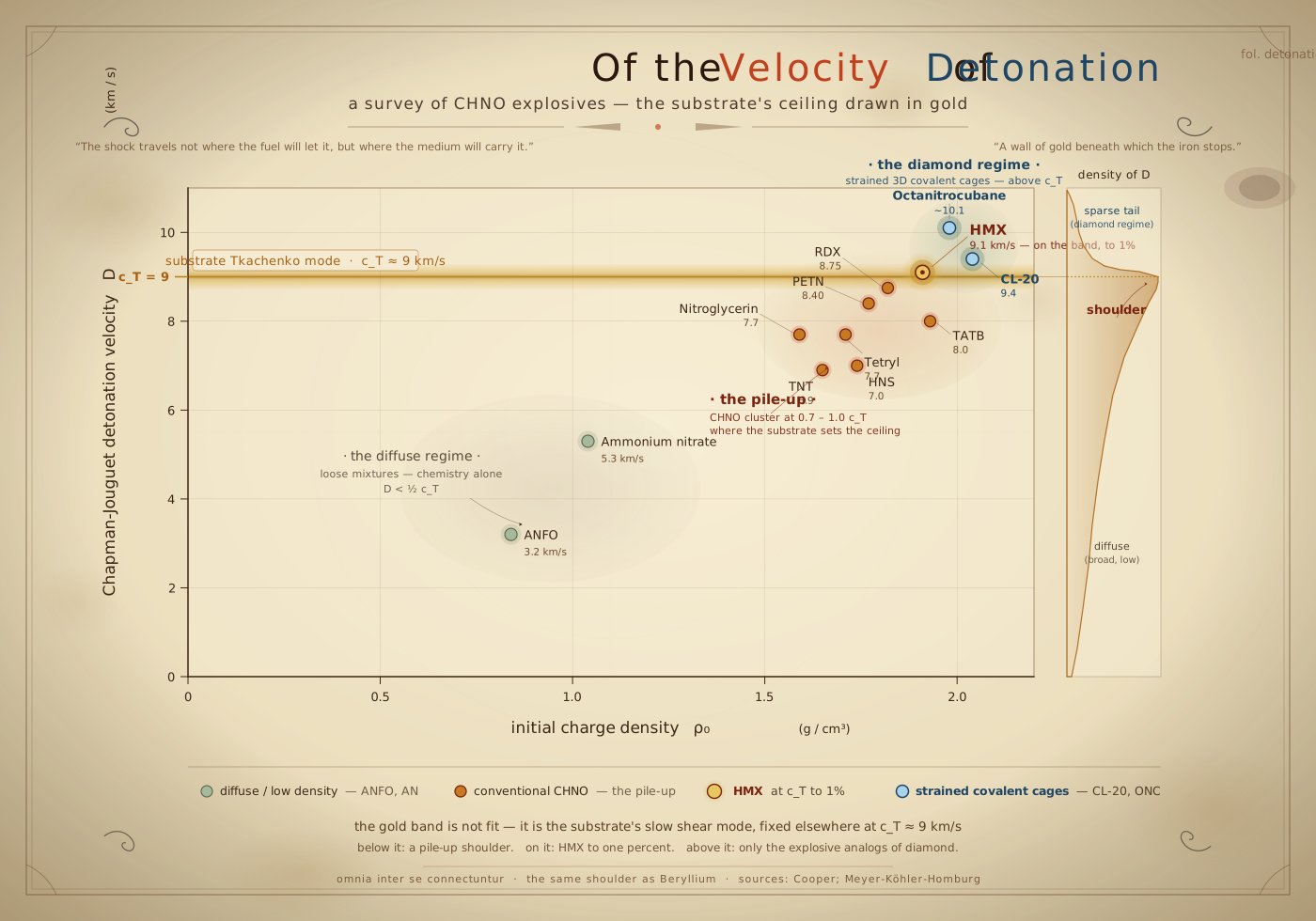
Empirically, D for ordinary CHNO chemical explosives clusters at 6–9 km/s.
Representative values:
| Explosive | D (km/s) | \rho_0 (g/cm³) | D/c_T |
|---|---|---|---|
| Octanitrocubane (ONC) | ~10.1 | 1.98 | 1.12 |
| CL-20 (HNIW) | 9.4 | 2.04 | 1.04 |
| HMX | 9.1 | 1.91 | 1.01 |
| RDX | 8.75 | 1.82 | 0.97 |
| PETN | 8.40 | 1.77 | 0.93 |
| TATB | 8.0 | 1.93 | 0.89 |
| Nitroglycerin | 7.7 | 1.59 | 0.86 |
| Tetryl | 7.7 | 1.71 | 0.86 |
| HNS | 7.0 | 1.74 | 0.78 |
| TNT | 6.9 | 1.65 | 0.77 |
| Ammonium nitrate | 5.3 | 1.04 | 0.59 |
| ANFO | 3.2 | 0.84 | 0.36 |
Sources: standard explosives engineering references (Cooper, Meyer-Köhler-Homburg). Densities at peak loading; D at the corresponding density.
What the data shows:
HMX hits c_T on the nose. D(\text{HMX}) = 9.1 km/s versus c_T = 9 km/s — a 1\% match. HMX is the workhorse high explosive: a dense (1.91 g/cm³) cyclic nitramine with strong directional N–NO₂ bonds and a fully-bonded cage structure. The substrate framework reads it as the natural place where chemical boundary collapse co-stiffens with the substrate’s slowest mode, in exactly the way Be matched c_T for transverse phonons.
CL-20 and octanitrocubane exceed c_T. D(\text{CL-20}) = 9.4, D(\text{ONC}) \sim 10.1 km/s. Both are strained 3D covalent cages — CL-20 is a hexanitro-hexaazaisowurtzitane cage; ONC is a cubane skeleton with one NO₂ on every carbon. They are the explosive analogs of diamond: ultra-rigid, ultra-light covalent networks whose boundary-collapse cascade is faster than the substrate’s free Tkachenko mode. When the chemical reorganization rate exceeds substrate response stiffness, the explosive’s own network — not the substrate — sets the propagation speed.
Conventional CHNO explosives cluster at D \approx 0.7–1.0\,c_T. TNT, RDX, PETN, Tetryl, HMX, TATB all sit in the band 6.9–9.1 km/s. This is the heart of the pile-up.
Low-density formulations fall well below. ANFO at 3.2 km/s and pure ammonium nitrate at 5.3 km/s sit roughly 1/3 to 1/2 of c_T — analogous to lead’s v_T falling far below the Tkachenko speed in the phonon plot. Diffuse, weakly-bonded reactive mixtures cannot couple to the substrate’s slow mode; their detonation propagates through chemistry alone.
The conventional reading of this pattern is that it is an accident of CHNO bond energetics: the heat release per unit mass of CHNO chemistry is bounded by the bond enthalpies of CO₂, H₂O, and N₂, and the CJ formula gives detonation velocities in the observed range as a consequence. The framework’s reading is different: the substrate’s slowest mode at c_T = 9 km/s sets a soft ceiling on how fast a dispersive reorganization can propagate through the dc1, and chemical chemistry that approaches this ceiling sits at it, while only fully-rigid 3D covalent networks (the explosive analogs of diamond) cross above.
The two readings are not yet experimentally distinguished. The framework’s prediction is that they should be distinguishable by the shape of the distribution, not just its peak. A population set by chemistry alone should have a smooth distribution centered on whatever CJ chemistry happens to give. A population set by substrate response should show a shoulder — a pile-up from below at c_T, with a sparse population crossing above only for the most rigid networks. This is the same statistical signature predicted for transverse sound speeds; the empirical detonation distribution shows it qualitatively.
A finer survey of D for strained-cage and extended-network explosives — beyond CHNO, including aluminized formulations, nitrogen-rich heterocycles, and theoretical N₈/N₆ cages — should reveal whether the 9 km/s shoulder is sharp or smeared. A sharp shoulder is a substrate fingerprint. A smooth trend with bond strength is the conventional CJ-chemistry explanation. Either outcome is informative.
The framework is not claiming that detonation cannot exceed 9 km/s; it can, and ONC and CL-20 already do. It is claiming that the typical CHNO chemistry sits at the substrate’s slow mode for the same structural reason that typical metals sit below it for transverse phonons — substrate response stiffness is matched to the chemistry. The strong prediction is that the distribution of measured D shows the same shoulder-and-overshoot structure as the v_T distribution, which is not a conventional CJ-theory consequence. The weak version of the prediction is that the numerical coincidence between the densest cluster of CHNO detonation velocities and c_T = 9 km/s — already striking — has substrate physics behind it rather than being a chemistry accident.
The framework also predicts a connection to the DESI dispersive-shock analysis: a chemical detonation and a cosmological undular bore are the same kind of mathematical object — a dispersive shock in an elastic medium — at vastly different scales, with the same internal structure (leading discontinuity + trailing oscillatory wave train + characteristic velocity ceiling). The substrate is the elastic medium in both cases; the propagating front is the visible signature of the same wave physics that DESI’s dark-energy crust analysis exhibits at cosmological distance.
Cool Flames as Subcritical Cascade
Below the temperature regime of ordinary flames, a separate combustion phenomenon exists: “cool flames” at 200–400°C, observed in hydrocarbon-air mixtures at low pressure or with diluted fuel. A cool flame produces faint blue luminescence, modest temperature rise (\sim 100 K above ambient), partial oxidation rather than complete combustion (aldehydes, peroxides, and acids in place of CO₂ + H₂O), and a self-propagating front much slower than ordinary deflagration. The phenomenon is technologically important — it governs the autoignition behavior of diesel engines, gas turbines, and detonation engines — and is well-characterized in the combustion-chemistry literature.
The framework reads cool flames as the substrate’s subcritical cascade regime: a boundary reorganization that propagates but does not complete. The temperature is high enough to populate the radical chain (CH₃·, HO₂·, peroxy radicals) but not high enough to overcome the topological barriers to complete oxidation. The substrate participates — modons are shed, the blue luminescence is genuine line emission from CH and CHO radicals — but the cascade self-extinguishes locally rather than running to thermodynamic equilibrium.
Two regions of the cool-flame phase diagram are worth highlighting. The “negative temperature coefficient” region — where increasing temperature decreases reaction rate, between \sim 600 and \sim 700 K for many hydrocarbons — is a long-standing puzzle in conventional combustion theory. The framework reads it as a regime where increasing thermal energy disrupts the substrate-coherent boundary configurations of the peroxide intermediates faster than it accelerates the underlying chemistry. The “low-temperature ignition” regime — where a cool flame sometimes transitions to full ignition after a delay of milliseconds — corresponds, in framework language, to the local accumulation of substrate-mediated boundary stress crossing the threshold for cascade-runaway. A prediction emerges:
Cool-flame propagation speed should scale with the local substrate-coupling parameter \alpha_{mf}, not just with thermal diffusivity and reaction rate. Specifically, the ratio of cool-flame to ordinary-flame propagation speed at the same fuel/oxidizer composition should follow a substrate-fixed scaling involving \alpha_{mf} — the same coupling that controls modon shedding in lightning, the dissipation onset for magnetic reconnection in solar flares, and the substrate floor in transverse phonons. This is a parameter-free prediction: \alpha_{mf} is already fixed by the bridge equation.
The cool-flame literature has not yet been re-examined through this lens. The data — propagation speeds, ignition delays, NTC widths across a range of fuels — is in the engineering combustion archives. A re-analysis is a tractable project.
Firestorms and the Rotating Column
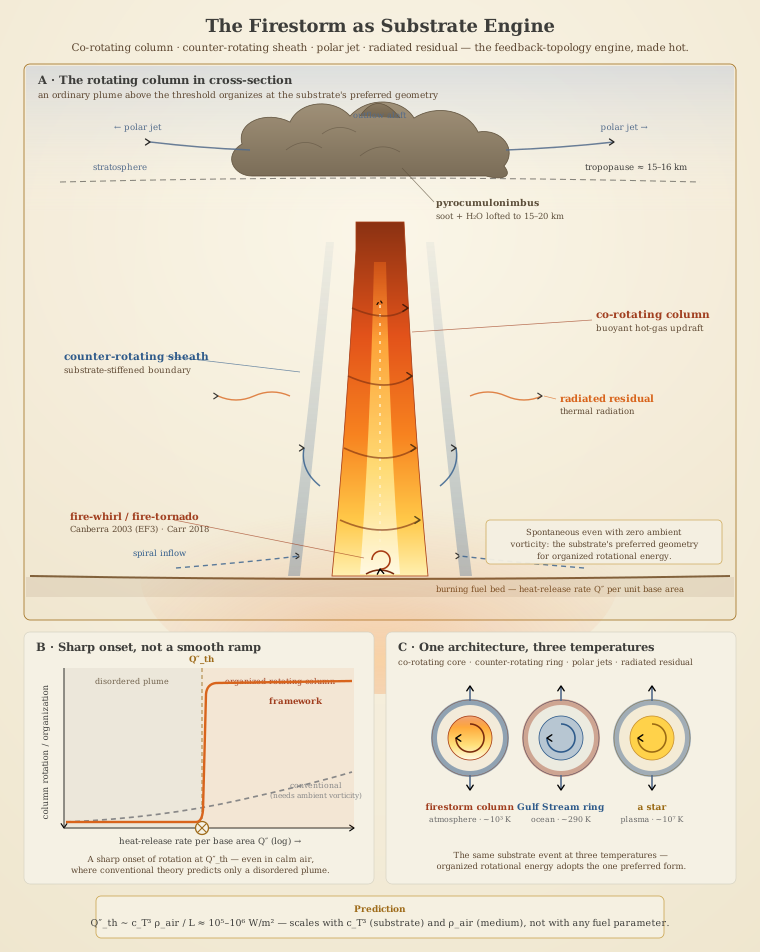
At small scale a fire is a column of rising hot gas, a buoyant plume with no particular organizational structure beyond what buoyancy and entrainment dictate. Above some threshold of intensity, the plume’s character changes. It begins to rotate. Inflow from the surroundings spirals inward. A counter-rotating sheath develops at the column’s outer boundary. The top of the column punches into the stratosphere as a pyrocumulonimbus cloud, carrying soot and water vapor to altitudes of 15–20 km. The fire has organized itself into the same architecture that the feedback topology chapter identified as the substrate’s preferred boundary-collapse geometry: co-rotating disk, polar jets, counter-rotating sheath, residual radiation.
The 2003 Canberra firestorm produced a tornado strong enough to be classified as an EF3 by Australian meteorologists — winds exceeding 250 km/h, peeling roofs off buildings, lifting cars. The 2018 Carr Fire in California spawned a similar fire-tornado that lofted debris a mile into the air. The 1923 Tokyo firestorm following the Great Kantō earthquake killed \sim 38{,}000 people in a single rotating fire column. The Dresden firestorm of 1945 generated organized inflow winds reaching hurricane force. These are not unusual fires; they are ordinary fires above the threshold where substrate organization takes over the dynamics.
The framework reads a firestorm as the same structure that produces the Gulf Stream — a coherent rotating system stabilized by a counter-rotating boundary sheath, with radiative output and discrete shed eddies — applied to a column of buoyant hot gas instead of a current of warm seawater. The architecture is identical: organized rotational energy in an elastic medium adopts the same form at every scale where it can take it. Firestorms are simply where the fire’s heat-release rate is high enough that the surrounding atmosphere can no longer absorb the energy passively, and the rising column begins to organize at the substrate’s preferred geometry.
The transition criterion is qualitative in the existing fire-meteorology literature: “above some heat-release-rate threshold, fire-whirl or pyrocumulonimbus formation becomes likely.” The framework would predict a quantitative threshold in terms of substrate-relevant scales:
Fire-whirl onset should occur when the heat-release rate per unit base area Q'' exceeds a substrate-coupling threshold of order Q''_\text{th} \sim c_T^3 \rho_\text{air} / L, where L is the column base scale. For a kilometer-base fire and atmospheric density at sea level, this gives a threshold of order 10^5–10^6 W/m² — broadly consistent with the empirically observed regime where conflagrations transition to firestorms. The cleaner prediction is a scaling: Q''_\text{th} should scale with c_T^3 (substrate-fixed) and with atmospheric density (medium-fixed), but not with any fuel-specific parameter. A survey of historical firestorms and modern large wildfires, classified by Q'' and base scale L, should test whether the transition lies on a substrate-fixed curve.
The substrate framework adds something the standard fire-meteorology picture does not: a reason for the threshold to exist at all. In conventional theory, fire whirls form when ambient vorticity is stretched and concentrated by the upward flow; without ambient vorticity, no whirl. The framework adds that even with zero ambient vorticity, a sufficiently hot column should organize spontaneously, because the substrate’s preferred geometry for organized rotational energy is the feedback-topology pattern — and a column above the threshold has enough energy that the substrate-organized geometry is energetically favored over the disorganized plume.
Standard fire-whirl theory predicts whirls when fires interact with horizontal wind shear, terrain channeling, or pre-existing atmospheric rotation. The framework’s prediction is more aggressive: above Q''_\text{th}, organization should appear even in conditions where conventional theory predicts a disordered plume. The cleanest test would be controlled large-scale fire experiments in calm-air conditions — open desert, no terrain features, no synoptic-scale vorticity — varying Q'' across the predicted threshold. Government fire-research programs (US Forest Service, CSIRO Bushfire CRC) maintain facilities where this is feasible. The framework predicts a sharp onset of column rotation at Q'' \approx Q''_\text{th}, not a smooth transition.
A firestorm is, in this reading, a flame that has grown large enough to express the substrate’s structure macroscopically — the same way a Gulf Stream ring is an ocean current that has grown large enough to express the substrate’s modon topology, or a glacier is an ice flow that has grown large enough to express the substrate’s directional memory. The three are the same substrate event at three different temperatures.
Stellar Fire
The framework is scale-invariant in a way that connects ordinary fire to the next octave up. A star is sustained nuclear fire: nuclear boundary topologies (the bound configurations of protons and neutrons in nuclei) reorganizing into lower-energy boundary configurations and shedding the energy difference through the same three channels.
| Aspect | Chemical fire | Stellar fire |
|---|---|---|
| Boundary scale | molecular bonds (\sim 10^{-10} m) | nuclear interiors (\sim 10^{-15} m) |
| Boundary energy | \sim eV per bond | \sim MeV per nucleon |
| Channel 1 (modons) | visible/IR photons | gamma rays + neutrinos |
| Channel 2 (substrate) | dc1 perturbations at c_T, etc. | same — but now coupling at \sim MeV scale |
| Channel 3 (convection) | hot gas plume | stellar convection cells, granulation |
| Macroscopic organization | firestorm rotating column | the star itself — co-rotating equatorial disk, polar jets, counter-rotating boundary at the tachocline |
The architecture matches. The substrate’s feedback-topology pattern, asserted at atmospheric scale by a firestorm, is asserted at 10^9-m scale by a star. The solar-stellar dynamics chapter develops the stellar case in detail; what fire offers is the everyday version. Sitting by a campfire and watching the plume reach turbulent convection is watching a smaller version of what produces the granulation pattern on the solar photosphere, with the same underlying substrate organization at both ends.
The 300 keV cross-domain prediction connects fire and stellar physics directly: the same modon-shedding threshold at 0.776\,c that turns on in atmospheric lightning, tokamak runaway disruptions, and solar flares is a stellar phenomenon at one end of the temperature axis and an atmospheric phenomenon at the other. Fire — chemical fire — is too cold to reach the 300 keV threshold by many orders of magnitude. Stellar fire reaches it routinely. The substrate floor is the same in both; only the energy scale of the boundary reorganization differs.
What Fire Predicts
| Prediction | Substrate origin | Test |
|---|---|---|
| Detonation-velocity pile-up at c_T = 9 km/s for CHNO explosives, with shoulder-and-overshoot structure mirroring transverse-phonon v_T | Substrate slow shear mode caps dispersive-shock propagation | Survey of D for strained-cage and extended-network explosives; look for shoulder at 9 km/s |
| Premixed laminar flame thickness has a \sim 100\;\mum floor | Substrate cell size \xi is the minimum reaction-zone resolution | High-pressure flame experiments; thickness should plateau at \xi rather than continue decreasing |
| Substrate-mediated angular signature in radiant heat from flames | Channel 2 (Tkachenko) couples through lattice geometry, not line of sight | Angular profile of integrated radiant flux vs. distance from a controlled flame, looking for non-Lambertian residual |
| Cool-flame propagation speed scales with substrate-coupling \alpha_{mf} | Subcritical cascade is substrate-mediated | Re-analysis of cool-flame propagation data across fuels with \alpha_{mf} as a single fitting parameter |
| Fire-whirl onset threshold Q''_\text{th} \sim c_T^3 \rho_\text{air} / L | Substrate-preferred geometry asserts itself above coupling threshold | Controlled large-scale fire experiments in calm-air conditions; sharp onset at substrate-fixed Q''_\text{th} |
| Flame-color line emissions are quantitatively predicted by boundary topology, not just by molecular orbital theory | Modon energy = boundary reorganization energy | Cross-check selected band intensities against substrate-derived boundary energies — likely a long-term test |
| 300 keV signature in stellar fire | Same modon-shedding threshold as lightning, tokamak runaways | Already in thermal dynamics — restated here as the stellar case of the fire arc |
Connections
This chapter sits at the intersection of several threads developed elsewhere in the paper:
- The thermal dynamics chapter provides the analytical scaffolding: the substrate floor at \sim MeV per cell, the three heat-transfer channels at their respective speeds, the modon emission spectrum as boundary signature, the Tkachenko–phonon coincidence in Be that motivates the detonation-velocity pile-up prediction here.
- The aromatic rings chapter supplies the molecular-scale topological-stability argument that the section on aromatic latent heat uses. Benzene’s 36 kcal/mol torus energy is the substrate-physics reason aromatic fuels burn hot.
- The feedback topology chapter supplies the architecture (co-rotating disk + counter-rotating sheath + polar jets + radiated residual) that firestorms express at atmospheric scale, mirroring what the Gulf Stream expresses in seawater.
- The lightning chapter is the closely-related case where atmospheric plasma physics crosses the substrate threshold; this chapter is its low-temperature complement.
- The DESI dark-energy crust analysis treats dispersive shocks at cosmological scale; chemical detonations exhibit the same mathematical structure at the scale of a high-explosive charge.
- The bridge equation fixes the substrate constants (\xi, c_T, \alpha_{mf}, 0.776\,c) that every prediction in this chapter draws on. Fire-in-the-substrate adds no new parameters.
What the Three Elements Together Reveal
Water is the substrate’s preferred fluid — the medium most easily organized at every scale from the molecule to the ocean basin. Ice is the substrate template made visible at the molecular scale and grown out to the snowflake and the glacier. Fire is the substrate’s surface activity made visible across the temperature axis where boundaries reorganize but the lattice stays calm — a window onto the boundary topology of matter that opens whenever bond enthalpies become accessible to thermal energy.
The deeper point that unifies the three: each element is a different regime of substrate participation in matter. Liquid water is the regime where the substrate’s organization is soft enough to flex with the chemistry; ice is the regime where it locks rigid and shows its template; fire is the regime where the surface tears and the energy difference between boundary configurations comes out as light. The same substrate — the same dc1 lattice, the same coherence length \xi, the same Tkachenko mode at c_T — produces all three behaviors at the temperatures and pressures we know. Earth and air, when this section adds them, will fill in the remaining branches of the same single tree.