Tropisms and Substrate Response
Sensing light, gravity, touch, and water with no sense organs — and the slow auxin signal that pools it all
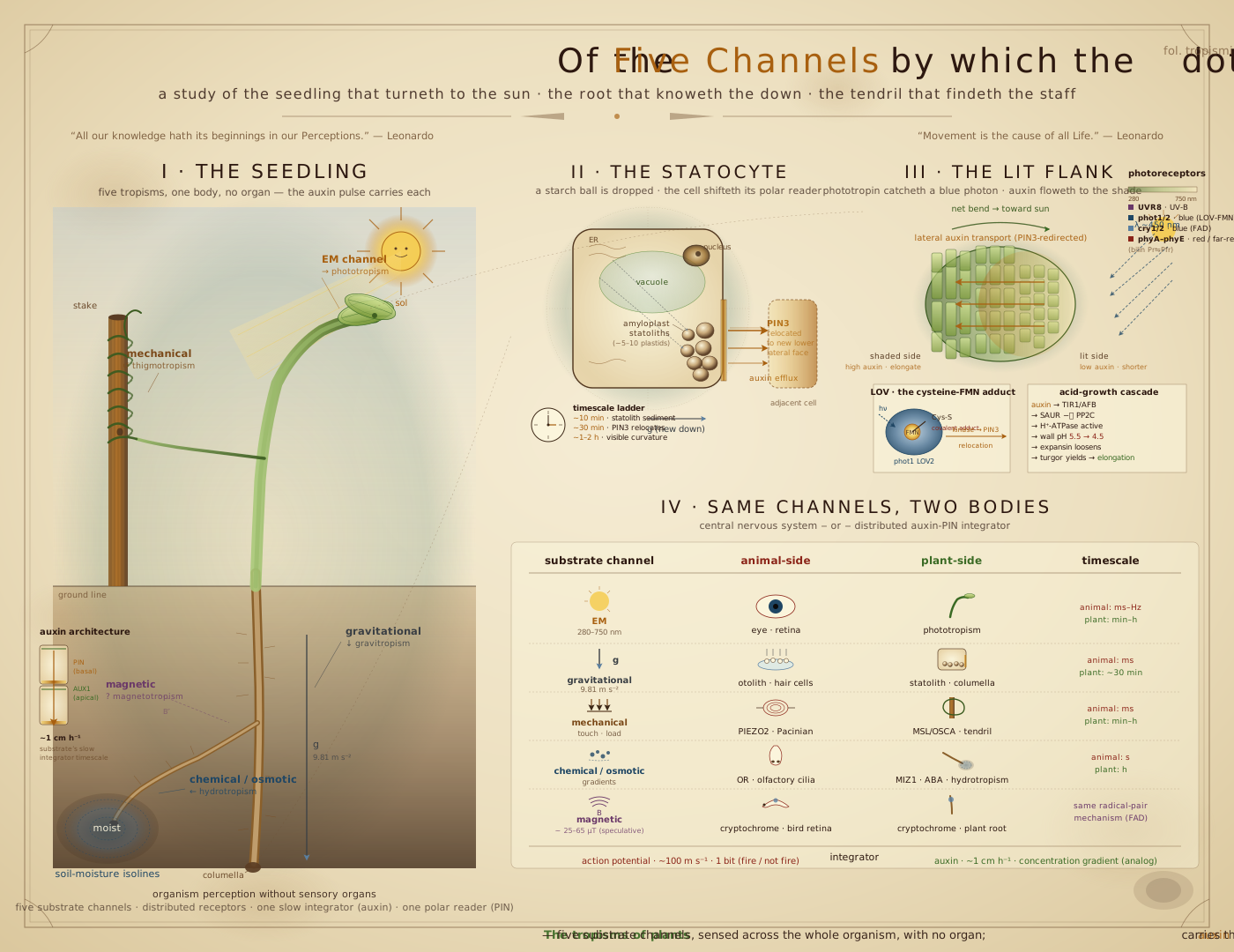
A plant has no eyes, no ears, no nose, no fingertips, no inner-ear balance organ, and no brain to pool what any of them would report. Yet it tracks the direction and colour of light, the pull of gravity at every cell, touch and wind and soil resistance, the moisture gradient in the ground, and — probably — Earth’s magnetic field. To each it responds by growing, bending toward or away from the signal. Biology names the responses by channel: phototropism, gravitropism, thigmotropism, hydrotropism, magnetotropism.
That is the whole chapter. Plant tropisms are the perception walk run at organism scale without sense organs: each substrate channel is read by receptors spread through the whole body, the readings are pooled by a slow chemical signal — auxin — and the answer is differential growth. The difference the substrate makes here is one of layer: the receptors are the same chemistry the perception walk catalogued in animal sense cells, but where an animal wires its receptors into one organ and a brain and answers in milliseconds, the plant scatters its receptors across every cell and answers over hours — with auxin in place of the action potential, and PIN-protein polarity in place of a synapse. Same channels, integration moved from a central organ to the cells themselves.
Phototropism: The EM Channel Sensed Without an Eye
The plant reads the direction, intensity, and colour of light with four photoreceptor families spread across nearly every photosynthetic cell. Phototropins (phot1, phot2) catch blue light through an FMN-binding LOV domain; cryptochromes (cry1, cry2) are blue-light FAD receptors tied to photomorphogenesis and the clock; phytochromes (phyA–phyE) switch between red- and far-red-absorbing forms to read the canopy’s spectral signature; UVR8 absorbs UV-B directly through tryptophan. Between them they decompose the EM channel from \sim 280 to 750 nm.
The Darwins’ classic experiment (1880) drew the arc: a lit oat seedling bends, but the tip does the sensing while the bending happens below it — so a signal must travel between them. The Cholodny–Went hypothesis (1928) named that signal auxin, shifted to the shaded side. Modern work fills in the middle: blue light triggers PIN3 to relocate, auxin is redirected to the shaded side, and the gradient drives faster elongation there, bending the stem toward the light over minutes to hours.
The framework reads phototropism as the EM channel sensed across the whole body instead of at one retina. The eye concentrates its receptors in a single organ with enormous spatial resolution; the plant spreads them over its entire lit surface, each photosynthetic cell its own pixel, and integrates the result not as a neural code in milliseconds but as an auxin gradient over hours. Same substrate channel, two timescales — matched to what each organism must track (a predator in milliseconds, the sun’s elevation over hours).
Gravitropism: The Gravity Vector Sensed Without a Vestibular System
The plant reads which way is down using statoliths — dense, starch-packed amyloplasts that sink to the low side of specialised statocyte cells (the columella at the root tip, the starch-sheath endodermis in the shoot). Lay a seedling on its side and the sequence runs: statoliths settle to the new lower face within \sim 5–10 min; PIN3 relocates toward that face within \sim 20–30 min, redirecting auxin sideways; curvature appears within \sim 1–2 h; the tip is realigned with gravity within \sim 4–8 h.
The framework reads this as gravity read by mass sedimentation — the same physical trick as the vertebrate inner ear, where calcium-carbonate otoliths ride over hair cells and their sinking is detected. A dense body falling through a viscous medium, at both scales. The difference is only the output: hair cells fire in milliseconds; statocytes shift their PIN polarity over minutes. And that direction-reader is not fixed wiring — it is rebuilt within minutes, the cell shifting PIN from one face to another by endocytosis and recycling whenever the gravity vector changes. The reading direction is regulatable and reversible, not anatomically pinned.
Thigmotropism, Hydrotropism, and the Other Channels
The same pattern repeats at every remaining channel. Thigmotropism (touch): tendrils coil, roots steer around obstacles, touched stems thicken — sensed by mechanosensitive ion channels (MSL, OSCA, MCA) that let calcium in on deformation, the plant-side echo of the touch chapter’s PIEZO2 architecture. Hydrotropism (water): roots grow toward moisture, governed by MIZ1 and ABA signalling — the nose chapter’s gradient-sensing applied to water instead of volatiles. Magnetotropism: a smaller and more contested literature, but replicated (Maffei 2014 and others), with cryptochrome’s FAD radical pair the proposed sensor — the same mechanism proposed for magnetoreception in migratory birds. Thermomorphogenesis: phytochrome B doubles as a thermometer, its far-red form reverting to the red form faster as temperature rises (Legris et al. 2016).
The framework reads all of these as one architecture: a distributed receptor population for each substrate channel, feeding the same auxin-and-PIN integrator, driving the same differential-growth output — populated wherever a channel carries information worth tracking.
Auxin: The Plant’s Action-Potential Analog
Auxin (indole-3-acetic acid) is made in young leaves and shoot tips and moves two ways: as bulk cargo in the phloem (\sim 0.3–1.0 m h^{-1}), and as a short-range polar transport stream from cell to cell (\sim 1 cm h^{-1}), driven by PIN efflux carriers on one face and AUX1/LAX influx carriers on another. The polar stream is the directional, locally-regulatable channel the tropisms steer; the phloem stream is bulk delivery.
The framework reads auxin as the plant’s slow integrator signal — the counterpart to the action potential, retuned to the timescales a plant lives on. An action potential races along an axon at \sim 1–120 m s^{-1} carrying one bit (fire / don’t) at fine time resolution. Auxin creeps at \sim 1 cm h^{-1} carrying a concentration gradient at fine space resolution, read by downstream cells against threshold switches (the TIR1/AFB receptor cascade). Both are biology’s slow-relative-to-light but fast-relative-to-the-organism integrators; both sit cleanly in the substrate’s slow modes at the organism rung.
How auxin actually bends an organ is the acid-growth mechanism: auxin drives proton pumps that acidify the wall, acid activates expansins that loosen it, and the turgor-pressurised cell yields and elongates. The loop closes — auxin → wall loosening → turgor-driven elongation → asymmetric growth → bending — and the framework reads it as the slow-current commit pulse at the organ-bending rung, the morphogenetic cousin of the Calvin cycle’s RuBisCO commit pulse.
PIN Polarity: The Direction Setter the Cell Can Rebuild
The eight Arabidopsis PIN proteins are auxin export pumps, each parked on one face of the cell, so each cell pushes auxin in a chosen direction. PIN1 points rootward in the stele; PIN2 shootward in the epidermis; PIN3 is the dynamic one, repolarising to handle gravitropism and phototropism. Their placement is held by constant recycling and switched by PINOID kinase and by auxin’s own feedback.
The framework reads PIN polarity as the substrate-pinned direction setter at the cell rung — the plant’s version of the polar readers found all across the cellular and brain walks: the primary cilium at the cell’s apical face, the axon initial segment at the neuron’s, the source-to-sink polarity of the phloem at organism scale. What sets PIN apart is that it is constitutively reorientable: the cell can flip its polarity within \sim 20–30 min while leaving everything else unchanged — the substrate’s preferred move when a response must be fast but reversible. PIN polarity is therefore the integration node: every channel’s sensor feeds into PIN relocation, PIN sets the auxin direction, auxin carries the pooled signal across the organism, growth completes the loop. It is the plant’s distributed answer to the same problem the brain solves with a central cortex — many channels in, one direction of response out.
Phyllotaxis: The Golden Angle and the Ladder’s Gap
The same auxin-and-PIN machinery that points an organ also spaces the organs themselves. At the shoot tip, new primordia form one at a time at auxin maxima built by PIN1 convergence; each new organ drains auxin from around itself, so the next can only form in the largest remaining gap (Reinhardt et al. 2003; Jönsson et al. 2006). The angle between successive organs — the divergence angle — is, across most vascular plants, the golden angle \approx 137.5^\circ, and the spirals it traces count consecutive Fibonacci numbers, 34 one way and 55 the other (Vogel 1979). The same integrator, turned from a directional problem (which way to grow) to a patterning one (where to put the next organ so it never lands on an old one).
Phyllotaxis: φ on a Circle, the Ladder's Gap
A meristem places each new organ at the largest open gap. Any rational divergence angle marches successive organs onto a few radial arms where they collide; the unique escape is the most‑irrational angle, the golden angle. Drag the angle and watch the arms dissolve.
Interactive: Douady and Couder’s front runs live in the centre view of the patterns simulation — each element placed where the repulsion of the others is least and carried outward, nothing else assumed; sweep G down and the divergence walks from 180^\circ through the Fibonacci near-misses to 137.5^\circ, with the scene drawing its own bifurcation diagram; set three at once and it locks at 120^\circ instead.
The meristem’s anti-lock. Any rational divergence angle marches successive organs onto a few radial arms where they collide; the arm count at each near-lock is a Fibonacci number, and the unique escape is the most-irrational angle, the golden angle — \varphi on a circle. Folded onto the substrate ladder’s combs it lands on the \varphi tooth and off both \sqrt2 and the octave: the gap the teeth define, read into space. Levitov (1991) derived the same configuration as the ground state of a vortex lattice trapped between two counter-rotating boundaries.
That the answer is the golden angle is not plant chemistry — the cleanest proof is that the pattern appears with no plant in sight. Douady and Couder (1992) dropped magnetised droplets into a dish one at a time, each repelled by the others; they settle at the golden angle and make Fibonacci spirals from pure physics. Nisoli et al. (2009) built the same thing from a stack of repelling magnets, a “magnetic cactus,” and annealed it into identical patterns. The reason is always the same: repelling elements added one at a time avoid rational organisation, because any rational angle stacks them onto a few radial lines where they collide — and the limit of “avoid every rational” is the most irrational number, the golden ratio. The chemistry (auxin, PIN1) is the implementation; the principle is substrate-level, and the non-biological copies are the proof.
That principle has a home in the substrate’s own materials. Levitov (1991) showed phyllotaxis is the energy-minimising flux lattice of a layered superconductor — vortices threaded between two counter-rotating boundaries, which cannot lock to either spacing and so settle at the golden-mean configuration. The substrate is that system: a layered superfluid threaded by a vortex lattice between the two boundaries of its octave (\sim 8\;\mum and \sim 16\;\mum). The framework reads phyllotaxis as that flux-lattice physics surfacing at the meristem — a lattice that cannot commit to either boundary, so it sits at the most-irrational point between them.
On the substrate ladder this places phyllotaxis at the anti-lock pole — the gap the teeth define, not a rung. The golden angle is \varphi on a circle by construction, and folded through the comb test it lands dead on the \varphi tooth and off both \sqrt2 and the octave. It is the gap’s circular face — and the ladder reads the same gap in two other arithmetics: where parts tile a plane at once the optimum is a disordered “blue-noise” packing (the retinal cone mosaic, and in the plant’s own kingdom the chloroplast array across a leaf); where the variable is whole generations the optimum is a prime (the periodical cicada’s 13- and 17-year cycles). One principle — be as far from resonance as the space allows — wearing three faces.
What de-risks the reading is that a neuron reaches for the same number in time: the resting cortex spaces its rhythms at the most-irrational \varphi so they cannot lock. A meristem and a cortex, sharing no chemistry, refusing overlap for the same reason. That the golden angle is \varphi, and that it follows generically from repelling elements on a growing front, is centuries and decades old respectively; what the framework adds is the unification — phyllotaxis, the resting-EEG ratio, the cone mosaic, and the cicada as one anti-lock gap read in each arithmetic its space allows — and the identification of that generic geometry with the substrate’s own vortex-and-boundary lattice. The coupling is the interpretive step, flagged as a proposal; the comb is what makes it testable.
The Meristem at Both Poles
The same auxin maximum that spaces an organ also connects it, and the two jobs are the ladder’s two poles in sequence. Placement is the anti-lock step just described: each primordium drains auxin from its neighbourhood, so the next forms only in the largest gap — repelling elements refusing to overlap, the \varphi gap. But once a primordium is fixed, that same maximum becomes a sink that drains a narrow PIN1-polarised file of cells beneath it — canalisation (Sachs 1969; Reinhardt et al. 2003) — and that file becomes the new organ’s midvein, plumbing it into the existing vascular system. That is the lock step: it binds the organ into the substrate’s lossless channel.
So the meristem realises both poles by developmental sequence: it separates — placing each organ in the \varphi gap so none overlaps — then connects, canalising a vein that locks the organ into the plumbing. It is the same separate-then-connect dyad the hippocampus wires anatomically (dentate-gyrus separation feeding CA3 completion), run here in time by one molecule that first repels its neighbours and then drains a conduit. Like the genetic code, the plant reaches the gap by a developmental route rather than a chemistry-free geometry, so this is an application of the sign rule; what it adds is that one machine runs the plant to both poles.
Predictions and What Would Falsify
Six predictions extend the reading beyond the structural anchors.
Polar auxin transport velocity clusters at a substrate-preferred rung near \sim 1 cm h^{-1} across angiosperm and gymnosperm lineages and across organs, rather than varying continuously with PIN-AUX1 expression. Radio-labelled auxin transport data (Goldsmith 1977 and successors) test it.
PIN polarity reorientation clusters at \sim 20–30 min for gravitropic and phototropic responses across species, rather than varying continuously with cell type and organ. Live PIN-GFP imaging under stimulation tests it.
Statolith count per columella statocyte clusters at a substrate-preferred small integer (\sim 5–10 in Arabidopsis) across lineages — the same integer-clustering as the flagellar stator count — rather than scaling with cell size. Cross-phylum electron microscopy tests it.
Tropic responses populate substrate-preferred channels only. A robust tropism should exist for each channel the perception walk catalogued (EM, gravity, mechanical, chemical-osmotic, magnetic, thermal) and not for arbitrary intermediate channels — distinct from a continuous behavioural-ecology response space.
Phyllotactic divergence angles cluster at the golden angle — the anti-lock gap — not at \sqrt2 or any rational/octave commensuration. Folded through the comb test they should land on the \varphi comb and off the others, and transient or aberrant phyllotaxis should pass through the Fibonacci-convergent near-locks rather than scatter. This is the chapter’s one deliberately between-the-rungs prediction; the species-wide phyllotaxis literature and the non-biological copies (flux lattices, the magnetic cactus) supply the test and its control.
The meristem’s two poles are separable. Placement (anti-lock, prediction 5) and canalisation (lock) should be dissociable operations of one auxin maximum: there should exist conditions and mutants where organs are still placed near \varphi but fail to canalise a vein, and others where venation proceeds while placement degrades — not one inseparable output. Auxin-reporter imaging with vein tracing under graded transport perturbation (NPA series, weak pin1) tests it.
The picture is falsified if (a) auxin transport velocity varies continuously, (b) PIN reorientation timescales vary continuously, (c) statolith counts scale continuously with cell size, (d) tropic responses fill a continuous arbitrary-channel space, (e) divergence angles scatter or cluster at \sqrt2 or a rational/octave commensuration instead of the golden gap, or (f) placement and canalisation prove inseparable. It is supported, even partially, if any of the six orderings hold against existing data.
Putting the Section in Context
Plant tropisms are the perception walk run at organism scale without sense organs. Light is read by distributed phototropins, cryptochromes, phytochromes, and UVR8; gravity by sedimenting statoliths in columella statocytes; touch by MSL/OSCA/MCA mechanosensitive channels; water by MIZ1 and ABA signalling; magnetism by cryptochrome’s radical pair (the same mechanism proposed for birds); temperature by phytochrome B. Each sensor feeds PIN polarity at the cell rung, which steers auxin across the organism at \sim 1 cm h^{-1}, which bends the organ through acid growth. Auxin is the plant’s slow integrator signal — the action potential’s counterpart at hours rather than milliseconds — and PIN polarity is the direction setter the cell rebuilds within minutes to track a new input. The whole architecture is biology’s distributed, brainless alternative to the centralised sense-organ-plus-nervous-system pattern animals built.
And the same auxin–PIN integrator that points an organ also spaces and plumbs the organs themselves: phyllotaxis places each one at the golden angle — the ladder’s anti-lock gap read into space, the circular face of one gap whose planar face is the chloroplast array and whose temporal face is the cicada’s prime-numbered clock — and canalisation then locks each placed organ into the vascular plumbing. One machine, run to both of the substrate’s poles, separate-then-connect, from a single auxin maximum.