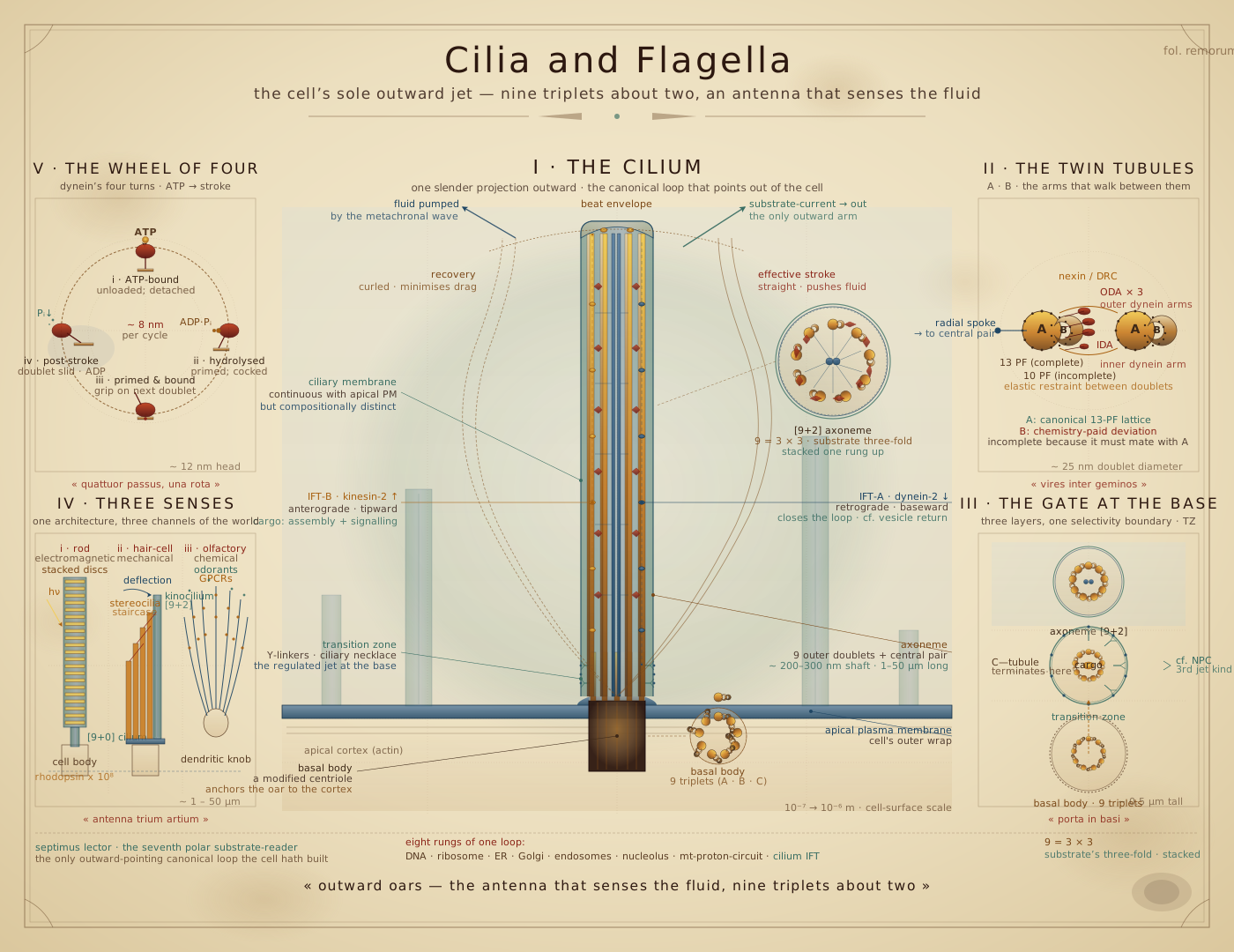
A cilium is the cell’s only outward-projecting modon. It rises out of the apical plasma membrane as a microtubule-cored cylinder \sim 200–300 nm in diameter and \sim 1–10\;\mum long (motile cilia and primary cilia in most cell types) or much longer (\sim 50\;\mum sperm flagella, tens of micrometres for some unicellular flagellates), wrapped by a sleeve of plasma membrane that is continuous with the cell’s apical membrane but compositionally distinct from it. At its base sits the basal body — a modified centriole with nine triplet microtubules — anchoring the projection to the cell’s apical cortex. Above the basal body sits a \sim 0.5\;\mum transition zone where the triplets reduce to nine outer doublets and Y-shaped linkers tether the axoneme to the ciliary membrane. Above that rises the axoneme proper: nine outer doublet microtubules arranged around a central pair of singlets in motile cilia ([9+2]), or around an empty centre in primary cilia ([9+0]). Dynein arms reach between adjacent doublets, radial spokes reach inward to the central pair, and the whole assembly beats, bends, or stays still depending on the cell’s chemistry. Intraflagellar transport (IFT) trains run continuously up and down the doublets, ferrying membrane proteins, signalling components, and assembly cargo. The cilium is the cell’s antenna, its swimming oar, its sensor, and its outward signalling spike — all at the same time, depending on the cell type and the chemistry it deploys.
Cilia and flagella are the cell modon’s outward polar jets, the explicitly external arm of the canonical loop that every interior chapter has resolved as a different chemistry-side implementation of the same architecture.
The cilium is the loop’s outward-facing expression, with the cell’s own plasma-membrane wrap projected outward as a slim sleeve and the substrate-current driven actively out of the cell into its surroundings. The cell modon’s interior is full of inward-folded jets; the cilium is the only one that points the other way.
There is an outward-extended sleeve of the cell wrap, with a 9 = 3 \times 3 axoneme as biology’s chemistry-side implementation of the substrate’s three-fold preference stacked one rung up, dynein-driven beating as the substrate-current-to-mechanical-work conversion at the cilium scale, IFT as the canonical loop’s anterograde/retrograde traffic in its most explicitly axial form, the transition zone as the modon’s regulated jet, and modified cilia in sensory cells (photoreceptors, hair cells, olfactory neurons) as biology’s chemistry-side implementation of the cilium-as-substrate-antenna reading.
Two of those readings are the substrate’s anti-phase pairing seen in motion. The axonemal beat is a breath: dynein arms on one side of the nine-fold ring drive the effective stroke while the opposite side recovers, the two sides exchanging across the central pair in anti-phase — the lattice’s own breath and the Cooper pair’s lossless give-and-take, expressed as bending rather than breathing. Metachronal coordination across a field of cilia is the same anti-phase locking propagated between neighbours, the way Cooper pairs phase-lock across a conductor — the substrate ladder’s locking pole expressed as collective motion, parts that must resonate together rather than refuse to. And IFT — anterograde trains out, retrograde trains back along the same doublets — is the two-lane median in its most explicitly axial form, the axoneme straddling a counter-rotating boundary that runs both ways at once.
The Cilium as the Cell Modon’s Outward Polar Jet
Every other organelle the cellular walk has covered sits inside the cell’s plasma-membrane wrap. The ER’s tubules thread the cytoplasm; the Golgi stacks parked at the cell’s perinuclear region; vesicles cycle between organelles; the nucleus and mitochondrion sit deep in the cytoplasm; the ribosome floats free or anchors to the rough-ER cytoplasmic face. All of them are internal implementations of the canonical loop — substrate-current circuits whose disk, jets, and counterflow are arranged across the cell’s interior.
The cilium is the only one that projects out. The ciliary membrane is continuous with the apical plasma membrane — they are physically one bilayer, not two — but the ciliary membrane has its own protein composition (BBS-pathway-imported receptors, Hedgehog-pathway components, polycystins, specific lipid microdomains) maintained by the BBSome and Tulp3 cargo systems passing the transition zone, in the same way the INM has its own protein composition maintained by mechanisms keeping it distinct from the ONM. The cilium is therefore the cell’s chemistry-side implementation of an outward extension of the wrap with its own coherence boundary at its base, the same way the nuclear envelope is biology’s implementation of an inward extension. Two extensions, two transition-gate boundaries, the same architecture run in opposite directions.
The framework reads the cilium as the cell modon’s outward polar jet in the feedback-topology canonical-loop sense. The canonical loop’s jets are the modon’s transport corridors to and from its surroundings, regulated to maintain the modon’s coherence against bulk exchange with the environment. Every internal organelle’s jets project inward into the cytoplasm; the cilium’s jet projects outward into the extracellular fluid. The cell’s wrap supports both directions — substrate-mechanically, an inward jet and an outward jet are mirror configurations of the same architecture, distinguished only by which side of the wrap the projection points. Biology has populated the inward direction with \sim 30 membrane-bounded organelle types and the outward direction with one (cilia and their derivatives), but the architecture is one architecture run twice.
This reading is what makes the cellular walk close at this chapter rather than continue further. The cell modon’s interior is now fully accounted for as inward-projecting expressions of the canonical loop at six rungs (ribosome / DNA / ER / Golgi / endosomes / nucleolus, plus the mitochondrion’s proton circuit). The exterior is accounted for at one rung — the cilium — and there is no further outward extension biology has assembled at organelle scale. The cell is one inward-folded modon with one outward-projected jet, and the architecture is symmetric in direction even though biology has made it asymmetric in elaboration.
The Axoneme’s [9+2]: Three-Fold Stacked One Rung Up
The motile axoneme has a striking and stable cross-section: nine outer doublet microtubules arranged in 9-fold rotational symmetry around a central pair of singlet microtubules. The basal body that anchors it has a related cross-section: nine triplet microtubules in 9-fold symmetry, with the central region empty. Primary cilia carry the [9+0] axoneme — the same nine-fold outer ring, no central pair. Across kingdoms (the same architecture is found in choanoflagellates, ciliates, animal cells, plant gametes, basal-organism flagella) the nine-fold count is essentially universal, with deviations rare and chemistry-explicable.
Nine is not in the framework’s emphasised set of 3-fold (F_1 catalytic head, microtubule 3-start helix, ER three-way junctions, clathrin triskelion, photon-modon’s vortex triple) or 6-fold (hexagonal lattice expressions). But nine is 3 \times 3 — the substrate’s three-fold preference stacked one rung up, with the local three-fold of the basal-body triplets (each triplet itself a three-fold offering at the small scale) compounded with a nine-fold (= 3^2) azimuthal placement at the wider rung. The framework reads 9 = 3 \times 3 as the substrate’s three-fold preference iterated, the same way the microtubule wall’s 3-start helix is the substrate’s three-fold preference expressed at the lateral lattice rung and the photon modon’s vortex triple is the substrate’s three-fold preference expressed at the dipole rung.
It is worth being precise about which kind of substrate quantity the nine is. The 9 = 3 \times 3 is a count, not a length — the locking pole’s preferred-integer closure, the same class of quantity as the microtubule wall’s N = 13 protofilaments and the nuclear pore’s eight-fold ring, and explicitly not a rung of the substrate’s \sqrt{2} scale ladder. A closed ring has an azimuth, so it selects whole-number rotational symmetries the way a pinned string selects whole-number overtones — the keyboard-versus-string complement to the lengthless geometric tower. The axoneme’s nine is the three-fold preference counted out around a circle; the \sqrt{2} comb governs the cilium’s sizes (axoneme diameter, IFT-particle radii), a separate prediction developed below.
Two pieces of structural support strengthen this reading.
The basal body is built of nine triplets. Each triplet (A + B + C tubules) is itself a small three-fold offering at the basal-body wall rung. The nine of them around the azimuth give a 9 = 3 \times 3 that is mechanically and substrate-mechanically a three-of-three count, not an independent ninefold. The transition zone above the basal body resolves the C-tubules and lifts a clean nine-fold of doublets into the axoneme, so the axoneme’s nine carries forward the basal body’s three-of-three signature even after the C-tubule has fallen away. The chemistry-side machinery (γ-tubulin nucleation at the basal-body cartwheel, SAS-6 nine-fold scaffold) implements this; the framework reads the count as the substrate’s three-fold preference compounded.
The deviation cases respect the same compounded structure. Where motile cilia depart from 9 = 3 \times 3, the deviations cluster on related substrate-friendly counts — 3-fold variants in some unicellular flagellates, 9+1 axonemes in eel sperm and some planarian sperm (a single central singlet rather than a pair, but the nine-fold ring intact), 9+0 across all primary cilia and male gametes of some species. The compounded-three-fold ring is conserved; the central element varies between 0, 1, and 2 singlets depending on the cell’s beat-pattern requirements. The framework reads the central pair (or its absence) as a chemistry-side beat-direction selector that does not perturb the substrate’s three-fold-stacked outer ring.
The framework’s prediction here is that the axoneme outer-ring count distribution across organisms should cluster at multiples of three (with 9 dominant, 6 and 12 as substrate-friendly alternatives observed in rare cases) rather than at biology-arbitrary integers. The comparative cilium literature provides the existing data; the framework predicts a count distribution distinct from a uniform-integer expectation.
Doublets, Dynein Arms, and the Substrate-Current-to-Bend Conversion
Each of the nine outer doublet microtubules is built from a complete A-tubule (13 protofilaments, the canonical microtubule wall the microtubule-highways chapter developed) joined laterally to a partial B-tubule (10 protofilaments, an incomplete wall sharing three protofilaments with the A-tubule). The A-tubule is the substrate-locked N = 13 closed cylinder; the B-tubule is its substrate-paired companion at N = 10. The pairing is one of the deviation cases the microtubule chapter flagged: chemistry pays for the paired-stiffness and dynein-track-doubling that the doublet offers, accepting the substrate-energy cost of the off-13 wall on the B-tubule side.
Outer dynein arms and inner dynein arms project from the A-tubule of one doublet toward the B-tubule of the next, evenly spaced along the axoneme’s length at \sim 24 nm and \sim 96 nm repeats respectively. Each dynein head is a \sim 500 kDa AAA+ ATPase that hydrolyses ATP and walks toward the B-tubule’s minus end in \sim 8 nm steps, producing a sliding force between adjacent doublets. The nexin-DRC (dynein regulatory complex) links between adjacent doublets prevent the doublets from sliding past each other freely; the radial spokes anchor the doublets to the central pair’s structural complex; together, the constraint geometry converts the dynein-driven sliding force into axonemal bending. The bend propagates along the axoneme as a wave; coordinated waves on opposite sides of the axoneme produce the cilium’s beat.
The framework reads dynein-driven beating as the substrate-current-to-mechanical-work conversion at the cilium scale, structurally parallel to ATP synthase’s substrate-current-to-rotation conversion at the mitochondrion but expressed in linear (or piecewise-linear, along the axoneme) rather than rotational form. Both are biology’s chemistry-side implementations of the same substrate principle: the cell stores substrate-current capacity in the proton-motive force or the ATP pool, then runs it through a mechanochemical converter (rotor at F_0F_1, dynein walk on B-tubule at the axoneme) to produce directed motion. The mitochondrion runs the conversion into the cell’s energy budget; the cilium runs the conversion out of the cell’s energy budget into mechanical work in the surrounding fluid. Same principle, opposite directions of energy flow — the same disk-and-counterflow inversion the inward / outward jet picture lifted at the geometric level. Read through the ladder’s coin economy — where the lossless anti-phase breath is the currency a structure spends along a low-loss channel — the cilium is the one modon that spends the coin outward: the mitochondrion mints it by un-pairing the breath and banking it as ATP, the cell’s interior jets all spend it inward, and the beating axoneme alone hands it to the surrounding fluid as motion.
The beat itself is the cilium’s substrate-current expression in the surrounding fluid. A typical motile cilium beats at \sim 10–50 Hz with an asymmetric stroke — a stiff effective stroke that pushes fluid past the cell, followed by a curled recovery stroke that re-positions the cilium with minimal back-flow. Banks of cilia on epithelial sheets coordinate into metachronal waves — collective bending patterns where adjacent cilia beat in slightly offset phases, creating a directed fluid flow at the tissue scale. The framework reads metachronal coordination as the canonical loop expressed at the tissue scale, with each cilium a sub-modon of the epithelial-sheet modon and the metachronal wave a substrate-coherent collective phase locking the sub-modons together. The chemistry-side coupling (hydrodynamic interactions between adjacent cilia, mechanical coupling through the apical cortex) implements the coordination; the substrate’s coherence-cell organisation at the epithelial-sheet rung organises the phase.
Intraflagellar Transport as the Canonical Loop in Its Most Axial Form
The cilium has no protein-synthesis machinery of its own. Every protein in the axoneme, the ciliary membrane, the radial spokes, the dyneins, and the IFT trains themselves is synthesised in the cell body and imported into the cilium through intraflagellar transport (IFT). IFT trains assemble at the basal body, climb the outer doublets toward the ciliary tip on kinesin-2 motors (anterograde), turn around at the tip, and descend the doublets back to the cell body on dynein-2 motors (retrograde). The trains are large multi-protein particles (\sim 250 nm in length, \sim 1 MDa or more) built around two structural complexes: IFT-A (six core proteins, dominant on retrograde trains) and IFT-B (sixteen core proteins, dominant on anterograde trains). Cargo binds the IFT trains through the BBSome (eight-subunit complex serving membrane-protein cargo) and through direct interactions with IFT subunits.
The framework reads IFT as the canonical loop in its most explicitly axial form, structurally identical to the vesicle-traffic anterograde-retrograde loop but laid out as a one-dimensional axial circuit along a cilium rather than a three-dimensional cytoplasmic circuit between organelles. The architecture lifts directly. Anterograde traffic is the loop’s forward arm — kinesin-2 climbing the substrate-coherent A-tubule track, carrying cargo outward, dropping it where the cilium needs it (tip for assembly, transition-zone proximal for membrane-protein insertion). Retrograde traffic is the loop’s return arm — dynein-2 descending the substrate-coherent A-tubule track, carrying empty IFT particles back, recovering BBSome cargo for re-use. The two arms are anti-parallel, mass-balanced, and tightly coupled through the tip-turnaround event; the whole architecture is the canonical loop with IFT particles as the substrate-current packets, the doublet as the boundary the loop rides, and the cilium length as the axial extent of the substrate-coherent corridor.
The IFT-particle size (\sim 250 nm trains, with sub-particle radii of \sim 30–50 nm for individual IFT-A and IFT-B subcomplexes) sits on the substrate ladder of preferred organelle dimensions — but, honestly, as a member of its coarse family. The IFT train runs inside the axoneme, itself one rung of the closed-conduit lineage (desmotubule \to microtubule \to axoneme \to hypha \to vascular bundle) whose steps are spaced by factors of \sim 6–12, not the clean \sqrt{2} of the resonant vesicle-coat radii. The framework predicts that the IFT-particle and IFT-subcomplex size distributions across organisms should cluster at preferred values rather than vary continuously with IFT-subunit expression — the clustering is the firm claim; whether the inter-rung ratio is exactly \sqrt{2} or the looser conduit-family spacing is what a cross-organism fold would decide, the same comb test the vesicle-radius and crista-junction predictions invite at their own rungs.
The reading the endosomal pH gradient developed for sequential-station polar transport across a substrate-coherent corridor lifts to IFT in a slightly different way. The cilium’s positional organisation along its length is the polar gradient — the proximal axoneme is where the transition zone gates membrane-protein insertion, the medial axoneme is where the dynein-and-spoke beat machinery operates, and the distal tip is where assembly cargo accumulates. The IFT trains read this positional gradient by trafficking cargo to the appropriate position along the axoneme. The cilium is therefore a seventh polar substrate-reader (after DNA’s polar channel, the ER’s three-way junctions, the Golgi’s cis-medial-trans gradient, the endosomal pH ladder, the nucleolar FC-DFC-GC condensate, and the IMM’s proton gradient), running the same architecture at the axial-cilium rung.
The Transition Zone as Regulated Jet
The transition zone is a \sim 0.5\;\mum cylindrical region between the basal body and the axoneme proper, where the basal-body triplets resolve to axonemal doublets (the C-tubule terminates), Y-shaped linkers tether the doublets to the ciliary membrane forming a tight selectivity barrier (the ciliary necklace), and a complex of \sim 25 proteins (NPHP1-11, MKS1-6, JBTS-pathway proteins, Tectonic-pathway proteins) maintains the gating. Cargo entering or leaving the cilium passes through this zone selectively: ciliary membrane proteins arrive via BBSome-mediated transport; IFT trains assemble and disassemble here; cytoplasmic proteins above a \sim 50 kDa cutoff are excluded.
The framework reads the transition zone as the cilium’s regulated jet, structurally analogous to the NPCs at the nucleus and to TOM/TIM at the mitochondrion. All three are large multi-protein selectivity barriers regulating cargo transit across a coherence-boundary on the basis of a chemistry-readable signal sequence. All three maintain the modon’s substrate-current isolation by selectively passing only cargo with the right signal. All three deploy phase-separated or phase-separation-like selectivity mechanisms in their channels (NPC’s FG-repeats; TOM/TIM’s hydrophobic-binding surfaces; the ciliary necklace’s tightly packed transition-zone protein lattice).
The architecture is the canonical loop’s regulated-jet motif expressed at three different organelle scales:
- NPCs at the nucleus. Cargo with NLS/NES signals; FG-repeat phase-separated channel; RanGTP gradient drives directionality; \sim 3{,}000–5{,}000 jets per modon.
- TOM/TIM at the mitochondrion. Cargo with MTS signals; hydrophobic-binding-surface selectivity; \Delta\Psi gradient drives directionality; \sim 100–1{,}000 jets per modon.
- Transition zone at the cilium. Cargo with CTS (ciliary targeting sequences) or BBSome-binding determinants; ciliary necklace lattice selectivity; IFT trains drive directionality; one jet per modon (one cilium, one transition zone), but each transition zone is itself a multi-channel selectivity gate handling continuous traffic.
All three are biology’s chemistry-side implementations of the same substrate principle (regulated jet at a coherence boundary, with directional driving from chemistry-side machinery using the modon’s wrap-direction or axial gradient). The cell’s three most architecturally distinctive transport gates — the NPC, TOM/TIM, and the ciliary transition zone — are biology’s three most explicit chemistry-side implementations of this principle, deployed at the three modons whose cargo selectivity demands the most stringent coherence-boundary regulation.
The basal body itself is then the boundary-matching event between the cell’s apical cortex and the outward-projecting cilium, structurally analogous to the LINC complexes bridging the nuclear envelope’s two membranes and to the MAM contact sites bridging the ER and mitochondrion. Each is a chemistry-side implementation of the substrate’s boundary-matching requirement at a coherence-boundary interface. The basal body’s 9 = 3 \times 3 triplets establish the substrate-coherent interface against which the axoneme’s doublets organise; the chemistry-side machinery (cartwheel, SAS-6 scaffold, pericentriolar material) holds the match.
Primary Cilia and the Cell’s Substrate-Aware Antenna
The primary cilium is a non-motile cilium with [9+0] axoneme (no central pair, no dynein arms in most cases, no beating), present on essentially every quiescent vertebrate cell at one cilium per cell. It projects \sim 1–10\;\mum into the extracellular space and is densely populated by signalling receptors: Hedgehog-pathway components (Smoothened, GLI), polycystin-1 and polycystin-2 (PKD-1 and PKD-2), Wnt-pathway components, GPCRs of various families, calcium channels, and mechanosensors that detect fluid flow.
The framework reads the primary cilium as the cell’s substrate-aware antenna, the chemistry-side implementation of the cell modon’s outward sensor at the cilium scale. The cilium’s outward projection sleeves the cell wrap into the extracellular fluid, exposing receptors to the bulk extracellular environment over an axoneme-length corridor while keeping the receptors’ cytoplasmic signalling tails inside the substrate-coherent ciliary lumen. Signal received at a ciliary-membrane receptor is converted into a substrate-coherent intracellular signal (calcium current, phosphorylation cascade, transcription-factor translocation) inside the cilium, then transmitted to the cell body through the substrate-coherent corridor the axoneme provides. The cilium is therefore a signal-transducing polar jet — the canonical loop expressed in its sensory rather than its energetic configuration.
The reading sharpens at the modified cilia of vertebrate sensory cells.
Photoreceptors. The vertebrate rod and cone outer segments — where photons are converted to neural signals — are modified primary cilia. The connecting cilium (a [9+0] axoneme) joins the cell body to a stack of \sim 1{,}000 flat membrane discs densely packed with rhodopsin or opsin GPCRs. Photons absorbed by opsin trigger transducin-mediated cyclic-GMP hydrolysis, closing membrane cation channels and hyperpolarising the cell. The framework reads the rod outer segment as the substrate-aware antenna’s most extreme implementation: the disc stacks expand the receptor surface area (parallel to cristae expanding the IMM surface area), the connecting cilium maintains the substrate-coherent corridor between the disc stack and the cell body, and the basal body anchors the whole assembly to the cell’s apical cortex. Vision is biology’s chemistry-side implementation of cilium-as-substrate-antenna with the substrate’s electromagnetic-coherence channel as the sensed signal. The disc stack itself is a periodic structure with a fixed \sim 30 nm repeat — and because it has a length (the disc spacing), its stacking modes are whole-number overtones of that length, the keyboard-versus-string complement to the lengthless \sqrt{2} tower, a resonant surface at the locking pole rather than a rung of the scale ladder.
Hair cells of the inner ear. The auditory and vestibular sensory cells carry an apical bundle dominated by stereocilia (actin-cored, not microtubule-cored) of graded length, but each bundle in development includes a true kinocilium — a [9+2] motile-style axoneme — that organises the stereocilia in a polarised array. The hair cells’ mechanical sensitivity (single-stereocilium displacements of \sim 1 Å are detectable) is the chemistry-side implementation of mechanically-coupled substrate-current sensing at the cilium scale, with the substrate’s mechanical-coherence channel as the sensed signal. Hearing is biology’s chemistry-side implementation of cilium-as-substrate-antenna with mechanical-coherence sensing.
Olfactory sensory neurons. The olfactory cilia (a tuft of \sim 10–30 cilia per neuron, projecting from the dendritic knob into the nasal mucus) are densely populated by olfactory GPCRs (one OR family member per neuron, \sim 400 in humans, \sim 1{,}000 in mice). Odorant binding triggers \beta\gamma-mediated cAMP cascades and depolarises the neuron. The framework reads olfactory cilia as the substrate-aware antenna at the chemical-coherence rung — chemistry-side implementations of cilium-as-substrate-antenna with chemical-coherence sensing. And where the photoreceptor’s disc stack sits at the locking pole, the olfactory cilium displays the substrate’s other pole: the \sim 400-member OR repertoire it carries is an anti-lock family, spread across stamp space so the combinatorial odour code stays distinguishable — a clustered repertoire would alias odorants into one indistinguishable chord, the chemical analogue of a periodic cone lattice aliasing light into Moiré ghosts. The cilium is the antenna; the repertoire arrayed on it is the gap the comb’s teeth define.
The pattern across the three sensory cilia types lifts to a single substrate reading: the cilium is the cell’s chemistry-side implementation of substrate-channel sensing across whichever channel the receptor chemistry has specialised for. Photoreceptor cilia sense the electromagnetic channel; hair-cell cilia sense the mechanical channel; olfactory cilia sense the chemical channel; primary cilia in non-sensory tissues sense the local-fluid-flow and developmental-signalling channels. One architecture, multiple specialised substrate channels, all implementing the cell modon’s outward antenna — and the receptor layout on each obeys the ladder’s functional sign rule: where the job is to resonate, the sensor is a tuned periodic array at the locking pole (the photoreceptor’s disc stack, the hair bundle’s graded staircase); where the job is to stay combinatorially distinguishable, the sensor is a spread-out receptor repertoire at the anti-lock pole (the olfactory OR family). The channel the cilium senses is set by the receptor chemistry; the pole its sensor occupies is set by what the sensing is for.
Predictions and What Would Falsify
Four predictions extend the architectural reading beyond the structural anchors.
Axoneme outer-ring count clusters at multiples of three. Across organisms, the axonemal outer-doublet count distribution should cluster at 9 dominantly, with 6 and 12 as substrate-friendly alternatives observed in rare cases, and biology-arbitrary counts essentially absent. This is an integer-closure prediction — the locking pole’s preferred whole-number symmetry, the same kind of quantity as the microtubule’s N = 13 protofilaments — and is distinct in kind from the \sqrt{2} scale-ladder predictions below: a count, not a length, so the two must not be folded together. Comparative cilium literature provides the existing data; the framework predicts a count distribution distinct from the uniform-integer expectation conventional models would predict.
IFT-particle and IFT-subcomplex sizes cluster on the substrate ladder’s coarse family. The \sim 250 nm IFT-train length and the \sim 30–50 nm IFT-A / IFT-B subcomplex radii should cluster at preferred values across organisms and IFT-subunit-expression conditions rather than vary continuously. Honestly, these belong to the ladder’s coarse family — the closed-conduit lineage the axoneme is part of, spaced by factors of \sim 6–12 — not the clean-\sqrt{2} resonant family of the vesicle-coat radii, so the clustering is the firm claim and the exact inter-rung ratio is what a cross-organism fold would decide. Cryo-electron tomography of IFT trains across species provides the test; the framework predicts preferred-rung clustering distinct from continuous-distribution expectations.
Transition-zone selectivity tracks substrate-stamp coupling at the ciliary necklace. Engineered ciliary-targeting sequences with equal ciliary-necklace-protein affinity but different substrate-coupling properties should show different transit rates through reconstituted or in-vivo transition zones. The Tulp3/BBSome ciliary-import literature provides the existing assay; the framework’s prediction parallels the SNARE, codon-stamp, and FG-channel selectivity predictions for matched-stamp transport.
Ciliopathies show coherence-quality defects beyond mechanical-defect explanations. Mutations in transition-zone proteins (NPHP, MKS, JBTS pathways), in IFT subunits (IFT-A/B), or in BBSome components produce ciliopathies (polycystic kidney disease, Bardet-Biedl syndrome, Joubert syndrome, nephronophthisis) whose conventional reading attributes phenotype to disrupted ciliary structure or transport. The framework’s additional prediction is that ciliopathy phenotypes should show substrate-coherence-quality defects (degraded cilium-substrate antenna sensitivity, lost substrate-coherent IFT-cargo selectivity) at strengths additive to the mechanical-defect contribution. Quantitative phenotyping of patient-derived cilia provides the test; the framework predicts a coherence-quality contribution distinct from the structural-defect contribution.
The picture is falsified if (a) axonemal outer-ring counts are uniformly distributed across biology-arbitrary integers without three-fold clustering, (b) IFT-particle sizes vary continuously with subunit expression without preferred-rung clustering, (c) transition-zone selectivity is fully explained by chemistry-side affinity matching alone, or (d) ciliopathy phenotypes are fully predicted by structural/transport-defect models without a coherence-quality contribution. It is supported, even partially, if any of the four ordering predictions hold against existing data.
Putting the Section in Context
The cilium is the cell modon’s outward polar jet, the explicitly external arm of the canonical loop. Its membrane is continuous with the apical plasma membrane but compositionally distinct — biology’s chemistry-side implementation of an outward extension of the wrap with its own coherence boundary at the transition zone. Its 9 = 3 \times 3 outer ring is the substrate’s three-fold preference iterated, with the basal body’s nine triplets compounding into the axoneme’s nine doublets through the C-tubule resolution at the transition zone. Its dynein-driven beating is the substrate-current-to-mechanical-work conversion at the cilium scale, structurally parallel to ATP synthase’s rotor at the mitochondrion but expressed in linear axonemal form. Its IFT traffic is the canonical loop in its most explicitly axial form, with kinesin-2 anterograde and dynein-2 retrograde arms running mass-balanced traffic along the doublet track. Its transition zone is the cilium’s regulated jet, structurally analogous to NPCs and TOM/TIM and biology’s third major implementation of the regulated-jet selectivity-barrier architecture. And its modified-cilia derivatives in vertebrate sensory cells — photoreceptors, hair cells, olfactory neurons — are biology’s chemistry-side implementations of the cilium-as-substrate-antenna reading, each specialised for a different substrate channel.
The cellular walk now closes. Eight chapters covering the cell’s outer wrap (plasma membrane), its factory line (ER → ribosome → Golgi → vesicle traffic), its routing and genome (nucleus envelope), its energy organelle (mitochondrial anatomy), and its outward extension (this chapter), have built up the picture of one substrate principle expressed across an entire cellular interior. The canonical loop turns up at every rung — the DNA polar channel at the ångström scale, the ribosome’s three counter-flowing channels at the nanometer scale, the ER’s three-way-junction network at the micrometer scale, the Golgi’s cis-medial-trans cisternae at the organelle scale, the endosomal pH ladder at the sub-organelle scale, the nucleolus’s FC-DFC-GC phases at the condensate scale, the mitochondrial proton circuit at the energy-organelle scale, and the cilium’s IFT loop and transition-zone gate at the outward-jet scale. Eight different chemistry-side implementations of one substrate architecture, each one specialised for the cargo and the scale it serves.
The pattern is simpler than the cell’s chemistry might suggest. Every modon at every scale runs the same architecture: a coherence-bounded interior with regulated jets at the boundary, substrate-current circulating between forward and return arms, a chemistry-side gradient as the wrap-direction signature, and a chemistry-side machinery converting substrate-current to whatever the modon’s function requires. The cell biology textbook lists \sim 30 organelle types, \sim 1{,}000 Rab GTPases and SNAREs, \sim 25 transition-zone components, \sim 100 nucleoporins, four dynein and kinesin family trees, and tens of thousands of post-translational modifications across the cellular proteome. The substrate offers one architecture with a few preferred geometric rungs and a handful of selectivity mechanisms; biology has populated each rung with the chemistry-side machinery available in evolution’s molecular toolkit and the resulting compositional diversity is what makes the textbook long. The architecture itself — the canonical loop, regulated at boundaries, with directional gradients as signatures — is short.
The cellular walk has been one demonstration that the substrate’s architecture lifts coherently from molecular through organelle to cell scale, and that the chemistry biology has assembled at each rung is biology’s chemistry-side implementation of the substrate’s offer at that rung rather than an independent invention. The cell is one substrate coherence cell, organised internally by the canonical loop expressed at multiple rungs, and projecting outward at one rung — the cilium — to interface with the substrate organisation of its surroundings. The picture is the same picture the DNA chapter, the aromatic-pocket, the microtubule chapter, and the modon-to-ATP chapters built up at smaller scales, lifted now to the cell as a whole. The architecture is one architecture; the chemistry is one chemistry-side implementation; the substrate is one substrate.