The Cortical Resonator ODE
Bilateral cortical dynamics as Kuramoto-coupled Stuart-Landau oscillators, with substrate-pinned detuning and callosal coupling-strength as the cognitive-state control parameter
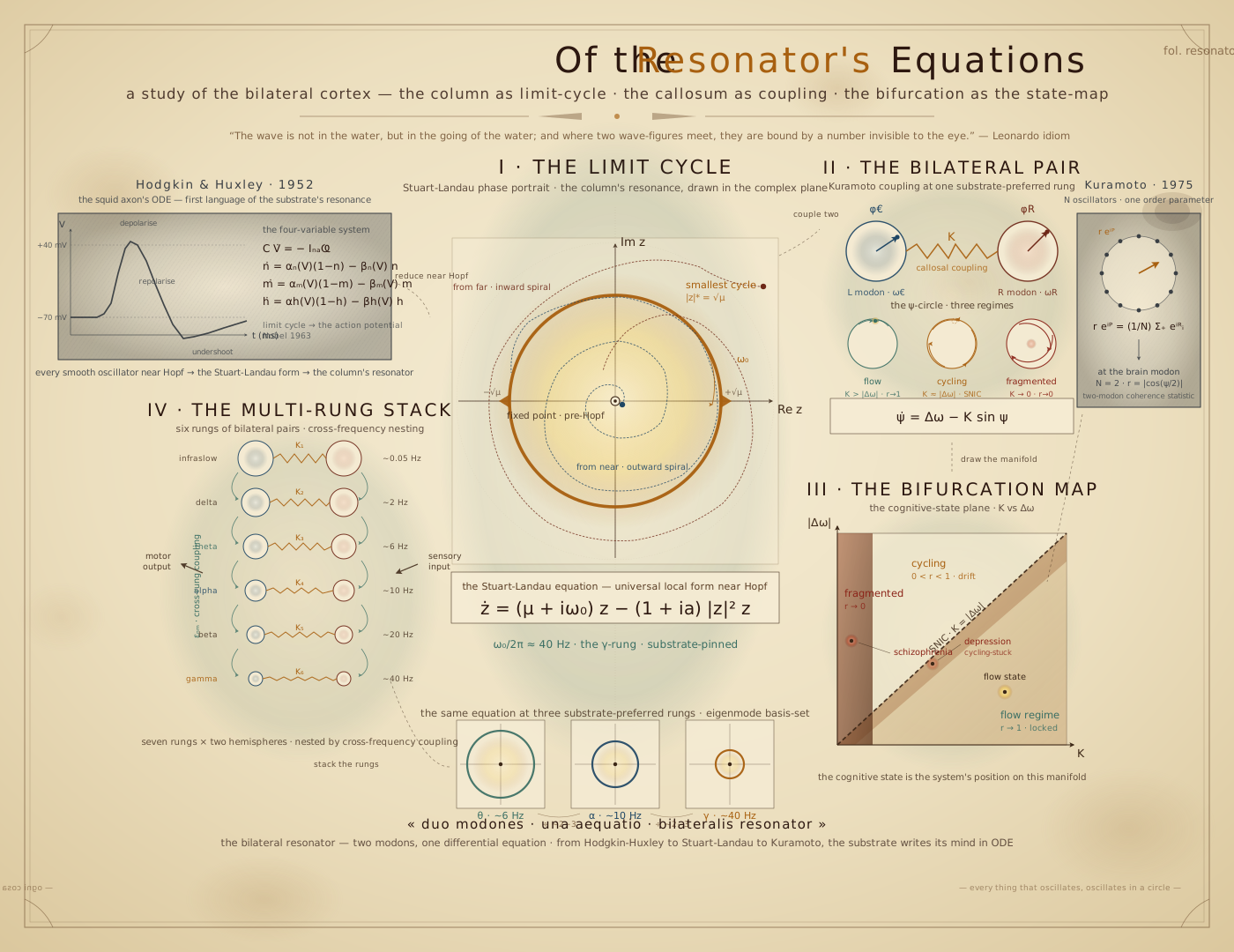
This chapter tries to get more formal with the equations by modeling the cerebral cortex as a multi-rung network of tuned limit-cycle oscillators, with each cortical column acting as a Stuart-Landau resonator at its substrate-eigenmode rung \omega_0.
The bilateral hemispheres are modeled as Kuramoto-coupled oscillator pairs at each rung with a substrate-pinned detuning \Delta\omega = \omega_L - \omega_R set by the Yakovlevian torque and planum temporale asymmetry developed in the previous chapter.
The corpus callosum’s effective inter-modon coupling strength K(t) modeled with the dynamical control parameter whose modulation across cognitive states moves the system through the flow (K > |\Delta\omega|, r \to 1, in-phase locked), dominant-submissive cycling (K \sim |\Delta\omega|, drift with 0 < r < 1), and dephased-disorder (K \to 0, r \to 0) regimes the bilateral-coupling chapter named qualitatively.
The prediction-error and active-inference dynamics of the prediction-engine are used with the substrate-coherent forcing terms acting on the oscillator network at the substrate’s preferred temporal rungs.
The multi-rung stack is used as a nested system of coupled oscillator pairs across the substrate’s preferred logarithmic frequency rungs (infraslow, delta, theta, alpha, beta, gamma, high-gamma), with cross-rung phase-amplitude coupling implementing the multi-rate temporal integration the cross-frequency-coupling section developed.
The Cortical Column as a Substrate-Pinned Stuart-Landau Resonator
Near a Hopf bifurcation — the codimension-one bifurcation at which a stable fixed point loses stability and a limit cycle emerges — every smooth dynamical system reduces to the Stuart-Landau equation in a complex amplitude z = r e^{i\phi}:
\dot z = (\mu + i\omega_0)\, z - (1 + ia)\,|z|^2\, z.
The parameter \mu is the distance from the bifurcation: for \mu < 0, the origin z = 0 is the only attractor; for \mu > 0, the origin is unstable and a stable limit cycle appears at radius |z|^* = \sqrt{\mu} rotating at angular frequency \omega_\text{eff} = \omega_0 - a\mu. The parameter a — the shear or nonisochronicity — controls how strongly amplitude perturbations couple back into phase, and the parameter \omega_0 — the natural frequency — sets the linear oscillation rate at the bifurcation point. This equation is the universal local form of any oscillating dynamical system near the onset of oscillation; the Wilson-Cowan excitatory-inhibitory population ODE, the FitzHugh-Nagumo relaxation oscillator, and even the full Hodgkin-Huxley system all reduce to this form in the neighbourhood of their respective Hopf bifurcations.
The framework reads the cortical column as a Stuart-Landau resonator operating at its substrate-eigenmode rung, with the chemistry-side machinery of pyramidal-cell-and-interneuron-network feedback (Wilson-Cowan reduction at the column scale) as the substrate’s implementation of the Hopf-bifurcation dynamics at the cortical-column rung. The substrate-physics layer pins the parameters that an unconstrained chemistry-side model would have to fit by hand. The natural frequency \omega_0 is not a free parameter to be tuned to match measured cortical oscillation rates; the cortical-maps-and-rhythms chapter developed the substrate’s preferred logarithmic frequency-rung ladder at the brain modon’s organ scale, and the framework’s claim is that a cortical column of effective length L supports a fundamental resonance at \omega_0 \approx \pi v_\text{substrate}/L pinned to the nearest substrate-preferred rung. This is the string side of the keyboard-versus-string distinction the ladder draws: a single column has a length L, so its own \omega_0 and overtones form an ordinary harmonic series; the substrate’s \sqrt2 comb lives not in one column’s overtones but in the \sqrt2-spaced set of column lengths — the laminar depth gradient the cortical-maps chapter chains into the bands — so the ladder is the keyboard the columns are tuned across, not the string each one is. The parameter \mu — the distance from Hopf — is not an arbitrary bifurcation-tuning knob; it is the substrate-coherence-quality of the column, measurable as the dimensionless ratio of standing-wave amplitude to thermal-noise floor at the column’s preferred rung, and tracking the chemistry-side observables (PV-interneuron health, glial-syncytium integrity, neuromodulator tone) that the neuron-as-cable-modon chapter developed as substrate-coherence-quality biomarkers.
The phase-only reduction is the structurally important move for this chapter. When \mu is sufficiently positive that the limit cycle is robust against the perturbations the column actually experiences, the amplitude r relaxes quickly to \sqrt{\mu} and the slow dynamics live on the phase \phi. The Stuart-Landau equation reduces to the phase equation:
\dot\phi = \omega_0 - a\mu + \text{perturbation terms from couplings},
which is the entry point to the Kuramoto framework the next section develops. The framework’s reading is that the substrate’s preferred operating regime for the cortical column is well into the post-Hopf limit-cycle regime — far from \mu = 0 on the oscillating side — so that the column’s substrate-coherent state is robustly oscillating and the slow dynamics on the phase \phi are what the bilateral-coupling architecture of the previous chapter actually integrates. The departure from this regime (\mu \to 0^+ or \mu < 0) is the substrate-physics signature of the chemistry-side cortical pathology the disorder section closed on.
The Bilateral Pair: Kuramoto Coupling at One Rung
The Kuramoto coupled-oscillator model in its N = 2 form, restricted to the substrate-preferred rung the previous section developed, gives the bilateral cortex’s elementary equation pair. Let \phi_L(t) and \phi_R(t) be the phases of the left and right hemispheres’ Stuart-Landau resonators at one rung, with intrinsic frequencies \omega_L and \omega_R set slightly different by the substrate’s Yakovlevian-torque-and-planum-temporale detuning developed in the bilateral-coupling chapter. The coupled phase ODE — derived by averaging the corpus-callosum-mediated coupling over one cycle and keeping the lowest harmonic — reads:
\dot\phi_L = \omega_L + \frac{K}{2}\sin(\phi_R - \phi_L), \qquad \dot\phi_R = \omega_R + \frac{K}{2}\sin(\phi_L - \phi_R),
where K is the effective inter-hemispheric coupling strength carried by the \sim 2 \times 10^8 callosal axons plus the anterior, posterior, and hippocampal commissures of the bilateral-coupling chapter. The phase difference \psi = \phi_L - \phi_R obeys the single-variable ODE:
\dot\psi = \Delta\omega - K\sin\psi, \qquad \Delta\omega \equiv \omega_L - \omega_R,
and the Kuramoto order parameter at N = 2 — the framework’s substrate-coherence statistic at the bilateral-modon scale, and the explicit lock/anti-lock coordinate of the two-pole reading (r \to 1 at the lock pole, r \to 0 at the anti-lock pole) — is:
r = \left|\frac{e^{i\phi_L} + e^{i\phi_R}}{2}\right| = \left|\cos\left(\frac{\psi}{2}\right)\right|.
The fixed points of the \psi-ODE are the solutions of \sin\psi^* = \Delta\omega/K. They exist if and only if K \geq |\Delta\omega|. When they exist, the stable fixed point sits at \psi^* = \arcsin(\Delta\omega/K) — for the small detuning the substrate’s slight modon asymmetry implies, this is close to \psi^* \approx \Delta\omega/K, near zero, so r \approx 1 and the two hemispheres run nearly in phase. When K falls below |\Delta\omega|, the fixed points vanish via a saddle-node-on-invariant-circle (SNIC) bifurcation, and the phase difference drifts — rotating slowly through \psi \in [0, 2\pi) with period T = 2\pi/\sqrt{\Delta\omega^2 - K^2}. The order parameter r now oscillates between 0 and 1 over each drift period: the two hemispheres alternately come into phase (high r) and fall out of phase (low r) at the slow drift rate. This is the substrate’s dominant-submissive cycling regime of the bilateral-coupling chapter — the slow r-cycle is the substrate-coherence-leader exchange the chapter named qualitatively, now derived as the exact integral of the \psi-ODE in the sub-critical-K regime.
The framework reads the three regimes of the bilateral cortex the previous chapter named — flow, cycling, and disorder — as three distinct dynamical regimes of the bilateral-pair phase ODE separated by the SNIC bifurcation at K_c = |\Delta\omega| — the lock pole, the anti-lock-resting band, and the slide between them that the two-pole reading below makes precise.
- Flow regime (K \gg |\Delta\omega|): the stable fixed point \psi^* \approx \Delta\omega/K \approx 0 exists, r \approx 1, both modons run in-phase at the substrate-preferred rung. The prediction-error cycle at both hemispheres settles in concert at substrate-friendly transit times; the system is dynamically locked.
- Cycling regime (K \approx |\Delta\omega| to K slightly below): the SNIC bifurcation is near or just past, drift period T is long, r swings slowly between near-1 and near-0; the system runs the substrate-coherence-leader exchange at the slow time-scale that maps onto McGilchrist’s dominant-submissive cortical-attention cycle.
- Fragmentation regime (K \to 0): drift period T \to 2\pi/|\Delta\omega|, the hemispheres run at their independent natural frequencies, r oscillates rapidly between 0 and 1 with no coherent leader; the substrate-coherent integrated brain-modon state fragments into two near-independent half-modons, the substrate-physics signature of the schizophrenia / inter-modon-coupling-disturbance regime the disorder section closed on.
The substrate-physics layer pins the detuning \Delta\omega that is otherwise a free parameter. The framework’s claim is that \Delta\omega/\omega_0 at each rung is a substrate-pinned ratio set by the planum-temporale asymmetry, Yakovlevian-torque, and minicolumn-density-asymmetry chemistry-side observables of the bilateral-coupling chapter, not a free per-individual fit, and clustering at substrate-preferred values across human populations and across mammalian species rather than varying continuously with brain size. In the ladder’s terms that pinning has a definite location: \Delta\omega/\omega_n is the anti-lock \varphi-detuning that holds the two hemispheres distinct — the within-rung splitting sits at the comb’s most-irrational gap while the rung centre \omega_n sits on a \sqrt2/octave tooth, so each bilateral pair is a \varphi-split doublet riding one lock-pole rung. Were the detuning to collapse to \Delta\omega \to 0 (\omega_L \to \omega_R) the pair would degenerate into a single modon and forfeit the whole family of regimes the next sections develop; the substrate keeps the pair two by spacing it at the gap.
The Multi-Rung Stack: Nested Couplings Across the Substrate’s Eigenmode Basis
The single-rung bilateral pair the previous section developed is one layer of the brain modon’s full dynamical state. The cortical-maps-and-rhythms chapter developed the substrate’s seven canonical rungs from infraslow (\sim 0.05 Hz) through high-gamma-and-ripples (\sim 200 Hz), at substrate-preferred logarithmic intervals of \sim 2–3\times, and the brain-as-prediction-engine chapter developed the cortical-column-length variation as the substrate’s preferred eigenmode-basis-set across these rungs. The full bilateral-cortex ODE is therefore a stack of coupled bilateral pairs at the substrate-preferred rungs, with cross-rung coupling implementing the cross-frequency-coupling architecture the prediction-engine chapter developed:
\dot\phi_{L,n} = \omega_{L,n} + \frac{K_n}{2}\sin(\phi_{R,n} - \phi_{L,n}) + \sum_{m \neq n} \epsilon_{nm}\sin(\phi_{L,m} - \phi_{L,n}),
\dot\phi_{R,n} = \omega_{R,n} + \frac{K_n}{2}\sin(\phi_{L,n} - \phi_{R,n}) + \sum_{m \neq n} \epsilon_{nm}\sin(\phi_{R,m} - \phi_{R,n}),
with rung index n \in \{\text{infraslow, delta, theta, alpha, beta, gamma, high-gamma}\}, natural frequencies \omega_{L,n}, \omega_{R,n} at substrate-pinned values, intra-rung bilateral coupling K_n at the inter-hemispheric callosal-region carrying that rung, and inter-rung cross-frequency coupling \epsilon_{nm} implementing phase-amplitude nesting.
The framework’s substrate-physics constraint on this stack is that the inter-rung coupling \epsilon_{nm} is non-negligible only between adjacent substrate-preferred rungs, and that the coupling has the phase-amplitude form the cross-frequency-coupling literature documents — slow-rung phase \phi_{L,m} modulating fast-rung amplitude rather than fast-rung phase directly. The full amplitude-and-phase form of the Stuart-Landau system makes this explicit: writing z_{L,n} = r_{L,n} e^{i\phi_{L,n}} and similarly for R, the amplitude equation receives a slow-phase-modulated drive r_{L,n} increases when slow \phi_{L,m} is in its peak-arousal phase, decreases when it is in its quiet-trough phase. The theta-gamma nesting the cortical-maps-and-rhythms chapter developed empirically — gamma bursts riding on theta phase — falls out of this multi-rung Stuart-Landau system as the natural dynamics of two coupled oscillator stacks with adjacent-rung phase-amplitude coupling. In the ladder’s reading this cross-rung coupling is the anti-phase breath — the substrate’s lossless “coin” — spent at the brain rung: the slow rhythm hands amplitude to the fast one along the same paired-breathing channel that ties each rung of the comb to the next.
This is the brain modon’s spectral basis-set decomposition expressed as a differential equation. The substrate’s preferred-rung structure pins the basis-set; the substrate’s preferred-rung-ratio structure pins the cross-rung coupling architecture; the chemistry-side cortical machinery (PV-interneuron-mediated gamma, thalamocortical-mediated alpha, septohippocampal-mediated theta, cortico-thalamic-and-DMN-mediated slow rhythms) implements each rung’s resonator. An engineering reader can now write down the model the brain modon actually runs as \sim 7 rungs \times 2 hemispheres \times many cortical columns per hemisphere, with substrate-physics constraints on the \omega, K, \epsilon, \mu parameters, and a manageable number of remaining degrees of freedom corresponding to inter-individual and inter-state cognitive variation.
Said in the section’s running terms, this stack is the long vector’s equation of motion. Each complex amplitude z_{L,n} = r_{L,n}e^{i\phi_{L,n}} is one coordinate of that vector — a single rung’s amplitude and phase, exactly the a_n the long-vector chapter defined — and the left/right split is the pair of half-vectors the previous chapter named. The whole coupled system is then \dot\psi: the rule by which the long vector moves, coordinate by coordinate, while sensation and prediction push on it. And the bilateral order parameter r is the coherence-match \langle a\mid b\rangle run between the two half-vectors at each rung. The earlier chapters said the cortex builds a long vector and matches it; this one says how that vector evolves.
Forcing Terms: Sensory Input, Predictive-Coding Error, and Motor Output
The Stuart-Landau / Kuramoto stack of the previous sections is the unforced bilateral-cortex resonator. The brain modon does not run unforced; it is continuously driven by sensory input at the substrate’s preferred temporal rungs, by the prediction-error signal the prediction-engine chapter developed, and by the active-inference closure with the body and environment. The framework reads the full bilateral-cortex ODE as the Stuart-Landau / Kuramoto stack of the previous section plus substrate-coherent forcing terms at each rung:
\dot z_{L,n} = (\mu_{L,n} + i\omega_{L,n}) z_{L,n} - (1 + ia)|z_{L,n}|^2 z_{L,n} + \frac{K_n}{2}\big(z_{R,n} - z_{L,n}\big) + F_{L,n}(t),
with F_{L,n}(t) the forcing term at rung n for the left hemisphere, and similarly for the right. The forcing carries the prediction-engine’s three architectural channels.
Sensory input enters as forcing at the rung corresponding to the input’s substrate-preferred temporal-rung — fast-changing visual edges drive the gamma rung at V1; slower body-state interoceptive signals drive the theta-and-alpha rungs at the insular cortex; slowest contextual-and-default-mode signals drive the infraslow rung at the DMN. The retinotopic, tonotopic, and somatotopic maps the cortical-maps-and-rhythms chapter developed are the chemistry-side spatial structure of F(t) — each column receives its rung-and-location-specific component of the sensory drive.
Prediction error enters as forcing at the canonical-microcircuit’s ascending channel. Layer 2/3 pyramidal cells project to higher cortex carrying F^\text{error}_{n}(t) — the substrate-coherence-mismatch between top-down prediction and bottom-up measurement at rung n, as the prediction-engine chapter developed. The framework’s reading is that the prediction-error forcing is substrate-coherent — it carries phase information in z_{L,n}, z_{R,n} rather than rate-only information — and its substrate-coherent character is what allows Friston’s free-energy minimisation to operate at the substrate-physics level, not only at the chemistry-side firing-rate level.
Motor output is the closure of the forcing through the body. The brain modon’s polar-jet motor axons carry F^\text{motor}(t) to muscle effectors; the muscle effectors adjust the world; the adjusted world returns through sensory channels as the modified F^\text{sensory}(t) at the next time step. The active-inference loop the prediction-engine chapter developed is therefore implemented as a delayed-feedback term in the bilateral-cortex ODE, with delay \tau_\text{loop} set by the body-scale substrate-corridor transit times the touch-and-proprioception chapter developed and the neuron-as-cable-modon conduction-velocity classes developed. The full closed-loop ODE for the brain modon embedded in the body modon is the bilateral-cortex stack ODE plus a delay-feedback term with substrate-pinned delay structure.
Regime Transitions: Flow, Cycling, and Fragmentation
The bifurcation analysis of the bilateral-pair ODE — extended across the multi-rung stack — gives the substrate-physics a reading of the substrate’s influence on cognitive-state transitions the bilateral-coupling chapter and disorder section named qualitatively. The control parameter is the time-dependent coupling-strength vector \vec K(t) = (K_\text{infraslow}, \ldots, K_\text{gamma}) across rungs; the cognitive state of the bilateral cortex at any moment is the system’s position on the bifurcation manifold.
Flow influenced by the regime in which K_n > |\Delta\omega_n| at multiple substrate-preferred rungs simultaneously. The order parameter r_n at each engaged rung is near 1; both hemispheres’ prediction-error cycles settle at substrate-friendly transit times; the integrated coherence-mismatch across the canonical-loop hierarchy is minimised. The substrate-physics signature is broadband cross-hemispheric phase coherence at substrate-preferred rung frequencies, exactly the EEG flow-state observation the bilateral-coupling chapter developed, now derived as the natural high-K-at-multiple-rungs limit of the multi-rung Stuart-Landau / Kuramoto stack.
Dominant-submissive cycling influenced by the regime in which K_n \sim |\Delta\omega_n| at the engaged rungs. The system sits near the SNIC bifurcation; r_n(t) undergoes the slow drift the bilateral chapter named substrate-coherence-leader exchange. The framework predicts a specific dynamical signature: the drift period T_n = 2\pi/\sqrt{\Delta\omega_n^2 - K_n^2} should cluster at substrate-preferred values across cognitive states and individuals, with the cycling-frequency-to-rung-frequency ratio T_n^{-1}/\omega_n pinned by substrate physics rather than freely varying. Empirically, the slow alternation between focused-task left-modon-dominance and contextually-integrating right-modon-dominance the McGilchrist-style attention literature describes should show up as a slow modulation of cross-hemispheric coherence at substrate-preferred sub-Hz rates.
Depression in the framework’s reading influenced by a state in which K_n has fallen to near |\Delta\omega_n| at the approach-motivation-carrying rungs — particularly the left-prefrontal alpha-and-theta rungs Davidson’s frontal-alpha-asymmetry literature documents — and the system has become stuck near the cycling regime’s right-modon-dominant phase. The drift slows further; the leader-exchange ceases; the right-modon’s broad-vigilant attention dominates without the left-modon’s approach-and-narrative integration. The substrate-physics prediction is that depression severity should correlate not with absolute coherence-loss but with drift-period prolongation at the approach-motivation rungs.
Schizophrenia in the framework’s reading influenced by a state where K_n \ll |\Delta\omega_n| across multiple rungs simultaneously — the dephased-fragmentation regime. The substrate-physics prediction is that the order parameter r_n shows reduced mean and increased variance compared with healthy controls, with the effect strongest at the rungs the chemistry-side disorganised-thinking literature has identified (gamma-band reduction in active perception, theta-band disorganisation in working memory).
Autism influenced by a regime in which intra-modon (intra-hemisphere) Stuart-Landau \mu has been enhanced — local-loop coherence-quality higher than average — while inter-modon K at the long-range callosal-projection rungs has been reduced. The local-coherence-stronger-than-long-range-coherence pattern Just-and-Anagnostou functional-connectivity studies document is in the framework’s reading the substrate-physics signature of a regime in which the cortical resonators run with strong amplitude but with reduced inter-modon synchronisation across rungs.
PTSD influenced by a state in which the active-inference forcing term F^\text{sensory}(t) has been strongly amplified at the right-hemisphere arousal-carrying rungs while the prediction-error forcing F^\text{error}_{L}(t) at the left-hemisphere narrative-integration rungs has been disrupted. The system sits in a strong right-modon-leader-locked drift regime with the left modon’s narrative-construction prediction-error cycle compromised — the substrate-physics reading of the van-der-Kolk “speechless terror” phenomenology the bilateral-coupling chapter named.
The substrate’s influence on the cognitive-state space of the bilateral cortex is in this reading, the bifurcation manifold of the multi-rung Stuart-Landau / Kuramoto stack parametrised by the time-dependent coupling vector \vec K(t), the substrate-coherence-quality vector \vec\mu(t), and the forcing-vector field \vec F(t). The brain modon’s cognitive-state trajectory is the path the system traces through this manifold across moments, hours, and days, with neuromodulator tone, sleep-wake cycle, attention, training, and psychological-state shifting modulating the underlying parameter vectors. The substrate-physics layer pins which regions of the manifold the substrate’s preferred-rung architecture supports as stable cognitive states.
The Bifurcation Is the Two Poles Meeting
The previous section’s flow, cycling, and fragmentation regimes are not three points on a line; they are regions of the two-dimensional bifurcation plane (K, |\Delta\omega|) the chapter’s parameter diagram draws, and that plane is the bilateral pair’s two poles made quantitative. The horizontal axis K carries the lock-versus-slide distinction; the vertical axis |\Delta\omega| carries the two-versus-degenerate distinction. The lock pole is the high-K flow region, where the pair co-coheres onto a shared rung — the octave 2 = \sqrt2^{\,2}, the cleanest tooth of the comb. The anti-lock pole is the resting band where K is finite but the detuning holds the pair at the comb’s most-irrational \varphi gap, free to slide without collapsing. The two pathological edges are the two ways off the poles — K \to 0 (fragmentation, the coupling channel lost) and |\Delta\omega| \to 0 (degeneracy, the pair ceasing to be two) — the pole-pathology axis the disorder section reads.
The diagonal K_c = |\Delta\omega| — the SNIC bifurcation — is the seam where the two poles meet, and the equation says something the qualitative chapters could not: crossing that seam has a universal signature. As callosal coupling rises toward the threshold, the drift period derived above, T = 2\pi/\sqrt{\Delta\omega^2 - K^2}, does not shorten smoothly to zero — it diverges, T \propto (K_c - K)^{-1/2}, the square-root critical slowing every saddle-node-on-invariant-circle bifurcation shows. So flow-onset is not a dimmer-switch ramp into coherence but a genuine bifurcation: the residual cross-hemispheric phase-slipping should lengthen with the universal -\tfrac12 exponent just before the pair locks, then snap to r \approx 1. And because the threshold is K_c = |\Delta\omega|, the cost to bind is fixed by the \varphi-detuning at which the pair rests — the more anti-locked the resting pair, the more coupling it takes to pull it onto a tooth. The two poles are not separate dials but the two ends of one bifurcation: the anti-lock detuning sets the lock threshold, and the path across it carries the SNIC fingerprint. This is the resonator ODE’s own contribution to the substrate ladder’s sign-rule — the dynamical law of the transition between poles, where the prediction-engine and bilateral-coupling chapters supplied the poles themselves.
Toward an Engineering-Tractable Model of Mind
The ODE the previous sections developed is what a research engineer studying the brain modon would write down. The Stuart-Landau form is canonical near Hopf bifurcation and is universally accepted as the local limit of any neural-population dynamical model near oscillation onset; the Kuramoto coupling is canonical for synchronisation analysis; the multi-rung-stack architecture maps directly onto the canonical EEG bands the empirical electrophysiology literature has measured for nearly a century. The framework’s substrate-physics contribution is not a new equation — it is the parameter-pinning that constrains the equation’s degrees of freedom to substrate-preferred values rather than to chemistry-side fits.
This is what an engineering reader hearing the substrate framework should take away. The mind is not magic. The bilateral cortex is a network of \sim 10^4–10^6 Stuart-Landau resonators per hemisphere, organised into \sim 7 substrate-preferred rungs, coupled bilaterally through callosal K_n and across rungs through cross-frequency \epsilon_{nm}, forced by sensory F^\text{sensory}(t) and prediction-error F^\text{error}(t) terms, closed through motor output and body-environment delay. The equations are integrable on a laptop for low-dimensional reductions and on a research cluster for full-resolution simulations. The substrate-physics constraints reduce the parameter-fitting burden from “fit every \omega, every K, every \mu to the data” to “verify that the substrate-pinned-rung values give the observed cross-hemispheric coherence spectra, cross-frequency coupling rates, and bifurcation thresholds at the regime transitions the disorder section documented.” The framework is, in this sense, a parameter-reduction claim: it asserts that the empirical brain-ODE parameters cluster at substrate-preferred values, not freely across the parameter space.
This is also the framework’s most engineering-actionable prediction. A research group with the Hodgkin-Huxley-to-Wilson-Cowan-to-Kuramoto modelling tradition can take the ODE this chapter has laid out, set the substrate-preferred rung values from the cortical-maps-and-rhythms chapter, set the substrate-preferred detuning ratios from the bilateral-coupling chapter, integrate the system across the cognitive-state space the previous section described, and compare the simulated cross-hemispheric coherence spectra, drift-period distributions, regime-transition thresholds, and forced-response signatures against the empirical electrophysiology, neuropsychiatric, and contemplative-neuroscience datasets the prediction-engine and bilateral-coupling chapters listed. The framework is falsifiable through this comparison in a way the previous two chapters’ qualitative claims alone are not. The chapters ahead build on this resonator ODE as the brain modon’s substrate-physics-pinned dynamical heart: the memory walk tells in plain language how the substrate preserves the structure of these dynamics across time, the hippocampal-modon chapter gives that memory machinery in technical detail, the vagal highway embeds the brain modon in the body, and the transformer chapter compares the engineered architectures that have surprisingly converged on substrate-friendly computation.
Predictions and What Would Falsify
Five predictions extend the resonator-ODE reading beyond the structural anchors.
Stuart-Landau natural-frequency parameters \omega_0 fit to single-column intracortical recordings cluster at substrate-preferred logarithmic rungs. Direct intracortical microelectrode recordings of single-column local-field-potential oscillations across cortical areas with varying column length should yield natural-frequency fits clustering at the substrate-preferred rung frequencies — gamma (\sim 40 Hz), beta (\sim 20 Hz), alpha (\sim 10 Hz), theta (\sim 6 Hz) — rather than varying continuously with column length alone. Existing intracortical-recording datasets from Logothetis, Buzsáki, and Kandel-collaborators provide the test platform; the framework predicts column-resonance-frequency clustering at substrate-preferred rungs distinct from a smooth \omega_0 \propto 1/L scaling — specifically, per the ladder’s comb test, on the \sqrt2 comb (the octave teeth where the rhythms nest), with the fine adjacent-rung ratio left as the open \sqrt2-versus-\varphi question the cortical-maps prediction now carries.
Bilateral-coupling SNIC-bifurcation thresholds K_c = |\Delta\omega| derived from cross-hemispheric EEG coherence analysis cluster at substrate-preferred values across populations. Time-resolved cross-hemispheric phase-locking-value analysis during transitions between focused-task and free-recall states should yield apparent SNIC-bifurcation thresholds clustering at substrate-preferred coupling-to-detuning ratios across healthy individuals, with disorder populations (depression, schizophrenia, autism) showing shifts in the threshold distributions consistent with the regime assignments the previous section developed. Existing high-density-EEG and MEG datasets (Lutz-and-collaborators contemplative-neuroscience, Davidson laboratory mood, Lanius PTSD imaging) provide the test. Because the detuning \Delta\omega itself sits at the anti-lock \varphi gap (the pair held two), the meaningful threshold fraction is K_c/\omega_n = |\Delta\omega|/\omega_n, and the framework predicts it to cluster at the \varphi-spacing — the same within-rung doublet the bilateral chapter predicts — distinct from broadband variation.
Cross-frequency phase-amplitude coupling indices \epsilon_{nm} measured across rung pairs cluster at substrate-preferred ratios. The phase-amplitude-coupling literature has documented theta-gamma, alpha-gamma, delta-theta, and infraslow-alpha couplings across cortical regions and cognitive states; the framework predicts that the cross-rung coupling strengths cluster at substrate-preferred ratios (each adjacent-rung pair carrying coupling at roughly the same fractional strength relative to the rung-frequency ratio), distinct from continuous variation across rung pairs. Existing cross-frequency-coupling literature (Canolty, Tort, Voytek) provides the test; the framework predicts substrate-pinned \epsilon_{nm} ratios distinct from arbitrary coupling-strength assignments.
Drift-period distributions in the dominant-submissive cycling regime cluster at substrate-preferred sub-Hz rates. EEG and MEG recordings of slow cross-hemispheric coherence modulation during free-thought, default-mode, and contemplative states should yield drift-period distributions clustering at substrate-preferred sub-Hz rates (e.g. \sim 0.05, \sim 0.1, \sim 0.2 Hz) tied to the infraslow-rung structure of the DMN coherence-cycle architecture, distinct from continuous variation across recording sessions or individuals. Existing slow-fluctuation fMRI-and-EEG-resting-state datasets (Raichle, Buckner, Greicius-and-collaborators) provide the test; the framework predicts substrate-pinned drift-rate clustering at the infraslow rung.
Flow-onset is a SNIC bifurcation: cross-hemispheric coherence shows universal square-root critical slowing as the pair locks, with the threshold set by the anti-lock \varphi-detuning. The drift period derived above, T = 2\pi/\sqrt{\Delta\omega^2 - K^2}, diverges as T \propto (K_c - K)^{-1/2} as callosal coupling rises toward the lock threshold K_c = |\Delta\omega| — the universal critical slowing of a saddle-node-on-invariant-circle bifurcation. The framework therefore predicts that a person sliding into flow — or through any rest-to-bind transition — should show the residual cross-hemispheric phase-slipping lengthen with the -\tfrac12 exponent before snapping to coherence (r \to 1), rather than ramp smoothly, and that the threshold K_c at which the lock occurs is fixed by the \varphi-gap detuning at that rung — so the cost to bind is set by how anti-locked the pair rests. This is the two poles meeting at the equation’s own bifurcation: the anti-lock detuning sets the lock threshold, and the approach to lock carries the SNIC fingerprint. Time-resolved cross-hemispheric phase-locking-value trajectories through flow-onset (continuous-performance, expert-improvisation, or contemplative state-transition recordings) provide the test; the framework predicts critical slowing with the universal exponent, distinct from a smooth coherence ramp.
The picture is falsified if (a) single-column natural-frequency fits vary continuously with column length without substrate-rung clustering, (b) SNIC bifurcation thresholds from cross-hemispheric coherence vary continuously without substrate-preferred-ratio clustering, (c) cross-frequency phase-amplitude coupling indices vary continuously across rung pairs without substrate-preferred-ratio structure, (d) drift-period distributions in cycling-regime cross-hemispheric coherence vary continuously without substrate-preferred sub-Hz clustering, or (e) cross-hemispheric coherence ramps smoothly into flow with no square-root critical slowing at a \varphi-pinned lock threshold. It is supported, even partially, if any of the five ordering predictions hold against existing intracortical, high-density-EEG, MEG, cross-frequency-coupling, resting-state-fluctuation, or flow-onset coherence-trajectory datasets.
Putting the Section in Context
The bilateral cortex is a multi-rung network of substrate-preferred-rung-tuned limit-cycle oscillators. Each cortical column acts as a Stuart-Landau resonator at its substrate-eigenmode rung, with the natural frequency \omega_0 pinned by substrate physics to the nearest preferred logarithmic rung the cortical-maps-and-rhythms chapter developed and with the distance-from-Hopf parameter \mu as the column’s substrate-coherence-quality biomarker. The bilateral hemispheres are Kuramoto-coupled oscillator pairs at each rung carrying substrate-pinned detuning \Delta\omega from the Yakovlevian-torque-and-planum-temporale asymmetry, with the corpus callosum’s effective coupling strength K(t) as the dynamical control parameter whose modulation across cognitive states moves the system through the flow (K > |\Delta\omega|, r \to 1), cycling (K \sim |\Delta\omega|, drift), and fragmentation (K \to 0, r \to 0) regimes the bilateral-coupling chapter named qualitatively. The multi-rung stack is a nested system of coupled bilateral pairs across the substrate’s preferred logarithmic frequency rungs, with cross-rung phase-amplitude coupling implementing the multi-rate-temporal-integration architecture the prediction-engine chapter developed. The forcing terms — sensory input, prediction-error signal, motor-output closure — drive the resonator stack at substrate-coherent phase as well as chemistry-side firing-rate, implementing the active-inference closure the prediction-engine chapter named. The cognitive-state space is the bifurcation manifold of the multi-rung stack parametrised by the coupling vector \vec K(t), the substrate-coherence-quality vector \vec\mu(t), and the forcing-vector field \vec F(t); flow, dominant-submissive cycling, depression, schizophrenia, autism, and PTSD are distinct regions of this manifold corresponding to substrate-pinned dynamical regimes the chapter has derived. That manifold is the bilateral pair’s two poles drawn as an equation — the high-K lock pole, the \varphi-detuned anti-lock band, and the SNIC seam between them whose crossing the resonator ODE predicts should show the universal critical slowing of a flow-onset bifurcation.
The brain-as-prediction-engine chapter developed the cortex’s computational architecture qualitatively; the bilateral-coupling chapter developed its bilateral organisation qualitatively; this chapter has written the explicit ODE that pins both architectures into a computable dynamical system whose parameters are constrained by substrate physics — the long vector’s own law of motion, each rung a coordinate, the two hemispheres its two half-vectors, the order parameter its coherence-match. The framework’s contribution is the parameter pinning — the substrate-preferred-rung structure, the substrate-pinned detuning ratios, the substrate-preferred cross-rung-coupling architecture — that reduces the brain-ODE’s free-parameter burden and makes the equation’s predictions falsifiable through comparison with existing electrophysiology, neuropsychiatry, and contemplative-neuroscience datasets.
What this chapter adds to the framework is the reading that mind is a computable dynamical system in the most concrete engineering sense — a multi-rung network of coupled limit-cycle oscillators with substrate-pinned parameters, integrable on a research cluster, falsifiable against existing electrophysiology, and constrained tightly enough by substrate physics that the parameter-fitting burden collapses from the unconstrained free-fit case to a small handful of substrate-coherence-quality variables. The Hodgkin-Huxley-to-Wilson-Cowan-to-Kuramoto modelling tradition that has run for seventy years through mathematical neuroscience has been searching, in the framework’s reading, for the substrate-physics constraints that the resonator-ODE actually obeys; the substrate framework supplies those constraints from the substrate-preferred-rung structure that runs across every smaller scale developed across the paper. The chapters ahead lift the resonator ODE into the brain modon’s memory architecture, into its embedding in the body via the vagal corridor, and into the engineered transformer-style computational analogues that have surprisingly converged on substrate-friendly architectural primitives — each chapter building on the explicit equation this chapter has now committed the framework to.