Ice in the Substrate
Why frozen water gets bigger — hexagonal templates, slow flow, and the substrate made visible
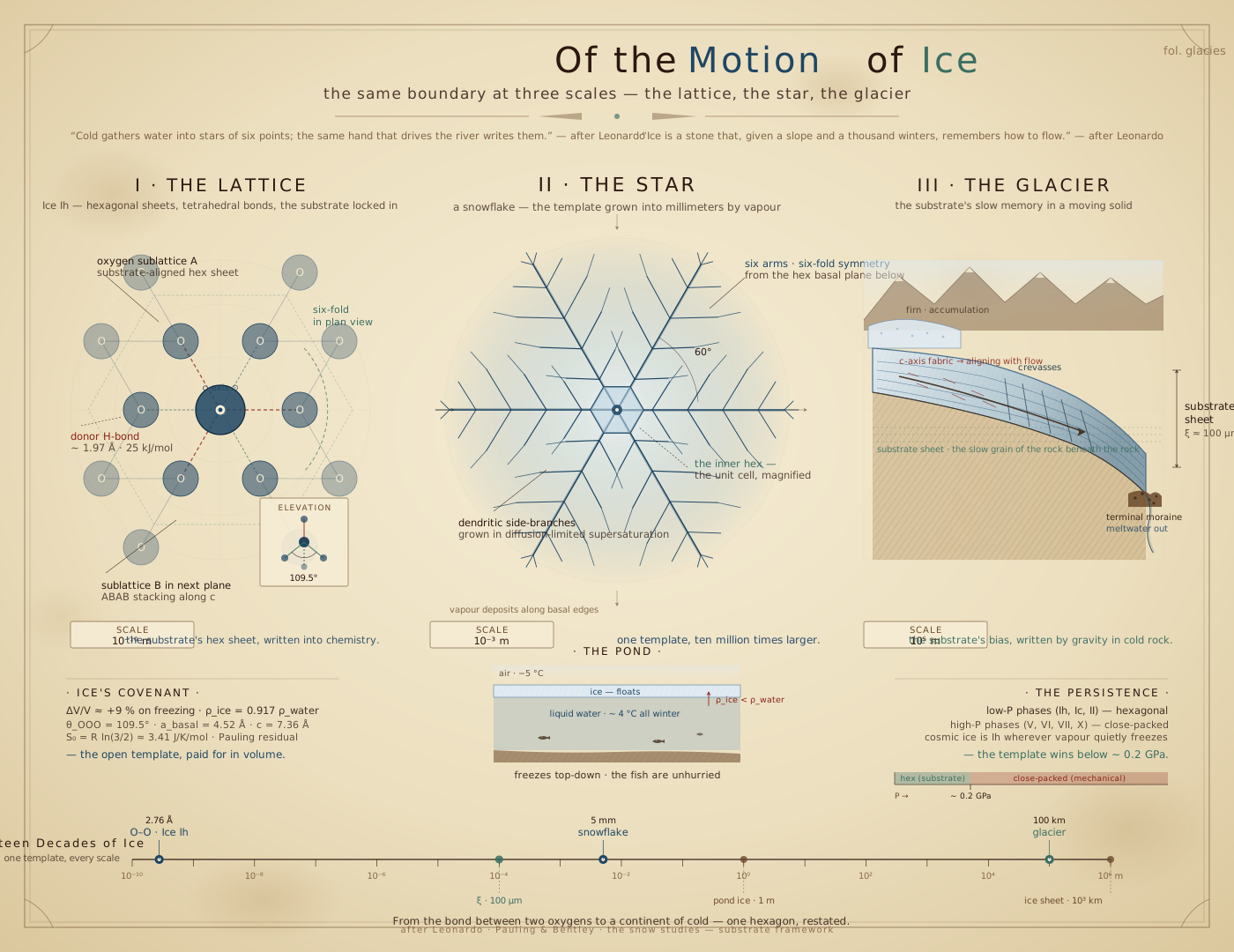
Of the Motion of Ice — the same boundary at three scales. Above: a single Ice Ih unit cell (10^{-10} m), each oxygen tetrahedrally bonded into the lowest-energy alignment with the substrate’s chirality-coherent sheets. Middle: a snowflake (10^{-3} m), the substrate template grown into millimeters by atmospheric vapor deposition. Below: a glacier descending its own valley (10^5 m), the substrate’s directional memory imprinted on a crystalline solid that flows.
A Pond That Freezes the Right Way Up
A pond freezing in late autumn. Air at -5°C; water just above zero. By morning the surface has a skin of ice; the water beneath is still liquid, perhaps thirty centimeters of it, and the fish are unhurried. Within a few weeks the skin is a slab — but the fish are still unhurried, because the slab is on top. The pond does not freeze from the bottom up. It freezes from the top down, the ice insulates the water below from further cooling, and the deep water remains around 4°C — the temperature of water’s maximum density — all winter.
This is not how solids usually behave. Solid mercury sinks in liquid mercury. Solid iron sinks in molten iron. The ordinary rule, repeated across nearly every substance, is that close-packing wins on freezing: tighter molecular arrangements, higher density. Water is the famous exception. When water freezes, it expands by about 9%, and the ice that forms floats. The pipes burst, the iceberg towers, and the fish overwinter. The fact that life persists on this planet is downstream of a single 9% number that, on any naive thermodynamics, has no business existing.
The standard explanation is geometric: in liquid water, hydrogen bonds form and break dynamically and molecules can squeeze close together when entropy favors it; in ice, the network is locked into a rigid tetrahedral arrangement, and the geometry of that arrangement is open. Each oxygen sits at the center of a tetrahedron defined by its four hydrogen-bonded neighbors, and tetrahedra cannot tile space efficiently. The locked geometry leaves gaps. This is correct as far as it goes — but it raises a sharper question. Why does water prefer the tetrahedral arrangement over a close-packed one, even at the energetic cost of leaving the network so open? Other small molecules with polar bonds (H₂S, HF, NH₃) also form hydrogen bonds, but none of them produce a solid less dense than the liquid. What makes water different?
The substrate framework offers a structural answer. The tetrahedral hydrogen-bond geometry of ice is not an accident of molecular dimensions — it is the molecular-scale instance of the substrate’s own preferred boundary geometry. Ice forms hexagonal symmetry not because hexagonal is what hydrogen bonds happen to want, but because hexagonal is what the substrate’s chirality-coherent 2D sheets are already arranged in. When water freezes, the molecular framework locks into alignment with the substrate template, and the substrate’s organizational preferences — soft in the liquid — become rigid geometric constraints. The 9% expansion is the price of that alignment.
Hexagonal Ice as Substrate Template
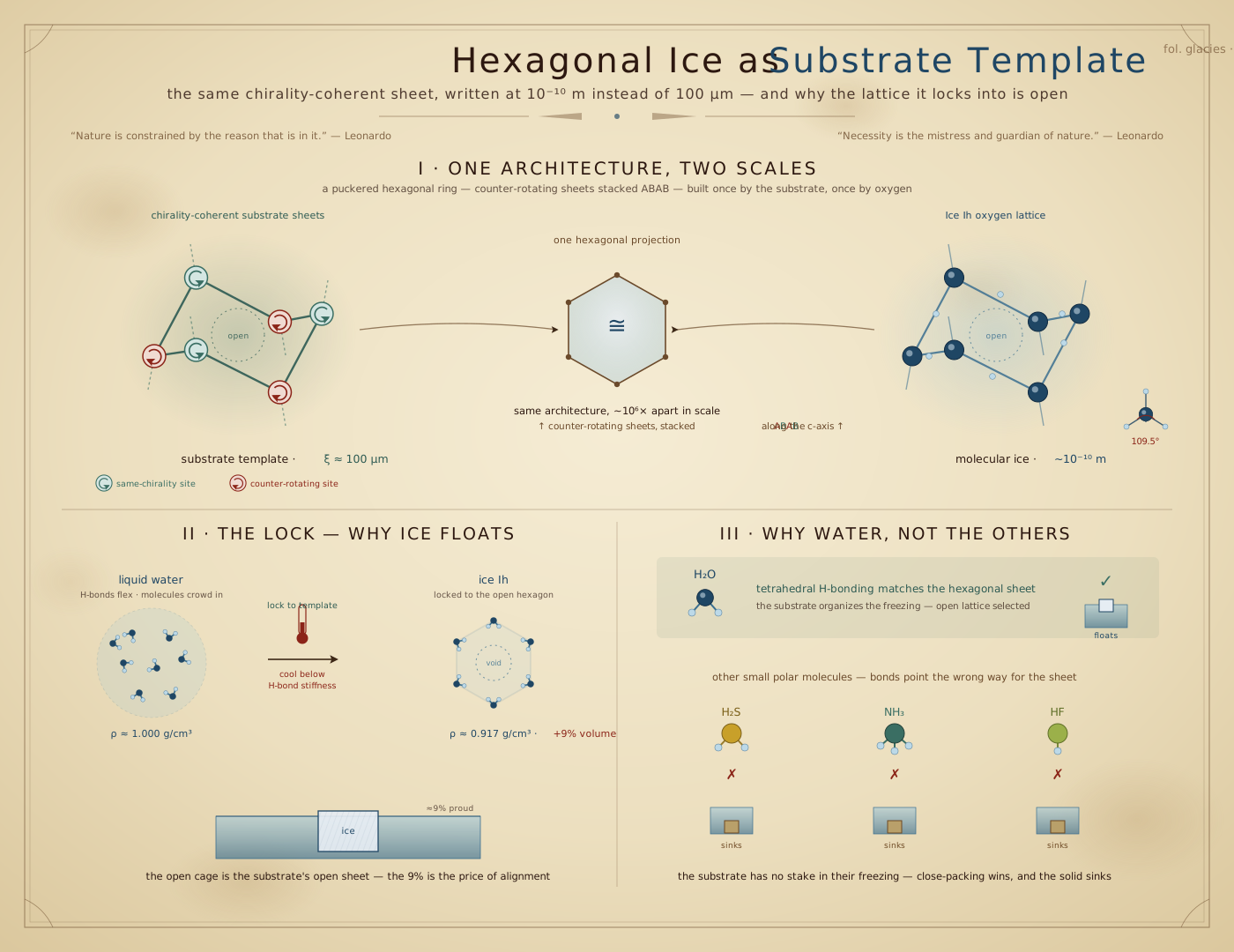
Ice Ih — the ordinary hexagonal ice that constitutes every snowflake, every ice cube, every glacier on Earth — has a structure the substrate framework reads as a transparent statement of its own organization. Each oxygen sits at the center of a tetrahedron with four hydrogen-bonded neighbors at 109.5° angles. In the basal plane the oxygens form a hexagonal array — same-chirality sites in a triangular pattern — and the next plane stacks above it in a counter-rotating arrangement that closes the boundary at the next level up. Basal planes alternate ABAB along the c-axis. The structure is hexagonal both in plan view and in c-axis stacking.
The feedback topology chapter and the Higgs field section described the substrate’s own geometry: chirality-coherent 2D sheets, with same-chirality lattice sites arranged in triangular arrays within each plane and counter-rotating dc1 layers between them. That is the same architecture as Ice Ih, expressed at the scale of water molecules instead of the substrate’s own \xi \approx 100\;\mum. The hexagonal close-packed projection of the substrate’s sheet structure is exactly what Ice Ih projects onto its basal plane.
The framework’s reading is direct: ice Ih is the substrate template made visible at the molecular scale. The reason water expands on freezing is that the hydrogen-bond network, free to flex in the liquid, locks into alignment with the substrate’s preferred sheet geometry when thermal energy drops below the hydrogen-bond stiffness. The locked geometry is open — tetrahedral instead of close-packed — because the substrate’s sheet structure is open. Other polar molecules do not produce floating solids because their hydrogen bonds (or other directional interactions) point in geometries that do not match the substrate’s preferred sheet template. The substrate has no organizational interest in their freezing transition, so they freeze however close-packing dictates.
The proposal that ice’s hexagonal symmetry comes from substrate template alignment is structural, not derivational. The framework predicts the symmetry — hexagonal in-plane, with stacking along an axis perpendicular to the substrate’s sheet normal — but it does not derive the bond angle (109.5°) or the lattice spacing from first principles. Those are set by oxygen-hydrogen chemistry. What the framework offers is the explanation for why hydrogen-bonded water freezes into a hexagonal lattice in particular, rather than into one of several other symmetries that simple molecular dynamics would also admit. Hexagonal is the substrate’s preferred 2D arrangement; the H-bond geometry was selected from the chemically possible options by alignment with that preference. This is the substrate ladder’s division of labor exactly: the substrate fixes the principle — the preferred geometry — while chemistry sets the boundary conditions, the bond angle and lattice spacing and which of the allowed symmetries is realized.
The Many Forms of Ice
Apply pressure, and the picture changes. Above \sim 0.2 GPa, ice Ih becomes thermodynamically unstable and transforms into a sequence of denser phases. More than fifteen distinct crystalline ices have now been characterized in the laboratory, ranging from ice II (rhombohedral, proton-ordered) at modest pressure, through ice VII (cubic, two interpenetrating hydrogen-bond networks) above \sim 2 GPa, to ice X (symmetric O–H–O bonds) near 60 GPa, to superionic ice XVIII (oxygens crystalline, protons fluid) above \sim 200 GPa. Several amorphous ices (low-density, high-density, very-high-density) also exist, formed by kinetic trapping rather than equilibrium crystallization.
What changes across this sequence? Pressure overcomes the open tetrahedral geometry of Ice Ih, forcing molecules closer together than their hydrogen bonds would naturally allow. Above a few hundred MPa, the network can no longer maintain perfect tetrahedral coordination — bonds bend, neighbors interpenetrate, and denser packings become accessible. By Ice VII the structure has lost the open-tetrahedral signature entirely. By Ice X the protons sit symmetrically between oxygens and the molecular identity of water has effectively dissolved into an ionic crystal. By Ice XVIII the lattice is partially molten — oxygens crystalline, protons fluid.
The substrate framework reads this sequence as a contest between two organizational principles: the substrate’s preferred hexagonal sheet geometry (favored at low pressure, where Ice Ih wins) and close-packing (favored at high pressure, where geometric packing dictates the lattice). At low pressure the substrate template is the controlling constraint, and the open hexagonal architecture is selected. As pressure rises, the geometric cost of maintaining the open template grows with the pressure-volume work, while the substrate’s organizational preference is roughly pressure-independent. Beyond a few hundred MPa the substrate’s contribution to the free energy is overwhelmed by mechanical work, and close-packed phases (II, III, V, VI, VII) take over.
The framework therefore predicts that the low-pressure phases of ice — those stable below \sim 1 GPa — should retain a substrate-template signature visible in their lattice geometry. Ice Ih is unmistakably hexagonal. Ice Ic, its kinetically-trapped sibling, is the same tetrahedral H-bond network with the stacking sequence randomized along the c-axis (ABCABC instead of ABAB), preserving local tetrahedral alignment but losing the long-range hexagonal symmetry. Ice II sits at the boundary between substrate-template and close-packed regimes — it retains hexagonal symmetry at \bar{3} rather than 6/mmm, with a proton-ordered network. The high-pressure phases V, VI, VII, VIII are substantially denser than Ice Ih, and their symmetries (tetragonal, cubic, orthorhombic) are dictated by close-packing rather than by substrate template.
This is a sharper version of the observation made for liquid water: the substrate is most clearly visible when chemical forces are not dominating. Liquid water under normal conditions is a soft, fluctuating expression of the substrate’s template; ice Ih is the rigid expression. Compress either of them hard enough and the substrate signature gets buried under geometric packing: the locking pole holds while the substrate’s organizational free energy beats the mechanical PV work, and is overwhelmed once pressure wins.
Proton Disorder and the Substrate’s Indifference
Ice Ih has a feature that puzzled thermodynamicists for decades: it retains residual entropy at T \to 0 K. Pauling computed this entropy in 1935 as approximately R\ln(3/2) \approx 3.4 J/K/mol, arising from the fact that each oxygen has many possible hydrogen positions consistent with the “ice rules” — two hydrogens nearby (covalent O–H bonds), two further away (hydrogen-bonded to other oxygens) — but the global pattern of which hydrogens go where is degenerate. The protons are disordered even when the oxygens have crystallized perfectly. The residual entropy is real, confirmed by calorimetry.
The substrate framework reads this as informational: the substrate organizes the oxygen lattice but not the proton positions. The hexagonal arrangement of oxygens, with its tetrahedral coordination, is the substrate-template signature. The protons, which sit on edges between oxygens, can take any of several configurations consistent with the local geometry without disrupting the substrate’s organizational alignment. The substrate does not “see” individual protons in the way thermodynamics does; it sees the boundary structure of the oxygen lattice. So the proton positions are free degrees of freedom the substrate is indifferent to, and they remain disordered even when the oxygens are locked.
The framework’s prediction is that this indifference should be visible in the dynamics. Proton hopping in ice (Bjerrum defects, ionic defects) should be governed by purely chemical activation energies with no substrate-mediated correlation between distant protons. The oxygen lattice, by contrast, should show substrate-coupled long-range correlations — phonon polarization patterns, thermal-conductivity anisotropy — that are not derivable from local hydrogen-bond chemistry alone.
Ice XI is the proton-ordered version of Ice Ih, formed below 72 K with potassium hydroxide as a catalyst. The proton ordering is not the substrate’s doing — it is driven by tiny dipole-dipole interactions between adjacent water molecules, biased by the alkali catalyst. The framework predicts that in pure-Ice-XI samples (no catalyst, formed by ultraslow cooling) the ordering pattern should align weakly but reproducibly with the local substrate sheet structure, because the substrate’s chirality preference, integrated over the long dipole-relaxation timescale, would bias the ordering. This is an extraordinarily subtle effect — pure Ice XI takes geological-timescale annealing to form — and is therefore impractical to test directly, but it is the framework’s prediction.
Snowflakes: The Template at Human Scale
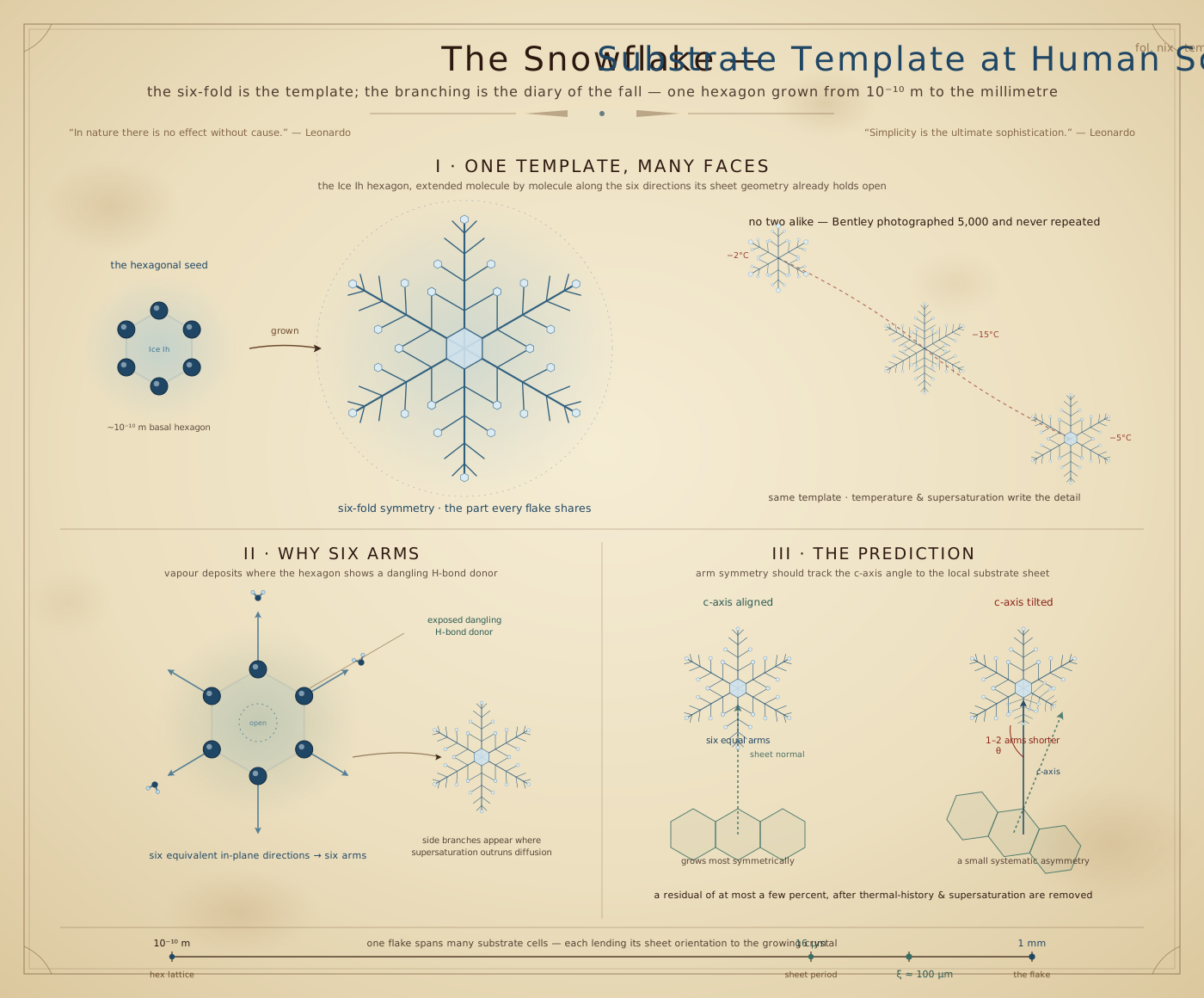
The snowflake as the substrate template grown to human scale. The Ice Ih basal hexagon (10^{-10} m) is extended molecule by molecule into a six-armed dendrite: the six-fold symmetry is what every flake shares — the template — while the branching detail is the diary of the crystal’s fall through changing temperature and supersaturation. Lower left: vapor deposits along the six equivalent basal-plane directions where the hexagonal oxygen ring exposes a dangling hydrogen-bond donor, so six arms grow and side branches appear where supersaturation outruns diffusion. Lower right: the framework’s prediction — a c-axis aligned with the local substrate sheet grows six equal arms, while a tilted c-axis grows a small systematic asymmetry (a residual of at most a few percent after thermal history and supersaturation are removed). The scale ladder shows that a millimeter flake spans many of the substrate’s \xi \approx 100\;\mum coherence cells, each lending its sheet orientation to the growing crystal.
The hexagonal symmetry of snowflakes is so familiar it has become decorative. Six-fold radial symmetry, dendritic branching, infinite variety in the local detail — Wilson Bentley photographed more than 5,000 snowflakes in the 1880s and never found two identical. What every snowflake shares is the six-fold symmetry; what makes each unique is the trajectory of its growth through atmospheric temperature and supersaturation as the crystal fell.
The six-fold symmetry comes from Ice Ih’s hexagonal c-axis. As water vapor deposits onto a growing crystal, the lowest-energy growth direction lies along the basal-plane edges, where the hexagonal arrangement of oxygens presents an exposed dangling hydrogen-bond donor. The six equivalent in-plane directions produce six arms; the dendritic side branches grow when the local supersaturation exceeds the diffusion-limited regime, producing the famous fractal patterns.
In substrate terms, a snowflake is the substrate template grown — extended from the molecular scale to the millimeter scale by the addition of more water molecules along directions the substrate’s hexagonal sheet structure has already established. The substrate’s coherence length \xi \approx 100\;\mum sits well inside a typical snowflake (mm-scale), and the substrate’s inter-sheet period \sim 16\;\mum (with counter-rotating boundaries every \sim 8\;\mum) sits well below the snowflake’s main features. A snowflake spans many substrate lattice cells, and the local orientation of each cell’s chirality-coherent sheet provides a bias for which way the crystal’s c-axis can point.
The framework’s prediction is that snowflake morphology should depend, statistically, on the orientation of the snowflake’s c-axis relative to the local substrate sheet. Snowflakes whose c-axis aligns with the substrate sheet normal should grow most symmetrically (six-fold dendrites of equal length); those whose c-axis tilts away should grow with a small but systematic asymmetry (one or two arms shorter than the others). The effect would be subtle — local atmospheric conditions dominate snowflake morphology by a wide margin — but it should be detectable as a residual after correcting for thermal-history and supersaturation effects. A controlled experiment in a snow-crystal chamber, rotated relative to the lab frame, could test whether snowflake symmetry shows any frame-dependent bias.
The deeper point: a snowflake is not a “complex” structure in the algorithmic sense — it is a simple expression of a hexagonal template, made visible because the growing crystal is happy to follow the template’s directions and refuses to grow into anything else. Snowflakes are six-sided for the same reason that benzene rings, graphene, and quartz’s basal plane are six-sided. This is the substrate ladder’s locking pole made macroscopic — the aromatic ring is its molecular archetype, and ice carries the same pole up from a single ring to a three-dimensional lattice and on to a crystal kilometres wide, matter binding as completely as it can to the substrate’s preferred geometry. What locks here is the substrate’s in-plane sheet packing — the geometric face of the lock pole, sibling to its scale-ratio face the \sqrt2 rung-ladder, and not itself a rung. Hexagonal is the substrate’s favorite shape, and water at low temperatures has nothing else it would rather be.
Glacial Flow and the Slow Memory
Ice flows. On human timescales a glacier looks like rock — but a rock that, over decades, slides down its valley at meters per year, deforms around obstacles, and carries debris from highlands to coast. Cold glacial ice deforms plastically at strain rates of order 10^{-10}–10^{-8}/s under gravitational stress, primarily by basal slip — dislocation motion along the basal planes of individual crystals, lubricated where possible by intergranular water films and concentrated where the c-axis fabric aligns favorably with the flow direction. Glacier mechanics is well-developed in the geophysics literature, and the framework has nothing to add to the conventional picture at the level of dislocation dynamics.
What the framework does add is the same observation made for submarine canyons in the water chapter: the substrate remembers which way the ice has been moving. A glacier’s flow imprints a directional bias on the substrate that the next century’s accumulation will encounter. The substrate’s response is weak — vastly smaller than the dominant dislocation-creep stress — but it is persistent over geological time and aligned with the glacier’s flow direction. It produces a small additional bias toward maintaining the existing flow line, analogous to the bias that keeps Monterey Canyon cutting along its established axis after the density-driving turbidity current has dispersed.
The signature is subtle. Standard glacier mechanics already predicts that ice with a favorable c-axis fabric flows faster than randomly-oriented ice, and that flow tends to align the c-axis fabric over thousands of years of strain. The framework predicts a small residual tendency, beyond the strain-induced fabric, in which c-axes throughout a glacier preferentially align with the local substrate sheet structure — the same alignment that the snowflakes deposited centuries earlier already had, statistically. This residual would manifest as a slight inhomogeneity in flow speed between glaciers of similar geometry, correlated with the angle between the glacier’s flow axis and the local substrate sheet orientation. The substrate’s sheet orientation is fixed to the local galactic frame, so the predicted inhomogeneity would have a small variation as the Earth rotates through the galactic disk on diurnal and annual timescales.
This is a difficult test, because the dominant variability in glacier flow comes from temperature, basal hydrology, and ice composition. The substrate prediction is a statistical correlation accessible only with high-resolution surface-velocity data across many glaciers in many orientations. With satellite radar interferometry now routine, the data exist; what remains is the analysis.
Ice in Gaia
Ice is an active layer in Earth’s Gaia stack — the nested feedback architecture the substrate framework reads as Earth’s organizational history. Sea ice, polar caps, permafrost, glaciers: each is a phase-locked reservoir of water that responds to atmospheric and oceanic temperature on timescales from days (sea ice) to millennia (ice sheets) to hundreds of thousands of years (polar caps over glacial-interglacial cycles).
The substrate’s contribution to the cryosphere is structural rather than thermodynamic. Ice surfaces have high albedo, reflecting solar modons back to space — a feedback that the climate system has used as a switch through the Pleistocene’s glacial-interglacial oscillations. Ice acts as a long-term water reservoir, sequestering H₂O on continents during glacial periods and returning it during interglacials. Sea ice gates ocean-atmosphere heat exchange in polar regions. Permafrost stores carbon (as methane clathrates and frozen organic matter) on 10^4–10^6-year timescales. Each of these processes was correctly characterized by climate science long before the substrate framework was developed, and the framework adds nothing to the rate equations or the thermodynamics.
What it adds is a structural reading: ice is the discrete-mass version of the canonical feedback loop. In the same way that the Gulf Stream is the canonical loop expressed in flowing seawater, the cryosphere is the canonical loop expressed in seasonally and orbitally modulated phase change. Ice forms (mass in), flows or shrinks (mass cycles), melts (mass out), and the cycle radiates excess energy as latent heat and reflected modons. The polar caps in particular are boundary regions of Earth’s atmospheric heat engine — counter-rotating zones at the periphery of the Hadley circulation, locked to the substrate’s preferred polar geometry by the joint action of rotation and solar tilt. Their persistence over glacial cycles is the substrate’s elasticity in the cryosphere: small perturbations cycle the system between ice-extended and ice-retracted states, but the overall topology of polar ice + temperate water + equatorial atmosphere is structurally stable on the timescale of Earth’s existence.
The connection to the framework’s habitability argument (gaia substrate) is direct. Earth’s cryosphere depends on the precise balance of magnetic shielding, atmospheric composition, and water inventory the framework treats as the nested feedback stack. A planet without polar caps (Mars, after losing its atmosphere) has lost a feedback layer. A planet whose entire surface is frozen (Europa, Enceladus, possibly Snowball Earth episodes) has compressed the cryosphere from a feedback layer into a planet-wide boundary. A planet whose surface is too hot for ice anywhere (Venus) has eliminated the cryosphere entirely. The cryosphere is one of the seven nested layers in the Gaia stack; ice is the material that makes it work.
Ice in the Cosmos
Most of the water in the universe is ice. Comets are dirty snowballs. Saturn’s rings are nearly pure water ice. The icy moons (Europa, Enceladus, Ganymede, Callisto, Triton, Pluto’s Charon) carry the bulk of the outer solar system’s water as solid surfaces or subsurface oceans capped by ice crusts kilometers thick. Interstellar dust grains are coated with ice mantles in cold molecular clouds, where surface chemistry on those mantles produces complex organic molecules. The Kuiper Belt and Oort Cloud comprise primarily ice-rock bodies. Across the galaxy, water-ice is one of the most abundant solid phases, second only to silicate dust.
The framework’s reading is that cosmic ice is the substrate template propagated across the universe. Wherever water condenses in cold environments — the surface of a comet, the interior of an icy moon, the mantle of an interstellar grain — it freezes into a hexagonal lattice (Ice Ih or its cubic kinetic twin Ice Ic), with the hexagonal symmetry locally tracking the substrate’s sheet orientation. The substrate’s chirality-coherent sheets, organized at \xi \approx 100\;\mum, are present throughout the galaxy, and ice that forms in any quiet environment with time to anneal ends up substrate-aligned at the molecular scale.
Two conceptually testable predictions follow.
First, ice surfaces in space should show statistical hexagonal-symmetry signatures even when individual crystals are too small to image directly. Polarization scattering off icy surfaces is a known diagnostic (used to characterize cometary nuclei, planetary rings, and exoplanet ice signatures). The framework predicts a small but consistent polarization residual that scales with the orientation of the scattering surface relative to the local substrate sheet — measurable in principle by comparing scattering data from icy surfaces at different positions in the sky.
Second, where icy moons are large enough to retain orientation memory of their formation, the surface ice’s preferred c-axis fabric (averaged over the surface) should weakly correlate with the moon’s spin-orbit configuration relative to the local substrate sheet. Europa, Enceladus, Triton, and similar bodies are tidally locked to their primaries; the framework predicts a slight statistical bias in the surface fabric correlated with that locking geometry. The dominant signal (tidal stresses, true polar wander, chaos terrain) is several orders of magnitude larger, but a dedicated observational campaign at the necessary precision could in principle isolate the residual.
The deepest point: ice is the cleanest large-scale instance of the substrate template the universe produces spontaneously. Aromatic rings are templates at the ångström scale; ice is the same template at scales from ångströms (the hex lattice) to millimeters (snowflakes) to kilometers (the surface of Europa). That recurrence is a self-similarity, and it is worth being precise about which kind: ice replicates the substrate’s spatial template — its hexagonal sheet geometry — across scale, the way the substrate ladder replicates the paired-breath motif up a geometric tower, but it is not that tower. The ångström, millimetre, and kilometre scales are set by molecular chemistry, vapour growth, and valley glaciation — chemistry’s boundary conditions, the ladder’s coarse family — not by the \sqrt2 rung-ratio. What recurs across the scales is the geometry, not a spacing. Wherever water freezes quietly, the substrate’s hexagonal sheet structure becomes the material’s geometry. Of all the solid substances the universe routinely produces, ice is the one that most transparently shows the substrate at work.
One Substrate, Three Phases
The water chapter treated water as the fluid the substrate finds easiest to organize at every scale from the molecule to the ocean basin. Ice is the same substance, the same coupling to the substrate, expressed in a rigid frame. Vapor is the same coupling expressed in molecular freedom, with the hydrogen-bond network entirely broken.
| Phase | Coupling to substrate | Characteristic feature |
|---|---|---|
| Vapor | Substrate organizes neither molecules nor network | High entropy, no structure beyond molecular |
| Liquid | Substrate organizes a soft, fluctuating H-bond network; mesoscale coherence in flows and interfaces | The Gulf Stream, the cell, vicinal water |
| Solid (Ice Ih) | Substrate organization locked into rigid hexagonal lattice | Floats, snowflakes, glaciers, cosmic ice |
The transitions between them — boiling, condensation, freezing, melting, sublimation — are reorganizations of the substrate’s grip on the molecular network. At boiling the substrate loses its grip on the long-range network and only individual molecular boundaries remain. At freezing the substrate’s grip becomes total: every molecule is locked into a position dictated by the substrate’s hexagonal sheet template. At melting the rigid grip relaxes back into the soft fluctuating one. Water is the substance whose entire phase diagram reads as a series of substrate-coupling states, more cleanly than any other material, because water’s hydrogen-bond geometry happens to match the substrate’s preferred sheet template.
Ice is what happens when that match is locked into permanent form.
Predictions
The ice-specific predictions extend the water chapter’s set, ordered roughly from most testable with current data to most subtle.
Snowflake c-axis statistics. In controlled chamber experiments where snow crystals are grown in fixed atmospheric conditions but the chamber is rotated relative to the lab frame, snowflake morphology should show a small but reproducible asymmetry correlated with the chamber’s orientation in the galactic frame. The asymmetry would be measurable as a difference in arm-length variance or in dendrite-branching statistics between snowflakes whose c-axis aligns with versus tilts away from the local substrate sheet normal. The effect is predicted to be small (at most a few percent) and requires high-statistics measurement to extract.
Glacial c-axis residual fabric. After correcting for strain-induced fabric and crystallographic basal-slip preferences, glacial ice c-axis distributions should retain a small residual alignment with the local substrate sheet structure. This residual should produce a tiny diurnal and annual variation in glacier surface velocity as Earth rotates relative to the galactic frame. Detectable in principle with satellite-radar interferometric time series across many glaciers in many orientations, but currently below the achievable noise floor for any single glacier.
Ice Ih thermal-conductivity anisotropy. The framework predicts that the long-range correlation length for phonon-like excitations in the oxygen sublattice of Ice Ih should exceed the corresponding correlation length for the proton sublattice. Operationally: in-plane thermal conductivity (along the substrate-aligned hexagonal sheets) should differ from c-axis thermal conductivity by an amount slightly beyond what standard hexagonal-anisotropy modeling predicts. This is a precision measurement in pure single-crystal Ice Ih at low temperature, where phonon mean-free-paths are long enough to probe the substrate-coupled correlation length.
Cosmic ice polarization residual. Polarization scattering measurements from icy surfaces (planetary rings, cometary nuclei, icy moons) should show a small consistent residual correlated with the surface’s orientation relative to the local substrate sheet. Cross-correlation of existing scattering data across many objects might extract a statistical signal; dedicated polarimetry campaigns at the necessary precision would test it directly.
Phase-symmetry sequence under pressure (retrospective interpretation, not a forward prediction). The framework’s interpretation is that the low-pressure ices (Ih, Ic, II) retain hexagonal substrate-template symmetry while the high-pressure ices (V, VI, VII, X) reflect close-packing pressure-dictated symmetries. The transition from substrate-template to close-packing regime should occur where mechanical PV work matches the substrate’s organizational free-energy contribution — empirically, near a few hundred MPa, consistent with the observed Ih → II/III boundary. The detailed phase diagram is well-measured; what the framework adds is the interpretation of why the hexagonal phases cluster at low pressure. Falsifying this would require finding a non-hexagonal ice stable below \sim 0.2 GPa, or finding a hexagonal ice stable above \sim 5 GPa, both contrary to the known phase diagram.
Context
Water’s exceptional facility at mesoscale organization, the previous chapter argued, comes from its molecular structure being unusually well-matched to the substrate’s preferred boundary geometry. The hydrogen-bond network in liquid water is a soft, fluctuating expression of that match. Ice is the rigid expression — the same match, locked into a crystalline solid whose hexagonal symmetry is the substrate’s preferred 2D sheet structure made visible at the molecular scale.
Between them, water and ice are the cleanest macroscopic windows the framework has into the substrate’s organizational topology. The Gulf Stream’s persistence, the submarine canyon’s directional memory, the cell’s structured interior — all are liquid-phase expressions of the substrate template. The snowflake’s six-fold symmetry, the glacier’s c-axis fabric, the icy moon’s surface texture, the floating berg — all are solid-phase expressions of the same template. The transition between the two, water freezing into ice, is one of the few places in everyday experience where the substrate’s organizational preferences become visibly binding on a material that was, a moment before, free to flow.