The Golgi Apparatus
Stacked substrate sheets and the cell’s literal stamp line
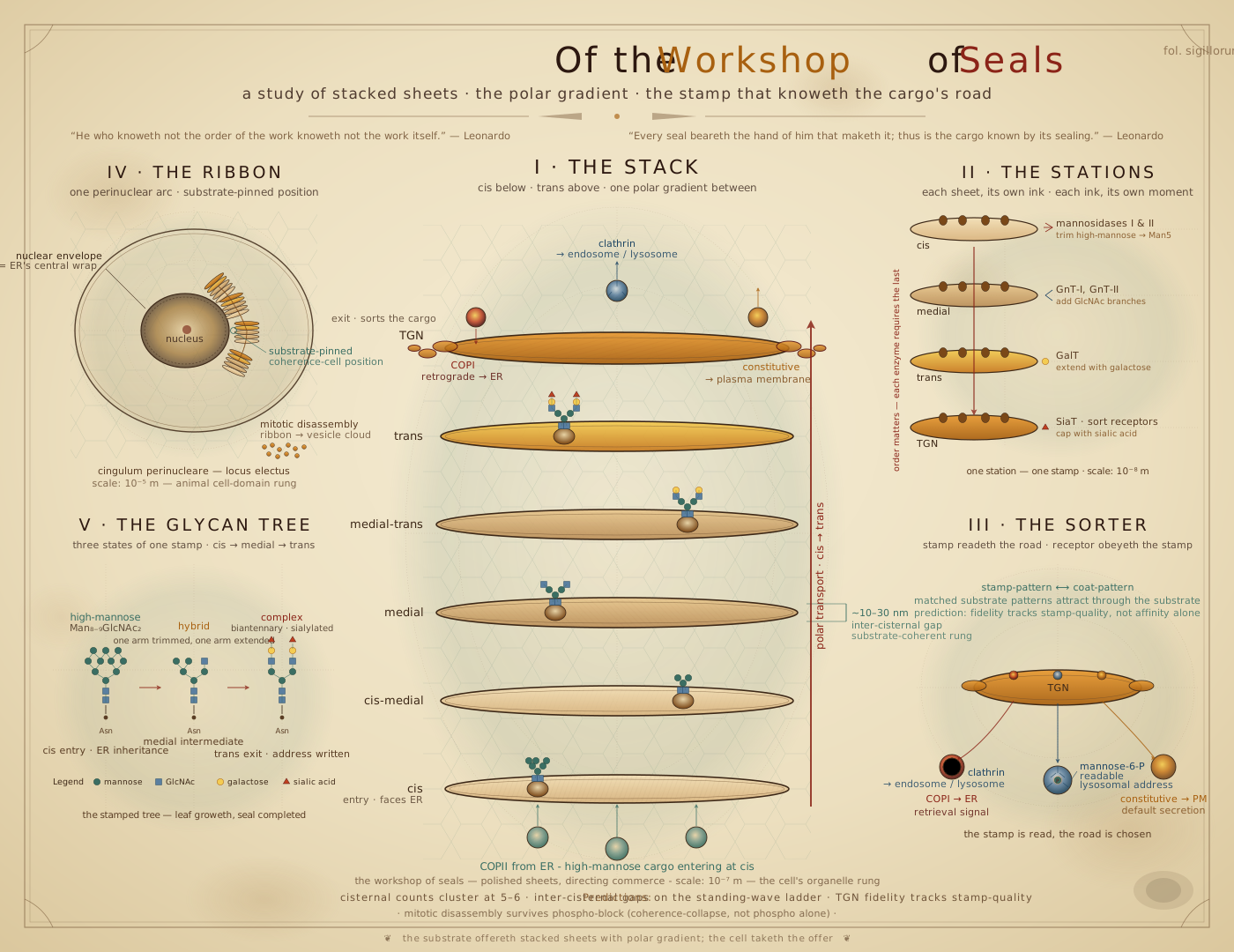
The Golgi apparatus is the most visually obvious stack in cell biology. Four to eight flattened membrane cisternae, each \sim 30 nm in luminal thickness and \sim 10–30 nm in inter-cisternal gap, lie parallel to one another in a polarised pile. Cargo enters at the cis face (from ER-derived vesicles), traverses the stack, and exits at the trans face (in vesicles bound for the plasma membrane, endosomes, lysosomes, or back to the ER). At each cisterna the cargo is enzymatically modified — N-linked and O-linked glycans are trimmed and extended, sulfates and phosphates are added, lipids are remodelled — so that what emerges at the trans face carries a glycan and modification signature distinct from what entered at cis. The trans-Golgi network (TGN) then reads that signature and dispatches the cargo to one of several destinations.
The framework’s claim about this organelle is the most explicit one in the cellular walk so far. The Golgi is the cell’s organelle-scale stamp line: stacked substrate sheets oriented as a polar transport corridor, with each sheet running its own stamping chemistry, and a sorter at the trans face that reads the accumulated stamp and dispatches the cargo. Every element of that sentence is anchored in established Golgi biochemistry. The framework’s addition is a structural reading of why the architecture looks the way it does, and why biology found this configuration the natural one to take when the substrate’s offered architecture is “stacked sheets with polar transport across them.”
The ribosome chapter’s defensible reading parked the codon-stamp-as-persistent-memory conjecture under Speculations. The Golgi is the architectural cousin of that conjecture made mechanical — biology runs a literal stamp machine here, every cell, every minute, on every secreted protein, at chemical timescales the field has resolved in detail. Where the codon-stamp-as-memory picture asks whether the substrate carries a stamp through fast picosecond chemistry, the Golgi asks no such question: the stamp is glycan, the substrate is sugar chain, and the persistence problem is solved by covalent bonds. The framework reads this as biology taking the substrate’s offered “stacked-sheet polar-stamp” architecture and implementing it with chemistry stiff enough that the persistence question never arises. The codon-stamp-as-memory question, if it lands, would identify a second stamp machine running on the same architectural template at a smaller, faster, and more transient scale.
Stacked Cisternae as Stacked Substrate Sheets
A Golgi stack has \sim 4–8 cisternae in most animal cells, with 5–6 being the modal count across cell types. The number is not arbitrary. Cells with disrupted stack assembly (GRASP55/GRASP65 knockdown, golgin perturbation, brefeldin-A treatment) show disorganised or disassembled Golgi morphology, and the disorganised state does not run cargo processing efficiently. Cells with intact stacks tile the cisternal count in a narrow band; cells with disrupted stacks tile it broadly or to zero.
The framework reads the 4–8 band as a substrate-preferred discrete geometry, in the same register the microtubule chapter reads N=13 protofilaments and the endoplasmic reticulum chapter reads 120° three-way junctions. A pile of sheets that must nest and register against one another is the substrate ladder’s locking pole made architectural — parts sharing a scale so they couple. But it is worth being precise about which quantity the ladder rules: like N=13, the cisternal count is a preferred integer geometry — how many sheets nest — not a rung of the \sqrt2 ratio-ladder. The ladder quantity in this organelle is the inter-cisternal gap, a length, taken up next. The substrate’s planar-sheet preference — already cited for the ecliptic, for aromatic rings, for planetary rings, for the atmosphere’s layered structure, and for the chirality-coherent sheets of the bridge equation — recurs here at organelle scale as a stack of bilayer cisternae with discrete preferred counts. Each cisterna is one substrate-sheet expression at the 30 nm luminal-thickness rung; the stack as a whole is the substrate’s preferred “few sheets, polar gradient across them” configuration, the same architecture the cell uses for the photoreceptor outer-segment disk stack (\sim 1000 disks, but a separate substrate-rung discussion) and for thylakoid grana.
The inter-cisternal gap of \sim 10–30 nm sits at the same rung as the ER’s contact-site gaps and as the plasma membrane’s raft-scale domains — a rung of the substrate ladder, not an overtone of a standing wave. A critical medium has no length of its own, so it rules these scales by ratio — the half-octave \sqrt2 — and not by harmonic step. The framework reads it as the same substrate-coherent boundary-matching scale: a gap small enough that the substrate’s flow across it is continuous between adjacent cisternae, large enough that the bilayers do not fuse. The cell’s tethering proteins (golgins, GRASPs) are biology’s chemistry-side locking implementation for this gap, the same way reticulons lock the ER’s high-curvature tubule shafts.
Polar Transport: The cis → medial → trans Gradient
Cargo enters the Golgi at the cis face and exits at the trans face. The directionality is anchored in two independent literatures. Tunicamycin and brefeldin-A block ER→Golgi traffic at the cis face; secretory cargo pulses (radiolabel chase, fluorescent reporter waves) consistently move cis → trans on a \sim 10–30 minute timescale; the glycan modifications themselves are sequential, with high-mannose N-glycans trimmed at the cis cisterna and complex N-glycans extended through medial and trans cisternae. The direction is so robust across cell types that it is one of the few “facts of biology” that no model contests.
The framework reads the cis → trans direction as the same polar transport architecture the DNA chapter develops for the genome and the ER chapter develops for the tubule network, expressed here at the organelle scale with chemistry-side stamping at each station.
The parallel is structurally exact. DNA’s polar channel runs 5' \to 3' along the helix, with [4Fe-4S]-cluster terminals reading the channel locally and Mediator condensates reading it at the regulatory ends (Polar Channel as Regulatory Engine). The ER’s polar membrane surface runs across a three-way-junction network, with junction-position commitments reading the substrate landscape and contact-site choices acting as the readout terminals (Endoplasmic Reticulum). The Golgi’s polar transport runs across stacked cisternae, with glycosylation enzymes reading the cargo’s current stamp at each station and adding the next layer.
Three polar substrate-readers, three scales (ångström, micrometer, organelle), three different chemistry-side implementations. The framework’s reading is that polar transport across a substrate-coherent corridor is the cell’s general-purpose information-processing motif, and the Golgi is biology’s most chemistry-explicit instance of it.
Sequential Glycosylation as Substrate Stamping
A protein entering the cis-Golgi as a high-mannose N-glycoprotein leaves the trans-Golgi as a complex or hybrid N-glycoprotein, with two to four terminal sialic acids, branched galactose-GlcNAc arms, and possibly fucose decorations. The transformation is run by approximately twenty cisterna-localised enzymes, each restricted to one or two cisternae and acting on a specific glycan substructure presented by the cargo’s current state. The order matters: the medial-cisterna N-acetylglucosaminyltransferases can only add their sugar after the cis-cisterna mannosidases have trimmed the high-mannose precursor; the trans-cisterna sialyltransferases can only add their sugar after the medial-cisterna galactosyltransferases have extended the chain.
This is, in literal terms, a polar stamp line. Cargo enters carrying a starting stamp (the ER-installed high-mannose glycan); each cisterna reads the current stamp and adds, removes, or modifies one layer; the cargo exits carrying a final stamp that encodes its destination, its half-life, its receptor-binding properties, and its quality-control status. The framework’s reading is that the Golgi is a stamp machine — and the cell built it because the substrate’s offered architecture (“stacked sheets with polar gradient and discrete stations along the gradient”) is the architecture biology converged on the moment it needed to run a sequential modification line on every secreted protein.
The architectural template is the same one the codon-stamp picture would invoke at smaller scale, but with two critical differences that put the Golgi entirely inside the defensible reading.
First, the stamps are covalent. Glycan additions are real carbohydrate-protein bonds with bond energies of tens of kcal/mol. The persistence problem the codon-stamp-as-memory conjecture wrestles with does not arise — the glycan stamp survives whatever the protein encounters until a specific glycosidase removes it. The codon stamp’s femtosecond-to-picosecond lifetime question is replaced here by the much longer minutes-to-hours timescale of glycan turnover.
Second, the stamping enzymes are anchored to the cisternae. The substrate’s role is to maintain the stack’s discrete polar architecture; the chemistry is run by enzymes biology has built and positioned to take advantage of that architecture. The substrate does not itself do the stamping; it does the stacking. This is the same division of labour the ribosome chapter introduced — the substrate decides; the chemistry executes — applied to a much slower and more covalent set of decisions.
The framework’s reading is that the Golgi is the substrate’s “stacked-sheet polar-stamp” architecture made fully visible, with the chemistry doing exactly what the substrate’s offered geometry supports. Biology took the offer where biology found it; the Golgi is the result.
The Cisternal Maturation Question
The Golgi field has two long-running models for how cargo moves through the stack:
- Vesicular transport (the older model): cisternae are static, cargo moves between them in COPI/COPII vesicles.
- Cisternal maturation (the current consensus): cisternae themselves mature from cis to medial to trans, with their enzyme content changing over time as cargo rides along, and old trans cisternae budding off as the TGN.
The substrate framework’s reading is orthogonal to this debate. Whichever model is correct, the cisternal positions are substrate-pinned and the polar gradient is fixed; what varies is whether the chemistry doing the stamping moves with the position or with the cargo. In the vesicular-transport reading, the substrate-pinned positions are the cisternae themselves, with vesicles carrying cargo across them. In the cisternal-maturation reading, the substrate-pinned positions are the gradient stations (cis, medial, trans), with the cisternae rotating through those stations as they mature. The framework can sit comfortably with either, and predicts that the positions are clustered at substrate-preferred separations regardless of which model is right.
This makes the dual nature of the debate the framework’s prediction. Cargo-tracking experiments and enzyme-localisation experiments give conflicting evidence because both are partially right: cisternae do mature (as the current consensus holds), but they mature through positions set by the substrate, and vesicles also transit (as the older model held) across the polar gradient at scales where the substrate-pinned positions are stable. The substrate-physics reading gives the stack its persistent identity; the chemistry runs the stamping; the field’s two models are arguing about which level of the architecture is moving.
The TGN as Substrate-Pattern-Driven Sorter
The trans-Golgi network is where cargo with different final stamps gets dispatched to different destinations. A protein with mannose-6-phosphate residues goes to the lysosome; a protein with appropriate glycan trimming goes to the plasma membrane; a protein with retrieval signals goes back to the ER; a protein with specific stamp-recognising adaptor binding goes to the endosomal pathway. The TGN reads the stamp and selects the vesicle coat.
The framework reads the TGN as a stamp-pattern-driven sorter — the destination is selected by the substrate’s matching of the cargo’s accumulated stamp to the receptor patterns at the trans cisterna and the vesicle-budding sites. Mannose-6-phosphate-receptor binding is the cleanest cell-biological example: the lysosomal targeting signal is literally a substrate-physics-readable chemical pattern (a phosphate group on a specific mannose residue) that the receptor reads at structural strength. The receptor’s selectivity for M6P-bearing cargo is the same lock-and-key logic the codon-stamp’s diagonal lights up by — matched substrate patterns attract through the substrate, and the substrate’s matched-stamp selection biases the chemistry-side commitment toward the correct vesicle coat.
This recognition has the two-faced structure the substrate ladder finds wherever a code is read. The receptor binding its cognate stamp is a lock — matched substrate patterns ring together at structural strength, the same resonance the codon–anticodon match strikes. But the glycan stamps as a set have the opposite job: the TGN must never confuse one cargo’s destination for another’s, and a system whose failure mode is confusion between addresses belongs at the ladder’s anti-lock pole, exactly where the genetic code and the olfactory receptor repertoire already sit. The division is the one the DNA chapter draws for the genome — the machinery locks (here the stacked sheets and the anchored enzymes), the message anti-locks so it can be read without error (here the glycan address). And like the genetic code, the Golgi reaches the pole not by a clean geometric spread but by labelling: where the stamp alphabet runs short, the cell can keep the addresses that share a destination cheap to confuse and the ones that part ways maximally distinct, so a slip in the stamp lands a cargo somewhere harmless rather than somewhere wrong.
What is true at the M6P receptor is true in less chemistry-explicit form at every TGN sorting station. The framework’s prediction is that the substrate-stamp matching does work the chemistry-of-contact reading does not capture — sorting fidelity at the TGN should track substrate-stamp coupling strength as much as receptor-affinity geometry, and missorting rates should correlate with stamp-quality perturbations even when the local receptor-cargo affinity looks normal. The N-glycan-sorting literature provides existing data series on missorting; the prediction is a substrate-stamp-quality correlation not yet extracted.
The Golgi Ribbon and Mitotic Disassembly
Animal cells maintain a single perinuclear Golgi ribbon — multiple Golgi stacks laterally connected into one continuous structure draped around the nuclear envelope at a characteristic position. Plant and yeast cells distribute their Golgi stacks throughout the cytoplasm. The ribbon is therefore not a universal eukaryotic feature; it is an animal-cell adaptation.
The framework reads the ribbon as a substrate-pinned position within the cell’s lattice domain. Animal cells, with their relatively small size and tight cytoplasmic organisation, can sustain a single perinuclear coherence-cell position dedicated to the Golgi stack; plant cells, much larger and with multiple substrate sub-domains across their cytoplasm, find no single position that supports a unified Golgi and instead distribute their stacks across many sub-domains. The ribbon’s position just outside the nuclear envelope places the Golgi at the boundary-matching interface between the nucleus (the largest internal modon by chromatin) and the ER (the largest internal modon by membrane), which is also where ER-Golgi contact sites are densest. The substrate’s reading is that the ribbon sits where the cell’s coherence-boundary geometry maximally supports a stacked-sheet polar-transport device.
Mitotic disassembly closes the picture. During mitosis the Golgi ribbon breaks down into a population of small vesicles and tubular clusters, then reassembles in each daughter cell after cytokinesis. The conventional reading is protein-phosphorylation-driven dispersal (CDK1-mediated GM130 phosphorylation, GRASP65 modification). The framework’s reading adds that the dispersal is the cell’s substrate-coherence-cell splitting in two — a single coherence domain cannot host a single perinuclear stack while preparing to divide into two coherence domains, so the stack disassembles into pieces small enough to redistribute between the two daughter domains. The protein-phosphorylation chemistry is biology’s implementation; the substrate-coherence requirement is the geometric reason the disassembly happens at all.
Predictions and What Would Falsify
Four predictions extend the stamp-line reading beyond the structural anchors.
Cisternal count clusters at substrate-preferred integers. The \sim 4–8 cisternal-count band should show clustering at preferred integers across cell types, not a smooth distribution. This is a preferred-integer geometry — like the microtubule’s N=13, the locking pole’s count of how many sheets nest — and is therefore a different prediction from the \sqrt2 ratio-comb the gap prediction below tests; the two should not be folded together. Quantitative electron microscopy of Golgi stacks across cell types (the existing Golgi-morphology atlas in the cell-biology literature) is the data series; the framework predicts 5 and 6 as the modal values, with falloff at 3, 4, 7, 8 and essentially zero density at \geq 9. Conventional models predict a continuous distribution shaped by cargo demand.
Inter-cisternal gaps fall on the substrate’s \sqrt2 comb. The \sim 10–30 nm gap distribution across cell types should cluster at the substrate’s sub-sheet rungs — preferred values spaced a half-octave (\sqrt2) apart on the substrate ladder, the same rungs the ER’s contact-site gaps and the plasma membrane’s raft-scale domains sit at — not a continuous spread, and not a harmonic overtone series. Super-resolution gap measurements provide the data; the prediction is that, folded against \ln\sqrt2 \approx 0.347 in the log, the peaks land on the same comb the cleaner vesicle-coat radii test.
TGN sorting fidelity tracks stamp-quality — and missorting concentrates on the least-distinguishable addresses. Engineered cargo with stamps of identical receptor affinity but different substrate-coupling characteristics (perturbations to glycan branching geometry, sulfation patterns, or local protein conformation around the stamp) should show different missorting rates at the TGN. The N-glycan-missorting literature is reanalysable for this prediction; conventional receptor-affinity models predict no such effect. The anti-lock reading adds a sharper, structural form: across the cell’s glycan-address inventory, destinations that share a routing class should carry stamp-similar addresses while destinations that part ways should carry stamp-distant ones, so real missorting events fall preferentially on the closest stamp pairs — the trafficking analog of the genetic code’s silent-transversion prediction, where the dangerous confusions are kept maximally distinct and the harmless ones are allowed to crowd.
Mitotic disassembly is coherence-collapse, not protein-phosphorylation alone. Cells engineered to prevent CDK1-mediated Golgi-protein phosphorylation should still show partial Golgi disassembly during mitosis, because the coherence-cell-splitting requirement is independent of the protein-phosphorylation chemistry. Single-cell live imaging of phosphorylation-resistant Golgi mutants is the test; conventional models predict full disassembly prevention.
The picture is falsified if (a) cisternal counts are smoothly distributed across cell types, (b) inter-cisternal gaps are continuously distributed without preferred-node clustering, (c) TGN sorting fidelity is fully predicted by receptor-affinity geometry alone, or (d) mitotic disassembly is fully prevented by blocking the conventional phosphorylation pathway. It is supported, even partially, if any of the four ordering predictions hold against existing data.
Putting the Section in Context
The Golgi is the cell’s organelle-scale stamp line: stacked substrate sheets oriented as a polar transport corridor, with sequential chemistry-side stamping at each station and a substrate-pattern-driven sorter at the trans face. The architecture is the substrate’s offered “stacked sheets with polar gradient and discrete stations along the gradient” configuration, made covalent and made over biological time into the most explicit information-processing organelle the cell builds. Glycan stamps are real, persistent, and chemistry-readable; the persistence problem the codon-stamp-as-memory speculation parked under Speculations does not arise here because biology solved it with covalent bonds the substrate stamps through and not under.
The three substrate-readers the cellular walk has now developed — DNA’s polar channel reading sequence at the ångström scale, the ER’s tubule network reading the lattice landscape at the micrometer scale, the Golgi’s stacked stamp line reading and writing cargo at the organelle scale — together cover the geometric range the substrate makes available between the nucleotide and the organelle. Each has chemistry-side machinery biochemistry has worked out in detail; each has a substrate-side reading the framework adds; and each runs the same architectural motif (polar transport across a substrate-coherent corridor) at its own scale. The cell is not three machines that happen to share a motif. It is one substrate-organisation principle expressed three times.
The reading the ribosome chapter offered — that the substrate offers architectures and evolution takes the offer where biology finds it — lands here at its most chemistry-explicit. The Golgi is biology taking the offer, repeatedly, every cell, every minute, with a billion years of optimisation behind every detail of the stack count, the cisternal spacing, the enzyme distribution, the vesicle-coat geometry, the ribbon position, and the mitotic-disassembly chemistry. The substrate offers; the cell builds; the chemistry executes; the cargo gets stamped. The next chapter — the endomembrane vesicle traffic loop the Golgi’s output feeds — closes the loop by showing how the stamped cargo gets delivered, and how the cell’s vesicle population organises into the canonical loop’s most chemistry-conventional expression.