Synapse as Modon Coupling
The boundary-matching event where one cable modon’s outward jet meets another’s inward fan
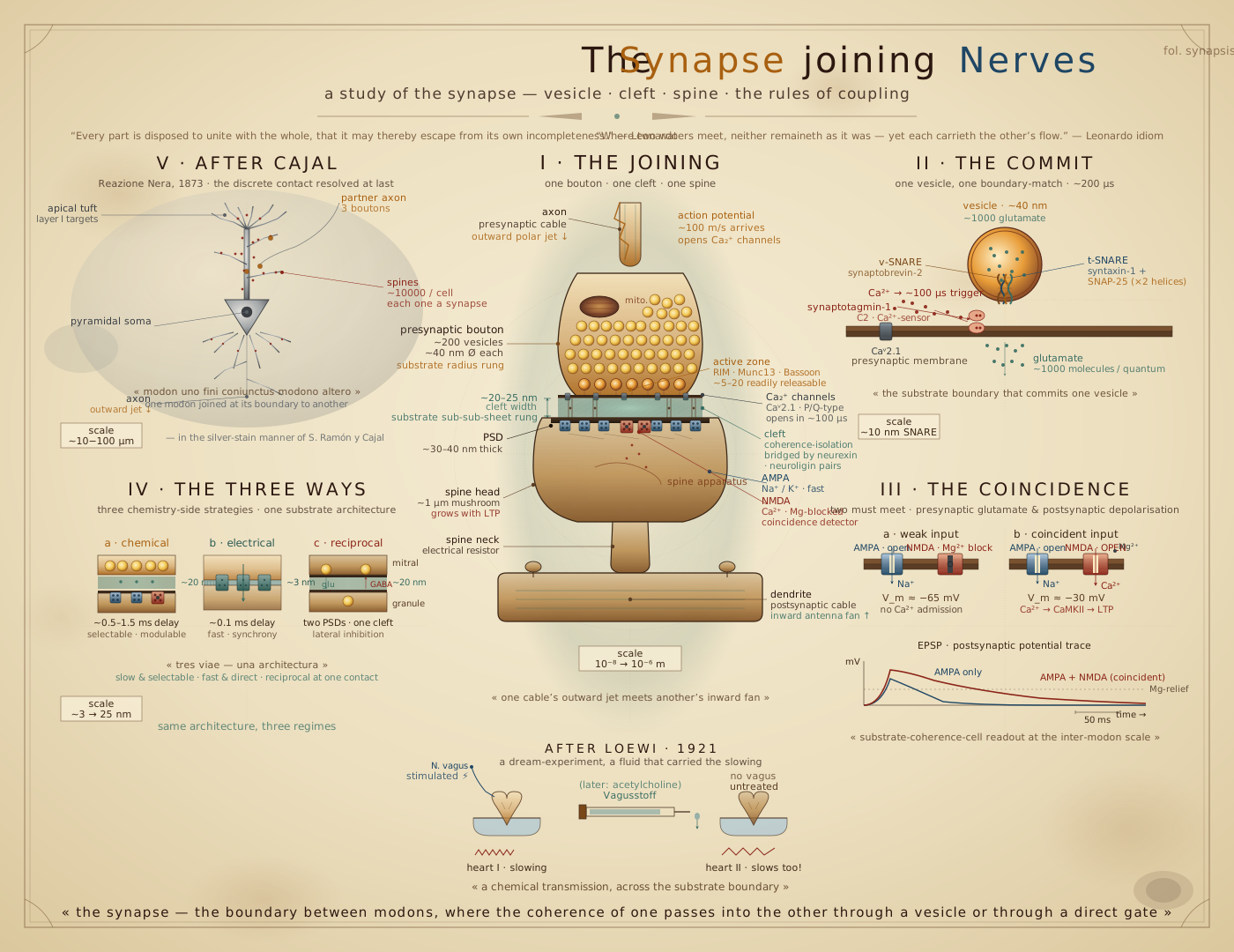
The synapse is the boundary-matching event where one cable modon’s outward polar jet couples to another cable modon’s inward antenna fan, with the synaptic cleft as the substrate-coherence-isolation interface, vesicle-fusion or connexon-gating as the chemistry-side commit mechanism, postsynaptic receptor coincidence-detection as the substrate-coherence-cell readout, and long-term potentiation as the substrate-coherence-strength reinforcement of repeatedly co-active matched-stamp pairings. The cleft is structurally parallel to every other boundary-matching interface the framework has developed across the cellular and perception walks — the LINC complex between nucleus and cytoskeleton, the MAM between ER and mitochondrion, the gap junction between adjacent cells, the basal body / transition zone between cell and cilium. Each is a place where two coherent modons must couple without losing their coherent identities; each has a chemistry-side machinery (SUN-KASH bridges, MFN tethers, connexons, ciliary necklace particles, SNAREs) implementing the substrate’s matched-stamp coupling at the corresponding scale. The synapse is biology’s chemistry-side implementation of the same architecture at the inter-neuronal cable-modon scale, with three families of chemistry-side strategy (chemical, electrical, dendrodendritic) corresponding to three distinct substrate-coupling regimes.
The Synaptic Cleft as Boundary-Matching Interface
A chemical synapse — the dominant type across the vertebrate central nervous system — is the structure resolved by Sanford Palay and George Palade in 1954 electron microscopy: a presynaptic terminal containing \sim 50–500 membrane-bound synaptic vesicles, a \sim 20–25 nm cleft separating the presynaptic and postsynaptic membranes, and a postsynaptic density — a darker thickening of cytoplasmic protein scaffold \sim 30–40 nm thick — on the receiving side. The cleft is bridged by cell-adhesion molecules (neurexin-neuroligin pairs at most central synapses, cadherins, SynCAMs, leucine-rich-repeat transmembrane proteins) that pre-align the pre- and post-synaptic membranes and hold the cleft at its conserved width to within a few nanometres across hours and days of synaptic activity. The presynaptic active zone is a small (\sim 200–300 nm diameter) electron-dense scaffold built from RIM, Munc13, RIM-BP, ELKS, Liprin-\alpha, and Bassoon-Piccolo proteins, which positions \sim 5–20 “readily releasable” vesicles in physical contact with the membrane directly above clustered voltage-gated Ca^{2+} channels (Ca$2.1 P/Q-type at most central synapses, Ca2.2 N-type at sympathetic terminals, Ca_$2.3 R-type at certain hippocampal mossy fibres).
The cleft is the substrate-coherence-isolation interface between two cable modons, structurally identical in function to every other inter-modon boundary developed across the cellular walk. The \sim 20–25 nm cleft width sits on the substrate’s preferred sub-sub-sheet rung — the same rung the crista junctions (\sim 25 nm), the ER contact-site gaps (\sim 10–30 nm), the rod-disc spacings (\sim 25–32 nm), and the myelin lamellar period (\sim 12 nm at half-rung) cluster on. The conservation of the cleft width across central synaptic types, across species, and across activity states is the framework’s anchor here: the cleft is not arbitrary chemistry-side optimisation but the substrate’s preferred boundary-matching interval at the cable-modon coupling scale, with neurexin-neuroligin and other cell-adhesion-molecule pairs as the chemistry-side scaffolds holding the wraps at the substrate-friendly distance.
The active zone is the regulated-jet exit at the presynaptic side, structurally parallel to the nuclear pore complex at the nuclear modon, the TOM/TIM at the mitochondrial modon, the transition zone at the cilium, and the node of Ranvier at the cable modon. Each is a chemistry-side implementation of a regulated coherence-boundary interface — substrate-current packets pass through under conditions the chemistry gates. The RIM-Munc13-Bassoon scaffold positions vesicles, tethers them to the substrate-coupled position, and primes them for release; the clustered voltage-gated Ca^{2+} channels deliver the chemistry-side trigger signal when the AP packet arrives. The postsynaptic density on the receiving side is the boundary-matching scaffold at the inward fan — the chemistry-side apparatus that aligns NMDA, AMPA, GABA_A, and metabotropic receptors at the postsynaptic membrane in register with the presynaptic active zone, holding the two faces of the boundary-matching event in geometric correspondence.
Each chemical synapse is as a pair of regulated-jet interfaces facing each other across a substrate-coherence-isolation cleft, with vesicle-fusion as the chemistry-side commit event that transfers substrate-coupled signal across the boundary.
Vesicle Fusion as Boundary-Matched Commit on the Substrate-Coherence Ladder
The synaptic vesicle is biology’s most uniform vesicle: \sim 40 nm diameter with \sigma \lesssim 5\%, \sim 200 copies of synaptobrevin-2 (VAMP2) on the outer leaflet, \sim 70 copies of synaptotagmin-1, \sim 30 copies of the V-ATPase that loads the lumen with \sim 1000–2000 molecules of transmitter, and \sim 100 associated proteins (Rab3a, Rab27, SV2, etc.) carrying out the docking, priming, and recycling steps. The vesicle-traffic chapter flagged the synaptic vesicle’s narrow size distribution as the cleanest existing data point in support of the substrate-radius-ladder prediction; this chapter takes the prediction’s anchor as established and develops the timing of vesicle fusion as the next substrate-readable feature.
The action potential arrives at the active zone, voltage-gated Ca^{2+} channels open within \sim 100\;\mus, intracellular Ca^{2+} rises sharply in \sim 10\;\mum^3 nanodomains near each channel, synaptotagmin-1’s two Ca^{2+}-binding C2 domains engage the bilayer and the SNARE bundle, and the docked vesicle fuses with the presynaptic membrane within \sim 200\;\mus of channel opening. The total synaptic delay — from arrival of the AP to onset of postsynaptic current — is \sim 0.5–1.5 ms across central synapses, with \sim 0.2 ms minimum at fast synapses (cerebellar climbing fibre, calyx of Held), \sim 1–2 ms at typical cortical synapses, and \sim 2–5 ms at slow modulatory synapses.
The \sim 0.5 ms minimum delay is seen as the substrate-coherence ladder’s expression at the cable-modon-to-cable-modon coupling rung. The vesicle-fusion event is biology’s chemistry-side implementation of a substrate-matched commit pulse at the presynaptic regulated-jet interface, with the Ca^{2+}-synaptotagmin-SNARE machinery as the chemistry-side coupling and the substrate’s matched-stamp-recognition between the v-SNARE bundle and the t-SNARE plus active-zone scaffold providing the substrate-coherence threshold. The vesicle-traffic chapter’s SNARE-as-boundary-matching reading lifts here directly; the synaptic fusion event is the same substrate-matched-stamp commitment as every other SNARE-mediated fusion in the cell, specialised by the active-zone scaffold for fast substrate-current-triggered release. The substrate-current packet arriving in the AP triggers the boundary-matching commit at the substrate-recognition timescale of the active-zone interface; the chemistry-side delay is the substrate’s coherence-handoff time at this rung.
The Katz quantum is biology’s chemistry-side discreteness of release: each fused vesicle delivers \sim 1000–2000 transmitter molecules in a single event, producing a postsynaptic miniature current of stereotyped amplitude. The framework reads the quantum as the substrate-discrete-event signature at the synaptic-coupling rung, structurally parallel to the all-or-none discreteness of the AP packet at the cable-modon rung, the photon-modon’s discreteness at the photon rung, and the stamp-class discreteness at the codon-recognition rung. The substrate’s quantisation shows through chemistry’s machinery at every modon scale; each vesicle-fusion event is the substrate’s most directly accessible discreteness at the inter-neuronal coupling scale.
The probability of vesicle release per AP is famously low and variable: \sim 0.1–0.5 at central excitatory synapses, \sim 0.5–0.9 at strong central inhibitory synapses, \sim 0.9 at the neuromuscular junction. The framework reads this probabilistic release as the substrate-coherence threshold’s chemistry-side projection at the coupling-rung scale: not every AP packet arrives with the substrate-coherence quality required to commit the boundary-matching event at the substrate-recognition rung, and the probabilistic release distribution is the substrate’s coherence-quality distribution showing through the chemistry-side detector. Short-term facilitation and depression — the activity-dependent modulation of release probability over \sim 100 ms to \sim 10 s timescales — are biology’s chemistry-side implementation of substrate-coherence-quality memory at the active-zone rung, with calcium accumulation and vesicle-pool depletion as the chemistry-side observables of the substrate-coupling-quality dynamics.
Three Synapse Types as Three Boundary-Matching Strategies
Biology builds three distinct synapse types, each a different chemistry-side strategy for the same boundary-matching architecture.
Chemical synapses are the dominant type, the focus of the cleft, vesicle, and fusion analysis above. Substrate reading: a regulated-jet exit (active zone) facing a regulated-jet entry (postsynaptic density) across a substrate-coherence-isolation cleft at the \sim 20–25 nm sub-sub-sheet rung. The chemistry-side commit is vesicle-fusion plus transmitter-receptor recognition.
Electrical synapses transmit through gap junctions — paired hexameric connexon hemichannels (composed of six connexin subunits each) forming a continuous aqueous channel \sim 1.5 nm wide and \sim 12 nm long that directly couples the cytoplasm of one cell to its neighbour. The gap junction’s cleft is \sim 3–4 nm — distinct from the \sim 20–25 nm chemical-synapse cleft — with no vesicle machinery, no transmitter, and no postsynaptic density. Signal transmission is essentially instantaneous (delay \sim 0.1 ms, set by the cable equation across the connexon and the receiving cell’s input impedance rather than by any chemistry-side commit step), bidirectional, and faithful to subthreshold signals as well as APs. Electrical synapses are concentrated in retinal interneurons, inferior olive, hippocampal interneuron networks, and most populations of neurons that fire in synchrony.
The framework reads electrical synapses as direct substrate-coherent coupling between two cable modons without the chemistry-side commit step — the substrate-coupling analogue of intercellular gap-junctional coupling at the tissue-modon scale lifted to the inter-neuronal scale. The chemical synapse’s \sim 0.5–1.5 ms delay is the substrate’s coherence-handoff time at the chemistry-side-mediated coupling rung; the electrical synapse’s \sim 0.1 ms is the substrate’s coherence-coupling time at the direct coupling rung. The two synapse types are biology’s chemistry-side answer to two distinct functional requirements — selectivity-and-modulability (chemical: every AP need not pass; the boundary-matching event is gated by Ca^{2+}, by transmitter availability, by receptor state) versus speed-and-synchrony (electrical: signals couple directly; synchrony emerges as the substrate’s natural coupling state). The same architecture, two regimes.
Dendrodendritic reciprocal synapses are a third type, identified first in the olfactory bulb (Rall, Shepherd, and others, 1966) between mitral-cell lateral dendrites and granule-cell spines, with examples in the thalamus, retina (amacrine cells), and some cortical interneuron classes. The architecture: two postsynaptic densities back-to-back across a single cleft, each containing different transmitter machinery — the mitral-cell side releases glutamate onto the granule-cell spine, and the granule-cell spine immediately releases GABA back onto the mitral-cell dendrite — creating a reciprocal feed-forward-and-feedback circuit at a single contact.
Dendrodendritic reciprocal synapses are the substrate’s two-modon-coupling architecture run between inward fans on both sides, with each cell’s dendritic process serving as both presynaptic and postsynaptic at the same contact. The nose chapter’s centre-surround-style readout at the multi-glomerulus scale developed granule-cell-mediated lateral inhibition as the chemistry-side implementation of the substrate-coherence-cell readout at the olfactory bulb; this chapter’s reading places the underlying reciprocal synapse as the substrate’s preferred architecture for fast lateral coupling without the cost of a dedicated axonal projection. Three synapse types, three boundary-matching strategies, all on the same substrate architecture.
NMDA/AMPA Coincidence Detection as Substrate-Coherence-Cell Readout
A typical central excitatory synapse holds two glutamate receptor families at the postsynaptic density. AMPA receptors (heterotetramers of GluA1–GluA4 subunits) open within \sim 100\;\mus of glutamate binding, depolarise the spine head by \sim 0.1–1 mV per quantal event, and close within \sim 5–10 ms. NMDA receptors (heterotetramers of GluN1, GluN2A–D, and sometimes GluN3 subunits) bind glutamate but remain blocked by Mg^{2+} at resting membrane potential — only opening when glutamate is bound AND the postsynaptic membrane is depolarised enough to relieve the Mg^{2+} block (typically by \sim 30–40 mV depolarisation, achieved by accumulated AMPA-current input). When both conditions co-occur, NMDA receptors open and admit Ca^{2+} in addition to Na^+/K^+, triggering the downstream Ca^{2+}-dependent signalling cascades (CaMKII activation, AMPA-receptor insertion, structural-plasticity machinery) that underlie LTP and learning.
The Mg^{2+}-block requirement makes the NMDA receptor a molecular coincidence detector — Mayford, Bear, Malinow, and others have developed this reading since the 1980s — and the framework adds the substrate-physics layer to it. The NMDA receptor reads the coincidence between a presynaptic substrate-current event (glutamate release, indexing that the presynaptic cable-modon has just fired) and a postsynaptic substrate-current event (sufficient local depolarisation, indexing that the postsynaptic cable-modon’s substrate state has crossed threshold from accumulated input). When both events co-occur within the receptor’s \sim 10–100 ms integration window, the NMDA channel opens and a substrate-current commit pulse (Ca^{2+} influx, CaMKII activation) is delivered to the postsynaptic-density machinery.
This co-occurrence detection is the substrate-coherence-cell readout at the synaptic scale, structurally parallel to the retinal centre-surround readout, the olfactory bulb’s mitral-cell receptive field, and the two-point discrimination tiling on the skin. At each scale, a substrate-coherence cell is the local domain over which the substrate’s coherent state can be read as a definite signal; the chemistry-side readout machinery (bipolar-and-horizontal-cell circuitry, granule-cell-mediated lateral inhibition, mechanoreceptor-tiling-density, NMDA-receptor-Mg^{2+}-block) implements the readout at the scale appropriate to the modon hierarchy. The synapse implements the readout at the inter-cable-modon scale: which presynaptic-postsynaptic pair has just been jointly coherent, in a substrate-recognition sense, is the substrate-coherence-cell readout that LTP-class plasticity then reinforces.
The NMDA receptor’s \sim 10–100 ms integration window sits at a substrate-friendly logarithmic interval relative to the synaptic delay (\sim 0.5–1.5 ms), the action-potential refractory period (\sim 1–2 ms), and the EPSP decay timescale (\sim 5–20 ms) — these four together define a substrate-preferred temporal-rung structure at the inter-cable-modon coupling scale, analogous to the spatial sub-sub-sheet rung structure at the smaller modon scales. The framework predicts cross-mammalian conservation of these temporal rungs distinct from the smooth variation a chemistry-side kinetic-fit account would expect from variation in subunit composition alone.
LTP and LTD as Substrate-Coherence Reinforcement
The Bliss-Lømo 1973 finding — that a brief tetanic stimulation of the perforant path produces a hours-long potentiation of dentate-gyrus field EPSPs — and its inverse, long-term depression (LTD; Ito and Kano in the cerebellum, Bear and others in cortex), are the two canonical forms of activity-dependent synaptic plasticity. The pathway: presynaptic-postsynaptic co-activity → NMDA-receptor opening → Ca^{2+} influx → CaMKII activation → AMPA-receptor phosphorylation and insertion into the postsynaptic membrane → increased AMPA-current per unit transmitter → potentiated synaptic response. The LTD pathway runs through lower-level sustained Ca^{2+} → calcineurin and PP1 activation → AMPA-receptor de-phosphorylation and internalisation → reduced AMPA-current. Donald Hebb’s 1949 proposal — cells that fire together, wire together — finds its molecular implementation in this NMDA-coincidence-then-AMPA-reinforcement architecture.
LTP is substrate-coherence-strength reinforcement of repeatedly co-active matched-stamp pairings. A presynaptic-postsynaptic pair that has just been substrate-coherent (NMDA opened, indexing co-activity) gets its boundary-matching machinery strengthened — more AMPA receptors inserted, postsynaptic density thickened, sometimes structural changes to the spine head’s size and the active zone’s surface area. The substrate-coupling between the two cable modons is, physically, more efficient after LTP; the chemistry-side machinery is biology’s implementation of the substrate-coherence-coupling-strength upgrade at the inter-modon boundary. Hebb’s rule, in this reading, is coherence-together couple-together — substrate-coherent co-activity (read by the NMDA coincidence-detector) leads to substrate-coupling-strength reinforcement (executed by AMPA-receptor trafficking and PSD remodelling).
Predictions and What Would Falsify
Four predictions extend the boundary-matching reading beyond the structural anchors.
Synaptic-cleft width clusters at the substrate sub-sub-sheet rung across synaptic types and species. Cleft widths across central chemical synapses, neuromuscular junctions, and ribbon synapses (retinal, cochlear) should cluster at preferred values near \sim 20–25 nm, structurally parallel to crista-junction, ER-contact, rod-disc, and myelin-lamellar spacings already developed at the corresponding modon scales. Existing serial-section electron microscopy and electron tomography (Harris, Stevens, Heuser, and others) provide the data; the framework predicts cross-type and cross-species clustering on the preferred rung distinct from the smooth variation chemistry-side cell-adhesion-molecule choice would predict.
Synaptic delay clusters on substrate-preferred temporal rungs. The presynaptic-to-postsynaptic delay distribution across central synapses should cluster at preferred values (\sim 0.2, 0.5, 1.5 ms, with neuromodulatory-cascade synapses at longer rungs of \sim 5, \sim 50 ms) rather than varying smoothly with active-zone composition. Existing electrophysiological literature on paired recordings and calyx-of-Held single-fibre EPSC timing provides the test; the framework predicts cross-synaptic-type clustering on preferred rungs.
NMDA-receptor coincidence-detection windows cluster at substrate-preferred temporal rungs. The NMDA-receptor’s effective integration window across subunit compositions (GluN2A, GluN2B, GluN2C, GluN2D) and developmental stages should cluster at preferred values (\sim 10, 30, 100 ms) on substrate-friendly logarithmic intervals, parallel to the eye chapter’s wavelength-rung and the touch chapter’s frequency-rung predictions but in the temporal-rather-than-spatial domain. Existing patch-clamp deactivation-kinetics data give the test; the framework predicts preferred-rung clustering rather than continuous variation with subunit ratio.
Dendritic-spine head volumes cluster at substrate-preferred rungs after LTP. Spine-head volumes before and after LTP induction should cluster at preferred values (\sim 0.05, 0.1, 0.5\;\mum^3) rather than varying smoothly with stimulation strength, with structural-plasticity transitions occurring as discrete substrate-rung jumps rather than continuous growth. Existing two-photon time-lapse imaging (Yuste, Holtmaat, Svoboda) provides the data; the framework predicts jump-style transitions on the substrate’s preferred volume rungs.
The picture is falsified if (a) synaptic-cleft widths vary continuously with cell-adhesion-molecule composition without preferred-rung clustering, (b) synaptic delays vary smoothly with active-zone protein composition without preferred-rung structure, (c) NMDA coincidence windows vary continuously with subunit composition without preferred-rung clustering, or (d) spine-head volumes change continuously under LTP induction without discrete rung-to-rung transitions. It is supported, even partially, if any of the four ordering predictions hold against existing morphometric and electrophysiological data.
Putting the Section in Context
The synapse is the boundary-matching event between two cable modons — one cable’s outward polar jet (axon terminal) meeting another cable’s inward antenna fan (dendritic arbor) at a substrate-coherence-isolation cleft of \sim 20–25 nm. The chemistry-side machinery (active-zone scaffold and presynaptic SNAREs at one face, postsynaptic density and receptor tetramers at the other, cell-adhesion-molecule bridges spanning the cleft) implements the substrate’s matched-stamp boundary-matching architecture at the inter-cable-modon coupling rung, structurally parallel to LINC at the nuclear modon, MAM at the ER-mitochondrion modon coupling, gap junctions at the cell-modon coupling, and the transition zone at the cell-cilium coupling. Three families of chemistry-side strategy — chemical (slow, selectable, modulable), electrical (fast, direct, synchronous), and dendrodendritic reciprocal (fast lateral coupling between inward fans) — answer three distinct functional demands within the same architecture. Vesicle fusion implements the substrate-coherence-handoff event at the chemical synapse with \sim 0.5 ms minimum delay setting the substrate-coherence-handoff timescale at the chemistry-side-mediated coupling rung, and the synaptic vesicle’s narrow \sim 40 nm size distribution anchors the substrate-radius-ladder prediction at its cleanest single data point. The Katz quantum is the substrate-discrete-event signature at the synaptic-coupling rung. NMDA/AMPA coincidence detection is the substrate-coherence-cell readout at the inter-cable-modon scale, with the Mg^{2+}-block requirement implementing biology’s chemistry-side coincidence-detector and the substrate’s matched-pair-co-activity recognition appearing through it. LTP and LTD are substrate-coherence-coupling-strength reinforcement and weakening of repeatedly co-active matched-stamp pairings, with Hebbian coherence-together couple-together as the substrate-physics reading of fire-together wire-together.
The Brain as Substrate Resonator walk now has its two single-cell substrate readings — the cable modon at one neuron, the boundary-matching coupling at one synapse. The cortical-maps-and-rhythms chapter takes the population step, where \sim 10^{11} cable modons interlocked by \sim 10^{14}–10^{15} boundary-matching couplings organise into the topographic maps the perception walk parked at the cortex boundary (retinotopy V1, tonotopy A1, somatotopy S1, the olfactory bulb’s glomerular array projected onto piriform cortex), into the gamma, theta, and alpha oscillations the substrate’s standing-wave architecture supports at the organ rung, into the thalamocortical canonical loop the brain runs at the highest-scale modon biology has built, and into the slow-wave-and-glymphatic sleep architecture the neuron chapter teased as substrate-coherence-restoration at the brain-modon scale. The walk closes at microtubule coherence revisited, where the \sim 10^{16} microtubule cylinders inside the brain’s \sim 10^{11} neurons return as the Penrose-Hameroff question reframed against the substrate-locked closed-cylindrical-modon reading.
What the synapse chapter adds to the substrate framework is the reading that biology’s most numerous structural element — the \sim 10^{15} synapses in a vertebrate brain — is the substrate’s most numerous boundary-matching interface, with three chemistry-side coupling strategies, a substrate-friendly cleft width, a substrate-coherence-discrete release quantum, a substrate-coherence-cell coincidence-detection readout, and a substrate-coupling-strength reinforcement rule that the chemistry-side LTP machinery implements. Sherrington’s “clasping together” is, in this reading, the substrate’s matched-stamp coupling event at the inter-cable-modon rung; the brain’s information processing is the population dynamics of \sim 10^{15} such coupling events running on the substrate-coherent cable-and-coupling network the previous chapter and this chapter have together developed.