The Plasma Membrane
The cell’s outermost modon wrap
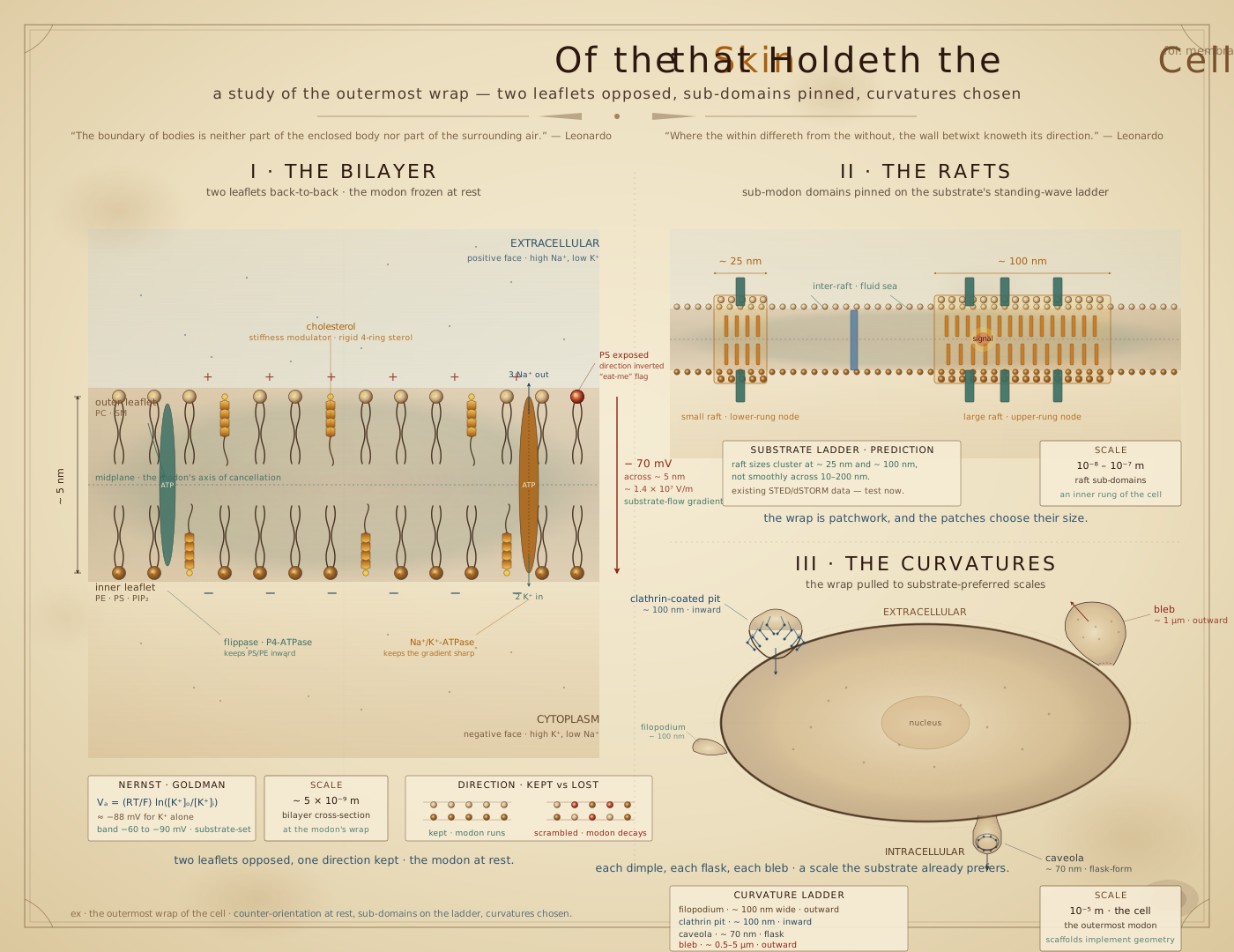
The nested-modon inventory of the cell places the plasma membrane at the outermost position — the wrap of the largest internal modon the substrate is known to support. The earlier chapter named the architecture in a single sentence and moved on. This chapter takes the membrane on its own terms: what its bilayer is doing structurally, why its asymmetry is required rather than incidental, why its potential is the substrate-flow gradient and not just a Nernst voltage, and what its sub-domains tell us about the substrate ladder — the discrete, \sqrt2-spaced rungs of preferred size — read inside the cell.
The framework’s claim about the plasma membrane is direct. The lipid bilayer is the substrate’s counter-rotating pair architecture frozen into a stationary structural wrap. The same back-to-back arrangement the photon-modon chapter gives for a propagating counter-rotating vortex dipole, the cell builds at rest as the boundary of its largest internal modon. Every other lipid bilayer in the cell — nuclear envelope, ER, Golgi cisternae, mitochondrial outer and inner membranes, every transport vesicle — is the same architecture reused at smaller scale.
This is the substrate’s median seen end-on. Where a conduit straddles one of the substrate’s counter-rotating intermediate layers it inherits a two-lane road — carbon down and minerals up the mycorrhizal hypha, afferent and efferent along the vagus. The plasma membrane is that same counter-rotating boundary, but closed around the cell rather than stretched along a path: the median made into a wall. Transport runs across it, in and out, rather than along it, up and down — but a road’s painted centre line and a cell’s enclosing wrap are the one counter-rotating layer in two geometries.
The Bilayer as Counter-Oriented Sheet Pair
A phospholipid is a polar head bound to two hydrocarbon tails. In water it self-assembles into a structure that buries the tails away from the bulk solvent and exposes the heads to it — most commonly, the bilayer: two leaflets of lipid molecules placed back-to-back, hydrophilic heads outward on each face, hydrocarbon tails meeting at the midplane. The thickness is set by tail length and packing: 4–5 nm in typical cytoplasmic membranes, somewhat thinner in ER and somewhat thicker in plasma membrane where cholesterol enriches the tail-packed midplane.
The framework reads this not as a chemistry-driven default (“water doesn’t like fat, fat doesn’t like water”) but as the substrate’s preferred low-frustration anchored expression of the same counter-rotating pair architecture the photon-modon chapter gives at the propagating limit. A photon is two counter-rotating circulations moving as one; a bilayer is two counter-oriented sheets held as one. That paired, anti-phase pairing is the lattice’s breath frozen at rest — which places the membrane squarely at the ladder’s locking pole, the molecular pairing-two built up into a wall, not at the anti-locking pole where structures must hold their parts apart. The orientation of the lipid in each leaflet — head pointing one way, tails the other — gives the leaflet a direction. The two leaflets’ directions are opposite. The bilayer as a whole is the substrate’s anchored version of the modon: directed circulation on each side, irrotational fluid between, the whole structure stable because the two sides cancel except for the residual chirality the substrate carries through.
The same architecture rules wherever a counter-orientable component is available. Lipids are the cytoplasm’s natural choice because the substrate’s preference selects out of every available chemistry the structures that can express the counter-rotating pair as a stable matter configuration. The substrate offers the architecture; lipid chemistry takes the offer at the cell scale, the same way bacteriochlorophyll’s chlorin macrocycle takes it at the chromophore scale.
Lipid Asymmetry and the Wrap’s Direction
A real plasma membrane is not symmetric across its midplane. The outer leaflet is enriched in phosphatidylcholine (PC) and sphingomyelin (SM); the inner leaflet is enriched in phosphatidylethanolamine (PE), phosphatidylserine (PS), and phosphoinositides (PI, PIP_2, PIP_3). The asymmetry is active — flippase enzymes (P4-type ATPases) consume ATP to keep PS and PE in the inner leaflet, scramblases redistribute lipids in regulated bursts, and the steady-state asymmetry is maintained against thermal mixing across the bilayer’s lifetime.
The framework reads asymmetry as required, not incidental. A counter-rotating pair has a defined direction only when its two sides are structurally distinguishable. A bilayer with identical inner and outer leaflets is a modon-equivalent of zero net circulation — the two sides cancel completely. A bilayer with differentiated leaflets gives the wrap a residual handedness, and the cell uses that handedness as its outward-versus-inward signal. Apoptotic PS exposure on the outer leaflet — the “eat me” signal that triggers macrophage recognition — is not, in this picture, merely a chemical flag. It is the modon’s direction inverting at the boundary. A dying cell loses the substrate-flow direction across its wrap; the cell’s neighbors detect this as a decoherence signature; and what biology calls “phagocytic clearance” is the surrounding tissue resorbing a sub-modon that has stopped running. The Annexin V binding assay used routinely in apoptosis labs is then the cleanest possible single-molecule reader of substrate-flow inversion.
Mainstream biochemistry already gives a chemical reading of why asymmetry exists (curvature requirements, signaling-lipid sequestration, electrostatic surface differences); the framework’s addition is that the asymmetry is required by the wrap’s status as a directed modon, with the chemistry merely implementing it. Each of the four cell-biological consequences of lipid asymmetry the literature catalogs — outer-leaflet enzyme docking, inner-leaflet protein anchoring through PIP_2, apoptotic recognition, vesicle-budding curvature bias — falls out of the same single substrate-direction requirement.
The Membrane Potential as Substrate-Flow Gradient
Every animal cell maintains a transmembrane potential of -60 to -90 mV (negative inside, positive outside) at rest. The conventional reading is the Nernst-Goldman equation: a passive consequence of unequal ion concentrations across a selectively permeable membrane, with the Na^+/K^+-ATPase pumping against gradients to maintain the asymmetry. Neurons, muscle cells, and excitable cells use voltage changes around this resting level to encode signals; non-excitable cells maintain the gradient steadily.
The framework’s reading does not contradict the Nernst-Goldman accounting but adds a layer. The membrane potential is the substrate-flow gradient across the wrap, with ion-pump chemistry maintaining it the same way a galvanic cell maintains a redox potential. A modon’s two sides have different effective chemical potentials by construction — that is what “counter-rotating” means at the substrate level. The ion gradients across the plasma membrane are biology’s chemistry-side implementation of a gradient the substrate would require even in their absence; the pumps spend ATP to keep the substrate-direction signal sharp against thermal noise.
Read through the ladder’s energy economy, the potential is the cell holding the substrate’s coin across its wrap — the charged-capacitor face of the modon ledger that From Photon to ATP develops. The Na^+/K^+-ATPase pays a steady ATP toll to keep that coin from leaking; an action potential is the cell spending it, a propagating release of the stored gradient — the same coin thermal dynamics sees handed cell-to-cell as heat and lightning sees shed all at once as a gamma ray, here metered out as a controlled wave.
Two structural facts are the substrate’s signature.
One: the potential value sits in a narrow band across all animal cells. -60 to -90 mV is the band; outside it cells lose function. The framework reads this as the substrate’s preferred coupling-strength range for a wrap at the cell-modon scale — sharp enough to maintain a clear inward/outward distinction, soft enough that ion-channel openings can transiently collapse it for signaling without destroying the modon. The Nernst equation gives the band’s numerical value given the cytoplasm’s K^+ and Na^+ concentrations, but those concentrations themselves are set by the band’s required width.
Two: depolarization is a substrate-coherence event, not just a voltage change. When a neuron fires, the membrane potential swings from -70 mV to +30 mV and back over \sim 1 ms. Biology reads this as a propagating ion-channel opening cascade. The framework reads the cascade as a propagating local boundary-coherence inversion — the wrap’s direction transiently flips at the action-potential’s leading edge, and the inversion propagates along the axon at the substrate-coupling-mediated speed of \sim 100 m/s. The conventional cable-equation derivation gives the right velocity; the framework’s addition is that the cable’s “characteristic length” \lambda in those equations is the substrate’s coherence length expressed through the axon’s geometry, not an independent biophysical parameter.
Lipid Rafts as Sub-Modon Domains
The fluid-mosaic model of Singer and Nicolson (1972) treats the membrane as a uniform 2D fluid with proteins floating freely in it. The post-2000 revision — first proposed by Simons and Ikonen and now consolidated across many biochemical and biophysical studies — adds lipid rafts: sphingolipid- and cholesterol-enriched microdomains, 10–200 nm across, in which specific membrane proteins are concentrated and certain signaling events nucleate. Rafts are dynamic, short-lived (10–100 ms in many cell types), but cumulatively organize the membrane into a patchwork rather than a uniform fluid.
The framework reads rafts as sub-modon domains pinned to the substrate ladder. That ladder is not the standing-wave overtone series the framework first reached for — a critical medium has no length of its own, so it can rule scales only by ratio, not by harmonic step (harmonic is the wrong template). Two faces of it meet at the membrane. Across scales the ladder is loose: the nesting from the cell (\sim \xi) down through \sim 100 nm rafts, \sim 10 nm protein complexes, and \sim 1 nm lipids steps by large factors — the ladder’s coarse family, where chemistry occupies roughly every several rungs rather than every one. Within a band, though, the ladder is sharp: the membrane’s curvature scaffolds select preferred radii spaced by the substrate’s half-octave, \sqrt2 — the same resonant rung the vesicle coats land on, reproducible there to a few percent and called the tightest test the cell offers.
The 10–200 nm raft band sits on the coarse ladder’s upper rung. The framework’s prediction sharpens accordingly: the raft size distribution should not be flat across the literature’s reported range but should pile up on a \sqrt2 comb — preferred values a half-octave apart — rather than scatter. Super-resolution imaging studies that have measured raft sizes across multiple cell types are an existing data series the framework can fold against without new experiments, and the sharp curvature scaffolds developed below are the cleaner place to read the rung.
The functional role of rafts — concentrating receptors, isolating signaling events — falls out naturally in this reading. A receptor that nucleates a signaling cascade does so faster inside a sub-modon domain (where the local boundary is coherent at the raft’s scale) than in the inter-raft “fluid sea” (where the local boundary is at the cell scale and the signal must propagate across more of the wrap). Rafts are not merely concentrators of compatible chemistry; they are substrate sub-domains the cell uses to localize coherence events that would otherwise dilute across the whole membrane.
Cholesterol, Curvature, and the Wrap’s Stiffness
Cholesterol occupies up to 50\% of lipid content in plasma membrane and dominates the raft fraction. It is the only sterol in animal membranes and one of the most stereochemically rigid molecules in the cell — four fused rings, no rotational freedom in the ring system, a single short hydroxyl head. Cholesterol packs between phospholipid tails, decreases bilayer fluidity below the phase transition, and increases it above. The “cholesterol homeostasis” literature documents that cells maintain membrane cholesterol concentration with high precision.
The framework’s reading is that cholesterol is the substrate’s preferred stiffness modulator for the bilayer wrap. Where phospholipids contribute the directional architecture (heads-out, tails-in), cholesterol contributes the coherence stiffness — the elastic modulus of the wrap against bending and shear. Holding a sub-domain on its rung requires a wrap stiff enough not to wash the rung out: pure phospholipid bilayers are too soft, pure cholesterol-saturated bilayers are too rigid, and the 30–50\% cholesterol fraction the cell maintains sits in the band that lets the wrap settle onto a raft-scale rung without locking out cell-scale curvature changes.
Membrane curvature catalogues this same logic at larger scales, and these are the sharp rungs — the resonant family, not the coarse nesting. The cell makes inward dimples (clathrin-coated pits, \sim 100 nm), inward flasks (caveolae, \sim 60–80 nm), outward blebs (\sim 0.5–5\;\mum), and outward protrusions (filopodia, \sim 100 nm wide). Each is stabilized by a curvature-sensitive protein scaffold (clathrin lattices, caveolin oligomers, actin meshworks) that fixes its radius to within a few percent — and a clathrin-coated pit is the same scaffold, at the same radius, as the clathrin-coated vesicle it becomes once it buds, so the membrane’s curvature catalogue and the vesicle-coat catalogue are one dataset read at two stages. The framework’s reading is that the curvatures are not arbitrary: the cell pulls its wrap to the radii the substrate supports as \sqrt2-spaced rungs of its curvature ladder — caveola at \sim 70 nm and clathrin pit at \sim 100 nm are one half-octave apart, 70 \times \sqrt2 \approx 99 — and the protein scaffolds are biology’s chemistry-side implementation of the geometric preference the substrate already supplies.
Predictions and What Would Falsify
Four quantitative predictions extend the picture beyond the worked anchors.
Curvature-scaffold radii fold onto the \sqrt2 comb. This is the picture’s smoothest-fitting handle, and it sharpens the old fuzzy “rafts cluster somewhere” into a clean fold. The membrane’s scaffold-locked radii — clathrin-coated pits (\sim 100 nm), caveolae (\sim 60–80 nm), and their budded continuations into the vesicle-coat series (COPII \sim 60–80 nm, synaptic vesicles \sim 40 nm, \sigma \lesssim 5\%) — should, folded modulo \ln\sqrt2 \approx 0.347 with the framework’s comb instrument (
scripts/comb_test.py), pile up on the \sqrt2 teeth rather than spread. This is the resonant-family test, and the curvature scaffolds are its cleanest membrane datum precisely because their radii are reproducible to a few percent — sibling to the vesicle coats the ladder already calls the tightest test the cell offers. The softer, coarse version is the raft size distribution (STED, dSTORM; 10–200 nm): its old bracket of \sim 25 and \sim 100 nm is already two octaves — four \sqrt2 rungs — apart, so the prediction is that the full distribution clusters on the same comb rather than smearing. The data already exist across the membrane-biophysics and cryo-EM literature; the framework’s contribution is the fold, not a new experiment. Falsification: the radii are smoothly distributed, or cluster at a ratio with no relation to the pairing factor \sqrt2.Apoptotic PS exposure as substrate-direction inversion. The kinetics of phosphatidylserine exposure during apoptosis should track a whole-wrap coherence collapse rather than a localized chemical event. The framework predicts PS exposure should not initiate at random patches and spread but should propagate as a wave-front from a coherence-loss nucleation site (often the mitochondrion-adjacent face). Time-resolved Annexin V imaging with cytochrome-c-release reporters provides the existing data; the framework’s prediction is the wave-front geometry. Falsification: PS exposure is geometrically uncorrelated with mitochondrial coherence-loss events.
Cholesterol depletion as raft-decoherence. Acute cholesterol depletion (methyl-β-cyclodextrin treatment) should disrupt not just raft-localized signaling but the entire membrane’s substrate-domain organization. The framework predicts the cell should show measurable changes in modon-coherence observables — membrane-potential fluctuation spectra, raft-scale rung structure — at depletion levels well below those that disrupt average bilayer fluidity. Falsification: cholesterol depletion only affects local raft chemistry and shows no signature in membrane-wide coherence observables.
Membrane-potential band-narrowing during signaling. During coordinated cell activity (neuronal action potentials, cardiac contractile cycles, β-cell glucose-stimulated insulin release), the framework predicts the local membrane-potential variance should decrease — the wrap becomes more substrate-coherent during high-throughput signaling, not less. The Hodgkin-Huxley equations and Patch-clamp variance analysis already provide the data; the framework’s prediction is a coherence-narrowing signature that conventional channel-noise accounting does not predict. Falsification: variance increases with signaling activity in the way passive channel-noise models predict.
The picture is falsified if (a) curvature-scaffold and raft radii are smoothly distributed, or cluster at a ratio unrelated to \sqrt2, (b) apoptotic PS-exposure geometry is uncorrelated with substrate-coherence-loss propagation, (c) cholesterol-depletion effects are confined to local raft chemistry, or (d) signaling activity increases rather than narrows membrane-potential variance. It is supported, even partially, if any of the four ordering predictions hold against existing or accessible data.
Putting the Section in Context
The plasma membrane is the cell’s outermost modon wrap, and the framework reads its architecture as the substrate’s counter-rotating pair frozen at rest. The bilayer’s two leaflets are the modon’s two sides; the leaflet asymmetry is the modon’s required direction; the membrane potential is the substrate-flow gradient across the wrap, the coin held at the boundary; lipid rafts and curvature scaffolds are sub-modon domains pinned to the substrate’s \sqrt2 ladder; cholesterol is the wrap’s stiffness modulator; membrane curvature catalogues the substrate-preferred scales. Each of these claims has a chemistry-side reading already established by membrane biophysics; the framework’s addition is a single structural identification that links them.
Every other membrane in the cell — the nuclear envelope, the ER, the Golgi cisternae, the mitochondrial outer and inner membranes, every vesicle — is the same bilayer architecture reused at a smaller scale, with the same direction requirement, the same potential-as-gradient reading, and the same sub-domain pinning. The plasma membrane chapter is the vocabulary the next several chapters reuse: when the endoplasmic reticulum chapter discusses the largest internal membrane folded into tubules and sheets, when the nuclear envelope discussion frames pore complexes as the wrap’s regulated jets, when the mitochondrial-anatomy chapter develops the cristae as a stacked sub-sheet ladder inside one organelle, the same modon-wrap reading applies recursively. The cell is one structure made of nested wraps; the plasma membrane is the wrap at the top.
The reading that the cell is a substrate-organized machine of nested modons, its scales tuned to the substrate’s \sqrt2 ladder — first stated in Cells as Nested Modons, anchored quantitatively in Microtubule Highways and From Photon to ATP — gains its outer-boundary chapter here. The membrane is not just biology’s solution to the engineering problem of separating inside from outside. It is the substrate’s preferred shape for the boundary of a self-organizing energy structure at the coherence scale, and the cell’s chemistry has been doing what the substrate offered since the first lipid vesicle accreted in a hydrothermal pore.