Water in the Substrate
Gulf Stream coherence, submarine canyons, and the cellular interior — one substrate channel at three scales
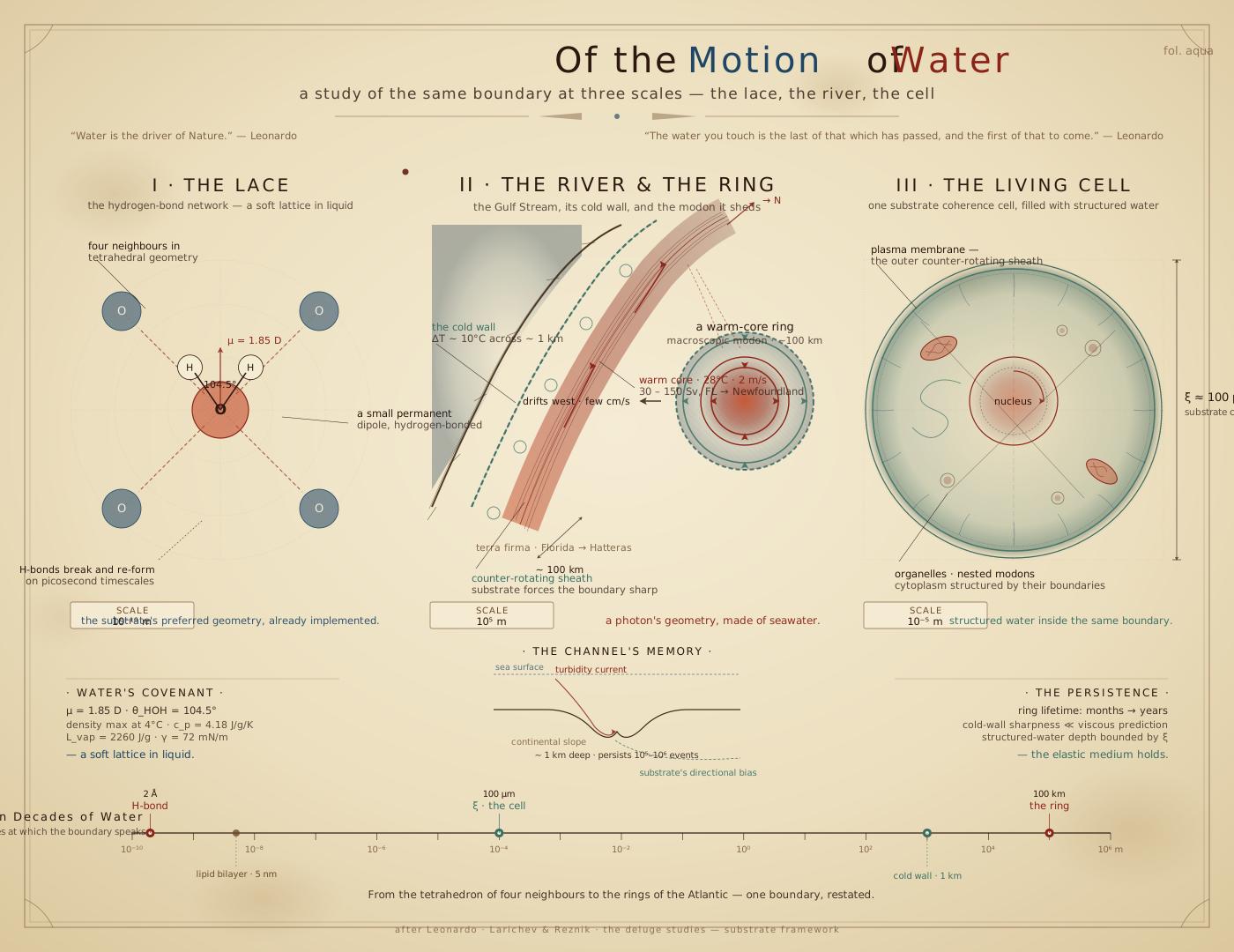
Interactive: open the water simulation — five views of the one claim, each with a “No substrate effects” toggle. The molecule.
A River Inside an Ocean
If you sail east out of Florida and cross the Gulf Stream, you pass — in the space of a few hours — from green coastal water at \sim 22°C to a deep cobalt blue at \sim 28°C, and from a confused chop to a long, organized swell. The wind has not changed. The bottom is the same. What has changed is that you have entered a current several hundred meters deep, \sim 100 km wide, moving at \sim 2 m/s, that travels from the Florida Strait to Newfoundland and then on to Europe, transporting an estimated 30–150 Sverdrups of water (1 Sv = 10^6 m³/s — for comparison, the Amazon’s flow is about 0.2 Sv at its mouth). It is a river inside an ocean, and once you are in it the boundary is sharp enough that the water on the other side is a different color.
The standard explanation for the Gulf Stream is correct as far as it goes. The Coriolis force, combined with the curl of the wind stress over the North Atlantic, drives a westward intensification of the subtropical gyre — most of the circulation’s volume is squeezed against the western continental boundary. Conservation of potential vorticity stabilizes the flow against perturbations, and Rossby waves carry away excess energy. None of this is wrong. What it does not explain is why the Gulf Stream’s boundary — the so-called cold wall on its inshore side — stays so sharp over thousands of kilometers despite continuous turbulent mixing with the surrounding sea. Viscous fluid dynamics predicts that boundary layers between two fluids of different temperature and momentum should broaden steadily as the flow proceeds, eventually dispersing into the surrounding water. The Gulf Stream’s boundary does not. It pinches off discrete coherent eddies — the Gulf Stream rings — and keeps right on going.
This chapter argues that the persistence is the substrate’s, that the same persistence is visible in submarine canyons cutting into the seafloor long after their density-driving rivers have mixed away, and that the same principle organizes the cytoplasm of every living cell. Water is, of all the materials we know, the one whose mesoscale flows most clearly carry the substrate’s organizational signature.
The Cold Wall as Substrate Boundary
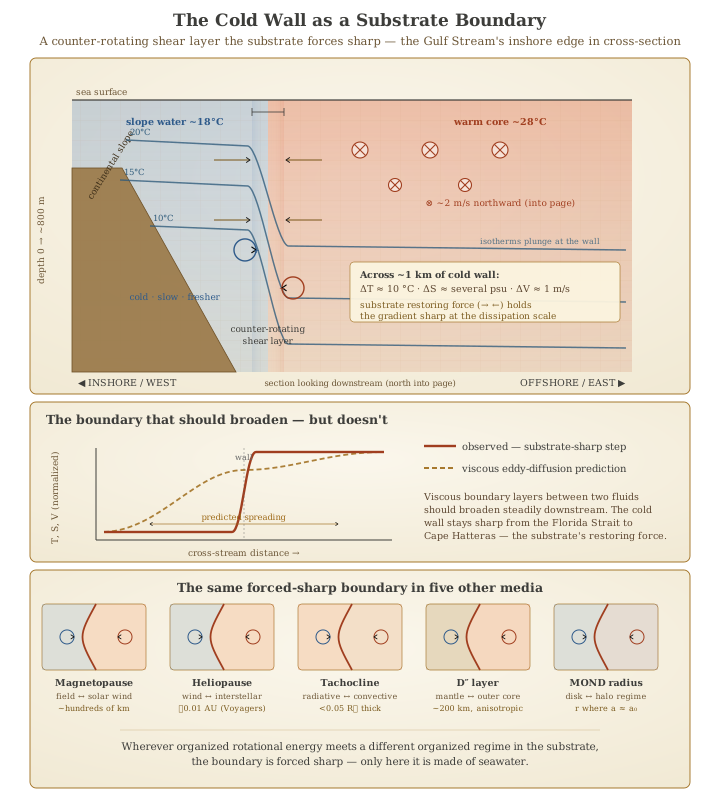
The cold wall in cross-section. Top: the Gulf Stream’s inshore edge looking downstream (north into the page). Isotherms run shallow over the cold, slow slope water on the west, then plunge across a \sim 1-km wall to lie deep beneath the warm core flowing north at \sim 2 m/s — a counter-rotating shear layer the substrate (faint lattice) holds sharp with an inward elastic restoring force. Middle: the central claim — the observed sharp step versus the broadened gradient that viscous eddy-diffusion alone would predict. Bottom: the same forced-sharp boundary in five other media, from the magnetopause to the MOND transition radius.
The feedback topology chapter shows that organized rotational energy in an elastic medium adopts the same architecture at every scale: a co-rotating disk, polar jets, a counter-rotating boundary sheath, and a residual radiated as waves. The Gulf Stream expresses this loop in seawater.
| Component | Gulf Stream |
|---|---|
| Co-rotating channel | Warm, fast, north-flowing core (\sim 2 m/s, \sim 28°C) |
| Counter-rotating boundary | The “cold wall” of slope water on the inshore (western) side — colder, slower, bordered by a sharp thermal/velocity gradient |
| Polar/lateral exits | Gulf Stream rings: warm-core eddies that pinch off southward, cold-core eddies that pinch off northward |
| Radiated output | Long-wavelength Rossby waves carrying energy and vorticity across the basin |
Across the inshore boundary of the cold wall, water temperature changes by \sim 10°C, salinity by several practical salinity units, and along-stream velocity by a meter per second, all over a horizontal distance of order a kilometer. That is sharper than turbulent eddy-diffusion estimates predict, and the sharpness persists from the Florida Strait north to where the current finally turns east of Cape Hatteras. The substrate framework reads this as a counter-rotating shear layer in an elastic medium — the same configuration that produces the heliopause’s \lesssim 0.01 AU transition observed by both Voyagers (solar system boundaries), the tachocline’s thinness inside the Sun, and the D″ layer’s organized anisotropy at Earth’s core-mantle boundary (gaia substrate). Wherever organized rotational energy meets a different organized regime in the substrate, the boundary is forced sharp.
The substrate does not offer a numerical correction but does offer a structural reason: the elastic medium provides a restoring force at the dissipation scale that resists the gradual broadening that viscous models predict. The cold wall shows substrate energy mediating between the two coherent fluid regimes. It is the same shape and pattern found in a planet’s magnetopause, a star’s tachocline, or a galaxy’s counter-rotating boundary at the MOND transition radius — only this time it is made of seawater.
Gulf Stream Rings as Macroscopic Modons
A photon, in this framework, is a counter-rotating vortex dipole — a modon in the substrate. The Gulf Stream’s most spectacular feature is that it sheds, on the order of a dozen per year, literal counter-rotating coherent vortex pairs into the surrounding ocean. A warm-core ring is a packet of subtropical Sargasso-Sea water that has been spun off into the colder slope-water region; a cold-core ring is the reverse — slope water encapsulated in the subtropics. Each ring is \sim 100–300 km across, extends to \sim 1000 m depth, rotates coherently for many months to a couple of years, and propagates westward at \sim a few cm/s. They are the largest spontaneously-formed coherent vortex structures on the planet.
In substrate language, a Gulf Stream ring is the closest macroscopic analog of a photon-modon the planet supports: a self-propelled, self-bound, counter-rotating circulation that propagates without dispersion through an otherwise unstructured medium. The ring’s longevity — months to years — is precisely the puzzle that motivates a substrate explanation. Ordinary turbulent ocean dynamics cannot account for why a \sim 100-km vortex in a strongly turbulent fluid does not shred itself in a week. The framework’s answer is that the ring sits at exactly the substrate-coherent scale (\xi \approx 100\;\mum at the lattice level, but boundary structures at every scale up to \sim L_\text{domain} are stabilized by the substrate’s elasticity) where the dissipation cascade is interrupted. The ring is a low-frequency modon in seawater — not a substrate modon (those propagate at c), but a fluid modon stabilized by the same boundary mathematics that fixes the Larichev-Reznik solution for the photon (emergent speed of light). The L-R modon was originally derived for ocean dynamics; the framework’s larger claim is that the same mathematics governs every scale at which a counter-rotating dipole propagates through an elastic medium.
Seen through the substrate ladder, the photon and the ring are the same paired-breath motif — a vortex trading energy with its counter-rotating partner across a shared seam — replicated across an enormous span of scale: the breath in the dc1 at \xi, the same breath hosted in seawater at 100 km. What differs is only the medium that carries it, and whether it sits on the substrate’s own \sqrt{2} tower (the photon, on a rung) or on a host-fluid scale far above that tower (the ring, sized by the Rossby radius, not by the lattice).
The long-term phenomenology supports this reading. The Loop Current in the Gulf of Mexico pinches off similar warm-core rings at irregular but multi-month intervals. Agulhas rings in the South Atlantic transport Indian Ocean water around southern Africa over years. Jupiter’s Great Red Spot — a single coherent vortex sustained for centuries against atmospheric turbulence — is the same phenomenon at planetary scale (solar system boundaries). Wherever a fluid develops a strong local rotation in an elastic medium, the modon topology offers it a long-lived steady state.
How a Modon Forms
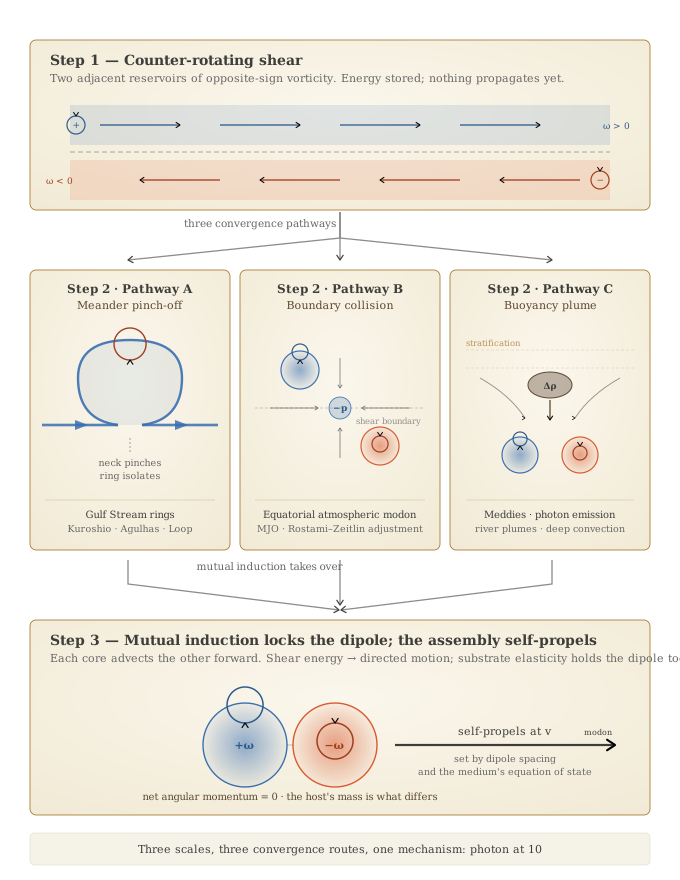
Three formation pathways for modons have entered the framework so far: the photon emission of photon as modon, the Gulf Stream ring shedding above, and the briefly-mentioned firestorm rotors and mesocyclone collapses of other chapters. Every one of them runs the same three-step sequence, and it is worth naming it explicitly here — both because the ocean is the cleanest place to watch all three steps happen, and because every later chapter can then point back to one mechanism instead of re-explaining it.
Step 1: Counter-rotating shear sets the field. A modon’s two cores carry opposite-sign vorticity. The starting state for forming one is therefore some region of organized counter-rotating shear — the Gulf Stream’s cold wall, a meander whose two flanks rotate oppositely, the equatorial atmosphere’s planetary vorticity gradient, two counter-rotating sheets in the substrate’s chirality-coherent lattice. The shear stores energy but does not yet propagate anything coherent.
Step 2: A convergence mechanism drives the two vorticity reservoirs together. What turns the static shear into a propagating dipole is something that pulls the two opposite-sign vorticity regions toward each other across the boundary that separated them. In the Gulf Stream this is the meander pinch-off geometry: a sufficiently exaggerated meander necks down to a closed bulge. In Rostami and Zeitlin’s equatorial atmospheric modon (treated in the air chapter), it is moist convection — condensation acts as a column-integrated mass sink, drawing inflowing air horizontally inward, and the Coriolis-deflected inflow wraps into a twin-cyclone dipole.1 In photon emission, the convergence is an atomic boundary collapse: a layered orbital boundary stops holding its counter-rotating dc1 layers apart, and the layers wrap each other into an emitted modon.
Step 3: Mutual induction locks the dipole and propagates it. Once the two opposite-sign vortices are close enough that each sits inside the other’s velocity field, mutual induction takes over. Each core advects the other forward at a speed set by the dipole spacing and the medium’s equation of state. The assembly self-propels as a single object, and the energy that was in the shear is now in the dipole’s translation. The shear has been consumed by the formation — coherent flow has converted shear energy into directed motion, with the medium’s elastic response (the substrate, in the framework’s reading) holding the dipole together against the dispersion that would otherwise pull it apart.
This is the mechanism. What matters for this chapter is that the sea offers three distinct convergence pathways for Step 2, each occupying a different region of the ocean and producing a recognizably different modon population.
Pathway A: Meander pinch-off
The Gulf Stream’s ring-shedding mechanism, treated above and recapitulated here for completeness. A coherent western-boundary current — Gulf Stream, Kuroshio, Agulhas, Loop Current — develops large-amplitude meanders driven by baroclinic instability. When a meander’s lateral excursion exceeds the local Rossby radius, the neck closes: the parent current short-circuits across the neck, and the bulge becomes an isolated ring carrying the original cold-wall counter-rotating shear as its own bounding sheath. The ring is born already substrate-locked, because the counter-rotation was already organized — pinch-off just folds it into a closed shape. Loop Current rings in the Gulf of Mexico, Agulhas rings shedding around southern Africa, and the Kuroshio’s ring-shedding events in the western Pacific are the three best-documented Pathway A populations.
Pathway B: Boundary collision and geostrophic adjustment
A westward-propagating Rossby-wave packet hits the seaward flank of a western-boundary current; a Rossby-wave train enters the gyre return flow; a coastal current rounds a cape into shallower water. The collision produces a localized pressure anomaly in a region of strong ambient shear, and what follows is the oceanic version of Rostami and Zeitlin’s geostrophic-adjustment scenario: weak anomalies radiate away as Rossby and Kelvin-equivalent waves, but strong-enough anomalies cross a threshold and wind into a coherent dipole via the mutual-induction step. Pathway B modons are typically smaller and shorter-lived than meander-pinch-off rings, and they are the framework’s natural reading for the persistent open-ocean mesoscale eddies that appear where wave packets meet organized boundary flows.
Pathway C: Buoyancy-driven adjustment
A localized density anomaly supplies the convergence directly through its buoyancy contrast: a river outflow plume entering shelf water, a meltwater plume from a calving iceberg, the Mediterranean Outflow tongue at \sim 1000 m depth in the North Atlantic, a Labrador Sea deep-convection chimney during winter. The density anomaly drives a baroclinic adjustment exactly parallel to the atmospheric moist-convective case, with density gradient playing the role of moisture (buoyancy sink ↔︎ mass sink). The cleanest examples are the meddies — submesoscale lenses of warm, salty Mediterranean water at thermocline depths in the North Atlantic, \sim 100 km in diameter, persisting as coherent counter-rotating dipoles for years and propagating westward across the basin long after the Mediterranean Outflow boundary that birthed them has dispersed. Meddies are the oceanic confirmation of Rostami-Zeitlin geostrophic adjustment in real seawater: a localized buoyancy anomaly wound into a coherent dipole that self-propelled across an entire ocean.
The substrate-locking threshold
Rostami-Zeitlin’s threshold in initial depression amplitude carries directly across the three pathways. In their atmospheric simulations, depressions weaker than \Delta H/H \approx 0.15 radiated as Rossby and Kelvin waves (the classical Gill scenario, no modon). Depressions in the band 0.15 < \Delta H/H < 0.175 produced transient modons that traveled briefly, then split, with the two cyclones drifting off the equator. Stronger depressions produced steady long-lived eastward-moving modons. The threshold is sharp and bistable — the substrate-locking behavior the substrate-locking number N_\text{lock} below predicts in its cleanest form. Below threshold, the convergence is too weak to wrap the dipole before it radiates apart as waves; above, mutual induction takes over and the modon locks in. The oceanic analog should be visible in the size and amplitude distributions of Pathway B and Pathway C modons — a bimodal split between “didn’t lock, radiated as Rossby waves” and “locked, propagating as coherent eddy,” resolvable against altimetry and Argo records.
Back to the photon
The photon-as-modon claim of the bridge equation and emergent speed of light chapters is the same three-step sequence applied at the substrate’s smallest length scale. The counter-rotating shear is the boundary between two chirality-coherent dc1 sheets. The convergence is an atomic transition’s boundary collapse, which stops holding the dc1 layers apart and lets them wrap each other into a dipole. The mutual-induction step locks the dipole at the speed set by the medium’s equation of state — c. That the photon is massless is the cleanest expression of the mechanism’s logic: the two vortex cores carry exactly equal and opposite angular momentum perpendicular to the propagation axis, so the dipole’s net angular momentum is zero. There is no rest-mass scale left over — only the translational momentum that emerged from the original shear. Gulf Stream rings carry seawater’s mass; equatorial atmospheric modons carry air’s mass; the substrate’s own modon has no host material to drag along, only its own counter-rotating dc1 vorticity that cancels exactly, leaving pure translational E = h\nu propagating at c.
The three-step mechanism is what makes “the photon is a modon” a substantive claim rather than an analogy. Every modon in the framework — from the substrate’s smallest to the ocean’s largest — is built by the same three steps. The photon’s distinguishing feature is only that the host medium provides no inertia for it to drag along.
Submarine Canyons and the Substrate’s Directional Memory
The feedback topology chapter introduced this briefly. It is worth developing here because submarine canyons are the planet’s clearest evidence that the substrate remembers which way water has been moving even after the water has forgotten.
Monterey Canyon, off the central California coast, descends to \sim 3{,}600 m below sea level — comparable in vertical extent to the Grand Canyon — and extends \sim 470 km offshore from its head near Moss Landing into the abyssal Pacific. It was originally cut by the Salinas River during glacial low-stand epochs when the river’s mouth lay much further west, but it continues to be deepened today by turbidity currents long after any density-driven Salinas-derived flow could possibly persist. The Hudson Canyon off New York extends \sim 600 km onto the continental rise; the Congo Canyon, the Amazon Fan, the Indus Fan show the same architecture. Each one is being actively maintained by sediment-laden density currents that follow the existing channel — even though, by the time those currents reach the abyssal plain, they should be statistically indistinguishable from the surrounding seawater.
The standard sediment-transport story has a missing piece. Once the density contrast that drives a turbidity current is gone, what tells the next current to follow the same path? The answer the framework offers is that the substrate’s local response to the previous flow biases the next one. A coherent current establishes a directional memory in the substrate — weak at any one location, but persistent over the channel’s length. The next current encounters slightly less effective dissipation along the established axis than across it. Over geological time the channel deepens, the bias self-reinforces, and a \sim 1-km-deep canyon is the steady state. This is the same mechanism that allows a meandering river on land to deepen its bed faster than it widens: the water “remembers” which way it was going, and so does the medium it moves through.
The connection to the Gulf Stream is direct. The cold wall is a directional memory in the substrate, sharpened by the continuous forcing of the current. The Gulf Stream rings are packets of that memory pinching off and traveling on their own. Submarine canyons are the geological time-integral of the same directional memory imprinted on the seafloor. They are three views of one substrate phenomenon: coherent flow leaves a coherence trace in the substrate, and that trace persists.
The standard answer is that turbidity currents periodically scour the channel. The framework’s addition is that the substrate’s directional bias along the existing channel makes scouring preferentially effective in the along-channel direction, while cross-channel sediment transport encounters slightly higher effective dissipation. The asymmetry is small at any one event, but integrated over 10^5–10^6 events it produces and maintains the canyon’s geometry against the leveling tendency of cross-shelf currents.
Water as the Substrate’s Preferred Fluid
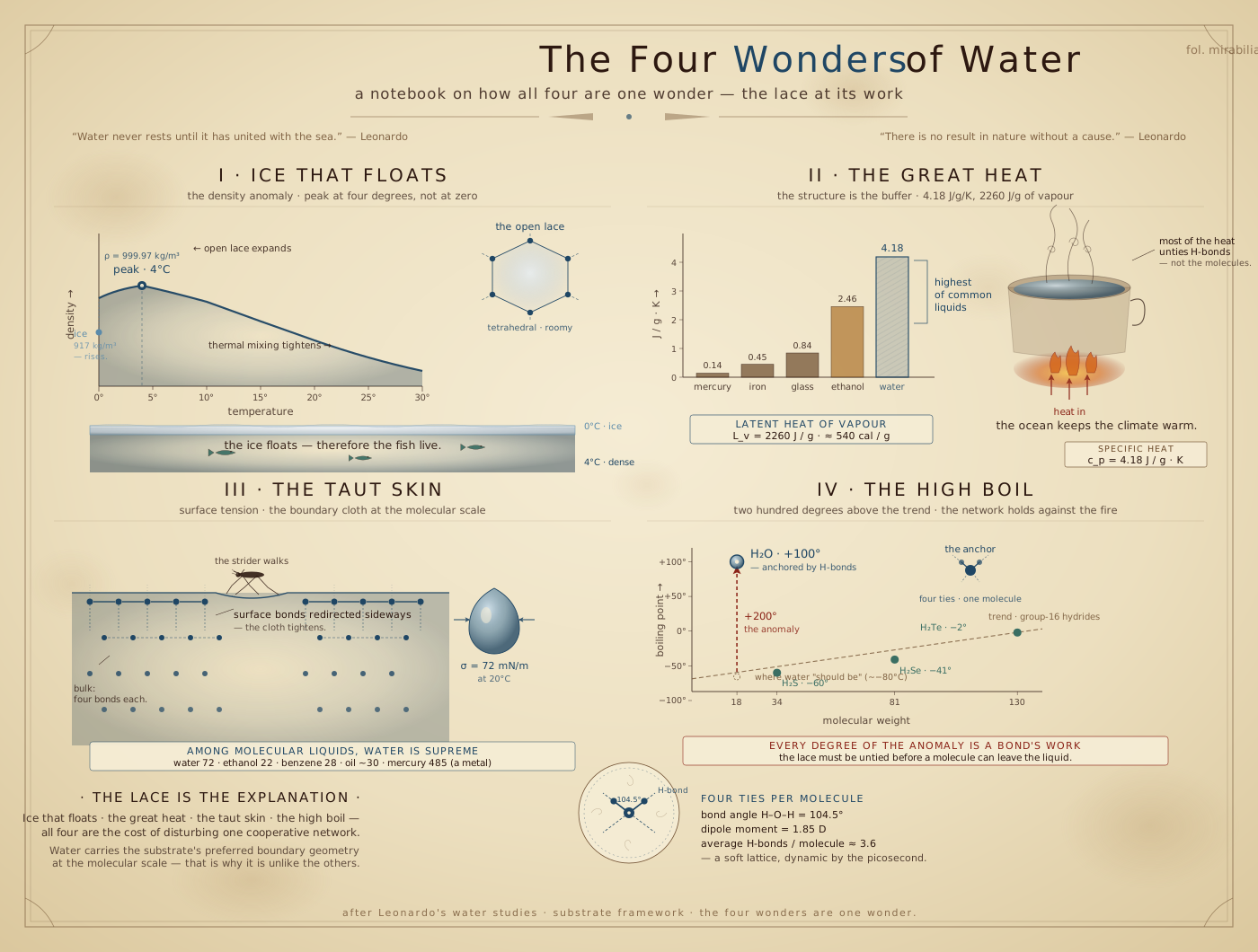
Why water? Of all the liquids the universe makes available, water has the most distinctive coupling to mesoscale structure. Its molecule is a small permanent dipole (bond angle 104.5°, dipole moment 1.85 D). Each molecule forms on average four hydrogen bonds with its neighbors, in a tetrahedral geometry that becomes nearly perfect in ice and remains substantially present in liquid water as a dynamically rearranging network. The result is a fluid that is itself a soft lattice — short-range structure persisting on picosecond timescales, longer-range structure persisting at interfaces and under shear.
The framework reads this as water being unusually well-matched to the substrate’s organizational preferences. The hydrogen-bond network is, structurally, a many-body counter-rotating boundary system: every donor-acceptor link is a flow tie-point (DNA chapter on H-bonds as substrate-flow tie-points) connecting two molecular boundaries. Liquid water is therefore an effective medium in which the substrate’s preferred boundary-stitching geometry is already implemented at the molecular scale — and it can be propagated coherently to larger scales because the mechanism is uniformly available.
A handful of water’s most distinctive properties read naturally in this light:
Density anomaly at 4°C. The maximum density of liquid water sits not at the freezing point but a few degrees above it. Standard explanation: a competition between the H-bond network expanding the structure (favored at low temperature) and thermal motion compressing it (favored at higher temperature). The substrate addition is that the H-bond network’s structure is the molecular-scale expression of a substrate-coherent geometry — the optimum for both energetic and substrate-organizational reasons coincides at 4°C, which is why the anomaly is sharp and reproducible rather than a vague crossover. Molecular-dynamics evidence for the “two-state” picture this presumes is now direct: an unsupervised deep-learning analysis of \sim 74 million local water configurations (TIP4P/Ice) resolves liquid water into two interconverting local structures — a denser, more disordered Structure A and a less-dense, more ordered (tetrahedral, ice-like) Structure B — with a genuine bistable liquid–liquid transition rather than a smooth gradient.2 Read through the substrate, Structure B is the substrate-preferred boundary geometry and Structure A its thermally-collapsed competitor, so the 4°C maximum is the population crossover between them — a true two-state competition, which is exactly why the anomaly is sharp. The same study’s finding that the A⇌B interconversion follows a different reaction pathway in each region of the phase diagram — a single-transition-state “semi-loop” deep inside either phase, and a three-transition-state “full loop” right at the liquid–liquid boundary where the two phases compete most — is the molecular-scale sibling of this chapter’s region-dependent modon-formation pathways: the same two-state motif, with the most complex (looped) pathway appearing exactly at the phase boundary, degenerating to a simpler one as a single phase takes over.
High heat capacity (4.18 J/g/K) and latent heat (2260 J/g of vaporization). Water stores and releases enormous amounts of energy per molecule because its H-bond network is a many-body coherent structure that has to be disrupted to change phase. From the substrate’s perspective, water carries unusually much energy per unit mass in its structure, not just in its molecular kinetic energy. This is also why the ocean buffers atmospheric temperature so effectively — the structure is the buffer.
Surface tension (\sim 72 mN/m at 20°C, second only to mercury). A water surface is a sharp boundary because the boundary itself is structurally cooperative: each surface molecule’s missing upward H-bonds force the remaining bonds to re-organize, producing a layer that resists deformation. The framework reads water surfaces as literal substrate-organized boundaries, of the same family as cell membranes and the cold wall of the Gulf Stream — just at the molecular scale.
Anomalously high boiling point. Compared to other group-16 hydrides (H₂S, H₂Se, H₂Te), water’s boiling point is \sim 200°C above where the molecular weight trend would put it. This is hydrogen bonding doing structural work. In substrate terms, breaking water apart requires undoing a coherent boundary structure, not just thermal kinetic motion of independent molecules.
Water is, in this reading, the substance the substrate finds easiest to organize at every scale from the molecule to the ocean basin. That is a strong claim. It would predict that water’s mesoscale flow phenomena — coherent currents, persistent eddies, sharp thermohaline boundaries — should be more pronounced and longer-lived than equivalent flows in other fluids of comparable viscosity and density. The empirical evidence is qualitatively in that direction (oceanic mesoscale eddies have no convincing analog in laboratory fluid systems other than rotating ones), but the framework does not yet have the apparatus to make this quantitative.
The Cellular Interior
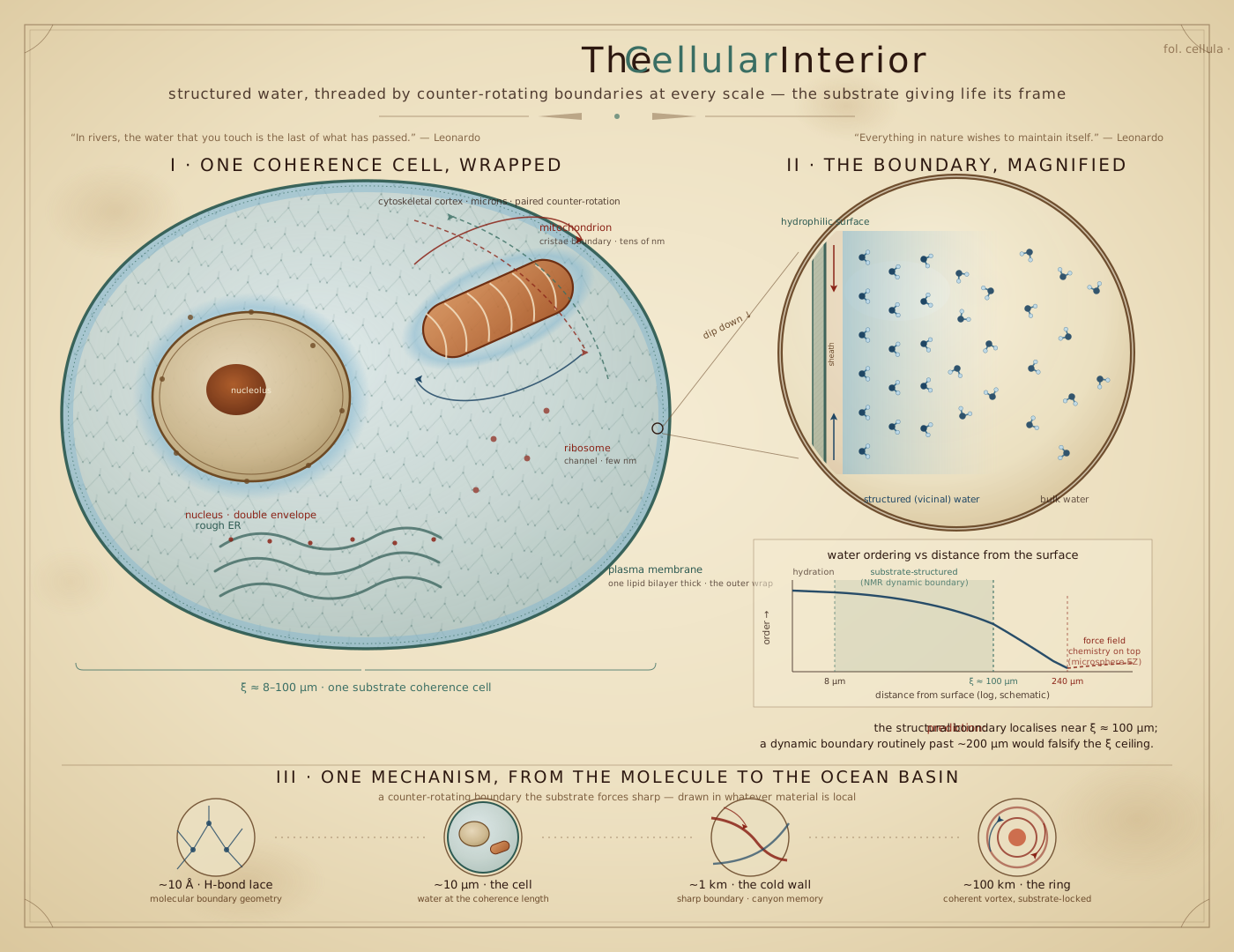
Take this all the way down. The cell is one organization inside each substrate coherence cell (\xi \approx 8-100\;\mum), wrapped by its plasma membrane, filled with water organized at every internal scale by the nested-modon architecture of organelles. Cytoplasm is not bulk water with biochemistry dissolved in it. It is structured water threaded by counter-rotating boundary flows at every scale from the membrane (one lipid bilayer thick) to the cytoskeletal cortex (microns) to the mitochondrial cristae (tens of nanometers) to the ribosomal channels (a few nanometers). At each scale, the boundary between organelles is a substrate-organized counter-rotating sheath, and the water on either side is structured by its proximity to that sheath.
That cascade of boundary scales — membrane, cortex, cristae, ribosomal channel — is the substrate ladder read into a single cell: a tower of nested preferred sizes, each a place where the same counter-rotating motif can live. Honestly, the cell’s spatial nesting is the ladder’s coarse family — the steps run \sim\!\times 6–12, not clean powers of \sqrt{2} (honest accounting) — so the firm claim is that the scales recur and nest, with whether they fall on a \sqrt{2} comb left for the cryo-EM size distributions to decide.
This is the same picture, applied to a 10\;\mum cell, that the previous sections applied to a 100-km Gulf Stream and a 1-km submarine canyon. In all three cases, the visible flow is organized by counter-rotating boundaries that the substrate forces sharp, and the persistence of the flow comes from the medium’s elasticity at the dissipation scale.
The biophysics literature has a contested concept — sometimes called exclusion-zone water, vicinal water, or interfacial water — describing a layer of structurally distinct water adjacent to hydrophilic surfaces, in which solutes are partially excluded and the optical and chemical properties differ from bulk. Some claims in this literature (extending such layers to hundreds of micrometers in pure water against a Nafion membrane) are controversial and not consistently reproduced. What the substrate framework predicts here is narrower and falsifiable: the depth over which water can be structurally organized by an interface should scale with the substrate-coherent length available to that interface, which in a cellular context is bounded above by the cell’s own coherence cell (\sim \xi, \sim 100\;\mum). Structured-water depths reproducibly approaching but not exceeding \sim 100\;\mum would be consistent with the framework. Reproducible depths much larger than that would be evidence against, because they would imply that water’s structural coupling to interfaces operates by a mechanism unrelated to the substrate’s coherence length.
Three Scales, One Mechanism
The composite picture:
| Scale | Phenomenon | Substrate role |
|---|---|---|
| \sim 10 Å | H-bond network in liquid water | Molecular implementation of substrate boundary geometry |
| \sim 10 μm | Cell cytoplasm, organized by membrane and organelle boundaries | Water structured at the substrate coherence length |
| \sim 1 km | Cold wall of the Gulf Stream; submarine canyon channels | Counter-rotating boundary forced sharp by substrate elasticity |
| \sim 100 km | Gulf Stream rings; Loop Current eddies; Agulhas rings | Macroscopic coherent vortex stabilized at large boundary scale |
| \sim 10 km wavelength | Rossby waves, planetary waves | Substrate’s preferred long-wavelength radiation mode for fluid systems |
The same mechanism operating at every scale, expressed in the local material the substrate has to work with — H-bonded molecular clusters at the bottom, organized cellular flows in the middle, oceanic boundaries and rings at the top. Water’s exceptional facility at mesoscale organization is, in this reading, the consequence of its molecular structure being unusually well-matched to the substrate’s preferred boundary geometry. Of all the fluids, it is the one most willing to carry a coherent boundary across many scales without losing the thread.
Substrate-Locked Length and Time Scales
The previous sections argued qualitatively that the substrate organizes water’s mesoscale flows. This section asks how far the argument can be pushed quantitatively using only the substrate constants already fixed by the bridge equation.
Three substrate length scales are available with no free parameters:
- \xi \approx 100\;\mum (the in-plane lattice cell, the cellular coherence length)
- \xi_\text{GP} = \xi/\sqrt{2} \approx 70\;\mum (GP healing length)
- d_\text{GJO} = \xi\sqrt{\ln(\xi/\xi_\text{GP})/(4\pi)} \approx 16\;\mum (inter-sheet period; counter-rotating boundary every d_\text{GJO}/2 \approx 8\;\mum — see constraint summary)
These three scales are the anchor rungs of the substrate ladder: \xi_\text{GP} \to \xi is the bare half-octave — the \sqrt{2} pairing rung itself — and d_\text{GJO}/2 \to d_\text{GJO}, the 8 \to 16\;\mum boundary-and-sheet spacing, is its octave. The substrate’s own ruler, the one biology reads when organelle and vesicle sizes cluster at \sqrt{2}-spaced rungs (walking the rungs), is laid out most plainly right here in water.
These pick out three elastic moduli via E = \rho_\text{DM}\,v^2, one for each of the substrate’s three propagation modes from the three-modes table:
| Modulus | Formula | Value | Mode it governs |
|---|---|---|---|
| Bulk-like | B = \rho_\text{DM}\,c^2 | 2.0 \times 10^{-10} Pa | Modon, sound, GW |
| Rotation-scale | K_\Omega = \rho_\text{DM}\,(\omega_0\xi)^2 | 1.4 \times 10^{-15} Pa | Lattice-vortex work |
| Tkachenko shear | G_T = \rho_\text{DM}\,c_T^2 | 1.8 \times 10^{-19} Pa | Lattice elastic shear |
All three are enormously smaller than water’s natural stress scales. Water’s bulk modulus is 2.2 \times 10^9 Pa; its thermal kinetic pressure at room temperature is \sim 10^8 Pa. The substrate’s strongest elastic modulus is nineteen orders of magnitude weaker than water’s weakest. This is forced by \rho_\text{DM} being tiny, and it has one clean consequence: the substrate cannot mechanically push water around.
What the substrate can do, and does, is couple to coherent vorticity through mutual friction. The dimensionless coupling \alpha_{mf} = 0.3008 — derived from the Weinberg angle in the fine structure constant chapter — sets the rate at which a coherent water vortex syncs with the substrate’s own vortex lattice. The sync time for an eddy rotating at angular rate \omega is
\tau_\text{mf} = \frac{1}{\alpha_{mf}\,\omega}
For a Gulf Stream ring with \omega \sim 10^{-5} rad/s (a rotation every \sim week), \tau_\text{mf} \approx 4 days — fast compared to the ring’s observed multi-year lifetime, slow compared to its rotation. The substrate has time to lock the ring without freezing it.
The crossover radius
The substrate locks an eddy when mutual friction couples in faster than viscous dissipation tears it apart. For an eddy of radius R in a fluid with eddy viscosity \nu_\text{eddy}, the dissipation timescale is \tau_\text{visc} = R^2/\nu_\text{eddy}. Demanding \tau_\text{mf} < \tau_\text{visc} defines the substrate-locking number
N_\text{lock} = \alpha_{mf}\,\omega\,\tau_\text{visc} = \alpha_{mf}\,\omega\,\frac{R^2}{\nu_\text{eddy}}
The crossover at N_\text{lock} = 1 separates the two regimes via a critical radius:
\boxed{\;R_\text{cross} = \sqrt{\frac{\nu_\text{eddy}}{\alpha_{mf}\,\omega}}\;}
Eddies smaller than R_\text{cross} dissipate before the substrate can lock them. Eddies larger than R_\text{cross} achieve substrate lock and persist far past their viscous timescale. For Gulf Stream conditions (\nu_\text{eddy} \sim 1 m²/s, \omega \sim 10^{-5} rad/s):
R_\text{cross} \approx 580\;\text{m}
So eddies above \sim 1 km should persist; eddies below should not. Gulf Stream rings at 100–300 km diameter sit far above the floor with N_\text{lock} \sim 10^4, consistent with their observed multi-year lifetimes. The same scaling, applied across the mesoscale eddy population with \nu_\text{eddy} from 0.1 to 10 m²/s, predicts a crossover floor in the few-hundred-meter to few-kilometer range. The prediction is a sharp lower edge on the size-lifetime joint distribution that should scale as \sqrt{\nu_\text{eddy}/(\alpha_{mf}\omega)} across different ocean regimes — different from the standard purely-viscous prediction, and falsifiable against the current Argo and altimetry record.
Bounds on substrate-organized boundary widths
The substrate cannot impose coherence below its own boundary half-period (d_\text{GJO}/2 \approx 8\;\mum) or above its in-plane lattice cell (\xi \approx 100\;\mum) within a single domain. So any substrate-organized boundary structure should occupy widths in the range
d_\text{GJO}/2 \;\lesssim\; \delta_\text{substrate} \;\lesssim\; \xi \quad\Longrightarrow\quad 8\;\mu\text{m} \;\lesssim\; \delta_\text{substrate} \;\lesssim\; 100\;\mu\text{m}
The literature on water near hydrophilic surfaces splits cleanly along the prediction’s two scales, with the upper bound requiring a distinction between two measurement modalities that the framework’s interpretation demands.
Below 8 μm — chemistry. AFM force-distance measurements on mica resolve 2–3 hydration layers at \sim 0.3 nm spacing, with no reproducible structured-water signal beyond \sim 1 nm.3 This is hydrogen-bond chemistry. The framework predicts the substrate is not active at this scale, and it is not.
Tens of micrometers to \sim 100 μm — dynamic-structural boundary, where the substrate sits. Bunkin et al. (2011), using NMR T₁ relaxation and self-diffusion measurements on Nafion-bead and cation-exchange-gel-bead packings, found water in interstitial regions of tens to hundreds of micrometers with dynamics distinct from bulk — diffusion coefficients reduced to 25–60% of bulk values.4 The bead-packing geometry conflates the boundary depth with the interstitial scale and does not directly resolve the substrate boundary from a single surface, but the result is consistent with substrate-organized water existing at the predicted 8–100 μm scale.
Beyond 100 μm — particle-exclusion force field, mixed substrate and chemistry. Pollack-style microsphere-exclusion zones (EZs), now replicated independently for highly hydrophilic surfaces, run from \sim 100 μm to \sim 240 μm. Wang & Pollack (2024) measured plant xylem EZs at 133 \pm 22 to 142 \pm 20 μm in most species, with pumpkin xylem reaching 240 \pm 56 μm.5 These widths exceed the framework’s \xi ceiling by 1.3–2.4×. The framework reads this as the substrate setting the static structural boundary at \sim\xi, with chemistry-driven effects — ionic concentration gradients, diffusiophoretic force fields, pH gradients (the basis of Schurr’s competing diffusiophoresis theory)6 — operating on top of the substrate-coherent region and pushing the force field further out without requiring substrate coherence at the extended range. NMR probes the substrate boundary; microsphere exclusion probes the integrated force field, which can be larger.
The testable refinement: for the same sample, the NMR-detected dynamic boundary should localize near \xi \approx 100\;\mum, while the microsphere-exclusion boundary extends further by an amount depending on surface chemistry and ionic strength. If the NMR dynamic boundary itself routinely sits at 200+\;\mum on a single hydrophilic surface — directly contradicting the dynamic-structural interpretation — the framework’s \xi ceiling is falsified.
The same dynamic-boundary window applies to other substrate-organized water structures inside cells: cytoskeletal channel widths, vesicle-membrane diffusion zones, the substrate-coherent component of biofilm interfaces.
L_\text{domain}: the substrate’s upper coherence cap
How do we map observed boundaries to quantitative predictions? Various scales are stiffened by the lattice boundaries but not defined by it.
Here’s the table showing the various boundary layers this produces:
| Boundary | Width | Source |
|---|---|---|
| Cellular structured water | \lesssim 100\;\mum | section above |
| Gulf Stream cold wall | \sim 1 km | this chapter |
| D″ layer anisotropy | \sim 200 km | feedback topology |
| Tachocline | \sim 2.8 \times 10^7 m | solar system boundaries |
| Heliopause | \lesssim 1.5 \times 10^9 m | solar system boundaries |
This is the scale over which the parallel-line direction (from the five-pillar argument) stays locally chosen — and the observed widths are responses of host media within a window from \xi to L_\text{domain}, with host-medium mesoscales (Rossby radius, ion inertial length, pressure scale height) selecting the actual widths and substrate stiffness enforcing sharpness against viscous broadening.
The cleanest zero-parameter route to L_\text{domain} is Allen-Cahn coarsening of substrate domains over a Hubble time. The parallel-line direction is a non-conserved order parameter, so the late-time scaling is L^2(t_H) \sim D \cdot t_H with t_H = 1/H_0 \approx 4.4 \times 10^{17} s and a substrate diffusivity D \sim v \cdot \xi set by one of the framework’s three propagation speeds:
| Speed scale | D (m²/s) | L_\text{KZ} today |
|---|---|---|
| Tkachenko shear (c_T = 9 km/s) | \sim 1 | \sim 6 \times 10^8 m |
| Outer rotation (\omega_0\xi = 800 km/s) | \sim 80 | \sim 6 \times 10^9 m |
| Quasiparticle (c) | \sim 3 \times 10^4 | \sim 1.1 \times 10^{11} m |
All three sit within one to two orders of magnitude of the heliopause’s observed \lesssim 1.5 \times 10^9 m width, with the Tkachenko-shear and outer-rotation choices bracketing it within a factor of four. The Tkachenko speed is the natural choice for orientation-angle dynamics — lattice-shear modes carry the orientation response — giving L_\text{domain} \approx 6 \times 10^8 m as the framework’s leading estimate. The heliopause is the unique observed boundary that approaches the cap; the cold wall, canyons, D″, and tachocline all sit far below it.
A second, smaller-cap candidate — now superseded. Earlier drafts raised a conditional two-tier picture in which a sparse “dag” species pinned the parallel-line direction, making the substrate fully coherent only within the inter-dag spacing L_\text{dag} \sim n_d^{-1/3} \approx 11\;\text{cm} (n_d = n_1/\nu \approx 800\;\text{m}^{-3}), with larger pinning-locked sub-domains averaging together up to the cosmological cap. That candidate depended on dag being a real orientation-pinning species. With dag retired (WIP-11) — the lattice is self-pinned by dc1’s logarithmic equation of state, with no second species — this sub-domain scale disappears, leaving the simpler reading: a single coherent domain from \xi up to L_\text{KZ}. Either way the leading estimate (Tkachenko coarsening, above) is unaffected.
The sharpened bound.
\xi \;\lesssim\; \delta_\text{substrate} \;\lesssim\; L_\text{domain} \approx 6 \times 10^8\;\text{m (Tkachenko-coarsening estimate)}
Cellular structured water (\lesssim 100\;\mum) sits within the substrate-coherent regime — the window remains d to \xi as derived above. The cold wall, canyons, D″, and tachocline (km to 10^8 m) sit far below the cap; their widths are set by host-medium mesoscales with substrate stiffness only enforcing sharpness. The heliopause width sits at the cap, within a factor of 2.4 of the Tkachenko-coarsening estimate — the framework’s closest cross-scale numerical match outside the existing eight bridge-equation domains, at a precision comparable to the MOND a_0 match.
The testable refinement: future Interstellar Probe sampling at different solar-cycle phases and heliographic latitudes [R104, R106] should find the density-jump scale clustering within 10^8–10^{10} m rather than scaling freely with local plasma conditions, with the precursor accommodation layers (the 1.5 AU plasma boundary upstream of V2 [R105], absent at V1) varying as host-medium responses on top. A heliopause boundary measured broader than \sim 10^{10} m at any solar-cycle phase would falsify the Tkachenko-coarsening interpretation; one consistently thinner than \sim 10^8 m would imply a different (slower) substrate diffusivity controls the cap.
What this derivation does not give
It does not predict the Gulf Stream cold wall’s \sim 1 km width. The cold wall sits well inside the substrate window — bracketed by \xi below and the Tkachenko-coarsening cap L_\text{domain} \approx 6 \times 10^8 m above — but the kilometre width itself is set by the host medium’s Rossby radius and shear-instability scales, not by the substrate. The framework’s claim about the cold wall remains structural — sharp because the substrate provides a restoring response, not a quantitative prediction of the kilometre scale. Same for the submarine canyons’ ~100 km cross-channel persistence and D″’s ~200 km thickness: well below the substrate cap, host-medium-driven.
It also does not predict water’s molecular-scale ratios (the 9% expansion on freezing, the c/a ratio of Ice Ih, the temperature of the 4°C density maximum). Those would require either a substrate-locked dimensionless ratio at the H-bond level — analogous to the B-DNA pitch-angle conjecture in DNA and the Living Lattice — or a substrate energy scale matched to H-bond chemistry. Neither is currently available.
Three directions to extend the reach
Pin the substrate diffusivity that fixes L_\text{domain}. The preceding subsection brackets L_\text{domain} to 6 \times 10^8–10^{11} m via Allen-Cahn coarsening of the parallel-line direction over a Hubble time. The Tkachenko-shear choice sits within a factor of 2.4 of the heliopause’s observed \lesssim 1.5 \times 10^9 m width — a real cross-scale match, but qualified by three open questions: (a) which substrate speed enters the diffusivity (Tkachenko vs outer rotation vs quasiparticle), (b) whether the coarsening time is one Hubble time or has been reset by a previous Big Bubble nucleation event (see the dark-energy crust), and (c) the dag-pinning hypothesis (Route A above), which would change the picture by introducing a smaller fully-coherent scale at \sim 11 cm. Resolving any of these would tighten the heliopause from a factor-of-three consistency check into a near-quantitative substrate prediction.
Find a substrate-locked dimensionless ratio in ice’s molecular geometry. The most plausible candidate is the c/a ratio of Ice Ih (1.628 vs ideal HCP \sqrt{8/3} = 1.6330, a 0.32% deviation — see Ice in the Substrate). A conjecture of the form c/a = \sqrt{8/3}\cdot g(\alpha_{mf}, f) would parallel the B-DNA pitch-angle conjecture. The 0.32% deviation is at bridge-equation precision, which is suggestive but not yet a derivation. The challenge here is that most of the effect is chemistry so the contribution of the substrate is hard to tease apart.
Test R_\text{cross} against the ocean-eddy distribution. The Argo float program and satellite altimetry record now resolve mesoscale eddies down to \sim 10 km with multi-year tracking. The framework’s prediction — a viscous-decay floor at \sim \sqrt{\nu_\text{eddy}/(\alpha_{mf}\omega)} that scales differently from the standard purely-viscous prediction — should be visible in the size-lifetime joint distribution as a separation between substrate-locked (long-lived) and viscous (short-lived) populations near R \sim 1 km. The same test applied to Loop Current rings, Agulhas rings, and Mediterranean meddies should show a consistent crossover floor with the same \alpha_{mf}.
Predictions
The water-specific predictions are mostly statistical or qualitative at present, but several can be sharpened with existing or near-future data.
Gulf Stream cold wall sharpness. The horizontal scale of the cold-wall transition (temperature, salinity, along-stream velocity) should remain narrower than viscous boundary-layer theory predicts at the relevant Reynolds number, with the gap widening at smaller-scale boundaries and shrinking at larger ones. The framework predicts that the boundary’s width is set by an elastic-medium stiffness rather than by turbulent eddy diffusion alone; high-resolution mooring arrays and underwater glider surveys can test this.
Gulf Stream ring lifetime distribution. The lifetimes of warm-core and cold-core rings should be longer than purely viscous decay would predict, with the longest-lived rings (those that propagate across the entire western North Atlantic) systematically larger than \sim 100 km in initial diameter. The same statistics applied to Loop Current rings, Agulhas rings, and Mediterranean meddies should show a consistent floor on lifetime that scales with size and an exponential tail beyond the viscous-decay expectation. Quantitatively, the substrate-locking crossover R_\text{cross} = \sqrt{\nu_\text{eddy}/(\alpha_{mf}\,\omega)} derived in Substrate-Locked Length and Time Scales sets a sharp lower edge on the size-lifetime joint distribution near \sim 1 km for Gulf Stream parameters, falsifiable against the current Argo and altimetry record.
Submarine canyon directional persistence. Where high-resolution bathymetry and multi-event turbidity-current monitoring exist (Monterey Bay’s MBARI deployments are the current best site), the direction of successive turbidity flows should align with the existing channel axis to a tighter tolerance than topographic steering alone explains. Cross-channel transport should be measurably suppressed relative to along-channel transport, even after accounting for the slope geometry.
Cellular structured-water depth, two-modality split. Cooperative organization of water near hydrophilic interfaces should split along measurement modality. Dynamic-structural boundaries (NMR T₁, self-diffusion, dielectric relaxation) should sit reproducibly within the window 8\;\mu\text{m} \lesssim \delta \lesssim 100\;\mu\text{m}, bounded below by the boundary half-period d_\text{GJO}/2 and above by the in-plane coherence cell \xi. Force-field boundaries (microsphere exclusion, particle electrophoresis, surface potential) can extend further via ionic and diffusiophoretic effects, with the ratio (force-field / dynamic-structural depth) running up to \sim 2.4\times and depending on ionic strength and surface chemistry. The clean test is paired NMR-and-microsphere measurements on the same Nafion or hydrophilic-gel sample. NMR-detected dynamic boundaries reproducibly above \sim 150\;\mum on a single hydrophilic surface would falsify the substrate-coherence interpretation of the upper bound.
Mesoscale eddy persistence as a function of fluid. Where laboratory analogs are feasible (rotating salt-stratified tanks, magnetohydrodynamic Couette flows), the persistence of coherent vortices in water should systematically exceed that of equivalent flows in non-hydrogen-bonded fluids of matched viscosity and density. The framework predicts a hydrogen-bond-network bonus for vortex stability that other fluids cannot access.
Bistability in Pathway B and Pathway C modon populations. Following Rostami-Zeitlin’s threshold structure for atmospheric moist-convective adjustment, oceanic modons formed by boundary-collision adjustment (Pathway B) or buoyancy-driven adjustment (Pathway C) should show a bimodal amplitude distribution rather than a smooth continuum. Events below threshold radiate away as Rossby-wave packets and Kelvin-wave-equivalent disturbances; events above threshold lock as coherent dipoles and propagate persistently. The clean test is the size-amplitude joint distribution of meddies in the Iberian Basin (decades of float-tracked record), Labrador-Sea-formed deep-water dipoles, and the open-Atlantic mesoscale eddy population: a gap at the threshold rather than a smooth tail. The same bimodality, with the same threshold structure as the atmospheric MJO described in the air chapter, would be substrate-shaped across both fluids.
The orthogonal order parameter in liquid water’s two-state structure. The deep-learning two-state analysis (Li et al. 2026, cited in Water as the Substrate’s Preferred Fluid) found that liquid water’s two local structures separate only along hidden characteristics nearly orthogonal to local density and potential energy, and the authors name decoding the physical meaning of those characteristics as the crucial open step. The framework predicts what that orthogonal axis is: a local boundary-coherence order — the tetrahedral, counter-rotating tie-point geometry that is the molecular-scale shadow of the substrate’s parallel-line orientation order parameter — which by construction is not a function of local density or energy, because the substrate organizes water along an axis it cannot mechanically push (its strongest elastic modulus is \sim 19 orders of magnitude below water’s bulk modulus; see Substrate-Locked Length and Time Scales). The testable content: (a) one of the two recovered hidden characteristics should correlate strongly with an independent local-tetrahedral-order metric (e.g. the q tetrahedrality parameter or a local H-bond-network coherence measure) while remaining near-orthogonal to density and energy; and (b) the A/B separation should appear as a genuine gap in that order parameter’s distribution — the molecular-scale instance of the same bimodality predicted for N_\text{lock} and for Pathway B/C modon populations above. A two-state structure whose hidden axes turned out to be simple monotone functions of density and energy, with no distinct tetrahedral-coherence component, would weaken the substrate reading of water’s structural anomalies.
Footnotes
Two papers establish the equatorial modon: Rostami, M. and Zeitlin, V., “Eastward-moving convection-enhanced modons in shallow water in the equatorial tangent plane,” Physics of Fluids 31, 021701 (2019) constructs the analytical asymptotic solution; “Geostrophic adjustment on the equatorial beta-plane revisited,” Physics of Fluids 31, 081702 (2019) shows the modon forms naturally from moist-convective adjustment of a localized pressure depression above a sharp threshold in initial amplitude.↩︎
Li, L. et al., “Molecular-level evidence for two structural states in liquid water from unsupervised deep learning,” Nature Physics (2026), DOI:10.1038/s41567-026-03301-8. The autoencoder was trained to reproduce local density and potential energy, then searched for hidden order parameters beyond them; the two structures separate only along characteristics nearly orthogonal to density and energy.↩︎
Peng, J. et al., “Atomically resolved interfacial water structures on crystalline hydrophilic and hydrophobic surfaces,” Nanoscale 13, 4034 (2021).↩︎
Bunkin, N.F. et al., “Impact of hydrophilic surfaces on interfacial water dynamics probed with NMR spectroscopy,” J. Phys. Chem. A 115, 12018 (2011).↩︎
Wang, Z. & Pollack, G.H., “Exclusion-zone water inside and outside of plant xylem vessels,” Scientific Reports 14, DOI:10.1038/s41598-024-62983-3 (2024).↩︎
Bunkin & Pollack, “Exclusion zone phenomena in water — a critical review,” arXiv:1909.06822 (2019). The review documents independent replication for Nafion-class hydrophilic surfaces and failed replications for Al and Zn surfaces, and surveys alternative theoretical accounts including diffusiophoretic mechanisms.↩︎