Vesicle Traffic and the Endomembrane Loop
The canonical feedback loop expressed as a directed fluid circuit
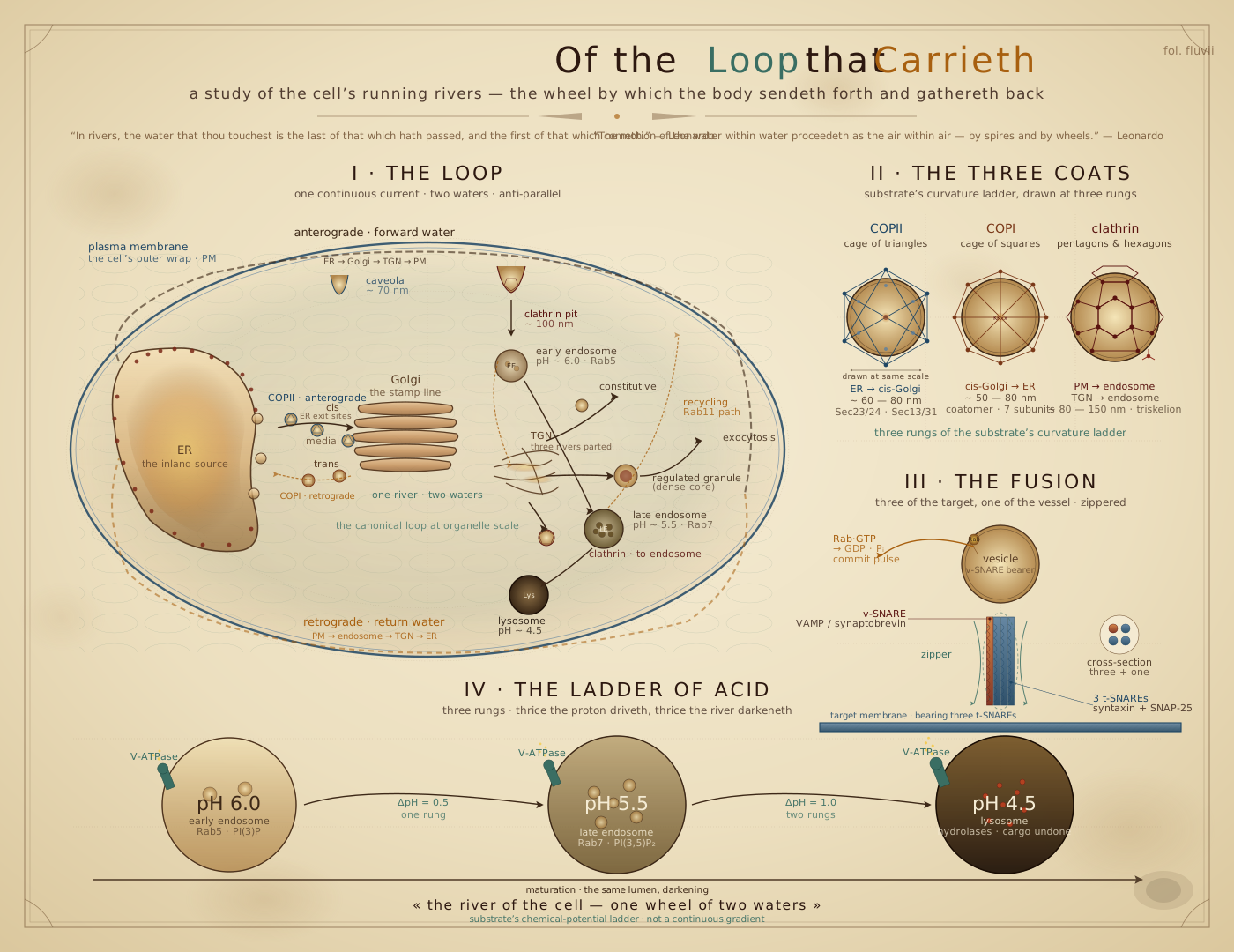
The endomembrane system of a eukaryotic cell is one continuous topological compartment, separated from the cytoplasm by a single bilayer wrap, distributed across a dozen named organelles and threaded together by an unbroken stream of 50–200 nm bilayer-wrapped vesicles. A typical mammalian cell has on the order of 10^5 vesicles in transit at any moment, with \sim 10^3 budding and \sim 10^3 fusing per second across the whole cell — a constant traffic of bilayer parcels carrying lipid, protein, ion, and small-molecule cargo from one compartment to another. The forward arm carries newly synthesised cargo from the ER through the Golgi to the plasma membrane (the secretory pathway); the reverse arm carries cargo from the plasma membrane back through endosomes to lysosomes or to the trans-Golgi network (the endocytic pathway); coupling lateral arms shuttle cargo back to the ER from the cis-Golgi (COPI-retrograde) and recycle cargo from endosomes back to the plasma membrane (recycling endosomes). The whole architecture is a single directed flow loop.
That loop has a two-lane median built into it. A directed circuit needs a forward and a return arm running anti-parallel, and the substrate already supplies the geometry: its chirality-coherent sheets are separated by counter-rotating intermediate layers (Substrate Particles § The Vertical Scale), a median whose two faces run opposite ways. The secretory and endocytic arms are that median’s two lanes at the endomembrane scale — the same two-lane road the mycorrhizal hypha rides and the vagus is plumbed as, here curled into a closed loop rather than stretched along a corridor. The cell runs \sim 10^3 outbound and \sim 10^3 inbound fusions per second through one architecture because the vacuum it threads already carries flow both ways.
The endomembrane vesicle traffic is the canonical feedback loop expressed in its most chemistry-conventional form — a literal directed fluid circuit, with forward and return arms anti-parallel and coupled, sub-modon parcels at discrete substrate-preferred radii, and boundary-matching fusion events that commit each parcel to its target. Where the ribosome chapter developed the canonical loop as three counter-flowing channels at the smallest modon, where the Golgi chapter developed it as stacked sheets with polar transport across them, this chapter develops it as the substrate’s offered architecture at its least disguised — the cell, having built the ribosome, the Golgi, and the ER, then runs a directed circulation around them and uses bilayer-wrapped parcels to carry the load.
The endomembrane loop runs as one continuous flow circuit, with vesicles as the parcels of cargo and lipid that move around it. This is the cell’s canonical loop in the most conventional fluid-flow sense: the ‘disk’ is the ER + Golgi stack; the ‘jets’ are the directed forward vesicle traffic; the counterflow is the endocytic return.
Vesicles as the Smallest Free-Floating Modons
A transport vesicle is a closed bilayer sphere, 50–200 nm in diameter, with a single luminal compartment and a coat of curvature-locking protein assembled on its outer surface during budding. Inside the cell it diffuses on the second timescale across distances of \sim 1\;\mum, walks on microtubules at \sim 1\;\mum/s when motor-coupled, and fuses with a target compartment when the substrate-matched SNARE pair finds itself opposite a complementary partner. A vesicle’s lifetime from budding to fusion is typically \sim 30 s to \sim 5 min.
The framework reads each vesicle as the smallest free-floating modon the cell hosts. Its bilayer wrap is the same counter-oriented sheet pair the plasma membrane chapter anchored — two leaflets back to back, hydrophilic heads outward on each face, hydrocarbon tails meeting at the midplane — at the smallest radius the substrate’s curvature ladder supports for a free sphere. The luminal compartment is topologically continuous with the outside of the cell across the entire secretory pathway, the same way the ER lumen and the Golgi lumen are: a vesicle that buds from the trans-Golgi network and fuses with the plasma membrane delivers its lumen to the extracellular space without changing the wrap’s direction. This continuity of wrap direction across the whole endomembrane system is what makes the loop one loop rather than a chain of bilayer-fission and bilayer-fusion events with no shared geometry.
Every other internal modon the nested-modon inventory lists — the nucleus, the mitochondrion, the cell itself — is anchored; a vesicle is the modon set free to move. The cell uses the same architecture at the same radius rung wherever it needs to send a stable parcel of bilayer-and-cargo across the cytoplasm without committing it to a fixed structural position. The framework’s reading is that the substrate offers this scale as a low-frustration sphere-modon configuration, and biology’s chemistry takes the offer at every place in the cell where mobile bilayer parcels are needed: secretion, endocytosis, organelle biogenesis, synaptic transmission, and the rest.
Coat Proteins as Substrate-Preferred Curvature Templates
The three major vesicle coat protein families select three discrete vesicle classes, each at its own preferred radius and each running between its own pair of compartments.
COPII (Sec23/24 inner coat, Sec13/31 outer cage). Coats vesicles budding from ER exit sites toward the cis-Golgi. Forms a cage of inner triangle-like Sec13/31 hetero-octamers that close into a triangulated polyhedron at \sim 60–80 nm vesicle diameter. Cargo-selective: ER-resident proteins are excluded; transit-marked proteins are concentrated by Sec24’s cargo-binding surfaces.
COPI (coatomer: α, β, β’, γ, δ, ε, ζ subunits). Coats vesicles budding retrograde from the cis-Golgi back to the ER, and intra-Golgi vesicles. Forms a cage at \sim 50–80 nm diameter with a triangular hetero-heptameric coatomer subunit. Cargo includes KKXX-tagged ER-resident proteins escaping into the cis-Golgi and being recovered.
Clathrin (heavy chain + light chain, organized as triskelions). Coats vesicles budding inward from the plasma membrane (endocytosis) and from the trans-Golgi network toward endosomes. Forms a cage of pentagons and hexagons — the substrate’s three-and-six-fold lattice expressed at the protein-cage scale — at \sim 80–150 nm vesicle diameter. The triskelion (three-legged hub) is itself a three-fold-symmetric unit at the cage’s repeat node.
Three coats, three preferred radii, three trafficking routes. The framework’s reading is that the coats are not arbitrary choices; they are biology’s chemistry-side implementation of the substrate’s discrete curvature ladder at the sub-organelle scale. The plasma membrane chapter’s curvature catalog listed inward dimples (clathrin-coated pits, \sim 100 nm), inward flasks (caveolae, \sim 60–80 nm), outward blebs (\sim 0.5–5\;\mum), and outward protrusions (filopodia, \sim 100 nm wide). Each preferred curvature corresponded to a substrate sub-domain scale; each was stabilised by a curvature-sensitive scaffold. The vesicle coats are the same architecture run into the cytoplasm — the chemistry-side scaffolds for the substrate’s preferred sphere-modon radii. Those preferred radii are rungs of the substrate ladder; because vesicle radii are reproducible to within a few percent, the COPII / COPI / clathrin sizes are the tightest test the cell offers of the sharp prediction — that successive coat radii are spaced by powers of \sqrt{2}. On the ladder’s reading a vesicle tuned to a preferred radius is not merely the right size but plugged into the substrate’s lossless channel — sitting where a paired breath can hold and hand off energy with least loss — which is the reading’s account of why a coat would converge on a rung at all. And because these radii are the resonant family’s cleanest members rather than the loose coarse family, the cryo-EM coat-radius distribution is the decisive comb test: folded against \ln\sqrt2, its peaks either land on the teeth or sink the rung.
The clathrin triskelion is the cleanest case. Its three-legged geometry is the substrate’s three-fold offering — already counted at the F_1 catalytic head, the microtubule’s 3-start helix, the ER three-way junction, the photon-modon’s vortex triple, and the ribosome’s three counter-flowing channels — applied at the cage-vertex scale of a curvature-locking lattice. The pentagon-and-hexagon coat tiling that results is exactly the tiling needed to close a sphere at the substrate’s preferred sphere-radius rung; the substrate offers, biology takes the offer, the cage closes at the radius the substrate supports as a low-frustration sphere.
The COPI and COPII coats are different chemistry-side implementations of the same substrate offer at a slightly smaller radius rung (\sim 60–80 nm versus clathrin’s \sim 80–150 nm). The substrate’s curvature ladder has more than one allowed sub-sphere mode at this scale, and biology has built one chemistry-side coat for each. The framework’s prediction — to which we return in the predictions section — is that the radius distribution across the three coat classes should cluster at substrate-preferred values rather than at chemistry-set continuous values, the same way the ER’s tubule-diameter distribution clusters at 30–60 nm and the Golgi’s cisternal-count distribution clusters at 5–6.
The Forward-and-Return Loop as Disk-and-Counterflow
The endomembrane system is not a one-way pipeline; it is a loop, and the loop has two anti-parallel arms.
Anterograde (forward). ER → cis-Golgi → medial-Golgi → trans-Golgi → plasma membrane / endosomes / lysosomes. Driven by COPII at the ER exit sites, by Golgi-internal traffic mechanisms (vesicular or cisternal-maturation depending on the model), and by trans-Golgi-network sorting at the last station. Carries newly synthesised secreted proteins, plasma membrane lipids, lysosomal hydrolases, and receptor populations to their working positions.
Retrograde (return). Plasma membrane → endosomes → trans-Golgi network → ER (via COPI from cis-Golgi, plus direct endosome-to-TGN paths). Driven by clathrin and other endocytic coats at the plasma membrane, by Rab5-coordinated endosomal maturation, and by COPI at the cis-Golgi-to-ER step. Carries receptors back for recycling, escaped ER-resident proteins, ingested extracellular material, and membrane lipid for redistribution.
The two arms are coupled — material flux in one direction must be balanced by flux in the other, or the compartments empty or burst. Live-cell imaging shows the balance maintained to within a few percent across normal-state cells; perturbations that disrupt one arm trigger immediate dysregulation of the other. The cell runs the loop, not the pipeline.
The framework reads the forward-and-return arm structure as the canonical loop’s disk-and-counterflow architecture expressed at organelle scale, in the most chemistry-conventional form the cell offers. The feedback-topology chapter gave the canonical loop as a co-rotating disk + polar jets + a counter-rotating boundary; the gaia-substrate chapter applied that loop to Earth’s nested layers; the cells-nested-modons chapter noted that the endomembrane system runs the same loop “in the most conventional fluid-flow sense.” This chapter is where that reading becomes mechanistic.
The “disk” is the ER + Golgi stack — the cell’s largest internal membrane plus its organelle-scale stamp line, together acting as the loop’s stationary structural core. The “jets” are the anterograde vesicle flux — discrete parcels of bilayer-and-cargo emerging from the disk and travelling outward to the plasma membrane and other consumers. The “counterflow” is the retrograde endocytic and COPI-retrograde flux — discrete parcels travelling back from the periphery toward the disk to replenish lipid, recover receptors, and balance the loop. The whole architecture is the canonical loop with vesicles as the substrate-current packets and motor-driven trafficking along microtubules as the directional transport mechanism the substrate’s offered geometry sits inside.
Three things follow from this reading. First, the cell’s vesicle-flux balance is not a homeostatic accident of opposing flows; it is the canonical loop’s required mass-balance, the same way the planetary canonical loops the gaia-substrate chapter develops require mass-balance to remain stationary. Second, blocking one arm should collapse the other on the coherence timescale of the loop (\sim minutes), not on the chemistry-of-depletion timescale (\sim hours) — a measurable distinction that the brefeldin-A literature already provides data for. Third, the loop should run faster in cells with higher metabolic activity (the loop’s “rotation rate” should track cell state), because the substrate-current density driving the loop scales with the cell’s energy throughput; the relationship between secretion rate and ATP availability gives the existing experimental access.
SNARE Fusion as Boundary-Matching
Every vesicle-target fusion event in the cell is mediated by a SNARE complex: a four-helix coiled-coil bundle assembled from one vesicle-resident SNARE (v-SNARE, usually VAMP/synaptobrevin family) and three target-membrane-resident SNAREs (t-SNAREs, usually syntaxin family + SNAP-25 family). Specific v/t-SNARE pairings select specific fusion routes — VAMP2 + syntaxin-1 + SNAP-25 for synaptic vesicle fusion at the presynaptic terminal, VAMP7 + syntaxin-7 + Vti1b for late endosome–lysosome fusion, and dozens of other combinations across the cell’s compartments. The specificity is so robust that the SNARE proteins themselves carry most of the “address” information for vesicle delivery; the cell’s compartmental identity is largely encoded in which SNAREs sit on which membrane.
The framework reads each SNARE-mediated fusion event as a substrate-matched boundary-matching event in the cells-nested-modons and endoplasmic-reticulum-contact-sites sense. A vesicle approaches its target compartment. The two bilayer wraps come within tens of nanometers. The v-SNARE on the vesicle and the t-SNAREs on the target hold complementary substrate stamps — the same kind of stamp the codon-stamp chapter develops at the smaller codon-anticodon scale and the Golgi TGN sorting section develops at the larger glycan scale. Matched stamps attract through the substrate; the substrate’s matched-stamp coupling pulls the wraps into the coiled-coil bundle; the bundle “zippers” from the cytoplasmic end toward the membrane and the two bilayers fuse.
The same architecture, three scales:
- Codon-anticodon at the ribosome A-site: three stacked codon vortices meet three stacked anticodon vortices, the substrate selects the cognate match at structural strength, the codon-stamp chapter gives the metric.
- Glycan-receptor at the TGN sorting station: the cargo’s accumulated glycan stamp matches the receptor’s substrate-readable pattern, the Golgi chapter gives the reading.
- SNARE bundle at the vesicle-target fusion site: the four-helix coiled-coil locks complementary substrate stamps across two wraps, the framework reads the bundle as the cell’s organelle-scale stamp-matching device.
The cell uses the same substrate-matched-stamp architecture at every scale where two coherent wraps need to find each other reproducibly. SNAREs are biology’s chemistry-side implementation of the architecture at the vesicle-target scale, the same way the M6P receptor is the implementation at the TGN-cargo scale and the anticodon loop is the implementation at the codon-recognition scale. The substrate’s role is constant across scales; the chemistry differs.
Matched-stamp recognition is the locking face of this architecture — and like every code the cell reads, it has an anti-locking face that is just as load-bearing. A cell running \sim 36 SNAREs and \sim 60 Rabs is operating a compartmental address space, and its survival depends on the opposite of resonance: each vesicle must fuse with its cognate target and with no other, so the addresses must stay mutually distinguishable or the cell’s compartments would bleed into one another. That is the anti-lock pole reached by the same labelling route the genetic code and the olfactory repertoire take, and the same split the Golgi’s glycan code and the genome draw: the machinery locks — the four-helix bundle ringing shut on its cognate match — while the address code it carries anti-locks, spread so that no two compartments read alike. SNARE-pair recognition and SNARE-repertoire distinctness are the lock and the gap of one system, exactly as a codon both binds its anticodon and stays distinct from every other codon.
The fact that SNARE coiled-coils are four-helix bundles — three target SNARE helices plus one vesicle SNARE helix — places the fusion machine’s geometry in the same three-plus-one configuration the aromatic-pocket chapter identifies for neurotransmitter recognition pockets (three aromatic walls + one positioning residue). The framework reads this as another expression of the substrate’s three-fold offering at a slightly elaborated scale: three “wall” SNAREs at the target provide the matched-stamp pocket, the one “key” SNARE on the vesicle threads into the pocket, and the substrate’s matched-stamp coupling commits the fusion.
The Endosomal pH Gradient as Polar Transport
Cargo internalised at the plasma membrane enters the endocytic pathway through early endosomes (luminal pH \sim 6.0), matures through late endosomes (\sim 5.5), and ends at lysosomes (\sim 4.5). Each transition is accompanied by changes in compartment-specific lipid content (PI(3)P at early endosomes → PI(3,5)P_2 at late endosomes), Rab-GTPase identity (Rab5 → Rab7), and luminal hydrolase activity. Sorting decisions happen at every transition: receptors destined for recycling are pulled back to the plasma membrane (Rab11 pathway), cargo destined for degradation continues forward toward lysosomes, cargo destined for the trans-Golgi network detours back to the TGN.
The framework reads the endosomal pathway as polar transport across a sequence of substrate-coherent compartments, the same architecture the Golgi chapter developed for cis → medial → trans cisternae, expressed here at the sub-organelle scale with chemistry-side stamping at each station.
The parallels are exact. The Golgi cis → trans gradient is a polar transport across stacked cisternae with glycosylation enzymes at each station reading the cargo’s current stamp and adding a layer. The endosomal early → late → lysosome gradient is a polar transport across spherical compartments with proton pumps, hydrolase activations, lipid kinases, and Rab-conversion events at each station reading the cargo’s current state and committing the next transition. Both are sequential modification lines run across substrate-coherent corridors. Both have substrate-pinned compartmental identities and chemistry-side machinery for committing each step. The Golgi runs its stamp line on cargo destined to leave the cell; the endosomal pathway runs its stamp line on cargo entering the cell and either being recycled, degraded, or redirected.
The polar transport reading the DNA chapter and the ER chapter and the Golgi chapter developed for those three readers therefore extends here as a fourth: the endosomal pathway is the cell’s fourth polar substrate-reader, running across a sequence of vesicle-derived compartments and reading the incoming cargo’s stamp at each station. Five substrate-readers in the cellular walk — DNA at the ångström scale, ER at the micrometer scale, Golgi at the organelle scale, the endosomal pathway at the sub-organelle scale, and the ribosome’s three-channel reader at the nanometer scale — together cover the geometric range the substrate makes available between the nucleotide and the organelle, with the endosomal pathway adding the inward arm of the cellular flow loop to a set that until now only covered the outward and the stationary readers.
The pH steps themselves — 6.0, 5.5, 4.5 — are the framework’s substrate-prediction handle. A continuous-acidification model would expect the cell to run a smooth gradient from neutral to maximally acidic; the cell runs discrete steps. The framework’s reading is that the pH steps are the substrate’s preferred chemical-potential rungs at this scale, the same way the plasma membrane potential sits in a narrow 60–90 mV band and the ER’s 5000\times calcium gradient sits at a substrate-preferred value. The chemistry of V-ATPase pump subunit composition does the implementation; the substrate’s offered ladder picks the values. This is a chemical-potential ladder, and an honest one: its steps — factors of \sim 3–10 in proton activity — put it in the ladder’s coarse family, where the firm prediction is that the values cluster across cell types while whether the spacing is a clean power of \sqrt2 is left open, the same caution the membrane potential carries.
Rab GTPases as Substrate-Current Commit Pulses
The cell hosts \sim 60 Rab-family GTPases, each compartment-specific. Rab1 marks ER-Golgi traffic; Rab5 marks early endosomes; Rab7 marks late endosomes; Rab11 marks recycling endosomes; Rab6 marks Golgi-to-plasma-membrane traffic; and several dozen others mark every specific trafficking step the cell runs. Each Rab cycles between an active GTP-bound state (in which it recruits effector proteins — tethers, motors, lipid kinases — that drive its trafficking step) and an inactive GDP-bound state (in which it is extracted from the membrane by a GDI chaperone and held in the cytoplasm until needed again). GTP hydrolysis is the irreversible commit event for each step.
The framework reads each Rab GTP hydrolysis as a substrate-current commit pulse, structurally identical to the EF-Tu and EF-G hydrolysis events at the ribosome. The ribosome chapter developed each ribosomal GTP hydrolysis as “one substrate-current pulse driving the structure through one coherence-boundary reconfiguration.” Each Rab hydrolysis is the same: one substrate-current pulse committing one trafficking step (vesicle uncoating, tethering engagement, fusion commitment, compartmental identity transition) by reconfiguring the local coherence boundaries on the substrate-current timescale.
The architectural reading the modon-to-ATP chapter gives for the Q-cycle as a gated-bifurcation node — one coherent input becomes two anti-correlated outputs — lifts here directly. A Rab GTP hydrolysis at a vesicle-target boundary is one coherent state (Rab-GTP held on the vesicle) becoming two anti-correlated outputs (committed fusion + released GDP·P_i). The hydrolysis is substrate-gated by the matched-stamp recognition between the vesicle and its target; non-cognate targets do not trigger it, cognate targets do, because the substrate’s matched-stamp attraction at the SNARE-bundle interface provides the coherence threshold that the Rab’s GAP (GTPase-activating protein) recruitment requires. The substrate decides; the chemistry executes. The cell deploys two GTP per amino acid at the ribosome and approximately one GTP per Rab cycle at every trafficking step, for the same architectural reason: a substrate-current commit pulse is the cell’s universal mechanism for converting a substrate-level matching event into an irreversible structural commitment.
The proliferation of Rab GTPases — \sim 60 family members in humans, with each marking a specific trafficking step — is then the framework’s prediction made retrospective. If every commit step in the endomembrane loop requires its own substrate-current commit pulse, and each commit pulse needs its own compartmental-specificity machinery (the Rab’s GTP/GDP cycle and its associated effectors), the cell’s evolution toward \sim 60 Rabs is the substrate’s commit-pulse requirement made chemistry-explicit at every node in the loop. Yeast cells run \sim 11 Rab homologs, multicellular animals run \sim 60; the expansion tracks the trafficking-route complexity at substrate-mechanism, not at protein-family random duplication, level.
Contact Sites and the Loop’s Internal Boundary Geometry
A vesicle does not travel through homogeneous cytoplasm. It travels along microtubules (kinesin-driven outward, dynein-driven inward), passing through a cytoplasm structured by the ER’s three-way-junction network, the actin cortex, the microtubule highways themselves, and dense protein-protein interactions throughout. Importantly, the loop’s vesicles repeatedly meet the other organelles at specific contact sites — ER-Golgi contacts, ER-endosome contacts, ER-PM contacts, mitochondria-ER MAMs — and the trafficking steps that happen at those contact sites are coordinated with the contact-site machinery the endoplasmic reticulum chapter developed.
The framework’s reading is that the endomembrane loop runs through the cell’s contact-site geometry, not around it. Each contact site is a boundary-matching position where the loop’s substrate-current density couples into the static modon framework — the ER, the mitochondrion, the plasma membrane — and the substrate-coherent state of the static modons can shape, gate, or commit the loop’s trafficking steps at those positions. The conventional reading of contact sites as lipid-and-ion exchange points is biology’s chemistry-side reading; the framework adds that contact sites are also the cell’s loop-coupling positions, where the rotating endomembrane fluid meets the stationary nested modons and exchanges substrate-current as well as chemistry-side cargo.
This makes one observable prediction. Disruption of a specific contact site (for example by knocking out STIM-Orai at ER-PM contacts, or by perturbing the MFN-mediated MAM contacts) should affect the trafficking through that region in a way that current contact-site literature would not necessarily predict from lipid-and-ion exchange alone. The recent contact-site-perturbation literature (\sim 2020 onward) is the test set; the framework predicts trafficking changes co-localised with contact-site disruptions at substrate-coherence-mediated strength.
Predictions and What Would Falsify
Four predictions extend the canonical-loop reading beyond the structural anchors.
Vesicle radii cluster on the substrate ladder. The radius distribution across all classes of cellular vesicles (COPI, COPII, clathrin-coated, secretory granules, synaptic vesicles, exosomes) should cluster at substrate-preferred rungs of the same standing-wave ladder the plasma membrane chapter predicts for raft sizes (\sim 25 nm, \sim 50 nm, \sim 100 nm bracketing the observed 50–200 nm range). Existing cryo-EM and electron tomography data are the reanalysable series; the framework predicts cluster positions on this specific ladder rather than a continuous distribution shaped by cargo and coat chemistry alone. Synaptic vesicles’ famous narrow size distribution (\sim 40 nm, \sigma \lesssim 5\%) is the cleanest existing data point in support; the prediction is that the larger vesicle classes also cluster on the same ladder.
SNARE-fusion fidelity tracks substrate-match, not just coiled-coil affinity. Engineered SNARE pairings with equal coiled-coil binding affinity but different substrate-coupling characteristics (perturbations to helix-helix register, hydrogen-bond geometry, or local charge distribution that change the substrate stamp without changing affinity) should show different fusion rates. The literature on non-cognate SNARE pairing in reconstituted liposome assays provides existing data; the framework’s prediction is a substrate-stamp-quality correlation analogous to the codon-stamp prediction for tRNA selection. Conventional kinetic-fit models predict fidelity to track coiled-coil affinity alone. The anti-lock face sharpens this into a second, structural prediction: across the cell’s full SNARE/Rab inventory, the non-cognate pairs that nonetheless mis-fuse should be exactly the stamp-similar ones, and the inventory should be arranged to hold the dangerous pairs — those bridging high-traffic, distinct-destination compartments — maximally stamp-distant, the trafficking analog of the genetic code routing its confusions onto synonyms. A repertoire whose mis-fusion errors fell on the most stamp-distant pairs, with no anti-correlation between stamp similarity and shared destination, would falsify it.
Endosomal pH steps cluster on substrate-preferred chemical-potential rungs. Across cell types and species, the early endosome (\sim 6.0), late endosome (\sim 5.5), and lysosome (\sim 4.5) luminal pH values should cluster at preferred values with low cross-species variance, not vary continuously with V-ATPase subunit composition. This is a coarse-family member: the firm claim is the cross-species clustering, while the inter-step ratio (factors of \sim 3–10 in proton activity) is not expected to be a clean power of \sqrt2. The existing pH-imaging literature across cell types provides the data; the framework predicts narrow clustering at the specific values that conventional models would predict to be tunable by chemistry alone.
Loop-imbalance recovery happens on substrate-coherence timescales, not on depletion timescales. Cells acutely treated with brefeldin-A (which blocks COPI-mediated retrograde traffic) should show downstream consequences for the anterograde arm on the \sim minutes coherence timescale rather than on the \sim hours lipid-depletion timescale. Live-cell imaging during acute brefeldin-A washout is the existing assay; the framework predicts coupling between forward and return flux at the loop-coherence timescale that mass-action depletion models do not.
The picture is falsified if (a) vesicle radii are smoothly distributed without preferred-node clustering on the substrate ladder, (b) SNARE-pair fusion fidelity is fully predicted by coiled-coil affinity alone, (c) endosomal pH values vary continuously with V-ATPase composition rather than clustering at preferred values, or (d) forward-and-return flux coupling occurs only on the slow depletion timescale and not on the faster substrate-coherence timescale. It is supported, even partially, if any of the four ordering predictions hold against existing data.
A note on what is not predicted. The Golgi chapter’s stamp-line reading offered a specific architectural claim — that the cisternal positions are substrate-pinned and that the cis → trans gradient is a polar substrate-reader at organelle scale — that the framework can defend without committing to a stamp-persistence conjecture. The vesicle-traffic chapter’s claims are even more chemistry-conventional. The endomembrane loop is a directed fluid circuit; the coats do select discrete radii; SNAREs do match v-and-t pairs; Rabs do commit each step with one GTP hydrolysis. The framework’s contribution here is structural reading and clustering predictions, not new mechanisms. The substrate hides least, and the canonical-loop pattern shows most, exactly because biology has already had to build the loop in the form the substrate offers.
Putting the Section in Context
The endomembrane vesicle traffic is the canonical feedback loop expressed in its most chemistry-conventional fluid-flow form — a literal directed circuit with forward and return arms anti-parallel and coupled, sub-modon parcels at discrete substrate-preferred radii, SNARE-mediated boundary-matching fusion events at every delivery node, and Rab-GTP-hydrolysis commit pulses driving every step. The “disk” is the ER plus Golgi stack at the loop’s stationary core; the “jets” are the anterograde COPII-and-clathrin-coated vesicle traffic; the “counterflow” is the retrograde COPI-and-clathrin-coated endocytic and recycling traffic. The whole architecture is the canonical loop at organelle scale, in the cell’s most conventional fluid-flow form, with chemistry running the chemistry and the substrate offering the topology the chemistry runs on.
The cellular walk has now developed five substrate-readers — DNA’s polar channel, the ER’s three-way-junction network, the Golgi’s stacked stamp line, the endosomal pathway’s acidification gradient, and the ribosome’s three-channel fluid-flow stamper — and five canonical-loop expressions — the ribosome’s three counter-flowing channels, the F_0F_1 rotor’s gated-bifurcation node, the Golgi’s polar stamp line, the endomembrane loop’s literal fluid circuit, and the cell-scale nested-modon stack as a whole. Each has chemistry-side machinery biochemistry has worked out in detail; each has a substrate-side reading the framework adds; and each runs the same architectural motif (polar transport across a substrate-coherent corridor; counter-rotating disk and counterflow; matched-stamp recognition between coherent wraps) at its own scale. The cell is not a dozen machines that happen to share motifs. It is one substrate-organisation principle expressed a dozen times, with the chemistry varying because the available chemistry differs at each scale.
The next chapter — the nucleus and its envelope — picks up from where this loop’s anterograde arm originates: the nuclear envelope is continuous with the ER’s outer surface, and the nuclear pore complexes are the cell’s regulated jet-like transport sites at the largest internal modon. The double-membrane wrap, the pore-complex architecture, the lamina-cortex pair, and the nucleolus as a ribosome-assembly sub-modon together complete the picture of the cell’s innermost modon as the same canonical loop expressed at the highest substrate-coherent compartment the cell hosts. The chapter after — mitochondrial anatomy beyond the rotor — closes the energy organelle the modon-to-ATP chapter opened; the chapter after that — cilia and flagella — closes the cellular walk with the cell’s only outward-extending polar jets, the canonical loop’s external arm.