From Photon to ATP
Energy capture as modon splitting
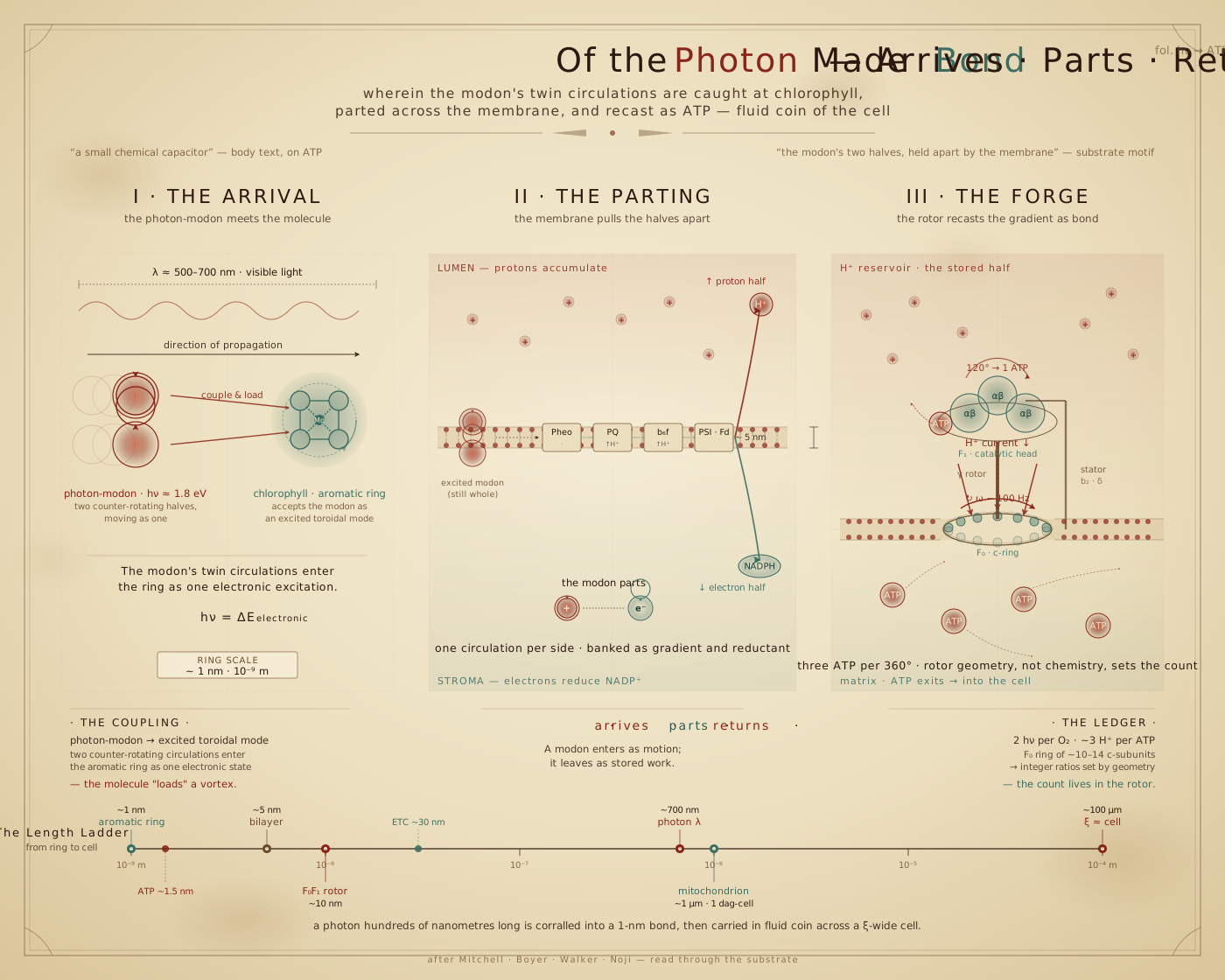
Interactive: open the photon-to-ATP simulation — the bacterial reaction center at unit = Å, a photon-modon arriving at the special pair and its two halves leaving in opposite directions: the electron half down the L branch on the measured 3 ps / 1 ps / 200 ps clock, every step downhill and the 0.4 eV drop at H → Q where the halves are irrevocably apart, the hole half to the periplasmic face; \Phi counts up toward 1.02. Put the same modon on an isolated chlorin and it flares and re-pairs (fluorescence, yield 0.32) or dissipates — nothing banked. The rotor spends the halves: protons through the two half-channels step the c-ring, γ turns, the three β sites pass open → loose → tight, three ATP per turn whatever c is; set c = 14 for the chloroplast’s 4.67 H⁺/ATP against the measured 4.0, or reverse the proton-motive force and run it as a pump.
A photon is a modon — a counter-rotating vortex dipole carrying energy h\nu in its dual circulation. An aromatic ring is a toroidal vortex — a closed substrate raceway that the photon can couple into. A cell is a nest of modons wrapped one inside the next, with rotors at the inner-membrane scale that convert substrate currents into stored chemical work. The question this chapter answers is what connects the three: how the substrate’s smallest propagating excitation is delivered to the cell’s smallest persistent one, and what biology has built in between.
The answer the framework reads off the photosynthetic and respiratory apparatus is structural and direct. The cell’s energy economy is the substrate’s modon ledger: photons arrive as modons, are split spatially into their two counter-rotating halves at a reaction center, are banked separately as a proton gradient and a reduced electron carrier, and are spent back through a rotor whose threefold catalytic head reassembles them into the phosphate bond of ATP. That ledger is the cellular face of the substrate ladder’s economy of energy. The ladder reads the lattice’s anti-phase breath — a paired vortex trading energy across its shared seam without loss — as a coin the substrate mints and chemistry learns to spend; thermal dynamics spends it as heat, lightning sheds it as a gamma ray. This chapter is where a cell coins it: the photon arrives as one breath of that currency, is broken in two for safekeeping, and is re-struck as a small chemical coin the cell can carry. Each step has a structural reading the framework already supplies from elsewhere in the paper. Each step also has a public experimental anchor sharp enough to read against.
This is the third worked example of the “Life in the Substrate” section, structurally parallel to the codon stamp (information read across a triplet), the aromatic pocket (chemistry read across a cage), and the microtubule cylinder (geometry read across a closed wall). Here the object is energy read across a chain of boundary-matching events.
The Arc in Three Steps
The energy ladder of a photosynthetic cell, expressed in substrate-physics language:
- Photon arrives. A modon couples its two counter-rotating circulations to the toroidal raceway of a chlorin macrocycle in a chlorophyll molecule. The chlorin is a branched toroidal antenna — its ring current is measurably stronger than benzene’s, and its four-pyrrole topology gives the modon four parallel branches to load into rather than the single ring of the simpler aromatics.
- Modon is split. The excited chlorin couples into the protein-organized cofactor chain of a photosynthetic reaction center. The reaction center pulls the modon’s two halves apart geometrically — one half walks down a chain of acceptors as a reduced electron carrier, the other half is banked across the thylakoid membrane as a proton gradient. The split is gated and quantum-yield-near-unity: the modon does not fluoresce back, it commits to spatial separation.
- Modon is spent. The proton gradient flows back through the F₀ ring of ATP synthase, driving the rotation of the F₁ catalytic head. F₁’s threefold symmetry produces exactly three ATP per full rotation, regardless of organism. The c-ring count of F₀ varies (c8 in mammalian mitochondria, c14 in chloroplasts) and acts as an impedance match between F₁’s fixed catalytic step and each organism’s local proton-motive-force composition.
The respiratory chain runs the same architecture without the photon step — the reducing equivalents come from glucose oxidation rather than from chlorin antennas, but the modon-splitting step is conserved, with Complex III’s Q-cycle as a second instance of the gated-bifurcation pattern that the reaction center already demonstrates. The rotor is the same.
The rest of this chapter takes each step in turn, anchors it against the cleanest published numbers, and notes where the framework’s reading is structural-only versus where it makes a sharp prediction.
Chlorin as a Branched Toroidal Antenna
The aromatic-rings chapter developed the substrate picture of an aromatic ring as a closed toroidal raceway whose strength is the ring current measured in NMR by the magnetically induced current density1. Benzene’s current density sits at \sim 12 nA/T; chlorins — the macrocycle class chlorophyll belongs to — sustain \sim 19–24 nA/T, a factor of 1.5–2× stronger than benzene’s. Porphyrins (free-base and metalloporphyrins, including the iron-coordinated heme of cytochromes) sit higher still. The per-pigment toroidal amplitude is not an unknown the framework has to fit; it is published.
What is not a clean copy of benzene is the topology of the current. The textbook “18-π annulene” pathway is wrong in detail. Fliegl and Sundholm’s gauge-including current density resolves the chlorin macrocycle’s ring current into four parallel branches, one per pyrrole, with the inner N–H protons of the macrocycle bypassed rather than crossed. Chlorophyll a breaks the four-fold symmetry further by saturating ring D, and the Mg²⁺ ion pulls electron density out of the plane without compromising planarity enough to break aromaticity.
The substrate reading is direct, and it sharpens the aromatic-pockets-style stamp machinery into the right form for porphyrins. A chlorin’s substrate profile \phi_\text{chlorin} is not a single toroidal lobe over the ring centroid but a four-petal branched profile, with one lobe per pyrrole and an inner-N axis along which the proton density (or the Mg²⁺ density in chlorophyll, or the Fe²⁺/Fe³⁺ density in heme) acts as a re-routing point rather than a current path. The dominant lobe pattern is then asymmetric in chlorophyll a (three full pyrrole lobes + one reduced one for ring D) and symmetric in free-base porphyrins (four pyrrole lobes). Bacteriochlorin — with two reduced rings — splits further into a two-strong-two-weak quadrupolar pattern. Each variant carries a distinctive substrate signature that the per-residue vortex profile machinery of the aromatic-pocket section can already compute, once the four-petal correction is wired into scripts/aromatic-pocket/.
This is the entry point for the photon. A modon arriving with quantum energy comparable to the chlorin’s lowest excited transition (the Q_y band, \sim 1.85 eV for chlorophyll a) finds a toroidal raceway four times larger than a benzene ring and 1.5–2× more strongly conducting. The modon couples into the chlorin’s excited toroidal mode (the \pi \to \pi^* transition is, in this language, the modon loading the macrocycle’s branched raceway with an additional unit of circulation) and the chlorin sits in its excited state at the substrate-equivalent of a charged capacitor — boundary topology unchanged, internal raceway loaded. In the ladder’s terms the chlorin is a lock-pole antenna: an aromatic ring is the molecular archetype of a structure plugged into the substrate’s lossless channel — its diamagnetic ring current is that channel at its smallest closed instance — and chlorophyll is the same raceway widened and strengthened to catch a propagating breath. The charged capacitor is the coin captured but not yet spent.
What happens next depends on what the chlorin is embedded in. If the chlorin is isolated in solution, the loaded modon comes back out as fluorescence, slightly red-shifted by vibrational losses. The fluorescence quantum yield of chlorophyll a in solution is \sim 0.32. If the chlorin is embedded in the protein-organized cofactor chain of a reaction center, the loaded modon takes a different path — it splits.
Worked Example: The Bacterial Reaction Center
The cleanest published case of modon-splitting at a photosynthetic reaction center is the bacterial RC of Rhodobacter sphaeroides. Of the four candidate systems — bacterial RC, Photosystem I, Photosystem II, and the FMO antenna complex — it is the only one with all four of: a high-resolution crystal structure since 1985, a kinetically clean three-step cascade with sharply separated timescales, a quantum yield statistically indistinguishable from unity, and no antenna-trapping or oxygen-evolving-complex confound2. PSII drags in the Mn₄CaO₅ oxygen-evolving complex and unresolved questions about the P680 multimer; PSI drags in three iron-sulfur clusters and an antenna heterogeneity that the bacterial system avoids; FMO is an antenna complex, not a reaction center, and post-2017 corrective work has retracted the long-lived electronic-coherence picture it was famous for (see the FMO sidebar below).
The bacterial RC binds six chromophores in a roughly two-fold-symmetric arrangement across L and M protein subunits: the “special pair” P of two bacteriochlorophylls, two accessory bacteriochlorophylls (B_L, B_M), two bacteriopheophytins (H_L, H_M), two quinones (Q_A, Q_B), and a non-heme iron. The kinetic cascade after photon absorption3 ^{,}4:
| Step | Process | Timescale |
|---|---|---|
| 1 | P^* \to P^+ B_L^- | \sim 3 ps |
| 2 | P^+ B_L^- \to P^+ H_L^- | \sim 1 ps |
| 3 | P^+ H_L^- \to P^+ Q_A^- | \sim 200 ps |
The quantum yield of stable P^+ Q_A^- formation per absorbed photon is \Phi = 1.02 \pm 0.04. Three timescales spanning two hundred picoseconds, one structure, no antenna confound, yield indistinguishable from unity. This is the worked example.
What the substrate framework reads off
The bacterial RC’s geometry is the cleanest physical realization of the modon-splitting picture available. Three structural facts carry the framework’s reading.
One: the two halves of the modon depart in geometrically opposite directions. The L and M subunits are arranged in a near-twofold symmetric pseudo-C₂ axis across the special pair. The electron half of the modon walks down the L branch — through B_L, H_L, to Q_A — while the proton half rests at the special pair as P⁺ until it is reduced from the periplasmic side by cytochrome c₂, and is ultimately delivered as a proton to the cytoplasm via Q_B and the Q-cycle of Complex III (the bc₁ complex in this organism). The geometric opposition between the two product channels is structural, not chemical: the protein has placed the acceptor cofactors on one side of the special pair and the donor cofactors on the other, and the modon’s two counter-rotating halves are advected into the two opposite channels. In the ladder’s reading these two halves are the lattice’s anti-phase breath pulled apart: a photon is the paired vortex set propagating (the breath let loose to travel), and the reaction center’s geometry drives its two counter-rotating circulations into opposite channels — charge separation is un-pairing the breath.
Two: the cascade is “downhill” in free energy at every step. Each step in the 3 ps / 1 ps / 200 ps chain is energetically favorable by at least kT at room temperature, with the largest drop (\sim 0.4 eV) at the P^+H_L^- \to P^+Q_A^- step where the modon’s two halves become irrevocably separated by the membrane geometry. The framework reads the free-energy bias as the substrate’s preference for the lower-coherence-cost configuration: each step closes one boundary that was open, and the substrate pays for the closure with the released energy. The modon does not “decide” to commit to charge separation; the substrate-thermodynamic landscape has been built such that the committed state is the substrate-minimum-energy one.
Three: the A-branch–vs-B-branch asymmetry is structural. Despite the near-twofold symmetry of the cofactor placement, primary charge separation runs almost exclusively down the L branch (the “A side”) and not the M branch (the “B side”). The conventional explanation is the small asymmetry between the L and M proteins around the special pair. The framework’s structural reading is the same one the codon-stamp section gives for why one tRNA wins the A-site over a near-cognate: the substrate selects the configuration that closes the boundary most smoothly, and small structural asymmetries amplify into binary directional preferences when the underlying coherence event is sensitive to them. The A-branch is the substrate’s preferred channel because the L-protein’s local environment is the one that closes the boundary; mutations that increase B-branch yield (Heller et al. and follow-ups) shift the framework’s prediction in proportion to how much they restore symmetry of boundary closure on the M side.
What is anchored, what is conjectured
The 3 ps / 1 ps / 200 ps cascade and the \Phi = 1.02 yield are anchor numbers — published, replicated, and unambiguous. The structural reading above is what the framework adds: an identification of the kinetic cascade with substrate boundary-matching events at three nested timescales. What the framework does not yet do is compute the timescales from substrate parameters. The hooks for such a computation are clear — the local chlorin-to-bacteriopheophytin distance, the bacteriopheophytin-to-quinone distance, and the protein-mediated reorganization energies are all measurable from the PDB, and the framework’s own scale parameters (\xi, d, \alpha_{mf}) bracket the relevant ranges — but the rate constants themselves are at present an anchor, not an output.
The directional binary (A-branch wins over B-branch by \sim 200{:}1) is the cleanest place where the framework makes a sharp structural claim that disagrees with a purely chemical reading. Mutational studies that restore B-branch competence (Heller et al. 1995 Science, Kirmaier et al. on the L181/M210 mutant series) provide the data series. The framework’s prediction is that B-branch yield should track an independent structural measure of boundary-closure symmetry on the M side — not simply the energetics of the M-side cofactors.
The Q-Cycle: A Second Modon Splitter
The reaction center is the most photogenic instance of modon splitting, but it is not the only one. Complex III (the cytochrome bc_1 complex in respiratory chains, b_6f in photosynthetic ones) implements a second instance of the same architecture without a photon. It is the Q-cycle of Mitchell and Crofts5, updated with the modern obligate-bifurcation accounting of Buckel and Thauer6.
The mechanism. Ubiquinol (the reduced form of ubiquinone, with two electrons) enters the Q_o site of Complex III. Its two electrons are forced down divergent paths: one through the iron-sulfur Rieske cluster to cytochrome c_1 (an exergonic high-potential route) and the other through cytochromes b_L and b_H back across the membrane to the Q_i site (an endergonic low-potential route, against the electrochemical gradient). The split is strictly gated — both electrons cannot go down the exergonic path or the chain shorts itself. The net result of two ubiquinols transiting Q_o, with the recycled half at Q_i, is 2 electrons to cytochrome c, 4 H⁺ pumped across the membrane.
The substrate reading is the cleanest possible. One reducing quasi-particle in, two anti-correlated halves out, gated. This is literally a modon-splitter, implemented at a chemistry node rather than at a photon-driven cofactor chain. The constraint that both electrons cannot go down the same path is the framework’s boundary-closure rule: the Q_o intermediate (the semiquinone, with one electron remaining) is unstable on a one-electron basis because the substrate cannot close its boundary at that site with the remaining single electron — the configuration is forced to discharge across the bifurcation. The Buckel–Thauer flavin-based electron bifurcation literature has identified the same architecture across at least a dozen anaerobic energy-coupling enzymes in the cell, all running “one quasi-particle in, two anti-correlated halves out” as their core mechanism. The Q-cycle is the most thermodynamically efficient instance, with the membrane geometry doing double duty as the substrate’s spatial separator.
Why this matters for the framework
The reaction center splits a photon-modon (a propagating substrate excitation) into a chemical-modon pair (an electron-half and a proton-half). The Q-cycle splits a chemical-modon (a two-electron reducing equivalent) into two single-electron halves, one of which is repaid against the gradient to double the proton pumping. The two splitters share an architecture: gated, irreversible at the bifurcation, with the two output channels held apart by a piece of protein-organized geometry stiffer than the propulsion that would otherwise hold them together. The framework reads this as one of the substrate’s recurring energy-handling moves — like the counter-rotating pair as photon, like the helix as bound modon, the gated-bifurcation node is a structural offering the substrate makes and biology has taken up wherever the cell needs to coherently split one stored excitation into two anti-correlated halves. And the ladder says why splitting is how a cell banks energy at all. A paired breath is lossless but for exactly that reason cannot be stored — left whole it only trades back and forth, handing the coin straight back out, which is what the isolated chlorin does when it fluoresces. To bank the coin the cell must break the pairing and hold the two anti-phase halves apart on a scaffold stiffer than the circulation that would re-pair them; the near-unity quantum yield is the measure of how completely the reaction center keeps them split, and recombination — the breath completing wastefully as heat — is the loss the whole architecture is built to prevent.
The respiratory chain’s other complexes (Complex I, II, IV) do not implement gated bifurcation; they pump or accept electrons in single sequential channels. Complex III’s special status — and the fact that its mechanism is conserved from purple bacteria to mitochondria to chloroplasts — is the framework’s strongest signal that gated bifurcation is a substrate-preferred architecture, not an evolutionary accident of one lineage.
The Rotor: F₀F₁ ATP Synthase
The chapter treats ATP as the cell’s small mobile capacitor without saying what stores the charge. The neighbors of carbon supplies it: a phosphoanhydride is exactly the geometry the carbon chapter’s bond table identifies as worst — two spectator-loaded boundaries pressed into adjacency, the same penalty that makes O–O worth 142 kJ/mol against C–C’s 346 and makes hydrogen peroxide a propellant. Biology did not avoid that failure mode; it banked in it, holding it in check with a charge shell and a Mg²⁺ clamp. The one bridging oxygen between the two spectator shells is the tuned distance: enough separation to survive months in neutral water, not enough to relieve the repulsion. So the rotor below is re-striking stored spectator repulsion, and the reason the coin is worth {\sim}30 kJ/mol rather than PEP’s 62 is simply what a P–O–P bridge is worth at that length.
The proton gradient is now banked across a membrane. The reduced electron carrier is queued in NADPH or NADH. The cell’s job at this point is to convert the stored gradient back into mobile chemical-bond energy that can diffuse across the cytoplasm. The structure that does this is the only macromolecular rotary engine in biology: F_0F_1 ATP synthase.
The architecture is well known and the numbers are sharp.
The F₁ catalytic head. Three α and three β subunits arranged αβαβαβ around a central γ subunit. The three β catalytic sites pass cyclically through “open / loose / tight” conformations (Boyer’s binding-change mechanism) as the γ-subunit rotates. Single-molecule imaging since Noji’s 1997 demonstration has progressively refined this picture; the current resolution (Sobti, Ueno, Noji & Stewart, Nature Communications 20217) is a six-step cycle per 360°, with each 120° main rotation split into a binding-dwell and a catalytic-dwell sub-step. Three ATP are synthesized per full rotation, full stop, in every species and method. The three is invariant.
The F₀ proton-driven ring. A ring of c-subunits in the membrane, rotating as protons flow through it. The c-ring count varies across organisms over an unusually wide range8 ^{,}9:
| Organism | c-ring count | Geometric H⁺/ATP (= c/3) |
|---|---|---|
| Mammalian mitochondrion (bovine, human) | 8 | 2.67 |
| Yeast mitochondrion | 10 | 3.33 |
| E. coli | 10 | 3.33 |
| Bacterial F_0F_1 (various) | 11–13 | 3.67–4.33 |
| Chloroplast | 14 | 4.67 |
| Alkaliphilic Bacillus | 13–15 | 4.33–5.00 |
The c-ring count is the only substantially-varying parameter of the rotor across the entire biosphere. F₁ is invariant; F₀ tunes.
Rotation speed. Vmax ≈ 350 rev/s in vitro at 37 °C. Single-molecule F₁ has been pushed to \sim 700 rev/s with gold-nanoparticle reporters. Under physiological pmf and load, in-vivo rates collapse to 1–10 ATP/s per synthase.
H⁺/ATP ratio. The thermodynamic measurement of chloroplast and E. coli synthase by Steigmiller, Turina and Gräber10 gives H⁺/ATP = 4.0 ± 0.2. Geometric prediction for chloroplast (c14/3): 4.67. The 14% gap is a real elastic-slip signature — the rotor leaks coherently on each cycle, returning some fraction of the proton flux to the gradient side without coupling it to ATP synthesis.
The framework’s reading
Two structural facts are the substrate’s signature on this machine.
F₁’s threefold catalytic head is the framework’s claim. Three is the symmetry of the catalytic head independent of organism. Three is the symmetry of the simplest non-trivial cam-and-rotor configuration on a hexameric ring — three catalytic sites at 120° offsets, with the asymmetric γ-coiled-coil acting as a single cam that passes each site through the binding-change cycle in turn. The framework reads this as the substrate’s lowest-frustration rotary configuration on a closed ring: any fewer than three sites and the cam cannot cycle through distinct conformational states without retracing; any more and the protein engineering required to keep all sites cycling coherently exceeds what natural selection can stabilize. The substrate offers a threefold cam-rotor as the simplest stable cyclic energy-storage configuration; biology has taken the offer. This is the same substrate-symmetry reasoning that picked the threefold counter-rotating arrangement out of the microtubule’s 13-protofilament lattice’s 3-start helix.
F₀’s c-ring is the impedance match. The c-ring count varies in inverse proportion to how much of each organism’s pmf is carried as electric potential (\Delta\Psi) versus chemical gradient (\Delta\text{pH}). Mammalian mitochondria run on a large \Delta\Psi and small \Delta\text{pH} — they can afford a small c-ring (c8) because each proton transit through the membrane carries a lot of energy. Chloroplasts run on a large \Delta\text{pH} and small \Delta\Psi — they need a large c-ring (c14) because each proton transit carries less energy and more protons must be moved per ATP. The c-ring count is an impedance match between the substrate-fixed F₁ catalytic step (3 ATP per 360°) and the chemistry-fixed proton-motive-force composition of each cell type. The H⁺/ATP ratio is then literally an impedance-matching number, and the 14% chloroplast gap (4.0 thermodynamic vs 4.67 geometric) is the elastic slip the framework would predict if the rotor is not perfectly stiff at the c14/F1-3 reduction ratio. Read against the substrate ladder, the c-ring is the chemistry-sets-the-boundary-conditions half of the division of labor: the substrate fixes the principle — a paired breath, a threefold cam — and the c-count is the dial each organism turns to match its own proton-motive force. It is worth being explicit that the c8–c15 sequence is not a \sqrt2 rung tower; it is a linear count of subunits, the ladder’s coarse, mechanism-set family rather than its resonant comb (honest accounting). The elastic slip, though, is the ladder’s own currency leaking: a rotor perfectly plugged into the paired channel would hand every proton’s coin to a phosphate bond losslessly, and the 14% is the fraction it returns instead — the metered, gentle cousin of the lightning electron that, driven past its circulation speed, can no longer hand the coin off in time and sheds it whole.
What is anchored, what is conjectured
The threefold F₁ symmetry and the 3-ATP-per-rotation invariance are anchor facts. The c-ring variability and its correlation with pmf composition are anchor facts (Pogoryelov, Vollmar, Müller). The 4.0 ± 0.2 H⁺/ATP measurement in chloroplasts and E. coli is an anchor fact (Steigmiller–Gräber). What the framework adds is the identification of F₁’s threefold as substrate-set and F₀’s c-ring count as impedance-set. The sharp prediction the framework can make from this reading is that an organism’s c-ring count should be derivable from its measured \Delta\Psi:\Delta\text{pH} ratio with a single substrate-impedance constant. The chloroplast and mammalian extremes set up that calibration; alkaliphilic Bacillus (c13–c15 on very high \Delta\text{pH}) is the test point.
Predictions and What Would Falsify
Four quantitative predictions extend the picture beyond the worked anchors.
Chlorin profile from the four-petal correction. Applying the aromatic-pocket profile machinery to chlorophyll a with the per-pyrrole branched profile (rather than the textbook 18-π single loop) should predict the experimentally measured pigment-protein binding-site geometries in the bacterial RC L/M subunits. The PDB structures are public; the per-residue profile module already exists in
scripts/aromatic-pocket/; the four-petal correction is one parameter (a branching fraction analogous to the ring-competition β of the nAChR result). Falsification: the branched profile performs no better than the single-loop profile at recovering the measured cofactor placements.A-branch versus B-branch yield from boundary symmetry. Across the mutational series that progressively restores B-branch electron transfer in R. sphaeroides (Heller et al. 1995 and follow-ups), the B-branch yield should track an independent structural measure of boundary-closure symmetry between L and M subunits — not simply the local energetics of the M-side cofactors. The framework predicts a sharper-than-energetics correlation; the data exist to check.
c-ring count from PMF composition. Across organisms with measured \Delta\Psi:\Delta\text{pH} ratios spanning at least one order of magnitude (mammal \to yeast \to E. coli \to chloroplast \to alkaliphilic Bacillus), the c-ring count should be derivable as a single impedance match with one substrate constant. The c8 and c14 endpoints are the calibration; c10–c15 are the test points. Falsification: c-ring counts fall outside the impedance-match envelope, or organisms with similar PMF composition have substantially different c-ring counts.
Elastic-slip from rotor stiffness. The 14% chloroplast gap (4.0 thermodynamic vs 4.67 geometric H⁺/ATP) is a real number. The framework predicts the gap is a function of the rotor’s elastic compliance at the F₀/F₁ junction, derivable from cryo-EM-measured γ-shaft flexibility, and that it should be larger in organisms with larger c-rings (more lever arm) and smaller in mammalian c8 (stiffer shaft). The mammalian H⁺/ATP measurement against the geometric 2.67 prediction is the cleanest counter-test. Falsification: the slip is independent of c-ring count, or it scales the wrong direction.
The picture is falsified if (a) the bacterial RC cascade kinetics fail to scale with substrate parameters \xi, d, and \alpha_{mf} once the per-distance scaling factors are calibrated against an independent system; (b) the A-branch directional preference is not structurally correlated with boundary symmetry; (c) c-ring counts are insensitive to PMF composition; or (d) the elastic slip in F₀F₁ scales the wrong way with c-ring lever arm. It is supported, even partially, if any of the four prediction handles produce consistent ordering against measured data.
Putting the Section in Context
The cell runs on a substrate-modon ledger. A photon arrives as a modon, the reaction center pulls its two counter-rotating halves apart in geometrically opposite directions, the proton half is banked across a membrane and the electron half walks down a cofactor chain to a reduced carrier, and the F₀F₁ rotor reassembles the two halves back into a small mobile chemical capacitor (ATP) one threefold turn at a time. The respiratory chain runs the same architecture without the photon — its modon-input is a two-electron reducing equivalent from glucose, and Complex III’s Q-cycle is a second instance of the gated-bifurcation node that the photosynthetic reaction center already demonstrates. The rotor is the same. The cell’s energy economy is the substrate’s energy economy.
What the framework adds across this chapter is not a new mechanism for any of the individual steps — biochemistry has worked out the molecular detail of each one — but a structural identification of why the architecture looks the way it does. The reaction center is a modon splitter because the substrate’s natural energy-handling move is to hold a propagating excitation’s two counter-rotating halves apart on a stiffer-than-propulsion scaffold. Complex III is a second modon splitter because the same architecture works at a chemistry node. ATP synthase’s threefold catalytic head is the substrate’s lowest-frustration cam-rotor configuration on a closed ring. The c-ring’s organism-by-organism variability is the impedance match between substrate-fixed F₁ and chemistry-varying pmf. The 14% chloroplast slip is the rotor’s elastic compliance at finite stiffness.
The codon stamp shows the substrate reading information across a triplet. The aromatic pocket shows it reading chemistry across a cage. The microtubule cylinder shows it locking geometry across a closed wall. From-photon-to-ATP shows it banking energy across a cascade. The same substrate, four different boundary-matching events, four different worked examples — and across all four, the same pattern of “small structural offers from the substrate, taken up by chemistry because they are what the lattice rewards.” Energy is the through-line the ladder makes explicit: information, chemistry, and geometry are each read across a boundary, but energy is spent across one — and the coin spent here, the cell’s captured-and-re-minted breath, is the same one the substrate passes whenever heat flows or a bolt falls. The cell did not invent an energy currency; it learned to strike the substrate’s.
Life is not an accident of carbon chemistry that happens to capture sunlight efficiently. It is the substrate’s natural tendency to organize matter into modon-splitting and modon-spending configurations, expressed at every scale the substrate makes structurally available. The reason photosynthesis works at near-unity quantum yield, the reason every organism builds its rotor with the same threefold head, the reason the cell’s energy currency is a small mobile chemical capacitor instead of a long-range electromagnetic signal — all of these may turn out to be the substrate’s signature, written into living matter in the same hand as the spectrum of hydrogen and the pitch of B-DNA.
Footnotes
Fliegl, H. & Sundholm, D., “Aromatic Pathways of Porphins, Chlorins, and Bacteriochlorins,” Journal of Organic Chemistry 77, 3408–3414, 2012. Gauge-including magnetically induced current calculations on the full porphyrin / chlorin / bacteriochlorin family resolving the dominant aromatic pathway.↩︎
Wraight, C.A. & Clayton, R.K., “The absolute quantum efficiency of bacteriochlorophyll photochemistry in reaction centres of Rhodospirillum rubrum,” Biochimica et Biophysica Acta 333, 246–260, 1974. The original “near-unity” measurement, reproduced many times since.↩︎
Groot, M.L., Pawlowicz, N.P., van Wilderen, L.J.G.W., Breton, J., van Stokkum, I.H.M. & van Grondelle, R., “Initial electron donor and acceptor in isolated Photosystem II reaction centers identified with femtosecond mid-IR spectroscopy,” Proceedings of the National Academy of Sciences 102, 13087–13092, 2005.↩︎
Pawlowicz, N.P., van Stokkum, I.H.M., Breton, J., van Grondelle, R. & Jones, M.R., “An Investigation of Slow Charge Separation in a Tyrosine M210 to Tryptophan Mutant of the Rhodobacter sphaeroides Reaction Center by Femtosecond Mid-Infrared Spectroscopy,” Biophysical Journal 95, 1268–1284, 2008.↩︎
Crofts, A.R., “The cytochrome bc_1 complex: function in the context of structure,” Annual Review of Physiology 66, 689–733, 2004. Definitive review of the Q-cycle mechanism.↩︎
Buckel, W. & Thauer, R.K., “Flavin-Based Electron Bifurcation, A New Mechanism of Biological Energy Coupling, Chemical Challenges, and the Negative Redox Potentials of Electron Carriers,” Chemical Reviews 118, 3862–3886, 2018.↩︎
Sobti, M., Ueno, H., Noji, H. & Stewart, A.G., “The six steps of the complete F₁-ATPase rotary catalytic cycle,” Nature Communications 12, 4690, 2021. Six dwell states per 360°, refining the classical three-step picture.↩︎
Watt, I.N., Montgomery, M.G., Runswick, M.J., Leslie, A.G.W. & Walker, J.E., “Bioenergetic cost of making adenosine triphosphate,” Proceedings of the National Academy of Sciences 107, 16823–16827, 2010. c8 mammalian rotor; predicts H+/ATP = 2.67.↩︎
Pogoryelov, D., Yildiz, Ö., Faraldo-Gómez, J.D. & Meier, T., “High-resolution structure of the rotor ring of a proton-dependent ATP synthase,” Nature Structural & Molecular Biology 16, 1068–1073, 2009.↩︎
Steigmiller, S., Turina, P. & Gräber, P., “The thermodynamic H+/ATP ratios of the H+-ATPsynthases from chloroplasts and Escherichia coli,” Proceedings of the National Academy of Sciences 105, 3745–3750, 2008.↩︎
Engel, G.S. et al., “Evidence for wavelike energy transfer through quantum coherence in photosynthetic systems,” Nature 446, 782–786, 2007.↩︎
Panitchayangkoon, G. et al., “Long-lived quantum coherence in photosynthetic complexes at physiological temperature,” Proceedings of the National Academy of Sciences 107, 12766–12770, 2010.↩︎
Duan, H.-G. et al., “Nature does not rely on long-lived electronic quantum coherence for photosynthetic energy transfer,” Proceedings of the National Academy of Sciences 114, 8493–8498, 2017.↩︎
Cao, J. et al., “Quantum biology revisited,” Science Advances 6, eaaz4888, 2020.↩︎
Hayashi, T. & Stuchebrukhov, A.A., “Quantum Electron Tunneling in Respiratory Complex I,” Journal of Physical Chemistry B 115, 5354–5363, 2011.↩︎