Phloem and Xylem as Polar Transport
Two rivers in one trunk — water pulled up under tension, sugar pushed down under pressure, the plant’s polar axis
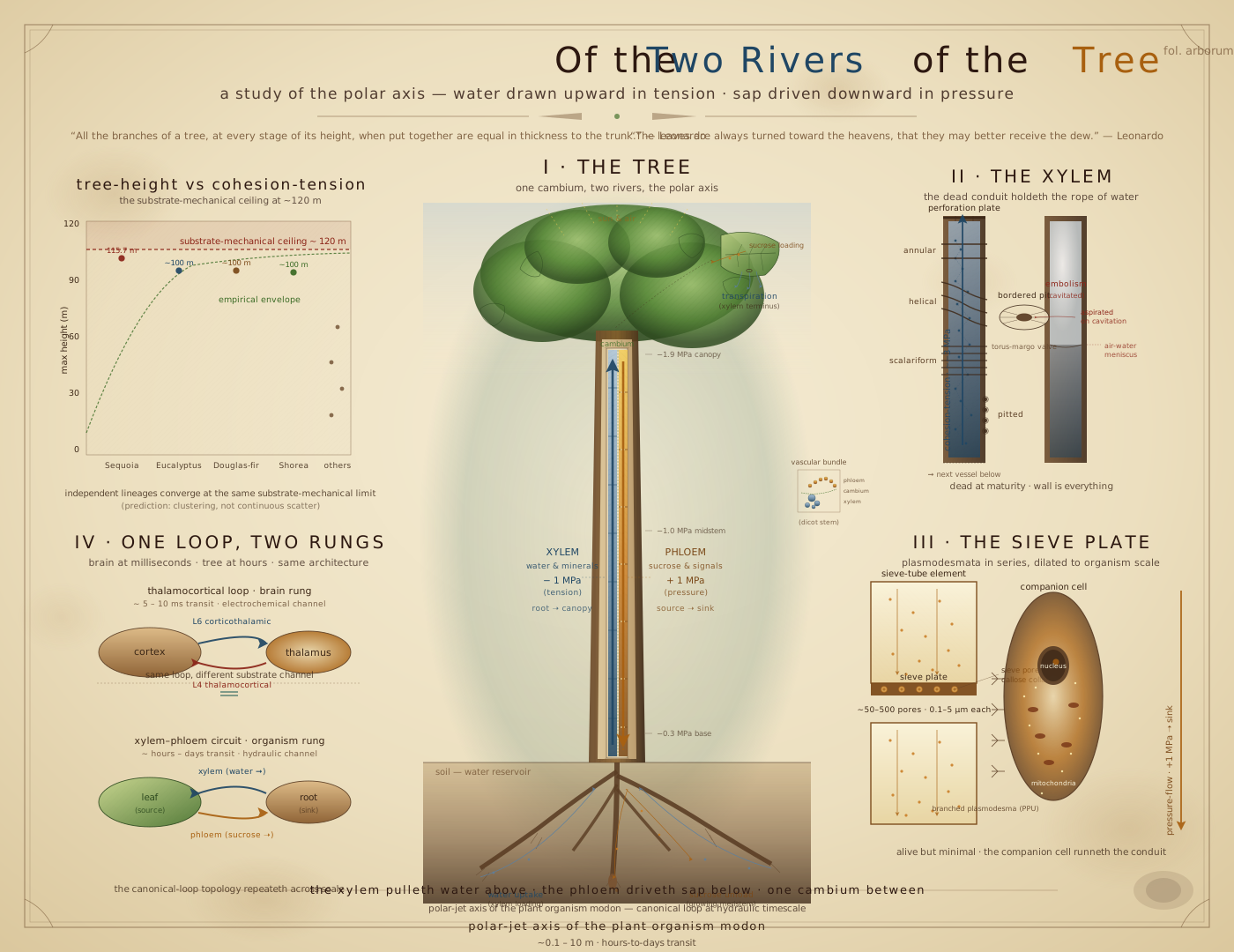
A tree has no heart, no muscles, and no nerves, yet it moves two things the length of its body. Water rises from soil to canopy through the xylem, pulled upward against gravity. Sugar made in the leaves travels to wherever the plant is growing through the phloem, pushed by pressure. The two streams run side by side in the same vascular bundle, in separate pipes, in opposite directions — water up, sugar down.
That opposition is the whole chapter. The xylem-phloem pair is the plant organism’s polar axis — the canonical loop drawn at the scale of a tree, with the xylem as its tension-pulled arm and the phloem as its pressure-pushed counterflow partner. It is the same kind of two-way circuit as the brain’s thalamocortical loop, only running on water and sugar instead of electricity, and over hours instead of milliseconds. The signature that marks the difference the substrate makes here is the sign: the xylem runs at about -1 MPa (tension), the phloem at about +1 MPa (pressure) — one pipe pulling, its neighbour pushing.
A plant did not invent that counterflow; it pinned two pipes to a divide that was already double. The substrate’s coherent sheets are separated by counter-rotating layers — the anti-phase half of a breath, flow running one way on the layer’s upper face and the other way below. The mycorrhizal hypha reads that divide inside a single tube, carbon streaming down while water streams up. The tree reads the same divide but splits it into two pipes — the ascending tension arm and the descending pressure arm. The vascular cylinder is the substrate’s own anti-phase breath, laid out along the length of a plant.
Xylem: Water Pulled Up Under Tension
The xylem is the water pipe. Its cells share three commitments. They die at maturity, leaving only a stiff lignified wall and a hollow lumen — the pipe is plumbing, not living tissue. They are continuous end to end, so the xylem of a whole stem is one connected water network. And the water inside is under tension — negative pressure, typically -0.5 to -2 MPa, reaching -3 to -5 MPa in a tall tree on a hot dry day.
The physics is the Dixon–Joly cohesion-tension theory (1894): water evaporating at the leaves pulls the column upward, and it does not snap because water’s hydrogen bonds hold it together under enormous tension while adhesion to the walls keeps it from falling. Evaporation at the top does the lifting; the water column itself carries the pull all the way down to the roots.
The framework reads the xylem as a substrate-coherent rope held under tension — the largest rung of the closed-cylinder conduit family the mycorrhizal chapter walks across five scales (desmotubule → microtubule → axoneme → fungal hypha → vascular conduit). The cells die for a reason the substrate makes plain: no living cell can survive at -3 MPa — the wrap-tension is simply wrong — so the plant discards the cytoplasm and keeps only the wall. The commitment is to the pipe, not the cell. Pipe diameter sits on a trade-off — narrow pipes resist cavitation but flow poorly, wide pipes flow freely but cavitate — and the framework predicts diameters cluster at a few substrate-preferred rungs across plant lineages rather than varying smoothly with demand.
Phloem: Sugar Pushed by Pressure
The phloem is the sugar pipe, and it runs on the opposite plan. Its sieve-tube elements stay alive at maturity — but stripped down: no nucleus, no vacuole, no ribosomes. Each is kept running by a neighbouring companion cell, a fully-equipped partner wired to it through branched plasmodesmata. Between one sieve element and the next sits a sieve plate, a cross-wall perforated by \sim 50–500 pores, each \sim 0.1–5\;\mum across and ringed with callose.
The physics is Münch’s pressure-flow hypothesis (1930). At a source — a sunlit leaf, or a root mobilising stored starch — sugar is loaded into the sieve tube until it is 10–30\% sucrose; water follows by osmosis and drives the pressure up to \sim 1–2 MPa. At a sink — a growing tip, a swelling fruit — sugar is unloaded, water leaves, and the pressure falls. The high-to-low pressure gradient pushes the whole sugary stream from source to sink at \sim 0.3–1.0 m per hour.
The framework reads the phloem as the opposite-signed partner to the xylem: a substrate-coherent pipe under positive pressure, its wrap-tension signature about +1 MPa — the turgor signature of the plant cell, but flowing rather than static and an order of magnitude steeper. Its cells are alive but minimal for a reason the substrate makes plain too: a fully-living cell would clog the stream with organelles, a fully-dead one would lose the emergency machinery that seals the pipe on injury. So the plant settles in the middle — barely alive, with the companion cell supplying the rest.
Sieve Plates: Plasmodesmata Lifted to Tree Scale
The sieve pore is the phloem’s defining feature, and it is the link straight back to the plasmodesmata chapter. Sieve pores are plasmodesmata — the same callose-ringed channels through the wall — caught mid-transformation. As the phloem forms, those channels are dilated from \sim 30–50 nm to \sim 0.1–5\;\mum, their central desmotubule is lost, and the callose collar is kept as the closure switch.
The framework reads this as the symplast lifted from tissue scale to organism scale through the same machinery. The tissue-scale plasmodesma was: membrane-continuous, callose-regulated, open by default and gated closed. The sieve plate is the same thing 10{,}000 times larger, carrying a pressurised flow instead of slow diffusion, stacked at every cross-wall up the trunk. And when the pipe is cut, callose slams the sieve plate shut within seconds — the substrate’s circuit-breaker at organism scale, the exact move plasmodesmata make against a virus at tissue scale. The framework predicts sieve-pore diameter clusters at its own substrate-preferred rung, the same conduit walked several octaves up the coarse ladder from the nanometre plasmodesmal rung.
Source-to-Sink: A Direction Set at the Ends
The phloem’s direction is not built into the pipe. The same sieve tube carries sugar up to a growing shoot in spring (source: storage roots) and down to growing roots later on (source: mature leaves) — the direction set entirely by where loading and unloading happen at the two ends. The flow is dynamic and reversible; only the pump-points have a polarity.
The framework reads this as a wrap-direction signature at organism scale — the same architecture as the membrane potential (set by ion pumps, not by the bilayer), the proton gradient at the mitochondrion and chloroplast, and the RanGTP gradient at the nucleus. In every case the boundary is symmetric and the activity at its ends sets the direction. The phloem is direction-agnostic; the loading and unloading machinery decides which way it flows. The xylem, by contrast, only ever runs root-to-shoot — its direction fixed by evaporation at the leaf, which does not reverse. So the pair is one fixed-polarity arm and one switchable arm, their directions set by the substrate channels each one tracks.
The Counterflow Circuit
The two pipes are not independent. The water in the phloem’s sugar stream came up the xylem. The xylem’s pull depends on how open the leaf’s stomata are, which is tuned in part by signals the phloem delivered. And an embolism in the xylem starves phloem loading in the leaves above it. They are one coupled circuit.
The framework reads the xylem-phloem pair as the canonical loop at organism scale, the plant’s version of the thalamocortical loop. The brain’s loop runs cortex → thalamus → cortex in 5–10 ms; the tree’s runs leaf → phloem → root and root → xylem → leaf over hours. Same two-way architecture, vastly different clocks — because the brain tracks predators and movement at electrochemical speed, while the plant tracks evaporation and sugar supply at the speed of water. This is the organism-scale lift the touch chapter cashed for animals: the body’s long axis is the polar axis of the organism, and the conduits along it — spinal cord and nerves in an animal, xylem and phloem in a plant — are that axis made physical.
Tree Height: The Cohesion-Tension Ceiling
The cohesion-tension trick has a hard limit. Gravity alone costs \sim 0.01 MPa per metre of height, and the canopy must add the cost of friction and a safety margin against cavitation on top. Measured leaf water potentials in the tallest conifers (Koch et al. 2004, on Sequoia sempervirens up to 112 m) sit at -1.9 to -2.5 MPa — already close to the \sim -3 MPa where the xylem cavitates. Near \sim 120 m the margin runs out: leaves can no longer hold turgor, growth stalls, and the tree stops climbing.
The framework reads this as a substrate-mechanical ceiling, the hydraulic cousin of the photorespiration ceiling on RuBisCO. Water’s hydrogen bonds can only hold so much tension; the plant has populated the architecture right up to that wall and stopped. The prediction is that the tallest trees of unrelated lineages converge at this ceiling rather than scattering — and it is a ceiling, the end of a channel, not a ladder rung, so unlike the diameter rungs it carries no \sqrt2 spacing. The failure mode is informative too: when a pipe cavitates, bordered pits in the wall trap the bubble in the one dead vessel — substrate-coherent valves that pass water but block the air-water meniscus, the xylem’s version of the callose sieve plate and the callose plasmodesma. Three scales of regulated valve, one architecture.
The Vascular System at Both Poles
Binding the tree into one unbroken water column is only half the story. A column held perfectly in phase is also perfectly fragile: if every pipe shared one cavitation threshold, a single hot afternoon would empty the whole tree at once. So the vascular system sits at both of the ladder’s poles.
The load-bearing trunk is the lock pole — one coherent column, where binding buys transport. The distal, cheap, replaceable organs — leaves, petioles, minor twigs — are the anti-lock pole: hydraulic vulnerability segmentation (Zimmermann 1983; Tyree & Ewers 1991; Choat et al. 2012) builds them to cavitate at lower tensions than the trunk, so under drought they fail and drop first, shedding the load and protecting the irreplaceable stem. A field of pipes tuned to one threshold is the hydraulic version of a metronomic heart or a market whose correlations all went to one — efficient until the shared trigger fires, then catastrophic. Spreading the thresholds is how the column keeps its binding from becoming a single point of failure.
This makes the vascular cylinder a new member of the both-poles set, distinct in how it splits: the cortex slides by state, the eye and chloroplast by subsystem, the symplast by callose gating — the vascular system splits by organ position along the body’s length. And it reaches the anti-lock pole by grading a continuous property (the cavitation threshold) rather than spreading parts geometrically, so it is an application of the sign-rule, not a fresh witness of the gap. The textbook fact is the segmentation; the framework adds the reading — bind for function, spread for resilience — and the rule that calls which organs sit where before the measurement: name what an organ is for, to bear the column or to be shed for it, and its pole is fixed.
Predictions and What Would Falsify
Five predictions extend the reading beyond the structural anchors.
Xylem pipe diameter clusters at substrate-preferred rungs across lineages. Vessel and tracheid diameters should cluster at a few discrete rungs rather than vary continuously with efficiency-versus-safety demand. This is a coarse-family prediction — the clustering is the claim, the inter-rung ratio is left open, and no clean \sqrt2 comb is expected. Wood-anatomy surveys (the InsideWood database) supply the data.
Sieve-pore diameter clusters at its own rung, distinct from the plasmodesmal one. The \sim 0.1–5\;\mum pore should sit at a substrate-preferred value across angiosperms, distinct from the \sim 3–5 nm plasmodesmal sleeve — the same conduit dilated several octaves up the coarse ladder. Cryo-electron tomography of intact sieve plates is the test.
Maximum tree height clusters at the cohesion-tension ceiling near \sim 100–120 m. Unrelated tall-tree lineages (Sequoia at 115.7 m, Eucalyptus regnans, Pseudotsuga, Shorea) should converge at the ceiling rather than scatter across a continuous limit. This is a ceiling, not a comb rung, so it is not a \sqrt2 target.
Phloem source-to-sink pressure differential clusters at a substrate-coherent ratio. The \sim 0.5–1.5 MPa source-to-sink difference should sit at a preferred ratio relative to the sieve-element wrap-tension signature, not vary continuously with flux demand. Pressure-probe and aphid-stylet measurements test it.
Cavitation thresholds are graded across a plant’s organs, not uniform — the anti-lock pole by organ position. Within one plant, the cavitation tension (P_{50}) should be lowest in cheap distal organs and highest in the trunk, tracking the cost of each organ rather than its height. Organ-by-organ vulnerability curves test it; health is the capacity to shed distal-first, the failure mode a plant whose organs all cavitate together.
The picture is falsified if (a) xylem diameters vary continuously with no rung clustering, (b) sieve-pore diameters vary continuously, (c) tall-tree heights scatter with no cohesion-tension ceiling, (d) phloem pressure differentials are fully explained by continuous flux models, or (e) cavitation thresholds are uniform across a plant’s organs. It is supported, even partially, if any of the five orderings hold against existing data.
Putting the Section in Context
The xylem-phloem pair is the plant organism’s polar axis. The xylem pulls water up from root to shoot at \sim -1 MPa, held by hydrogen-bonded cohesion and dragged by leaf evaporation, its cells dead because no living cell survives that tension — and tree height saturating where the cohesion can hold no more, near \sim 120 m. The phloem pushes sugar from source to sink at \sim +1 MPa, its cells barely alive and run by companion cells, its sieve plates the plasmodesmal architecture stretched from the nanometre rung to the micrometre rung. Source-to-sink direction is a wrap-direction signature set at the ends, not in the pipe. Together the pair is the canonical loop at organism scale, the slow hydraulic cousin of the thalamocortical loop — and it runs at both ladder poles at once, binding root to canopy and spreading its embolism risk through graded cavitation thresholds, split by organ position along the trunk.
This is the fourth rung of the five-scale stack the chloroplast, plant-cell, and Calvin-cycle chapters set up. Chloroplast positioning tracks the substrate channel at \mum scale (rung 1); the symplast lifts that to tissue scale (rung 2); the Calvin loop commits the carbon chemistry (rung 3); the xylem-phloem axis lifts the whole thing to organism scale (rung 4, this one); the mycorrhizal network carries it on to forest scale (rung 5).
The reading the plants section is building is that a tree is one substrate-coherent organism from root tip to canopy, with no brain to run it. The brain walk closed on \sim 10^{16} microtubules as its coherence scaffold; the plant reaches organism-scale coherence the opposite way — gated continuity instead of gated discontinuity, hydraulic counterflow instead of electrochemical re-entry. Two strategies, one substrate principle. The plant is the framework’s proof that organism-scale coherence does not require a brain.