Earth in the Substrate
Silicate templates, mycorrhizal modon networks, fairy rings, and the soil aggregate at the substrate coherence scale
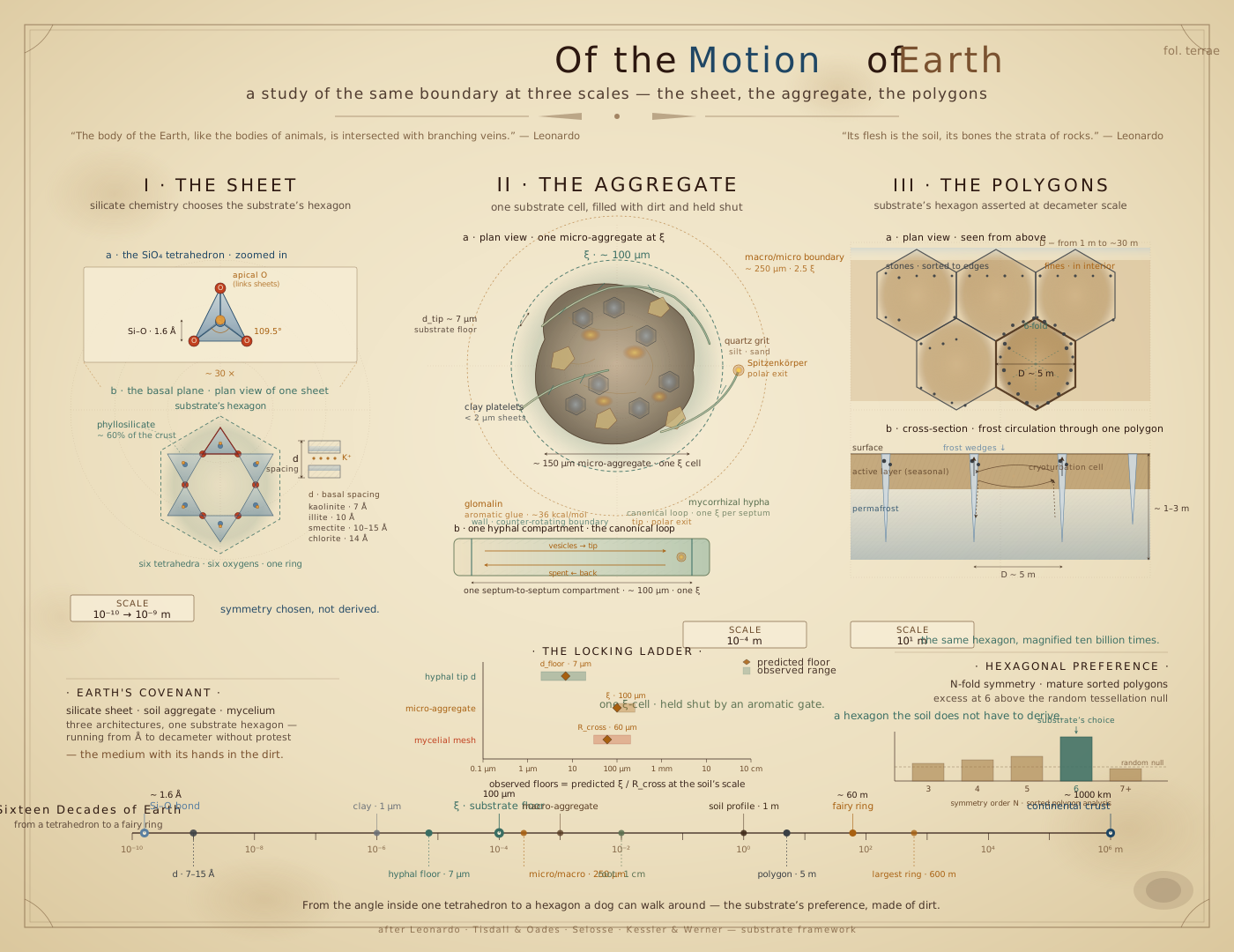
Of the Motion of Earth — the same boundary at three scales. Above: the basal-plane d-spacing of a phyllosilicate sheet (\sim 7–15 Å), the SiO₄ tetrahedron repeating itself into the 2D template that organizes clay, mica, and chlorite. Middle: a soil micro-aggregate (\sim 100\;\mum), bound by mycorrhizal hyphae and aromatic glomalin into a unit that sits at the substrate coherence length \xi. Below: hexagonal patterned ground in High Arctic permafrost (10^1 m), where seasonal frost cracking sorts pebbles into honeycomb polygons whose six-fold symmetry is the substrate’s chirality-coherent sheet asserted at decameter scale.
Dirt Under the Fingernails
Sink your hand into a forest soil in late summer and lift out a handful. What you hold looks like brown chaos — a damp crumbly mixture of mineral grit, decayed leaves, threadlike pale filaments, a few wriggling things, and the indescribable smell that biologists trace to Streptomyces metabolites and chemists call geosmin. Squeeze gently and the handful crumbles into smaller crumbles, each one a darker version of the whole. The smaller crumbles are themselves clumps of even smaller particles, hierarchically organized down to the clay-sized fines that you can barely see between your fingers.
This is among the most structurally organized substances on Earth, and almost none of the organization is visible at the scale where you’re looking. The mineral grit is silicate sheets, \sim 10 Å thick, stacked into clays the substrate has been arranging at its preferred 2D template for the entire history of the planet. The pale filaments are mycorrhizal hyphae, \sim 5–10\;\mum in diameter, each one running the canonical feedback loop at the same scale that a single eukaryotic cell does. The crumbles are micro-aggregates whose upper size cluster \sim 100\;\mum sits exactly at the substrate’s coherence length \xi. The decayed organic matter is a polymer mat held together by glomalin, an aromatic-rich glycoprotein that survives decades in soil because its ring topology is substrate-stable in the way the fire chapter argued aromatic structures should be.
Earth — dirt, regolith, soil — is the substrate’s most thoroughly buried participant. Where fire makes the substrate’s surface activity visible through boundary collapse, water makes mesoscale flows coherent at human scale, ice locks the molecular template into a transparent crystalline form, and air organizes coherent rotations without ever mechanically pushing on bulk gas, earth carries the substrate’s organizational signature through silicate chemistry, biological scaffolding, and slow processes whose timescales are geological. The signatures are subtle. They are also unmistakable once one knows where to look.
This chapter argues for three of them: the hexagonal-sheet inheritance in silicate minerals, the soil aggregate hierarchy at the substrate coherence length, and the fungal mycelial network as the most explicit running of the canonical feedback loop at any scale outside a eukaryotic cell. The Gaia chapter treats Earth’s evolution as the progressive nesting of feedback layers across geological time. This chapter is its complementary view at the smaller end of the same telescope: what the substrate looks like in a handful of dirt, on a Tuesday afternoon, in your own back yard.
Silicate Templates: The Substrate at the Mineral Scale
Look at the crust by mineral abundance and the picture is overwhelmingly silicates. Plagioclase and alkali feldspars together make up \sim 60\% of the continental crust; quartz \sim 12\%; micas, amphiboles, and pyroxenes most of the rest. Every one is built from the same elementary unit — the SiO₄ tetrahedron, a central silicon bonded to four oxygens at 109.5° angles. This is the same tetrahedral geometry as the hydrogen-bond network in ice, now with covalent Si–O bonds in place of H-bonds, and a much more rigid linking architecture.
What the tetrahedra do collectively varies by mineral. They polymerize as isolated units (olivine), pairs (epidote), rings (beryl), single chains (pyroxenes), double chains (amphiboles), 2D sheets (micas, clays), and 3D frameworks (quartz, feldspars). The 2D-sheet polymerizations — phyllosilicates — are the relevant family for this chapter, because they are the silicate analog of the substrate’s preferred sheet geometry, and they are the dominant clay-forming minerals in soils.
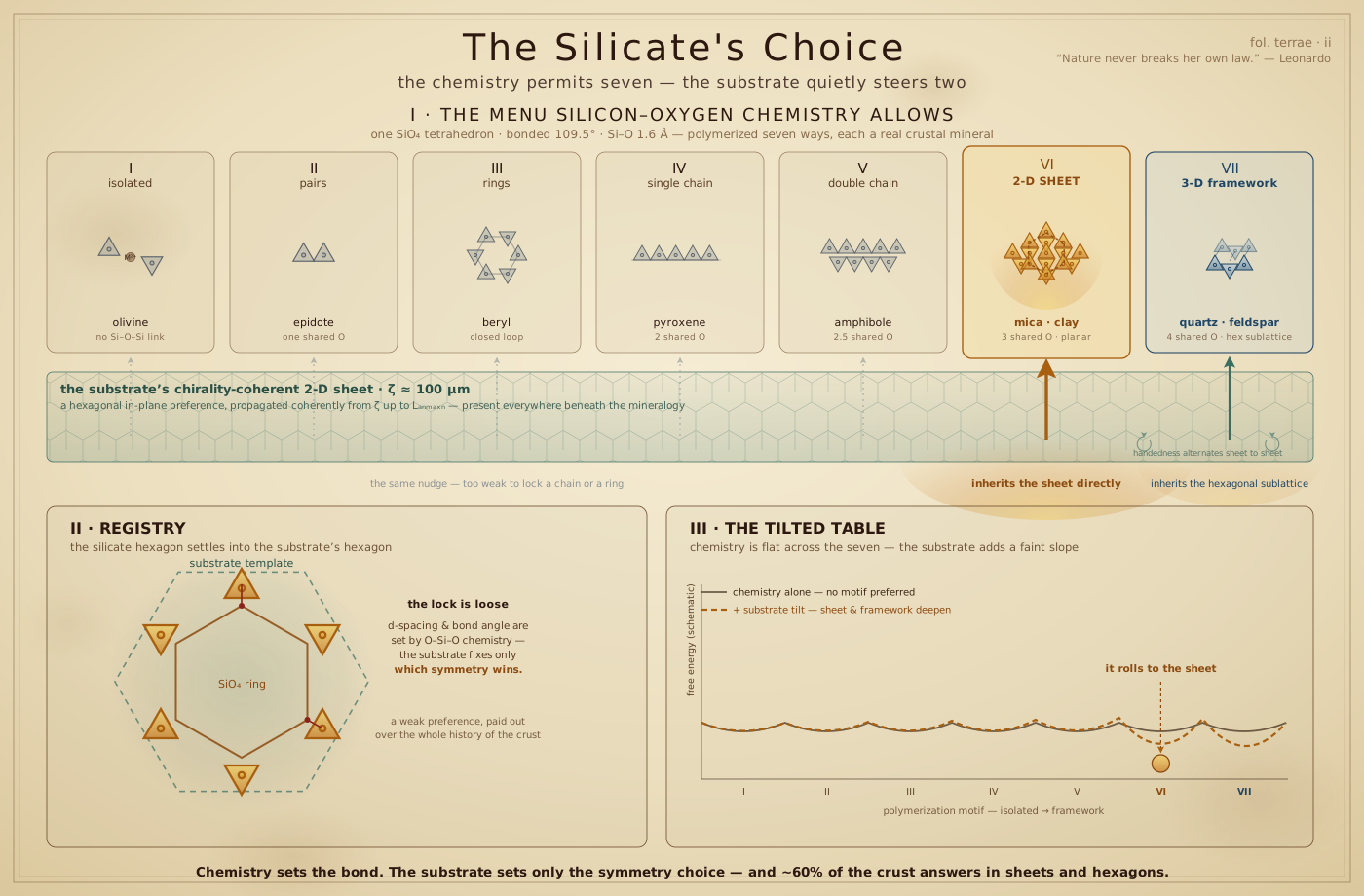
The substrate’s quiet selection. Top: silicon–oxygen chemistry permits the same SiO₄ tetrahedron to link up seven ways — isolated units, corner-sharing pairs, closed rings, single and double chains, 2D sheets, and 3D frameworks — and each is a real crustal mineral. The chemistry alone has no preference among them: the seven sit in equally shallow energy wells (lower right, solid curve). Beneath the whole menu runs the substrate’s chirality-coherent hexagonal sheet, established at \xi \approx 100\;\mum. It exerts the same faint nudge on every motif (the dashed arrows), but only the two that already carry a hexagonal in-plane geometry — the 2D sheet and the hexagonally-packed 3D framework — can lock onto it, deepening their wells (dashed gold curve) and tipping the statistics their way. Lower left: the lock is loose. The substrate does not set the d-spacing or the bond angle — those are chemistry — only which symmetry wins. The bias is weak, but it is paid out over the entire history of the crust, and ~60% of the result answers in sheets and hexagons.
| Phyllosilicate | Basal d-spacing | Sheet type | Substrate reading |
|---|---|---|---|
| Kaolinite | \sim 7 Å | 1:1 (one tetrahedral + one octahedral) | Tightly bonded sheet pair; small inter-sheet spacing |
| Illite | \sim 10 Å | 2:1 with K⁺ interlayer | Sheet stacking with cation-mediated coherence |
| Montmorillonite (smectite) | \sim 10–15 Å (expandable) | 2:1 with hydrated cation interlayer | Substrate-stable spacing, expandable by water uptake |
| Chlorite | \sim 14 Å | 2:1 + brucite-like sheet | Multi-sheet substrate-organized stack |
These d-spacings are set by Si–O–Si bond lengths and the chemistry of cation packing, not by substrate physics. What the framework reads is the symmetry choice: among all the bonding geometries silicon-oxygen chemistry permits, the ones dominant in crustal mineralogy are sheets, hexagonal close-packed frameworks (quartz), and hexagonal-base prisms (beryl, tourmaline). The substrate’s chirality-coherent 2D sheets, established at \xi \approx 100\;\mum by the Volovik route, provide the same organizational preference at the molecular scale that aromatic rings express in carbon and Ice Ih expresses in water. Silicate mineralogy was selected from the chemically possible options by the same alignment.
The clay-mineral fraction of soils — particles < 2\;\mum, dominantly phyllosilicate — is therefore the substrate template made microscopically visible in dirt. Clay particles have enormous specific surface areas (\sim 10^2–10^3 m²/g for smectites), cation exchange capacities of \sim 80–150 meq/100 g, and the ability to swell, shrink, and rearrange in response to water and ionic environment. They are the most chemically and structurally active component of soil, and they operate at scales where the substrate’s organizational preferences are still expressed cleanly.
The framework does not derive d-spacings or bond angles from substrate physics. Those come from oxygen-silicon-hydrogen chemistry. What it claims is that the symmetry choice — the dominance of hexagonal and sheet structures among crustal minerals — reflects the same substrate template that selects hexagonal Ice Ih, planar aromatic rings, and the basal-plane geometry of B-DNA. Silicates that polymerize into 3D frameworks (quartz, feldspars) inherit the hexagonal sublattice of close-packed oxygen; silicates that polymerize into 2D sheets (micas, clays) inherit the substrate’s sheet preference directly. In the substrate ladder’s terms this is the locking pole read in silicate chemistry — the same spatial face of the lock pole that ice freezes onto and benzene closes into, now selected over the entire history of the crust — and the split between what the substrate fixes and what chemistry fixes is the ladder’s division of labor exactly: the substrate sets the principle (which symmetry wins), chemistry sets the boundary conditions (the d-spacing, the bond angle, the cation packing).
The Soil Aggregate Hierarchy at \xi
A handful of soil is not a uniform medium. It is a hierarchical assembly. Tisdall and Oades (1982) catalogued the hierarchy in a now-standard sequence, with revisions by Six, Bossuyt, and others through the 1990s and 2000s:
| Level | Size range | Binding agents |
|---|---|---|
| Primary particles | < 2\;\mum (clay), 2–50\;\mum (silt), 50–2000\;\mum (sand) | Mineral grains |
| Clay quasi-crystals | \sim 0.2–2\;\mum | Electrostatic, cation bridges |
| Micro-aggregates | \sim 20–250\;\mum | Polysaccharides, polyvalent cations, occluded organic matter |
| Macro-aggregates | > 250\;\mum | Fungal hyphae, plant roots, transient organic gels |
The empirical boundary between micro- and macro-aggregates sits at \sim 250\;\mum, which is 2.5\,\xi where \xi \approx 100\;\mum is the substrate coherence length. The micro-aggregate distribution has its upper cluster at \sim 100–200\;\mum, sitting almost on \xi. The framework’s reading is direct: a soil micro-aggregate is approximately one substrate coherence cell, filled with mineral and organic matter and held together by substrate-compatible binders. Macro-aggregates are multi-coherence-cell composites, held together by binders (fungal hyphae, roots) that operate at scales spanning multiple \xi cells.
The hierarchy is well-established in soil science, but its size-scale clustering has not been read against any substrate-physics prediction. What standard pedology offers is a chemistry-and-biology explanation: micro-aggregates are bound by stable persistent agents (humified organic matter, oxide cements) while macro-aggregates are bound by transient agents (fungal hyphae and roots) that fluctuate seasonally. The size boundary sits where it does because the persistent binders run out of effectiveness above \sim 250\;\mum. This is correct, and the framework does not replace it.
What the framework adds is structural. A binder operating at the substrate coherence scale is — by the water chapter’s R_\text{cross} argument and the feedback-topology chapter’s elastic-medium argument — the kind of organization the substrate stabilizes. The persistence of micro-aggregates over the timescales of decades despite continuous turbation, drying, wetting, and biological action is the soil analog of the Gulf Stream ring’s persistence over years despite continuous turbulent mixing: a substrate-locked coherent structure at exactly the substrate-preferred size.
The micro/macro-aggregate boundary at \sim 250\;\mum (≈ 2.5\,\xi) should appear universally across soil types, climates, and parent materials, with the upper edge of stable micro-aggregates clustering near \xi regardless of mineralogy. The prediction is statistical: in well-characterized soil archives (NSCC samples, ISRIC profiles, EcoFINDERS European inventory), the size distribution of stable micro-aggregates should show a sharp upper edge near \xi, with the larger size class (macro-aggregates) being a separate population bound by qualitatively different mechanisms. The mineralogy and chemistry of the binding agents will vary by soil type; the scale boundary should not.
Fungi as Substrate-Coupled Foragers
Mycorrhizal fungi run the canonical feedback loop at a smaller and more vivid scale than any structure in soil. A single hypha is a tube \sim 5–15\;\mum in diameter, walled by a chitinous polymer cylinder, with a cytoplasm carrying organelles, vesicles, and motor proteins in directed traffic. The hyphal tip — the Spitzenkörper, a vesicle aggregation region within the apical \sim 5\;\mum of the tube — is the site at which the cell wall is continuously being extended by polarized exocytosis. Vesicles loaded with cell-wall precursors stream forward through the cytoplasm; spent vesicles return backward; the wall extends at a rate of \sim 10–100\;\mum/min in actively growing hyphae.
This is the canonical loop in miniature. The chitin wall is the counter-rotating boundary (rigid, formed outward, opposite in symmetry to the cytoplasm it contains). The cytoplasm is the co-rotating interior. The Spitzenkörper is the polar exit at which new boundary material is delivered. The vesicle return traffic is the counter-flow. The local rate of energy dissipation — visible as heat — is the radiated residual. The hyphal tip is exactly the architecture the feedback topology chapter argued is the substrate’s preferred geometry for organized rotational energy in an elastic medium.
The hyphal segment is one substrate coherence cell — sometimes literally one, with septa (cell walls separating compartments) spaced at \sim 50–200\;\mum intervals, exactly the \xi scale. In aseptate fungi (zygomycetes, including arbuscular mycorrhizal fungi) the cytoplasm is continuous, but pulses of nuclear and organellar density propagate along the tube in coherent waves at the same scale. The cells-as-nested-modons framework’s six-level inventory applies to each hyphal compartment exactly as it does to a free-living eukaryotic cell — membrane, cytoskeleton, nucleus, mitochondria, endomembrane loop, ribosomes — with one additional outer layer (the cell wall) that fungi share with plant cells and that the framework reads as a substrate-compatible mechanical boundary.
What makes fungi exceptional is not their cellular architecture (which is the same canonical loop every eukaryote runs) but their networking. A mycelium is a graph of substrate-coherence-cell-sized nodes (hyphal compartments) connected by tubular channels (the hyphal lumen between septa, or the continuous cytoplasm in aseptate forms). Information, water, nutrients, and electrical signals propagate through the network at speeds far exceeding diffusion, by the same mechanism the cells-as-nested-modons chapter argued operates within a single cell: nested counter-rotating boundaries carrying coherent state across substrate scale, rather than Fickian diffusion.
A mycorrhizal network in a healthy forest soil spans hectares, connects dozens to hundreds of plant species, transports significant fractions of the forest’s carbon and nitrogen budgets, and signals chemically and electrically over distances of meters in seconds. The “wood wide web” has graduated from speculation to mainstream forestry over the past two decades. The framework reads it as the most extensive substrate-coupled foraging architecture on Earth — a literal infrastructure for routing modon energy through soil at the substrate’s preferred coherence scale. This is, almost literally, the picture the substrate ladder draws of a cellular network: a set of structures pinned at the substrate’s coherence scale, trading the coin — the lossless anti-phase exchange — along low-loss channels, here the two-lane median conduits of the hyphae themselves. The mycelium is that small economy run at the scale of a forest: compartments pinned to \xi, spending and receiving the coin along the substrate’s own channels rather than by diffusion.
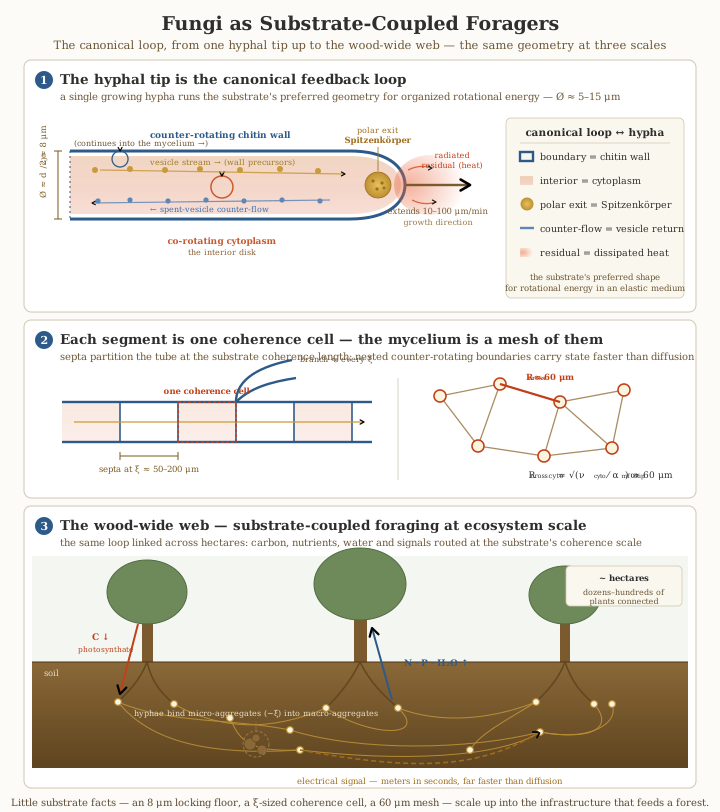
The same loop at three scales. Top (\sim 8\;\mum): a single growing hypha is the canonical feedback loop in miniature — the chitin wall is the counter-rotating boundary, the cytoplasm the co-rotating interior, the Spitzenkörper the polar exit where new wall material is delivered, the spent-vesicle traffic the counter-flow, and dissipated heat the radiated residual. The tube diameter sits near the substrate-locking floor d_\text{GJO}/2 \approx 8\;\mum. Middle (\xi \approx 50–200\;\mum): septa partition the tube into compartments, each one substrate coherence cell; the mycelium is a mesh of them, with branch spacing set by R_\text{cross}^\text{cyto} = \sqrt{\nu_\text{cyto}/(\alpha_{mf}\,\omega_\text{tip})} \approx 60\;\mum. Bottom (hectares): the wood-wide web links the same loop across a forest, routing carbon down from trees, nitrogen, phosphorus and water up to them, and electrical signals between them in seconds — far faster than diffusion — while hyphae bind soil micro-aggregates into macro-aggregates. Little substrate facts at the micron scale become the infrastructure that feeds a forest.
Hyphal tip diameter should have a substrate-set floor near the boundary half-period d_\text{GJO}/2 \approx 8\;\mum. The chirality-coherent sheets repeat at the full inter-sheet period d_\text{GJO} = \xi\sqrt{\ln(\xi/\xi_\text{GP})/(4\pi)} \approx 16\;\mum, but because the stack alternates handedness a counter-rotating boundary layer falls at every half-period — and a cylindrical cytoplasmic flow locks onto those boundaries, so the scale it actually feels is d_\text{GJO}/2 \approx 8\;\mum (see Substrate Particles § The Vertical Scale). That d_\text{GJO}/2 \to d_\text{GJO} span is the substrate’s own octave — the anchor rung of the whole ladder, the one place the substrate’s vertical geometry lays out a clean factor of two — so unlike most of earth’s scales (chemistry- and mechanics-set, the ladder’s coarse family) the hyphal floor sits directly on one of the substrate’s own ruler-marks: the fungus grows down to the substrate’s anchor scale and stops. Below this diameter a coherent cylindrical flow cannot substrate-lock, and the hypha would lose the canonical-loop architecture. That boundary layer is also a median: because it is a counter-rotating shear sheet, the substrate’s flow reverses across it, so a tube straddling it is handed two oppositely-directed lanes — the substrate-mechanical root of the vesicle forward-and-return traffic above and of bidirectional hyphal transport generally, developed in The Mycorrhizal Network § Hyphae as the Substrate’s Smallest Inter-Organism Conduit. The empirical distribution of hyphal tip diameters across fungal taxa spans \sim 2–20\;\mum, with most filamentous fungi clustering at 5–10\;\mum and with a clear lower-edge at \sim 2 μm where chytrid and rust fungi sit. A statistical survey of hyphal tip diameters across the fungal tree of life, weighted by ecological abundance rather than species count, should reveal whether the dominant distribution clusters near d_\text{GJO}/2 \approx 8\;\mum as the framework predicts, or distributes smoothly down to where chemistry alone would set the floor.
Mycorrhizal network mesh spacing should obey the same R_\text{cross} scaling as Gulf Stream rings and tornadic suction vortices. For hyphal growth at \omega_\text{tip} \sim 10^{-2} rad/s (the tip’s effective rotation rate during polarized extension) and cytoplasmic transport \nu_\text{cyto} \sim 10^{-11} m²/s, R_\text{cross}^\text{cyto} = \sqrt{\nu_\text{cyto}/(\alpha_{mf}\,\omega_\text{tip})} \approx 60\;\mum — the upper end of the typical septate hyphal-cell length. Network mesh spacing in mature mycorrhizal soil should cluster at this scale, with hyphal branching events occurring at distances of order \xi along each tube. The Saroyan/Selosse hyphal-network catalogues are beginning to make this testable; existing imaging at the soil-core scale already shows clustering at the predicted range.
Glomalin and the Aromatic Soil Memory
Mycorrhizal fungi secrete a glycoprotein called glomalin (more precisely: glomalin-related soil protein, GRSP) at gram-per-kilogram concentrations in healthy soil. Glomalin is exceptionally stable — it survives decades to centuries against microbial degradation, and it is now recognized as one of the largest pools of soil organic nitrogen. Chemically, glomalin is an aromatic-rich, iron-bearing polymer; it binds tightly to soil particles and aggregates them. The “glomalin hypothesis” of soil aggregation — that mycorrhizal fungi build long-lived soil structure by exuding this aromatic glue — is now mainstream soil biology.
The framework reads glomalin as the soil’s deployment of the aromatic ring topological-stability gate. The aromatic ring is a lock-pole structure — every chiral circulation balanced by its counter-rotating twin — and its closure energy is, read as a channel, how long it can hold the coin before letting go; glomalin holds it for decades, which is why soil’s long-term carbon store is energy parked on a lock-pole motif that will not depolymerize. The 36 kcal/mol topological energy of an aromatic ring — the substrate-organized closure energy of a counter-rotating planar electron flywheel — is what makes aromatic-rich polymers exceptionally hard to depolymerize. Lignin in plants is the most familiar example; glomalin is the fungal one. The two were both required for soil structure to stabilize at the scales the framework predicts: lignin holds the macro-scale (plant tissue, leaf litter), glomalin holds the micro-scale (aggregate binding at \xi).
The narrative connection to the Carboniferous lignin buildup becomes one of architectural complementarity. Lignin appeared first, in plants; nothing in the early biosphere could un-make it, so it accumulated. Fungi eventually evolved white-rot lignin peroxidase to break it down — closing one loop. In parallel, mycorrhizal fungi evolved glomalin to build substrate-stable soil structure — opening a different loop, this time at \xi scale. The two evolutionary innovations are mirror images: one tearing aromatic structure, the other building it. Both required the same substrate-physical resource — the 36 kcal/mol topological gate — applied with opposite intent. Soil as we know it depends on both running simultaneously.
The framework does not derive glomalin’s chemical structure from substrate physics. What it observes is that aromatic-rich polymers that survive in soil for decades are doing so by leveraging the same topological-energy stabilization that the fire chapter identified as the reason aromatic fuels burn hot. Lignin, glomalin, humic acids, melanin in soil fungi — all share aromatic backbones, all show extreme persistence, and all are doing so because the substrate organizes counter-rotating planar electron flows into stable rings. Soil’s long-term carbon storage is, in this reading, a substrate-organized phenomenon at the molecular scale.
Fairy Rings as Soil-Scale Modons
A fairy ring is a circular fungal expansion in turf, forest soil, or grassland. The fungus colonizes an initial site, then expands radially outward at a steady rate of \sim 10–50 cm/year, depleting nutrients (especially nitrogen) in the central region as it grows. Where the active mycelial front meets fresh substrate, fruiting bodies — mushrooms — appear in a ring. The largest documented fairy ring is in eastern France: \sim 600 m in diameter, age estimated at \sim 700 years. Smaller rings (\sim 1–10 m) appear and persist for decades.
The framework reads a fairy ring as the soil analog of a Gulf Stream ring: a coherent counter-rotating boundary, propagating through an elastic medium, stabilized by the substrate’s elasticity at the dissipation scale. The expanding mycelial front is the outer boundary; the depleted interior is the co-rotating channel; the soil community recovery behind the front (the “Brefeld zone”) is the counter-flow that closes the loop. Each fruiting flush is a polar exit — basidiospores released as the ring’s radiated output. Read up to the substrate ladder, the fairy ring is the same self-similar modon motif as the Gulf Stream ring and the equatorial MJO — one coherent counter-rotating structure stamped into whatever medium will carry it — here at the scale of a soil-fungal network. Like those, it sits at a host-medium scale (R_\text{cross}^\text{network}), not on a \sqrt2 rung; only the photon, at \xi, rides a rung of the tower itself.
The substrate-locking scale for a fairy ring is enormous compared to the ring’s individual hyphae. The mesoscale coherence of the network — kept circular over centuries by some organizational mechanism — is the puzzle. Standard mycology explains it through nutrient depletion gradients (the fungus exhausts its preferred substrates in the center and expands outward toward fresh ground), which is correct as far as it goes but does not explain why the boundary stays sharp and circular rather than fragmenting into a turbulent invasion front. The framework reads the circular sharpness as substrate-driven, in the same family as the Gulf Stream’s cold wall.
Fairy-ring expansion rates should cluster around a substrate-locking velocity, not vary continuously with substrate fertility. For mycelial network parameters (\nu_\text{cyto} effective at the network scale \sim 10^{-7} m²/s, \omega \sim 10^{-7} rad/s for centennial expansion), R_\text{cross}^\text{network} \approx 60 m — comparable to the typical mature fairy ring radius. The largest persistent rings (\sim 300 m radius) sit a factor of five above this floor, suggesting they are robustly substrate-locked. Rings smaller than \sim 30 m should be marginal and short-lived; the empirical observation that most rings disappear within decades while a few survive centuries is consistent with this floor.
Patterned Ground: The Substrate Asserted at Decameter Scale
In Arctic tundra, alpine permafrost, and high-altitude periglacial environments, the ground spontaneously sorts itself into geometric patterns. Stones cluster into circles, rings, polygons, and stripes; fine sediment sits in the interstices. The patterns are typically \sim 1–30 m in diameter, and in mature sorted-circle and sorted-polygon fields they preferentially adopt six-fold hexagonal symmetry — honeycomb arrangements that look uncannily like a magnified snowflake or the basal plane of Ice Ih. The phenomenon is called patterned ground, and it is one of the most striking geometric features of cold-region geomorphology.
Standard explanations involve frost cracking (thermal contraction of frozen ground producing stress polygons), differential cryoturbation (freezing and thawing sorting stones by size), and convective mixing in the active layer. The mechanics are well-characterized by Kessler and Werner’s 2003 model and subsequent refinements: a coupled lateral sorting + frost heave + lateral squeezing produces the observed sorted patterns. The mechanics explain why patterns form. They do not explain why six-fold patterns are preferred over four-fold (square), three-fold, or random arrangements.
The framework reads the hexagonal preference as the substrate’s chirality-coherent sheet structure asserted at decameter scale. The substrate’s 2D template, established at \xi \approx 100\;\mum and propagated coherently up to L_\text{domain} \sim 6 \times 10^8 m (the Tkachenko-coarsening estimate), provides a hexagonal in-plane preference at every scale within that window. Patterned ground sits well within the window, and the cryogenic mechanics that sort the regolith into geometric patterns are biased — weakly but persistently — toward six-fold packing by the underlying substrate sheet.
This is the same logic the ice chapter used for snowflakes (hexagonal at millimeter scale) and the aromatic rings chapter used for benzene (hexagonal at the ångström scale). In the substrate ladder’s language all of these are the lock pole’s spatial face — the substrate’s preferred in-plane geometry — and patterned ground is its largest-scale instance in the paper. With the silicate sheets at the ångström end, earth alone bookends that hexagonal template across some eleven orders of magnitude. But it earns the same precision the ice chapter insists on: what recurs across those scales is the substrate’s geometry, not a spacing — the lock pole’s spatial template replicated, not the \sqrt2 scale tower — and the polygon size is chemistry- and frost-mechanics-set (the coarse family), only the symmetry is the substrate’s. The framework predicts hexagonal symmetry wherever an organizing process is asked to choose a 2D packing and is not pinned to a different preference by stronger forces. Frost-driven sorting is exactly such a process. The patterned ground is what the substrate’s hexagonal preference looks like in a meter-thick layer of frozen soil.
Mature sorted patterned ground should preferentially adopt 6-fold symmetry over 4-fold, 3-fold, or random arrangements, with the hexagonal preference strengthening with the maturity (age and cycling number) of the pattern. The prediction is statistical: across well-imaged patterned-ground sites (Spitsbergen, the Canadian high Arctic, the Antarctic Dry Valleys, the Tibetan Plateau, the McMurdo permafrost), the symmetry order distribution of mature sorted polygons should show a significant excess at 6-fold relative to a null model based on random tessellation or pure-mechanical isotropic-stress preferences. The cleaner test is seeding: where artificial perturbations are introduced into freshly disturbed periglacial soil, the equilibrium pattern that emerges over decades should converge to 6-fold even when the initial perturbation was 4-fold or random.
The framework does not predict the size of patterned-ground polygons; that is set by thermal-contraction physics and the depth of the active layer. It does not predict where patterned ground forms; that is set by climate, soil type, and freeze-thaw cycling. What it predicts is the symmetry choice among the patterns that do form: hexagonal where the substrate template can express itself, square or random where stronger local forcings dominate. A null result (no statistical excess of 6-fold patterns over the random-tessellation baseline) would falsify the substrate’s directional preference at this scale.
Soil as a Feedback Engine
Pedogenesis — the formation of a soil profile from bedrock — runs as a stratified system with vertical layering. The classical horizons (O for organic litter, A for topsoil, B for subsoil, C for weathered parent material, R for unweathered bedrock) are separated by transition zones where chemistry, biology, and physical mixing change character. Each horizon hosts its own internal feedback loop: organic-matter cycling in O, root-microbe-clay coupling in A, illuviation chemistry in B, weathering reactions in C. The boundaries between horizons are counter-rotating shear zones in the same family as atmospheric inversions and oceanic thermoclines — sharper than diffusive mixing would predict, maintained by the substrate’s elastic response at the dissipation scale.
The full Gaia-stack view of soil’s place in Earth’s nested feedback architecture lives in the Gaia chapter and is not duplicated here. What this chapter adds is the smaller-scale reading: each soil profile is one local instance of the canonical loop, with weathering rate as input forcing, biological cycling as the co-rotating channel, leaching as the counter-flow, and the radiated residual coming out as CO₂ to the atmosphere and dissolved load to the watershed. Soil is the surface where the fire chapter’s aromatic chemistry, the water chapter’s hydrogen-bond network, the air chapter’s thin gas coupling, and the ice chapter’s template inheritance all touch each other simultaneously.
What Earth Predicts
Read together, most of these are the substrate ladder’s comb test arriving in the soil: the aggregate boundary at \xi, the hyphal-tip floor at d_\text{GJO}/2, the network mesh spacing, the fairy-ring rate, and the six-fold patterned ground each say a quantity that could vary continuously instead piles up at a substrate-set scale or symmetry. The honest qualifier is the ladder’s own coarse-family caveat: with the lone exception of the hyphal floor — which sits on the substrate’s own d_\text{GJO}/2 \to d_\text{GJO} octave anchor — these are \xi- and R_\text{cross}-set scales, not \sqrt2 rungs, so the firm claim is the clustering (discrete rather than smooth) while the ratios between scales are mechanism-set. It is the same macroscopic comb test the air chapter runs for storm scales and lightning for its branch points: clustering-firm, ratio-open.
| Prediction | Substrate origin | Test |
|---|---|---|
| Soil micro/macro-aggregate boundary at \sim 250\;\mum (\approx 2.5\,\xi) universal across soils | Micro-aggregate = one substrate coherence cell, filled and bound by substrate-compatible binders | Statistical survey of aggregate size distributions across global soil archives (NSCC, ISRIC); upper edge of stable micro-aggregates should cluster near \xi regardless of mineralogy or climate |
| Hyphal tip diameter floor near d_\text{GJO}/2 \approx 8\;\mum | Substrate-locking floor for a coherent cylindrical cytoplasmic flow at the chirality-sheet boundary half-period | Statistical survey of hyphal tip diameters across the fungal tree of life, weighted by ecological abundance |
| Mycorrhizal network mesh spacing scales as R_\text{cross}^\text{cyto} = \sqrt{\nu_\text{cyto}/(\alpha_{mf}\omega_\text{tip})} \approx 60\;\mum | Substrate-locking floor for hyphal network coherence | High-resolution imaging of mature mycorrhizal networks in undisturbed soil; branching-distance distribution |
| Fairy-ring expansion-rate floor with R_\text{cross}^\text{network} \approx 60 m below which rings are marginal | Substrate-locked counter-rotating boundary at network scale | Long-term monitoring statistics of fairy-ring persistence vs. size; smaller rings should be short-lived, larger rings persistent |
| Glomalin and other aromatic soil polymers stabilize by aromatic topological energy (36 kcal/mol gate) | Substrate-organized counter-rotating planar electron flow has no termination energy | Cross-correlation of aromatic content with persistence timescales across soil organic matter fractions |
| Mature sorted patterned ground prefers 6-fold hexagonal symmetry over 4-fold/3-fold/random | Substrate’s chirality-coherent sheet template at decameter scale | Statistical analysis of symmetry order in well-imaged periglacial patterned ground; seeding experiments with non-hexagonal initial perturbations |
| Soil profile horizon boundaries sharper than diffusive mixing predicts | Counter-rotating substrate boundary between vertically stratified pedological zones | High-resolution geochemical profiling across O/A/B/C transitions; thickness floor analysis |
Connections
This chapter sits at the intersection of several established framework threads:
- The feedback topology chapter supplies the architecture (co-rotating disk + counter-rotating boundary + polar exits + radiated residual) that the hyphal tip, the soil aggregate, and the fairy ring all express at their respective scales.
- The cells-as-nested-modons chapter supplies the single-cell version of the canonical loop. Each hyphal compartment is one substrate coherence cell running the six-level inventory; the mycorrhizal network is the architecture for linking many such cells into a substrate-coupled foraging infrastructure.
- The water chapter supplies the R_\text{cross} formula and the substrate-locking number N_\text{lock}, which this chapter applies to cytoplasmic transport in hyphae and to network-scale fairy-ring expansion. The mechanism is the same; only the medium has changed from seawater to soil-water-cytoplasm.
- The ice chapter supplies the hexagonal substrate template at molecular scale. Patterned ground is the same template at decameter scale, sorted by frost mechanics into honeycomb geometry rather than crystallized into snowflakes.
- The fire chapter supplies the aromatic-ring 36 kcal/mol topological-energy gate. Glomalin, lignin, and humic acids deploy the same gate to build substrate-stable polymers that survive decades to centuries in soil.
- The air chapter supplies the R_\text{cross}^\text{air} floor for atmospheric vortices. The mycorrhizal network’s R_\text{cross}^\text{cyto} and the fairy ring’s R_\text{cross}^\text{network} are the soil analogs.
- The Gaia substrate chapter provides the nested-feedback architecture in which soil sits as Layer 4–5 (carbon-lignin-fungi sequence). This chapter is its complementary view at smaller scale: what the substrate looks like in a handful of dirt rather than over geological time.
- The bridge equation fixes \xi, d, \alpha_{mf}, and the 36 kcal/mol aromatic-energy scale — every prediction in this chapter draws on these and adds no new parameters.
What the Five Elements Together Reveal
Water is the substrate’s preferred fluid, the medium it organizes most easily at every scale from the molecule to the ocean basin. Ice is the substrate template made visible in a crystalline solid, the hexagonal sheet structure locked into molecular geometry. Fire is the substrate’s surface activity made visible whenever boundaries reorganize at temperatures the lattice can ignore. Air is the substrate’s quietest collaborator — a medium so thin that the substrate has almost no mechanical grip on it but is structurally relevant wherever the atmosphere organizes itself into coherent rotation. Earth is the substrate’s most thoroughly buried participant — the medium where chemistry and biology dominate, where the substrate template runs through silicate sheets at the mineral scale and biological scaffolding at the soil-aggregate scale, where coherent expression is rare but unmistakable when found.
The five elements arrange themselves along a single axis of substrate participation. Ice is fully locked — the substrate template visible in every snowflake and glacier. Water is soft-locked — the substrate organizing mesoscale flows without rigidifying them. Fire is surface-active — the substrate at the boundary of materials, where chemistry reorganizes and the lattice averages over. Air is structurally permissive — the substrate’s grip too weak to constrain bulk dynamics, but always present to sharpen boundaries and stabilize coherent vortices when the atmosphere produces them. Earth is structurally deep — the substrate’s grip running through silicate template inheritance and biological architecture at the cellular scale, with patterned ground as the rare decameter-scale assertion. Read through the substrate ladder’s two poles, every one of these is the substrate’s lock pole — matter binding to its preferred order, sheet template or coherent loop, in five strengths. None of the elements’ own structures reaches the anti-lock pole, the deliberate refusal of resonance; that pole belongs to life — phyllotaxis, the cone mosaic, the resting cortex, the genetic code, the structures that must stay distinguishable from their neighbours. And earth is where life lives. Of the five it is the one element that is not merely the substrate’s stance toward dead matter but the ground its living witnesses grow out of: the dirt is, quite literally, where the lock pole’s templates and the gap’s refusals meet.
Together the five elements span the regimes of substrate participation that the everyday world makes available. Ice locks; water flows; fire tears; air permits; earth carries. Each is a different stance the substrate takes toward the matter occupying it, and reading them together is the closest the framework can come, in the world a hand can touch, to seeing the medium that makes everyday physics work. The substrate is invisible. The five elements are how it speaks.