The Bilateral Brain as Coupled Modons
Corpus callosum and commissural systems as inter-modon coupling, dominant-submissive cycling as substrate-coherence-leader exchange, and psychological disorders as substrate-coupling-imbalance signatures
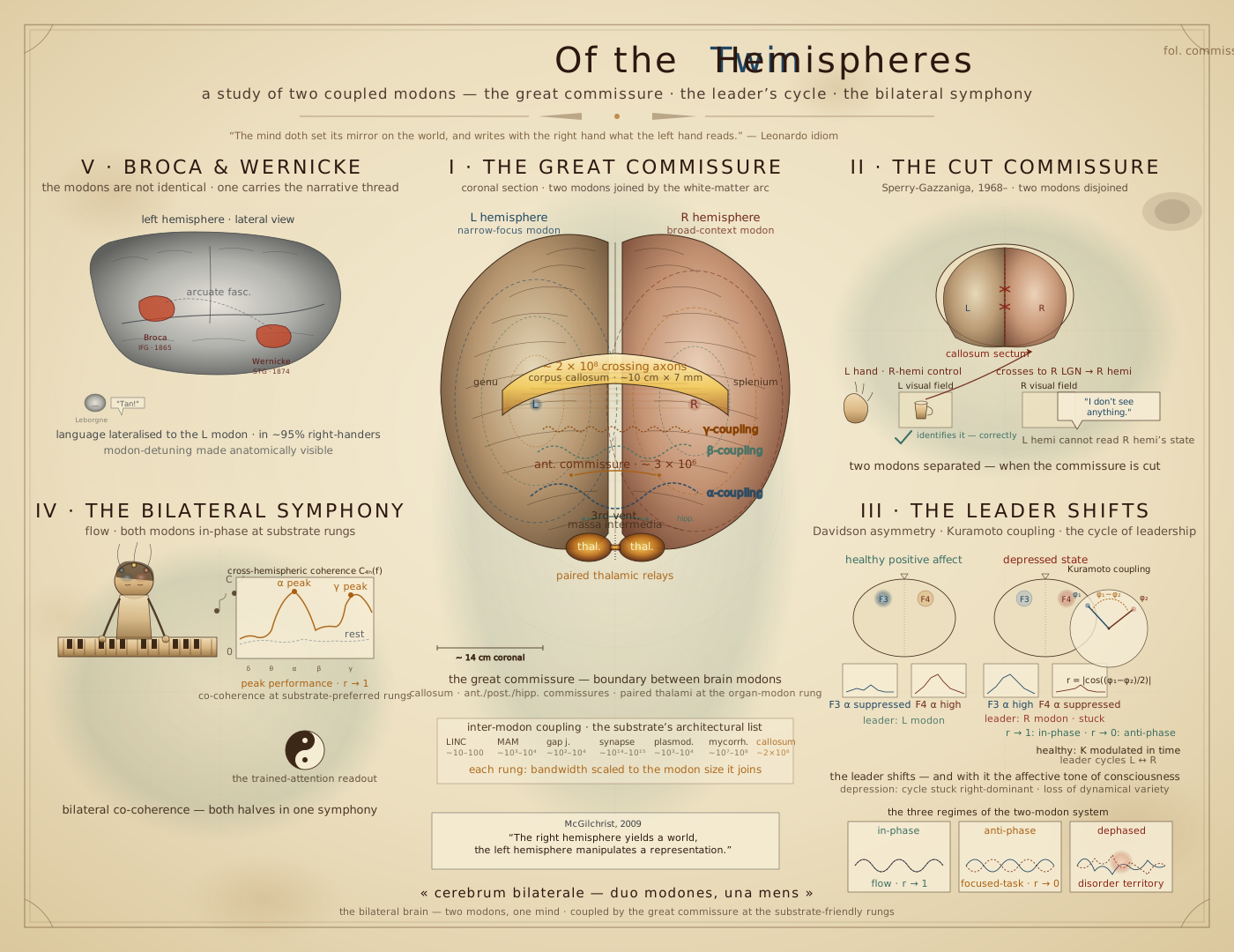
The two hemispheres of the brain are near copies and joined by the largest cable in the body. This chapter shows that the brain’s long vector is held as two coupled half-vectors. Their coupling adds a new lens onto the range of human states.
The cerebral cortex is organised from the substrate energy of two coupled near-mirror modons, with the corpus callosum, the anterior, posterior, and hippocampal commissures, and the paired thalamic relays as the high-bandwidth substrate-coherence-coupling boundary between them. The hemispheric specialisation is the natural differential coherence-cell tilings pinned to the two modons’ slightly asymmetric substrate-coherent states; with dominant-submissive cycling between them as the substrate’s coherence-leader exchange across moment-to-moment task demands.
Flow states are cross-hemispheric co-coherence in which both modons run in-phase and with some psychological disorders as substrate-coupling-imbalance signatures in which the dominant-submissive cycling, the inter-modon coupling strength, or the asymmetric specialisation has departed from the substrate-coherent regime.
The bilateral architecture is structurally parallel to every inter-modon-coupling interface the framework has developed at smaller scales — the LINC complex between nucleus and cytoskeleton, the MAM between ER and mitochondrion, gap junctions between adjacent cells, plasmodesmata between plant cells, dendrodendritic reciprocal synapses in the olfactory bulb, the synapse between cable modons, and mycorrhizal hyphal junctions between forest modons appear here at this organ scale as the brain’s defining architectural feature.
This chapter develops the bilateral architecture in seven passes: the two-coupled-modon architecture, the corpus callosum as inter-modon coupling channel, hemispheric specialisation as differential coherence-cell tiling, dominant-submissive cycling as substrate-coherence-leader exchange, flow as cross-hemispheric co-coherence, the bilateral pair as the substrate’s both-poles architecture at the organ scale, and psychological disorders as substrate-coupling-imbalance signatures.
Two Coupled Modons at the Organ Scale
The bilateral body plan is the substrate’s preferred organisation across mobile bilaterian animals — paired eyes, paired ears, paired lungs, paired kidneys, paired gonads, paired limbs, paired cerebral hemispheres — and the cerebral cortex is the highest-coherence expression of this plan. The framework reads the bilateral cortex as the substrate’s preferred organ-scale architecture as two coupled near-mirror modons rather than as a single large modon. A single cortical modon spanning the full \sim 2200 cm^2 folded sheet would have to maintain organ-scale substrate-coherence across that whole extent without internal coherence-boundaries. Two coupled half-modons of \sim 1100 cm^2 each, joined by a high-bandwidth substrate-coupling channel, support stronger internal substrate-coherence within each modon while allowing the inter-modon dynamics the next sections develop.
The substrate-physics argument is the same one the framework has made at every smaller scale. A modon is the substrate’s preferred coherent dynamical structure at a given scale; two coupled near-mirror modons with a high-bandwidth boundary support a wider range of stable substrate-coherent states than a single modon of equal total volume — in-phase locking, anti-phase locking, dominant-submissive cycling, and dephased exploration are all accessible in the two-modon system but absent or degenerate in the single-modon case. The bilateral body plan is the substrate’s chemistry-side answer when an organ scale requires both integrated coherence and dynamical-state variety; the brain is the limit case where both demands are maximal.
The two modons are not exactly identical. Geschwind and Galaburda’s asymmetry literature established that the planum temporale is larger on the left than on the right in \sim 65\% of right-handers, that the Yakovlevian torque (left-occipital, right-frontal cortical petalia) is a near-universal feature of human brain shape, and that subtle cytoarchitectonic differences exist between left and right homologous areas. The framework reads these asymmetries as the substrate’s preferred slight detuning between the two coupled modons — exactly enough to give each modon its own preferred substrate-coherent state’s centre of mass, without breaking the near-mirror coupling. A pair of identical coupled oscillators with \omega_1 = \omega_2 has only the trivial in-phase and anti-phase fixed points; a pair with \omega_1 slightly different from \omega_2 supports a much richer family of dynamical regimes including the dominant-submissive cycling and creative-flow co-coherence the next sections develop.
The substrate ladder fixes how much detuning the substrate prefers, and why. A coupled pair whose defining task is to remain two — never to collapse into the single degenerate modon that would forfeit the dynamical-state variety the bilateral plan exists to provide — is, by the ladder’s sign-rule, an anti-lock system: its preferred intrinsic-frequency detuning should sit not on a low-order tooth of the comb but in the comb’s one privileged gap, at the most-irrational ratio \varphi = 1.618 — the same gap the resting cortex’s fine cross-frequency ratio and the phyllotactic golden angle occupy. The physical picture is the same flux-lattice arrangement that grounds \varphi throughout the framework — repelling elements held between two counter-rotating boundaries, unable to align, converging on the golden mean (Levitov 1991) — now lifted from vortices between superconducting layers to two near-mirror modons held across a high-bandwidth coupling boundary. The framework therefore reads the Yakovlevian torque and the planum temporale asymmetry not merely as “slight detuning” but as the chemistry-side implementation of an anti-lock detuning whose ratio the substrate prefers near \varphi: enough to hold the two modons maximally distinguishable, the organ-scale, between-hemisphere member of the same anti-lock family as the cone mosaic in space and the resting EEG in time.
In the long vector’s terms this detuning is what keeps the brain’s vector full. Two half-vectors locked into perfect identity would be redundant — the pair would span no more directions than one hemisphere alone, a vector of half the rank. Holding the halves at the anti-lock \varphi spacing keeps them independent enough that together they reach directions neither reaches alone, so the bilateral long vector is genuinely longer than either half. The flow state the chapter builds toward is then not the two halves dissolving into one but the two, still distinct, briefly ringing the same coordinates in step — which is why flow feels like gain rather than loss, and why a brain that could only ever lock its halves together would be the poorer for it.
The Corpus Callosum as Inter-Modon Coupling Channel
The corpus callosum is the largest white-matter tract in the human brain: \sim 200 million myelinated axons connecting homotopic cortical regions across the midline, \sim 10 cm rostrocaudal, \sim 7 mm thick at the body, organised into anatomically distinct regions (genu, body, isthmus, splenium) carrying different cortical-area-pair projections. The anterior commissure (\sim 3 million fibres, primarily anterior temporal and olfactory), the posterior commissure (midbrain-tectal), and the hippocampal commissure (hippocampal-hippocampal) add three further inter-hemispheric bridges. The paired thalami, joined by the variable massa intermedia, provide a fourth inter-hemispheric pathway through subcortical relay. Together these structures carry the totality of moment-to-moment information exchange between the two hemispheres.
The framework reads the callosum-plus-commissural-system as the inter-modon substrate-coupling channel at the organ-modon scale, structurally parallel to all the smaller-scale inter-modon-coupling interfaces. The LINC complex couples the nuclear modon to the cytoskeletal modon through \sim 10–100 SUN-KASH bridges per nucleus; the MAM couples the ER and mitochondrial modons through \sim 1000–10^4 contact sites; gap junctions couple adjacent-cell modons through \sim 100–10^4 connexon pairs; the synapse couples cable modons through their \sim 10^{14}–10^{15} chemical or electrical contact points across the brain; plasmodesmata couple plant cell modons through \sim 10^3–10^4 symplastic channels per cell; and mycorrhizal hyphal junctions couple forest-tree modons at \sim 10^7–10^8 inter-tree connections per forest stand. The corpus callosum’s \sim 2 \times 10^8 inter-hemispheric axons sit precisely on this architectural list at the organ-modon rung — substrate-coupling bandwidth scaled to the modon size it couples, with chemistry-side machinery (myelinated cable conduction at \sim 10–100 m/s) implementing the substrate-coherent transit across the boundary.
The callosum’s topographic preservation is the substrate’s signature here. Homotopic projection — left-hemisphere V1 to right-hemisphere V1, left-S1-hand to right-S1-hand, left-Broca to right-pars-triangularis homologue — preserves the topographic-map coherence-cell architecture the cortical-maps-and-rhythms chapter developed across the inter-modon coupling. The transit time across the callosum at \sim 10–30 ms (genu) to \sim 5–10 ms (splenium) sits on the substrate’s preferred temporal-rung structure the prediction-engine chapter developed for the canonical-loop architecture — fast enough to support gamma-band coupling between hemispheres at the visual-cortex pair, slower for the long-range frontal-pair connections that integrate the higher-order canonical loops across hemispheres. The substrate-coupling architecture is not slower than the within-hemisphere canonical-loop transit times; it is comparable to them, allowing inter-modon and intra-modon canonical loops to interleave at substrate-friendly temporal rungs.
Hemispheric Specialisation as Differential Coherence-Cell Tiling
The Broca-Wernicke-Sperry-Gazzaniga-Geschwind lineage established a robust set of hemispheric specialisations distinct from the popular oversimplification of “logical left, creative right” — which McGilchrist explicitly rejected. The actual empirical pattern is more subtle: the kind of attention each hemisphere brings differs, not the content it processes. In right-handed humans (and most left-handers, with reduced lateralisation), the left hemisphere tends toward narrow, focused, sequential attention to known categorised objects, with strong language-production and language-comprehension lateralisation, sequential-skill execution, and explicit narrative integration. The right hemisphere tends toward broad, vigilant, novelty-and-context-sensitive attention, holistic spatial and face processing, prosodic and metaphoric language reception, embodied emotional state-tracking, and the integration of figure with ground rather than the abstraction of figure from ground. Both hemispheres can engage in most cognitive operations; the difference is in attentional style and integration mode, not in domain.
The framework reads this asymmetry as the substrate’s preferred differential coherence-cell tiling across the two coupled modons, with each modon supporting a distinct standing-wave regime at the substrate-preferred eigenmode rungs. The left modon’s coherence-cell tiling is biased toward shorter-wavelength, faster-temporal-rung standing waves — supporting the kind of fine-grained, sequential, focused operations that the prediction-engine chapter’s eigenmode-decomposition reading naturally selects for narrow-bandwidth coherence-matching. The right modon’s coherence-cell tiling is biased toward longer-wavelength, slower-temporal-rung standing waves — supporting broader-bandwidth, multi-scale coherence-integration across the cortical sheet. The Geschwind-Galaburda planum temporale asymmetry (left larger) is the chemistry-side observable of the left modon’s denser substrate-coherence-cell-tiling allocated to fine-temporal-resolution acoustic processing (the substrate’s preferred architecture for phoneme-rate sequential decomposition); the right hemisphere’s broader spatial-attention bias is the substrate’s preferred architecture for the slower, multi-scale coherence-cell readout the right modon’s tiling supports.
McGilchrist’s Master and Emissary metaphor — the right hemisphere as the integrating “master” that yields the world to consciousness, the left hemisphere as the “emissary” that manipulates a representation of that world — reads here as the substrate’s natural division of labour between the two modons of a coupled pair. The right modon’s broader, slower coherence-cell tiling provides the integrated organ-scale substrate-coherent ground state — the “yielded world” of McGilchrist’s reading, structurally parallel to the default-mode-network’s role as the brain modon’s integrating central body but lifted into the inter-modon coupling. The left modon’s narrower, faster coherence-cell tiling provides the focused-attention, sequential-manipulation operational mode — the “emissary’s representation” of McGilchrist’s reading, the prediction-engine’s narrow-bandwidth coherence-matching applied to specific tasks. The framework’s prediction here is that the differential standing-wave-rung distribution between the two hemispheres should be measurable as a substrate-coherence-quality biomarker: cross-hemispheric power-spectrum asymmetries clustering at substrate-preferred rung ratios rather than varying continuously with cortical-area or task demand.
Dominant-Submissive Cycling as Substrate-Coherence-Leader Exchange
The two-modon coupled system supports a family of dynamical regimes the single-modon case does not. The simplest mathematical instantiation — the Kuramoto coupled-oscillator pair with intrinsic frequencies \omega_1, \omega_2 and coupling strengths K_{12}, K_{21} — supports in-phase locking (\phi_1 \approx \phi_2, order parameter r = |\cos((\phi_1 - \phi_2)/2)| \approx 1), anti-phase locking (\phi_1 \approx \phi_2 + \pi, r \approx 0), drift (\phi_1 and \phi_2 rotating at distinct rates), and chaotic regimes between. With the two oscillators slightly detuned (\omega_1 \neq \omega_2) and coupling-strength varying in time (as the callosum’s effective bandwidth does across cognitive states), the system supports the full dominant-submissive cycling the substrate framework reads in the bilateral brain.
The framework reads bilateral cortical dynamics as substrate-coherence-leader exchange between the two coupled modons across moment-to-moment task demands. When a sequential focused task is engaged (reading, computing, parsing speech), the left modon’s substrate-coherent state takes the leader role — its preferred narrow-bandwidth coherence-matching dominates the integrated brain-modon state — while the right modon’s slower, broader state acts as the modulating context. When a spatially-integrated or emotionally-contextual task is engaged (recognising a face, navigating an unfamiliar environment, attending to social affective cues), the right modon takes the leader role and the left’s narrow-bandwidth machinery acts as the modulator. The transition between regimes is the substrate’s coherence-leader exchange, mediated by the corpus callosum’s coupling-strength modulation and by the prefrontal-cortex top-down attentional control the canonical-loop hierarchy maintains.
This reads McGilchrist’s developmental and cultural argument in the framework’s vocabulary. McGilchrist’s claim that modern cognitive culture has progressively over-relied on the left hemisphere’s mode at the expense of the right’s integrating function is, in the framework’s reading, the claim that the substrate-coherence-leader cycle has been chronically biased toward one modon, reducing the dynamical-state variety the bilateral architecture supports. A brain that perpetually runs left-leader-dominant cannot access the right-leader-dominant regime where broad context-integration, embodied-coherence reading, and slow-rhythm DMN consolidation operate; a brain that perpetually runs right-leader-dominant cannot access the focused-task narrative-construction left-leader regime. The substrate-preferred state is the cycling itself — the regular alternation between the two regimes that the bilateral coupled architecture supports. In the ladder’s terms this alternation is the bilateral pair’s expression of the two poles at the organ scale — the slide between them, developed in the section below — and the chronic-bias pathologies it describes are the first sign that the disorders the chapter closes on are failures of that slide.
Flow as Cross-Hemispheric Co-Coherence
Mihaly Csikszentmihalyi’s flow literature (1975 onward) established a robust set of empirical signatures of peak performance states: complete absorption in the task, loss of self-consciousness, temporal-experience distortion, sense of effortless control, intrinsic reward, and the optimal challenge-skill balance that supports the state. Arne Dietrich’s transient hypofrontality hypothesis proposed that flow states involve reduced explicit prefrontal control, allowing the implicit motor-skill system to operate without prefrontal interference. EEG correlates of flow include alpha-theta border activity at the moment of insight, increased frontal-midline theta, and — most pointedly for this chapter — increased cross-hemispheric phase coherence in expert performers during peak performance.
The framework reads flow as the substrate’s preferred bilateral co-coherence regime, in which both modons run in-phase at the same substrate-preferred standing-wave rungs. The Kuramoto order parameter r \to 1; the two modons’ substrate-coherent states are not in dominant-submissive cycling but in mutual reinforcement. In the ladder’s terms flow is the pair migrating to the lock pole: the rising callosal coupling pulls the normally \varphi-detuned modons transiently onto a shared rung — the octave 2 = \sqrt2^{\,2}, the cleanest tooth of the comb — the same binding move the cortex makes between adjacent rhythms, now the move the two hemispheres make with respect to each other. The prediction-engine chapter developed the coherence-mismatch cycle as the brain modon’s organ-scale prediction-error dynamics; flow is the regime where the coherence-mismatch cycle at both hemispheres simultaneously settles to near-zero error — the brain modon’s bilateral substrate-coherent state has found the configuration the task requires, and the prediction-error signal that drives effortful control falls quiet. Subjectively, this manifests as effortless action; physiologically, as the cross-hemispheric coherence increase the EEG literature documents; phenomenologically, as the loss-of-self-consciousness that Csikszentmihalyi’s interview subjects report.
The substrate-framework reading sharpens the training literature on flow. Expert performers (musicians, athletes, contemplatives, fluent speakers in their native language) reach flow more readily because their accumulated Hebbian substrate-coupling-strength updates have aligned the two modons’ coherence-cell-readout machinery for the relevant task. The right modon’s broad-context readout and the left modon’s narrow-focused readout match each other in the trained task domain — both modons’ coherence-cell tilings select the same substrate-coherent state from the eigenmode basis. The framework predicts that flow-state EEG signatures should show cross-hemispheric coherence increases specifically at substrate-preferred rung ratios (the canonical EEG bands) rather than smoothly across the spectrum, and that training-induced flow facilitation should correlate with bilateral substrate-coherence-quality biomarker improvements beyond what within-hemisphere skill-acquisition models predict. Contemplative-practice traditions that explicitly train the bilateral co-coherence regime — open-monitoring meditation, certain martial-arts kata practice, expert improvisation — should show the strongest such effects.
The Two Poles of the Bilateral Pair
The detuning, the cycling, and the flow regime are three readings of a single fact the substrate ladder supplies: the bilateral pair is the substrate’s both-poles architecture at the organ scale — two coupled modons whose entire reason for existing is to host the lock and anti-lock poles within one organ. The anti-lock pole is the resting \varphi-detuning that keeps the hemispheres two, spaced at the comb’s gap so they cannot collapse into a degenerate single modon and the full family of dynamical regimes stays available. The lock pole is the flow regime — the pair transiently co-cohering onto a shared rung when a task rewards integrated binding. And dominant-submissive cycling is the slide between them: the substrate-preferred state is neither pole held fixed but the regular traversal that the bilateral coupled architecture, alone among single organs, is built to perform.
This places the bilateral brain alongside the framework’s other both-poles systems and completes the set. The cortex occupies both poles by state, locking adjacent rhythms at integer ratios when it binds and spacing them at \varphi when it rests; the prediction engine occupies them by operation, binding on the teeth and separating in the gap; the eye occupies them by subsystem, every image-sampling mosaic anti-lock while the photoreceptor disc-stack locks. The bilateral pair occupies them by architecture — the substrate’s most literal both-poles solution, in which the two-modon hardware is the mechanism that makes both poles simultaneously reachable. The sign-rule names which pole the pair is meant to be at for a given task; the pathologies the next section reads are what happens when the pair cannot reach the pole its task demands, or cannot leave the one in which it is stuck.
Substrate Imbalance Signatures Influence on Psychological Disorders
The bilateral-coupling architecture provides a substrate-physics framework for possible influence on some psychological-disorders from substrate coupling signatures. The chemistry-side neuropsychiatry literature already documents the asymmetry-and-coupling correlates; the framework’s contribution is the substrate-physics reading that ties the disparate findings together. With the two-pole reading in hand the spectrum sorts onto a single axis — pole-pathology: a pair that cannot leave the pole in which it is stuck (the slide arrested), a pair that has lost the anti-lock detuning that keeps it two, or a pair that cannot reach the lock pole its task demands.
Depression. Davidson’s frontal alpha asymmetry signature — relative left prefrontal alpha (= relative left deactivation) in depression — could be influenced by the substrate-coherence-leader cycle stuck in the right-dominant regime with the left modon’s narrative-integration and approach-motivation machinery underactivated. Major depressive disorder shows reduced cross-hemispheric coherence in resting-state EEG, reduced callosal white-matter integrity in DTI, and reduced approach-motivation behavioural and physiological signatures consistent with chronic left-modon-underactivation. The framework reads depression as a substrate-coherence-leader cycle that has lost its dynamical variety, locked into right-modon-dominant with reduced inter-modon coupling-strength updates — the slide arrested at one pole, the traversal between regimes frozen rather than the resting detuning shifted.
Schizophrenia. Reduced or reversed hemispheric asymmetry, abnormal corpus callosum size and integrity, reduced inter-hemispheric coherence, and disorganised cross-frequency coupling are well-documented in the schizophrenia literature. The framework sees a possible influence on schizophrenia as a disturbance of the inter-modon coupling itself — the corpus-callosum-mediated substrate-coupling-strength has departed from the substrate-preferred regime — such that the two modons cannot maintain stable dominant-submissive cycling and the integrated brain-modon state fragments. This is the pathology of the lost anti-lock baseline: the reduced or reversed hemispheric asymmetry the literature documents reads as the inter-modon detuning collapsing off the \varphi gap toward degeneracy (\omega_1 \to \omega_2) — the trivial-fixed-point case noted above, where neither pole can be held stably. The phenomenology — disorganised thought, auditory hallucinations attributed to external sources, loss of self-other boundary — reads as the chemistry-side observable of the brain modon’s failure to maintain its bilateral substrate-coherent integration.
Autism spectrum. Atypical corpus callosum size (often reduced), increased local cortical connectivity, decreased long-range cortical connectivity, and atypical hemispheric specialisation are now well-documented. The framework sees a possible influence on autism as a substrate-coupling regime in which intra-modon coherence is strengthened at the expense of inter-modon coupling — each modon runs with stronger within-hemisphere local-loop dynamics but weaker corpus-callosum-mediated inter-modon coherence, supporting strong within-modon focused-attention and pattern-recognition but reduced cross-modon broad-context integration — in pole terms, a pair stuck at anti-lock, unable to reach the lock-pole co-coherence that flow requires. The framework’s reading is not eliminative of the chemistry-side accounts but adds the substrate-physics reading that ties them together.
Alexithymia. The inability to identify and label internal emotional states correlates with right-hemisphere damage in some cases, and with reduced right-to-left inter-hemispheric transfer in functional imaging. The framework reads alexithymia as a deficit in the right-to-left coupling channel specifically, with the right modon’s embodied-emotional-state coherence-readout not reaching the left modon’s narrative-naming machinery across the callosum. The body’s substrate-coherent emotional state is physically present in the right modon’s coherence-cell-readout (the insular cortex chapter developed the bilateral substrate-coherent interoceptive map), but the left modon’s narrative-integration cannot read it for linguistic articulation.
Post-traumatic stress disorder. Bessel van der Kolk’s neuroimaging work showed that during traumatic recall, Broca’s area (left, language production) deactivates while right limbic structures (amygdala, insular) hyperactivate, producing the “speechless terror” phenomenology. The framework reads PTSD as a substrate-coherence-leader cycle stuck in right-modon-dominant arousal mode, with the left modon’s narrative-integration machinery disrupted in its capacity to integrate the substrate-coherent body-arousal state into a temporally-located memory — like depression, a slide arrested at a single-leader lock, which is why the effective treatments below all act to restart the traversal. Effective trauma treatments (EMDR’s bilateral stimulation, somatic experiencing’s body-attention work, narrative therapy’s deliberate left-modon engagement) all engage the inter-modon coupling explicitly — re-establishing the dominant-submissive cycling that the trauma-locked state has disrupted.
Predictions and What Would Falsify
Five predictions extend the bilateral-coupling reading beyond the structural anchors.
Cross-hemispheric EEG coherence in flow states clusters at substrate-preferred rung ratios. Expert-performer EEG during peak performance should show cross-hemispheric coherence increases specifically at the canonical band-rung frequencies (theta, alpha, gamma) rather than smooth spectral increases. Existing flow-state EEG literature (Dietrich, Berkovich-Ohana, Cseh) provides the test platform; the framework predicts substrate-rung-clustered coherence increases distinct from broadband synchronisation.
Corpus-callosum transit-time and conduction-velocity distributions cluster at substrate-preferred temporal rungs. Inter-hemispheric transit times measured by transcranial-magnetic-stimulation-evoked-potential studies should cluster at preferred values (e.g. \sim 5, \sim 10, \sim 20, \sim 30 ms) tied to specific callosal-region fibre populations rather than vary smoothly with callosal-region anatomy. Existing TMS-EEG literature (Ferreri, Rossini, Massimini) provides the test; the framework predicts cross-region clustering on substrate-preferred ms rungs analogous to the conduction-velocity-class structure at the within-hemisphere cable-modon scale.
Psychological-disorder severity correlates with substrate-coupling-imbalance biomarkers beyond unimodal-region accounts. Depression severity, schizophrenia symptom load, autism-spectrum functional measures, alexithymia scores, and PTSD severity should each show measurable correlations with bilateral substrate-coupling biomarkers — frontal-alpha-asymmetry index, callosal fractional anisotropy, cross-hemispheric phase-locking value, inter-hemispheric power-spectrum-ratio asymmetry — beyond what unimodal region-or-network models predict. Existing neuropsychiatric-imaging literature (Davidson, Pizzagalli, Whitwell, Anagnostou, Lanius) provides the data; the framework predicts substrate-coupling-imbalance correlates that survive controlling for unimodal severity predictors.
Contemplative-practice and bilateral-stimulation interventions improve substrate-coupling biomarkers beyond attention-and-emotion-regulation accounts. Open-monitoring meditation, EMDR, somatic-experiencing, and other practices that explicitly engage bilateral coupling should improve cross-hemispheric coherence, callosal integrity (in longer-term practice studies), and dominant-submissive cycling biomarkers beyond what attention-control and emotion-regulation models predict, with effect sizes scaling with practice-time and skill measures. Existing meditation-neuroscience and trauma-treatment-imaging literature (Davidson laboratory, Lutz, Lanius, Brewer) provides the test; the framework predicts substrate-coupling-improvement effects distinct from unimodal training effects.
The resting inter-hemispheric detuning sits at the \varphi gap; flow migrates it toward integer lock; and the disorder axis is directional pole-pathology. This is the bilateral, organ-scale instance of the ladder’s two-pole sign-rule. The ratio of the two hemispheres’ intrinsic resting frequencies — hemisphere-specific individual-alpha-peak frequencies, or the resonant-frequency pair of homotopic region pairs — should cluster at the anti-lock ratio \varphi = 1.618 and its convergents rather than at integer or octave ratios, the organ-scale member of the same anti-lock family as the resting-EEG fine ratio, the phyllotactic golden angle, and the retinal cone mosaic. During flow and binding-heavy tasks, cross-hemispheric coupling should migrate that relationship transiently toward integer/octave lock (r \to 1 on a tooth). And the disorder axis should be directional: schizophrenia’s reduced or reversed hemispheric asymmetry should appear as the inter-hemispheric detuning ratio collapsing off the \varphi gap toward degeneracy (\omega_1 \to \omega_2), while the slide-arrested disorders (depression, PTSD) should show reduced traversal between poles rather than a shifted resting ratio. Hemisphere-resolved resting-state spectral data (individual-alpha-peak laterality, magnetoencephalographic resonant-frequency mapping) provide the test; the framework predicts \varphi-gap clustering of the bilateral detuning distinct from any integer-rung account.
The picture is falsified if (a) flow-state cross-hemispheric coherence increases are broadband without substrate-rung clustering, (b) callosal transit-time distributions vary smoothly without preferred-ms-rung clustering, (c) psychological-disorder severity reduces entirely to unimodal-region predictors without bilateral-coupling-imbalance contributions, (d) bilateral-engagement-therapy effects reduce entirely to attention-control and emotion-regulation effects without substrate-coupling-biomarker improvements, or (e) the inter-hemispheric intrinsic-frequency detuning ratio scatters with no \varphi-gap clustering, flow shows no migration toward integer lock, and disorder asymmetry biomarkers fail to sort onto the directional pole-pathology axis. It is supported, even partially, if any of the five ordering predictions hold against existing flow-state-EEG, callosal-TMS, neuropsychiatric-imaging, contemplative-and-trauma-treatment-imaging, or hemisphere-resolved-resting-spectral data.
Putting the Section in Context
The bilateral cerebral cortex is the substrate’s preferred organ-scale architecture as two coupled near-mirror modons. The corpus callosum’s \sim 200 million crossing axons, together with the anterior, posterior, and hippocampal commissures and the paired thalamic relays, constitute the inter-modon substrate-coupling channel — structurally parallel to the LINC complex, MAM contact sites, gap junctions, plasmodesmata, dendrodendritic reciprocal synapses, and mycorrhizal hyphal junctions developed across the framework at smaller scales, now lifted to the organ-modon rung with chemistry-side coupling-bandwidth scaled to the modon size it joins. Hemispheric specialisation — left for narrow-focused-sequential attention, right for broad-vigilant-contextual attention — is the substrate’s preferred differential coherence-cell tiling across the two coupled modons, with the Yakovlevian torque, planum temporale asymmetry, and Geschwind-Galaburda findings as the chemistry-side cytoarchitectonic observables of the substrate’s slight modon-detuning that supports the family of dynamical regimes the bilateral architecture enables. Dominant-submissive cycling between the two modons is the substrate’s coherence-leader exchange across task demands; McGilchrist’s Master and Emissary reads in the framework’s vocabulary as the substrate’s natural division of labour with the right modon’s integrating ground state and the left modon’s manipulating focused state alternating across the substrate-coherent state-cycle. Flow is the bilateral co-coherence regime in which both modons run in-phase at substrate-preferred rungs, the coherence-mismatch cycle settles to near-zero error at both hemispheres simultaneously, and the subjective effortless-action and loss-of-self-consciousness signatures appear. The bilateral pair is, in the ladder’s reading, the substrate’s both-poles architecture at the organ scale — the anti-lock \varphi-detuning at rest that holds the two modons distinct, the lock-pole co-coherence in flow, and the dominant-submissive slide between them as the substrate-preferred state — the by-architecture member of the same both-poles family as the cortex (by state), the prediction engine (by operation), and the eye (by subsystem). Psychological disorders are substrate-coupling-imbalance signatures sorted onto that axis as pole-pathology — depression as right-locked leader-cycle, schizophrenia as disturbed inter-modon coupling, autism as intra-modon-stronger-than-inter-modon coupling regime, alexithymia as right-to-left transfer deficit, PTSD as right-locked trauma-arousal with disrupted left integration — each reading the chemistry-side neuropsychiatric findings through the substrate-physics framework that ties them to a common dynamical architecture.
The brain-as-prediction-engine chapter developed the cortex’s organ-scale computational architecture; this chapter has developed the bilateral organisation that the brain’s left-right structure encodes. The substrate framework’s reading of mind is neither dualistic nor eliminative. The chemistry-side neuropsychiatry and neuroanatomy literature reads the bilateral findings correctly at the algorithmic and clinical level; the framework adds the substrate-physics layer that explains why the bilateral architecture is the substrate’s preferred organ-scale solution, why the inter-modon coupling sits on the same architectural list as every smaller-scale modon-coupling interface the framework has developed, and why the dynamical regimes the bilateral architecture supports — dominant-submissive cycling, in-phase flow co-coherence, dephased disorder — are the substrate’s preferred state-family at the organ-modon scale. Sperry, Gazzaniga, Geschwind, Galaburda, Davidson, and McGilchrist describe what the bilateral brain does; the framework reads what its bilateral architecture is — two coupled substrate modons whose substrate-coherent coupling dynamics constitute the dynamical ground of the human mind.
What this chapter adds to the framework is the reading that mind is not produced by either hemisphere alone, nor by the simple sum of the two, but by the substrate-coherent dynamics of the inter-modon coupling between them — and that the wide range of human cognitive-emotional regimes from focused work to creative flow to depressive rumination to traumatic dissociation are not separate categories but points on the bilateral-coupling state-space that the substrate’s two-coupled-modon architecture naturally supports. In the section’s running terms, those regimes are the ways two coupled half-vectors can be held: flow is the pair ringing one vector in step, rest is the pair held apart at \varphi so the vector keeps its full reach, and the disorders are that balance stuck at a pole or collapsed off the gap. The yin-yang intuition that recurs in contemplative traditions across cultures reads here as the trained-attention readout of this bilateral substrate-coherent dynamical structure already physically present in the brain modon’s organ-scale state — the substrate’s two-coupled-modon architecture made phenomenologically accessible through extended attention to the alternating coherence-leader cycle’s moment-to-moment expression. Mind, in the framework’s reading, is what the substrate’s two coupled brain modons co-produce when they hold each other in dynamical balance.