Observational Predictions
Bell’s Theorem and Entanglement
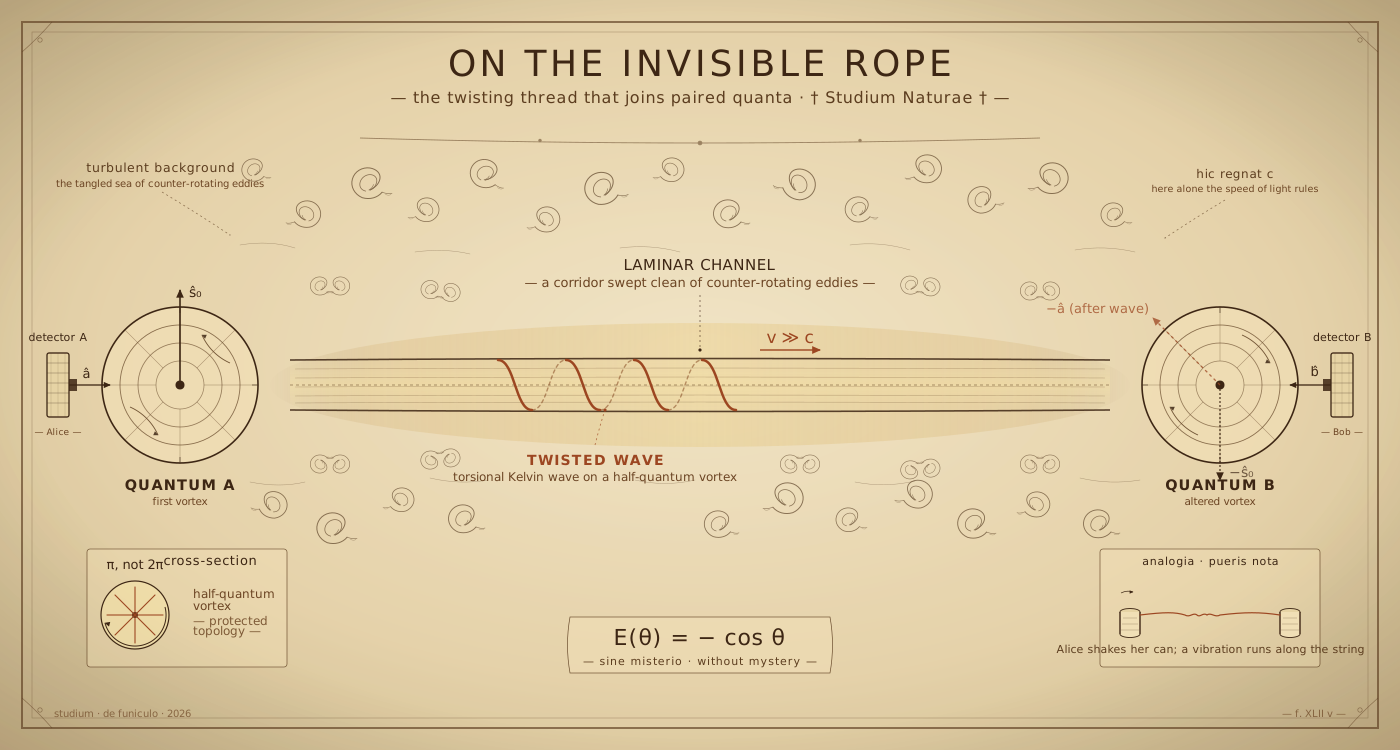
Interactive: open the Bell simulation — watch a singlet pair carve its half-quantum channel, see A’s snap send a twist wave down it and turn B’s axis before B locks, and let the tally build E(\theta) and the CHSH |S| live; switch the channel off and the same hidden variable dilutes to -\cos\theta/3, or slide the separation out past L_\text{max} and watch the wave arrive too late.
The most challenging test for any framework proposing a physical substrate beneath quantum mechanics is reproducing the correlations measured in Bell test experiments. Bell’s theorem proves that any theory satisfying three assumptions — realism, locality, and measurement independence — must obey the CHSH bound S \leq 2. Quantum mechanics predicts S = 2\sqrt{2} \approx 2.83, and experiments consistently measure S \approx 2.7–2.8, violating the bound and ruling out local hidden variable theories.
The substrate framework proposes that the entangled pair is connected by a topologically protected vortex channel in the substrate — and measurement at one end sends a physical disturbance along that channel to the other end at a speed faster than the emergent speed of light.
This section builds that argument from the ground up, in five parts:
- What the entanglement channel is and why it persists
- What sets the speed of disturbances along it — what is derived, what is measured, and what is not
- What the measurement disturbance carries and how it modifies the second particle
- The exact derivation of E(\theta) = -\cos\theta
- Why this doesn’t enable faster-than-light signaling
Part 1: The Entanglement Channel
When an entangled pair is created — whether by atomic cascade, parametric down-conversion, or any process that produces a singlet state — the two particles emerge from a shared vortex core. In the substrate picture, this shared core is a single bound configuration of co-rotating and counter-rotating flows that then splits into two separate vortex cores moving apart.
As the particles separate, they carve a channel through the substrate. This is the modon channel: a vortex defect connecting the two vortex cores, threaded through the substrate’s order parameter. It’s the same kind of structure as the counter-rotating seam between nucleons (the strong force), or the shared vortex in a Cooper pair — but stretched across macroscopic distance.
The channel is specifically a half-quantum vortex (HQV) in the substrate’s SU(2) \to U(1) order parameter. The order parameter — the local orientation of the cell-vortex core field — winds by \pi (not 2\pi) around the channel axis. This half-integer winding is the topological encoding of the singlet constraint: the two particles have total spin zero, and the channel’s winding number records that fact in the substrate’s geometry.
Why does the channel persist? For the same reason quantized vortex lines persist in superfluid helium: topological protection. A half-integer winding cannot be unwound by any local, continuous deformation of the substrate. The substrate would have to undergo a global reorganization to eliminate the defect — and the energy cost of that reorganization exceeds any local thermal fluctuation. The channel is stable against perturbation and persists until the topological charge is annihilated, which happens when measurement destroys both endpoints.
This is not exotic physics. Half-quantum vortices have been directly observed in superfluid He-3-A (Autti et al., 2016) and in spinor Bose-Einstein condensates. Their topological stability is well-established experimentally. The substrate framework proposes that the same mathematics governs entanglement channels in the dc1 medium.
The channel interior: a laminar corridor
Here is the key physical insight that distinguishes this model from generic “topology explains everything” hand-waving: the interior of the channel is not the same medium as the bulk substrate.
In the bulk substrate, the cell-vortex cores are organized into the tangled counter-rotating boundary layer structure that gives rise to all the emergent physics — the speed of light c (from the Larichev-Reznik dispersion), quantum mechanics (from the two-fluid interaction), gravity (from boundary layer leakage). Propagation through this medium is limited to c because modons must navigate through all those counter-rotating layers — the elastic collisions, the flip-flopping at boundaries, the whole obstacle course that sets the speed limit.
But the two separating particles swept those layers aside as they traveled. The channel interior is a laminar stream — a corridor of coherent substrate flow, cleared of the counter-rotating obstacles that exist in the bulk. Think of it as a racetrack carved through the substrate: the boundary layers that would normally slow things down have been pushed to the channel walls, leaving a clean path through the middle.
This distinction — bulk medium vs. channel interior — is the reason the channel can support propagation faster than c. The emergent speed limit applies to the emergent medium. The channel interior is sub-emergent structure, operating at the level of the substrate’s microscopic dynamics rather than its collective behavior.
The helium analogy needs care, and Part 2 is exact about it. Kelvin waves on a quantized vortex line are indeed a mode of the vortex rather than of the bulk phonons, and they carry angular information along the line — but they are slow, capped below the vortex’s own edge speed, and they never outrun first sound. What the channel needs is a core-bound zero mode of the kind Volovik describes for half-quantum vortices in He-3-A: an excitation trapped on the defect whose speed is set by the microscopic carriers rather than by the emergent sound. That is the type of mode the twist wave is, and its speed is the one number in this chapter the framework bounds but does not derive.
Part 2: Channel Propagation Speed — What Is Derived, What Is Bounded, and What Is Not
We now ask how fast a disturbance travels along the entanglement channel. An earlier version of this section derived a number, v_\text{ch} \approx 10^7\,c, from the Kelvin-wave dispersion of a vortex line. That derivation was wrong, and it is worth showing exactly why, because the failure is instructive: it fixes what kind of mode the channel must carry, and it separates cleanly what this framework can compute from what it can only bound.
The Thomson-Kelvin dispersion relation
In an inviscid, incompressible superfluid, small helical perturbations of a quantized vortex line propagate as Kelvin waves. In the Local Induction Approximation (the Arms-Hama form of the Biot-Savart integral), a vortex with circulation \Gamma and core radius a carries
\omega(k) = \frac{\Gamma\, k^2}{4\pi} \cdot \ln\!\left(\frac{1}{k\,a}\right), \qquad v_\text{phase} = \frac{\omega}{k} = \frac{\Gamma\, k}{4\pi} \cdot \ln\!\left(\frac{1}{k\,a}\right), \qquad v_\text{group} \approx 2\,v_\text{phase},
valid for k a \ll 1 — wavelengths much longer than the core. This is Kelvin’s 1880 result, and it is extensively verified in superfluid helium. The dispersion is anomalous: shorter waves run faster. That is the feature the earlier derivation leaned on, and it is real. But it is capped.
The cap
Within its range of validity the Kelvin phase speed has a maximum. The function x\ln(1/x) peaks at x = 1/e, so
v_\text{phase}^\text{max} = \frac{\Gamma}{4\pi e\, a} \approx 0.18\,\frac{\Gamma}{2\pi a},
about a fifth of the swirl speed of the superfluid at the edge of the core, with the group speed twice that. The wave cannot be pushed past this by choosing a shorter wavelength: at ka \gtrsim 1 the line no longer responds as a line, the approximation fails, and what remains is bulk sound at the ordinary speed. A Kelvin wave is a mode of the vortex, and the vortex’s own edge speed is its ceiling.
This already disposes of the helium analogy as it was previously stated. In He-4 the circulation is \kappa = h/m_\text{He} \approx 10^{-7}\;\text{m}^2/\text{s} and the core is about 1 Å, so the cap is about 20 m/s against a first-sound speed of 238 m/s; at the micron wavelengths where Kelvin waves are actually observed they move at millimetres per second. Kelvin waves do not outrun first sound in helium.
In the substrate the same cap is fixed by the framework’s own identities, and every choice of vortex gives the same answer:
| Vortex the channel might be | circulation | core | edge swirl speed | Kelvin cap (phase) |
|---|---|---|---|---|
| dc1 half-quantum vortex | h/2m_1 | \xi = \hbar/m_1 c = 97\;\mum | c (the Volovik identity) | 0.09\,c |
| dc1 half-quantum vortex, GP core | h/2m_1 | \xi/\sqrt2 | 1.4\,c | 0.13\,c |
| effective-quantum vortex | h/2m_\text{eff} | r_\text{eff} = 150 fm | 0.78\,c (Electron) | 0.07\,c |
A Kelvin wave on the channel is subluminal. That is not a loose end; it is a result.
Where the earlier estimate went wrong
The earlier derivation set the core radius to the substrate’s healing length \xi = \hbar/(m_s c) and asserted that with m_s = m_1 \ll m_e this length is “vastly smaller” than the particle scale r_\text{ch} \sim a_B. The sign of that inference is backwards: a Compton length grows as the mass shrinks. With m_s = m_1 the healing length is the lattice cell, 97\;\mum, nine orders of magnitude larger than the Bohr radius — as the rest of the paper says it is (Substrate Particles). The “key equation” v_\text{ch}/c \approx (m_e/m_s)(\alpha/4)\ln(r_\text{ch}/\xi) is the algebraic identity (m_e/m_1)(\alpha/4) = \xi/(4a_B) in disguise: its large prefactor is precisely the statement that \xi \gg r_\text{ch}, which puts the wave at k\xi \sim 10^6, six decades outside the k\xi \ll 1 range where the dispersion holds, and makes the logarithm negative. The 10^7\,c was the LIA formula evaluated where the LIA does not exist.
What the channel needs instead: a core-bound zero mode
What the argument of Part 1 actually requires is not a bending wave of the vortex line but a mode bound to its core, whose speed is set by the substrate’s microscopic carriers rather than by the emergent sound speed. Volovik’s analysis of half-quantum vortices in He-3-A (The Universe in a Helium Droplet, Chapters 14–16) shows what such a mode looks like:
- Vortex cores in He-3-A bind zero modes — gapless fermionic excitations that propagate along the line, and whose velocity is the microscopic Fermi velocity v_F, not the quasiparticles’ emergent “light speed” c_\perp = \Delta/p_F. In He-3-A, v_F/c_\perp \sim 10^3.
- The half-integer winding protects them: a half-quantum core mode has no integer decomposition into bulk modes and cannot scatter out of the core.
- Spectral flow along the core is the mechanism by which information moves along the defect.
The channel of this chapter is a half-quantum vortex in an SU(2)\to U(1) order parameter with a Majorana zero mode at each endpoint (Part 3 and Quantum Computing); the twist wave is the propagating member of that family. This is the right type of mode. What the framework does not yet supply is its speed. The He-3-A number comes from the weak-coupling hierarchy v_F \gg c_\perp; the substrate sits in Volovik’s strong-coupling BEC limit, where the spectrum is isotropic with a single c (Substrate Particles), and the corresponding hierarchy has to come from somewhere else. The natural candidate is the mass hierarchy the paper already carries, m_e/m_1 = \alpha_{mf}\,\nu = 2.5\times10^8 — the lift from the substrate quantum to the particle that carved the channel — which would put v_\text{ch}/c somewhere between \alpha\,m_e/m_1 \sim 10^6 and m_e/m_1 \sim 10^8. That is a scale, not a derivation, and it is logged as such in Open Problems. Everything downstream in this chapter — the -\cos\theta correlation, the no-signalling marginals, the prediction of Part 7 — takes v_\text{ch} as a finite, unknown number and asks only that it be large.
What experiment says
The speed of the influence is not free in the other direction either. If a preferred frame exists — and the substrate is one — then two measurement events that are simultaneous in that frame leave no time for any finite-speed influence to cross, and the correlation should fail for them. Three experiments have been built to look for exactly this, sweeping the two detection events through simultaneity in every candidate frame by letting the Earth rotate an east-west baseline through a full day:
| Experiment | Baseline | Method | Bound on v_\text{ch} |
|---|---|---|---|
| Salart et al. 2008 [R178] | 18 km, Geneva | 24 h Bell test, source at the midpoint | > 10^4\,c for any frame moving at < 10^{-3}\,c relative to Earth |
| Yin et al. 2013 [R179] | 15.3 km, Qinghai, east-west | 12 h continuous violation with the locality and setting loopholes closed; events timed to 350 ps | > 1.38\times10^4\,c for \beta = 10^{-3} |
| Cocciaro, Faetti & Fronzoni 2018 [R180] | 1.2 km, the east-west gallery at EGO Cascina | optical paths equalized interferometrically to 0.22 mm, 36 h run | > 5\times10^6\,c for \beta \approx 10^{-3} |
The famous long-baseline tests — Aspect at 12 m, the cosmic Bell test at 600 m, Micius at 1,200 km [R72, R73, R74] — do not bound v_\text{ch} directly, because none of them aligned the two detection events in any preferred frame: in the substrate frame their event offsets are spread over microseconds by path-length differences and the Earth’s 370 km/s motion, so the shots that a finite v_\text{ch} would spoil are a negligible fraction of their data. What those tests constrain is the loss fraction of Part 7, and at any v_\text{ch} above the Geneva floor that fraction is invisible to them.
The substrate frame is the CMB frame, in which the Earth moves at 370 km/s, \beta = 1.2\times10^{-3} — the case these experiments were designed for. The Cascina bound holds for preferred frames whose velocity makes a polar angle between 18° and 162° with the Earth’s rotation axis; the CMB dipole sits near 97°, well inside. So the floor that applies to this framework is the Cascina one: v_\text{ch} > 5\times10^6\,c. The mass hierarchy’s lower edge, \alpha\,m_e/m_1 \approx 2\times10^6, is already excluded; its upper edge, m_e/m_1 = 2.5\times10^8, clears the floor by a factor of fifty.
So the honest status of v_\text{ch} is: not derived; bounded below at 5\times10^6\,c by direct measurement; plausibly of order m_e/m_1 \approx 2.5\times10^8 on the framework’s mass hierarchy; and finite. The last word is the one that carries the prediction.
Part 3: The Measurement Disturbance — What Propagates and How
When detector A activates, its electromagnetic field couples to particle A’s dual-spin gyroscope. The gyroscope precesses and snaps to alignment with the detector axis — the boundary-matching quantization that gives \cos^2(\theta/2) probabilities. This reorganization changes the boundary structure of A’s vortex core.
The reorganization disturbs the A-endpoint of the channel. The disturbance is a twist wave — a torsional mode bound to the channel’s core (Part 2) — that propagates along the channel. Here’s exactly what it carries.
Before measurement: the channel encodes the singlet constraint
At every point along the channel, the substrate order parameter \hat{\mathbf{d}} winds by \pi around the channel axis. At the A-endpoint, the reference direction \hat{\mathbf{d}}_0 equals the particle’s spin axis \hat{\mathbf{s}}_0 — the axis determined at the moment of entangled pair creation. At the B-endpoint, the half-integer winding ensures:
\hat{\mathbf{d}}_0(B) = -\hat{\mathbf{d}}_0(A) = -\hat{\mathbf{s}}_0
This is the singlet constraint J_A + J_B = 0, encoded topologically.
The direction \hat{\mathbf{s}}_0 itself is random — uniformly distributed on the sphere. The parent system had total spin zero, so the common axis of the two antiparallel spins was set by whatever microscopic substrate fluctuation broke the symmetry at creation. This is the “hidden variable” in the model.
The twist wave: encoding A’s measurement outcome
Suppose detector A is set along axis \hat{\mathbf{a}}, and particle A’s pre-measurement spin axis \hat{\mathbf{s}}_0 makes angle \theta_A with \hat{\mathbf{a}}. The dual-spin gyroscope snaps to either +\hat{\mathbf{a}} (spin-up, probability \cos^2(\theta_A/2)) or -\hat{\mathbf{a}} (spin-down, probability \sin^2(\theta_A/2)).
Say A gets spin-up: the spin axis at A’s endpoint rotates from \hat{\mathbf{s}}_0 to +\hat{\mathbf{a}}. This is a physical rotation of the order parameter at the channel endpoint. The rotation R_A maps \hat{\mathbf{s}}_0 \to \hat{\mathbf{a}}, performed about the axis perpendicular to both (\hat{\mathbf{s}}_0 \times \hat{\mathbf{a}} / |\hat{\mathbf{s}}_0 \times \hat{\mathbf{a}}|) through angle \theta_A.
This discontinuous change at the endpoint launches a twist wave into the channel — a torsional core mode that carries the rotation R_A along the channel at speed v_\text{ch}.
Topological protection: why the signal arrives intact
The twist wave is a zero mode bound to the vortex core. This is established by an index theorem: for a half-quantum vortex in an SU(2)/U(1) order parameter, the Atiyah-Singer index of the Dirac-type operator governing order parameter dynamics in the vortex background is 1. This guarantees exactly one family of protected modes.
The protection is physical: the twist wave cannot scatter into the bulk substrate because the bulk doesn’t support half-integer winding. Any radiation from the channel into the bulk would need to carry integer winding (since the bulk order parameter is single-valued), and a half-integer mode cannot decompose into integer modes. This is a topological selection rule — the same mathematics that protects qubits in topological quantum computers.
The consequence: the rotation R_A arrives at B’s endpoint with perfect fidelity. No information is lost to dispersion, radiation, or decoherence during transit.
Updating B’s state: the geometric identity
The twist wave arrives at B and applies the rotation R_A to B’s endpoint. Before arrival:
\hat{\mathbf{d}}_0(B) = -\hat{\mathbf{s}}_0
After R_A is applied:
\hat{\mathbf{d}}_0(B) \to R_A(-\hat{\mathbf{s}}_0) = \;?
We need to evaluate this. R_A is the rotation about axis \hat{\mathbf{m}} = (\hat{\mathbf{s}}_0 \times \hat{\mathbf{a}})/\sin\theta_A through angle \theta_A. Using Rodrigues’ rotation formula on the vector \mathbf{v} = -\hat{\mathbf{s}}_0:
R_A(\mathbf{v}) = \mathbf{v}\cos\theta_A + (\hat{\mathbf{m}} \times \mathbf{v})\sin\theta_A + \hat{\mathbf{m}}(\hat{\mathbf{m}} \cdot \mathbf{v})(1 - \cos\theta_A)
Since \hat{\mathbf{m}} is perpendicular to \hat{\mathbf{s}}_0, we have \hat{\mathbf{m}} \cdot (-\hat{\mathbf{s}}_0) = 0. The last term vanishes.
For the cross product term: \hat{\mathbf{m}} \times (-\hat{\mathbf{s}}_0) = -(\hat{\mathbf{m}} \times \hat{\mathbf{s}}_0). Using the BAC-CAB identity on (\hat{\mathbf{s}}_0 \times \hat{\mathbf{a}}) \times \hat{\mathbf{s}}_0 = \hat{\mathbf{a}} - \hat{\mathbf{s}}_0\cos\theta_A, we get \hat{\mathbf{m}} \times \hat{\mathbf{s}}_0 = (\hat{\mathbf{a}} - \hat{\mathbf{s}}_0\cos\theta_A)/\sin\theta_A.
Substituting:
R_A(-\hat{\mathbf{s}}_0) = -\hat{\mathbf{s}}_0\cos\theta_A - \frac{\hat{\mathbf{a}} - \hat{\mathbf{s}}_0\cos\theta_A}{\sin\theta_A} \cdot \sin\theta_A
= -\hat{\mathbf{s}}_0\cos\theta_A - \hat{\mathbf{a}} + \hat{\mathbf{s}}_0\cos\theta_A
= -\hat{\mathbf{a}}
So:
\boxed{R_A(-\hat{\mathbf{s}}_0) = -\hat{\mathbf{a}}}
This is exact — not an approximation. It follows from a fundamental property of rotations: any rotation that maps vector \mathbf{v} to \mathbf{w} (about the perpendicular bisector axis) also maps -\mathbf{v} to -\mathbf{w}. This is a consequence of linearity: R(-\mathbf{v}) = -R(\mathbf{v}) = -\mathbf{w}.
After the twist wave arrives, B’s effective spin axis is -\hat{\mathbf{a}}: antiparallel to A’s detector axis, independent of the original hidden variable \hat{\mathbf{s}}_0.
If A had gotten spin-down instead (axis snapping from \hat{\mathbf{s}}_0 to -\hat{\mathbf{a}}), the same argument gives R_A(-\hat{\mathbf{s}}_0) = +\hat{\mathbf{a}}. In general, for A’s outcome \alpha \in \{+1, -1\}:
\hat{\mathbf{s}}_B(\text{effective}) = -\alpha \cdot \hat{\mathbf{a}}
B’s spin axis after the channel update is always aligned or anti-aligned with A’s detector axis, with the sign determined by A’s outcome. The random hidden variable \hat{\mathbf{s}}_0 has been completely erased from B’s state.
Part 4: Deriving E(\theta) = -\cos\theta
This is the central calculation. We now have all the pieces: the dual-spin gyroscope response (from the spin statistics section), the channel signal mechanism, and the geometric identity for B’s state update. Let’s assemble them.
Setup
Two particles are created in the singlet state. Particle A’s spin axis is \hat{\mathbf{s}}_0, particle B’s is -\hat{\mathbf{s}}_0, with \hat{\mathbf{s}}_0 uniformly distributed on the unit sphere S^2. A modon channel (half-quantum vortex) connects them.
Detector A is set along axis \hat{\mathbf{a}}, detector B along axis \hat{\mathbf{b}}. The angle between the detectors is \theta, so \hat{\mathbf{a}} \cdot \hat{\mathbf{b}} = \cos\theta. Outcomes are labeled +1 (spin-up) and -1 (spin-down).
Step 1: What happens WITHOUT the channel (the classical baseline)
To understand why the channel is necessary, first compute the correlation when each particle simply carries its hidden axis to the detector with no communication.
A measures along \hat{\mathbf{a}} at angle \theta_A = \arccos(\hat{\mathbf{s}}_0 \cdot \hat{\mathbf{a}}) from its spin axis. B measures along \hat{\mathbf{b}} at angle \theta_B from its spin axis -\hat{\mathbf{s}}_0. Since outcomes are independent (no channel), joint probabilities factor:
E(\hat{\mathbf{a}}, \hat{\mathbf{b}} \mid \hat{\mathbf{s}}_0) = \bigl[\cos^2(\theta_A/2) - \sin^2(\theta_A/2)\bigr] \cdot \bigl[\cos^2(\theta_B/2) - \sin^2(\theta_B/2)\bigr] = \cos\theta_A \cdot \cos\theta_B
With \cos\theta_B = \cos(\text{angle between } {-\hat{\mathbf{s}}_0} \text{ and } \hat{\mathbf{b}}) = -(\hat{\mathbf{s}}_0 \cdot \hat{\mathbf{b}}), the hidden-variable correlation becomes:
E(\hat{\mathbf{a}}, \hat{\mathbf{b}} \mid \hat{\mathbf{s}}_0) = -(\hat{\mathbf{s}}_0 \cdot \hat{\mathbf{a}})(\hat{\mathbf{s}}_0 \cdot \hat{\mathbf{b}})
Averaging over \hat{\mathbf{s}}_0 uniform on S^2, using the standard identity \langle s_i \cdot s_j \rangle = \delta_{ij}/3:
E_\text{classical}(\hat{\mathbf{a}}, \hat{\mathbf{b}}) = -\tfrac{1}{3}\,\hat{\mathbf{a}} \cdot \hat{\mathbf{b}} = -\tfrac{1}{3}\cos\theta
This is the classical dilution — the factor of 1/3 that arises from averaging an unknown spin axis over the sphere. It satisfies Bell’s inequality (CHSH bound S \leq 2) and does not match quantum mechanics (which gives -\cos\theta, violating Bell with S = 2\sqrt{2}). The 1/3 dilution is inescapable in any local hidden variable model. This is the content of Bell’s theorem.
Step 2: What happens WITH the channel (the substrate prediction)
Now include the channel signal. A measures first (or more precisely, A’s measurement reorganization begins first — the key requirement is that A’s twist wave reaches B before B’s reorganization is complete).
A’s measurement: The dual-spin gyroscope at A, with spin axis \hat{\mathbf{s}}_0 and detector axis \hat{\mathbf{a}}, gives:
P(A = +1) = \cos^2(\theta_A/2), \qquad P(A = -1) = \sin^2(\theta_A/2)
where \theta_A = \arccos(\hat{\mathbf{s}}_0 \cdot \hat{\mathbf{a}}).
Channel signal: A’s outcome launches a twist wave. It propagates at v_\text{ch} \gg c and arrives at B with perfect fidelity (topological protection).
B’s updated state: After the twist wave arrives (from Part 3):
- If A = +1: B’s effective spin axis becomes -\hat{\mathbf{a}}
- If A = -1: B’s effective spin axis becomes +\hat{\mathbf{a}}
In both cases, B’s axis is now determined by A’s detector and outcome, not by \hat{\mathbf{s}}_0.
B’s measurement: Detector B along \hat{\mathbf{b}} interacts with B’s updated gyroscope.
Case A = +1, so B’s axis = -\hat{\mathbf{a}}:
The angle between -\hat{\mathbf{a}} and \hat{\mathbf{b}} is \arccos(-\cos\theta) = \pi - \theta.
P(B = +1 \mid A = +1) = \cos^2\!\bigl((\pi - \theta)/2\bigr) = \sin^2(\theta/2)
P(B = -1 \mid A = +1) = \sin^2\!\bigl((\pi - \theta)/2\bigr) = \cos^2(\theta/2)
Case A = -1, so B’s axis = +\hat{\mathbf{a}}:
The angle between +\hat{\mathbf{a}} and \hat{\mathbf{b}} is \theta.
P(B = +1 \mid A = -1) = \cos^2(\theta/2)
P(B = -1 \mid A = -1) = \sin^2(\theta/2)
Step 3: Computing the correlation
The joint probabilities for a given hidden variable \hat{\mathbf{s}}_0:
P(+1,+1 \mid \hat{\mathbf{s}}_0) = \cos^2(\theta_A/2) \cdot \sin^2(\theta/2)
P(+1,-1 \mid \hat{\mathbf{s}}_0) = \cos^2(\theta_A/2) \cdot \cos^2(\theta/2)
P(-1,+1 \mid \hat{\mathbf{s}}_0) = \sin^2(\theta_A/2) \cdot \cos^2(\theta/2)
P(-1,-1 \mid \hat{\mathbf{s}}_0) = \sin^2(\theta_A/2) \cdot \sin^2(\theta/2)
The correlation:
E(\theta \mid \hat{\mathbf{s}}_0) = P(+,+) + P(-,-) - P(+,-) - P(-,+)
= \sin^2(\theta/2)\bigl[\cos^2(\theta_A/2) + \sin^2(\theta_A/2)\bigr] - \cos^2(\theta/2)\bigl[\cos^2(\theta_A/2) + \sin^2(\theta_A/2)\bigr]
= \sin^2(\theta/2) \cdot 1 - \cos^2(\theta/2) \cdot 1
\boxed{E(\theta \mid \hat{\mathbf{s}}_0) = \sin^2(\theta/2) - \cos^2(\theta/2) = -\cos\theta}
The dependence on \hat{\mathbf{s}}_0 has dropped out entirely. The correlation is -\cos\theta for every value of the hidden variable, not just on average. Averaging over \hat{\mathbf{s}}_0 is therefore trivial:
\boxed{E(\theta) = -\cos\theta}
This is the exact quantum mechanical result for the singlet state.
Step 4: Verifying the CHSH violation
The CHSH parameter is:
S = E(\hat{\mathbf{a}}, \hat{\mathbf{b}}) - E(\hat{\mathbf{a}}, \hat{\mathbf{b}}') + E(\hat{\mathbf{a}}', \hat{\mathbf{b}}) + E(\hat{\mathbf{a}}', \hat{\mathbf{b}}')
With E(\theta) = -\cos\theta, the quantum-optimal detector settings (\hat{\mathbf{a}} at 0°, \hat{\mathbf{a}}' at \pi/2, \hat{\mathbf{b}} at \pi/4, \hat{\mathbf{b}}' at -\pi/4) give four angles of \pi/4, 3\pi/4, \pi/4, \pi/4 respectively:
S = -\cos(\pi/4) - \bigl(-\cos(3\pi/4)\bigr) + \bigl(-\cos(\pi/4)\bigr) + \bigl(-\cos(\pi/4)\bigr)
= -\frac{1}{\sqrt{2}} - \frac{1}{\sqrt{2}} - \frac{1}{\sqrt{2}} - \frac{1}{\sqrt{2}}
|S| = \frac{4}{\sqrt{2}} = 2\sqrt{2} \approx 2.83
This matches the Tsirelson bound — the maximum quantum mechanical value — and violates the classical CHSH bound of S \leq 2.
Beyond the singlet: triplet pairs from the vacuum
Everything above assumes a singlet source. Not every entangled pair is one. Quark–antiquark pairs drawn from the QCD vacuum are created in ³P₀ (spin S=1 locked against orbital L=1 to give J=0), and STAR has now seen their parallel spins in \Lambda\bar\Lambda pairs ([R217]). The mechanism covers them with one change. What the channel encodes is the pair’s total angular momentum, which is still zero. For a pair separating along \hat{\mathbf k}, the ³P₀ spin state is the singlet with one partner rotated by \pi about \hat{\mathbf k}. Because the channel lies along \hat{\mathbf k}, that is a frozen half-twist of the order parameter about the channel’s own length. B’s end becomes the mirror image of A’s in the plane perpendicular to the channel, \hat{\mathbf d}_0(B) = \hat{\mathbf d}_0(A) - 2(\hat{\mathbf d}_0(A)\cdot\hat{\mathbf k})\hat{\mathbf k}, in place of the point reflection -\hat{\mathbf d}_0(A). Steps 2 and 3 run unchanged and return E(\hat{\mathbf a},\hat{\mathbf b}) = \hat{\mathbf a}\cdot\hat{\mathbf b} - 2(\hat{\mathbf a}\cdot\hat{\mathbf k})(\hat{\mathbf b}\cdot\hat{\mathbf k}), the exact ³P₀ correlation. With the channel switched off, the same isotropic hidden axis dilutes it by the familiar \tfrac13. STAR’s data already sit above that diluted ceiling. The details, and the measurement that would distinguish the channel from every local model, are in Spin Pairs From the Vacuum.
Part 5: No-Signaling and Consistency
For the model to be physically consistent, Alice’s choice of detector axis \hat{\mathbf{a}} must not affect Bob’s marginal statistics. Otherwise the channel would enable faster-than-light communication — not just correlation, but actual signaling.
The no-signaling check
Bob’s marginal probability of getting +1:
P(B = +1) = P(B = +1 \mid A = +1) \cdot P(A = +1) + P(B = +1 \mid A = -1) \cdot P(A = -1)
= \sin^2(\theta/2) \cdot \cos^2(\theta_A/2) + \cos^2(\theta/2) \cdot \sin^2(\theta_A/2)
This depends on \theta_A = \arccos(\hat{\mathbf{s}}_0 \cdot \hat{\mathbf{a}}), which depends on A’s detector choice. But \hat{\mathbf{s}}_0 is hidden — unknown to both Alice and Bob and averaged over in any real experiment:
\langle P(B = +1) \rangle = \sin^2(\theta/2) \cdot \langle\cos^2(\theta_A/2)\rangle + \cos^2(\theta/2) \cdot \langle\sin^2(\theta_A/2)\rangle
Since \hat{\mathbf{s}}_0 is uniform on S^2, both \langle\cos^2(\theta_A/2)\rangle and \langle\sin^2(\theta_A/2)\rangle equal 1/2:
\langle P(B = +1) \rangle = \sin^2(\theta/2) \cdot \tfrac{1}{2} + \cos^2(\theta/2) \cdot \tfrac{1}{2} = \tfrac{1}{2}
Bob gets +1 and −1 with equal probability 1/2, regardless of Alice’s detector choice and regardless of the angle \theta between detectors. No-signaling is exactly preserved.
The physical reason: the channel signal is triggered by Alice’s random outcome (which she doesn’t control), not by her choice of axis. Alice’s choice affects which correlation is established, but since she can’t control which outcome she gets, she can’t encode a message into the channel. The correlations are only visible when Alice and Bob compare their results after the fact — which requires classical communication at speed \leq c.
This is the same resolution as in standard quantum mechanics, but now with a mechanical explanation: the randomness of quantum measurement outcomes is not just epistemological — it’s the physical randomness of which way a gyroscope snaps when it encounters a magnetic field at an oblique angle.
What Bell’s theorem actually rules out
Bell’s theorem rules out theories that are simultaneously: (1) realistic (definite pre-measurement values), (2) local (no superluminal influences), and (3) measurement-independent (detector settings are free variables).
The substrate framework is realistic (particles have definite vortex core configurations) and measurement-independent (detector settings are freely chosen — the substrate dynamics don’t conspire to correlate them with the hidden variable). It violates locality: the channel signal is a superluminal influence.
But — and this is the crucial distinction — the locality violation occurs at the sub-emergent level. The channel propagation at v_\text{ch} > c involves the substrate’s microscopic degrees of freedom (a zero mode bound to a vortex defect), not the collective excitations (modons) that constitute the emergent Lorentz-invariant physics. All observable physics — everything that interacts with detectors, carries energy, produces signals — propagates as modons through the bulk substrate at speed c. The channel signal can’t be harnessed for communication because:
- You can’t create a channel on demand (it requires an entanglement event)
- You can’t control what signal it carries (the measurement outcome is random)
- The channel is destroyed by measurement (the topological defect annihilates when both endpoints are consumed)
- The correlations are only visible in joint statistics requiring classical comparison
This is “nonlocal but not signaling” — the same operational situation as standard quantum mechanics, but with a physical mechanism rather than a postulate.
Part 6: Why This Isn’t Spooky
Let’s summarize the full mechanism in substrate language, because the whole point of this framework is to replace mystery with machinery.
The complete sequence
Creation. A singlet source produces two particles from a shared vortex core. As they separate, the departing flows carve a laminar channel — a half-quantum vortex in the substrate’s order parameter — connecting them. The channel’s half-integer winding encodes J_A + J_B = 0.
Flight. The particles travel to distant detectors. The channel persists because its topological charge (half-integer winding) cannot be unwound by local substrate fluctuations. The channel interior remains laminar — cleared of the counter-rotating boundary structures that limit bulk propagation to c.
Alice measures. Her detector’s magnetic field couples to particle A’s dual-spin gyroscope. The boundary-matching condition snaps the spin to \pm\hat{\mathbf{a}}. This reorganization disturbs the A-endpoint of the channel, launching a twist wave — a torsional core mode — that carries the rotation mapping \hat{\mathbf{s}}_0 \to \alpha\hat{\mathbf{a}} (where \alpha is A’s outcome).
The twist wave propagates. It travels along the laminar channel interior at v_\text{ch} \gg c — above 5\times10^6\,c by direct measurement, plausibly at the framework’s mass-hierarchy scale m_e/m_1 \approx 2.5\times10^8, and not yet derived (Part 2). The wave is topologically protected — it cannot scatter into the bulk because half-integer modes cannot decompose into integer bulk modes. The rotation arrives at B’s endpoint with perfect fidelity.
Bob’s particle is updated. The rotation transforms B’s spin axis from -\hat{\mathbf{s}}_0 to -\alpha\hat{\mathbf{a}} (the geometric identity R_A(-\hat{\mathbf{s}}_0) = -\hat{\mathbf{a}} for the spin-up case). The hidden variable \hat{\mathbf{s}}_0 is erased from B’s state. B now behaves as if its spin axis is -\alpha\hat{\mathbf{a}} — antiparallel to Alice’s result along Alice’s detector axis.
Bob measures. His detector couples to B’s updated gyroscope at angle \theta to axis -\alpha\hat{\mathbf{a}}. The dual-spin \cos^2(\theta/2) response gives joint probabilities that yield E(\theta) = -\cos\theta exactly, with no classical dilution.
No signaling. Alice’s outcome \alpha is random (set by the angle between the hidden \hat{\mathbf{s}}_0 and her detector). She can’t control it, so she can’t send a message through the channel. Bob sees 50/50 outcomes regardless of what Alice does. The -\cos\theta correlation only appears when they compare results using classical communication.
What “collapse” is
In this framework, wave function collapse is not a postulate, not an interpretation, and not a mystery. It is the physical reorganization of a particle’s vortex core boundaries during measurement, propagated to the entangled partner through a topologically protected vortex channel in the substrate. It’s a twist wave on a string.
The “instantaneous” character of collapse in standard QM is replaced by a very fast but finite-speed process. The speed belongs to the substrate’s microscopic dynamics — a core-bound mode of the channel, operating far below the emergent Lorentz-invariant layer that governs all observable physics — and it is bounded by experiment rather than derived (Part 2).
The analogy that makes it intuitive
Think of two tin cans connected by a taut string. The string is the channel. When Alice shakes her can (measurement), a vibration travels along the string and shakes Bob’s can. The vibration speed depends on the string’s tension and density — not on the speed of sound in the surrounding air (which is the “emergent speed” in this analogy). The string’s vibration can easily exceed the air speed of sound because it’s a different physical mechanism operating through a different medium.
The tin can string doesn’t let Alice send a message because she doesn’t control which way her can shakes — the “measurement outcome” is random. But it does create a correlation between the two shakes, and that correlation violates what you’d expect if the cans were simply pre-loaded with matching instructions (the hidden variable model).
The substrate replaces “spooky action at a distance” with “a vibration on a string that happens to be faster than the emergent speed limit.”
Part 7: A Testable Prediction
The channel has a finite speed, so there are pairs of measurement events it cannot connect. Stating which ones requires one more quantity than the speed, and it is not the one an earlier draft used.
Which shots the channel loses
Let \delta be the time between the two snap events in the substrate rest frame, and let \tau_\text{lock} be how long a snap takes to become irreversible. The spin chapter computes the second: the dual-spin gyroscope phase-locks in one Compton period, \tau_\text{lock} \approx 6\times10^{-21} s. The twist wave launched by the first snap reaches the far end after L/v_\text{ch}, and it updates the partner if it arrives before the partner’s own lock completes:
\frac{L}{v_\text{ch}} < |\delta| + \tau_\text{lock}.
Since \tau_\text{lock} is negligible against every other time in the problem, the rule is simple: a shot is lost when its two measurements are simultaneous in the substrate frame to within L/v_\text{ch}. A lost shot falls back to the local correlation of Part 4, E = -\cos\theta/3; every other shot gives -\cos\theta. If the experiment’s event offsets are spread over a window of width \Delta t, the lost fraction is
f \approx \frac{L/v_\text{ch}}{\Delta t} \qquad\text{and}\qquad E(\theta) = -\Big(1 - \tfrac{2}{3}f\Big)\cos\theta, \qquad S = 2\sqrt2\,(1 - f) + \tfrac{2\sqrt2}{3}\,f,
sliding from the Tsirelson value 2.83 toward the local model’s 0.94 as f \to 1. The transition is not sharp, and now for a stated reason: it follows the distribution of \delta across the run.
The earlier draft wrote the reach as L_\text{max} = v_\text{ch}\,\tau_\text{meas} with \tau_\text{meas} \sim 1 ns, an “atomic timescale.” No such timescale enters. The physical snap time is 10^{-21} s, twelve orders shorter, and if it were the window the mechanism would fail at Aspect’s 12 m. What plays the role of the window is the experiment’s alignment — how tightly it holds the two events simultaneous in the preferred frame — and that is an engineering number, nanoseconds for the Geneva and Qinghai experiments of Part 2, under a picosecond at Cascina, and effectively microseconds for any test that did not try. The reach is therefore a property of the experiment as much as of the channel:
L_\text{max} = v_\text{ch}\,\Delta t .
The prediction
The reach depends on both numbers, so it is best read as a table:
| v_\text{ch}/c | alignment \Delta t | L_\text{max} |
|---|---|---|
| 5\times10^6 (the Cascina floor) | 1 ns | 1,500 km |
| 5\times10^6 | 0.7 ps (Cascina’s path equalization) | 1.1 km — which is why Cascina’s 1.2 km sets that floor |
| 2.5\times10^8 (m_e/m_1) | 1 ns | 75,000 km |
| 2.5\times10^8 | 0.7 ps | 55 km |
The last row is the test the framework asks for: a Cascina-style aligned Bell test on a baseline of order 50–100 km. Two receivers on an east-west line, optical paths equalized to a fraction of a millimetre as Cocciaro et al. already do at 1.2 km, and the detection events swept through simultaneity in the CMB frame by the Earth’s rotation. If v_\text{ch} sits at the framework’s mass-hierarchy scale, the Bell violation should collapse toward S = 0.94 twice a sidereal day, in a window whose width in \delta measures v_\text{ch} directly. Nanosecond alignment on a ground-to-satellite or intercontinental baseline probes the same scale with less demanding optics.
The current situation:
- The direct bounds stand at v_\text{ch} > 5\times10^6\,c for the CMB frame [R178, R179, R180]. Every aligned test to date is consistent with the framework at any v_\text{ch} above that floor, and the framework’s own scale sits fifty times above it.
- Micius at 1,200 km [R74] shows undegraded correlations, as the framework requires for unaligned events at that distance; it does not test v_\text{ch}, because the fraction of its shots within L/v_\text{ch} of simultaneity is below its statistical reach for any v_\text{ch} \gtrsim 10^5\,c.
- The prediction is falsifiable in both directions. A dip at the predicted width in an aligned long-baseline test would measure v_\text{ch} and confirm the channel. Continued perfect correlation as the aligned baseline grows pushes v_\text{ch} upward: a null result at 100 km with Cascina’s alignment would put it past m_e/m_1, above the framework’s own mass hierarchy, and the channel would become indistinguishable from standard QM’s instantaneous collapse.
This makes the substrate framework a refinement of quantum mechanics rather than an alternative to it — it agrees with all existing measurements and makes a prediction for a regime (long aligned baselines) where it could be distinguished from standard QM.
Separation L
600 km
Within L_max
L / L_max
0.50
Channel fidelity: 100%
CHSH value S
2.83
Violates Bell bound (2.0)
Summary Table: Substrate vs Standard QM vs Classical for Bell Tests
| Feature | Classical (Local HV) | Standard QM | Substrate Framework |
|---|---|---|---|
| Correlation E(\theta) | -\cos\theta/3 | -\cos\theta | -\cos\theta (within L_\text{max}) |
| CHSH maximum S | 2 | 2\sqrt{2} | 2\sqrt{2} (within L_\text{max}) |
| Mechanism for correlation | Pre-set hidden variables | “Collapse” (postulated) | Twist wave on vortex channel |
| Why -\cos\theta exactly? | It isn’t (diluted to 1/3) | Born rule (postulated) | Channel erases hidden variable; gyroscope response at definite axis |
| No-signaling | Automatic | Built into formalism | Averaging over random \hat{\mathbf{s}}_0 gives 50/50 marginals |
| Collapse mechanism | N/A | Not specified | Order parameter rotation propagated by a core-bound zero mode |
| Speed of “influence” | N/A (no influence) | Instantaneous (by postulate) | v_\text{ch} > 5\times10^6\,c (measured floor), finite, not yet derived |
| Testably different? | Already ruled out | N/A (the benchmark) | Predicts loss of correlation for events simultaneous in the substrate frame to within L/v_\text{ch} |
| What’s the “hidden variable”? | Spin axis \hat{\mathbf{s}}_0 | N/A | Spin axis \hat{\mathbf{s}}_0 (but erased by channel before B measures) |
From Entanglement to Computation
The entanglement channel built in this chapter is not only the substrate’s explanation of Bell correlations — it is also, structurally, a topological qubit. The half-quantum vortex with its half-integer winding, the Majorana zero mode bound to each endpoint, the topological selection rule that protects the twist wave in transit: these are the exact ingredients a topological quantum computer engineers on purpose. What Nature grows to correlate two particles, an engineer grows and braids to store and process a bit. The next chapter, Quantum Computing in the Substrate, follows this thread — showing that every qubit is a boundary-matched doublet of the superfluid, that two-qubit gates are the carving and twisting of vortex channels, and that the framework’s distinctive, falsifiable prediction is a physical coherence floor on how much entanglement the medium can sustain at once.
Future Tests
Where the substrate framework is distinguishable from standard physics
The framework agrees with standard physics at all currently tested energy scales. What follows are the regimes where it makes distinct predictions. The most striking are zero-parameter predictions — concrete numbers derived from measured inputs with no adjustable parameters. Others are qualitative signatures whose detailed values await further calculation.
Zero-parameter predictions
These predictions use only measured constants as inputs. They can be checked against observation without fitting any free parameter.
1. The bridge equation. The bridge equation connects electroweak physics to cosmology through one relation:
n_1\,\xi_\text{SC2}^3 = \frac{4\pi}{K\sqrt{2}} = 0.5666
This is verified to 0.18% against the numerical value computed from \sin^2\theta_W, m_e, \rho_\text{DM}, \hbar, and c. If exact, it constrains \rho_\text{DM} in terms of particle physics parameters, reducing the independent parameter count of SM + ΛCDM by one. Any future improvement in the Planck measurement of \Omega_c h^2 (currently ~1% precision) tightens this test. A high-precision measurement of \rho_\text{DM} that disagrees with the bridge equation prediction at the sub-percent level would falsify the framework.
2. dc1 particle mass. From the Volovik relation c = \hbar/(m_1\xi) combined with close-packing and \rho_\text{DM} = n_1 m_1:
m_1 \approx 2.04\;\text{meV}/c^2 \approx 3.6 \times 10^{-39}\;\text{kg}
This is a specific ultralight dark matter prediction — lighter than any standard WIMP candidate but heavier than fuzzy dark matter (\sim 10^{-22} eV). It sits in a mass range potentially constrained by cosmological structure formation, Lyman-alpha forest observations, and future 21-cm hydrogen surveys.
3. Minimum photon energy. Modons (photons) require a coherence-length-scale vortex structure to exist. Below the lattice cell size, no modon can form:
E_\text{min} = \frac{hc}{\xi} = 2\pi\,m_1 c^2 \approx 13\;\text{meV} \qquad (\lambda \sim 100\;\mu\text{m},\; f \sim 3\;\text{THz})
Below this energy, electromagnetic radiation cannot propagate as photons — energy transport crosses over to lattice phonon modes (gravitational waves). This predicts an anomaly in photon propagation at wavelengths \gtrsim 100\;\mum, potentially detectable via far-infrared/THz spectroscopy in vacuum.
4. Tkachenko lattice mode. The vortex lattice supports slow shear oscillations at a speed and frequency determined entirely by substrate parameters:
c_T = \sqrt{\frac{\hbar\,\Omega}{4\,m_1}} \approx 9\;\text{km/s}, \qquad f_T \approx 3{,}700\;\text{Hz}
This is a substrate-specific oscillation with no counterpart in standard physics. Possible detection routes include kHz modulation of local dark matter density, precision interferometry at \sim 100\;\mum scales, or second-order coupling to the baryon-photon plasma (see Open Problems).
5. Fine structure constant (tree-level). From a single measured input (\sin^2\theta_W = 0.2312) and zero new parameters:
\alpha_\text{tree} = \frac{\sin^2\delta_0 \cdot \sin^2\theta_W}{\pi} = \frac{1}{135.1} \qquad (+1.45\%\;\text{from measured})
The +1.45% discrepancy is positive — consistent with missing vacuum polarization corrections. Computing the modon self-energy (WIP-5; see Open Problems) would promote this from a tree-level prediction to a precision test. The anomalous magnetic moment (g-2)/2 = 0.001178 (+1.6%) and core-boundary asymmetry \eta = 0.03432 (+0.8%) are independent cross-checks from the same input.
Cosmological predictions
6. CMB tensor-to-scalar ratio. The superfluid phase transition that replaces inflation (see Spacetime & Dynamics) predicts:
r \approx 0.01\text{–}0.02
This is within the detection range of LiteBIRD and CMB-S4. The current upper bound from BICEP/Keck is r < 0.036 (95% CL). If CMB-S4 measures r and it falls in the 0.01–0.02 range, it is consistent. If r < 0.005 or r > 0.03, the framework’s phase transition model is in tension.
7. Dark energy equation of state. The substrate predicts w \neq -1 exactly — dark energy is a residual disequilibrium, not a cosmological constant. The deviation from w = -1 is tiny but nonzero and evolving. DESI, Euclid, and the Roman Space Telescope will measure w(z) at the percent level over the next decade. Any detection of w \neq -1 is qualitatively consistent; a confirmed w = -1.000 \pm 0.001 with no evolution would be problematic.
8. Spectral running. The phase transition predicts dn_s/d\ln k \approx -5.6 \times 10^{-4} — small, negative, and specific. CMB-S4 should reach sufficient sensitivity to test this.
Qualitative signatures
9. Aligned long-baseline Bell tests. The substrate predicts a finite channel speed v_\text{ch} \gg c, bounded below at 5\times10^6\,c by the aligned tests of Salart, Yin and Cocciaro and plausibly at the mass-hierarchy scale m_e/m_1 \approx 2.5\times10^8. A pair whose two measurement events are simultaneous in the substrate (CMB) frame to within L/v_\text{ch} loses its correlation, falling from E(\theta) = -\cos\theta toward the classical -\cos(\theta)/3; the reach is L_\text{max} = v_\text{ch}\,\Delta t with \Delta t the experiment’s alignment. Unaligned tests such as Micius at 1,200 km cannot see this at any v_\text{ch} \gtrsim 10^5\,c. A Cascina-style aligned test on a 50–100 km east-west baseline, or nanosecond alignment ground-to-satellite, would probe the mass-hierarchy scale directly (Bell’s Theorem § Part 7).
10. Lorentz invariance violation at the cell scale, not the Planck scale. Emergent Lorentz invariance departs from exactness only at the lattice cell, \hbar c/\xi = m_1c^2 \approx 2 meV (Substrate Particles § Roton, Maxon, and the Edge of Spacetime). At the marginal density the sound branch is monotonic, \epsilon(p) = cp\sqrt{1+(p\xi/2\hbar)^2}, with no roton dip. High-energy photons are modons, not sound quanta, so gamma-ray-burst timing and ultra-high-energy cosmic rays should show no energy-dependent delay, consistent with Fermi’s GRB 090510 bound above the Planck energy. The signature is instead the modon-to-phonon crossover in the 0.3–10 THz band, \lambda\sim\xi (Quantum Foam).
11. Distance-dependent gravitational effects. The framework predicts gravity as dc1 leak current through boundaries. At very small separations (sub-micron), the boundary structure should produce measurable deviations from 1/r^2. These deviations would have a specific oscillatory signature from the boundary layer structure, distinct from the power-law modifications predicted by extra-dimension models.
12. CDM-to-MOND transition. The substrate predicts a crossover from CDM-like behavior at high accelerations to MOND-like behavior at accelerations below a_0 \sim v_\text{rot,outer}^2/r_\text{galaxy} \sim 10^{-10} m/s², driven by the phonon-mediated force at galaxy scales (Khoury’s superfluid dark matter mechanism applied to the dc1 substrate). The transition should appear as a break in galaxy rotation curves at v \sim 10^{-3}c. Existing data from the radial acceleration relation (McGaugh et al. 2016) is qualitatively consistent; a quantitative comparison requires computing the full phonon-force profile from substrate parameters.
13. Gravitational wave background from phase transition. The first-order superfluid phase transition that replaces inflation produces a stochastic gravitational wave background from bubble collisions. The spectrum is peaked (not scale-invariant), distinct from the tensor spectrum of slow-roll inflation, and potentially detectable by LISA or pulsar timing arrays.
14. Cosmological constant stability. The substrate resolves the cosmological constant problem via Volovik’s self-tuning mechanism. If the vacuum energy is truly self-tuning, then the phase transition in the early universe should leave a specific imprint in the CMB power spectrum — different from the generic inflaton prediction.
15. Neutron interferometry. The dual-spin gyroscope model predicts that the electron’s counter-rotating boundary should produce a tiny gravitational Aharonov-Bohm phase for neutrons passing near a magnetized sample. Standard physics does not produce a gravitational AB effect from electromagnetic sources.
16. The \nu=\tfrac52 pairing channel (thermal Hall). This is the framework’s one Hall prediction on a question standard physics has not settled — a stated bet, not a re-reading. The even-denominator \nu=\tfrac52 fractional quantum Hall state is a paired state of composite fermions: in the substrate it is the anti-phase paired breath — the same p-wave, BCS-like pairing as the Cooper pair, superfluid helium, and the nuclear pairing term, here a fourth time in a magnetotransport plateau. Standard theory offers three candidate topological orders for it — Pfaffian (Moore–Read), anti-Pfaffian (its particle–hole conjugate), and PH-Pfaffian — which are experimentally distinguished by the quantized thermal Hall conductance
\kappa_{xy} = c\,\frac{\pi^2 k_B^2}{3h}\,T, \qquad c = \tfrac72,\ \tfrac32,\ \tfrac52
through the chiral central charge c. The 2018 measurement (Banerjee et al. [R12f]) found the half-integer c\approx\tfrac52, favoring the PH-Pfaffian and against the numerically preferred (anti-)Pfaffian — a discrepancy still unresolved, plausibly involving edge equilibration and disorder.
The substrate makes two commitments here, of different weight. Qualitative (falsifiable now, and the part the calculation actually secures): the state is a topological (weak-pairing) paired condensate — non-abelian e/4 quasiparticles with a Majorana zero mode on each, and a chiral neutral edge. The framework already uses the Read–Green p-wave Bogoliubov–de Gennes program — [R12c], the source of its \delta_0 phase in the Weinberg angle and fine-structure constant chapters — and run on the paired-breath order parameter (scripts/bdg_vortex_pwave.py, scripts/bdg_pwave_chiral_central_charge.py) it puts the state on the weak-pairing side of Read–Green’s \mu=0 boundary: BdG Chern number |\mathcal N|=1, one Majorana per vortex, the sign of \mathcal N set by the p_x\pm ip_y chirality and not by \mu. The framework is embarrassed if \nu=\tfrac52 is shown to be an abelian or non-topological paired state — the strong-pairing or (3,3,1) alternatives — with no Majorana mode. What this does not do is pick among the three. All three candidates are Ising-type orders with exactly one Majorana per e/4 vortex; they differ only at the edge, in c = c_\text{charge} + c_\text{neutral} with c_\text{charge}=3 shared and c_\text{neutral}=\pm\tfrac12 per chiral Majorana edge mode (one with the charge: Pfaffian; one against: PH-Pfaffian; three against: anti-Pfaffian). A vortex zero-mode count fixes the parity of that edge count, not its size, and the single-band chiral p-wave model cannot return anything but |\mathcal N|\le1, so the solver does not exclude the anti-Pfaffian. The bet (a symmetry argument, not a solver output): in Son’s Dirac composite-fermion theory [R12g] the three orders are three pairing channels of one massless Dirac composite fermion — l=0 for the PH-Pfaffian, l=\pm2 for the Pfaffian and anti-Pfaffian — and the particle–hole symmetry of a half-filled level selects l=0. The substrate’s paired breath — two same-chirality fermions locked \pi out of phase, with nothing in the pairing to favor particle over hole — is bet to respect the symmetry of the fluid it condenses in, and so to pair in the l=0 channel. Predicted c=\tfrac52 (PH-Pfaffian), matching Banerjee’s \kappa_{xy} and betting against the numerically favored Pfaffian and anti-Pfaffian, which are each other’s particle–hole conjugates and break the symmetry spontaneously. Unlike the fraction spectrum (settled by composite-fermion theory), this is a live experimental frontier where the substrate can be right or wrong: if the PH-Pfaffian reading of the data is overturned as the edge-equilibration ambiguity resolves, or the bulk proves to be a symmetry-broken (anti-)Pfaffian whose unequilibrated edge merely reads as \tfrac52, the prediction fails.
What to test first
The most accessible tests, roughly ranked by near-term feasibility:
- Bridge equation — improving \rho_\text{DM} precision from Planck/future CMB missions directly tests the zero-parameter relation. Already verified to 0.18%.
- CMB B-modes (r \approx 0.01–0.02) — LiteBIRD launch expected ~2032; CMB-S4 in construction.
- Dark energy (w \neq -1) — DESI first-year results already hint at evolving w; Euclid and Roman will refine.
- High-energy Lorentz violation — existing Fermi-LAT and future CTA data can be reanalyzed for the roton-minimum spectral signature.
- \nu=\tfrac52 thermal Hall (c=\tfrac52, PH-Pfaffian) — already an active experimental frontier (Banerjee 2018 and follow-ups); the theory side is stated: the Read–Green BdG scripts secure a topological, one-Majorana-per-vortex paired breath (which all three candidate orders share), and the particle–hole symmetry of half filling selects the PH-Pfaffian channel — a symmetry bet, not a solver output, awaiting the experimental resolution.
- Minimum photon energy (~13 meV) — far-infrared/THz vacuum spectroscopy could probe the predicted propagation anomaly.
- Tkachenko mode (~3,700 Hz) — requires new experimental concepts; detectability is an open question (see Open Problems).