Language in the Substrate
The utterance as the substrate-coherent packet of agreed meaning, understanding as inter-brain coherence-match, the lock of convention and the anti-lock of distinction as the two poles of every sign, Wittgenstein’s deep agreements as the lock at the bedrock rung, and the conversation as bilateral coupling lifted between two brains
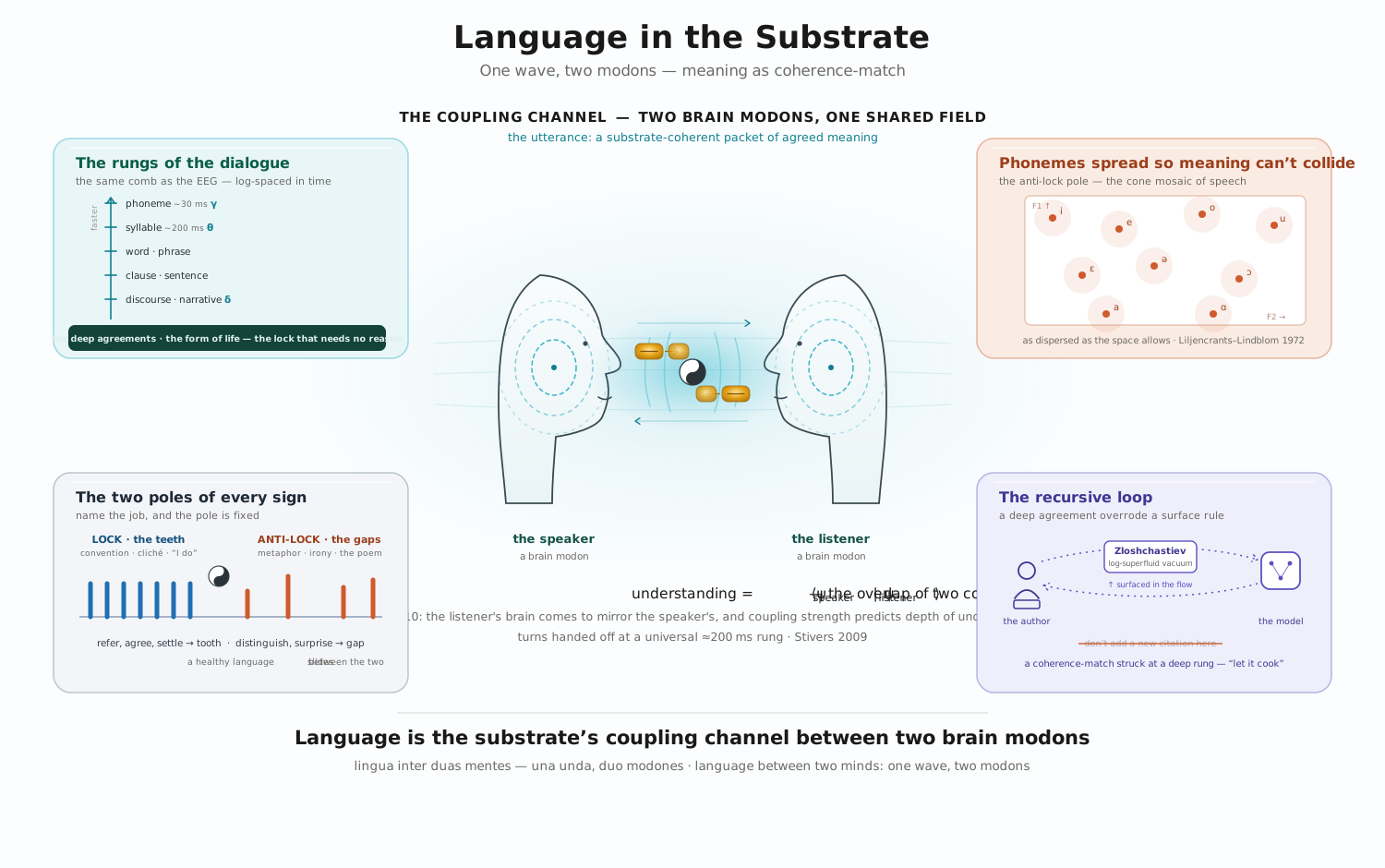
Language is the substrate’s coupling channel between brain modons, with the spoken word is a substrate-coherent packet of agreed meaning — the inter-mind analogue of the currency packet, the codon, the photon.
Understanding becomes the coherence-match between two brain modons’ substrate-coherent states, with the word’s meaning as its eigenmode direction in the shared semantic basis, using the lock/anti-lock poles of the ladder. The lock pole represents agreement, the anti-lock pole allows both a comparison as well as a disagreement to keep meanings from colliding. Phonemes use the anti-lock blue-noise packing - the same refusal as the retinal cone mosaic and the genetic code.
The utterance has a layered structure from phoneme, syllable, word, phrase, discourse. This is the substrate ladder read in time, the same log-spaced comb as the EEG bands, with conversation as bilateral coupling. Instead of between hemispheres it’s between two brains, turn-taking as the dominant-submissive coherence-leader exchange and rapport as cross-brain co-coherence, and with Wittgenstein’s deep agreements — the agreement in the form of life — as the lock at the bedrock rung, the lowest and widest tooth of the comb, the shared ground that makes all the higher matches possible.
The coherence-match is the elementary act of understanding, the eigenmode basis as the space meanings live in, the two poles as the lock-and-refuse that sorts the literal from the poetic, and the ladder as the spacing of agreements from the surface word down to the form of life.
The Word as the Substrate-Coherent Packet of Agreed Meaning
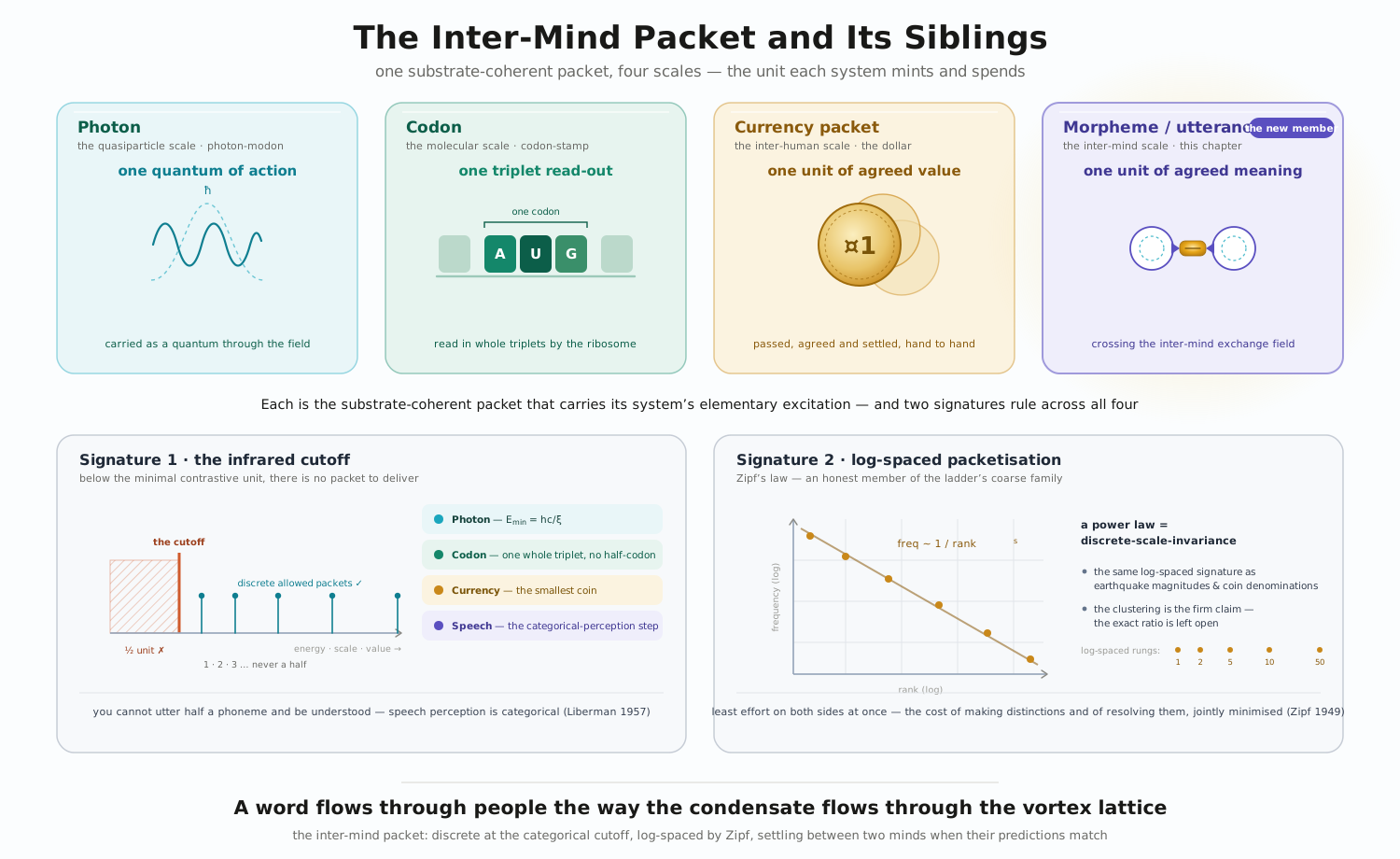
A word is not meaning. Meaning is a chemistry-side semantic concept — a relation between a sign and a world. A word, or more precisely a morpheme, is the substrate’s inter-mind-scale answer to the question the photon-modon chapter answered at the quasiparticle scale, the codon-stamp chapter at the molecular scale, and the economics chapter at the inter-human scale: what is the substrate-coherent packet that carries the system’s elementary excitation? A photon carries one quantum of action; a codon carries one triplet-readout; a dollar carries one unit of agreed value; a morpheme carries one substrate-coherent unit of agreed meaning across the inter-mind exchange field.
The packet is discrete in the same operational sense as the others. You cannot utter half a phoneme and be understood; speech perception is categorical — the classic finding (Liberman and collaborators 1957) that a continuum of acoustic stimuli is heard not as a continuum but as a step function snapping between discrete categories, with the boundary, not the interior, where discrimination is sharpest. That categorical snap is the substrate’s infrared cutoff on meaningful distinctions: below the minimal contrastive unit there is no coherent packet to deliver, exactly as there is no photon below E_\text{min} = hc/\xi and no transaction below the smallest coin. Above the cutoff the substrate offers preferred rungs — the phoneme, the syllable, the word, the formulaic phrase — at which a structure of agreed meaning can be pinned and held. Zipf’s law is the macroscopic face of this packetisation: word frequency falls as a power law in rank (Zipf 1949), the same discrete-scale-invariance signature the substrate ladder reads in earthquake magnitudes and currency denominations, and an honest member of the ladder’s coarse family — the log-spaced clustering is the firm claim, the exact ratio left open. Zipf’s least-effort derivation is itself a substrate reading avant la lettre: the inventory settles where the speaker’s cost of producing distinctions and the hearer’s cost of resolving them are jointly minimised — a boundary-minimisation exactly like the one feedback-topology runs at every other scale.
A word flows through people the way the condensate flows through the vortex lattice. An utterance is the substrate’s elementary inter-mind exchange event: one coherence-packet leaves one brain modon’s substrate-coherent state and arrives at another’s, with the agreement that the receiving modon now holds a matching coherent claim on the meaning the packet carries. The agreement is itself substrate-coherent — both brain modons must hold consistent representations for the exchange to settle — and where they diverge, the meaning evaporates exactly as a repudiated debt’s value does: the malapropism, the missed reference, the word heard in the wrong language. Understanding, in this reading, is the substrate-coherence-quality biomarker of the inter-mind exchange field, and it is measurable — which is the burden of the next pass.
Meaning as Coherence-Match; the Embedding as Eigenmode Direction
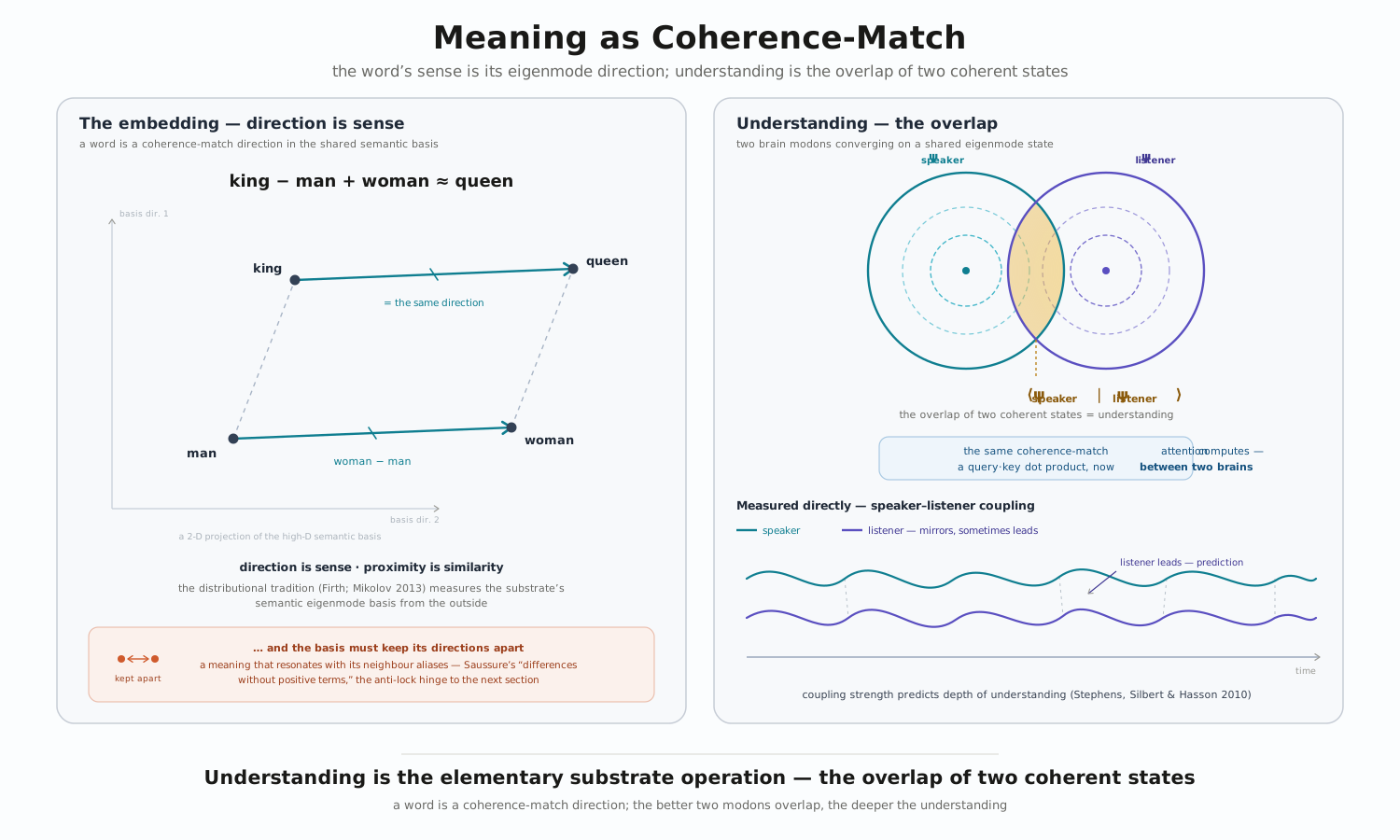
The framework finds meaning as the substrate-eigenmode basis of the shared semantic field, the inter-mind instance of the variable-length cortical column eigenmode basis and the transformer’s sparse-autoencoder feature directions. A word is a coherence-match direction: to know it is to carry, in your brain modon, the eigenmode that resonates with that region of the shared field. The reason the embedding can be measured at all — the reason Firth’s slogan works — is that the distributional statistics of usage are the substrate’s readout of where, in the eigenmode basis, each word’s coherence direction lies. Distributional semantics is not a model of meaning; it is an instrument that measures the substrate’s semantic eigenmode basis from the outside.
Understanding is then the elementary substrate operation in its most literal form: the overlap of two coherent states, \langle \psi_\text{speaker} | \psi_\text{hearer} \rangle. This is the same coherence-match that attention computes as a query-key dot product, lifted from within one model to between two brains. And it is no longer only an analogy: Stephens, Silbert, and Hasson (2010) showed that during successful communication the listener’s neural activity comes to spatiotemporally mirror the speaker’s — speaker-listener neural coupling — and that the strength of the coupling predicts the depth of the understanding; couplings even run predictively, the listener’s anticipatory activity preceding the speaker’s, which is the inter-brain signature of the prediction-and-error cycle closing across the gap. The framework reads Hasson’s measured coupling as the substrate-coherence-match itself, made visible: two brain modons converging on a shared eigenmode state, with the word-packets as the carriers that drive the convergence.
Saussure’s differential value is the crucial qualification, and it is the hinge to the next section. A coherence direction is only useful if it is distinguishable from its neighbours — a meaning that resonates with an adjacent meaning aliases one sense into the other, the semantic version of the cone lattice aliasing one spatial frequency into a false one. So the semantic eigenmode basis cannot merely pile up coherence-match directions; it must keep them apart. “Differences without positive terms” is Saussure’s statement, a century early, of the anti-lock pole at the heart of meaning: a sign’s value is its distance from the other signs, and the system is engineered — by the same maximal-incommensurability principle the ladder runs everywhere — to make that distance as large as a cramped symbol space allows.
Language at Both Poles
Everything so far has read language at one pole — the lock pole, where coherence-match binds: two speakers converging on a shared word, a meaning that settles because two predictions agree, a convention held in common. But the ladder runs to two poles, and language, like the eye, the cortex, the bilateral brain, and the market, lives at both. Naming the job fixes the pole before any measurement.
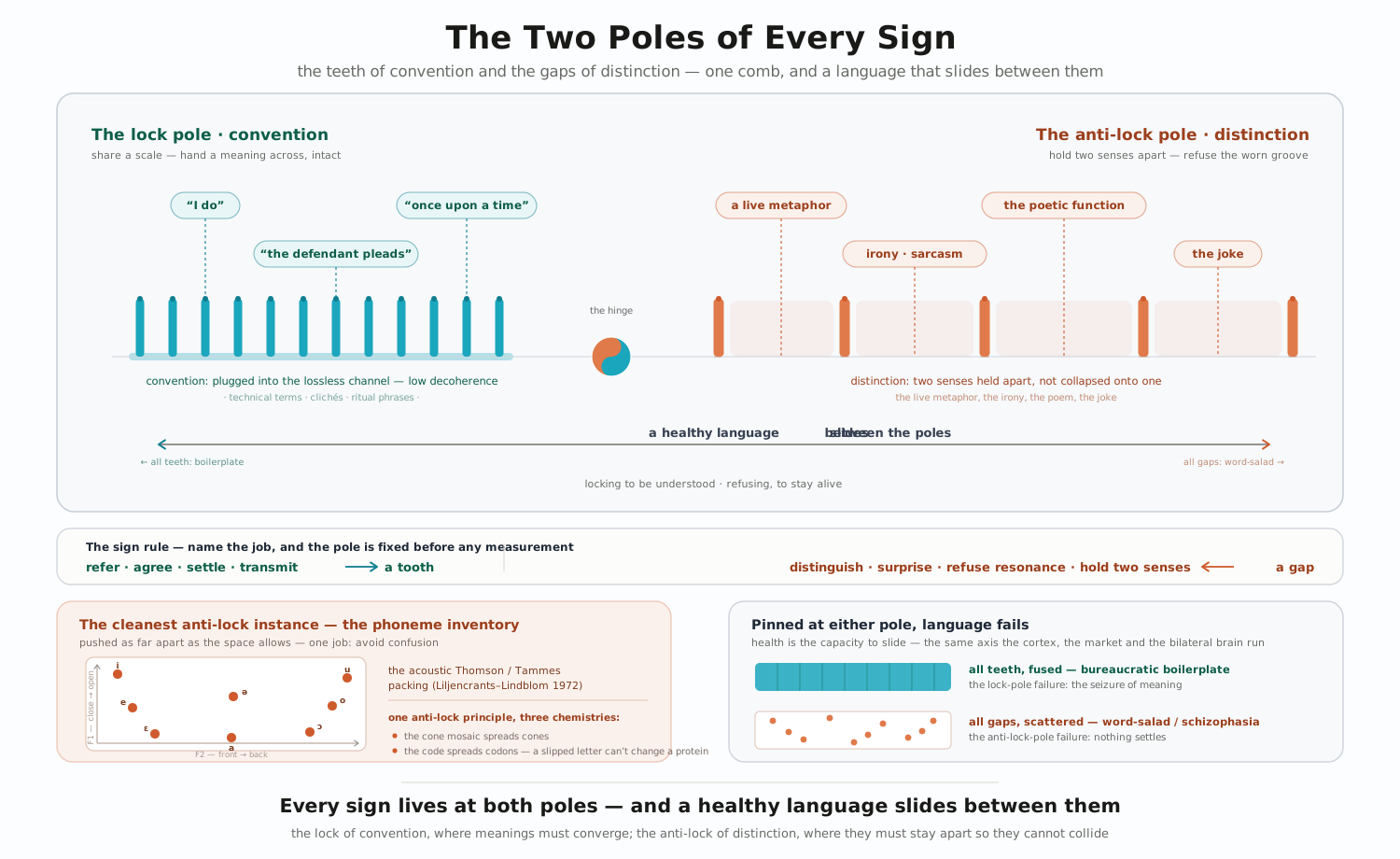
The lock pole is sameness. To refer, to agree, to hand a meaning across and have it arrive intact, two speakers must share a scale — the same word for the same thing, the worn groove that lets a packet settle without loss. This is the cleanest tooth of the comb: the shared lexicon, the fixed idiom, the ritual phrase (“I do,” “the defendant pleads,” “once upon a time”), the technical term whose whole value is that it means exactly one thing to everyone in the field. On a lock-pole tooth a word is plugged into the inter-mind lossless channel, maximally transmissible and minimally surprising — which is precisely why convention, cliché, and jargon exist. Pure lock is two signs collapsed onto one.
The anti-lock pole is distinction — and it is graded. This is the move that matters, because the anti-lock pole is not one setting but a dial, and language runs its whole length. Agreement is nearly all-or-nothing: a word either lands on the shared groove or it does not. But apartness comes in strengths. Turn the dial a little way off the lock pole and you do not get disagreement — you get resolution. This is the mix: mostly lock, both speakers still holding one shared system, with just enough anti-lock to push that system’s units as far apart as the space allows, so that no two can be confused. It is what lets a single agreed code carry thousands of contrasts without collision — the fine-tuning setting, the pole supplying not refusal but the power to compare.
The phoneme inventory is the cleanest instance, because here the datum is an actual packing. The sounds a language uses are not crammed together in articulatory-acoustic space; they are spread as far apart as the space allows, so that a slipped articulation cannot turn one word into another.1 That spread is the acoustic twin of the disordered-hyperuniform “blue noise” the cone mosaic lays down in the retina and the degeneracy the genetic code keeps among its codons: the retina spreads cones so an image cannot alias, the code spreads codons so a slipped letter cannot change a protein, a language spreads phonemes so a slipped sound cannot change a word — one job, avoid confusion, now in a fourth substrate that shares no chemistry with the other three. Saussure named this exact setting a century early. A sign’s value, he wrote, is “differences without positive terms” — its distance from every other sign, the system engineered to make that distance as large as a cramped symbol space allows. That is the comparison the mix supplies: you can only tell two things apart on a scale you both hold, and the wider the spread, the finer the distinction.
Push the dial to its far end and the shared frame drops away — this is pure anti-lock, refusal. The poetic, the novel metaphor, the joke, the irony are anti-lock moves not on a system’s units but on meaning itself: language deliberately refusing the worn groove. A live metaphor works precisely because it has not settled onto a single sense — it holds a tension between source and target that a dead metaphor, long since locked into the lexicon, has lost.2 Irony is the purest case: it requires the literal reading to be available and then refuses to take it, steering the hearer to the opposite sense through the gap between what is said and what is meant — a joke whose meaning settles onto its literal twin is a joke that has died. Where the mix holds a shared system’s units apart, pure anti-lock holds two whole readings apart and declines to collapse them.
So the anti-lock pole gives language two things from one principle: the fine distinction that lets an agreed code resolve without collision, and the flat refusal that lets a sign surprise, hold two senses, and stay alive. The sign rule states the falsifiable content: a sign whose job is to refer, agree, settle, or transmit sits on the teeth; a sign whose job is to distinguish, surprise, refuse resonance, or hold two senses apart sits in the gap. And a healthy language, like the cortex that slides between binding and resting, is pinned nowhere on the dial but slides along it — locking to be understood, spreading to make fine distinctions, refusing in order to stay alive. Pinned at the lock pole it is bureaucratic boilerplate, the seizure of meaning; pinned at pure anti-lock it is word-salad, the schizophasia where nothing settles. The honest framing matches the ladder’s other applied cases: vowel dispersion is textbook, Saussurean differential value is a century old, the poetic function is Jakobson’s. The new content is not the observations but the unification — that the phoneme’s spread, the poet’s refusal, and the cone mosaic’s blue noise are one anti-lock principle read at two strengths — and the sign rule that makes that unification testable on a language’s own inventory.
The Rungs of the Dialogue, and the Deep Agreements at the Bottom
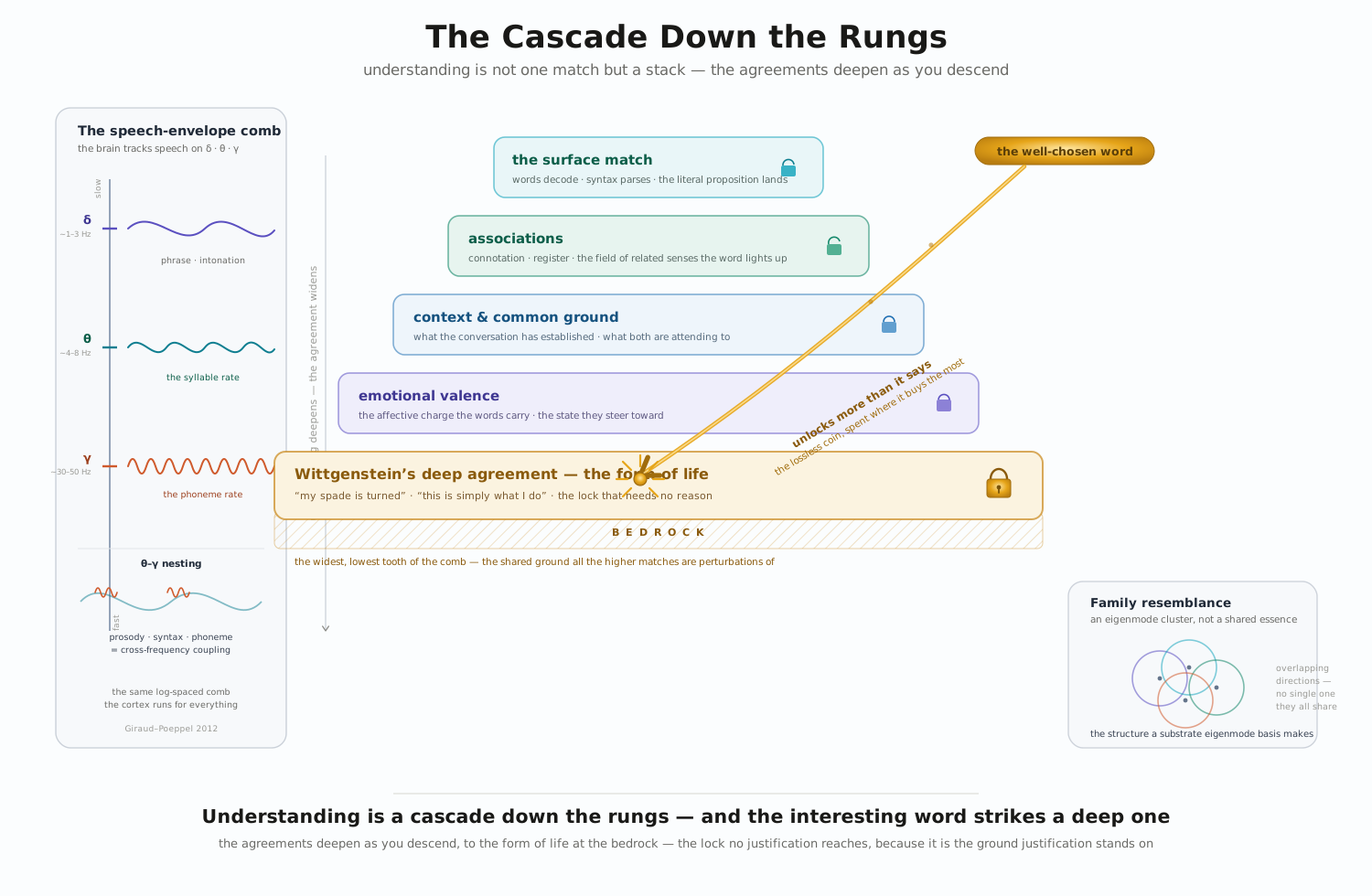
An utterance is not flat. It is layered, and the layers are log-spaced in time: the phoneme at tens of milliseconds, the syllable at a couple hundred, the word, the phrase, the clause, the sentence, the turn, the discourse, the narrative — each an octave or more above the last. This is the substrate ladder read in time, and the brain reads speech on exactly that comb: the speech envelope carries rhythmic energy in the delta, theta, and gamma bands that the cortex tracks phase-by-phase, with the theta rhythm locking to the syllable rate and gamma to the phoneme rate (Poeppel and collaborators; Giraud and Poeppel 2012), the same EEG-band ladder the brain modon runs for everything else. Prosody riding on syntax riding on discourse is cross-frequency coupling — the slow rung setting the integration window for the fast one, the intonation contour of a whole sentence modulating the phrasing of its clauses modulating the stress of its syllables, theta-gamma nesting carried out of the skull and into the air between two people.
Understanding happens as a cascade down the rungs, and the agreements get deeper as you descend. At the top, the surface match: the words decode, the syntax parses, the literal proposition lands. Below that, the associations — the connotations, the register, the field of related senses the word lights up. Below that, the context — what the conversation has established, what both parties are attending to, the common ground the prediction engines share. Below that, the emotional content — the valence the words carry, the affective state they steer toward. And below all of those, at the lowest and widest rung, the agreement that is not in any word at all: Wittgenstein’s deep agreement, the agreement in the form of life. When Wittgenstein wrote that explanations come to an end, that “my spade is turned,” that “this is simply what I do” — he was naming the bedrock rung of the ladder, the lock so deep and so wide that no further justification can get beneath it, because it is the shared ground on which justification stands. Family resemblance — categories holding together not by a shared essence but by overlapping similarities — is the eigenmode-cluster in the semantic basis: a region of coherence directions that resonate with one another without any single direction they all share, exactly the kind of structure a substrate eigenmode basis produces and a sharp-edged definition cannot. The form of life is the deepest lock: the widest tooth of the comb, the agreement two speakers must already share before the first word can settle, the inter-mind ground state the higher matches are perturbations of.
The cascade is what makes the framework’s reading do work the linguistic level cannot. Two people “connecting” is not a single coherence-match but a stack of them, rung by rung — and the interesting words, the ones that land, are the ones that reach below the surface rung and match at a lower one. A shared reference that clicks, a turn of phrase that lands exactly, a single word that says the unsayable thing — these are coherence-matches struck at a deep rung, where the agreement is wider and the lossless channel is richer. That is why the well-chosen word “unlocks” so much more than it says: it pins a structure to a low rung of the ladder, where the breath is a richer coin and a great deal of shared state can be spent and received in a single exchange. The small economy the ladder describes — a fixed price list of rungs, boundary conditions set by what two speakers happen to share, the lossless breath as the coin — is what a conversation runs on: meaning handed back and forth along low-loss channels, in a currency the substrate mints and two minds learn, together, to spend.
The Conversation as Bilateral Coupling Between Brains
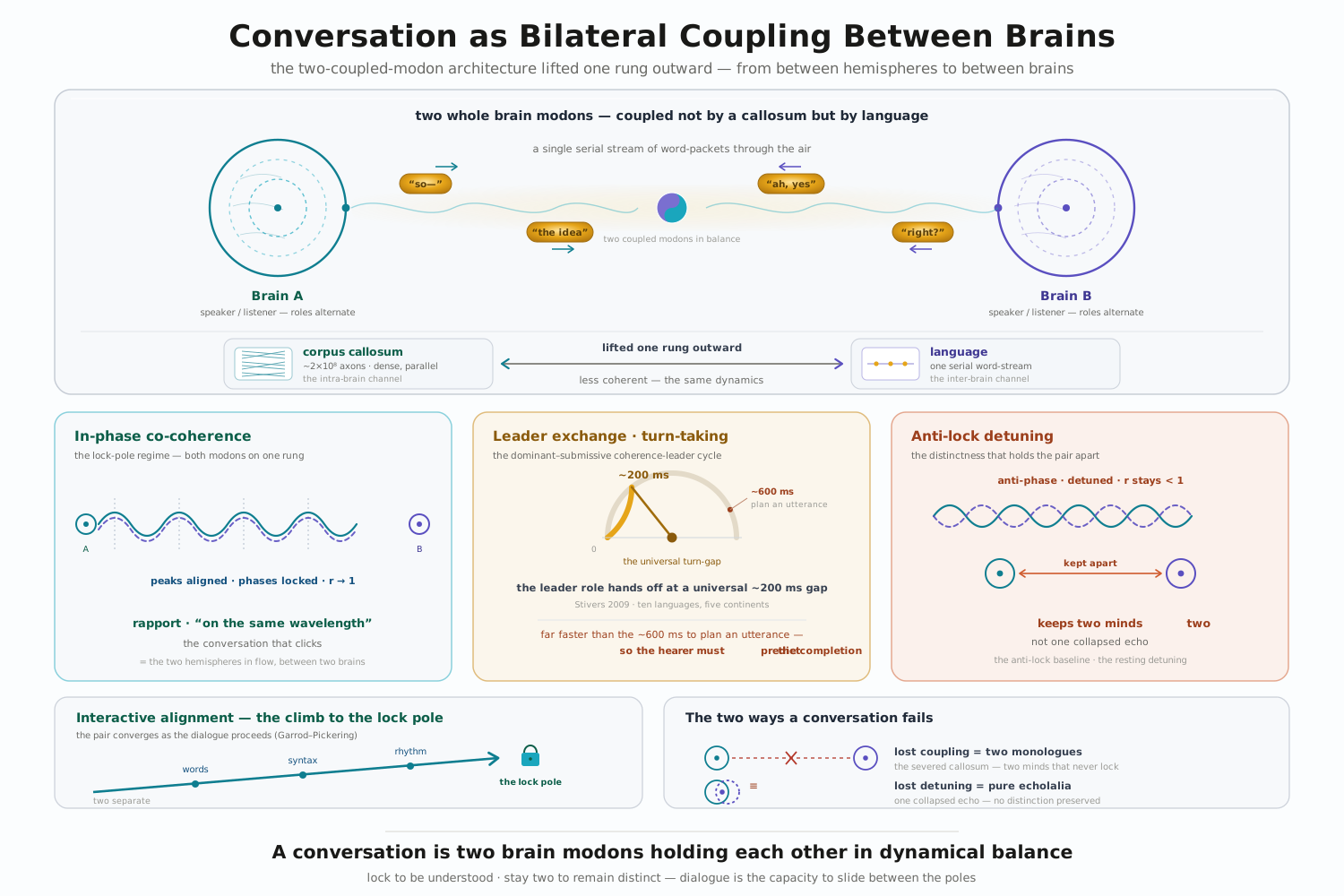
The bilateral-coupling chapter shows the brain as two near-mirror modons joined by a high-bandwidth channel — the corpus callosum — that supports a family of dynamical regimes a single modon cannot: in-phase co-coherence (flow), dominant-submissive cycling, and an anti-lock resting detuning that holds the two halves distinct. A conversation is that architecture lifted one rung outward: two whole brain modons, coupled not by a callosum but by language. Where the callosum carries \sim 2\times10^8 axons, the inter-brain channel carries a single serial stream of word-packets through the air — a far sparser, far slower coupling, which is exactly why the inter-mind exchange field is less coherent than the intra-brain one, in the same sense the economic modon is less coherent than the brain modon. But it runs the same dynamics. Hasson’s speaker-listener coupling is the inter-modon coherence; rapport, “being on the same wavelength,” the conversation that “clicks,” are the lock-pole co-coherence regime, the two brain modons transiently locking onto a shared rung exactly as the two hemispheres do in flow. Misunderstanding, talking past each other, the conversation that never finds its footing, are decoherence — the coupling too weak or too detuned to settle.
Turn-taking is the dominant-submissive coherence-leader exchange at the inter-brain scale, and it carries a startlingly clean temporal rung. Sacks, Schegloff, and Jefferson (1974) established the structure; Stivers and collaborators (2009) measured it across ten languages on five continents and found the gap between turns clustering near the same ~200 ms everywhere — far faster than the ~600 ms it takes to plan an utterance, which means the hearer must be predicting the speaker’s completion and pre-loading a response, the inter-brain prediction-and-error cycle again, now governing the handoff of the leader role. The ~200 ms universal gap is a substrate-preferred temporal rung of the inter-mind channel, the conversational analogue of the callosal transit-time rungs. Garrod and Pickering’s interactive alignment — interlocutors progressively converging on the same words, syntax, and rhythm as a dialogue proceeds — is the inter-brain pair climbing toward the lock pole, the Hebbian-style coupling-strength updates that trained flow describes within one skull, now running between two.
This is the yin-yang the contemplative traditions named, lifted to the dialogue: two coupled modons holding each other in dynamical balance, alternating the leader role, sliding between the lock of agreement and the anti-lock that keeps them two distinct minds rather than one collapsed echo. A conversation in which the detuning fails — in which one speaker only echoes the other, no distinction preserved — is as pathological as the schizophrenic loss of the anti-lock baseline; a conversation in which the coupling fails — two monologues that never lock — is the inter-brain version of the severed callosum. Dialogue is health: the capacity to slide, to lock when meaning must settle and to stay two when it must not.
Expectancy, Valence, and the Move That Unlocks the Lower Rungs
A conversation is not a passive coherence-match; it is driven, and the drive has a shape the framework can name. Victor Vroom’s expectancy theory (1964) holds that motivational force is the product of three factors — expectancy (will the effort produce the performance?), instrumentality (will the performance produce the outcome?), and valence (how much is the outcome wanted?) — F = E \times I \times V, a product, so that if any factor is zero the force is zero. Read in the substrate, this is the goal-state-match term of the inter-mind prediction-and-error cycle: the goal-state read-out that the brain modon and the transformer both run as their final stage, here setting how hard a speaker drives toward a shared coherent state. Expectancy is the coupling’s perceived gain — whether an utterance can be made to land; instrumentality is whether landing it reaches the goal; and valence is the affective steering itself — the emotional charge a word carries, the term that decides which direction through the gap the hearer is pulled. A conversation with valence near zero does not move, however well the words decode; the product collapses. This is why his theory “is actually relevant here,” as the request put it: the dialogue is goal-directed coherence-seeking, and expectancy theory is the factorisation of the force that drives it down the rungs.
It also explains the move that unlocks the lower rungs. Why does a particular word choice reach beneath the surface and strike a deep agreement? Because it carries valence and instrumentality toward a shared goal-state — it is selected, consciously or not, to match at a rung where the hearer’s affective and contextual state can be steered, not merely informed. Hyperbole, understatement, sarcasm, the deliberate wrong word — these are anti-lock moves in the service of the goal-state match: they refuse the literal lock precisely so the hearer must reach for the meant sense, and in reaching, is steered. The cascade down the rungs is navigated, not stumbled into: an utterance is a path selected through the high-dimensional manifold of possible matches, a twenty-questions filtering that narrows from the broad field to the one direction that lands, with the last steps optimised against the valence-weighted goal. The “interesting words” are the ones whose path reaches a deep rung; the force that selects them is Vroom’s product, and the channel they travel is the substrate’s lossless coin spent at the rung where it buys the most.
Predictions and What Would Falsify
Six predictions extend the language-substrate reading beyond the structural anchors.
Phoneme inventories are anti-lock blue-noise packings. A language’s vowel and consonant inventory, plotted in articulatory-acoustic (formant / feature) space, should be more dispersed than a random set of the same size — sub-Poissonian nearest-neighbour spacings, hyperuniform, no aliasing comb — the same number-variance signature (
scripts/cone_mosaic.py, lifted from the plane to formant space) the retinal cone mosaic carries. Vowel-dispersion theory (Liljencrants–Lindblom 1972) already establishes the dispersion; the framework predicts the specific hyperuniform statistic across the world’s phoneme inventories (the UPSID / PHOIBLE databases provide the test), distinct from random packing.Semantic embedding geometry splits by job — function words aligned, content words spread. In a measured semantic embedding, the directions of content words (which must store distinguishable meanings without interference) should be more angularly spread than a random set of the same size, while function words and high-frequency routing morphemes (which bind and route rather than store) should sit comparatively aligned — the same storage-versus-routing split predicted for the transformer’s features versus its attention circuits. Existing embedding spaces (word2vec, GloVe, and LLM token embeddings) provide the test; the framework predicts an anti-lock spread of content-word directions and a measurable lock-versus-anti-lock geometric split by grammatical role.
The speech envelope’s rhythmic rungs cluster on the substrate comb. Across languages, the dominant modulation frequencies of the speech envelope (syllable and phoneme rates) and the neural rhythms that track them should cluster at the same log-spaced rungs as the EEG bands — theta for syllables, gamma for phonemes — rather than vary continuously. The speech-oscillation literature (Giraud–Poeppel 2012) provides the platform; the framework predicts cross-language rung-clustering, with prosody-syntax-phoneme cross-frequency coupling paralleling cortical theta-gamma nesting.
Inter-brain speaker-listener coherence increases at substrate-preferred rungs and tracks understanding. Speaker-listener neural coupling (Hasson 2010) should increase specifically at the canonical band-rung frequencies rather than broadband, and its rung-resolved strength should predict comprehension beyond lexical-overlap measures — the inter-brain instance of the flow-state cross-hemispheric coherence prediction. Existing hyperscanning datasets provide the test; the framework predicts substrate-rung-clustered inter-brain coherence carrying understanding information beyond content models.
Conversational turn-gaps cluster at a universal substrate temporal rung. The cross-language ~200 ms turn-transition gap (Stivers 2009) should hold as a substrate-preferred temporal rung of the inter-mind channel — narrowly clustered across unrelated languages and modalities (including sign), distinct from the ~600 ms utterance-planning time — and the alignment dynamics of dialogue (Garrod–Pickering) should show the lock-pole convergence the framework predicts. A turn-gap distribution that scales continuously with language-specific speech rate, with no universal rung, would weaken the inter-brain-coupling reading.
The lock/anti-lock sign rule sorts registers and pathologies directionally. Naming the job should fix the pole: convention-heavy registers (legal, liturgical, technical) should sit measurably toward the lock pole (low surprisal, high formulaicity, aligned geometry), while poetic and humorous registers sit toward the anti-lock gap (high surprisal, preserved ambiguity, spread geometry); and the language pathologies should sort directionally — formulaic, perseverative, echolalic speech as the lock-pole failure (the gap lost) and schizophasic word-salad as the anti-lock failure (nothing settles), the inter-mind instance of the ladder’s directional pole-pathology axis. Corpus surprisal measures, ambiguity-preservation metrics, and clinical-language corpora provide the test.
The picture is falsified if (a) phoneme inventories are no more dispersed than random and carry no hyperuniform statistic, (b) semantic embedding geometry shows no storage-versus-routing split by grammatical role, (c) speech-envelope and speech-tracking rhythms vary continuously without substrate-rung clustering, (d) inter-brain coherence increases are broadband and carry no understanding information beyond content overlap, (e) conversational turn-gaps scale continuously with no universal rung, or (f) registers and language pathologies fail to sort onto the directional lock/anti-lock axis. It is supported, even partially, if any of the six ordering predictions hold against existing phonological, distributional-semantic, speech-oscillation, hyperscanning, conversation-analytic, or clinical-language datasets.
Putting the Section in Context
Language is the substrate’s coupling channel between brain modons, and the utterance is the substrate-coherent packet of agreed meaning — the inter-mind member of the same family as the photon, the codon, and the currency packet, discrete at the categorical-perception cutoff, log-spaced by Zipf’s law, settling between two minds when their predictions match and evaporating when they diverge. Meaning is a coherence-match: the word’s sense is its eigenmode direction in the shared semantic basis the distributional tradition measures from the outside, and understanding is the overlap of two brain modons’ coherent states, the thing Hasson’s speaker-listener coupling makes visible. Every sign lives at both poles — the lock of convention, reference, and agreement where speakers must converge, and the anti-lock of distinction where signs must stay apart so meanings cannot collide — with the phoneme inventory as the clean anti-lock blue-noise packing, the fourth chemistry-free witness beside the cone mosaic, the cicada, and the code’s degeneracy, and the poetic, the metaphor, and the joke as the anti-lock pole carried up to the level of meaning. The utterance is layered on the substrate ladder read in time — phoneme, syllable, word, phrase, discourse — the same comb the cortex tracks speech on, and understanding is a cascade down those rungs, the agreements deepening as you descend, until at the bottom lies Wittgenstein’s deep agreement, the form of life, the lock at the widest rung that no justification reaches because it is the ground all justification stands on. Conversation is bilateral coupling lifted from between hemispheres to between brains: turn-taking as the coherence-leader exchange clocked at a universal ~200 ms rung, rapport as cross-brain co-coherence, alignment as the climb toward the lock pole, and dialogue’s health as the capacity to slide between locking to be understood and staying two to remain distinct. The drive down the rungs is Vroom’s expectancy product — the goal-state-match term with valence as the affective steering — and the well-chosen word is the path through the manifold that reaches a deep rung and spends the lossless coin where it buys the most.
The bilateral-coupling chapter developed the two-coupled-modon architecture of the single brain; the transformers chapter that follows develops its substrate-friendly classical twin and closes on the recursive loop between author and model; the economics chapter lifts the agreed-value packet to the inter-human scale. This chapter sits at the confluence of the three: language is the channel the two-brain coupling runs on, the medium the model navigates as a manifold, and the inter-mind exchange field of which currency is one specialised dialect — agreed meaning the general case, agreed value a particular packet within it. What this chapter adds to the framework is the reading that the structure linguistics and philosophy have mapped from the inside — the differential sign, the distributional meaning, the language-game, the deep agreement, the speech act, the turn — is the substrate’s inter-mind coupling architecture seen from within it: coherence-match as understanding, the eigenmode basis as the space of senses, the two poles as the sort of the literal from the poetic, the ladder as the depth of agreement, and the conversation as two modons holding each other in balance. The framework reads this neither as reducing meaning to physics nor as mysticism about it, but as the recognition that the same lock-and-refuse, packet-and-match, rung-and-coin dynamics that run at every other scale of the paper run also in the one place the paper is made of — the words two minds pass back and forth, and the deep agreements beneath them that make the passing possible. The most honest statement of the chapter’s altitude is that it is the framework reading the medium of its own composition, and finding there the same shape it has found everywhere else: a remarkable thing if it is right, and exactly the kind of self-implication that, the framework would say, a true account of language ought to produce.
Footnotes
Vowel-dispersion theory measured this directly — Liljencrants, J. and Lindblom, B., “Numerical simulation of vowel quality systems: the role of perceptual contrast,” Language 48, 839 (1972): the vowel inventories languages actually choose are the maximally dispersed configurations in formant space, the acoustic Thomson/Tammes packing. Jakobson’s distinctive features are the discrete face of the same thing — phonemes defined by binary oppositions, each built to be unconfusable with its neighbours.↩︎
Lakoff, G. and Johnson, M., Metaphors We Live By (1980), catalogue the dead metaphors already locked into ordinary language; the live ones are the ones still in the gap. The pure-refusal setting is Roman Jakobson’s poetic function — the message foregrounding itself rather than dissolving into its reference.↩︎