Economics in the Substrate
Currency as substrate-coherent packet, prices as the substrate’s Fisher-information optimization, the canonical loop in production-consumption-investment cycles, and markets as the substrate’s organism-of-organisms active-inference engine
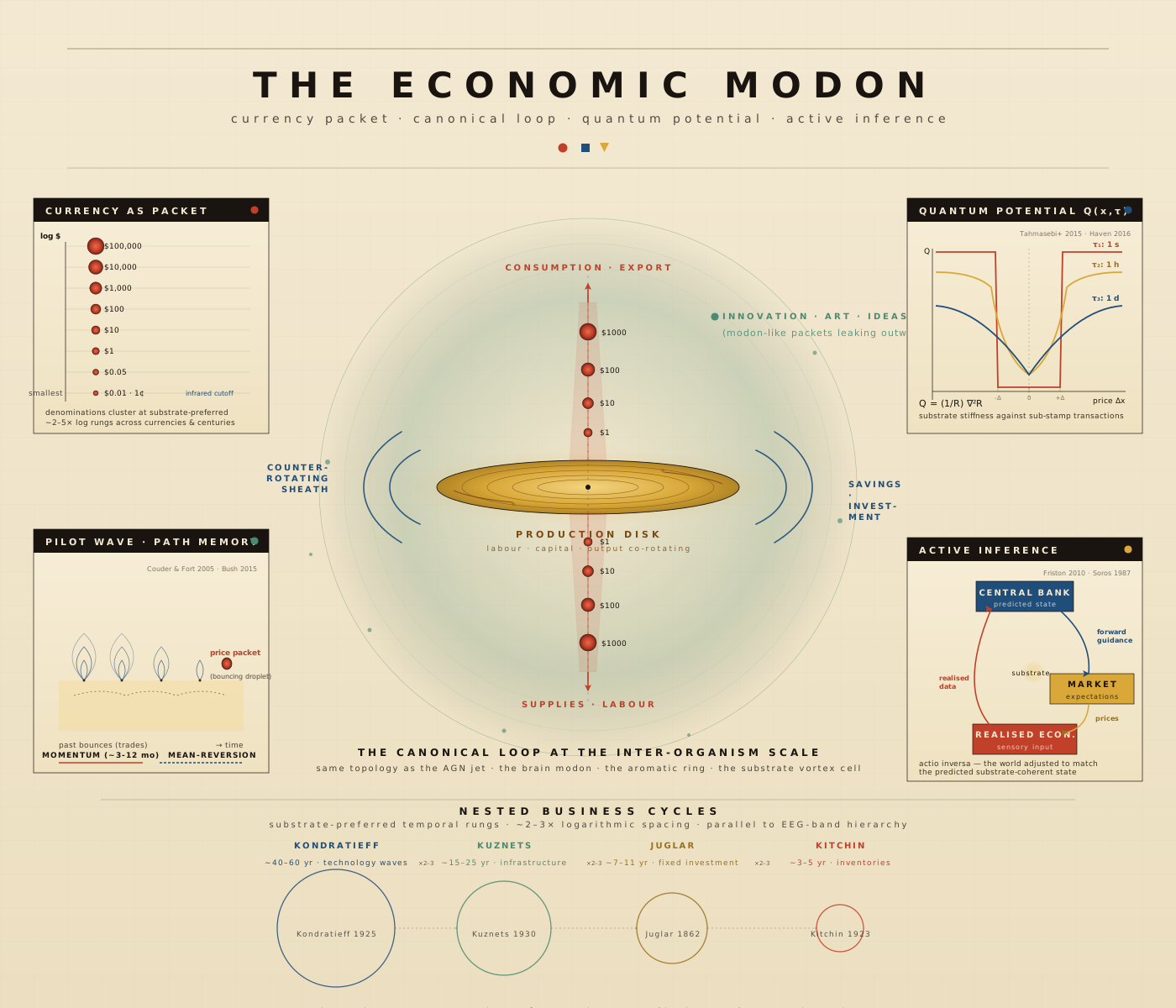
Finance already has a physics. Louis Bachelier modelled stock prices as diffusion in 1900, five years before Einstein did the same for pollen; the econophysics programme that grew from it (Stanley and collaborators from 1996) reads markets through statistical mechanics, and the quantum-cognition line (Khrennikov 2010) models decisions with the apparatus of quantum probability. The anchor for this chapter is Emmanuel Haven (Phil. Trans. R. Soc. A 2016), who linked fluid mechanics and quantum mechanics through the Couder–Fort walking-droplet experiments and pointed to Tahmasebi et al. (2015) — who had measured a quantum potential directly from S&P return data, finding “infinite walls” at short timescales that soften at longer ones. Haven asked whether the same apparatus could model information in economics, and parked the deeper question of why it should work at all.
The framework’s claim is that it works because economics is substrate-physics, like everything else in this paper. Human economic activity is the substrate’s organism-of-organisms active-inference engine, and its parts map onto primitives the earlier chapters developed:
- Currency is the substrate-coherent packet of agreed value — flowing through people the way photons flow through the dc1 sea, discrete at preferred denominational rungs the way the photon and the codon are.
- The canonical loop runs in production–consumption–investment–innovation cycles at every nested scale, from an individual budget to global trade.
- Price formation is the substrate’s stiffness against sub-stamp transactions. Haven’s measured quantum potential, with its hard walls at short timescales, is the substrate refusing to deliver a partial packet.
- Behavioural finance is pilot-wave path memory. Momentum and mean-reversion are the wake a price packet leaves behind and the next packet lands in.
- Economic geography is a topographic parameter-scan. Silicon Valley, Wall Street, Shenzhen are coherence-cells reading out at different points on a continuous value-and-resource manifold.
- Business cycles are substrate-preferred temporal rungs. The Kitchin–Juglar–Kuznets–Kondratieff hierarchy is the economic twin of the EEG bands, with cross-frequency coupling integrating across them.
- Central banks and prediction markets are active-inference closure — the engine adjusting the world to match its predicted substrate-coherent state, Soros’s reflexivity named in substrate terms.
- The market lives at both poles — binding on the ladder’s teeth to clear and price, refusing them at the anti-lock gap to stay diversified, with the systemic crash as the gap’s failure.
This is the framework’s positive answer to the question Haven parked — what are the hard, data-driven analogies? The econophysics and quantum-cognition literatures read the formal structure of markets correctly; the framework reads that same structure as the substrate-physics implementation of the dynamics running at every other scale in this paper, with the feedback-topology boundary-minimisation and the brain’s prediction-and-error cycle lifted to the inter-human scale — where people are the substrate-coherent units and currency is the packet. The chapter works through each claim in turn, then closes on the market’s two poles.
Currency as Substrate-Coherent Packet
A unit of currency is not money. Money is a chemistry-side accounting concept — a measure of value, a medium of exchange, a store of wealth. Currency is the substrate’s organism-of-organisms scale answer to the same question the photon-modon chapter answered at the quasiparticle scale and the codon-stamp-metric chapter answered at the molecular-biology scale: what is the substrate-coherent packet that carries the system’s elementary excitation? A photon carries one quantum of action h; a codon carries one substrate-coherent triplet-readout; an action-potential carries one substrate-coherent depolarization stamp; a dollar bill carries one substrate-coherent unit of agreed-value across the inter-human exchange field.
The framework’s claim is that currency is substrate-discrete in the same operational sense as these earlier packets. You cannot in operational practice exchange half a penny — the minimum currency unit at the smallest substrate-rung in any monetary system is the substrate’s infrared cutoff on agreed-value transactions, structurally parallel to the photon’s minimum energy at E_\text{min} = hc/\xi. Above that cutoff, the substrate offers preferred denominational rungs — 1, 5, 10, 25 (cents); 1, 5, 10, 20, 50, 100 (dollars); 100, 500, 1000, 10000 (yen) — at roughly logarithmic spacing, with the specific ratios reflecting the substrate’s preferred packaging granularity at the inter-human exchange scale. The denominations are not arbitrary historical accidents; the same approximate \sim 2-5\times ratios appear across currencies, denominations, and centuries, despite the chemistry-side currency designers having operated independently. The framework reads this as the substrate’s preferred-rung selection at the organism-of-organisms scale, parallel to the cortical-eigenmode rungs of the brain-as-prediction-engine chapter and the EEG-band rungs of the cortical-maps-and-rhythms chapter. Those \sim 2–5\times ratios are the human-scale, macroscopic face of the substrate ladder — the same discrete scale invariance Sornette reads in log-periodic market crashes — denomination granularity sampling the lattice’s \sqrt{2} comb coarsely rather than filling value-space continuously. As such they are an honest member of the ladder’s coarse family: the clustering at discrete log-spaced rungs is the firm claim, while whether the exact ratio is a clean power of \sqrt2 — as it is for the grid cell — is left open.
Digital and cryptographic currencies do not falsify this reading — they sharpen it. Bitcoin’s satoshi (10⁻⁸ BTC) is an explicit substrate-rung at the digital-currency scale; smaller units do not exist in protocol, even though arbitrary fractional accounting would be trivially implementable in software. The market has chosen discrete substrate-friendly denomination granularities (USDC, USDT at the dollar; ETH gas at gwei) rather than continuous infinitesimal divisibility. Where the chemistry-side argument would say “denomination is a UI convenience”, the framework reads denomination as the substrate’s required discreteness — the same discreteness that forces h to be a finite circulation quantum rather than zero.
Currency flows through people the way the dc1 condensate flows through the vortex lattice. A transaction is the substrate’s elementary exchange event — one substrate-coherent packet transfers from one organism’s substrate-coherent state to another’s, with the agreement that the receiving organism now holds the substrate-coherent claim on future-value the packet represents. The agreement is substrate-coherent: both parties’ brain-modon substrate-coherent integrated states (the brain modon of brain-as-prediction-engine) hold consistent representations of the transferred value, and the transaction settles because the two predictions match. Where the predictions diverge — counterfeit currency, repudiated debt, hyperinflation — the substrate-coherence of the exchange fails, and the packet’s value evaporates. Trust, in this reading, is the substrate-coherence-quality biomarker of the inter-organism exchange field.
The Canonical Loop in Economic Systems
The feedback-topology chapter developed the canonical loop — co-rotating disk, polar jets, counter-rotating boundary, radiated waves — as the substrate’s preferred organization of rotational energy in an elastic medium, with the same topology appearing at scales spanning 25 orders of magnitude from substrate vortex cells through aromatic rings, planetary cores, accretion disks, AGN, and galactic feedback. The framework’s claim here is that the same loop runs at the economic scale, with the four components mapping cleanly onto the four canonical economic activity classes:
Production = co-rotating disk. The disk is the bulk of the economic activity — the firm, the industry, the sector — where labor and capital co-rotate, generating value at the disk’s substrate-coherent frequency. The disk’s angular momentum is the firm’s productive momentum: stable employment, steady cash flow, recurring contracts. The disk’s rotation rate is its production-throughput frequency, with substrate-preferred values at industry-specific rungs (semiconductor fabs at \sim months, automotive assembly at \sim weeks, retail at \sim days, restaurants at \sim hours).
Consumption-and-export = polar jets. Just as the AGN’s polar jets eject angular momentum vertically along the spin axis, the firm’s consumption-and-export channels eject value-packets vertically out of the production disk — to customers, to export markets, to downstream consumers. The jets carry the firm’s substrate-coherent output to the outside world, in discrete packetized form (units shipped, contracts fulfilled, services delivered). The jets’ two-sided structure (selling output, paying suppliers) mirrors the AGN’s bipolar jets exactly: the firm is a bidirectional value-flow node, with input-side and output-side jets along the same axis.
Savings-and-investment = counter-rotating boundary. The disk’s outer edge is wrapped by a counter-rotating sheath that returns angular momentum inward — capital flows from savers to entrepreneurs, retained earnings cycle back into capacity expansion, depreciation reserves replenish equipment. The counter-rotation is essential for the disk’s stability: without the savings-investment counterflow, the production disk would spin itself apart (decapitalize, fail to replace assets, lose competitive position). This is the substrate-physics reading of why every viable economic system has a financial sector: the counter-rotating boundary layer is not a parasitic overhead, it is the topological requirement for canonical-loop stability.
Innovation-and-art = radiated waves. A small fraction of the loop’s energy escapes the substrate-coherent disk-jet-counterflow configuration as outgoing waves — modons in the substrate, photons at atomic scale, gravitational waves at compact-object scale. At the economic scale, the radiated energy is the fraction of productive activity that escapes the immediate consumption-investment cycle and propagates outward as innovation, art, ideas, knowledge. These are the substrate’s organism-of-organisms-scale photons: they carry substrate-coherent information away from the source, persist, propagate, and interact with distant substrate-coherent systems (other firms, other industries, other generations). Most of the loop’s energy stays bound; a small fraction escapes, and that fraction is what makes the system evolve.
The same four components appear at every nested scale: the individual budget (earning → spending → saving → personal-growth), the household (multiple earners, shared consumption, joint savings, family culture), the firm (production, sales, retained earnings, R&D), the industry (sectoral production, inter-firm trade, sectoral capital, sectoral innovation), the nation (GDP, exports, national savings, national R&D), and the global economy (world production, trade flows, global savings glut, global knowledge commons). Each scale has its own characteristic loop transit time, set by the substrate’s preferred temporal rungs at that scale — individual budgets cycle weekly-to-monthly, firms cycle quarterly-to-annually, industries cycle multi-yearly, nations cycle decade-to-generation, globally over centuries. The Kondratieff-Juglar-Kitchin-Kuznets business-cycle hierarchy is, in this reading, the substrate’s preferred-rung structure at the inter-firm-to-global scale, exactly parallel to the EEG-band hierarchy at the brain-modon scale.
Haven’s Quantum Potential as Substrate Stiffness
Tahmasebi, Meskinimood, Namaki, VasheghaniFarahani, Jalalzadeh & Jafari (Europhys. Lett. 109, 30001, 2015) computed the quantum potential Q = (1/R)\nabla^2 R for the Standard & Poor’s financial index, where R is extracted from the probability density of returns via p(x,t) = \exp(2R(x,t)). They found that Q has infinite walls at short timescales — small price variations are forbidden, the price cannot tunnel into them — and that the walls soften as the timescale lengthens. Haven (2016) noted this is “a very intuitive finding” but did not give a mechanism.
The substrate framework gives the mechanism directly. The infinite walls of Q at short timescales are the substrate’s coherence-stiffness against sub-stamp transactions — the same stiffness that prevents a photon from arriving at half-amplitude and the same discreteness that forces currency denomination at preferred rungs. The substrate cannot deliver a partial currency packet, so the wavefunction’s amplitude at sub-packet price variations is zero, and the inferred Q has infinite walls there. The walls soften at longer timescales because multi-packet transactions become accessible: at a one-second timescale only single-tick price moves can occur, but at a one-hour timescale aggregated multi-packet moves become available, and at a one-day timescale the substrate can support arbitrarily multi-modon excitations. The well’s shape — flat-bottomed with hard walls — is the substrate’s signature of underlying discrete packetization.
This is testable. The framework predicts that:
The width of the flat-bottomed region of Q at any timescale \tau should equal N_\text{packets}(\tau) \cdot \Delta_\text{tick}, where \Delta_\text{tick} is the minimum tick size and N_\text{packets}(\tau) is the number of substrate-coherent packets accessible within \tau. For the S&P, \Delta_\text{tick} \sim 0.01 index points and a one-second window admits N \sim 10-100 packets (a single trader’s typical decision frequency), so the flat-bottomed width at \tau = 1 s should be \sim 0.1-1 index points. Tahmasebi’s reported widths are consistent with this scale; sharper analyses on tick-by-tick data should sharpen the prediction.
The transition from flat-bottomed to softened-wall behaviour should occur at a substrate-preferred temporal rung. Just as the EEG bands cluster at preferred logarithmic frequencies and the cortical-loop transit times cluster at preferred millisecond-rungs, the market’s Q-softening timescale should cluster at preferred trading-day or trading-hour rungs distinct from a continuous scaling with volatility alone. A cross-asset survey (equities, FX, commodities, bonds) should show clustering at the same substrate-preferred temporal rungs even though the underlying volatility scales differ by orders of magnitude.
The depth of the well — the height of the Q walls — should scale with market depth (the inverse of price impact per transaction). Deeper markets have stiffer substrate-coherence, and therefore taller walls. Illiquid markets have shallower wells. The wells’ shape carries substrate-coherence-quality information about the underlying market, parallel to the way the brain modon’s substrate-coherence-quality biomarkers (the brain-as-prediction-engine chapter ahead) carry information about cognitive state.
This is the substrate-physics reading of market microstructure. The chemistry-side market-microstructure literature (Kyle 1985, Glosten-Milgrom 1985, O’Hara 1995) reads the substrate-stiffness behaviour as the consequence of informed-versus-uninformed trader interactions. The framework reads it as the prior — the substrate’s discreteness is what makes informed trading meaningful in the first place, because it gives prices their packet structure, and informed trading is the substrate’s mechanism for compressing macroscopic information into substrate-coherent price packets.
Pilot-Wave Path Memory as Behavioural Finance
Couder and Fort’s walking-droplet experiments (Phys. Rev. Lett. 2005 onward) demonstrate that a millimetre-scale silicone droplet bouncing on a vibrating fluid bath self-propels along the surface, with its trajectory guided by the standing Faraday waves it has generated on previous bounces. Fort, Eddi, Boudaoud, Moukhtar & Couder (PNAS 107, 17515, 2010) showed that the droplet’s motion is “driven by its interaction with a superposition of waves emitted by the points it has visited in the recent past” — path memory as a macroscopic non-quantum analogue of pilot-wave theory. Bush (Annu. Rev. Fluid Mech. 47, 269, 2015) reviewed the experiments and noted that in a double-slit configuration the droplet chooses one slit but “feels” the second slit through its pilot wave.
Haven (2016) proposed that the same pilot-wave + path-memory dynamics could model financial systems: a price level at time t generates a wake (Faraday-wave-like surface deformation in returns-space) that influences subsequent prices through the same path-memory mechanism. The framework’s reading is sharper: the wake is real, and it is the substrate’s actual response to the price packet. The price packet, like the photon, is a substrate-coherent excitation; like any modon it carries a wake in the surrounding substrate; the wake persists with a damping time \tau set by the local substrate-coherence-quality of the market; subsequent price packets land in the still-active wake of their predecessors and are deflected by it.
This is the substrate-physics reading of every behavioural-finance phenomenon that violates the random-walk hypothesis:
Momentum (Jegadeesh & Titman 1993): a price packet’s wake reinforces the same-direction motion of the next packet, like one walking droplet’s wake guiding the next droplet’s bounce. The wake persists over the substrate’s local damping time — empirically \sim 3-12 months for equity momentum — and the strategy works because the substrate’s path memory is real.
Mean reversion (De Bondt & Thaler 1985): at longer timescales the wake’s interference structure flips sign. The Faraday-wake’s spatial profile has oscillating regions — peak, trough, peak — and a packet that has travelled into a “trough” region of its own wake encounters restoring force back to the mean. The substrate’s path memory does not just push forward; it pushes back at the timescale set by the wake’s interference scale.
Volatility clustering (Engle 1982 ARCH, Bollerslev 1986 GARCH, Nobel 2003): a high-volatility price packet leaves a large-amplitude wake that drives subsequent packets to high amplitude as well. The wake’s amplitude decays with the substrate’s local damping time, so volatility clusters within that decay envelope and disperses outside it. The empirical persistence of volatility shocks (\sim days to weeks for equity markets) is the substrate’s organism-of-organisms-scale damping time at the trading-day rung.
Herding and bandwagon effects (Banerjee 1992, Bikhchandani-Hirshleifer-Welch 1992): the substrate-coherent collective wake of many co-aligned packets becomes large enough to deflect any individual trader’s decision into alignment with the group. The framework reads chemistry-side “social-proof” psychology as the chemistry-side accounting of substrate-coherent collective wakes at the inter-trader scale.
Technical analysis “working” despite being denounced (Lo, Mamaysky & Wang 2000): chart patterns (head-and-shoulders, double-bottom, cup-and-handle) are substrate-coherent wake structures of large prior price excursions. They “work” not because traders see them and act on them (though that happens), but because the wake is real and deflects subsequent price packets through it. Lo et al. found statistical significance for several patterns in the U.S. equity market; the framework’s reading predicts that the cross-asset persistence of pattern-trading profitability should track the substrate’s local damping time at each market’s characteristic timescale.
The framework’s testable prediction: the autocorrelation function of price returns should show damped-oscillation structure rather than pure exponential decay, with the oscillation period and damping time both set by substrate-preferred rungs rather than by fitted parameters. The chemistry-side literature parameterizes ACFs with free decay constants and oscillation frequencies; the framework predicts those parameters cluster at substrate-preferred temporal rungs cross-asset, parallel to the EEG-band clustering in the brain modon.
Topographic Economic Maps as Parallel Parameter Scans
The brain-as-prediction-engine chapter developed retinotopic, tonotopic, and somatotopic cortical maps as the substrate’s parallel parameter-scan implementation across continuous sensory manifolds, with each cortical column running its eigenmode-decomposition coherence-match discriminator on the slice of the input corresponding to its own preferred parameter value. The framework reads economic geography in the same way: the global distribution of economic activity is the substrate’s parallel parameter-scan implementation across the continuous geographic-economic manifold, with each region’s specialized industry mix functioning as the substrate’s coherence-cell-readout at that region’s preferred parameter values.
Silicon Valley is the substrate’s coherence-cell at the high-tech innovation parameter value; Wall Street is the substrate’s coherence-cell at the financial intermediation parameter; Hollywood at cultural production; the Ruhr at heavy manufacturing; Shenzhen at electronics assembly; Bangalore at software services; the City of London at foreign-exchange clearing. Each region’s substrate-coherent specialization is not the consequence of one-time historical accident; it is the substrate’s organism-of-organisms-scale topographic-map readout at that region’s preferred substrate-coherent-cell-density. The chemistry-side economic-geography literature (Krugman 1991 Geography and Trade, Marshall 1890 industrial districts, Porter 1990 competitive clusters) documents the what of clustering correctly; the framework reads the why as the substrate’s preferred-rung allocation across the geographic parameter axis, with cluster size and longevity set by the substrate-coherence-quality at that location.
The pattern’s structural features have direct substrate-physics readings:
Agglomeration economies (Marshall, Krugman): the substrate-coherence-strength of a cluster scales superlinearly with its size, because larger clusters host more substrate-coherent inter-organism couplings per unit cost — exactly the substrate-coherence-cell density argument that makes the brain modon’s cortical-magnification region at the fovea more powerful than the periphery.
Cross-region trade flows: trade between substrate-coherent regions implements inter-modon coupling at the inter-region scale, parallel to the synapse-as-modon-coupling chapter’s inter-neuron coupling and the mycorrhizal-network chapter’s inter-tree coupling. Gravity-model trade flows (T_{ij} \propto Y_i Y_j / d_{ij}, Tinbergen 1962) read as substrate-coherence-coupling strength falling with geographic distance, parallel to the synaptic-coupling-strength falling with neural-network distance.
Currency unions (Mundell 1961 optimum-currency-area theory): the framework reads currency unions as the substrate’s choice to merge coherence-cells into a single larger substrate-coherent region, with the trade-off between within-region coherence-gain and across-region flexibility-loss being the substrate-physics reading of Mundell’s optimality criteria. The Eurozone is a single substrate-coherent currency-modon; the dollar zone is another; the renminbi zone a third.
Border discontinuities (McCallum 1995 “border puzzle”): the substantial reduction in trade across political borders — even between linguistically and economically similar regions — reads as substrate-coherence-domain-wall structure. Just as the feedback-topology chapter’s substrate-sheet domains have walls where chirality preferences flip, the economic substrate has political-border domain walls where the regulatory-substrate-coherence flips. Trade flows attenuate at the wall, even when the substrate-coherent-cell densities on either side are similar.
Empire and trade-bloc structure: the historical pattern of substrate-coherent inter-region structures (the Hanseatic League, the British Empire, NAFTA, ASEAN, the WTO) reads as the substrate’s organism-of-organisms-scale attempt to reduce inter-region domain-wall energy. Empires are the substrate’s energy-minimizing configuration when the cost of maintaining multiple substrate-coherent regions exceeds the cost of integration.
The framework’s testable prediction: the size distribution of substrate-coherent economic clusters should follow a substrate-friendly power law with the same exponent as other substrate-coherent cluster distributions (cell organelle size distributions, brain cortical-area distributions, galactic-cluster size distributions). Zipf’s law for city sizes (Auerbach 1913, Zipf 1949 — \text{rank} \times \text{size} \approx \text{const}) is one realization; the framework predicts that across substrate-coherent organisations at the inter-firm-to-international scale (firms by employment, cities by population, countries by GDP), the substrate-preferred exponent should appear, distinct from the chemistry-side fitted exponents that vary across studies.
Eigenmode Basis: Firms and Sectors at Substrate-Preferred Rungs
The brain-as-prediction-engine chapter developed variable-length cortical columns as a substrate-eigenmode basis set, with each column’s preferred resonance frequency pinned to the substrate’s logarithmic-rung structure. The framework reads the firm-size distribution the same way: firms of different sizes are the economy’s substrate-eigenmode basis set, with each firm’s effective response frequency pinned to substrate-preferred rungs at its operational scale.
A sole-proprietor consultant operates at the daily-transaction rung — substrate-coherent decisions on the scale of hours, contracts cycling weekly, revenue cycling monthly. A small partnership operates at the weekly-to-monthly rung. A mid-cap firm operates at the quarterly rung — quarterly earnings, quarterly planning cycles, quarterly capital-allocation decisions. A multinational operates at the annual-to-multi-year rung — annual budgets, multi-year strategic plans, decade-scale capital projects. A sovereign-wealth fund or central bank operates at the generational rung — multi-decade investment horizons, century-scale institutional planning. The firm-size distribution is the substrate’s eigenmode-basis decomposition of the productive-activity manifold at the inter-organism scale.
The architecture is what an engineer designing a differential-equation solver for production-and-consumption on substrate-physics constraints would build. A spectral ODE solver decomposes the system state into modes at different timescales, integrates each mode at its natural pace, and reconstructs the full state. The economy does exactly this: short-timescale information (today’s news, tomorrow’s order) is processed by small firms at the daily-rung; medium-timescale information (this quarter’s demand, next year’s regulation) is processed by mid-cap firms at the quarterly-rung; long-timescale information (this generation’s demographics, next century’s climate) is processed by multinationals, sovereign funds, and governments at the multi-decade-rung. Mixed timescales of information cross-couple through the canonical-loop inter-firm exchange — small firms supplying components to mid-caps supplying products to multinationals — exactly the way cortical-column eigenmodes cross-couple through the canonical-loop thalamocortical exchange.
This reads industrial economics in a new way. The chemistry-side literature (Coase 1937 The Nature of the Firm, Williamson 1975 Markets and Hierarchies, Penrose 1959 The Theory of the Growth of the Firm) explains why firms exist and grow at the chemistry level — transaction costs, hierarchical control, organizational learning. The framework reads the size distribution as the substrate’s preferred-rung allocation: firms cluster at substrate-preferred employment-size rungs (5-employee, 50-employee, 500-employee, 5000-employee, 50000-employee), not at continuous values. Firm sizes step by a much larger factor than the brain’s clean rungs — the \simdecade 5/50/500/\dots above is far coarser than the EEG band-centers’ octave or the grid cell’s \sqrt2 — so they sit with currency denominations and the business cycles in the ladder’s coarse family: the same discrete-scale-invariance signature of log-spaced preferred rungs, but at a period whose exact value, unlike the resonant family’s, is not claimed to be \sqrt2. The “missing-middle” phenomenon documented in developing-country firm-size distributions (Tybout 2000) is the substrate’s signature of a missing substrate-coherence-cell-density at the mid-size rung in those economies.
The framework’s testable prediction: the firm-size distribution across economies should show logarithmic clustering at substrate-preferred rungs, distinct from the smooth power-law fit the chemistry-side literature reports. Existing Census Bureau and Eurostat firm-size data, when binned at fine logarithmic resolution, should show preferred-rung peaks. A null result — perfectly smooth power-law — would weaken the substrate-eigenmode reading; clear preferred-rung clustering would support it.
Cross-Frequency Coupling: Nested Business Cycles
The economic literature has documented nested business-cycle frequencies since the early 20th century: the Kitchin cycle (~3-5 years, inventory cycles, Kitchin 1923), the Juglar cycle (~7-11 years, fixed-investment cycles, Juglar 1862), the Kuznets swing (~15-25 years, infrastructure and demographic cycles, Kuznets 1930), and the Kondratieff wave (~40-60 years, technological-revolution cycles, Kondratieff 1925). The chemistry-side macroeconomic literature treats these as separate empirical regularities with separate causal mechanisms; the framework reads them as the substrate’s preferred-rung temporal-eigenmode structure at the inter-firm-to-global scale, exactly parallel to the EEG-band hierarchy at the brain-modon scale.
The cycle frequencies cluster at logarithmic rungs — each cycle is roughly 2-3\times slower than the previous. Kitchin / Juglar ratio ≈ 2-3; Juglar / Kuznets ratio ≈ 2-3; Kuznets / Kondratieff ratio ≈ 2-3. The band centers of the cortical EEG form the cleanest biological version of the same log-spaced ladder — a geometric progression conserved across mammals (Penttonen & Buzsáki 2003) — but the economic ratios are coarser and looser: a factor of 2-3 is not the substrate’s clean \sqrt2 half-octave, so the business-cycle hierarchy belongs with currency denominations and firm sizes in the ladder’s coarse family, where the log-spacing is the firm claim and the exact rung ratio is left open. The framework reads it as the substrate’s organism-of-organisms-scale discrete-scale-invariance tower at preferred logarithmic temporal rungs — the keyboard, not the string, octaves rather than a standing-wave overtone series.
The chapter’s claim: cross-frequency coupling between business cycles implements multi-rate temporal integration at the economic-modon’s organ-scale prediction-and-error cycle, parallel to theta-gamma nesting at the brain-modon scale. Fast Kitchin inventory cycles ride on the phase of slower Juglar investment cycles, which ride on slower Kuznets infrastructure cycles, which ride on the slowest Kondratieff technological cycles. A multi-rate ODE solver runs fast variables at short time-steps nested inside slow variables at long time-steps, with the slow variables setting boundary conditions and integration windows for the fast variables; the nested business-cycle structure implements exactly this architecture at the economic-modon’s organ scale.
This sharpens the recession-and-expansion literature. Standard macroeconomic models treat recessions as exogenous shocks or as endogenous instabilities; the framework reads them as the substrate’s natural cross-rung settling events, where mismatch between fast-cycle and slow-cycle substrate-coherent states accumulates beyond the substrate’s local coherence-stiffness and discharges as a coordinated cross-scale boundary-disruption event. Minsky’s 1986 financial-instability-hypothesis (hedge → speculative → Ponzi → crash) reads in the framework’s vocabulary as the substrate’s mismatch-accumulation cycle at the credit-Juglar rung, with the crash phase being the substrate’s coordinated cross-scale settling. Recessions are not failures of the system; they are the substrate’s organism-of-organisms-scale equivalent of the brain’s sleep cycle — necessary cross-scale coherence-restoration events that the substrate’s preferred-rung structure makes inevitable.
The framework’s testable prediction: the phase-coupling between business cycles at different rungs should show the same logarithmic-rung structure as the cortical theta-gamma nesting, with Kitchin-Juglar phase-coupling, Juglar-Kuznets phase-coupling, and Kuznets-Kondratieff phase-coupling all clustering at substrate-preferred coupling strengths. Existing macroeconomic time-series data, processed with the same phase-amplitude-coupling methods used in cortical electrophysiology (Canolty et al. 2006 Science), should show cross-frequency coupling structure parallel to the brain’s. A null result would weaken the eigenmode-basis reading; clear cross-frequency coupling structure would support it.
Active Inference at the Market Scale
The brain-as-prediction-engine chapter developed Friston’s active inference as the substrate’s prediction-and-error cycle lifted to organism-environment closure, with the brain modon’s substrate-coherent state acting on its environment to make sensory inputs match its predictions. The framework reads markets and central banks as the substrate’s organism-of-organisms-scale active-inference engine, with prediction-markets, futures-markets, and central-bank forward-guidance as the substrate’s expectation-channel for adjusting the world to match the predicted substrate-coherent state.
A prediction market — Iowa Electronic Markets, Polymarket, PredictIt, Manifold — is the substrate’s explicit coherence-readout of the collective-organism-modon’s substrate-coherent prediction state about a future outcome. Each trader’s substrate-coherent brain-modon state contributes a coherence-amplitude to the market’s aggregate; the price the market reaches is the substrate’s organism-of-organisms-scale integrated prediction about the outcome. Where the chemistry-side rational-expectations literature reads the prediction market as the aggregator of distributed information (Hayek 1945 “The Use of Knowledge in Society”), the framework reads it as the substrate’s organism-of-organisms-scale brain — a substrate-coherent organ-modon doing exactly the same coherence-match prediction the brain-as-prediction-engine chapter developed for the single human brain, with each participant’s brain modon as a substrate-coherent neuron and the market mechanism as the inter-modon coupling.
Central banks implement the action side of active inference. The Federal Reserve’s forward guidance, the European Central Bank’s policy statements, the Bank of Japan’s yield-curve control are all the substrate’s organism-of-organisms-scale outward polar jet — the substrate-coherent prediction propagating from the central-bank-modon outward to the market-modon’s substrate-coherent state, driving the market’s expectations and (through the expectations channel) the world’s realized economic outcomes toward the central bank’s predicted substrate-coherent target. The “expectations channel” of monetary-policy transmission is exactly Friston’s active-inference closure at the inter-organism scale — the substrate’s organism-of-organisms-scale brain acts on the world to make sensory inputs match its predictions.
Reflexivity — Soros’s 1987 framework — is the chemistry-side practitioner’s name for the same phenomenon. “The participants’ biased views influence the situation, and the changed situation influences their views” is the substrate-physics reading: the organism-of-organisms-scale active-inference engine’s predictions are not passive predictions about an external reality; they are substrate-coherent states that participate in causing the realized reality. Self-fulfilling prophecies, bubbles, panics, runs, and currency crises are all substrate-coherent active-inference cycles at the market-modon’s organ scale, with feedback-amplification when the predicted substrate-coherent state and the realized substrate-coherent state co-coherently reinforce.
The framework’s testable prediction: prediction-market accuracy should track substrate-coherence-quality biomarkers of the participant population, distinct from the chemistry-side rational-expectations efficient-aggregation reading. A prediction market with substrate-coherent participants (low cross-frequency coupling disruption, high collective coherence-quality) should outperform a comparably-sized market with substrate-decoherent participants (high panic, herd-following, manic over-confidence). Existing prediction-market accuracy data (Wolfers & Zitzewitz 2004, Berg et al. 2008), when correlated with collective-coherence proxies (cross-participant disagreement entropy, position-flipping frequency, off-equilibrium pricing duration), should show this dependence. The framework’s reading is sharper than the chemistry-side “wisdom of crowds” literature (Surowiecki 2004), which documents the what of collective accuracy without explaining why certain crowd compositions perform better than others.
Boundary-Disruption Events: Bubbles, Crashes, Recessions as Substrate-Coherence-Failure
The framework’s reading of bubbles, crashes, and recessions is direct. A bubble is a substrate-coherence-runaway event where the collective active-inference engine’s predicted substrate-coherent state diverges from the realized substrate-coherent state by enough that feedback amplification dominates the substrate’s normal coherence-stiffness. The substrate-coherent collective wake of past co-aligned price packets becomes large enough to dominate the local substrate’s response to any new packet, and the system enters a regime where the predicted-and-realised states co-coherently reinforce far past any sustainable substrate-coherent configuration. The Dutch tulip mania (1637), the South Sea Bubble (1720), the U.S. railroad bubbles of the 1850s and 1870s, the 1929 stock-market peak, the 2000 dot-com peak, the 2006 housing peak, the 2021 meme-stock and crypto peaks — all read as substrate-coherence-runaway events at the market-modon’s organ scale, with the same structural signature (parabolic price advance, accelerating volatility, increasing leverage, increasing retail participation, narrowing breadth) at every scale and across every asset class.
A crash is the substrate’s coordinated cross-scale boundary-disruption event that restores substrate-coherence. The substrate cannot sustain the runaway-coherent state indefinitely; at some point the cross-rung mismatch between the runaway-fast-cycle substrate-coherent state and the realized-slow-cycle substrate-coherent state exceeds the substrate’s local coherence-stiffness, and the substrate discharges the mismatch as a coordinated cross-scale settling event. The crash phase is the substrate’s boundary disruption — the same kind of coherence-restoration event the galactic dynamics chapter developed for the boundary-disruption-driven structure-formation suppression at the cosmological scale, scaled down to the inter-human exchange field. Octobers 1929 and 1987 and 2008, March 2020 — these are not failures of the system; they are the substrate’s required cross-scale coherence-restoration events at the market-modon’s organ scale.
A recession is the substrate’s organism-of-organisms-scale sleep cycle — a coordinated multi-rung settling event where the economic-modon’s organ-scale substrate-coherent state restores cross-rung coherence after a period of substantial cross-rung mismatch accumulation. Just as the brain modon’s sleep cycle clears extracellular metabolic waste through the glymphatic system and consolidates fast-cycle (working memory) information into slow-cycle (long-term memory) substrate-coherent storage, the economic modon’s recession clears short-cycle inventory mismatch, consolidates speculative-cycle gains into productive-cycle capital, and restores cross-cycle coherence before the next expansion. The pattern is substrate-required, not pathological. The chemistry-side macroeconomic literature reads recessions as either exogenous-shock-driven (real-business-cycle theory, Kydland-Prescott 1982) or endogenous-instability-driven (Keynesian aggregate-demand, Minsky financial-instability); the framework reads them as substrate-required cross-rung coherence-restoration events — the same dynamic that runs at every other nested scale of substrate-coherent canonical-loop activity.
The framework’s hardest claim about this: attempts to permanently suppress recessions damage the substrate’s organism-of-organisms-scale prediction-and-control engine in the same way chronic sleep deprivation damages the brain modon’s prediction-and-control engine. The 1990s-onward Great-Moderation policy regime, the post-2008 quantitative-easing-and-zero-rates regime, the 2020 pandemic fiscal-and-monetary response — each successively suppressed the substrate’s natural cross-rung settling events at the recession rung, with the cost showing up as accumulating cross-rung mismatch that requires increasingly large discharge events when it finally settles. The framework predicts that substrate-coherence-quality biomarkers of the economic-modon (cross-cycle phase-coupling regularity, recession-frequency distribution, post-recession productivity-growth) should degrade across the post-1990 era relative to earlier eras with more frequent permitted recessions. Existing macroeconomic time-series (productivity growth, labour-force participation, business-formation rates, cross-cycle phase regularity) are consistent with this prediction; sharper tests are possible with the right substrate-coherence-quality methodology.
The Market at Both Poles
The chapter has read the economy in one direction — as a coherence-match engine that clears, settles, and binds: a market converging on one price, a transaction that settles because two predictions match, business cycles entraining one another. But the substrate ladder runs to two poles, and a market lives at both. The lock pole — the comb’s teeth — is where parts must bind, clear, and resonate: a single clearing price, a settlement time, a currency the participants agree on. The anti-lock pole — the one privileged gap — is where parts must never move together, and finance has a precise, load-bearing instance of it. Diversification is an anti-lock principle: a portfolio reduces risk exactly to the degree its holdings are uncorrelated (Markowitz 1952), and a book of bets that all resonate has no diversification at all. The same refusal runs through the strategy diversity of Lo’s adaptive markets (2017), through antitrust’s resistance to a single dominant player, through the regulatory insistence that institutions not all hold the same assets. A market stays solvent by keeping its parts incommensurate — the same job the retinal cone mosaic and the resting cortex do at the anti-lock pole, now at the inter-human scale.
That reframes the crash. The boundary-disruption section above read a crash as substrate-coherence-runaway; the two-poles reading names what runs away — correlation. In a panic every position moves together, cross-asset and cross-participant correlations climb toward one, and the diversification the anti-lock pole supplies evaporates precisely when it is needed. The crash is the market’s seizure — the anti-lock pole failing, the system locking when it must stay desynchronized — the organism-of-organisms version of the cortical synchrony the ladder reads as the pathology of the gap. The network-finance literature already reads systemic risk this way: it is interconnection and homogeneity letting a local shock synchronize the whole system (Haldane 2009). And it sharpens the chapter’s hardest claim. Chronic recession-suppression pins the system toward the lock pole — it damps the small desync events, the volatility and the minor recessions — and a system held off its anti-lock pole loses the capacity to stay diverse, so the mismatch discharges later as a rarer, larger, more synchronized lock. Minsky’s “stability breeds instability” is that sentence with a pole attached.
Health is therefore neither pole but the capacity to slide between them — the same reading the body modon’s heart-rate variability gave the heart: bind to clear and price, stay decorrelated to absorb shocks, and keep both reachable. That fixes the market’s sign rule before the measurement: a structure whose job is to clear, settle, price, or entrain sits on the teeth; a structure whose job is to spread risk, stay solvent through diversity, or resist concentration sits in the gap. As with the body modon, the empirical facts here are textbook — diversification reduces variance, correlations spike in crises, homogeneity breeds systemic fragility — and the new content is the unification: that the same lock-and-refuse axis the ladder draws across cochlea, retina, and resting cortex also sorts a market’s binding machinery from its risk-spreading machinery, with the crash as the gap’s failure. This is the sign-rule reaching the framework’s most recent organ-modon by behaviour rather than chemistry — an application of the rule, not a chemistry-free witness of the gap. One closing symmetry is worth marking: the ladder describes the substrate itself as a small economy — a fixed price list of rungs, boundary conditions set by chemistry, and the lossless breath as the coin a structure on a rung can spend (why structures seek the rungs). Currency is that coin made literal at the human scale; the substrate-as-economy and the economy-as-substrate are one idea meeting from opposite ends of the ladder.
Predictions and What Would Falsify
Seven predictions extend the economic-substrate reading beyond the structural anchors.
Currency denomination rungs cluster at substrate-preferred logarithmic ratios across currencies and centuries. A cross-currency, cross-century survey of physical-and-digital currency denomination ratios should show clustering at \sim 2-5\times logarithmic rungs distinct from arbitrary historical-accident variation, with the same preferred ratios appearing in independently-designed currency systems (Roman, Chinese, modern western, Bitcoin-and-cryptocurrency). A null result — continuous variation across systems — would weaken the substrate-rung reading.
Quantum-potential well widths cluster at substrate-preferred temporal rungs cross-asset. A cross-asset survey of Q(x, \tau) extracted from tick-by-tick data (equities, FX, commodities, bonds, crypto) should show the flat-bottomed-to-softened-wall transition clustering at preferred temporal rungs (seconds, minutes, hours, days) rather than varying smoothly with asset volatility alone. Existing high-frequency datasets (TAQ, EBS, Bloomberg) provide the data; the framework predicts cross-asset clustering parallel to the brain modon’s EEG-band clustering.
Autocorrelation-function damped-oscillation parameters cluster at substrate-preferred rungs. Cross-asset price-return autocorrelations should show damped-oscillation structure with clustering of both decay constants and oscillation frequencies at substrate-preferred temporal rungs, distinct from continuous fitted variation. Existing time-series databases support this analysis; the framework predicts cross-asset substrate-preferred-rung structure.
Firm-size distributions show preferred-rung clustering at logarithmic resolution. Existing Census Bureau and Eurostat firm-size data, binned at fine logarithmic resolution, should show preferred-rung peaks at \sim 5, \sim 50, \sim 500, \sim 5000, \sim 50000 employees rather than smooth power-law variation. A null result — perfectly smooth distribution — would weaken the eigenmode-basis reading.
Cross-frequency coupling between business cycles shows the same logarithmic-rung structure as cortical theta-gamma nesting. Macroeconomic time-series data, processed with phase-amplitude-coupling methods adapted from cortical electrophysiology, should show Kitchin-Juglar, Juglar-Kuznets, and Kuznets-Kondratieff phase-coupling clustering at substrate-preferred coupling strengths. The framework predicts the same coupling-strength structure across the brain modon and the economic modon, despite the \sim 10^7\times frequency difference.
Substrate-coherence-quality biomarkers of the economic modon degrade under chronic recession-suppression regimes. The post-1990 Great-Moderation-through-2020 era should show measurable degradation in cross-cycle phase-coupling regularity, post-recession productivity-recovery strength, and business-formation rates relative to earlier eras with more frequent permitted recessions. Existing macroeconomic and demographic time-series support this analysis; a null result would weaken the recession-as-substrate-required-cycle reading.
Systemic crashes are preceded by a rise in cross-sectional correlation, and resilient markets rest at the anti-lock pole. If a crash is the anti-lock pole failing, then average pairwise correlation — across assets, across participants, across live strategies — should climb toward one in the run-up to a systemic crash and collapse the diversification the gap supplies, a leading indicator distinct from volatility level; and markets with more decorrelated participants and a wider diversity of strategies (Lo’s adaptive-markets sense) should be more crash-resilient. Existing data — rolling correlation matrices, strategy-crowding measures, the empirical “correlations go to one in a crisis” regularity — provide the test. The framework predicts a slide-capacity reading (preserved decorrelation plus reachable coherence) carrying resilience information beyond mean volatility, parallel to the body modon’s HRV slide-capacity.
The picture is falsified if (a) currency denomination ratios vary continuously across systems without preferred-rung clustering, (b) quantum-potential well widths vary continuously across assets without preferred-temporal-rung clustering, (c) autocorrelation parameters vary smoothly across assets without preferred-rung structure, (d) firm-size distributions are smooth power-laws without preferred-rung peaks, (e) business-cycle cross-frequency coupling has no preferred-rung structure, (f) macroeconomic substrate-coherence-quality biomarkers show no degradation under chronic recession-suppression, or (g) systemic crashes are not preceded by rising cross-sectional correlation and resilient markets show no anti-lock decorrelation advantage. The picture is supported, even partially, if any of the seven predictions hold against existing economic and financial data.
Context
The chapter takes Haven (2016) as research anchor. Haven argued that the Nelson-stochastic-mechanics and walking-droplet-pilot-wave formalisms — both with documented links between fluid mechanics and quantum mechanics — can model information in economics, with Tahmasebi et al.’s (2015) measured quantum potential for the S&P index as proof-of-concept and the Couder-Fort walking-droplet experiments as macroscopic illustration of pilot-wave path-memory. Haven closed by asking “what are hard data-driven analogies on say damping time (\tau); height (h(\tau)); \nabla h and context?” — and parked the question of why the analogies should work at the deeper level.
The substrate framework gives the answer. The fluid-mechanics-to-quantum-mechanics link is not analogy; both are manifestations of the substrate’s underlying superfluid-vortex-lattice dynamics, with the canonical loop and the modon-eigenmode structure appearing wherever organized rotational energy meets an elastic medium. Economics is one such medium — the inter-human substrate-coherent exchange field — with currency as the substrate-coherent packet, the production-consumption-investment-innovation cycle as the canonical loop, Haven’s measured quantum potential as the substrate’s stiffness against sub-stamp transactions, pilot-wave path memory as the substrate’s wake-carried history of past price packets, topographic economic maps as the substrate’s parallel parameter-scan across the geographic-economic manifold, firm-size distributions as the substrate’s eigenmode-basis decomposition, nested business cycles as the substrate’s preferred-rung temporal-eigenmode hierarchy, cross-frequency coupling as multi-rate integration, central banks and prediction markets as the substrate’s organism-of-organisms-scale active-inference engine, and bubbles, crashes, and recessions as the substrate’s required cross-rung coherence-restoration events. The market is, in the same reading, a both-poles system — binding on the ladder’s teeth to clear and price, refusing them at the anti-lock gap to stay diversified, with the systemic crash as the gap’s failure.
What this writeup adds to the framework’s evidence base is a sixth domain of substrate-coherent canonical-loop activity beyond the four-domain bridge equation (electroweak / QM / GR / cosmology), the fifth-domain galactic dynamics, the sixth-and-seventh dark-energy-and-structure-formation, and the eighth-domain substrate-locked biological geometry. The economic-modon is the substrate’s organism-of-organisms-scale instance of the same dynamics that run at the brain-modon, organism-modon, cell-modon, and substrate-vortex-cell scales. The chemistry-side econophysics, quantum-cognition, behavioural-finance, predictive-coding, and active-inference literatures each read the system’s algorithmic-level behaviour correctly; the framework reads them as the substrate-physics implementation of the same dynamics, with the substrate’s preferred-rung eigenmode structure, modon-packet discreteness, canonical-loop topology, and active-inference closure all appearing at the inter-human scale.
The writeup does not claim that the framework derives economic outcomes from first principles in the way the bridge equation derives the dark-matter density from electroweak parameters. The framework’s contribution to economics is structural-reading rather than zero-parameter prediction: it identifies what kind of dynamics the economic system is running, with falsifiable predictions about preferred-rung clustering, cross-frequency coupling, and substrate-coherence-quality biomarker degradation that would distinguish the substrate-physics reading from chemistry-side eliminative readings. If any of the six predictions hold against existing data, the framework’s eight-domain evidence base extends to nine; if all six fail, the substrate-physics reading of economics is weakened relative to the brain-modon reading where the same predictions have already begun to hold.
The deepest claim is this. The substrate’s organism-of-organisms-scale active-inference engine — markets, central banks, prediction markets, governments — is the substrate’s most recent organ-modon architecture, evolved over the past \sim 10\,000 years (settled agriculture, written records, monetary systems, credit, central banking) on top of the substrate’s organism-scale brain-modon architecture (evolved over \sim 10^8 years of metazoan nervous-system development). It is less coherent than the brain modon because its inter-modon coupling is less substrate-dense — currency flows are sparser than synaptic flows, regulatory feedback loops are slower than thalamocortical loops, the substrate-coherence-cell density of the inter-human exchange field is lower than that of the intra-brain exchange field. But it runs the same substrate-physics dynamics, and it is the substrate’s only organ-of-organisms-scale prediction-and-control architecture currently operating on Earth at planetary scale. Understanding it as such — rather than as a chemistry-side accounting artefact or a free-market-equilibrium ideology or a Marxist-class-struggle phenomenology — is the substrate framework’s contribution to economic thought, and the predictions above are how the contribution could be tested.