Modons in Space
Binary black holes, counter-rotating galactic disks, AGN pairs, tidal couples, storm pairs — the modon topology beyond the planet
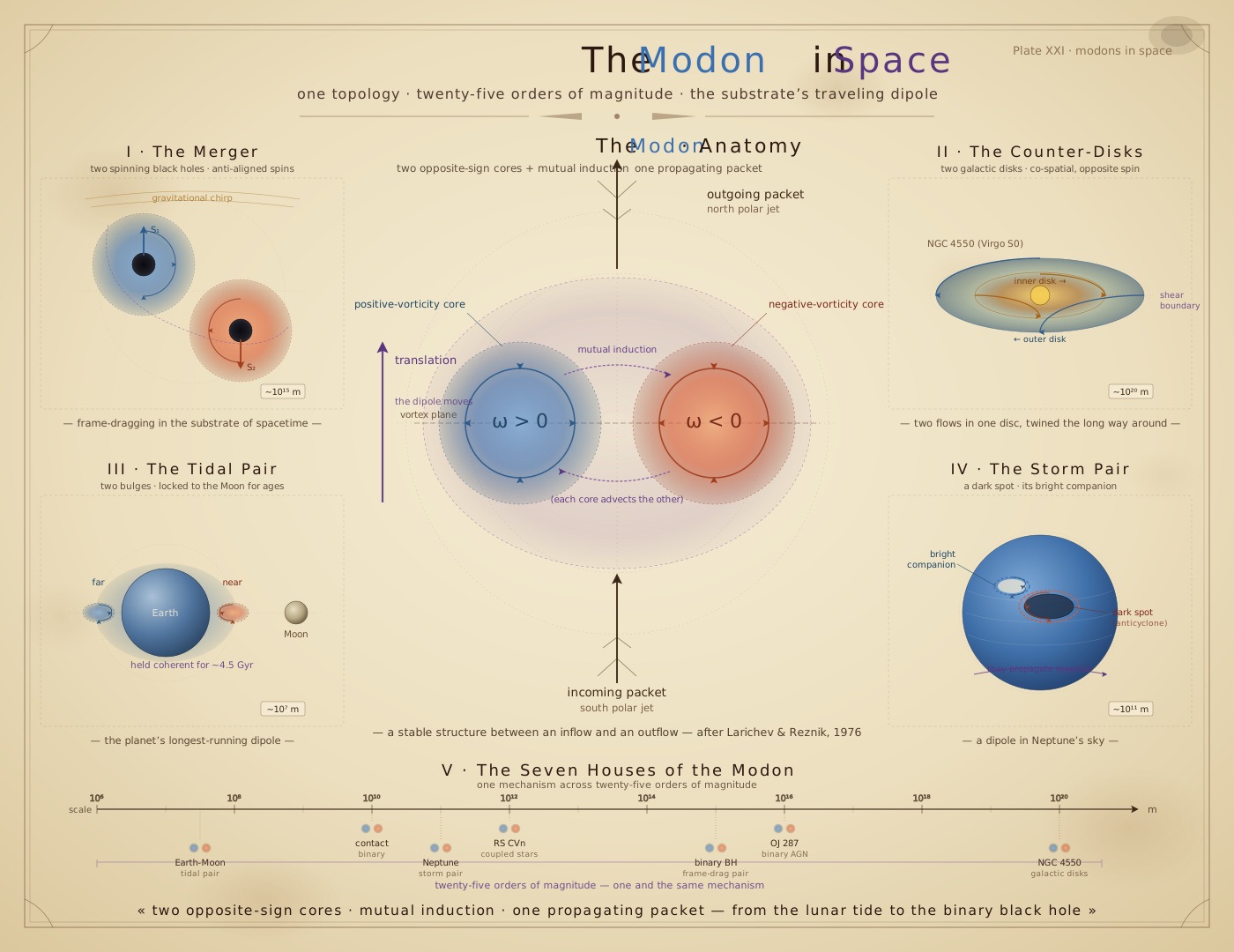
The water chapter named the three-step mechanism — counter-rotating shear, convergence, mutual-induction lock — and traced it across the photon, the Gulf Stream ring, and the equatorial atmospheric modon. The mechanism has no preferred scale. It asks only for two reservoirs of opposite-sign vorticity, something that drives them together, and a medium elastic enough at the relevant wavelength to hold the locked dipole against dispersion. Wherever that triple is satisfied, the framework predicts a modon.
This chapter applies the criterion to systems we observe in space. The cleanest cases are not the ones the eye is first drawn to. Two stars orbiting each other gravitationally are not a modon — Kepler does not require a substrate-velocity field, and a pair of point masses in mutual orbit has no counter-rotating circulation to speak of. The modon claim earns its content only when the two cores carry literal substrate-velocity fields and each sits inside the other’s. With that criterion in hand the candidate list shortens and clarifies.
The criterion: substrate-velocity coupling, not gravitational orbit
A modon in the framework’s sense is a dipole of substrate vorticity — two cores whose opposite-sign circulations advect each other through the surrounding medium. The Larichev–Reznik solution that anchors this picture is a fluid construction: it assumes a continuous velocity field surrounding both cores, with each core’s circulation contributing to the other’s translation. Drop that assumption and the system reduces to a two-body gravitational problem with no modon content. Point masses orbiting in vacuum are gravitationally bound but substrate-mute — their dynamics belong to the orbital mechanics of feedback topology at the disk-and-jet level, not to the dipole-translation mechanism this chapter is after.
What promotes a binary system into modon territory is one of three couplings:
| Coupling | Source of substrate-velocity field around each core |
|---|---|
| Frame-dragging (Lense–Thirring) | A spinning compact object literally drags the local substrate into co-rotation. The dragged field is the velocity field a partner sits in. |
| Accretion / circulation disk | Each core sits inside a rotating disk of gas, plasma, or dust whose circulation is the velocity field. Counter-rotating disks couple the partners through this field. |
| Shared envelope / common atmosphere | The two cores are embedded in a single fluid envelope whose circulation pattern is the velocity field. Contact binaries and storm pairs sit here. |
Each of these supplies a literal velocity field for the dipole to lock into. The five anchors below are ordered by how rigorously the coupling is established — frame-dragging in a binary black hole is essentially unavoidable in general relativity; storm pairs in a planetary atmosphere are direct fluid modons; the same-spin contact-binary case is more speculative and flagged as such.
Anchor 1: Binary black holes as substrate modons
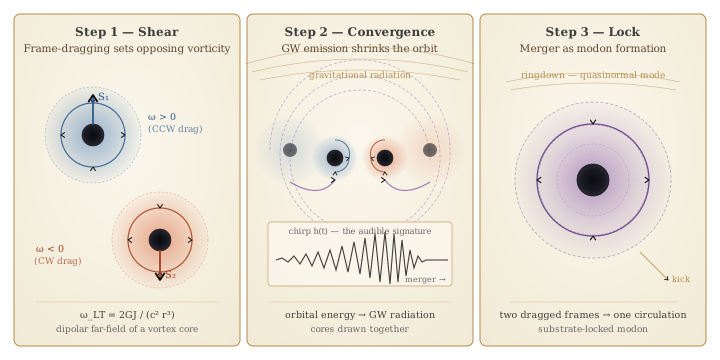
The cleanest case in the universe. Each Kerr black hole’s rotation drags the surrounding space into a co-rotating frame — the Lense–Thirring effect — and the dragged region is not a metaphor for a velocity field, it is a velocity field of the substrate the framework identifies with spacetime itself. The angular velocity of the dragged frame at distance r from a spinning BH of angular momentum J is, in the weak-field limit, \omega_\text{LT} = 2GJ/(c^2 r^3), falling off as r^{-3} — exactly the dipolar far-field of a vortex core.
A binary black hole with anti-aligned spins therefore consists of two opposite-sign vortex cores embedded in spacetime’s substrate, each immersed in the dragged frame of the other. This is the Larichev–Reznik configuration realized at the deepest level the framework knows. The three-step mechanism runs as follows:
- Step 1 — shear. Each BH’s frame-dragging sets up the local substrate-velocity field. Anti-aligned spins guarantee opposite-sign vorticity. Aligned spins instead produce two co-rotating cores in a shared sheath (see the same-spin variant below).
- Step 2 — convergence. Gravitational-wave emission removes orbital energy and shrinks the separation. This is what drives the two vorticity reservoirs together. The chirp signal LIGO and Virgo measure is the audio waveform of the convergence step.
- Step 3 — mutual-induction lock. At late inspiral the two dragged frames overlap so strongly that the system is no longer two cores plus a coupling but a single dipolar circulation. The merger is the modon-formation event itself: at the moment of ringdown, the two vortex cores have become one self-bound coherent rotation in the substrate.
This reading reframes what LIGO sees. The chirp is not a curiosity of strong-field GR — it is the audible signature of a substrate modon forming. The post-merger ringdown is the new modon settling into its quasinormal mode. The asymmetric emission that produces a remnant kick is the residual radiation step the framework names at every other scale.
Two predictions follow that distinguish this reading from the standard “two point masses inspiralling in a GR background” picture:
- Anti-aligned spin systems should show enhanced late-inspiral coherence relative to aligned-spin systems. The opposite-sign cores can lock as a modon; aligned-spin cores cannot, and must instead route their energy through the shared sheath, which is dissipative. Observationally this manifests as a difference in the residual after the standard inspiral template is subtracted — anti-aligned cases should leave less unmodelled energy than aligned cases. The LVK O4 spin catalogue is approaching the statistics needed to test this.
- The transition from inspiral to merger should be sharper than the standard waveform predicts, with a brief substrate-locking interval visible in residuals. This is the astrophysical analog of the Rostami–Zeitlin threshold the water chapter names — a bistable handoff between “still two cores” and “now one modon.”
The standard waveforms already fit the data within their stated systematics, so the framework’s predictions are at the level of residual structure, not gross morphology — see observational predictions for the analogous treatment at other scales.
Anchor 2: Counter-rotating galactic disks
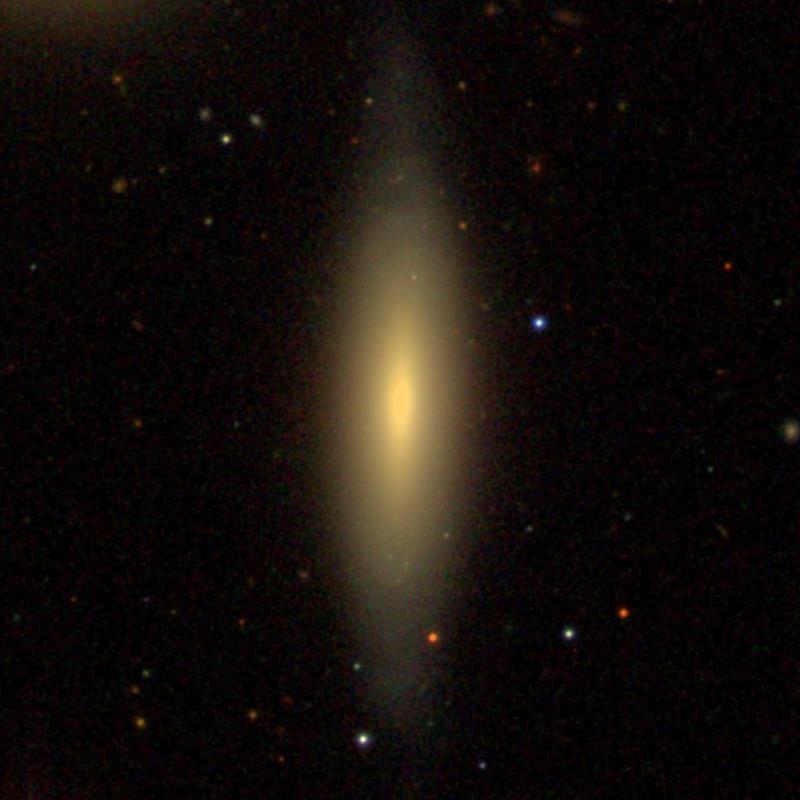
Sloan Digital Sky Survey, CC BY 4.0 https://creativecommons.org/licenses/by/4.0, via Wikimedia Commons
A more literal modon shows up at 10^4 pc. NGC 4550 — an S0 galaxy in the Virgo cluster — hosts two co-spatial stellar disks that rotate in opposite directions, each with roughly half the total mass, mutually penetrating, distinguishable only kinematically.1 NGC 7217 (Sa) has a counter-rotating inner stellar component; NGC 3593 hosts counter-rotating gas and stars; NGC 4138 has a counter-rotating outer HI disk. The class is rare but secure.2
The framework reads each such galaxy as a literal nested modon: an inner co-rotating disk and an outer counter-rotating disk that together form a dipolar velocity field at galactic scale, each component embedded in and advected by the other’s circulation. The standard explanation is a late acquisition event — retrograde gas accretion that formed the counter-rotating component from infalling material. The framework does not contest this origin but adds a stability claim: the configuration is dynamically long-lived because it sits on the modon attractor. A counter-rotating disk pair has the lowest dissipation rate available to a galaxy that has somehow received the angular momentum for both rotations — Larichev–Reznik in the substrate’s elastic medium at 10^4 pc rather than in seawater at 10^5 m.
The MOND scale that the galactic dynamics chapter derives is, in this language, the wavelength at which the counter-rotating boundary becomes substrate-locked. A counter-rotating galactic disk system is the same boundary mathematics expressed in the disks themselves rather than in a single disk and its environment. The prediction the framework offers is that counter-rotating-disk galaxies should sit on the baryonic Tully–Fisher relation with smaller residuals than ordinary disk galaxies of comparable mass. Their dipolar structure routes more of their angular momentum into the substrate-coherent locked configuration and less into dissipative bar / spiral / warp modes. The SPARC sample is too small in this subclass to test cleanly yet, but the prediction is sharp.
Anchor 3: Binary AGN with counter-rotating accretion disks — OJ 287
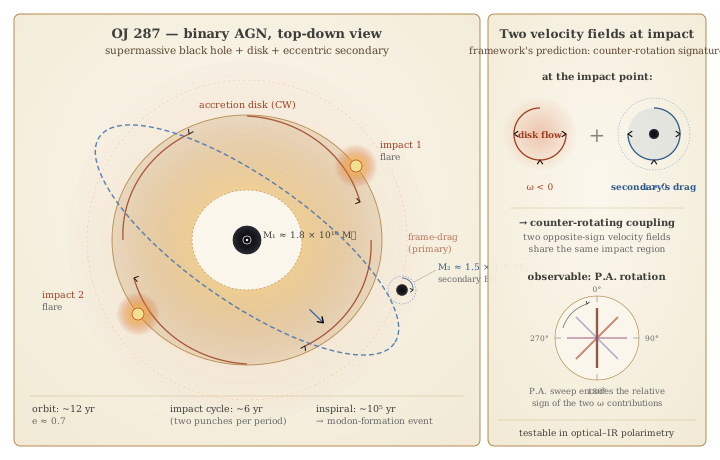
The blazar OJ 287 is the textbook supermassive-binary-black-hole candidate. Its optical light curve shows a \sim 12-year quasi-periodicity, with each cycle exhibiting a characteristic double-peaked outburst that has been modelled successfully as a smaller secondary BH (\sim 1.5 \times 10^8 M_\odot) on an eccentric orbit punching twice per period through the accretion disk of a much larger primary (\sim 1.8 \times 10^{10} M_\odot).3
The framework reads OJ 287 as a substrate modon under construction, with two distinguishable contributions to the velocity field at each core: the frame-dragging of Anchor 1 (the BHs are rotating Kerr objects), and the rotation of the accretion disk material the secondary punches through every \sim 6 years. The disk-impact events are convergence events in the Step-2 sense — episodic energy injections that nudge the system along its inspiral trajectory faster than gravitational-wave emission alone would. The 12-year periodicity is the orbit; the \sim 10^5-year inspiral timescale is the modon-formation timescale; the eventual merger is the formation event itself.
The prediction the framework offers here is a counter-rotation signature in the secondary’s disk-puncture flares. If the secondary’s accretion captures gas with the local disk’s circulation, the resulting tidal stream around the secondary should carry the disk’s angular momentum, opposite in sign to whatever spin angular momentum the secondary’s own dragged frame defines. The flare’s polarization position-angle should rotate through the cycle in a pattern that encodes the relative sign of the two velocity-field contributions. The optical–IR polarimetric monitoring already underway for the 2030s impact should be able to test this.
Anchor 4: Stellar binaries with coupled magnetospheres and winds
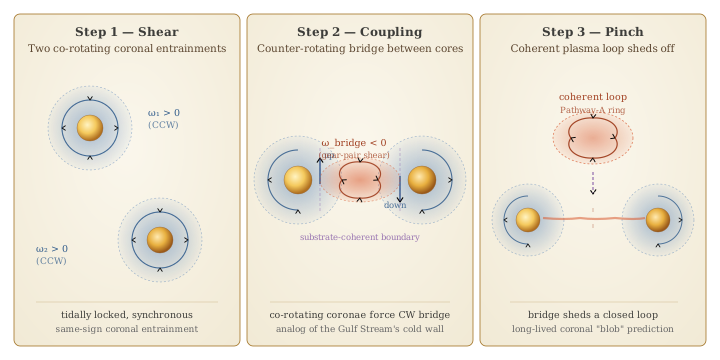
A step gentler in environment but still cleanly modon-like. RS CVn binaries — close, tidally-locked, magnetically active subgiant pairs — have stellar winds and magnetic fields that interpenetrate. The combined wind region around the binary is not “two stellar winds happening to overlap” but a single coupled flow with a measurable counter-circulation between the components, observed in radio interferometry of nearby systems (Algol, \beta Per, V711 Tau).4
The substrate-velocity field around each star is real but weaker than in the compact-object cases: it is the entrainment of the local dc1 by the star’s surface rotation, the same entrainment the solar–stellar dynamics chapter names for the Sun’s Parker spiral. In a sufficiently close binary, the two entrainment fields overlap and the system has a literal counter-rotating shear between the two co-rotation regions. This is the Step-1 shear in the modon-formation mechanism. The Step-2 convergence is supplied by orbital decay through magnetic braking; the Step-3 lock would be the common-envelope phase the next anchor treats.
The prediction the framework offers here is a sharp counter-rotating boundary in the inter-stellar coronal bridge of close RS CVn systems, analogous to the Gulf Stream’s cold wall — sharper than viscous coronal MHD predicts, with a thickness controlled by the substrate’s local coherence length rather than by classical resistivity. The bridge should also pinch off coherent plasma loops that survive longer than ordinary coronal mass ejections, as Pathway-A ring-shedding events at stellar scale. Some of the long-lived coronal “blobs” observed in RS CVn flaring may already be such events.
Anchor 5 — the same-spin variant: contact binaries with common envelopes
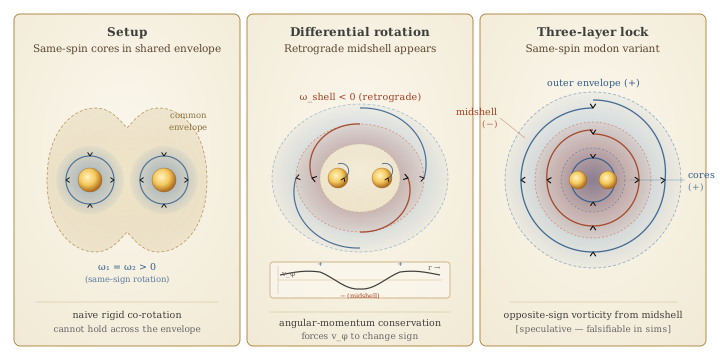
If a binary’s two components rotate in the same direction, the system can still be a modon — but only if a counter-rotating intermediate layer develops between them. Contact binaries are the cleanest astrophysical realization. W UMa systems and the late stages of common-envelope binaries share a fluid envelope around two stellar cores that orbit and rotate in the same sense. The envelope cannot rigidly co-rotate everywhere — angular-momentum conservation requires shear, and observed envelopes in numerical simulations develop substantial differential rotation, with some shells running retrograde relative to the orbital direction.5
The framework reads this as a same-spin modon variant: the two co-rotating cores ride inside a shared envelope whose middle layer counter-rotates, providing the third element the modon topology needs. The geometry is the same as the feedback topology chapter’s canonical loop applied to a pair of cores rather than to a single core — disk and jets reorganized into a configuration where each core acts as the other’s disk and the counter-rotating shell wraps both. The system holds until the shell decouples, which in a common-envelope binary is precisely the moment of envelope ejection and merger — the equivalent of the modon collapsing back into a single core.
This case is more speculative than the four above and the framework should be explicit about that. The Lense–Thirring coupling of Anchor 1, the kinematic counter-rotation of Anchor 2, the orbital construction of Anchor 3, and the magnetospheric coupling of Anchor 4 are all directly observed. The same-spin modon hypothesis predicts that common-envelope simulations should consistently show a substrate-coherent counter-rotating midshell whose thickness is set by the substrate’s local coherence length rather than by hydrodynamic viscosity alone. This is testable against existing simulation suites with the right diagnostics; it has not, to the author’s knowledge, been tested. Flagged as speculation pending that work.
Anchor 6: Earth–Moon as a tidal modon
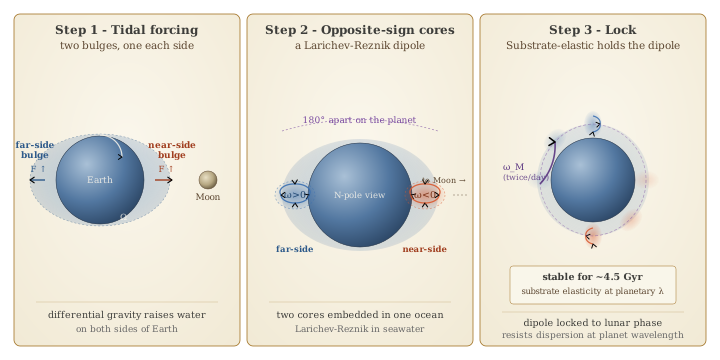
The closest-to-home case, and the one most often miscategorized. The Earth–Moon system is gravitationally a Kepler pair, but the ocean and the crust it sits on are not point masses — they are fluid (and visco-elastic) media whose tidal response is a propagating circulation. The semi-diurnal tidal bulge under the Moon and its antipodal partner on the far side are opposite-sign circulation patterns in the global ocean, locked together and propagating around the planet at the Moon’s apparent angular velocity. That is a Larichev–Reznik dipole in seawater, scaled to the planet’s circumference.
The framework’s reading is that the lunar tide is the largest-amplitude long-lived modon the planet supports — a single dipole locked at the planet’s rotation rate, sustained for \sim 4.5 Gyr, propagating coherently around the globe through media with order-unity dissipation. Standard tidal theory derives the amplitudes and phases without invoking modon language; nothing in the framework contradicts it. What the framework adds is a stability claim: the tide is long-lived because the substrate’s elasticity at planetary wavelengths holds the dipole together against the dispersion that would otherwise smear it. The same elasticity, at the much shorter wavelengths of the Gulf Stream’s cold wall, holds the ocean current sharp; at the wavelength of the Moon’s gravitational pull, it holds the tidal bulge coherent.
A specific prediction the framework offers: the tidal bulge’s phase lag should show a residual structure not captured by standard tidal dissipation models — a small (\sim 10^{-4}-level) modulation correlated with the lunar-orbit position rather than with the dissipation rate, set by the modon’s substrate-locking restoring force. This is at the edge of what tidal gravimetry can resolve.
Anchor 7: Storm pairs on giant planets
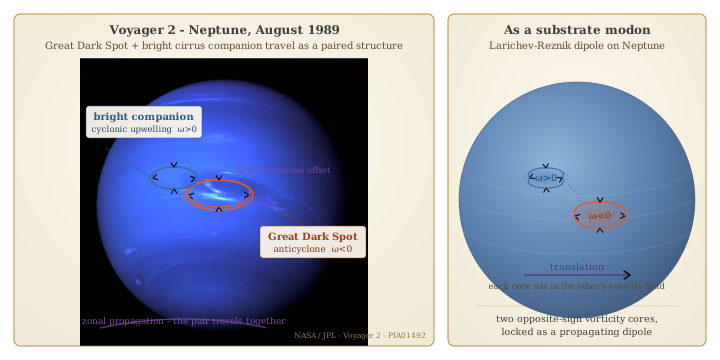
Finally, the case that is literally a fluid modon in a planetary atmosphere. Voyager 2’s encounter with Neptune in 1989 found a Great Dark Spot at \sim 22°S accompanied persistently by a small bright cloud feature — the “scooter” and the “bright companion” — that travelled with the spot, separated by a fixed latitudinal offset, for as long as the spot was observed.6 Hubble observations of subsequent Neptune dark spots (NDS-1994, NDS-2018, NDS-2020) have repeatedly found similar paired companions.7
The pairing is the modon. A Neptune Dark Spot is an anticyclonic vortex; its bright companion is the cyclonic partner, with the bright cloud being condensation in the cyclonic upwelling. Together they form a counter-rotating dipole that propagates zonally — exactly the Larichev–Reznik solution applied to Neptune’s atmosphere. The dark spot alone would disperse on the dynamical timescale; the dipole locks and travels coherently for years. This is the framework’s prediction made before it asked: that planetary atmospheres should host long-lived dipolar storm pairs whenever a sufficiently strong localized pressure anomaly arises in a region of opposing shear.
Jupiter’s Great Red Spot is the more famous case but a less clean one — it is a single anticyclone that has persisted for centuries by sitting in the shear between two oppositely-directed zonal jets, rather than a dipole partner. Saturn’s polar hexagon is a wave pattern at the boundary of the polar vortex, not a modon dipole. The Neptunian dark-spot-and-bright-companion pairings are the cleanest planetary-atmosphere realization of the modon topology outside the equatorial atmospheric MJO modon that the air chapter anchors.
What is not a modon in space
A short list of plausible-sounding candidates the framework explicitly does not read as modons:
- Ordinary binary stars in vacuum. Two main-sequence stars in a wide orbit are gravitationally bound but substrate-mute: their frame-dragging is negligible, they have no shared envelope, and their winds at large separation do not couple into a counter-rotating field. Kepler describes them completely.
- Bipolar AGN jets. The two oppositely-directed jets from a single AGN look superficially like a modon dipole but are not — they are the polar exit of a single feedback-topology loop, not a counter-rotating dipole pair. Each jet carries the same sign of angular momentum (the disk’s), reversed only in spatial direction. The feedback topology canonical loop covers them.
- Galaxy bars. A barred spiral’s bar is a single elongated vortex, not a counter-rotating dipole. It belongs to the disk dynamics, not to the modon ledger.
- Single rotating black holes. A Kerr BH alone is a vortex core, not a dipole. The modon claim requires two opposite-sign cores embedded in each other’s velocity field.
- Open star clusters and globular clusters. Many-body gravitational systems with no large-scale ordered rotation. Statistical mechanics, not modon dynamics.
The criterion for entry into the modon catalogue is sharp: two opposite-sign vorticity cores, a velocity-field coupling between them, and a convergence pathway. Without all three the system has different physics.
One mechanism, twenty-five orders of magnitude
The seven anchors above span from \sim 10^7 m (Earth–Moon tidal bulge) to \sim 10^{11} m (Neptune dark-spot pair) to \sim 10^{12} m (close stellar binaries) to \sim 10^{15} m (binary AGN orbital separations at impact phase) to \sim 10^{20} m (NGC 4550 disk radii). The same three-step mechanism — counter-rotating shear, convergence, mutual-induction lock — produces each of them. The photon, the Gulf Stream ring, the equatorial atmospheric modon, and these seven astrophysical cases share one topology and one formation logic at lengthscales spanning twenty-five orders of magnitude. The framework’s claim is not that every substrate-coherent structure in space is a modon — most are single feedback-topology loops, single vortex cores, or many-body gravitational systems. The claim is that when the modon topology appears, it is doing so for the same reason at every scale, and the cases the framework has flagged are the ones to look at first.
The Rostami–Zeitlin threshold the water chapter named — the sharp, bistable handoff between “radiates as waves” and “locks as a propagating modon” — predicts that all seven anchors should show analogous threshold structure. In the binary-black-hole case it is the inspiral-to-merger transition. In the counter-rotating-disk case it is the kinematic decoupling angle at which the inner disk’s counter-rotation becomes stable rather than dissipative. In the contact-binary case it is the envelope mass at which the counter-rotating midshell appears. In the storm-pair case it is the dark-spot amplitude at which a bright companion locks. Each of these is, in principle, observable — and each would, if found, push the modon mechanism further toward being the framework’s most universal feature.
Footnotes
Rubin, V. C., Graham, J. A., Kenney, J. D. P., “Cospatial counterrotating stellar disks in the Virgo E7/S0 galaxy NGC 4550,” Astrophysical Journal 394, L9 (1992); Rix, H.-W., Franx, M., Fisher, D., Illingworth, G., “NGC 4550: A laboratory for testing galactic dynamics,” Astrophysical Journal 400, L5 (1992). Original discovery of the two-disk counter-rotating structure.↩︎
Reviews: Bertola, F., Corsini, E. M., “Counterrotation in disk galaxies,” in Galaxy Interactions at Low and High Redshift, IAU Symp. 186, p. 149 (1999); Corsini, E. M., “Counter-rotation in disc galaxies,” in Multi-Spin Galaxies, Mem. S.A.It. 85, 123 (2014).↩︎
Valtonen, M. J. et al., “A massive binary black-hole system in OJ 287 and a test of general relativity,” Nature 452, 851 (2008); Valtonen, M. J. et al., “Refining the OJ 287 2022 impact flare arrival epoch,” Astrophysical Journal Letters 939, L33 (2022). The 2022 prediction was confirmed to ~4-hour accuracy with no-disk-warp models.↩︎
Mutel, R. L., Lestrade, J.-F., Preston, R. A., Phillips, R. B., “Dual-polarization VLBI observations of stellar binary systems at 5 GHz,” Astrophysical Journal 289, 262 (1985); subsequent VLBI imaging of Algol-type systems by Lestrade et al. shows large coronal structures bridging the components.↩︎
Ohlmann, S. T., Röpke, F. K., Pakmor, R., Springel, V., “Hydrodynamic moving-mesh simulations of the common envelope phase in binary stellar systems,” Astrophysical Journal Letters 816, L9 (2016); Iaconi, R., De Marco, O., “Speaking with one voice: simulations and observations discuss the common envelope \alpha parameter,” Publications of the Astronomical Society of Australia 36, e037 (2019). Differential rotation including retrograde shells appears robustly in 3D moving-mesh simulations.↩︎
Smith, B. A. et al., “Voyager 2 at Neptune: Imaging science results,” Science 246, 1422 (1989). The Great Dark Spot and its bright companion are documented as a paired structure travelling together at a relative velocity that was anomalous for either feature in isolation.↩︎
Hammel, H. B., Lockwood, G. W., Mills, J. R., Barnet, C. D., “Hubble Space Telescope imaging of Neptune’s cloud structure in 1994,” Science 268, 1740 (1995); Wong, M. H. et al., “Hubble Space Telescope observations of a Neptunian dark spot and bright companion,” Planetary Science Journal 3, 207 (2022).↩︎