Memory in the Substrate
A plain-language walk through memory under the substrate lens — a remembered moment as a coherent standing pattern, the cortex as a room of tuning forks that solves the world in parallel, the hippocampus as the night-librarian that catches a whole scene in one handle, sleep as the shift that files the day into the cortex, and recall as the substrate ringing a stored shape back into being
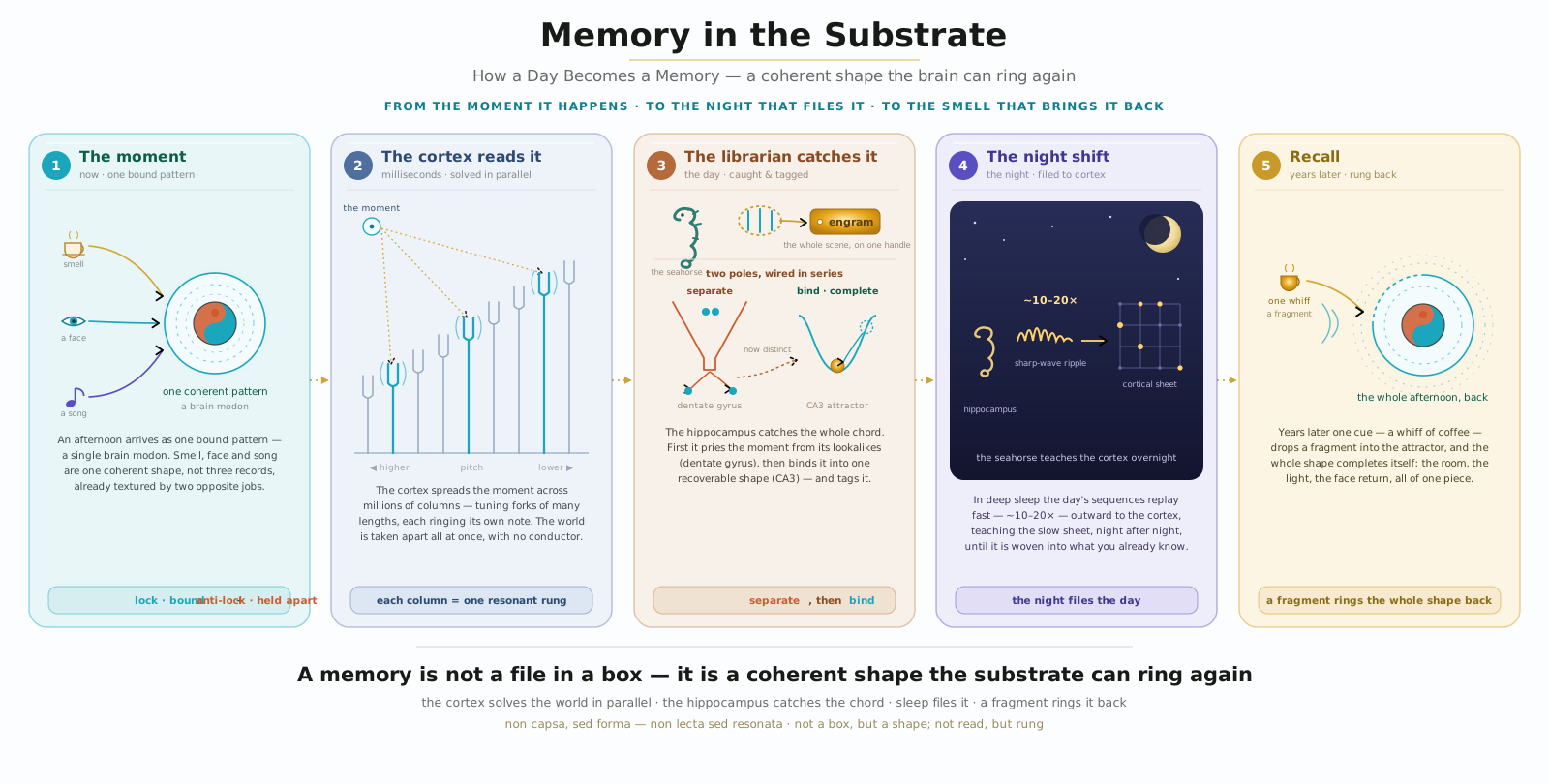
You are somewhere, and a smell arrives — coffee, or rain on hot pavement, or a particular soap — and without asking your permission an entire afternoon you had not thought about in twenty years assembles itself in front of you: the room, the light, the face across the table, the feeling in your chest. You did not retrieve a list of facts. Something whole came back, all at once, triggered by a single thread.
That experience is the thing this chapter is about, and the substrate framework has, I think, an unusually clean way to say what is happening. The section’s technical chapters write the machinery down in full — the cortex as a prediction-and-control engine, the bilateral pair and its resonator equations, and — in the chapter that follows this one — the hippocampus place-cell-and-grid-cell-and-sleep-replay story, with the conversation as two brains coupling through language, and the same machine built in silicon as a language model, later still. They are thorough, and they are technical. This chapter does something different and deliberately redundant: it tells the story of a memory — from the moment it happens, through the night that files it, to the morning years later when a smell brings it back — in plain language, so that a reader who never touches the equations can still come away feeling they have seen how memory works under this lens. Read this one first; then read its technical companion, the hippocampal modon, straight after.
The whole reframing fits in one sentence. A memory is not a file stored in a box; it is a coherent shape — a standing pattern in the brain’s substrate, woven from which-things-belonged-together and which-things-stayed-distinct — that the brain learns to hold across time and to ring back into being from a fragment. Everything below is an unpacking of that sentence.
A Moment Is a Shape, Not a Snapshot
Start with the moment itself. Right now, as you read, your brain is not a passive camera recording pixels. It is, in the framework’s reading, holding a single coherent state — one organism-scale pattern that the paper calls the brain modon, the same kind of self-sustaining, knotted-together excitation that shows up at every scale of this work, from the photon to the cell. “Coherent” here just means all of one piece: the smell, the face, the song, the feeling are not four separate recordings sitting in four drawers. They are bound into one shape, and that binding is what makes it a moment rather than a pile of unrelated sensations.
And the shape has a texture — this is the part the framework adds that ordinary accounts leave out. Look closely at any experience and you find two kinds of relationship in it. Some things belong together: the smell and the face and the song all arrived at once, so they lock into one bound chord. Other things must be kept apart: this face is not that face; this smell is not that smell; the word you heard was “bear,” not “pear.” If those distinctions blurred, the memory would be useless — you would confuse the people you love. So experience is built from two opposite jobs running at once: binding things that go together, and holding apart things that must not be confused. The paper has a name for these two jobs that runs through the entire work — the substrate ladder’s two poles, the lock pole and the anti-lock pole (the teeth and the gaps) — and the remarkable claim is that your sense organs are already sorting the world into these two textures before any memory is formed. The ear locks onto octaves and harmony (binding); the retina deliberately scatters its colour-sensors into a disordered “blue-noise” pattern so that fine patterns cannot fool it into seeing things that are not there (holding apart). Perception hands the rest of the brain a moment that is already labelled — this part is bound, that part is distinct — and memory’s job is to preserve that labelling. A remembered moment is a coherent shape that carries, baked into it, the record of what locked and what stayed separate.
The Cortex Is a Room Full of Tuning Forks
How does the brain catch a shape like that? The surprising answer the framework gives is that the cortex is built, almost literally, like a machine for solving the equations of the world in parallel — and once you see it that way, a lot of otherwise-strange brain anatomy turns friendly.
Picture a room full of tuning forks of many different lengths. A short fork rings at a high pitch; a long fork rings low. Strike a chord in that room and each fork picks out its own note from the chord and hums it — the room as a whole has just taken the chord apart into its ingredients, all at once, with no central conductor doing the work. The cortex is that room. Its basic unit, the cortical column, is a little vertical patch of tissue that behaves like a resonator tuned to one pitch — one rung of the brain’s natural ladder of rhythms (the variable-length columns are a “basis set” of resonators). The cortex holds millions of these columns at a spread of lengths, so an incoming sensory pattern gets decomposed across them like a struck chord — each column extracting the slice of the world that matches its own note. This is what is meant by the cortex being a differential-equation solver: a good way to solve a hard equation is to break a complicated state into simple resonant modes, advance each one on its own clock, and add them back up — and that is exactly the shape of the cortical sheet. It is not a metaphor the framework reaches for; it is the architecture an engineer would build under the same constraints.
Two more pieces of that architecture matter for memory. First, the cortex lays its columns out as maps — the famous fact that neighbouring patches of cortex handle neighbouring patches of the body, neighbouring tones, neighbouring points in the visual field (topographic maps as parallel parameter scans). A map is just the room of tuning forks laid out in an orderly grid, so that “scanning across the world” becomes “scanning across the cortex.” Second, the columns do not merely receive; they predict. Each one is constantly guessing what should come next and comparing that guess to what actually arrives, passing the mismatch up the line (canonical loops as the prediction-and-error cycle). What you experience as “the present moment” is not the raw sensory data — it is your brain’s best running guess, corrected by the surprises. A moment, then, is the particular chord the whole room is ringing right now: which columns are lit, at which pitches, in which map locations, all bound into one coherent state. That chord is the thing memory has to keep.
Holding the Note: Short-Term Memory
The simplest kind of keeping is the shortest. When you read a phone number and hold it in your head for the few seconds it takes to dial, you are doing something the framework describes plainly: you are keeping the chord ringing. Working memory, in this reading, is the brain modon holding a coherent pattern alive on one of its slow, long rhythms while the fast rhythms keep refreshing it cycle by cycle (cross-frequency coupling, the slow rhythm setting the window for the fast one). It is like keeping a spinning plate up: nothing is stored anywhere permanent, you are simply sustaining the shape with a small continuous expenditure, and the moment you stop attending — the moment you let the plate slow — the pattern fades and the number is gone.
This is why short-term memory is so small and so fragile, and why it does not survive a distraction. You are not writing to disk; you are holding a note in the air. To keep a memory past the next few seconds — past the next time the room rings a different chord — something has to capture the pattern and hand it somewhere it can outlast the present moment. That capturing is the hippocampus’s job, and it is where the story gets its most beautiful piece of machinery. (There is a whole further story in this kind of holding — what an unfinished held pattern costs, why an open errand keeps ringing you back, why writing it down releases it, and why the waiter forgets your order the instant the bill is paid — and the section gives it its own chapter.)
The Librarian That Catches the Whole Scene
Tucked under each side of the cortex is a small curled structure named, for its shape, the seahorse — the hippocampus. If you lose it on both sides (as the famous patient H.M. did, in surgery for epilepsy), something very specific happens: you keep everything you already knew, you can hold a thought for a few seconds, you can learn new skills with your hands — but you can no longer form a new memory of an event. Every conversation is the first one; every meal is a surprise. The seahorse is not where memories live. It is where they are caught and tagged on the way in.
Here is what it does, told as a story. A moment arrives at the hippocampus as that big bound chord from the cortex. The first thing the hippocampus does is pull the chord apart from its neighbours — it runs the incoming pattern through a stage (the dentate gyrus) whose entire purpose is to make this moment as distinct as possible from every similar moment, so that today’s lunch with a friend does not smear into last week’s lunch with the same friend at the same table (separation before completion). This is the anti-lock pole again — the keep-things-apart job — now built into anatomy as a dedicated stage. Only after the moment has been pried away from its lookalikes does the hippocampus do the opposite: it binds the now-distinct pattern into a single, recoverable shape in a network (called CA3) that works like an attractor — a basin that, once you have a memory in it, will pull any partial reminder back down to the whole (CA3 as the pattern-completion attractor).
Sit with that for a second, because it is the cleanest single idea in the chapter. The two opposite jobs of experience — keep distinct and bind together — are not blended into a vague compromise. They are wired as two stages in a row: separate first, so memories don’t collide; then bind, so each one becomes a single thing you can grab by a corner. The seahorse is the place where the framework’s two poles are soldered into one circuit, in series, and you can point at the wire. The output is what researchers call an engram — the specific little ensemble of cells that now carries this one memory’s identity (engram cells), the gold tag on the whole scene. The hippocampus has caught your afternoon and given it a handle.
It is worth noting what the hippocampus is so good at catching: wholes located in a place and a time. Its cells are famous as place cells and grid cells — they fire when you stand in a particular spot, and they lay a regular hexagonal graph-paper grid over the space you move through (place cells, grid cells). The framework reads this as the same architecture again, lifted to the scale of your whole body in the world: a map (the grid, a lock-pole ruler) over which distinct experiences are kept from blurring (the remapping, the anti-lock). And the seahorse has one more trick — it recodes space into time, threading the places you pass into a fast little sequence riding on a slow brain rhythm (theta-phase precession), so that a path through the world becomes a story with an order. That re-coding is exactly what makes a captured moment replayable — which is what the night shift needs.
The Night Shift: How Sleep Files the Day
A memory caught by the hippocampus is fast but precarious — held by a small structure, vulnerable, and not yet woven into the vast cortical landscape where what-you-know actually lives. Turning a caught moment into a lasting one is the work of sleep, and the framework tells this part as a literal night shift.
During deep sleep the hippocampus produces sharp little bursts of activity, and inside each burst it does something astonishing: it replays the day’s captured sequences, fast — the same order of places and events you actually lived, run back at perhaps ten to twenty times speed (sharp-wave-ripple replay). And each replay is aimed outward, at the cortex. The seahorse spends the night as a teacher with a single bright lesson, showing the slow, sprawling cortical sheet the pattern over and over until the cortex has learned it for itself. By morning the memory no longer depends on the hippocampus alone; copies of its structure have been written into cortex, where they join everything else you know and slowly settle into the meaning of your life rather than the bare episode of one afternoon.
This is the famous two-stage design — fast, fragile capture in the hippocampus by day; slow, durable consolidation into cortex by night — and the framework reads it as the substrate’s standard strategy for the same problem it faces everywhere: how to learn one new thing quickly without overwriting everything you already knew. The answer is to catch it sparsely and separately first (so it can’t collide with old memories), then teach it gently to the dense network over many nights (so it enriches the whole rather than scribbling over it). It is also why sleep is not optional for memory, why a crammed night before an exam betrays you, and why the day’s experiences feel settled after you have slept on them: the filing happened while you were out.
Recall: Ringing the Shape Back
Now the morning years later, and the smell of coffee. Here is where the whole picture pays off, because retrieval, in this framework, is not what it feels like and not what the filing-cabinet metaphor suggests. You do not go to a drawer and read out a record. A fragment of the old pattern rings the whole pattern back into being.
Remember that the memory was stored as a coherent shape in an attractor — a basin that pulls partial reminders down to the whole. The smell of coffee is a piece of the original chord. Drop that one piece into the basin and the dynamics do the rest: the partial pattern slides downhill to the nearest complete stored shape, and the entire afternoon re-assembles — the room, the light, the face, the feeling — because they were bound into one shape to begin with and the shape is an attractor that completes itself from any corner (pattern completion). This is why a hummed bar brings back a whole song, why one face in a crowd unlocks a name and a decade, why a single word lands and a friend understands far more than you said. Recall is re-resonance: the brain ringing a remembered shape again, the way a struck tuning fork sets a matching one humming across the room.
Seen this way, the everyday quirks of memory stop being bugs and become features of an attractor system:
- The tip of the tongue. You have the basin but not quite enough cue to fall all the way in — you are circling the rim of the shape, with its texture and first letter, unable to complete it. Give it another fragment and it drops.
- Why a cue from the wrong memory pulls up the wrong one. Two shapes that were not separated enough share a rim; a cue lands between them and you complete to the lookalike. That is exactly the failure the dentate gyrus exists to prevent — and when separation is weak, similar memories merge and false memories rise.
- Why remembering changes the memory. Ringing a shape back lights it up again, which is the very condition under which the night shift re-files it — so each recall can re-write the stored pattern a little. A memory is not a photograph in a drawer; it is a shape you re-ring, and re-ringing leaves a fingerprint. This is unsettling and it is also exactly what an attractor that learns would do.
- Why a smell is the most powerful key of all. Smell wires almost directly into this machinery, so it drops a clean fragment straight into the basin with little of the cortical processing other senses pass through — which is why a scent can complete a whole forgotten shape faster and more bodily than a photograph.
The Spin This Puts on the Whole Thing
If you step back, the framework has quietly swapped out the metaphor at the centre of how we talk about memory, and the swap is the real content of this chapter. The old metaphor is the library or the hard drive: memories are records, stored at addresses, written once and read back unchanged, and forgetting is a record going missing. Almost every confusion people have about their own minds comes from taking that metaphor literally.
The substrate metaphor is different all the way down. A memory is a coherent shape — a pattern the brain holds the way the substrate holds any of its modons. It is built from the same two ingredients as everything else in this paper: things locked together and things held apart, the two poles of the ladder, the very textures your senses were already measuring before you remembered anything (the eye, the resting brain, and now memory all running the same lock/anti-lock sorting). It is caught by a structure that does the two jobs in series — separate, then bind — so you can tell your memories apart and grab each as a whole. It is filed overnight by a teacher replaying the day to a slow student. And it is recalled not by reading but by re-ringing — dropping a fragment into a shape that completes itself.
Once you hold that picture, the brain stops looking like a computer that happens to be made of meat and starts looking like what the framework says it is: a richly coherent piece of the same substrate that carries light and builds atoms and runs cells, organised — at the scale of an organ — to preserve the coherent shapes of its own experience across time, and to ring them back on demand. The cortex solves the world in parallel like a room of tuning forks; the hippocampus catches the day’s chords and tags them; sleep teaches them to the cortex; and a smell, years later, sets the whole thing humming again. That is memory, under this lens — and it is, I think, a friendlier and a truer thing than a drawer.
What Would Show This Is Wrong
A narrative is not an excuse to stop being falsifiable, and the technical chapters carry the sharp tests in full; here is the honest short version, in plain terms. The framework would be in trouble if the brain’s “tuning forks” turned out to ring at any pitch with no preferred rungs, rather than clustering on the ladder’s spacing the way the grid-cell map and the cortical rhythms appear to. It would be in trouble if the hippocampus’s two stages did not carry opposite textures — if the “separate” stage (dentate gyrus) were no more distinct-making than the “bind” stage (CA3), the central wired-in-series claim collapses. And it would be in trouble if sleep’s replay-compression and the conversation’s turn-taking and the rest turned out to scale smoothly with no preferred steps at all. None of these would touch the framework’s hardest physics, but each would say the brain is not reading the substrate’s ladder the way the paper claims — and each is measurable with tools that already exist. That the same lock/anti-lock sign-rule keeps falling out of eye, cortex, hippocampus, and language, in tissues that share no chemistry, is either a deep unity or a coincidence the next round of measurement will dissolve. This chapter has bet, in plain language, on the unity.
Putting the Section in Context
A memory is a coherent shape the brain holds across time. The moment is captured as one bound pattern — a brain modon — already textured by the two jobs every sense organ performs, binding what belongs together and holding apart what must not be confused, the lock and anti-lock poles of the substrate ladder. The cortex reads that moment like a room of tuning forks of many lengths, decomposing the world into resonant modes laid out on orderly maps and corrected, moment by moment, against its own predictions. Short-term memory is the chord kept ringing on a slow rhythm; the hippocampus catches the chord and tags it, running the substrate’s two poles as two stages in series — separating each memory from its lookalikes before binding it into a recoverable whole. Sleep replays the day’s captured sequences fast and outward, teaching the slow cortex overnight until the memory is woven into the durable landscape of what you know. And recall is not read-out but re-resonance: a fragment dropped into an attractor that completes itself, ringing the whole shape back into being — which is why a hummed bar returns a song, why a word lands deeper than it says, and why a smell can summon a whole forgotten afternoon.
The prediction-engine chapter gave the cortex’s computation, the resonator-ODE chapter gave its equations, the hippocampal-modon chapter gave the memory machinery in technical detail, and the language chapter lifted the whole thing between two minds. This chapter has retold their shared story in the one register the others did not use — the plain one — for the reader who wants to understand memory before they study it. What it adds to the framework is not a new claim but a new door: the recognition that the substrate’s reading of memory can be told as a single human story, from a moment at a café to the smell that brings it back, and that the story holds together without a single equation — which is, in the end, the strongest sign that the picture underneath it is the right shape.