The Stealth Vacuum
Why a dense, energetic superfluid presents as empty space. The substrate hides by the same anti-lock principle the retina uses to avoid aliasing — it is disordered hyperuniform, so it does not scatter the radiation that probes it. ‘Hidden by coherence-match’ turns out to be a literal statement: the structure factor is the overlap of the lattice with the probe, and it goes to zero.
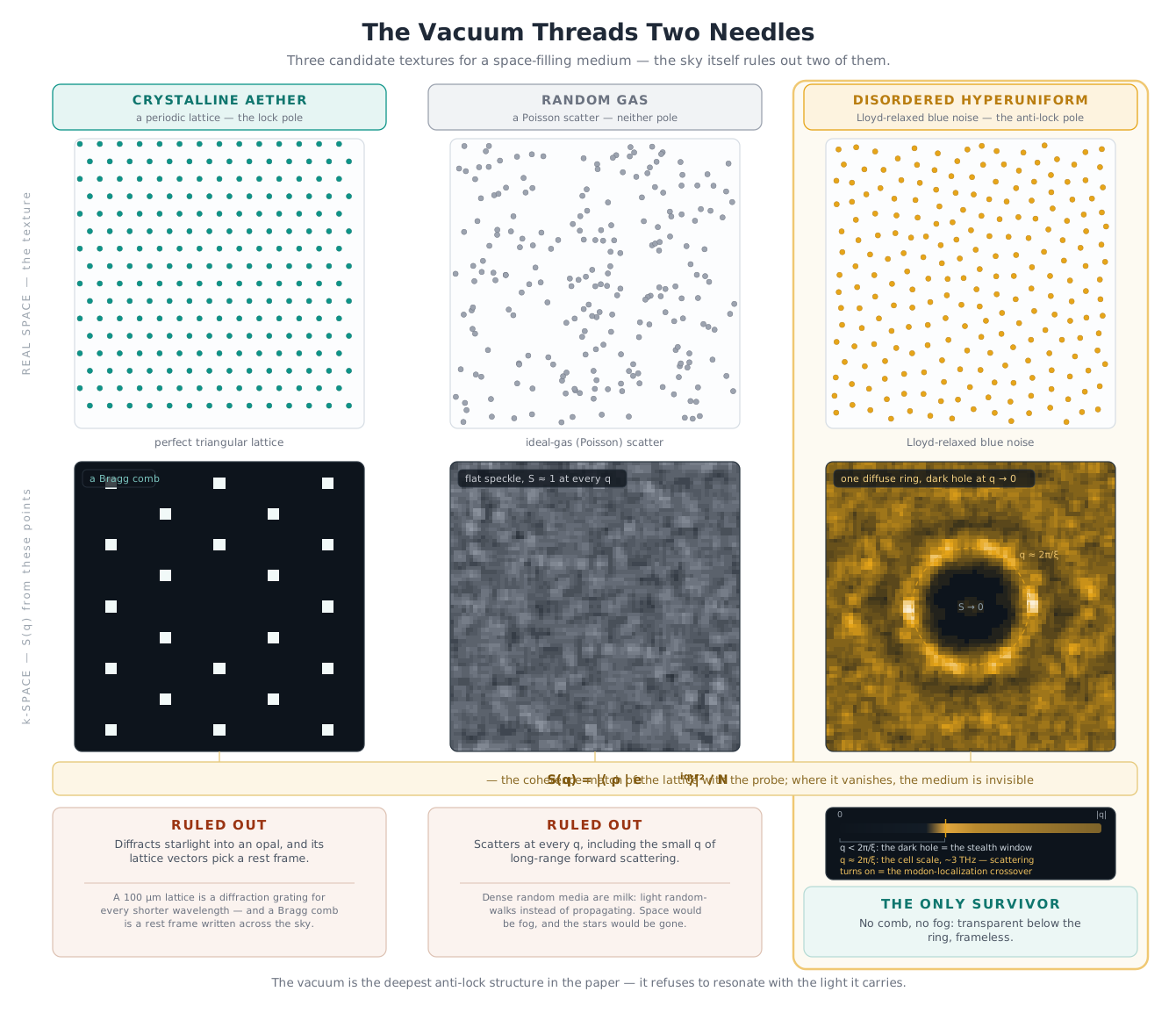
How are we supposed to believe that space is not only not empty, but it’s filled with a highly energetic superfluid, packed at the cosmological dark-matter density, woven into a lattice of cells about 100\;\mum across, every cell a vortex breathing in anti-phase against its partner, spinning at \approx 0.776\,c?
The substrate mimics a vacuum, but is nothing like one. If space is full, so energetic why can’t we see it? Why is the night sky not an opal, a fog, a shimmer — why does a medium this dense and this structured present, to every instrument we have, as nothing at all?
The Michelson–Morley chapter answers half of it. A superfluid’s excitations obey an emergent Lorentz invariance, so the speed of light comes back isotropic no matter how fast we move through the medium — the aether-wind experiment fails because it measures the acoustic metric with acoustic instruments. That settles why we cannot find a preferred frame in the timing.
It does not settle why we cannot find the medium in the scattering — why starlight crosses billions of light-years of this dense lattice without being dimmed, blurred, or split into diffraction orders. That second question has a separate sharper answer. The vacuum hides by the same anti-lock principle the retina uses to avoid aliasing — it is disordered hyperuniform, and a disordered hyperuniform medium does not scatter long-wavelength radiation. The substrate is the deepest and most fundamental member of the paper’s anti-lock roster, and the one where the job is not to keep two meanings apart but to keep the medium itself out of sight.
One quantity decides visibility
Whether a medium scatters when a wave hits it modeled but the structure factor S(\mathbf q), the spatial Fourier transform of how its density is arranged. For a medium of scatterers at positions \mathbf r_j,
S(\mathbf q) = \frac{1}{N}\left|\sum_j e^{-i\mathbf q\cdot\mathbf r_j}\right|^2 = \frac{1}{N}\,\bigl|\langle \rho \mid e^{i\mathbf q\cdot \mathbf r}\rangle\bigr|^2 , \tag{1}
where \mathbf q = \mathbf k_\text{out}-\mathbf k_\text{in} is the momentum the probe transfers to the medium in a single scattering event. To first (Born) order the scattered intensity is directly proportional to S(\mathbf q): a medium can only scatter a wave into a direction whose momentum transfer \mathbf q is a wavevector the medium’s density actually contains. Where S(\mathbf q)=0, that channel is dark — the medium is transparent to it, however dense it is.
Read Equation 1 again. The right-hand form is not decoration: S(\mathbf q) is the squared coherence-match — the overlap \langle\,\cdot\mid\cdot\,\rangle — between the substrate’s density field and the probe’s plane wave e^{i\mathbf q\cdot\mathbf r}. It is the very inner product the long-vector chapter shows is at the heart of cognition, used in the vacuum’s density against the radiation crossing it. The substrate is invisible to a probe exactly where its coherence-match with that probe vanishes in Equation 1. The whole question of why we cannot see the vacuum collapses to one question about its texture — for which \mathbf q is S(\mathbf q) zero? — and that question has only one acceptable answer.
The trilemma: two textures fail, one survives
A space-filling medium can arrange its density in essentially three ways, and the sky itself rules out two of them.
Crystalline — a periodic aether. If the cells sat on a perfect periodic lattice, S(\mathbf q) would be a Bragg comb: zero almost everywhere, but with sharp, intense spikes at the lattice’s reciprocal vectors. A 100\;\mum periodic lattice is a diffraction grating for any wavelength shorter than its spacing — it would split starlight into a forest of orders and paint the sky as an opal. Worse for the framework: a Bragg comb defines a set of lattice vectors, and lattice vectors define a rest frame. A crystalline aether would hand Michelson and Morley exactly the preferred frame they went looking for, in the diffraction pattern if not in the timing. Ruled out — and this is a sharper reason the classical aether fails than the timing argument alone.
Random — a particulate gas. If the cells were scattered at random (a Poisson gas), S(\mathbf q)\approx 1 at every \mathbf q, including the small-\mathbf q that governs long-range, forward, coherently-accumulating scattering. A dense random medium is milk; it is fog. Distant starlight would be scattered and extinguished. Ruled out.
Disordered hyperuniform — the survivor. There is exactly one texture that threads both needles: as uniform as a crystal on long wavelengths, yet as disordered as a gas on short ones. A disordered hyperuniform medium has its long-wavelength density fluctuations anomalously suppressed — S(\mathbf q)\to 0 as \mathbf q\to 0 (the Torquato–Stillinger hyperuniformity condition; Torquato & Stillinger 2003) — while carrying no Bragg comb at all. Its structure factor is a single diffuse ring at the wavevector of its characteristic spacing, wrapped around a dark hole at the origin. No comb means no diffraction grating and no rest-frame-revealing reciprocal lattice; the suppressed small-\mathbf q fluctuations mean no long-range scattering and no fog. It is the only way to fill space densely and still disappear.
This is the same trilemma the eye chapter already runs, in the same arithmetic, for the retinal cone mosaic: a triangular lattice folds incoming spatial frequencies into coherent Moiré ghosts (the opal); a Poisson scatter buries the image in noise (the fog); a disordered hyperuniform blue-noise packing — no Bragg comb, normalized number variance an order of magnitude below a random gas — scatters aliasing into incoherent noise instead of false pattern. The retina refuses the lattice for exactly the reason the vacuum must: a structure whose failure mode is unwanted resonance with the wave it handles flees to the anti-lock pole. The vacuum solves the retina’s problem at the scale of the universe — and it is the eye, the framework’s own instrument, that shows us the texture the vacuum wears.
The substrate is hyperuniform by construction, not by assumption
The crucial point is that nothing here is an added hypothesis. The framework already requires the surviving texture, for an entirely independent reason. The bridge equation’s \eta=1 factor rests on the lattice being a fiber bundle of straight parallel filaments in triangular (Tkachenko–Abrikosov) domains — locally crystalline, the only stable 2D vortex array — whose domain structure restores isotropy on long wavelengths while the texture stays locally organized. The eye chapter: shows that a critical, domain-structured superfluid is itself a disordered-yet-uniform medium - the hydrodynamic face of hyperuniformity. A medium that is crystalline inside each domain (no small-\mathbf q density noise) but disordered across domains (domain orientations and boundaries randomized, so no global Bragg comb survives) is the textbook construction of a disordered hyperuniform solid. The substrate is hyperuniform because it is a domain glass of triangular vortex crystallites — and it had to be a domain glass of triangular crystallites to be isotropic enough to emit light at one speed in every direction. Stealth and isotropy are the same fact about the texture, read twice.
There is a second, independent route to the same S(\mathbf q\to0)\to0, and it comes from the pairing rather than the domains. Every cell breathes in anti-phase against its partner — an alternating, checkerboard arrangement of the substrate’s leak. Anti-phase cancellation removes precisely the long-wavelength (small-\mathbf q) weight of that leak, the dipole term, and leaves only the higher multipole at the cell scale. In Fourier language that is S(\mathbf q\to0)\to0 with the surviving weight pushed up to the ring at q\approx2\pi/\xi: the anti-phase breath and the domain glass are two faces of one hyperuniformity, one reaching it from cancellation and one from geometry. The Magnetism chapter shows the cancellation measured on a benchtop anti-phase magnet array — the collective leak self-screening to \sim1\% within a single lattice constant, the quadrupole–quadrupole falloff of a source whose dipole has been arranged away. That measured self-screening is the multipole-space shadow of the diffuse ring computed here.
The cancellation is never quite perfect, and where the residual goes is the whole reason the lattice is so hard to find. Each cell is an anti-phase pair wrapped in one \xi-wide envelope; the envelopes tile on the triangular array, and the sliver the breath can’t cancel — the surviving quadrupole — is bottled in the gaps between them. Those gaps are not scattered voids: they form a single connected honeycomb of hollows, the lattice dual to the triangular array, one hollow between each trio of cells. The residual threads that honeycomb and self-screens to \sim1\% within one cell, so a probe standing even one \xi away sees nothing — the leak is real, but it never reaches. This is the same fact as S(\mathbf q\to0)\to0, read in real space instead of Fourier: killing the dipole removes the long-range (small-\mathbf q) weight and leaves only the quadrupole at the cell scale, the ring at q\approx2\pi/\xi. It is why a medium packed at the dark-matter density presents as a perfectly fluid soft boundary — the substrate hides in the seams of its own fabric.

The soft boundary — the honeycomb between the cells. Left: the cells tile on a triangular array, each an anti-phase pair (+\omega over -\omega) wrapped in one \xi\approx100\;\mum envelope; the cores vary in size from cell to cell while the envelopes stay identical — varying-energy modons sharing one wake, the boat-in-the-harbor scale separation of the emergent-c chapter. The gaps between each trio of envelopes form a honeycomb of hollows, dual to the array. Centre: a zoom into one hollow — the anti-phase breath cancels the dipole (the long-range, small-\mathbf q leak); what can’t cancel is the quadrupole, bottled in the gap between the trio, a perfectly fluid soft boundary that is nearly, but never quite, closed. Right: why it hides — the anti-phase quadrupole leak self-screens to \sim1\% within one lattice constant (e^{-4.44}; Magnetism § anti-phase self-screening), while an aligned dipole would reach macroscopically. Removing the dipole is S(\mathbf
q\to0)\to0, the surviving weight pushed to the single diffuse ring at q\approx2\pi/\xi — the stealth vacuum, read from its seams. Generated by scripts/gen_soft_boundary_svg.py.
Stealth transparency is established physics
That a dense disordered hyperuniform medium can be transparent is not a conjecture of this paper; it is a known and somewhat celebrated result in photonics. Leseur, Pierrat & Carminati (2016) proved that stealthy hyperuniform materials — those with S(\mathbf q)=0 on a finite window 0<|\mathbf q|<K — are transparent to radiation whose every scattering channel falls inside that window, at arbitrarily high density, precisely because single scattering is forbidden where S(\mathbf q)=0. Florescu, Torquato & Steinhardt (2009) and Man et al. (2013) showed the same disordered-yet-uniform texture opens complete, isotropic photonic band gaps — an order normally thought to require a crystal, achieved here without a crystal’s preferred directions. The substrate is the cosmic-scale instance of exactly these materials.
And the regime where the rigorous stealth argument bites is the regime the framework has already singled out. Transparency in the strict sense holds when all momentum transfers lie inside the stealth window — |\mathbf q|\lesssim 2\pi/\xi, i.e. wavelengths \lambda\gtrsim\xi\approx 100\;\mum. That is exactly the collective-modon regime: the bridge paper already argues that light below the \sim 13\;\text{meV}, \sim 3\;\text{THz} threshold — radio, microwave, the CMB — propagates not as a single localized dipole but as a delocalized, coherent, many-cell collective mode spanning \lambda\gg\xi. The light that the framework says rides across many cells at once is precisely the light the lattice is rigorously stealthy to. Two independent results — the modon’s existence condition and stealthy hyperuniform transparency — name the same band as the one the substrate carries losslessly.
The stealth edge is the modon crossover
A stealth window has an edge, at the ring: |\mathbf q|\sim 2\pi/\xi, where the dark hole gives way to the diffuse halo and scattering finally turns on. In substrate units that edge sits at the cell scale — \lambda\sim\xi\approx 100\;\mum, \nu\sim c/\xi \approx 3\;\text{THz}, energy \sim 13\;\text{meV}. This is the same crossover the bridge paper derives from a completely different argument: E_\text{min}=hc/\xi=2\pi m_1c^2\approx 13\;\text{meV} is the energy at which a modon’s counter-rotating dipole no longer fits inside one cell and the excitation must either localize or go collective. One number, reached two ways — the wavelength at which a modon stops fitting in a cell is the wavelength at which the lattice stops being stealthy. They must coincide, because both are the statement that \xi is the only length the lattice owns; that they do is an internal consistency check the framework did not put in by hand, and it sharpens the observational target. The signature of the substrate, if it is ever resolved, is not a sudden wall in the spectrum but a change in scattering structure near a few terahertz: the onset of a single diffuse ring at the cell scale.
Lock and anti-lock are two faces of one overlap
The picture closes on the framework’s own central operation. The structure factor Equation 1 is a coherence-match, and the vacuum runs it at both poles of the substrate ladder at once:
- On the lock pole, the lattice’s teeth are tuned to the modon — the photon rides the substrate’s circulation gradient at exactly c, handing energy across counter-rotating seams without loss, a maximal coherence-match between the carried signal and the channel. This is how the vacuum transmits.
- On the anti-lock pole, the lattice’s density is arranged so that its coherence-match with any probing plane wave vanishes over the stealth window, S(\mathbf q)\to 0. This is how the vacuum hides.
The same inner product, driven to +1 for the light it carries and to 0 for the light that would reveal it. “Hidden by coherence-match” is the anti-lock face; “propagates at c without loss” is the lock face; they are one operation read in two directions, the sign rule the paper carries throughout — name the job and the pole is fixed before any measurement. Name the vacuum’s job: carry signals without scattering them off your own texture. The pole follows immediately — anti-lock, S(\mathbf q)\to 0 — and it places the vacuum on the roster the framework has been assembling across chemistry-free domains: the cone mosaic spreading cones so images cannot alias, the genetic code spreading codons so a slip cannot change a protein, a phoneme inventory spread so a slipped sound cannot change a word, a transformer’s features spread so concepts cannot interfere — and now the vacuum itself, spread so the medium cannot scatter the radiation that probes it. It is the first and deepest of them, the one where the colliding pair is not two meanings but the signal and its own substrate.
Michelson–Morley, completed
This gives the null result its missing half. The existing chapter explains why the speed is frame-independent: the acoustic metric is Lorentz-invariant. Hyperuniformity explains why there is no static structure to betray a frame: a crystalline aether would carry a Bragg comb whose reciprocal vectors single out a rest frame and diffract starlight into orders; a hyperuniform vacuum carries no comb, so there is no diffraction pattern to orient, no grating to clock against the Earth’s motion, and no extinction to integrate over a line of sight. Michelson and Morley tested two independent things at once — that the medium has no preferred timing and no preferred structure — and a domain-glass superfluid passes both: Lorentz-invariant in its excitations, hyperuniform in its texture. The aether failed not because space is empty but because the medium that fills it is built, at both the dynamical and the structural level, to be unobservable.
Honest accounting
Established, and used here as such. That scattered intensity tracks S(\mathbf q) to first order is standard; that stealthy hyperuniform media are transparent at finite density (Leseur, Pierrat & Carminati 2016) and open isotropic photonic band gaps (Florescu, Torquato & Steinhardt 2009; Man et al. 2013) is established photonics; that a domain-structured triangular vortex array is locally crystalline and globally disordered-yet-uniform is the framework’s own \eta=1 commitment. The synthesis — the substrate hides because that texture is stealthy — follows from pieces already in the paper.
Computed (2026-06-11). The substrate analog of measuring the cone mosaic’s structure factor has now been run, lifting the scripts/cone_mosaic.py number-variance instrument from the plane to the 3D lattice (scripts/stealth_structure_factor.py, sessions/stealth-structure-factor-1.md). The framework’s literal texture — a domain glass of randomly-oriented triangular Abrikosov crystallites — comes out disordered hyperuniform: the long-wavelength fluctuations are crushed (S(\mathbf q\to0)=0.28 against a gas’s 0.99, normalized number variance 0.44 against 0.97, both \sim2\times below the Poisson floor), and the structure factor is a single diffuse powder ring at |\mathbf q|=1.12\,q_0 — exactly the cell scale 2\pi/\xi — carrying no Bragg comb (the randomly-oriented domains turn the single crystal’s sharp spots, directional contrast S_\text{max}/S_\text{mean}\approx1560, into an isotropic Debye–Scherrer ring of contrast \approx14, so no reciprocal lattice and no preferred frame survive). The result is seed-robust, and the ring’s inner edge |\mathbf q|\simeq
2\pi/\xi coincides with the modon crossover E_\text{min}=2\pi m_1c^2 — the trilemma’s surviving texture, computed. And it reaches the stealthy (hard S=0 window) limit, not just class III: a polycrystal’s small-q fluctuations live on its grain boundaries (S(\mathbf q\to0)\sim1/D for grains of size D), so growing the crystallites drives the stealth-window S(\mathbf q\to0) down monotonically and a fit S=S_\infty+c/D extrapolates to S_\infty\approx0.01 — statistically zero against the gas’s \approx1 (scripts/stealth_limit.py, sessions/stealth-structure-factor-1.md §4). The not-yet-stealthy reading of the small box — small-q power suppressed but no hard S=0 window — was a finite-grain artifact; the well-relaxed, large-grain texture the physical substrate occupies (\xi\sim100\,\mum cells, domains spanning many cells) is genuinely stealthy. So “the vacuum is hyperuniform” is now a computation reaching the stealthy limit.
And the shape of that suppression — the hyperuniformity class, S(\mathbf q)\sim|\mathbf q|^\alpha as \mathbf q\to0 — is now measured from scratch as well (scripts/stealth_class_exponent.py), the last piece the WIP-22 caution attached to. Two independent estimators on the isotropic-cell domain glass — a direct ensemble-averaged S(\mathbf q) fit below the ring, and the window-free number-variance exponent \sigma^2(R)\sim R^p read as \alpha=3-p — agree that the as-constructed texture is class III with \alpha\approx0.5 (\alpha=0.51\pm0.06 direct, 3-p\approx0.55), against a Poisson-gas null both routes read as \alpha\approx0; seed-robust. Exponent and amplitude are one suppression seen twice: the unrelaxed glass climbs out of \mathbf q=0 as a sub-linear power (\alpha<1, class III), and growing the crystallites (the stealthy limit, just above) flattens that climb’s amplitude into the hard S=0 window of a stealthy medium.
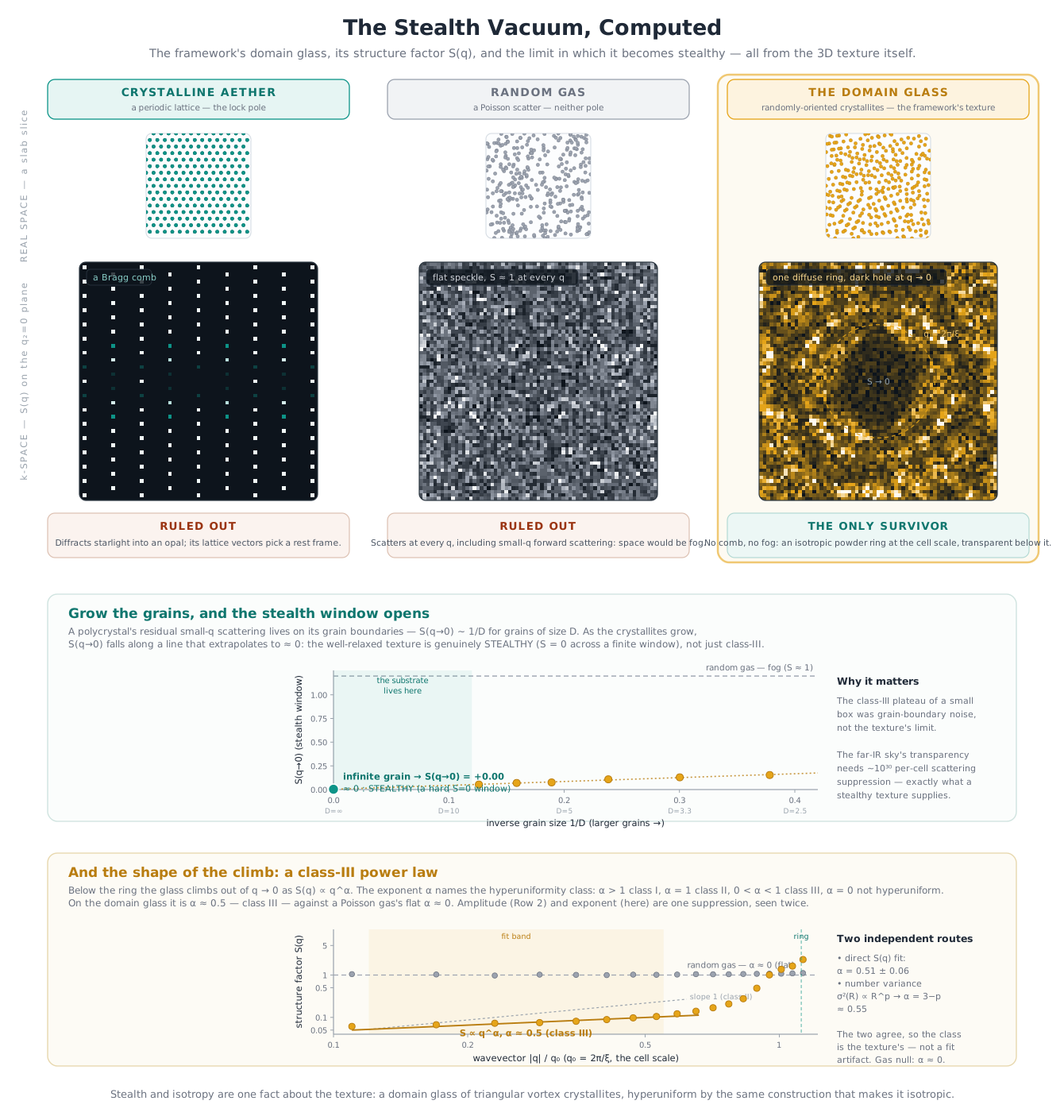
The stealth vacuum, computed (the conceptual trilemma above, now from the 3D texture itself). Top: three candidate space-filling textures, each as a real-space slab slice and its computed structure factor S(\mathbf q) on the q_z=0 plane. A crystalline aether gives a sharp Bragg comb (S_\text{max}\approx3600) — an opal, and a rest frame; a random gas gives flat speckle (S(\mathbf q\to0)\approx1.2) — fog; the framework’s domain glass gives a single diffuse ring around a dark S\!\to\!0 hole at the cell scale |\mathbf q|\approx2\pi/\xi — the only survivor. Middle: the stealthy limit (the small-q amplitude) — growing the crystallites drives the stealth-window S(\mathbf q\to0) down along S=S_\infty+c/D, extrapolating to S_\infty\approx0 (a hard S=0 window) far below the random-gas level, with the physical \xi-cell substrate sitting at the large-grain end. Bottom: the class exponent (the small-q shape) — a log-log plot of the ensemble-averaged S(\mathbf q) shows the domain glass climbing out of the origin as S\propto|\mathbf q|^\alpha with \alpha\approx0.5 (class III, shallower than the slope-1 class-II reference), against a Poisson gas’s flat \alpha\approx0; an independent number-variance route (\sigma^2(R)\propto R^p, \alpha=3-p\approx0.55) agrees, fixing the class. Generated by scripts/gen_stealth_3d_svg.py from the same machinery as scripts/stealth_structure_factor.py, scripts/stealth_limit.py, and scripts/stealth_class_exponent.py.
A vortex glass you can actually measure
The S(\mathbf q) above is computed on a synthetic domain glass. There is a real one, already photographed, waiting to be checked against it. Scanning-SQUID microscopy of a YBa₂Cu₃O₇₋ₓ film (Wells et al. 2015) resolves an isotropic vortex glass in the electron condensate: six nearest neighbours typical, but hexatic order parameter |\psi_6|^2\sim10^{-3} — no long-range orientational order, only a faint short-range positional ring in the autocorrelation. That is the same diagnostic suite — autocorrelation, Delaunay triangulation, \psi_6 — the framework’s own texture is scored with, run here on a genuine superfluid vortex array: a matter-condensate mirror of the substrate’s texture, the charged cousin of helium (Superfluid Helium § A Second Mirror).
The concrete, cheap test: the published vortex coordinates can be digitized and their structure factor computed directly. If S(\mathbf q\to0)\to0 — a suppressed small-\mathbf q hole around a single diffuse ring — the electron-condensate glass is disordered hyperuniform, landing in the same class the substrate computation predicts (class III, \alpha\approx0.5). If instead S(\mathbf q\to0) is flat and O(1), the pinning-dominated glass is not hyperuniform and the correspondence is morphological only. Either outcome is informative, and neither costs a new experiment — only a re-analysis of data that already exists. The one thing the images do not supply is a scale: the vortex spacing is a=1.075\sqrt{\Phi_0/B}, fixed by the applied field, so its proximity to \xi at Wells’s shielded \muT fields is a coincidence of the field, not a reading of the cell.
Where the argument stops. The strict stealth-transparency theorem covers long wavelengths, \lambda\gtrsim\xi — the collective-modon band. It does not by itself explain the transparency of short-wavelength light (\lambda\ll\xi: visible, IR, X-ray), whose momentum transfers run far above the stealth edge. There, hyperuniformity earns only the negative result that matters most — no Bragg comb, so no opal — while the positive account of short-wavelength transparency belongs to the existing crystal-optics mechanism: light couples elastically to off-resonant atomic boundaries, accumulating phase (the refractive index) without loss. The two mechanisms partition the spectrum cleanly at \xi, and saying so is part of keeping the claim honest.
What would falsify it
The reading makes a concrete, signed prediction about the one regime where the substrate could ever show itself.
The vacuum’s scattering response near the cell scale (\sim 100\;\mum, \sim 3 THz) should carry the disordered-hyperuniform signature — a single diffuse ring at |\mathbf q|\simeq 2\pi/\xi around a dark S(\mathbf q)\to 0 hole — and nothing at all below it. Concretely: (i) long-wavelength radiation (\lambda\gg\xi — radio, microwave, CMB) should propagate with no substrate-induced scattering, the stealth window; (ii) any onset of anomalous scattering or dispersion should appear at the few-terahertz cell scale and coincide with the modon-localization crossover, not at some unrelated energy; and (iii) the texture must be neither a Bragg comb (a periodic aether — which would also resurrect a preferred frame and break Michelson–Morley) nor flat white speckle (a random medium — which would fog the sky), but the single ring between them.
refit of the CHIME/FRB catalog bounds any substrate-induced dispersion of sub-floor light at \varepsilon < 6.5\times10^{-16}: long-wavelength radiation propagates with no anomalous frequency-dependent speed — the timing complement of the stealth window (i), which forbids the spatial cousin, scattering — and COBE/FIRAS confirms the modon→phonon crossing leaves the CMB blackbody unscarred to 50 ppm. Below the floor, light is a delocalized winding whose deviation from c is not power-law but exponential, \exp(-\nu_\text{floor}/\nu), with no \nu^2 term at all and a turn-on confined to 0.1–3 THz: precisely “at the cell scale, and nothing below it,” reached independently from the dispersion side (Photon as Modon § What Carries Light Below the Floor). The falsifiers that fire on timing — long-wavelength light dispersing off the vacuum, or an onset at an energy unrelated to \xi — have now been run, and the reading passed.
The structural axis shape — now with numbers, and a far-IR onset. The single diffuse ring (iii) is a spatial scattering signature, the substrate’s structure factor S(\mathbf q), which neither FRB nor FIRAS touches. The explicit computation owed for it has now been run (see the honest accounting): the domain glass does show S(\mathbf q\to0)\to0, one ring at the cell scale, and no comb. Feeding that S(\mathbf q) into a Born scattering integral (scripts/stealth_farir_opacity.py) turns the ring into a vacuum far-infrared opacity whose onset is pinned to \xi: single scattering off the ring needs \lambda\le2\xi, so the vacuum is transparent for \lambda>2\xi\approx200\,\mum (\nu<1.5 THz, the stealth window) and the onset is the cell scale and nothing else, rising to the ring at \lambda=\xi (\nu\approx3 THz). The observed transparency of the far-IR/submm universe to z\sim4–6 (Herschel, ALMA) matches the stealth window with no free parameter and bounds the per-cell cross-section below \sim10^{-31}\xi^2; a random gas would instead be opaque by \sim30 orders, so the sky’s far-IR transparency itself demands the hyperuniform suppression — the “fog” verdict, read from the sky. If the vacuum is found to diffract a comb, or to fog as a random medium, the stealth reading is wrong. And the exponential turn-on is itself now a separately falsifiable claim: a long-baseline propagation measurement anywhere in 0.1–3 THz that found a smoothly growing \nu^2 advance instead of the exponential rise would sink the topologically-protected reading in favor of the collective-branch one. It is the same bet the cone mosaic makes about the retina — one ring, no comb, no speckle — placed now on the vacuum itself; the timing half has been decided, and the structural half awaits the same instrument.
The substrate is not hidden because it is thin. It is hidden because it is arranged — a domain glass of triangular vortex crystallites, hyperuniform by the same construction that makes it isotropic, stealthy by the same anti-lock principle that lets the retina see without aliasing and the code mutate without breaking. It carries every signal we send through it at exactly c, and it returns nothing of itself, because the one operation it runs — the coherence-match \langle\rho\mid e^{i\mathbf q\cdot\mathbf r}\rangle — it drives to one for the light and to zero for the look.