Uranium in the Substrate
Past the crest — how one ratio sets both the peak of the binding curve and the cliff it falls off; why a nucleus sheds the one unit it made in advance; why every fissile nuclide is odd; why fourteen elements in a row are chemically the same element; why the innermost boundary of a heavy atom runs at two-thirds of the substrate’s own speed; and why the table ends twice
Past the crest
Four chapters have read the periodic table as an accounting problem, and the iron chapter closed them on a coincidence. Two unrelated ledgers — a nuclear one that peaks where surface-seam tension loses to co-rotating repulsion, and an electronic one that peaks where five lobes fill singly before they pair — happen to place their crests on the same element. Iron is what the substrate leaves on the beach in bulk, and it is one step off the cheapest two-state register in chemistry.
That chapter said what iron is. It did not say what the crest is a crest of, and the way to find out is to walk off it.
Above iron, both ledgers turn, and they turn for reasons that have nothing to do with each other. The nuclear ledger turns because a drop that keeps growing accumulates repulsion faster than it accumulates surface. The electronic ledger turns because a register buried deeply enough stops being chemistry at all. The first produces radioactivity; the second produces fourteen elements in a row that no chemist could separate for a century and a half. Neither knows about the other, and they run out within a few rows of each other, which is why the periodic table has an end rather than a taper.
Start with the nuclear one, because the framework already owns it and has never spent it.
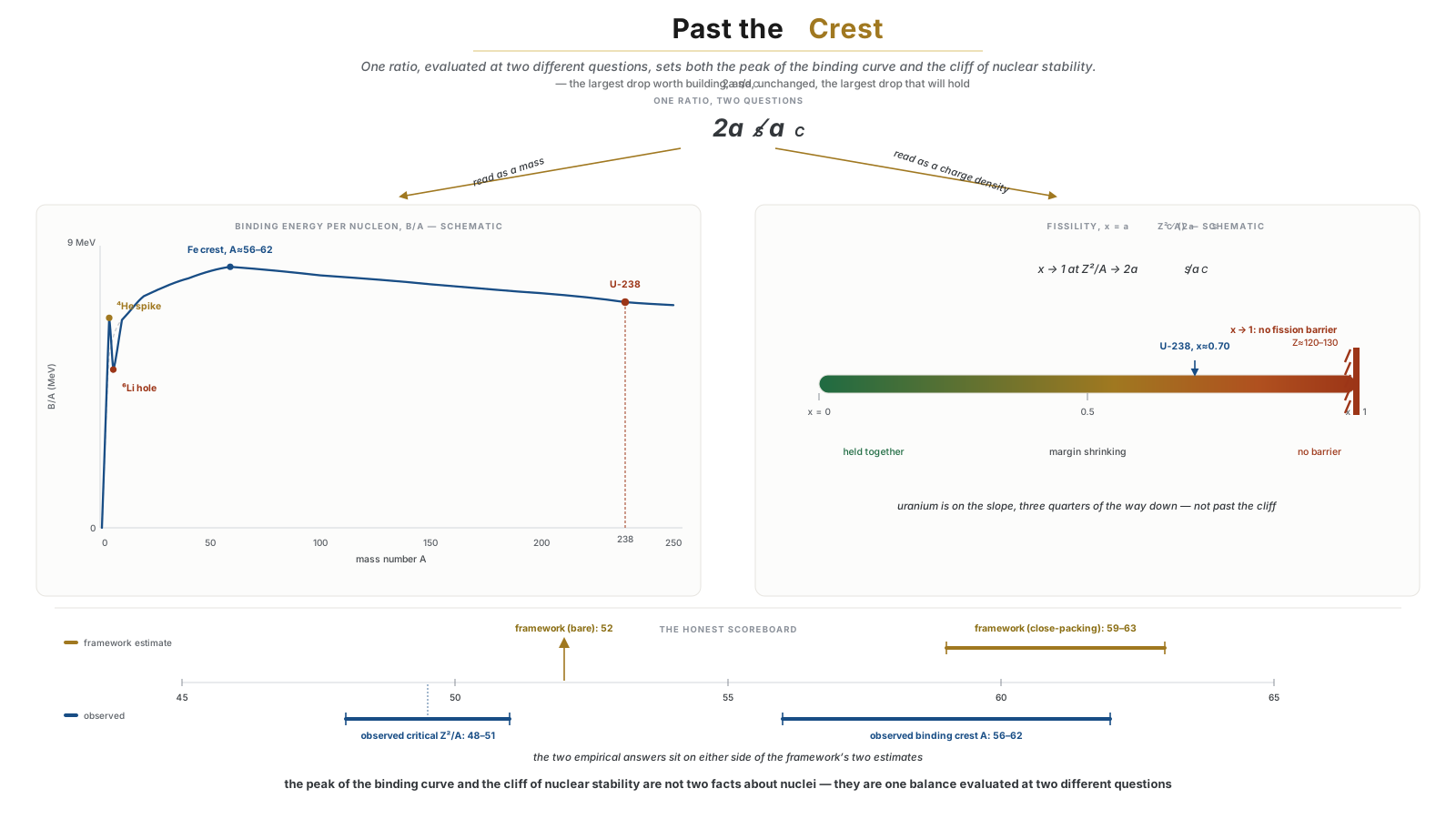
Proton core derives the crest of the binding curve as the point where the surface term stops paying against the Coulomb term:
A_\text{peak} \approx \frac{2a_S}{a_C},
and then notes, almost in passing, that the same ratio is Myers–Świątecki’s fissility parameter — the criterion for whether a nucleus comes apart on its own:
x = \frac{a_C Z^2 A^{-1/3}}{2\,a_S A^{2/3}} = \frac{a_C Z^2}{2\,a_S A}, \qquad x \to 1 \;\text{ at }\; \frac{Z^2}{A} \to \frac{2a_S}{a_C}.
One number, two thresholds. Read as a mass, 2a_S/a_C is the largest drop worth building. Read as a charge density, the same quantity is the largest drop that will hold. The peak of the binding curve and the cliff of nuclear stability are not two facts about nuclei; they are one balance evaluated at two different questions.
The empirical values bracket the framework’s own. With bare Myers–Świątecki coefficients, 2a_S/a_C = 2(18.56)/0.717 \approx 52 — which undershoots the observed binding crest at A \approx 56–62 and lands almost exactly on the observed critical charge density (Z^2/A)_\text{crit} \approx 48–51. With the framework’s close-packing geometric ratio a_S/a_V \approx 1.36, the same expression gives 59–63 — which nails the binding crest and overshoots the fission threshold. The two empirical answers sit on either side of the framework’s two estimates.
The liquid-drop model, the fissility parameter and their relationship are standard and eighty years old; the framework improves on none of them numerically and still cannot compute the absolute seam energy \epsilon that sets a_S and a_V separately. What is being claimed is the identification: that the crest and the cliff are the same competition, that the framework derives a_C from its own \alpha and fixes a_S/a_V from close-packing with no free parameters, and that the resulting single ratio has to land in the fifties — which it does, from both directions, bracketing both observed thresholds. The honest scoreboard is that the two estimates (52 and 59–63) do not agree with each other to better than 20\%, and the reason is known: the peak formula drops the asymmetry term while the fissility parameter carries Z^2 explicitly for nuclei with Z < A/2. Getting one number to serve both thresholds quantitatively is a live piece of work, not a completed one.
Uranium sits at Z^2/A = 92^2/238 = 35.6, so x \approx 0.70. It is not past the cliff. It is on the slope, three-quarters of the way down, held together by a margin that has been shrinking since element 26 — and everything uranium does is that margin running out slowly enough to watch.
The one unit already made
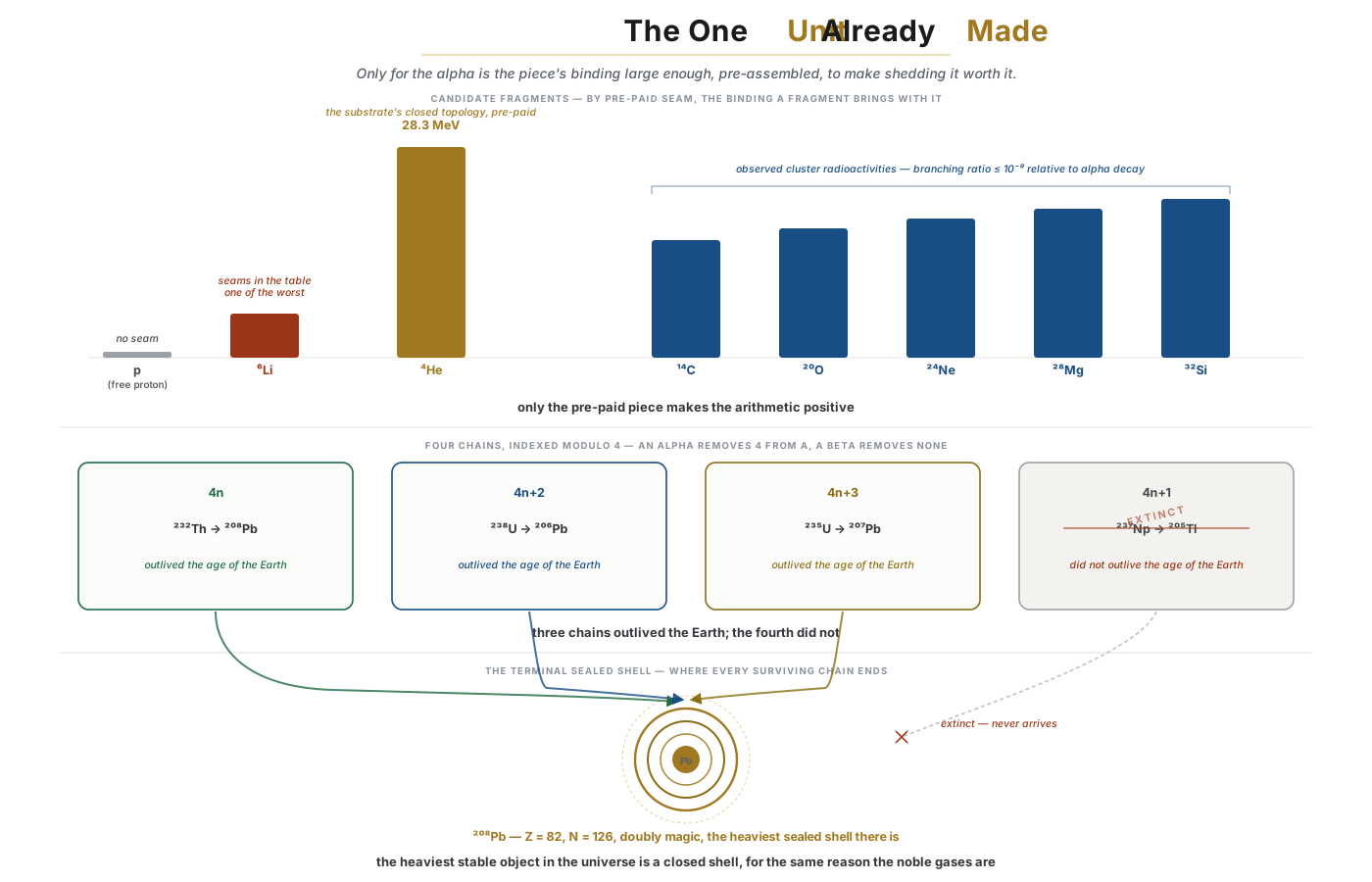
A nucleus past the crest is losing energy by existing, and the striking thing is not that it comes apart but what it emits. It does not shed a proton. It does not shed a neutron. It does not shed a lithium. Above A \approx 150 and all the way to the end of the table, the overwhelmingly dominant spontaneous emission is an alpha particle, and the framework has a one-line reason for it that it established two chapters ago in another context.
Helium-4 is the substrate’s closed topology — two nucleon pairs maximally anti-phase-coherent, the doubly-magic limit of the pairing term, sitting several MeV above the smooth liquid-drop value. It is the only small cluster whose seam is already paid for. When a heavy drop asks whether shedding a piece is worth it, the arithmetic is the piece’s binding minus the parent’s loss, and only for the alpha is the piece’s binding large enough, pre-assembled, to make the difference positive. A free proton has no seam to bring. A ⁶Li has one of the worst seams in the table — the lithium chapter spent a section on exactly how bad. The alpha brings 28.3 MeV of already-closed boundary with it, and that is the entire reason the heavy end of the periodic table decays the way it does.
Three consequences follow immediately, and all three are observed.
Alpha emission begins far below the actinides. If the alpha’s pre-paid seam is what makes the move allowed, then the move becomes allowed as soon as the parent’s binding-per-nucleon has fallen far enough — which happens around A \approx 145, not at uranium. And it does: ¹⁴⁴Nd (t_{1/2} = 2.3\times10^{15} yr) and ¹⁴⁷Sm (1.1\times10^{11} yr) are alpha emitters sitting quietly in the middle of the lanthanides, in every neodymium magnet and every samarium ore. Even ²⁰⁹Bi, the nuclide that was in every textbook as the heaviest stable one, was found in 2003 to be alpha-active with t_{1/2} = 2.01\times10^{19} yr. There is no stable element above lead. The table’s stable region ends at Z = 82, and it took a century of looking to notice, because the barrier is thick enough to hide the fact for a billion times the age of the universe.
Decay chains are indexed modulo four. An alpha removes exactly four from A and a beta removes none, so a decay chain can never change A \bmod 4. There are therefore exactly four chains, and the three whose progenitors outlived the Earth all terminate on lead: 4n (²³²Th → ²⁰⁸Pb), 4n+2 (²³⁸U → ²⁰⁶Pb), 4n+3 (²³⁵U → ²⁰⁷Pb). The fourth, 4n+1 (²³⁷Np → ²⁰⁵Tl), is extinct. That the entire heavy end of the periodic table drains through four disjoint channels is a direct fingerprint of the emitted unit being a single fixed closed topology, and nothing else.
And they drain to the last complete shell closure. ²⁰⁸Pb is doubly magic — Z = 82, N = 126 — the heaviest such nucleus there is. The framework reads magic numbers as boundary-shell closures, the same alternating co-/counter-rotating filling that conductors uses for electron shells, one structural tier down. So the picture the four chains draw is exact: everything above the last sealed boundary in the nuclear table runs downhill until it reaches it, and stops. The heaviest stable object in the universe is a closed shell, for the same reason the noble gases are.
The barrier is a clock
The alpha’s pre-paid seam says whether. What says when is the barrier it has to cross, and this is where the heavy end contributes something the paper’s other chapters have not.
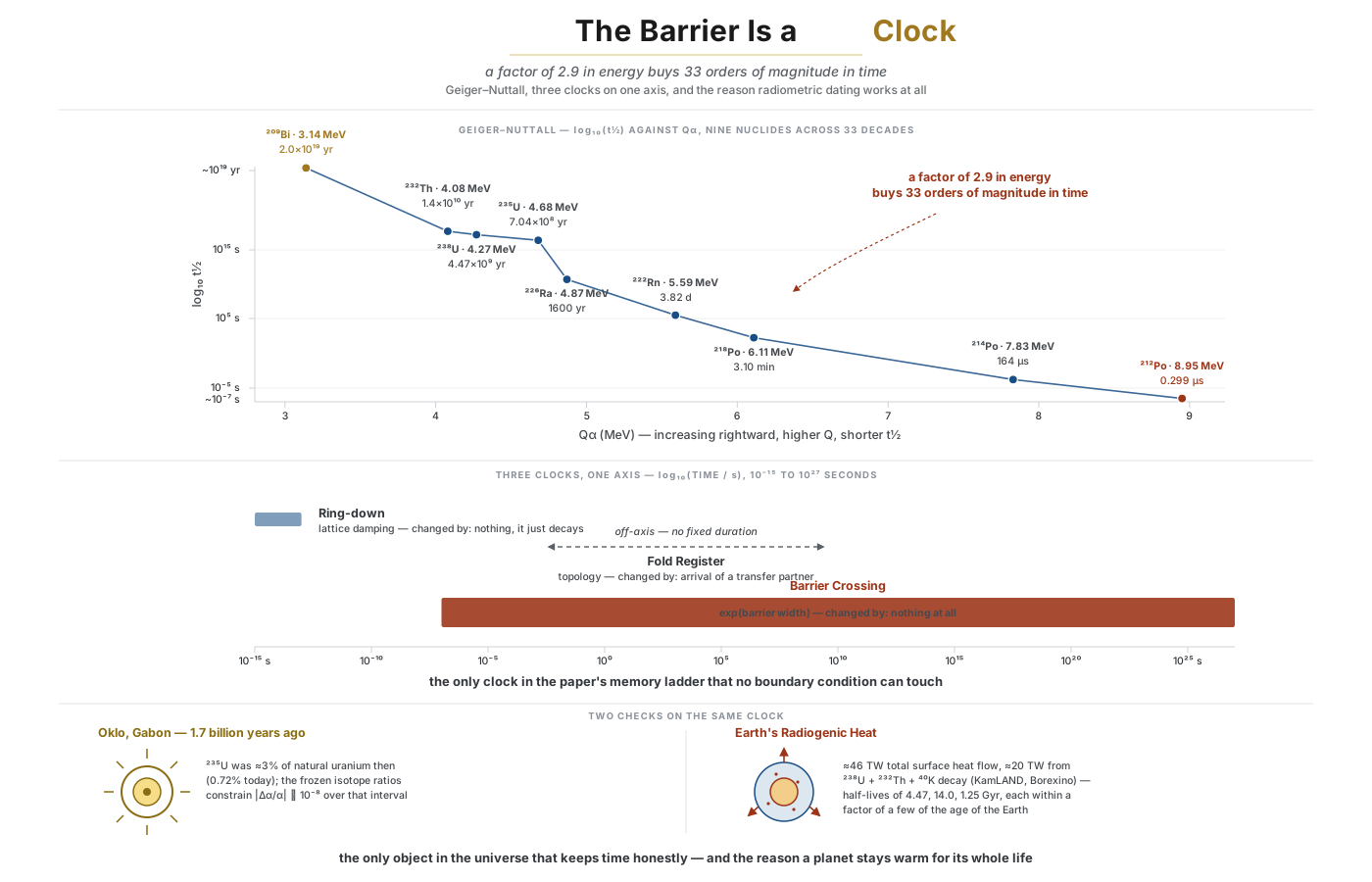
Alpha decay half-lives run from microseconds to 10^{19} years, and they are set by a single relation — Geiger–Nuttall, \log_{10} t_{1/2} linear in Q^{-1/2} — over a span that has no parallel anywhere else in physics.
| Nuclide | Q_\alpha (MeV) | t_{1/2} |
|---|---|---|
| ²⁰⁹Bi | 3.14 | 2.0\times10^{19} yr |
| ²³²Th | 4.08 | 1.4\times10^{10} yr |
| ²³⁸U | 4.27 | 4.47\times10^{9} yr |
| ²³⁵U | 4.68 | 7.04\times10^{8} yr |
| ²²⁶Ra | 4.87 | 1600 yr |
| ²²²Rn | 5.59 | 3.82 d |
| ²¹⁸Po | 6.11 | 3.10 min |
| ²¹⁴Po | 7.83 | 164 µs |
| ²¹²Po | 8.95 | 0.299 µs |
A factor of 2.9 in the energy buys 33 orders of magnitude in the time. That extreme leverage is the signature of an exponential in a barrier, and it is the whole reason the heavy end of the table is usable: a decay process whose rate depended linearly on anything would either all be gone or all be inert. Only an exponential can produce a population where some members last ten billion years and their own daughters last microseconds.
Now put that beside the two clocks the paper already has.
Channel with memory builds a ladder of ring-down times — copper’s Drude \tau \approx 25 fs, quartz’s polariton at 10^1–10^2 fs, DNA’s aromatic stack at \gtrsim 10 fs — every one of them an excited boundary decaying back toward smooth. The iron chapter added a second kind that is not on that ladder at all: the fold register, a topological setting with no ring-down time to quote, which changes only when a partner arrives to take a lobe.
Nuclear decay is a third kind, and it is neither.
| Clock | What sets it | Range | Changed by |
|---|---|---|---|
| Ring-down | lattice damping | 10^{-15}–10^{-13} s | nothing; it just decays |
| Fold register | topology | indefinite | arrival of a transfer partner |
| Barrier crossing | \exp(barrier width) | 10^{-7}–10^{27} s | nothing at all |
The third column is the one that matters. A ring-down time can be lengthened by cooling the lattice; a fold register can be flipped by presenting a ligand. A barrier clock responds to neither. Uranium’s half-life is the same in a star, in a crystal, in a chemical compound, at any temperature or pressure a laboratory can produce, in any oxidation state, bonded to anything. It is the only quantity in the paper’s entire memory ladder that no boundary condition can touch, and the reason is that the barrier is internal to the seam — the co-rotating repulsion the alpha must cross is inside the drop, screened from everything outside it by the drop itself.
Which is why radiometric dating exists and why nothing else does. Every other clock in nature is a rate that depends on its environment, so reading it backwards requires knowing the environment’s history. A barrier clock requires knowing nothing. The heavy end of the periodic table is the only object in the universe that keeps time honestly, and the geology section of this paper — reading the rocks, crustal lattice, the whole stratigraphic argument — rests on it silently throughout.
The check on that independence is itself a substrate result. The Oklo natural fission reactors in Gabon ran about 1.7 billion years ago, when ²³⁵U was still \approx 3\% of natural uranium rather than today’s 0.72\%, and the isotope ratios frozen into the ore constrain any drift in the fine-structure constant to roughly \lvert\Delta\alpha/\alpha\rvert \lesssim 10^{-8} over that interval. The framework derives \alpha from boundary geometry, so it is committed to \alpha being a property of the substrate’s structure rather than a running parameter, and Oklo is the tightest terrestrial measurement saying it has not moved. A natural reactor that ran before multicellular life is the framework’s own constant being checked against itself across a third of the age of the Earth.
And the clocks are why the planet is warm. Earth’s surface heat flow is \approx 46 TW, of which geoneutrino measurements at KamLAND and Borexino attribute \approx 20 TW to the decay of ²³⁸U, ²³²Th and ⁴⁰K. Those three nuclides have half-lives of 4.47, 14.0 and 1.25 billion years — all within a factor of a few of the age of the Earth, which is not a coincidence but a selection effect with teeth. Anything much shorter decayed away before the crust formed; anything much longer delivers negligible power. The only nuclides that can heat a planet for its whole lifetime are the ones whose barrier clock is tuned to that lifetime, and the mantle convection that the geology chapters treat as the planetary canonical loop is running on roughly half radiogenic power. Plate tectonics is, in a real accounting sense, the alpha barrier being crossed slowly.
The breath decides which nuclei come apart
The framework reads the pairing term as the lattice’s breath: like nucleons pair by locking their boundary breathing anti-phase into a shared counter-rotating seam, the same mechanism as a Cooper pair one tier up. That reading has so far bought the odd–even mass staggering and the magic-number bonus, both of which are standard. The heavy end is where it buys something nobody files under pairing at all.
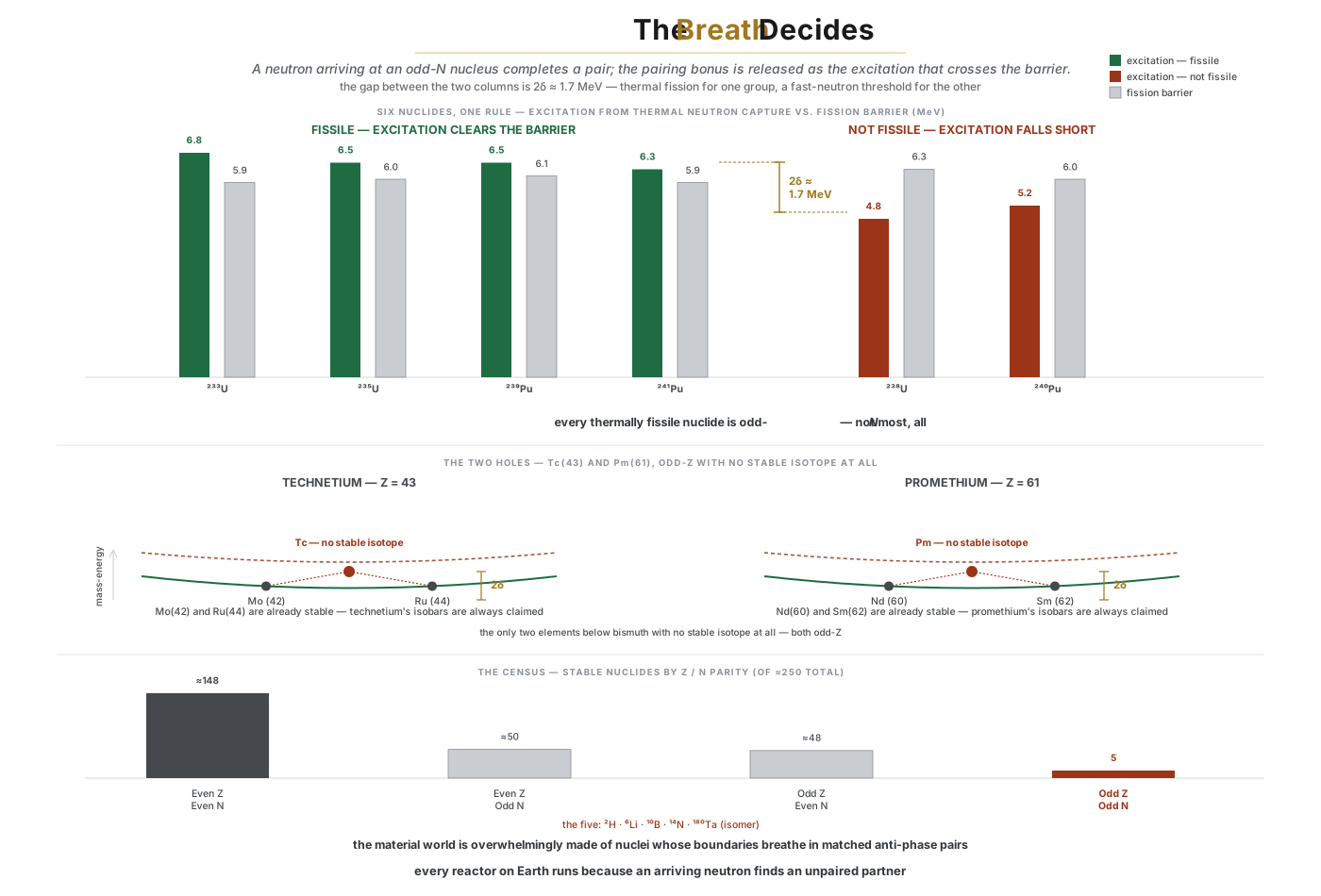
Every thermally fissile nuclide is odd-N. Not most — all of them, and it is the entire basis of the nuclear fuel cycle.
| Nuclide | N | Compound nucleus | Excitation from thermal n | Fission barrier | Fissile? |
|---|---|---|---|---|---|
| ²³³U | 141 (odd) | ²³⁴U (even–even) | 6.8 MeV | \approx 5.9 | yes |
| ²³⁵U | 143 (odd) | ²³⁶U (even–even) | 6.5 MeV | \approx 6.0 | yes |
| ²³⁹Pu | 145 (odd) | ²⁴⁰Pu (even–even) | 6.5 MeV | \approx 6.1 | yes |
| ²⁴¹Pu | 147 (odd) | ²⁴²Pu (even–even) | 6.3 MeV | \approx 5.9 | yes |
| ²³⁸U | 146 (even) | ²³⁹U (odd) | 4.8 MeV | \approx 6.3 | no |
| ²⁴⁰Pu | 146 (even) | ²⁴¹Pu (odd) | 5.2 MeV | \approx 6.0 | no |
The mechanism is one line. A neutron arriving at an odd-N nucleus completes a pair; a neutron arriving at an even-N nucleus starts a new one. The pairing bonus \delta \approx 12/\sqrt{A} \approx 0.8 MeV is therefore released as excitation energy in the first case and not in the second, and the difference between the two columns — about 1.7 MeV, which is 2\delta — is the entire gap between “fissions with a neutron that has fallen out of a room-temperature moderator” and “needs a fast neutron above roughly a megaelectronvolt.”
Every reactor on Earth runs because an arriving neutron finds an unpaired partner and the seam’s anti-phase breath pays the difference. That is 0.72\% of natural uranium, and the enrichment industry exists to concentrate it.
The same term explains the two holes in the table. Below bismuth, exactly two elements have no stable isotope at all: technetium (Z = 43) and promethium (Z = 61). Both are odd-Z, and the reason is the mass parabola that pairing splits — for odd A there is one parabola and one stable isobar, and for even A the even–even parabola sits about 2\delta below the odd–odd one, so an odd-Z element’s would-be stable isobars are almost always taken by its even-Z neighbours. The general form of that rule (Mattauch) is why no odd-Z element has more than two stable isotopes while tin (Z = 50, magic) has ten, the most of any element.
And the census is the starkest statement of all. Of the roughly 250 stable nuclides:
| Stable nuclides | |
|---|---|
| Even Z, even N | \approx 148 |
| Even Z, odd N | \approx 50 |
| Odd Z, even N | \approx 48 |
| Odd Z, odd N | 5 |
Five. ²H, ⁶Li, ¹⁰B, ¹⁴N, and a nuclear isomer of ¹⁸⁰Ta. Everything else in the stable universe has at least one complete pair-set, and more than half have two. The material world is overwhelmingly made of nuclei whose boundaries breathe in matched anti-phase pairs, and the exceptions are four light nuclides and a metastable state.
None of this is new nuclear physics. The pairing term, the Mattauch isobar rule, the odd-N fissility rule and the even–even dominance are all textbook, all quantitative, and all derived without any substrate. The framework contributes a single mechanism underneath them — that pairing is anti-phase boundary breathing, the same operation as a Cooper pair and as the lattice’s intermediate vortex lines — and the claim here is about reach: that one mechanism, stated once in proton core for the odd–even mass staggering, turns out to also decide which isotope powers a reactor, which two elements are missing from the table, and what the stable universe is mostly made of. That is a unification claim, not a numerical one. The framework cannot compute \delta from \sigma and the seam geometry, and until it can, the mechanism is an interpretation with a wide footprint rather than a derivation.
Fission is the same balance read at its own threshold
Spontaneous fission is what happens when x approaches one and the drop can no longer hold its own shape. It is already dominant over alpha decay by the fermium region and it is the wall that stops the table: pushing Z higher raises Z^2/A toward 2a_S/a_C, and past that point a nucleus deforms and separates with no barrier at all.
Two features of induced fission are worth reading on the ledger, because both are the paper’s own vocabulary showing up unannounced.
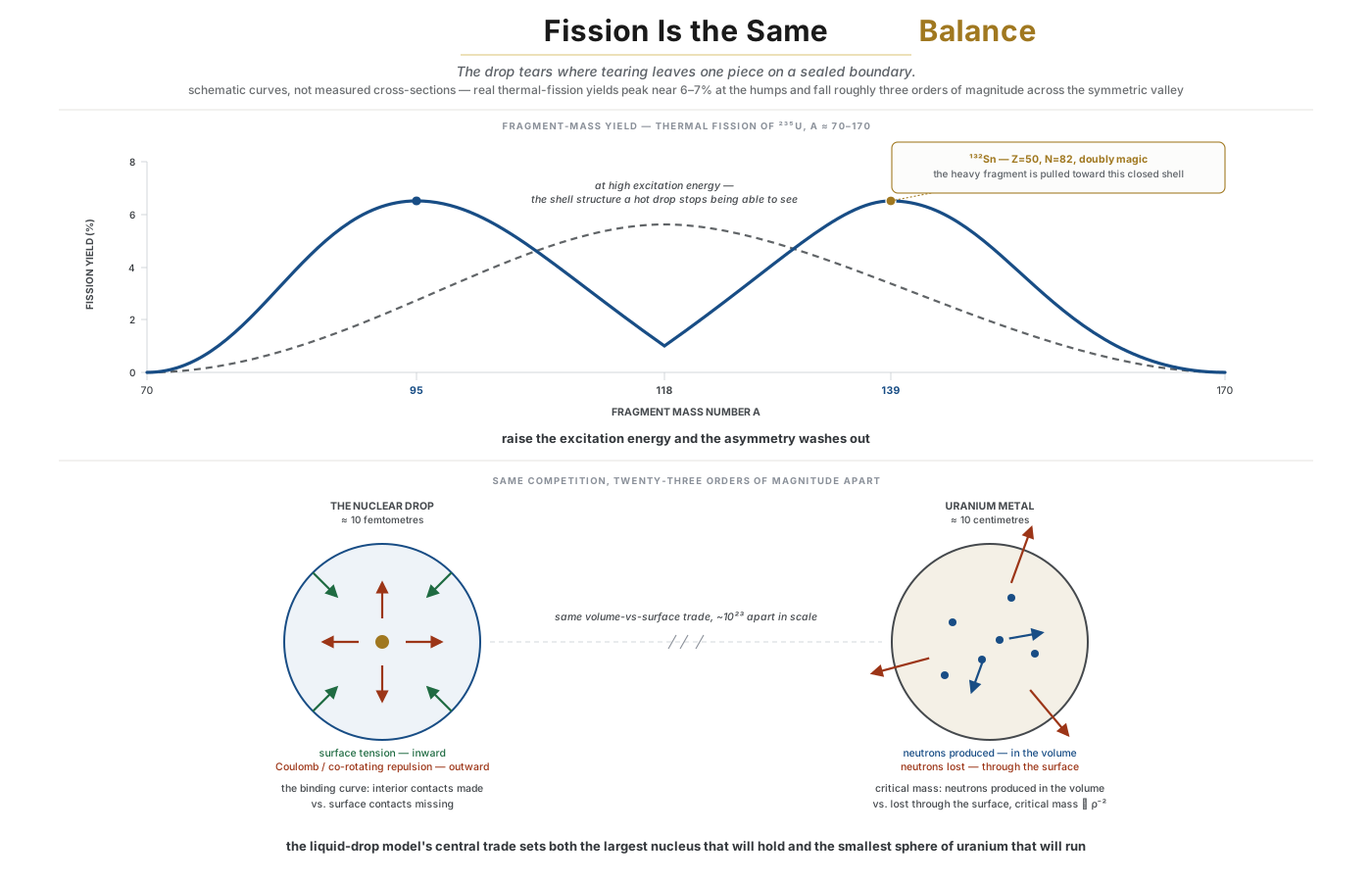
Fission is asymmetric, and the asymmetry is a shell closure. Thermal fission of ²³⁵U does not split down the middle. The fragment mass distribution is double-humped, with peaks near A \approx 95 and A \approx 139, and the heavy peak sits where it does because the fragment is trying to be ¹³²Sn — Z = 50, N = 82, doubly magic. The drop tears where tearing leaves one piece on a sealed boundary. And the prediction that comes with that reading is confirmed: raise the excitation energy and the asymmetry washes out, because a shell closure is a structural preference that a hot enough drop stops being able to see. At high excitation, fission goes symmetric, as the pure liquid-drop picture says it should. The double hump is the boundary-shell structure poking through the drop, and it disappears exactly when the drop stops caring.
And criticality is a boundary-scale threshold, not a materials property. A chain reaction runs when the neutrons produced inside a volume outnumber those lost through its surface, which is the same volume-against-surface competition the binding curve is built from, evaluated on a macroscopic drop instead of a nuclear one. Critical mass scales as \rho^{-2} for exactly this reason, which is why compressing a subcritical assembly makes it critical. The liquid-drop model’s central trade — interior contacts made versus surface contacts missing — sets both the largest nucleus that will hold and the smallest sphere of uranium that will run. Same shape, twenty-three orders of magnitude apart in scale.
The register goes dark
Turn to the other ledger, the electronic one, and it fails in a way that is almost the opposite of dramatic.
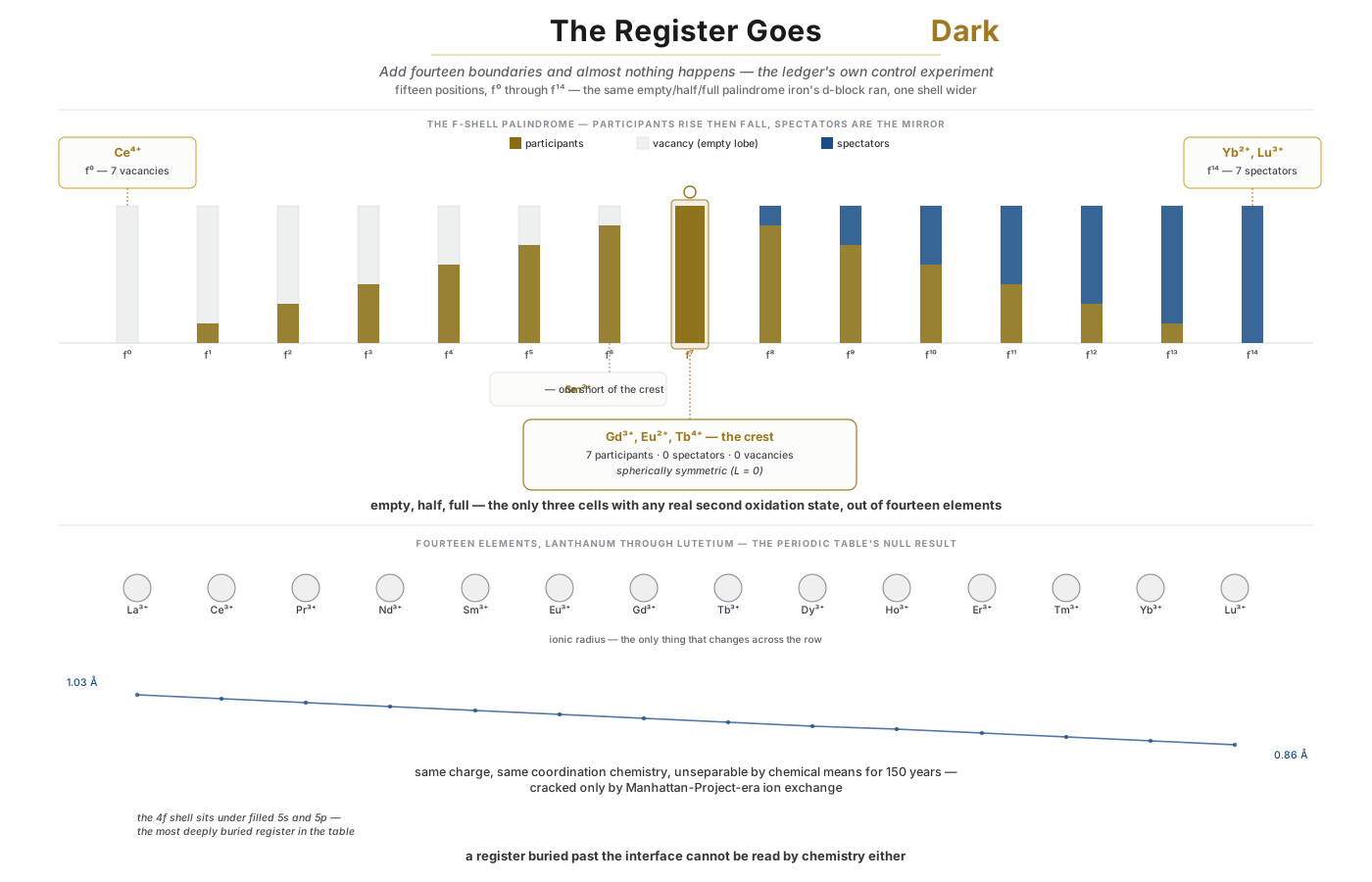
The iron chapter ran the participant/spectator/vacancy count across a shell of ten and got the same palindrome as a shell of eight, one step longer, cresting at d^5 where every lobe is a participant and nothing is left over. Run it again at fourteen and the arithmetic does not care:
| f^n | Participants | Spectators | Vacancies | Where it lives |
|---|---|---|---|---|
| f^0 | 0 | 0 | 7 | La³⁺, Ce⁴⁺ |
| f^1 | 1 | 0 | 6 | Ce³⁺ |
| ⋮ | ||||
| f^6 | 6 | 0 | 1 | Sm²⁺, Eu³⁺ |
| f^7 | 7 | 0 | 0 | Gd³⁺, Eu²⁺, Tb⁴⁺ |
| f^8 | 6 | 1 | 0 | Tb³⁺ |
| ⋮ | ||||
| f^{14} | 0 | 7 | 0 | Lu³⁺, Yb²⁺ |
The crest is at f^7, and the retrodiction is sharp. Every lanthanide is trivalent, and the handful of exceptions land exactly on the palindrome’s three special points. Ce⁴⁺ reaches f^0; Yb²⁺ reaches f^{14}; Eu²⁺ and Tb⁴⁺ reach f^7; Sm²⁺ is one step short of it. Those are the only lanthanide oxidation states with any real chemistry, out of fourteen elements, and there are three targets and five occupants. The palindrome has now been read at eight, ten and fourteen and produced the same three-point structure — empty, half, full — every time.
The crest earns its keep in two very different places. Gd³⁺ is f^7: seven unpaired participants, spherically symmetric, no orbital angular momentum to couple to the lattice, and therefore the slowest electron-spin relaxation of any paramagnetic ion — which is precisely why gadolinium is the metal in MRI contrast agents. It is the d^5 argument at a wider shell, cashed in a hospital. And Eu²⁺ is the same crest reached from the other side: the only lanthanide with a genuinely stable divalent state under geological conditions, which lets it substitute for Ca²⁺ in plagioclase feldspar while its trivalent siblings cannot. The result is the europium anomaly — the single most-used tracer in igneous petrology, the thing that reads crystal fractionation out of a rock and told us the lunar highlands are a plagioclase flotation crust. A crest in a fold palindrome, visible from orbit.
But the headline about the f-block is what does not happen, and it is the reason this chapter needed writing.
The lanthanides are the periodic table’s null result. Four chapters have argued that adding one boundary to an atom changes what that atom can do — that the whole ledger is a statement about how a single participant, spectator or vacancy reorganizes an element’s behaviour. The lanthanides are where you add fourteen and almost nothing happens. La³⁺ through Lu³⁺ are the same charge, the same coordination preferences, the same chemistry, differing only in a radius that shrinks smoothly from 1.03 to 0.86 Å. They were unseparable by chemical means for a hundred and fifty years; the Manhattan Project’s ion-exchange work was what finally cracked them, and separating them is still the expensive and dirty part of the rare-earth industry.
That is not a failure of the ledger. It is the ledger’s control experiment, and it comes out the way the iron chapter’s depth gauge requires. The 4f shell sits under filled 5s and 5p; it is the most deeply buried register in the table; and the same burial that makes Eu³⁺’s emission a hairline in every host makes fourteen elements chemically indistinguishable. A register buried past the interface cannot be read by chemistry either. The depth gauge predicted the spectroscopy; the same statement, unchanged, predicts the chemistry.
What burial is worth
Left there, the f-block sounds like a dead end, and that would be a misreading of the section’s own gauge. Burial is a liability exactly once — in chemistry — and an asset in the two places chemistry cannot look. Both of those places are industries, they have nothing to do with each other, and both are buying the property that ruins the chemistry.
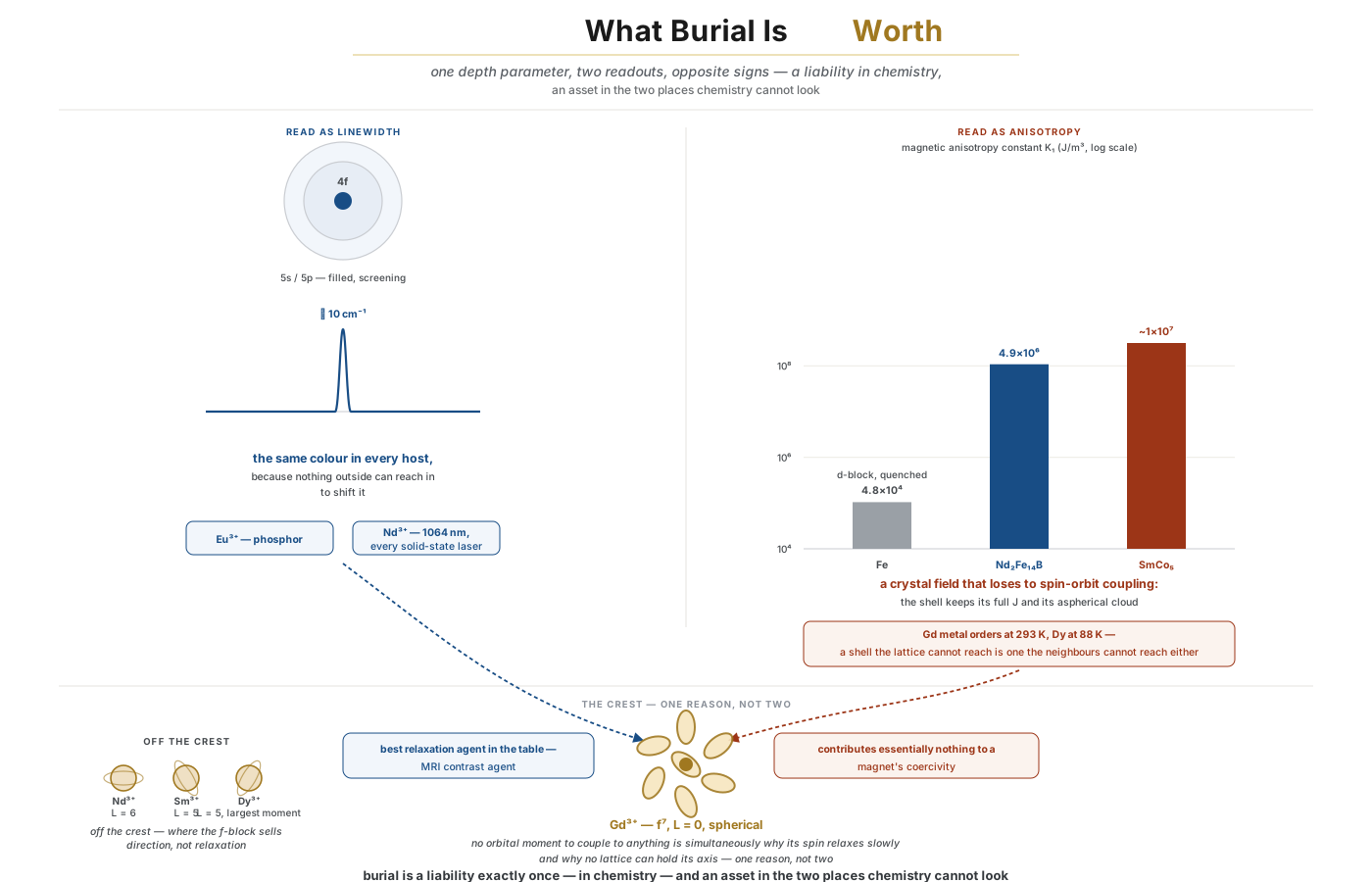
The first is already on the page. Read as linewidth, burial makes a bad dye and a superb reference: a 4f transition is a hairline of \lesssim 10 cm⁻¹ that is the same colour in every host, because nothing outside can reach in to shift it. That is why europium is in every phosphor and neodymium’s 1064 nm line is in every solid-state laser.
The second is nowhere in this section and it is the larger of the two. For a crystal to tell an atom’s circulation which way to point, the lattice has to press on the shell — and in the d-block it presses so hard that it wins. The crystal field pins the 3d orbital circulation, freezes it and cancels it; the orbital moment is quenched, and what survives is very nearly pure spin, which is spherical and offers a lattice nothing to grip. A 4f shell screened under filled 5s and 5p is the opposite case: the crystal field reaching it is two to three orders below its spin–orbit coupling, so the lattice loses, the shell keeps its full J and its aspherical cloud, and the magnetic anisotropy that results runs one to two orders above anything the d-block can supply — K_1 \approx 4.9\times10^{6} J/m³ in Nd₂Fe₁₄B and \sim10^{7} in SmCo₅ against iron’s 4.8\times10^{4}. Magnetism works that mechanism properly and finds the sentence this chapter should have seen coming: anisotropy and exchange are the same depth parameter with opposite signs, because exchange needs a shell that leaks through its boundary and anisotropy needs a shell the lattice cannot reach in to flatten. So burial charges for what it buys — a shell the lattice cannot reach is one the neighbours cannot reach either, and rare-earth-only ordering temperatures are hopeless, 293 K for gadolinium metal and 88 K for dysprosium. A permanent magnet has to use both shells at once, the buried one for the axis and the exposed one for the moment and the Curie temperature.
And then this chapter’s own palindrome sorts the two industries, which is the part I did not expect. Anisotropy needs a shell with a shape — an aspherical cloud with lobes that point somewhere in particular. The crest is the one configuration in the f-block that has none: f^7 is seven lobes each singly occupied, which is L = 0 and spherical, and it is the same sphericity the chapter already invoked two paragraphs ago. So Gd³⁺ is the best relaxation agent in the table and contributes essentially nothing to a permanent magnet’s coercivity, for one reason and not two — no orbital moment to couple to anything is simultaneously why its spin relaxes slowly enough for an MRI scanner and why no lattice can hold its axis. Step off the crest and the sphericity is gone: Nd³⁺ at L=6, Sm³⁺ at L=5, Dy³⁺ at L=5 with the largest magnetic moment of any element, and those are the three ions in every rare-earth magnet ever sold. The crest is where the f-block sells relaxation. Everywhere else is where it sells direction.
That is the palindrome doing work in a third place, and it costs nothing extra — the same f^7 special point that gives Eu²⁺ its independent geochemistry and Gd³⁺ its hospital career is the one cell of fourteen that a magnet cannot use.
The gradient inside one row
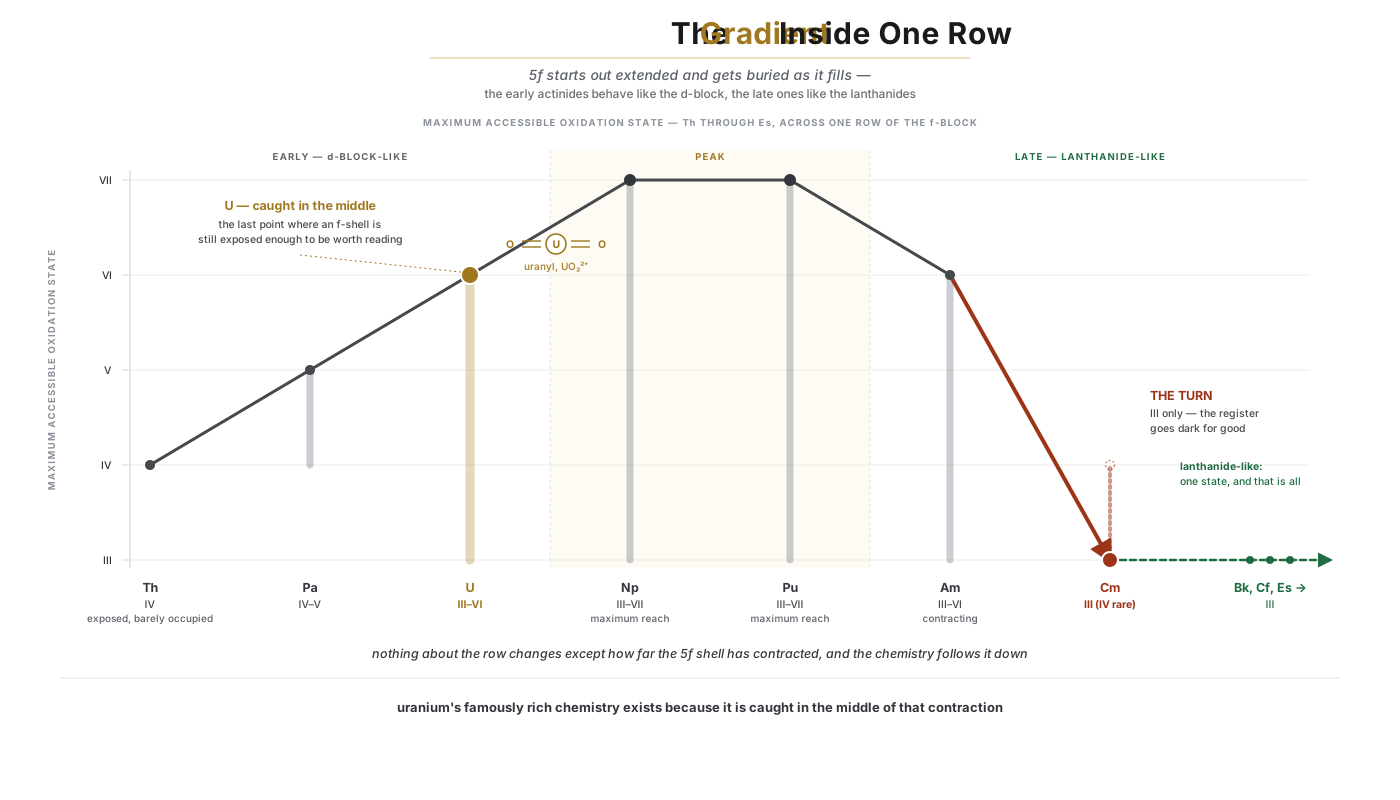
And the actinides run the same gauge as a gradient within one row, which is a better test than the lanthanides because the variable moves while everything else stays fixed. 5f starts out extended and gets buried as it fills, so the early actinides should behave like the d-block and the late ones like the lanthanides. They do, and the turn is abrupt:
| Element | Accessible oxidation states | Reading |
|---|---|---|
| Th | IV | 5f barely occupied, exposed |
| Pa | IV, V | |
| U | III, IV, V, VI | uranyl UO₂²⁺; d-block-like breadth |
| Np, Pu | III–VII | maximum reach |
| Am | III–VI | contracting |
| Cm | III (IV rare) | the turn |
| Bk, Cf, Es → | III | lanthanide-like: one state, and that is all |
The maximum oxidation state climbs to seven at neptunium and plutonium and then collapses to three at curium and never recovers. Nothing about the row changes except how far the 5f shell has contracted, and the chemistry follows it down. Uranium’s famously rich chemistry — four oxidation states, the linear uranyl ion, a whole coordination literature — exists because uranium is caught in the middle of that contraction, at the last point where an f-shell is still exposed enough to be worth reading. A few elements later, the register goes dark for good.
The lanthanide contraction, the burial of 4f, the early-actinide/late-actinide divide and the f^0/f^7/f^{14} preference are all standard inorganic chemistry with quantitative relativistic-DFT accounts. Orbital quenching, unquenched 4f moments and the design logic of rare-earth magnets are equally standard magnetism. The framework computes none of it and cannot produce a single f-orbital radial extent.
What it adds is two things. First, the palindrome now has three instances at three shell widths — eight, ten, fourteen — with the same empty/half/full structure each time, which makes it a statement about shells rather than about the d-block. Second, and more usefully, one parameter — burial depth — is being asked to predict three readouts that are measured by three communities who do not read each other: linewidth, breadth of accessible oxidation states, and magnetic anisotropy. It gets opposite signs on them, and that is the load-bearing part rather than a complication: burial is a liability only where the surroundings need to reach the register, and an asset wherever the point is that they cannot. The actinide row is the controlled test, because burial changes monotonically across it while charge, row and shell width do not, and the magnetism chapter’s prediction 6 is the same test run on the third readout. Both are falsifiable in the forms given.
Speed at the bottom of the table
There is a third thing wrong at the heavy end, and it is the one the paper has the best tools for. The gold chapter is where those tools get used properly — it takes what follows and makes a fourth token out of it, then runs the whole relativistic corner. What this section needs is the mechanism itself, because the second of this chapter’s two walls is built from it.
The framework treats c as emergent — a property of the substrate’s own dispersion rather than an external constant (emergent speed of light) — and the reach law says that an excitation’s coherent wake extends one Compton length, \hbar/(mc): the heavier the thing, the shorter its reach. Both statements are about a boundary moving against the medium, and neither has been applied to an electron in a heavy atom, where the electron is moving against the medium fast.
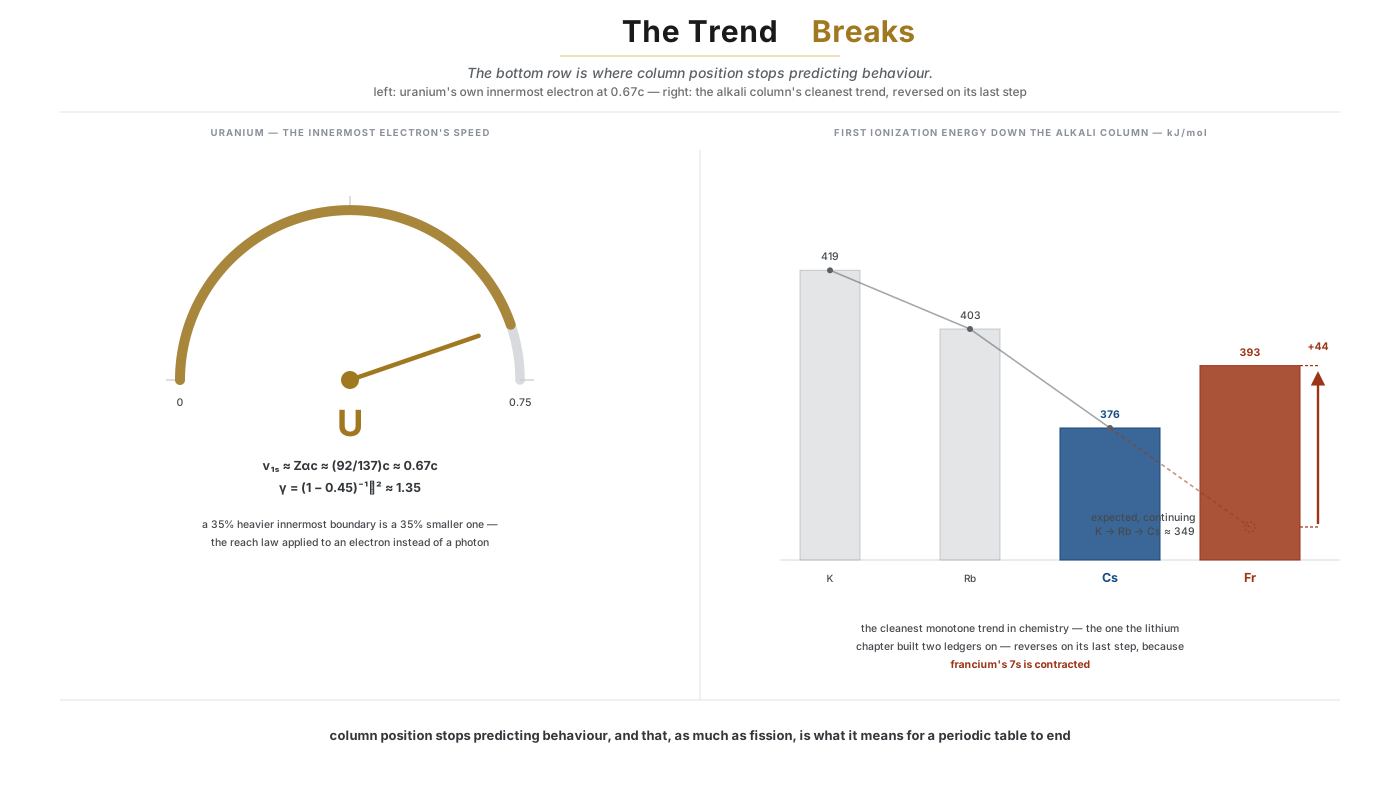
The innermost electron of an atom of charge Z runs at approximately Z\alpha c. For hydrogen that is 0.7\% of the substrate’s speed and nothing happens. For uranium it is
v_{1s} \approx \frac{92}{137}\,c \approx 0.67\,c, \qquad \gamma = \left(1 - 0.45\right)^{-1/2} \approx 1.35,
and the consequences are neither small nor subtle. The speed limit chapter’s account is that anything with a standing core builds a bow wave against the medium and gains inertia from it; the reach law then says that added inertia shortens the reach. A 1s orbital is a boundary whose radius is its reach, so a 35\% heavier boundary is a 35\% smaller one. The innermost shell of a heavy atom is contracted because it is moving fast enough to drag.
That contraction propagates outward through the whole atom, and it does so with a sign flip that is the interesting part. The s and p_{1/2} shells, which have amplitude at the nucleus, contract directly. The d and f shells, which do not, are expanded — because the contracted inner shells screen the nucleus better, so the outer folded shells see a weaker pull. One cause, opposite effects on the two kinds of shell, and every heavy-element anomaly is the gap between them opening.
Most of those anomalies are things everyone has held in their hand, and the gold chapter works them: gold is yellow because the 6s falling and the 5d rising close the interband gap to \approx2.4 eV and drop it into the visible; mercury is liquid because a sealed 6s^2 pair leaves it with a noble gas’s cohesion and radon’s ionization energy; and the inert pair effect is that closure taken one column at a time — Tl(I) over Tl(III), Pb(II) over Pb(IV), Bi(III) over Bi(V) — which is most of the voltage in a car battery. What that chapter makes of them is a fourth way to make a token: a participant converted into a spectator by velocity, with the count unchanged.
One of them belongs here rather than there, because it is not about an element — it is about the table.
The periodic trend breaks. Caesium, not francium, is the most electropositive element: Cs’s first ionization energy is 376 kJ/mol and Fr’s is 393, because francium’s 7s is contracted. The alkali column — the cleanest monotone trend in chemistry, the one the lithium chapter built two ledgers on — reverses on its last step. The bottom row is where column position stops predicting behaviour, and that, as much as fission, is what it means for a periodic table to end.
Two walls
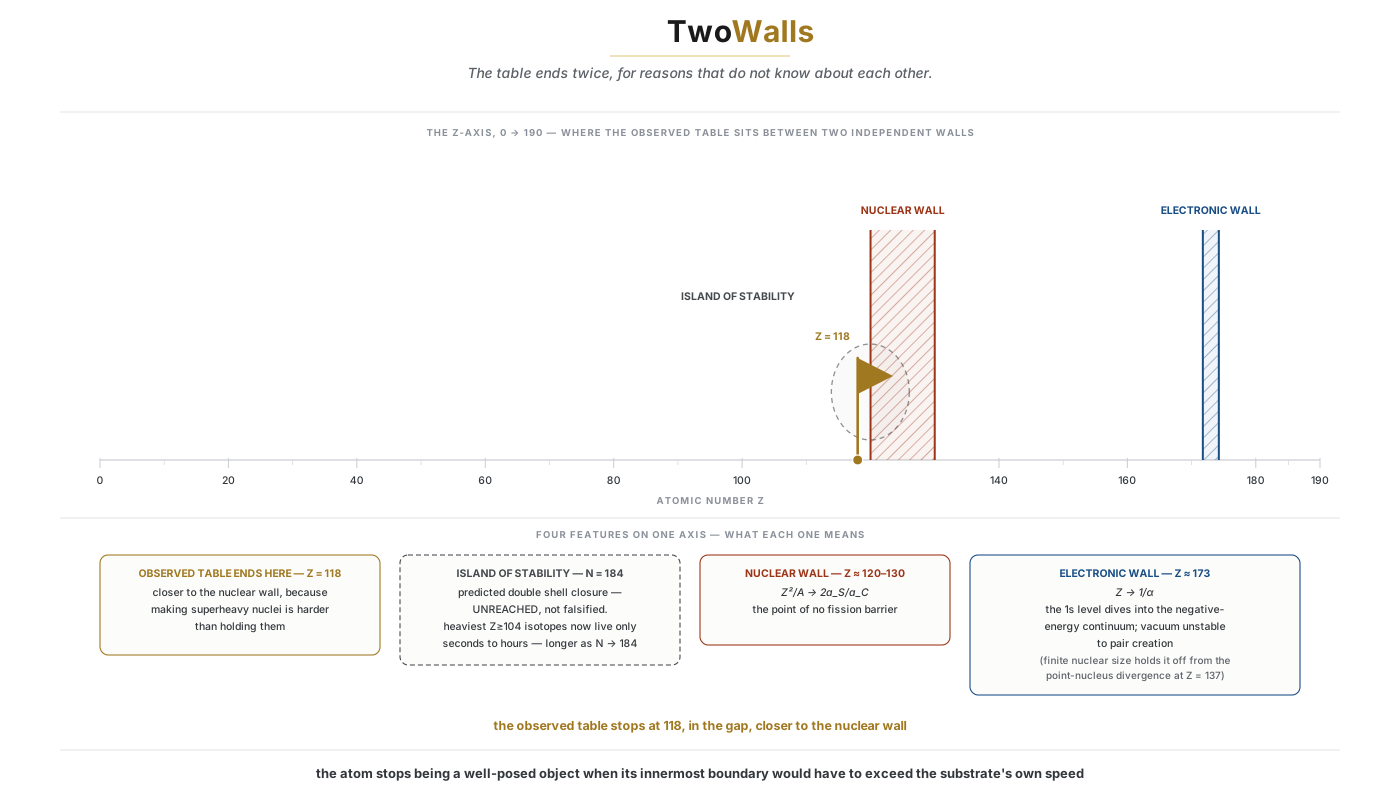
So the table ends twice, for reasons that do not know about each other, and the framework can name both in its own quantities.
The nuclear wall is x \to 1: Z^2/A \to 2a_S/a_C. With A \approx 2.5 Z in the superheavy region, that puts the point of no barrier at Z \approx 120–130.
The electronic wall is Z \to 1/\alpha. At Z\alpha \to 1 the 1s level of a point nucleus diverges; with a finite nuclear size it survives to Z \approx 173, where it dives into the negative-energy continuum and the vacuum becomes unstable to spontaneous pair creation — which is proton core’s pair-creation threshold reached by squeezing a boundary instead of stretching one. The atom stops being a well-posed object when its innermost boundary would have to exceed the substrate’s own speed, and the number where that happens is 1/\alpha, which this framework derives from boundary geometry.
The observed table stops at Z = 118, in the gap, closer to the nuclear wall — because the nuclear wall comes first and because making superheavy nuclei is harder than holding them. Everything above fermium exists for milliseconds to hours and only inside an accelerator.
The island of stability is what the shell reading predicts should interrupt the wall. If magic numbers are boundary-shell closures, then a closure well above lead should buy back some of the margin the liquid drop has lost, and the next predicted double closure is Z = 114 (or 120/126) with N = 184. That is a genuine forward prediction of the shell picture, made in the 1960s, and it remains unreached — not falsified, unreached, because no available projectile–target combination produces nuclei that neutron-rich. The heaviest isotopes yet made in the Z \geq 104 region survive seconds to hours, and they get longer-lived as N climbs toward 184, which is the right direction and nowhere near a confirmation.
The framework’s stake in it is specific and modest: it reads magic numbers as boundary-shell closures rather than as an independent postulate, so an island must exist if that reading is right, and its absence at N = 184 once that region is reached would be a real problem — for the framework and for the shell model together.
Why uranium
The iron chapter closed by asking why element 26 specifically, and answered that iron is the one place where the nuclear crest and the electronic crest coincide. The same question has an answer here, and it is the mirror image.
Uranium is the heaviest thing the r-process made in quantity that the barrier clock has not yet finished removing.
Three conditions, none of which knows about the others, and they meet at Z = 92. Neutron-star mergers and core-collapse supernovae fling out nuclei far past the crest, but everything above uranium had a fissility high enough that its barrier clock ran out during the four and a half billion years since the solar nebula formed — plutonium-244 at 80 million years is essentially gone, and neptunium-237 at two million years is entirely gone. Everything below uranium is either stable or lasts forever, and contributes no heat. Uranium and thorium are what the exponential left in the window: long enough to still be here, short enough to still be delivering power.
And that window is why uranium does what it does. It is the only naturally occurring element with a fissile isotope, because it is the only one still present that is heavy enough to have x near 0.7 and whose odd-N member has not decayed away. It is a fifth of the Earth’s internal heat, and with thorium and potassium about half of it — which drives the mantle convection that drives the plates that build the continents. Its two isotopes, decaying through separate mod-4 chains at rates differing by a factor of six, give the U–Pb concordia: two independent clocks inside a single zircon crystal, checking each other, which is why the age of the Earth is known to four significant figures.
Iron is what the stars left on the beach. Uranium is what the exponential has not finished taking back — and the reason it is still here is the same reason it is useful: a barrier so nearly, but not quite, wide enough.
Predictions
One ratio, both thresholds. The framework’s 2a_S/a_C must simultaneously set the crest of the binding curve and the critical charge density for fission, since they are the same expression evaluated on different questions. Retrodicted, weakly: the bare-coefficient value 52 lands on (Z^2/A)_\text{crit} \approx 48–51 and undershoots A_\text{peak} \approx 56–62; the close-packing value 59–63 does the reverse. The sharp form is that once the framework computes the absolute seam energy \epsilon — the open problem stated in proton core — a single a_S/a_C must reproduce both, with the residual gap accounted for entirely by the asymmetry term. Falsified if the two thresholds require values of a_S/a_C differing by more than the asymmetry correction can absorb.
The pre-paid seam sets the emitted unit. Spontaneous cluster emission should be governed by the emitted fragment’s own binding, not by its size — so the alpha dominates everywhere, and the only competitive exotic emissions should be the other near-closed clusters. Retrodicted: the observed cluster radioactivities are ¹⁴C, ²⁰O, ²⁴Ne, ²⁸Mg and ³²Si, all even–even, all with high binding per nucleon, all at branching ratios 10^{-9} or below; there is no observed ⁶Li or ⁹Be emission despite those fragments being smaller. Falsified by a spontaneous cluster emission of a poorly-bound light nuclide at a branching ratio comparable to a well-bound one of similar mass.
The barrier clock is environment-blind, and uniquely so. Ring-down times respond to lattice damping and fold registers respond to ligands; a barrier clock should respond to neither, since the barrier is interior to the seam and screened by the drop. Concretely, alpha-decay half-lives should be independent of chemical state, temperature, pressure and host to the precision of the measurement, while the electron-capture and internal-conversion decays — which depend on electron density at the nucleus and are therefore not purely interior — should show small but real chemical shifts. Retrodicted: ⁷Be’s electron-capture rate differs by \approx 0.9\% between metallic Be and BeF₂ and by more when caged in C₆₀, while no alpha emitter shows any comparable effect. Falsified by a reproducible chemical-environment dependence of an alpha half-life, or by an electron-capture nuclide showing none.
The palindrome at fourteen. The three-point structure — empty, half, full — must reappear at the f-shell, so the only lanthanides with a second accessible oxidation state should be those reaching f^0, f^7 or f^{14}. Retrodicted exactly: Ce⁴⁺ (f^0), Eu²⁺ and Tb⁴⁺ (f^7), Yb²⁺ (f^{14}), Sm²⁺ (one short of f^7), and nothing else with meaningful chemistry across fourteen elements. The forward form: at the crest, f^7 should show the same signatures d^5 does — anomalous stability, minimal orbital contribution, slow relaxation — which is why Gd³⁺ is the MRI ion and Eu²⁺ the only lanthanide with an independent geochemistry. Falsified by a lanthanide with robust second-state chemistry that is not adjacent to a palindrome zero.
Burial depth predicts three readouts, and the signs disagree. Extending iron prediction 1 from spectroscopy outward in two directions at once. To reactivity: across a series where shell burial changes monotonically and charge and row do not, the breadth of accessible oxidation states must contract in step with the linewidth. Retrodicted by the actinide row — maximum oxidation state climbing to VII at Np/Pu and collapsing to III at Cm, tracking the 5f contraction, with actinide spectra broader than lanthanide spectra throughout. To magnetism: the same burial must run the other way, because a shell the lattice cannot reach is a shell it cannot flatten, so single-ion anisotropy must rise as linewidth falls at matched site symmetry — 3d quenched and feeble against 4f unquenched and one to two orders larger. Retrodicted by K_1 \approx 4.8\times10^{4} J/m³ for iron against \approx4.9\times10^{6} for Nd₂Fe₁₄B and \sim10^{7} for SmCo₅, and by rare-earth-only ordering temperatures collapsing in step (293 K for Gd, 88 K for Dy) as the same burial starves the exchange. Falsified by a late actinide with genuine multi-state chemistry, by an element whose spectral burial and chemical burial order oppositely, or by a hairline-emitting ion with negligible single-ion anisotropy at matched site symmetry. The corollary this chapter owns is the crest: f^7 is L=0 and spherical, so the one lanthanide configuration with no anisotropy to sell must be the one the relaxation applications select, and Gd³⁺ is in the MRI agent and in no permanent magnet.
Two walls, both framework quantities. The periodic table must terminate at whichever of Z^2/A \to 2a_S/a_C (nuclear) and Z \to 1/\alpha (electronic) is reached first, and for the actual valley of stability that is the nuclear one, at Z \approx 120–130. Retrodicted by the table ending at 118 with sub-second half-lives above Z \approx 108. The shell reading additionally requires an island of stability near N = 184, since magic numbers are boundary-shell closures rather than an independent postulate. Falsified by synthesis of a Z > 130 nuclide with a measurable half-life, or by the N = 184 region — once reached — showing no stability enhancement at all.
Relativistic anomalies scale as (Z\alpha)^2 and split by shell type. Since the cause is one boundary’s speed and the sign depends only on whether a shell has amplitude at the nucleus, heavy-element anomalies must (a) grow as (Z\alpha)^2 down a column, (b) contract s and p_{1/2} while expanding d and f, and (c) therefore always narrow an s–d or s–f gap rather than widening it. Retrodicted by gold’s 5d\to6s gap at 2.4 eV against silver’s 3.7, by mercury’s melting point \approx 100 K below its non-relativistic value, by the Tl/Pb/Bi inert pair, by lead–acid’s 1.7 V of 2.1, and by Fr’s ionization energy exceeding Cs’s. Falsified by a heavy-element interband gap that opens rather than closes relative to its lighter congener, or by a relativistic anomaly whose column trend is not quadratic in Z\alpha.
Conclusion
Carbon is visible because chemistry abstains. Lithium is visible because chemistry collapses. Iron is visible because chemistry stalls halfway and stays there. Uranium is visible for the fourth reason, and it is the one that closes the table: chemistry, and the nucleus under it, run out.
They run out separately, which is the chapter’s point. The nuclear ledger runs out because a drop that keeps growing accumulates repulsion faster than surface, and the ratio that says where the crest is says, in the same breath, where the cliff is. The electronic ledger runs out because a register buried behind two closed shells cannot be read — not by a ligand, not by a solvent, not by a chemist, so that fourteen elements in a row become one element with fourteen masses. And a third thing runs out underneath both: the substrate’s own speed, which the innermost boundary of a heavy atom approaches closely enough that its reach contracts and the periodic trends the first four chapters were built on stop holding.
What is left, in the gap between those failures, is the strangest set of properties in the table, and every one of them is a margin that has not quite closed. An alpha that can leave because its seam was paid for in advance, crossing a barrier so nearly too wide that a factor of three in energy buys thirty-three orders of magnitude in time — which is the only clock in nature that no environment can touch, and therefore the only one that can date a rock or warm a planet for its whole life. A neutron that completes a pair and releases the lattice’s own breath as the megaelectronvolt that carries a nucleus over its fission barrier, which is why every reactor on Earth runs on the odd isotope. A 6s pair contracted just far enough to seal, which is why one metal is liquid and another is yellow. And a shell contracting across a single row, caught at uranium at the last point where an f-register is still shallow enough to read.
The paper has now read the periodic table five times as one accounting problem: how many boundaries an atom has, how many it can use, and what it does with the ones left over. Row two spends its leftovers on voice. The d-block spends them on state. The f-block cannot spend them on chemistry at all, because nothing can reach them — and then sells that unreachability twice over, as a line that will not move in any host and as an axis no lattice can bend, which is a phosphor and a permanent magnet. And past the crest there are no leftovers — only a boundary that has grown past the size its own seam can span, giving pieces back on a clock that nothing in the universe can hurry or slow.
Carbon shows the substrate’s sheet. Lithium shows its coin. Iron shows its fold. Uranium shows its limit — and of the four, the limit is the only one that tells time.