The Forge of the Elements
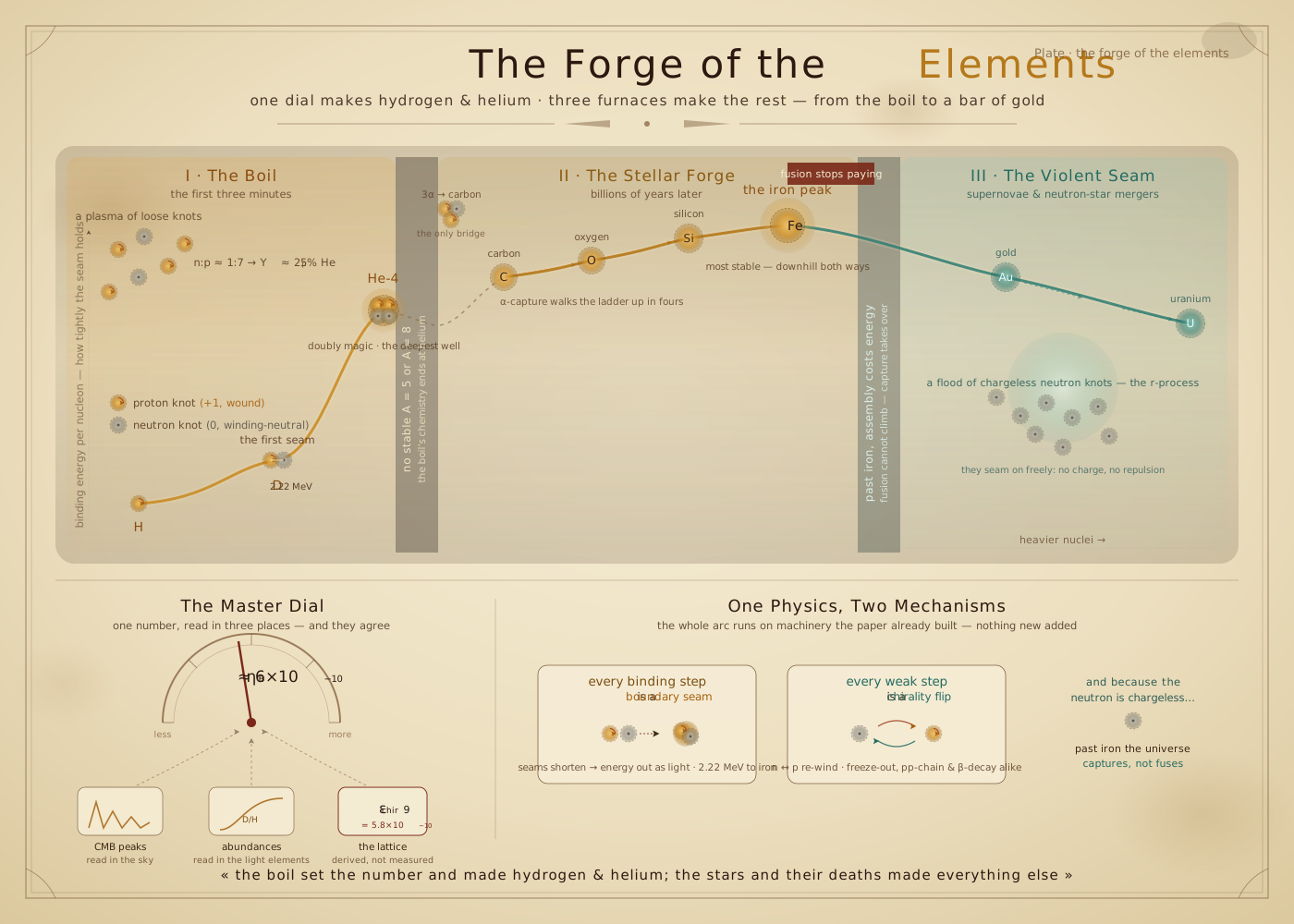
Nucleosynthesis on the substrate — one number, η_B = ε_chirality⁹, fixes the primordial hydrogen and helium; the same boundary-seam ladder builds the rest, from the first stellar cores to the neutron-star mergers
What this chapter answers
Two chapters balanced the boil’s books. Why Matter Won decided what survived — matter over antimatter, by the vacuum’s handedness — and The Two Ledgers of the Boil guaranteed that the survivors came out electrically neutral, each proton knot shadowed by its electron. What they left standing was a plasma of bare hydrogen: proton knots, an admixture of neutron knots, and the electrons the winding ledger owed them, all bathed in the annihilation fog that is the cosmic microwave background.
That is not yet a periodic table. Carbon, oxygen, iron, gold — the atoms a reader is made of — are nowhere in that inventory. This chapter follows the survivors forward, from the boil’s first minutes to the deaths of stars, and makes one claim throughout: nucleosynthesis needs no new substrate ingredient. It needs exactly one number the framework already derived — the baryon-to-photon ratio \eta_B \approx \varepsilon_\text{chirality}^9 — and one mechanism it already owns — the boundary seam by which nucleon knots bind. Everything from the primordial helium fraction to the last transuranic in a kilonova is those two things, read at rising temperatures.
The story has a clean three-part shape, and each part hands off to the next:
- The first three minutes. The boil’s \eta_B sets how much helium the young universe could build before it thinned out — and it stops, sharply, at helium.
- Recombination. The surviving protons capture their waiting electrons; the universe goes transparent and the CMB is released, freezing \eta_B into the sky as a signature we can still read.
- The stellar forge and its deaths. Everything heavier than helium is built later, in stars — up the binding curve to iron by fusion, past iron by neutron capture in the violent boundary disruptions of supernovae and neutron-star mergers.
One number, read in three places
Before following the chemistry, it is worth seeing why \eta_B deserves to be called the master dial — because the same number the boil handed us is a number the sky measures independently, twice, and the two measurements agree. That concordance is what makes the substrate’s \varepsilon_\text{chirality}^9 a real target rather than a lucky coincidence, and it is the hinge on which this whole chapter turns.
The CMB acoustic peaks
Before recombination the photon–baryon plasma rang like a struck bell. Perturbations fell into their own gravity and bounced back out on photon pressure, and the standing overtones of that ringing are the acoustic peaks in the microwave background. Their relative heights depend on how much baryon inertia loaded the oscillation: baryons weigh the compressions down, deepening the odd peaks relative to the even ones. The odd/even peak-height asymmetry is therefore a direct weighing of the surviving baryons — the baryon density \Omega_b, which is \eta_B in different units.
The framework takes this baryon–photon acoustic physics as standard and unmodified. Its MOND-like corrections act on the gravitational sector, not the photon–baryon coupling (early structure formation), so the peak calculation is the textbook one. What the substrate supplies is not a new spectrum but the value the peaks are measuring.
The primordial abundances
The second read comes from the first few minutes, and it is entirely independent of the microwave sky. How much helium, deuterium, and lithium the young universe forged depends sharply on \eta_B, because a denser baryon load drives fusion further before the plasma dilutes. Turn the dial up and more deuterium survives into helium, leaving less free deuterium behind; turn it down and the reactions stall earlier. The measured helium mass fraction (Y_p \approx 0.25) and — most sensitively — the deuterium abundance (\text{D}/\text{H} \approx 2.5\times10^{-5}) each pin \eta_B to the same \sim 6\times10^{-10} the acoustic peaks give.
Two utterly different processes — nuclear fusion at three minutes, photon acoustics at 380,000 years, separated by five decades of cosmic time — landing on one number is a cornerstone of hot Big Bang cosmology. It is a genuine over-determination: nothing requires the primordial deuterium and the third acoustic peak to agree unless a single baryon density underlies both.
The substrate’s third read
The framework adds a third value for the same dial, and it is the only one that claims to explain the number rather than measure it:
\eta_B \;\approx\; \varepsilon_\text{chirality}^{\,9} \;=\; (0.0942)^9 \;=\; 5.8\times10^{-10},
the vacuum’s handedness (bridge equation) raised to the count of a baryon’s 3\times3 junction interfaces (Why Matter Won). The full derivation, and its honest status as a bet rather than a banked result, live in that chapter. Here the point is narrower and, in its way, more striking: if that identification holds, the helium in every star and the height of the third acoustic peak are the same fact — the chiral vacuum, read once at the boil and propagated untouched through everything that follows. One number, measured twice by the sky and derived once from the lattice.
The first three minutes
Now the chemistry. The boil handed off a hot plasma of proton and neutron knots. What happened next is a race between the substrate’s cooling expansion and a short list of nuclear reactions — and \eta_B sets the terms of every stage of the race.
Neutron freeze-out: the weak clock
At the start, protons and neutrons interconverted freely. Each conversion is the chirality flip the framework uses for stellar fusion and for beta decay: a single Type-B (down) arm of the three-quark knot re-winds into a Type-A (up) arm, or back, mediated by the weak interaction — which the substrate reads as the handed background’s grip on that re-winding (Higgs field). While the flip runs faster than the universe expands, the two knot species track thermal equilibrium, and because the neutron knot costs slightly more to make — the 1.293 MeV the udd junction carries over uud — the equilibrium already tilts toward protons.
As the substrate cools, the flip rate falls faster than the expansion rate, and at about T \approx 0.7 MeV (one second in) the weak clock can no longer keep up. The ratio freezes: roughly one neutron for every six protons, caught out of equilibrium by the same kind of rate-outruns-reaction shove the boil itself used. Then a slow bleed follows — free neutron knots beta-decay with a fifteen-minute half-life — nudging the ratio to about 1{:}7 by the time fusion finally begins. That surviving neutron fraction is the single most important number for what comes next, because nearly every neutron that lives will end up locked inside a helium nucleus, and the 1{:}7 ratio is what fixes the 25\% helium the universe is born with.
The deuterium bottleneck
Fusion cannot start until neutron and proton knots can hold a shared seam, and the first seam — the deuteron, one proton knot and one neutron knot bound across a single boundary contact — is shallow. Its binding energy, 2.22 MeV, is of order the substrate’s minimal condensation unit, one effective quantum at m_\text{eff}\approx 1.70 MeV. A shallow seam is easily broken, and here \eta_B returns as the villain of the timing.
There are about two billion photons for every baryon — that ratio is 1/\eta_B. So even long after the mean photon energy has fallen below 2.22 MeV, the sheer exponential tail of that enormous photon fog still holds enough above-threshold photons to blast every deuteron apart the instant it forms. Nothing heavier can be built on a seam that will not set. The bottleneck does not break until the temperature has dropped to roughly T \approx 0.07 MeV — a factor of \sim 30 below the naive binding, a delay of order \ln(1/\eta_B) \approx 20 — around three minutes in. The very smallness of \eta_B that makes matter rare also postpones the first nucleus: the vacuum’s faint handedness, felt again in the clock of the cosmos.
The burst to helium-4
Once the deuteron seam holds, the whole ladder unlocks at once. Deuterons fuse to tritium and helium-3, those to helium-4, in a fast cascade — and it piles up almost entirely at helium-4, for a reason the framework has already named. He-4 is the boundary-minimizing closed topology: two uud and two udd junctions locked into the tightest, most fully-paired configuration below carbon, doubly magic and anomalously bound at 7.07 MeV per nucleon. It is the deepest well the primordial furnace can reach, so the flow drains into it. Nearly every neutron that survived freeze-out is sealed inside one; the leftover protons stay free as hydrogen. With a one-in-seven neutron fraction, the arithmetic is forced —
Y_p \;=\; \frac{2(n/p)}{1+(n/p)} \;\approx\; \frac{2/7}{8/7} \;=\; 0.25,
— about 75\% hydrogen and 25\% helium-4 by mass. This is the substrate “minting the coin” at cosmic scale, the same phrase the fusion chapter uses for the Sun, run once for the whole universe in its first minutes.
Why the ladder stopped at helium
The furnace built helium and then quit — not for want of heat but for want of a next rung. There is no stable nucleus at mass 5, and none at mass 8. Add a nucleon to helium-4 and the result (helium-5, lithium-5) falls apart in \sim10^{-21} s; fuse two helium-4 knots and the beryllium-8 you get unbinds in \sim10^{-16} s. In the substrate’s language, there is no boundary-minimizing closed configuration at those masses for a fifth or eighth knot to seam onto — the alpha is a local dead end, a well so deep that its immediate neighbors sit on unstable ground.
The only bridge across the gap is to bring three helium-4 knots together almost simultaneously into carbon-12 — the triple-alpha process — and that needs densities and dwell-times an expanding, thinning universe minutes old simply no longer has. So primordial nucleosynthesis ends. Its entire legacy is a whisper past helium: deuterium and helium-3 at the 10^{-5} level (the trace that escaped fusing), and lithium-7 at a few parts in 10^{10}. That is the whole primordial stock of the cosmos — set, like the asymmetry itself, in the first minutes and never rewritten.
An inherited tension: the lithium problem
Honesty requires naming where the standard picture the framework adopts is itself strained. Fed the CMB value of \eta_B, standard BBN predicts a lithium-7 abundance about three times what old-halo-star spectroscopy actually finds — the long-standing “cosmological lithium problem.” Because the substrate takes the BBN reaction network as standard and contributes only the value of \eta_B (which it matches), it inherits this tension rather than resolving it. The framework has nothing special to say about lithium-7 here, and it would be dishonest to imply otherwise; the discrepancy is generally suspected to lie in stellar depletion of lithium or in nuclear-rate systematics, neither of which the substrate touches. It is flagged, not fixed.
What the framework can add is a prior on where the fix lies, and it comes from the same mass-5/mass-8 gap this chapter just used. Lithium is the only element living on that unstable ground, with the lowest binding energy per nucleon of any stable nuclide past helium and the lowest ignition temperature of anything heavier than deuterium — so it is structurally the most destructible thing in the table, and a deficit measured in stellar photospheres is far likelier to be photospheric than primordial. The lithium chapter works that bet out, together with the observation that has moved furthest in its favour (interstellar ⁷Li in the Small Magellanic Cloud sitting at the BBN value, not the Spite value) and the new tension that same observation opens.
Recombination: the transition the CMB caught
For 380,000 years after the boil the universe was an opaque plasma — bare nuclei and free electrons, with photons scattering off the electrons at every turn. Then, at redshift z \approx 1100, the substrate cooled enough for the surviving protons and helium nuclei to capture their electrons and become neutral atoms. This is the winding ledger settling its account at last: the electron the boil budded off when it wound up each proton, held apart by heat for four hundred millennia, finally seats into its orbital. Charge, co-produced and neutral from the start, is now neutral and bound.
The instant the free electrons vanish into atoms, the photons stop scattering and the universe goes transparent. Those photons stream freely ever after — and they are the CMB. This is why the microwave background is the right place to read \eta_B: it is a flashbulb that caught the plasma at the single moment recombination froze the acoustic ringing into place, with the baryon loading — \eta_B — stamped permanently into the peak heights. The framework treats the whole of this epoch with standard baryon–photon physics (early structure formation); its contribution is not to recompute the spectrum but to explain the one number the spectrum encodes.
So recombination is the seam between the two halves of this chapter. Behind it lies the primordial furnace that made hydrogen and helium and stamped \eta_B on the sky. Ahead of it lies a long dark age, and then the second furnace — the stars — that made everything else.
The stellar forge: climbing to iron
Everything past helium — the carbon in a reader’s cells, the oxygen in each breath, the calcium in bone — was built later, and not at the boil. It was forged in stars, by the same boundary-seam machinery one tier up: each fusion step is a reduction in total flux-tube length as nucleon junctions merge into a shorter shared network, the excess boundary energy released as starlight. The framework’s account of stellar fusion is developed in the solar and stellar dynamics chapter; here we trace only how it climbs the ladder the boil could not.
Hydrogen burning
The first rung is the one the boil skipped for lack of time: fusing four hydrogen knots into helium-4. In lower-mass stars this runs as the proton–proton chain, whose rate-limiting first step, p+p\to d+e^++\nu, is a chirality flip — a proton knot re-winding one arm to a neutron knot — the same weak conversion that set the neutron fraction in the early universe, now running one knot at a time in a stellar core. It is slow precisely because it is weak, which is why stars burn for billions of years rather than seconds. In more massive stars the CNO cycle takes over: carbon, nitrogen, and oxygen act as catalysts, seams that pass nucleons along and emerge unchanged, letting the net 4\text{H}\to\text{He-4} proceed faster on the same 26.73 MeV budget.
Hydrogen burning fills the universe’s helium beyond its primordial quarter, but it climbs no higher — the star sits at the top of the first flight, against the same mass-5 gap the boil hit.
Crossing the gap: the triple-alpha bridge
What a star has that the early universe did not is time and sustained density. In a helium core at \sim 10^8 K, two helium-4 knots can form the fleeting beryllium-8 seam and, before it unbinds in 10^{-16} s, occasionally catch a third helium-4 — building carbon-12 through the triple-alpha process. The reaction hinges on a resonance in carbon-12 sitting just above the three-alpha energy (Hoyle’s famous prediction), which in the substrate reading is a matched breathing mode of the assembled boundary that lets three closed knots merge without first paying the unstable-intermediate penalty. This is the rung the boil could never reach, and it is the gateway to everything heavier.
Once carbon exists, alpha capture walks the ladder upward in fours — carbon to oxygen to neon to magnesium to silicon — each step another set of junctions seaming into a boundary-minimizing whole.
Interactive: the ladder, run — helium-4, an alpha that fails to stick (Be-8), the Hoyle step, alpha captures to Ni-56, and two arms re-wound to Fe-56; the released boundary energy leaves as modons at every rung and the binding chart marks the climb. The pp chain runs the first flight, the chirality flip in the act.
To the iron peak, and no further by fusion
Fusion keeps paying, releasing boundary energy at every rung, until it reaches the iron peak. There the binding-energy curve crests: iron-56 and nickel-62 sit at the bottom of the nuclear energy valley because they are the largest nuclei whose short-range surface-seam binding still outpaces the accumulated long-range co-rotating (electromagnetic) repulsion. The framework derives the location of that crest — A_\text{peak}\approx 2a_S/a_C \approx 59–63 — from the same surface-versus-Coulomb balance that governs nuclear fission (proton core).
Past iron, the balance has tipped: assembling a heavier nucleus by fusion costs energy rather than releasing it, because each new nucleon adds more co-rotating repulsion than seam binding. A massive star that has built an iron core has reached the end of what fusion can do — the core can no longer pay its own way, and it collapses. Fusion built the elements up to iron. It cannot build one atom heavier. Yet a reader’s blood carries iron and their ring may carry gold, so something else must finish the table.
Beyond iron: capture, not fusion
The elements past iron are built not by fusing charged nuclei against their mutual repulsion but by capturing neutrons — and the substrate makes plain why that is the only route left. A neutron knot is winding-neutral: it carries no net co-rotating monopole, which is exactly why the two ledgers read its charge as zero. Carrying no monopole, it feels no co-rotating repulsion from a nucleus — none of the barrier that stalls charged fusion. A neutron knot can therefore drift up to a nucleus and seam on freely, no matter how heavy and highly-charged that nucleus already is. Building past iron is a matter of feeding nuclei neutrons and letting the winding ledger sort out the rest.
Once a nucleus has swallowed a neutron it is neutron-rich, off the valley of stability, and it rebalances the only way the winding ledger knows: a Type-B arm re-winds to Type-A and sheds an electron in beta decay, converting the surplus neutron to a proton and stepping the nucleus one square up in atomic number. The whole of heavy-element synthesis is a footrace between two clocks the framework already owns — how fast neutrons seam on versus how fast arms re-wind back to the valley — and which clock wins names the process.
Interactive: the two clocks — an iron seed under a neutron flux you set, each neutron drifting in with no barrier and the β clock re-winding arms by the Q-value; on the N–Z chart a slow flux walks the valley, and a three-second flood gorges the droplet to the drip line and cascades back when it stops.
The s-process: slow capture along the valley
When neutrons arrive slowly — one every few decades, in the deep interiors of aging red-giant (AGB) stars, where reactions like \text{C-13}(\alpha,n) trickle neutrons out — each captured neutron has ample time to beta-decay back to the valley before the next arrives. The nucleus walks along the valley of stability, one careful square at a time, building the stable heavy isotopes up to lead and bismuth. This is the s-process (s for slow): the winding ledger kept balanced at every step, the path hugging the valley floor.
The r-process: the violent seam
When neutrons arrive in a flood — faster than any arm can re-wind — nuclei gorge on them, racing far up into extreme neutron-richness before beta decay can catch up, then cascading back down to stability only after the flux subsides. This is the r-process (r for rapid), and it forges the heaviest and most neutron-rich nuclei there are: the gold and platinum in jewelry, the uranium and thorium that warm the Earth’s interior.
It demands a neutron flux of staggering intensity, and the framework’s catalog offers exactly two sites violent enough. Core-collapse supernovae — the most extreme boundary disruption in the stellar catalog — momentarily flood their ejecta with neutrons. And, decisively, neutron-star mergers: when two neutron stars — each a macroscopic drop of the densest matter that is still matter, a superfluid of neutron knots threaded by quantized vortices — tear each other apart, they fling out a tidal spray of nearly pure neutron matter. That spray is the purest r-process furnace known, confirmed in 2017 when the kilonova following gravitational-wave event GW170817 lit up with the spectral signature of freshly minted heavy elements. In the substrate picture it is almost literal: a reservoir of neutron knots, suddenly unconfined, seaming onto seed nuclei faster than the winding ledger can rebalance — the heaviest atoms in the universe assembled in the debris of the densest objects in it.
What the substrate adds
Read straight through, this chapter recomputes nothing that standard astrophysics computes. It does something more modest and, in the framework’s terms, more valuable: it shows that the whole of nucleosynthesis runs on machinery the paper already built for other reasons, with a single derived input.
- The one input is \eta_B. Every primordial abundance follows from the baryon-to-photon ratio, and the framework alone claims to derive that ratio — \varepsilon_\text{chirality}^9 — rather than fit it. The concordance of CMB peaks and primordial deuterium is then a second, independent test of the same number.
- Every binding step is a boundary seam. From the primordial deuteron to a neutron-star-merger’s r-process, nuclei bind by merging boundary layers and shortening their shared flux-tube network (proton core) — one mechanism, from 2.22 MeV to the iron peak.
- Every weak step is a chirality flip. Neutron freeze-out, the pp chain’s first reaction, and every beta decay on the r- and s-process paths are the same Type-A/Type-B arm re-winding, governed by the same handed background that made the weak force left-handed.
- The neutron’s chargelessness is why capture builds the heavy tail. A winding-neutral knot feels no co-rotating barrier, so past iron the universe stops fusing and starts capturing — a fact the two-ledgers reading makes structural rather than incidental.
Helium-4 as a boundary-minimizing closed topology, the iron peak as a surface-versus-Coulomb balance, the mass-5/8 gaps as absent closed configurations — each was already in the paper. This chapter only strings them into the single arc that runs from the boil to a bar of gold.
Predictions and falsification
- The derived \eta_B must satisfy the primordial abundances, not just the photon count. Because \eta_B is the sole input to Big Bang nucleosynthesis, the substrate’s \varepsilon_\text{chirality}^9 is tested a second, independent time: fed to the standard BBN network it must reproduce Y_p \approx 0.25 and — decisively — \text{D}/\text{H}\approx 2.5\times10^{-5}. This is a sharper knife than the photon count, and it cuts both ways. Against the raw CMB photon ratio, 5.8\times10^{-10} vs. 6.1\times10^{-10} is a comfortable 5\%. But primordial deuterium now pins \eta_B to \sim1–2\%, and against that tighter ruler the same 5\%-low value sits in mild tension — passing easily on helium (which is only logarithmically sensitive to \eta_B) while sitting just below the deuterium-preferred window. So BBN is as much a live risk to the \eta_B=\varepsilon_\text{chirality}^9 bet as a second confirmation of it. A future \varepsilon_\text{chirality} or interface count that pushed \eta_B further from the deuterium value would fail here first — which is precisely what makes this the framework’s sharpest cosmological test of the identification.
- No modification to the standard nuclear network is permitted. The framework contributes the value of \eta_B and a re-reading of the mechanisms; it explicitly does not alter reaction rates, the baryon–photon coupling, or the acoustic-peak physics. Any claim that the substrate changes a BBN cross-section or the CMB damping tail would be a departure from this chapter, not a consequence of it — and would have to answer to the tight agreement the standard network already achieves.
- The primordial helium fraction is fixed by the neutron freeze-out ratio. Y_p\approx 0.25 follows from the \sim 1{:}7 neutron-to-proton ratio, itself set by the weak-flip (chirality-flip) rate against the expansion rate. This ties Y_p to the same weak physics the framework reads from the handed background; a Y_p badly inconsistent with that freeze-out would strain the chirality-flip account of the weak interaction, not just BBN.
- The heavy-element division of labor is forced by the neutron’s chargelessness. Elements past iron must be built by neutron capture, never by charged fusion, because a winding-neutral knot feels no co-rotating barrier. The r-process must therefore be sited in neutron-rich, violently disrupted environments — supernovae and neutron-star mergers — exactly where observation (GW170817’s kilonova) now places it. A confirmed dominant r-process site with no free-neutron reservoir would contradict the capture-not-fusion reading.
Honest assessment
What is solid is the architecture, and it is genuinely strong: the framework needs no new ingredient to account for the origin of the elements. It supplies the one number BBN requires and claims to derive it; it re-reads every binding step as a boundary seam and every weak step as a chirality flip, both mechanisms already load-bearing elsewhere in the paper; and it makes the fusion/capture divide at iron a structural consequence of the neutron’s winding-neutrality rather than a bare empirical fact. That the CMB peaks and the primordial deuterium independently agree on a single \eta_B is a cornerstone of standard cosmology; the substrate’s own claim on that number — \varepsilon_\text{chirality}^9, derived from lattice geometry to within 5\% — is the strongest single result the chapter can point to. Its honest temper is that the deuterium ruler is now tight enough (\sim1–2\%) that this same 5\% reads as a mild tension, so the BBN concordance is a live test of the bet, not yet a clean confirmation of it (prediction 1).
What is inherited, not earned is the quantitative nuclear astrophysics. The 25\% helium, the deuterium abundance, the triple-alpha resonance, the r- and s-process yields are all standard results the framework adopts wholesale; it re-narrates their mechanisms but computes none of them from substrate parameters. The absolute nuclear binding scale — the per-contact seam energy \epsilon that would let the framework predict binding energies rather than borrow them — remains the open nuclear computation flagged in the proton core. And the lithium problem is inherited outright: the substrate matches the \eta_B that BBN needs and therefore inherits BBN’s factor-of-three lithium-7 discrepancy, with nothing special to offer toward its resolution. This chapter’s honest claim is unification, not new numbers: it shows that the origin of the elements costs the framework nothing it had not already spent, and that a single derived \eta_B threads the whole of it.
Putting the section in context
The boil kept two books and this trilogy has now read all three of their consequences. Why Matter Won found what survived — matter, by the vacuum’s handedness. The Two Ledgers found that the survivors are neutral — one electron per proton, by conserved winding. This chapter follows what the survivors became: hydrogen and helium in the first three minutes, set by the very \eta_B the handedness fixed; then, after the long transparent pause that recombination opened and the CMB recorded, the whole periodic table forged in stars and their deaths, by the same boundary-seam physics one tier up. The chiral vacuum decided the matter would exist; the winding ledger decided it would be neutral; and here that neutral matter, handed down an unbroken chain of seams, becomes carbon and oxygen and iron and gold. The atoms a reader is made of are the boil’s one-in-a-billion survivors, cooked — and every step of the cooking is a mechanism the substrate had already paid for.