The Ocean Floor in the Substrate
Gabbro — the rock that is two-thirds of the planet’s surface: one melt read at two Deborah numbers, seven kilometres however hard you pull, three rungs of the silicate ladder with the fourth locked out, the longest tape in the memory ladder, and the one floor Gaia built in order to throw it away
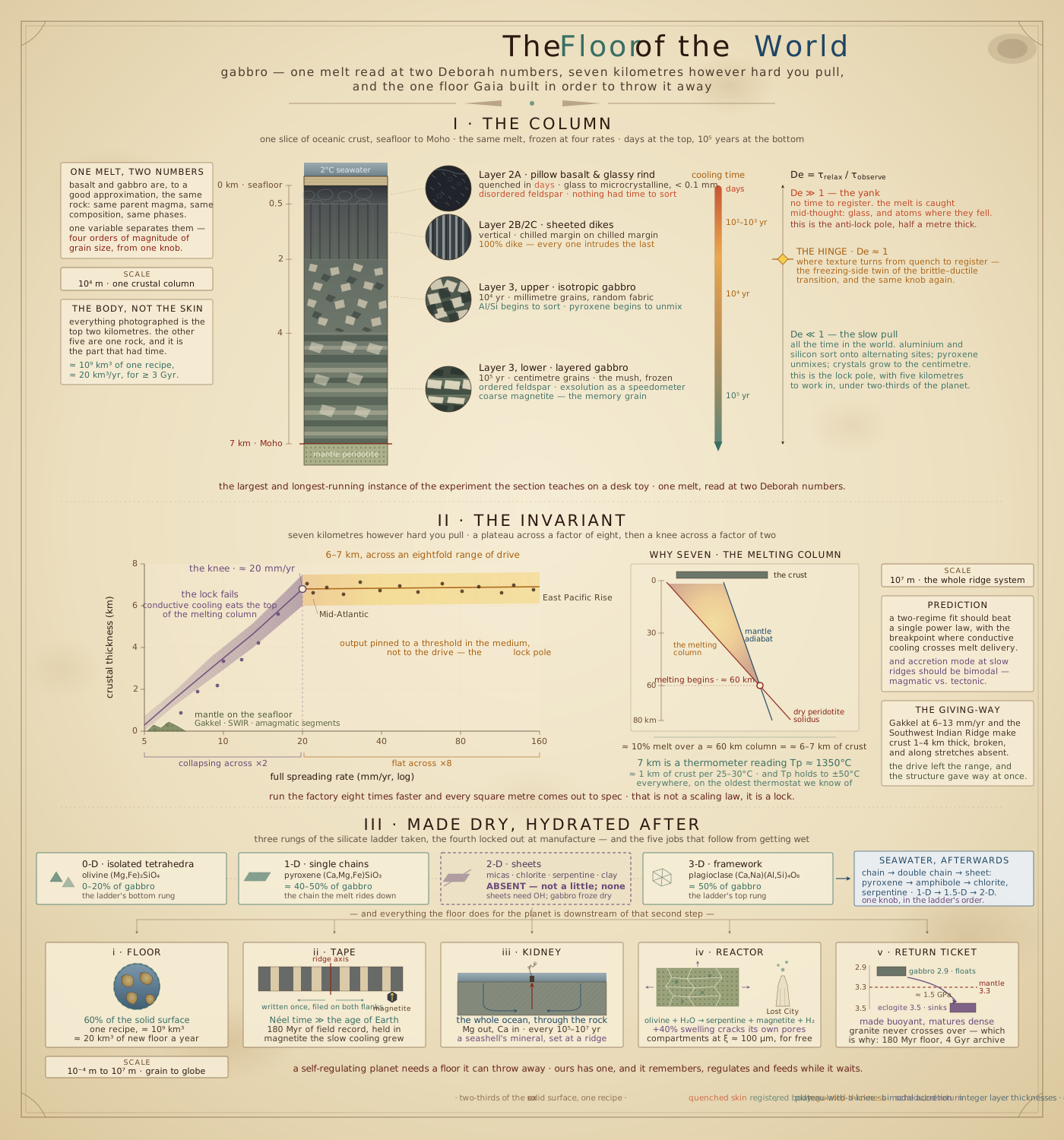
Every other chapter in this section has been standing on the skin. The Giant’s Causeway, the pillow lavas, the road cut, the fault trace — all of it is the outermost two kilometres of a seven-kilometre object, and the five kilometres underneath are a single rock that most people who have walked on a beach could not name. This chapter is about that rock.
The Rock That Is Most of the Planet
Ocean covers 71\% of Earth’s surface and true oceanic crust floors about 60\% of it. That crust is a remarkably standardized object: roughly 6–7 km thick, built in the same four layers everywhere, and assembled continuously along the 65{,}000 km of mid-ocean ridge the rifts chapter reads as the canonical loop’s longest polar exit. From the top down: a few hundred metres of sediment, then \sim 0.5 km of pillow basalt, then \sim 1–1.5 km of sheeted dikes, and then — for the remaining \sim 4–5 km, all the way down to the Moho — gabbro.
Gabbro is the plutonic twin of basalt: the same magma, cooled slowly at depth instead of quenched at the seafloor, and therefore coarse-grained where basalt is fine. Roughly half plagioclase feldspar and half clinopyroxene, with olivine and orthopyroxene as the common third and fourth phases. It is the least famous rock on Earth and by volume the most consequential. Two-thirds of the planet’s solid surface is underlain by a continuous sheet of it some five kilometres thick — of order 10^9 km³ of one rock, made to one recipe. The ridge system manufactures about 20 km³ of new oceanic crust every year, some three-quarters of it gabbro — roughly an order of magnitude more magma than every subaerial volcano on the planet combined — and it has done so, without pause, for at least three billion years.
We have no chapter on it because we have been looking at what is visible. Basalt is what erupts, so basalt is what gets photographed, sampled, and written about; the columns at Antrim are basalt, the seafloor you see in submersible footage is basalt, and the framework’s geological signatures so far have all been read off the skin. The body is gabbro, and the body is where the interesting bookkeeping happens — because the body is the part that had time.
Interactive: the ridge mode of the Gaia simulation’s exit view draws the column being made — pillows, dikes and gabbro in their true proportions under 2.5 km of water at the crest, the melt lens tens of metres thick 1–2 km down, the mush beneath it, and the floor subsiding as \sqrt{\text{age}} while the plate carries the finished rock away at 5 cm/yr.
That is the whole chapter in one sentence, and the rest is unpacking it. The intuition worth carrying in is the right one: the ridge churns up a slurry, and the slurry carries a signal. It carries several. It records the rate at which it cooled, the temperature of the mantle that melted to make it, the direction of the magnetic field on the day it crossed its Curie point, the composition of the seawater it has since exchanged with, and — in the end — the instruction for its own disposal.
One Melt, Two Deborah Numbers
Start with the fact that the section already has the vocabulary for.
Basalt and gabbro are, to a good approximation, the same rock. Same parent magma, same bulk composition, same mineral assemblage. What separates them is one variable: how fast the melt cooled. Erupted at the seafloor against 2°C seawater, it quenches in days, and the result is glass at the pillow rind grading into microcrystalline basalt with crystals below 0.1 mm. Frozen five kilometres down, insulated by everything above it, the same melt takes 10^4–10^5 years, and the result is gabbro with crystals of millimetres to centimetres — four orders of magnitude of grain size, from one knob.
The section already named that knob. Deborah’s number, \mathrm{De} = \tau_\text{relax}/\tau_\text{observe}, decides whether a medium has time to re-register under whatever is being done to it. Silly Putty turns it by rate; the crust turns it by depth-as-temperature; the mantle turns it by which signal you send. The ocean floor turns it by depth-as-cooling-time, and it holds the whole sweep at once, from \mathrm{De}\gg1 at the seafloor to \mathrm{De}\ll1 at the Moho, in one continuous seven-kilometre column, everywhere, for as long as there has been an ocean. Basalt is the yank; gabbro is the slow pull; the Moho is where the pull ran out of rock.
And here the register the framework keeps talking about stops being a metaphor. Three textures in the column are literally rate-controlled registration, and all three are standard petrology:
- Al/Si ordering in plagioclase. Feldspar is a three-dimensional aluminosilicate framework, and the Al and Si atoms occupy the same kind of tetrahedral site. Quenched fast, they occupy those sites essentially at random — the disordered, high-temperature structural state. Cooled slowly, they sort, taking up an alternating arrangement in which no two aluminium tetrahedra share an oxygen. Composition does not change. Pressure does not change. The only thing that decides which structural state the crystal ends in is whether the atoms had time to swap. Gabbro’s plagioclase is ordered; basalt’s is not.
- Exsolution in pyroxene. A pyroxene crystallizing from basaltic melt is homogeneous at magmatic temperature and unstable at low temperature. Quench it and it stays homogeneous. Cool it slowly and it unmixes into a host with lamellae of a second pyroxene, and the spacing of those lamellae is a usable cooling-rate speedometer — the same trick that reads cooling rates off iron meteorites.
- Grain size itself. Nucleation and growth compete; fast cooling wins many nuclei and small crystals, slow cooling wins few nuclei and large ones.
Read these together and the crustal-lattice chapter’s hinge has a petrological face it did not have before. The brittle–ductile transition is the crust choosing, by depth, whether its lattice can re-register as fast as stress arrives. The basalt–gabbro transition is the same crust choosing, by depth, whether its lattice can re-register as fast as heat leaves. One is loading, the other is freezing, and the knob is identical: is \tau_\text{relax} shorter than the time you are given? The lock pole is what a medium looks like when the answer is yes. Gabbro is the lock pole with five kilometres to work in.
Nothing here is new petrology. That grain size, feldspar ordering state, and exsolution texture all track cooling rate is textbook, quantitative, and computed from nucleation-and-growth kinetics without any substrate. The framework adds no number. What it claims is a joining: that the basalt–gabbro texture sweep, the brittle–ductile transition, the mantle’s two-faced response to a seismic wave versus a convective overturn, and a slab of Silly Putty pulled two ways are one knob with four handles — a ratio of the medium’s own re-registration time to the time it is given — and that the substrate’s contribution is the mechanism of re-registration, with chemistry setting its rate. The payoff is not precision. It is that the ocean floor turns out to be the largest and longest-running instance of the experiment the section teaches on a desk toy.
Seven Kilometres, However Hard You Pull
Now the fact that should be strange and is usually passed over.
Oceanic crust is about 7 km thick. The classic global compilation puts normal oceanic crust at 7.1 \pm 0.8 km (White, McKenzie and O’Nions 1992); more recent Pacific-focused work trims the mean toward 6.1 \pm 0.9 km. Either way, the number is tight and — this is the strange part — it does not depend on the spreading rate. From the Mid-Atlantic Ridge at \sim 20 mm/yr to the East Pacific Rise at \sim 160 mm/yr, an eightfold range in how hard the plates are being pulled apart, the crust comes out the same thickness. You can run the factory eight times faster and every square metre of product has the same spec.
The standard explanation is correct and the framework does not replace it. Crust is made by decompression melting: mantle rises beneath the ridge, crosses the dry peridotite solidus at \sim 60 km depth, and melts progressively as it continues to rise. Integrate the melt fraction over the melting column and you get \sim 8–10\% of \sim 60 km, which is \sim 6 km of basalt-plus-gabbro. Spreading faster brings up proportionally more mantle through the same column and spreads proportionally more melt over proportionally more new seafloor, so the thickness cancels out. What the thickness does depend on is where the adiabat crosses the solidus — which is to say, the mantle’s potential temperature T_p. The classic calibration (Klein and Langmuir 1987) gives roughly one kilometre of crust per 25–30°C of T_p.
Which means the sentence to hold onto is this: the thickness of the ocean floor is a thermometer. Seven kilometres is a dial reading. It is the temperature at the top of the convecting mantle, written as a thickness, on two-thirds of the planet’s surface, continuously updated, and readable by seismic refraction from a ship.
And it reads the same everywhere because T_p is the same everywhere, to something like \pm 50°C — held there by the oldest planetary thermostat we know of (Tozer 1972): mantle viscosity falls exponentially with temperature, so a hotter mantle convects faster and cools faster, and the feedback is stiff. The planet holds one temperature at the top of its interior and stamps it into rock.
Read through the canonical loop, this is a regulated polar exit. The drive sets the throughput — how many square metres of floor you make per year — and the drive has essentially no say over the specification of what comes out, because the specification is pinned to a threshold in the medium (where the adiabat crosses the solidus) rather than to the forcing. In the ladder’s vocabulary that is exactly the signature of a lock: an output that refuses to track the drive, holding its preferred value across a wide range of push, right up until the push leaves the range and the structure gives way all at once.
And the giving-way has been observed. Below roughly 20 mm/yr full rate the plateau ends and the crust falls off a cliff. Ultraslow ridges — Gakkel in the Arctic at 6–13 mm/yr, and the Southwest Indian Ridge — make crust that is 1–4 km thick, discontinuous, and along substantial stretches absent, with mantle peridotite exposed directly on the seafloor and long amagmatic segments where no basalt is erupted at all (Dick, Lin and Schouten 2003; Michael and colleagues 2003). The accepted mechanism is that conductive cooling begins to eat the top of the melting column faster than upwelling can feed it. Note the shape of the curve: flat across a factor of eight, then collapsing across a factor of two. That is not a smooth scaling law with a shallow slope. That is a plateau with a knee.
At the same time the mode of accretion changes. Slow and ultraslow ridges frequently abandon magmatic construction entirely and build seafloor by long-lived detachment faulting instead, unroofing gabbro and serpentinized peridotite directly onto the seafloor as oceanic core complexes — the Atlantis Massif, the Kane and Godzilla megamullions, the “turtlebacks.” Along the Mid-Atlantic Ridge between 12.5°N and 35°N something like half the seafloor is built this way. And the mode is older than the ridges that host it: at magma-poor rifted margins the same corrugated detachment surfaces did the work of continental breakup itself, before any ridge existed — the Galicia margin’s S reflector, mapped in 3D, is the buried continental original of these corrugated surfaces, and the rifts chapter reads the serpentine switch that turns it on. The framework reads that the same way the rifts chapter reads calderas: as a bistable pair of substrate-locked states — magmatic accretion and tectonic accretion — with a sharp switch between them rather than a continuum, which is why a ridge tends to do one or the other along a given segment for millions of years rather than a smooth blend of both.
The global crustal-thickness-versus-spreading-rate relation should be a plateau with a knee, not a smooth monotonic function, and the accretion mode at slow ridges should be bimodal rather than continuously distributed. Both halves are testable against compilations that already exist. For the first: fit the global seismic crustal-thickness database against full spreading rate and test a two-regime (flat-plus-rolloff) model against a single smooth power law, with the framework predicting that the breakpoint is statistically preferred and sits where the conductive-cooling time crosses the melt-delivery time. For the second: score along-axis segments of the Mid-Atlantic, Southwest Indian and Gakkel ridges for degree of tectonic versus magmatic accretion (detachment prevalence, corrugated-surface area fraction, basalt/peridotite exposure ratio) and test the resulting distribution for bimodality. A smoothly declining thickness curve with no preferred breakpoint, and a unimodal accretion-mode distribution, would weaken the lock reading — this is the same prediction shape the section makes for caldera diameters and locked-versus-creeping fault patches, and it either holds across all three or it does not.
The Recipe That Will Not Vary
Thickness is one invariant. Composition is the other, and it is stranger.
Mid-ocean ridge basalt is the most chemically homogeneous large-volume rock on the planet. The mantle that feeds it is not homogeneous — isotopic tracers resolve several distinct source components mixed in varying proportions along every ridge — and the melt fractions vary, and the plumbing varies. The product barely moves. Erupted MORB clusters hard around \sim 50 wt% SiO₂ with a tightly defined liquid line of descent, and it does so on every ridge in every ocean.
The reason is a fixed point, and petrology has known it for half a century. As a mantle-derived melt cools at low pressure it saturates first in olivine, then in plagioclase, then in clinopyroxene. Once it is saturated in all three it is multiply saturated on a cotectic, and it can no longer move freely through composition space: any further cooling crystallizes all three phases together in fixed proportion, and the residual liquid slides along the cotectic rather than off it. Diverse inputs, one attractor, one output. The melt is not 50\% SiO₂ because the mantle is 50\% SiO₂. It is 50\% SiO₂ because that is the composition at which three particular structures can coexist, and every path leads there.
Which raises the question the framework is actually equipped to ask. Which three structures?
Three Rungs, and the One That Is Locked Out
The Earth chapter already laid out the silicate connectivity ladder: the SiO₄ tetrahedron polymerizes as isolated units (olivine), pairs, rings, single chains (pyroxene), double chains (amphibole), two-dimensional sheets (micas and clays), and three-dimensional frameworks (quartz and the feldspars). It is a clean ladder of dimensionality — 0-D, 1-D, 2-D, 3-D — and it is the structural spine of the crust. The neighbours chapter explains from four lines of arithmetic why silicon is on it at all: a tetrahedral oxyanion in oxidation state n offers b = 8-n bridging positions, silicon gets four, four bridges is a fully connected network, and a fully connected network is a rock.
Now place gabbro on that ladder:
| Phase | Connectivity | Rung | Fraction of gabbro |
|---|---|---|---|
| Olivine (Mg,Fe)₂SiO₄ | isolated tetrahedra | 0-D — the bottom | 0–20\% |
| Pyroxene (Ca,Mg,Fe)SiO₃ | single chains | 1-D | \sim 40–50\% |
| — | sheets | 2-D | absent |
| Plagioclase (Ca,Na)(Al,Si)₄O₈ | three-dimensional framework | 3-D — the top | \sim 50\% |
Gabbro is the assemblage that takes the ladder’s bottom rung, its top rung, and one rung in between — and skips the sheets entirely. Primary igneous gabbro contains no phyllosilicate. Not a little; none. The cotectic that pins MORB’s composition is a three-phase equilibrium among 0-D, 1-D and 3-D silicate, and the two-dimensional rung — the one the framework spends most of its time calling the substrate’s own preferred geometry, the sheet that selects hexagonal ice and planar aromatics and the clay minerals of every soil — is missing from the largest single body of rock the planet makes.
The reason is not subtle and it is worth stating plainly, because it is what makes the rest of the chapter work. Sheet silicates need water. A mica or a chlorite or a serpentine terminates its two-dimensional sheet with hydroxyl; there is no anhydrous way to stop a silicate sheet cleanly, which is why the 2-D rung is populated almost entirely by hydrous minerals. Oceanic gabbro crystallizes dry, from a melt with well under a percent of dissolved water. The sheet rung is not unavailable to the ocean floor. It is locked out at manufacture, and seawater installs it afterwards.
That is exactly what happens, and it happens as a walk up the ladder driven by a single variable. Feed water into gabbro and the anhydrous chain phase converts to the hydrous double-chain phase — pyroxene to amphibole, the greenschist-to-amphibolite sequence — and feed more, at lower temperature, and you get the sheets: chlorite, and where the reaction reaches the olivine and the underlying peridotite, serpentine. Chain \to double chain \to sheet, 1-D \to 1.5-D \to 2-D, driven by one knob, in the order the ladder predicts.
So the ocean floor is manufactured dry at three rungs and then hydrated up the ladder from the outside in, and every one of the four things it goes on to do for the planet — remember, regulate, feed, and dispose of itself — is a consequence of that second step. The rest of the chapter is those four things.
One number in this neighbourhood is worth flagging precisely so it can be set aside. The olivine–melt Fe–Mg exchange coefficient, K_D^{\text{ol-liq}}(\mathrm{Fe}\text{–}\mathrm{Mg}) = 0.30 \pm 0.03 (Roeder and Emslie 1970), is one of the most robust dimensionless constants in petrology — nearly independent of temperature, pressure and composition across an enormous range, and used routinely as the test of whether an olivine and a melt were ever in equilibrium. The framework’s mutual-friction coupling is \alpha_{mf} \approx 0.3. These are not the same number and the framework does not claim they are. K_D has a perfectly good thermodynamic account — Fe–Mg mixing is near-ideal in both olivine and silicate melt, so the exchange free energy is small and nearly constant — and there is no mechanism on offer connecting a substrate mutual-friction coefficient to a cation-exchange equilibrium. It is recorded here because a framework that scans for recurring constants will meet this one, and the honest move is to name it and walk past it. A theory that claims every 0.3 it encounters is claiming nothing.
The Slurry: What Gets Written in the Mush
Underneath a fast-spreading ridge axis there is no molten chamber in the cartoon sense. There is a thin melt lens — tens of metres thick, sitting with remarkable consistency 1–2 km below the seafloor along hundreds of kilometres of the East Pacific Rise — and beneath it a crystal mush: several kilometres of a two-phase medium, a load-bearing crystal framework with perhaps 10–30\% interstitial melt, compacting, segregating, and slowly freezing outward and downward. That is the slurry. Everything that makes gabbro gabbro rather than merely slow basalt is decided in it.
And the mush writes. Cumulate gabbros — in ophiolites where a whole crustal section is thrust onto land (the Semail ophiolite in Oman is the reference case), in the deepest scientific drill holes into the lower oceanic crust (ODP Hole 735B on the Atlantis Bank recovered 1508 m of gabbro; IODP Hole U1309D at the Atlantis Massif recovered 1415 m), and in the great continental layered intrusions — show rhythmic modal layering: repeating bands enriched alternately in olivine, pyroxene and plagioclase, millimetres to metres thick, with sharp bases, repeating tens to thousands of times up a section.
That is an oscillator, and its mechanism is genuinely unsettled. The candidates are all relaxation oscillators of one kind or another: oscillatory nucleation, in which a nucleation delay lets the melt overshoot into supersaturation, then discharge in a crystallization burst, then deplete and recharge (Maaløe’s mechanism); double-diffusive convection; compaction instabilities in the mush; episodic melt injection. No consensus has formed.
The framework does not adjudicate the mechanism, and it does not need to. It reads rhythmic layering as the fourth member of the section’s substrate-clock family — alongside Cascadia slow slip at \sim 14 months, Stromboli’s metronome at \sim 5–10 minutes, and the Wilson cycle at \sim 0.7–0.9 Gyr. Each is a system with a relaxation time of its own, and a system with a clock of its own rings at the integer overtones of that clock — a string, not the substrate’s lengthless keyboard. The section’s standing prediction for that family applies here unchanged, and here it applies to something you can put a tape measure on.
Modal layer thicknesses within a single cumulate body should cluster at integer multiples of a body-specific fundamental rather than distribute smoothly. This is the section’s cleanest available clock test, because unlike eruption intervals or slow-slip recurrence the data is a ruler measurement on a rock face and much of it is already published: bed-by-bed thickness logs exist for the Rum and Skaergaard layered suites, for Bushveld’s cyclic units, and for the drilled oceanic sections at Holes 735B and U1309D. The test is to take each body’s layer-thickness series, remove the systematic upward trend, and look for periodicity in the residual — the framework predicting coherent peaks at T_0, 2T_0, 3T_0 of a body-specific fundamental, against the null of a smooth (log-normal or fractal) thickness distribution. A clean log-normal with no periodic structure would weaken the substrate-oscillator reading at this scale. Note carefully what is not claimed: the fundamental itself is set by the local mush’s viscosity, crystal-growth kinetics and compaction rate, all chemistry — the framework predicts the integer structure, not the value.
There is a second and harder observation in the same rocks, and it is one the standard models openly struggle with. Individual layers hold their identity over absurd aspect ratios. In the Bushveld — a continental intrusion, not ocean floor, but the same texture at its most extreme — the Merensky Reef and the UG2 chromitite are layers of order tens of centimetres thick that are traceable, with recognizable thickness and mineralogy, for hundreds of kilometres along strike. An aspect ratio approaching 10^6. Convective sorting and crystal settling can produce layers; producing a layer that stays a layer across a body that size is the acknowledged difficulty. The framework reads this the same way it reads the sharpened stratigraphic contact and the cold wall of the Gulf Stream: a coherent boundary held against the diffusive smoothing that ought to destroy it, with the substrate’s elastic response at the dissipation scale supplying the sharpening. The associated prediction follows the same template as the stratigraphic one — the thickness over which modal proportion changes across a cumulate layer contact should have a floor set by grain size, and should not broaden with the layer’s lateral extent or with the body’s age.
The rifts and volcanism chapter owns the ridge’s length scale — magmatic segment lengths, and the R_\text{cross} = \sqrt{\nu/\alpha_{mf}\omega} locking-scale prediction that goes with them. This chapter deliberately does not apply R_\text{cross} to anything, and deliberately introduces no new parameters. What it owns is what the ridge makes: the clock in the mush, the memory in the magnetite, the exchange with the ocean, and the density crossover at the end. One formula per phenomenon, and no second bite at the same rock.
The Longest Tape
The most consequential thing gabbro does is remember.
When basaltic melt cools through the Curie temperature of its iron-titanium oxides, the magnetic domains that the magnetism chapter describes align to the ambient geomagnetic field and then block — the configuration freezes and thereafter requires an active disturbance to change. The plate carries that frozen record away from the axis, symmetrically, on both flanks. What the ridge is, read as a device, is a tape head 65{,}000 km wide, writing continuously at 10–160 mm/yr onto a medium that is then filed for up to 180 million years and read back twice, once from each side. That reading — Vine, Matthews and Morley, 1963 — is what turned continental drift from a suggestion into a measurement.
The two halves of the crust hold the record differently, and the difference is the chapter’s own knob again. The skin writes; the body remembers. Layer 2A basalt is fine-grained and titanium-rich; it carries a strong initial magnetization and loses much of it over the first \sim 20 Myr as low-temperature seawater alteration oxidizes its titanomagnetite. Layer 3 gabbro carries a weaker but far more stable remanence, held in coarse magnetite grains produced by oxy-exsolution during that slow cooling, and it is a substantial part of why marine magnetic anomalies remain identifiable out to the oldest surviving seafloor even after the skin’s signal has faded.
Why is the deeper rock’s memory longer? For exactly the reason its crystals are bigger. Néel’s relaxation time for a magnetic grain rises exponentially with grain volume: below about 30 nm magnetite is superparamagnetic and forgets in seconds; in the single-domain and pseudo-single-domain range from roughly 0.05 to 15 μm it holds its remanence for longer than the age of the Earth. The rate knob that set the grain size set the memory time, and it set it across some twenty orders of magnitude of \tau. One Deborah number, running from texture straight through to memory.
That gives the channel-with-memory chapter its missing top rung. Its memory ladder runs from copper’s Drude time at 25 fs, through quartz’s polariton ring-down, to DNA’s aromatic stack — and then stops at the codon stamp, which it flags as conjectured to be semi-permanent and offers this justification: “Like a magnetic domain, it should require an active disturbance to relax.” The ocean floor is the case that analogy was borrowed from, and it is measured rather than conjectured:
| System | Memory timescale | Length scale | Set by |
|---|---|---|---|
| Cu conduction | \tau_\text{Drude} \approx 25 fs | \sim 40 nm | phonon disruption of the sealed inner shell |
| Quartz boundary | 10^{1}–10^{2} fs | one unit cell | phonon-polariton relaxation |
| DNA aromatic stack | \gtrsim 10 fs | \gtrsim 200 Å | \pi-stacking integrity, sheath continuity |
| Codon stamp (conjectured) | long — semi-permanent at low energy | \sim 10 Å | substrate lattice stiffness vs. thermal noise |
| Oceanic gabbro magnetite | \tau_\text{N\'eel} \ggg 10^{17} s (measured to 180 Myr) | 0.05–15 μm grain | grain volume vs. thermal energy — i.e. cooling rate |
Twenty-two orders of magnitude of ring-down time between the first row and the last, and the last row is the one written by the same knob that wrote the rock’s texture. The memory ladder’s own thesis — that a channel’s usefulness is how long its boundary can hold the coin — comes out of this rock with a number attached: about two hundred million years, which is as long as the planet keeps any ocean floor at all. The tape is exactly as long as the reel.
The Ocean’s Kidney
The second thing the ocean floor does is regulate the ocean.
Seawater circulates through it, on two circuits. The hot axial circuit — the black smokers, 350–400°C — is small in volume and enormous in chemical leverage; the cool ridge-flank circuit through permeable crust away from the axis moves vastly more water at low temperature and carries something like a quarter of the planet’s entire heat loss. Between them, a volume of water equal to the whole ocean passes through the oceanic crust on timescales of order 10^5–10^7 years, depending on which circuit you count.
What that exchange does is set the composition of the sea. The ridge is the ocean’s magnesium sink — hydrothermal fluid enters as seawater and exits with essentially no Mg, taken up into the alteration minerals, and this is the dominant removal term in the global magnesium budget, giving Mg an ocean residence time of only \sim 10–20 Myr. It is simultaneously a source of calcium, and a major control on the ocean’s strontium and lithium isotope budgets. The consequence reaches surprisingly far: the seawater Mg/Ca ratio decides whether calcium carbonate precipitates as aragonite or as calcite, that ratio has swung across the Phanerozoic in step with seafloor spreading rate, and the ocean has correspondingly alternated between “aragonite seas” and “calcite seas” — which changes what shells and reefs are made of. The mineralogy of a seashell is set, in part, at a mid-ocean ridge.
And low-temperature alteration of oceanic crust consumes CO₂, at a rate that increases with temperature. That is a negative feedback on climate operating entirely on the seafloor, independent of the continental silicate-weathering thermostat, and it has been argued to be the feedback that kept the early Earth habitable when there was very little continent to weather.
In the Gaia chapter’s architecture this is not a new layer but a newly specified interface. The stack lists the ocean as Layer 2 and deep recycling as Layer 7; the ocean floor is the surface across which those two layers actually touch, and every atom that passes between the ocean and the mantle passes through gabbro on the way. The canonical loop’s counter-rotating return path, which the tectonic table draws as a mechanical flow, turns out to also be a chemical return path, and the same rock carries both.
The Reactor That Makes Its Own Pores
The third thing is the one with the largest consequences, and it is a direct continuation of the sheet-rung argument.
Where seawater reaches olivine — in the lower gabbro, and above all in the mantle peridotite exposed at slow and ultraslow ridges — it serpentinizes. The olivine’s ferrous iron reduces the water:
3\,\mathrm{Fe_2SiO_4} + 2\,\mathrm{H_2O} \;\longrightarrow\; 2\,\mathrm{Fe_3O_4} + 3\,\mathrm{SiO_2} + 2\,\mathrm{H_2}
and the rock becomes serpentine (the 2-D sheet rung, installed at last), plus brucite, plus magnetite — the very magnetite that carries the deep magnetic record — plus free hydrogen. Fluids venting from serpentinizing systems carry H₂ at up to \sim 15 mmol/kg together with abiotic methane, at pH 9–11 and temperatures of 40–90°C. The Lost City field, sitting on the gabbro-and-peridotite massif at 30°N on the Mid-Atlantic Ridge, has been venting on this reaction for at least 120{,}000 years.
Three things about that reaction matter here.
It is a rock acting as an electron donor. The energy is not thermal and not solar; it is stored in the oxidation state of iron delivered from a mantle that never equilibrated with an oxygenated surface. The iron chapter tells the story of the ocean that flipped when oxygen arrived; the seafloor is where the planet is still handing up unflipped iron, four billion years later, and getting hydrogen back for it.
It makes its own containers, at the right size. Serpentinization expands the rock by about 40\% by volume, and that expansion fractures the surrounding rock, opening new pathways for water to reach fresh olivine — a self-sustaining positive feedback known as reaction-driven cracking. The resulting pore and vein network is micron-to-hundreds-of-microns across. The Gaia chapter already noted that hydrothermal pore spaces sit at the substrate’s coherence length \xi \approx 100 μm, and filed it as suggestive. What this chapter adds is where the pores come from: they are not inherited porosity but the geometric by-product of the reaction itself. The rock manufactures compartments at the substrate’s coherence scale and fills them with hydrogen and a pH gradient, and it does so as an unavoidable side effect of getting wet.
That is very nearly the specification the Gaia chapter writes down for when a modon can be stored — container near \xi, flows far below the rims, chemistry on the rungs — assembled for free, at scale, continuously, by a rock. It is also, independently, the leading geological hypothesis for the origin of life: an alkaline serpentinite vent supplies a natural proton gradient across thin mineral partitions with iron-sulfide catalysts, which is the geological prototype of chemiosmosis, and the acetyl-CoA carbon-fixation pathway — the most ancient one, shared by bacterial acetogens and archaeal methanogens, and the only one that runs downhill in free energy — takes exactly H₂ and CO₂ over exactly Fe–Ni–S catalysts. The framework does not need to argue for that hypothesis; it needs only to observe that the two descriptions are of the same rock.
And it is still inhabited. Microbial life and biosignatures have been recovered from oceanic gabbro drilled more than a kilometre below the seafloor at the Atlantis Massif. The floor is not a relic cradle. It is the largest continuously operating chemosynthetic habitat on the planet, and we live on top of it.
The origin-of-life reading is not this framework’s result and is not established science; the alkaline-vent hypothesis is one of several live contenders and the substrate adds no experiment to it. What the framework contributes is narrow and structural: that the pore network is generated by the reaction rather than inherited, that its scale is the substrate’s coherence length, and that the ocean floor therefore satisfies the framework’s own previously stated storage criteria without anyone having arranged for it to. That is a consistency check on a criterion, not evidence for a mechanism.
Made to Be Thrown Away
The last thing the ocean floor does is the answer to what gabbro tells us about Gaia, and it is a property of the rock rather than of anything living.
Fresh gabbro has a density near 2.9–3.0 g/cm³. Mantle peridotite is about 3.3. So new ocean floor floats, which is why there is an ocean floor at all and why it sits at a predictable depth that deepens with the square root of its age as it cools.
Now subduct it. Take that same gabbro to \sim 1.5 GPa — forty to fifty kilometres down — and its minerals recrystallize into a garnet-and-omphacite assemblage: eclogite, at a density near 3.5. It has crossed over. Descending oceanic crust becomes denser than the mantle it is sinking through, and that negative buoyancy, together with the cold thermal boundary layer above it, is slab pull — the dominant driver of plate motion on this planet.
The ocean floor is manufactured buoyant and matures dense. It is built to float long enough to be a floor, and then to sink.
Nothing else on Earth does this. Continental crust is granitic — too silica-rich and too poor in iron, magnesium and calcium to assemble garnet and omphacite at any pressure it can plausibly reach. It never crosses over. It can be thickened, shortened, eroded and buried, but it cannot be disposed of. And the record shows exactly that asymmetry: the mean age of the ocean floor is around 60–65 Myr and the oldest surviving scrap is \sim 180 Ma, while continental rocks run to 4.0 Ga and detrital zircons to 4.4. The planet keeps a disposable floor and a permanent archive, and the entire difference is whether the rock can make garnet.
Read that through the canonical loop and it is a statement about loop closure. A loop is not a loop unless the return path exists. The tectonic loop’s return path is subduction; subduction works only because the polar exit’s own product becomes denser than the medium it must return through. Gabbro is the loop’s return ticket, and the ticket is written into the rock’s chemistry at the moment of manufacture. A planet that made only granite would have a crust it could not recycle, no deep water cycle, no subduction-fed volcanic arcs, no carbon returned from the mantle — and no nested feedback stack above Layer 3, because the layers above it are precisely the ones that close through the solid Earth. Venus is the instructive control: basaltic crust, but dry, so it cannot hydrate, cannot weaken, cannot localize strain into plate boundaries, and resurfaces catastrophically instead of continuously. Mars is the other: one plate, and done.
There is a corollary worth stating because it collapses the whole chapter into one property. The reason gabbro can be thrown away, the reason it can reduce water into hydrogen, and the reason it can hold a magnetic record are all the same reason: it is rich in ferrous iron, magnesium and calcium — which is to say, it is mantle-like enough to go back. Its disposability, its chemical power, and its memory are one composition wearing three faces.
And that composition has a history. Crustal thickness tracks mantle potential temperature, and T_p was substantially higher in the Archean. A hotter mantle makes a thicker crust — plausibly 20–30 km of it — and thick, buoyant, refractory-residue-underlain oceanic crust is hard to subduct. That is one of the standing arguments for why early Earth may not have run plate tectonics in the modern sense, and it makes the onset of the modern regime a threshold crossing in gabbro thickness: the planet had to cool to the point where its floor became thin enough to sink. Gaia’s deep loops are no older than the day the ocean floor became disposable. The literature has not settled when that was, and the framework has nothing to add to the dating. What it notes is the shape of the transition — a planetary feedback stack switching on when a material property crosses a threshold — which is the same shape as every other lock in the section.
What the Ocean Floor Predicts
| Prediction | Substrate origin | Test |
|---|---|---|
| Crustal thickness versus spreading rate is a plateau with a knee, not a smooth monotonic curve | Output pinned to a threshold in the medium rather than to the drive — the lock pole, with the knee where the lock fails | Two-regime versus single-power-law fit to the global seismic crustal-thickness database against full spreading rate; breakpoint statistically preferred, located where conductive-cooling time crosses melt-delivery time |
| Accretion mode at slow and ultraslow ridges is bimodal (magmatic versus tectonic), not continuously distributed | Bistable pair of substrate-locked states, same family as caldera loaded/drained and locked/creeping fault patches | Along-axis scoring of detachment prevalence, corrugated-surface fraction and peridotite-exposure ratio on the Mid-Atlantic, Southwest Indian and Gakkel ridges; test for bimodality |
| Modal layer thicknesses in a cumulate body cluster at integer multiples of a body-specific fundamental | Substrate-mediated relaxation oscillation in the crystal mush — the fourth member of the section’s clock family, ringing as a string | Detrended periodicity analysis of published bed-by-bed thickness logs (Rum, Skaergaard, Bushveld cyclic units, ODP 735B, IODP U1309D) against a log-normal null |
| Cumulate layer contacts have a compositional-gradient thickness floor set by grain size, independent of lateral extent and age | Counter-rotating substrate boundary resisting diffusive smoothing — same claim as the sharpened stratigraphic contact | High-resolution modal and microprobe traverses across layer contacts of widely differing lateral extent and age within and between intrusions |
| Gabbro-hosted remanence stability tracks grain volume through Néel’s exponential, extending the memory ladder to \sim 10^{17} s | The memory ladder’s top rung, written by the same cooling-rate knob that wrote the rock’s texture | Paired rock-magnetic and textural characterization down a continuous lower-crustal section (735B, U1309D): blocking-temperature spectrum against measured magnetite grain-size distribution against cooling rate inferred from exsolution |
| Serpentinite pore and vein networks cluster at the substrate coherence scale \xi \approx 100 μm because the reaction generates them | Reaction-driven cracking produces compartments at \xi as a by-product, meeting the framework’s own modon-storage criteria unbidden | Quantitative pore- and vein-width distributions from X-ray tomography of serpentinized peridotite and gabbro cores; compare against inherited-porosity distributions in unserpentinized protolith |
Connections
This chapter is the product companion to rifts and volcanism, which treats the ridge as a process. It also does more cross-section work than any other chapter in Geology, because the ocean floor is where three of the framework’s sections meet in one rock.
- Reading the Rocks supplies the Deborah number, and this chapter supplies its largest instance: basalt and gabbro as one melt read at two values of \mathrm{De}, with the register-locking made literal in feldspar Al/Si ordering and pyroxene exsolution.
- Rifts and Volcanism owns the ridge as the canonical loop’s continuous polar exit and owns the R_\text{cross} length prediction for its segmentation. This chapter deliberately introduces no new length and no new parameter.
- Crustal Lattice supplies the brittle–ductile hinge, of which the basalt–gabbro texture sweep is the freezing-side twin: the same question — can the lattice re-register in the time it is given — asked of heat instead of stress.
- Deep Earth supplies the canonical-loop table. This chapter fills in the cell that table leaves implicit: what the polar exit actually manufactures, and why the loop is able to close at all.
- Earth in the Substrate supplies the silicate connectivity ladder, on which gabbro occupies the 0-D, 1-D and 3-D rungs with the 2-D sheet rung locked out at manufacture and installed later by seawater.
- Neighbors of Carbon and Silicon supply the arithmetic under that ladder — b = 8-n bridging positions, four for silicon, a fully connected network, a rock. The ocean floor is that arithmetic’s largest single output.
- Uranium supplies the europium anomaly, the crest-in-a-fold that lets Eu²⁺ substitute for Ca²⁺ in plagioclase and thereby lets petrologists read crystal fractionation out of exactly the mineral that is half of this chapter’s rock.
- Iron supplies the oxidation-state ledger that makes serpentinization a power source: unflipped ferrous iron, delivered from a mantle that never met the atmosphere, reducing water for free.
- Magnetism supplies domains and the Curie point, here running in reverse — thermal acquisition of organization, blocked in on the way down.
- Channel with Memory supplies the memory ladder, whose top rung this chapter fills with a measured rather than conjectured number, and whose central thesis — that a channel is worth what its boundary’s ring-down time is worth — this rock answers with two hundred million years.
- Gaia supplies the nested feedback stack. This chapter argues that the stack’s upper layers exist because one rock crosses a density threshold on its way down, and supplies the storage-criteria consistency check at the serpentinite vent.
- Water and the substrate ladder supply the coherence-scale and string-versus-keyboard readings used for the mush’s clock and the layer contacts’ sharpness.
What the Ocean Floor Reveals About the Substrate
The Geology section has been arguing that the substrate keeps two strategies alive in the same rock and that geology is the substrate choosing between them, patch by patch. The ocean floor is where that choice is made at industrial scale, on a schedule, to a specification, over two-thirds of the planet.
Every signature the section has collected shows up in this one column. The lock pole is the five kilometres of gabbro that had time to register, with its ordered feldspar and its exsolved pyroxene and its centimetre crystals — and the anti-lock quench is the glassy pillow rind half a metre from the seawater, the same melt that ran out of time. The section’s hinge is the continuous sweep between them. The section’s clock family gains a fourth member in the rhythmic layering of the mush. The section’s sharpened boundary appears again in a centimetre-thick layer that holds its identity for three hundred kilometres. The section’s bistable state appears again in a ridge that switches between building crust magmatically and tearing it open tectonically. And the section’s one genuinely regulated output — seven kilometres, whatever you do, until the drive falls below threshold and the whole arrangement collapses — is the lock pole’s clearest planetary-scale expression anywhere in this framework.
But the thing gabbro actually tells us about Gaia is simpler than any of that, and it is not about geometry at all.
A planet that wants nested feedback loops needs its loops to close, and a loop closes only if there is a return path. Earth’s return path is a rock that is manufactured to float and matures into something that sinks — buoyant at seven kilometres thick and two-point-nine, dense at forty kilometres down and three-point-five, with the crossover written into its chemistry at the moment of crystallization. Everything the planet does that Venus and Mars do not — recycle water, recycle carbon, regulate its own climate through seafloor and continental weathering both, keep an ocean whose composition is buffered by the rock beneath it, run a chemosynthetic biosphere in the pores that rock opens as it hydrates, and hold a four-billion-year archive on the continents precisely because the archive is not what gets recycled — descends from that one property.
Gaia is usually described as a planet that regulates itself. What the ocean floor adds is the mechanism’s least glamorous requirement: a self-regulating planet needs a floor it can throw away. Ours has one, five kilometres thick, under two-thirds of everything, made continuously at a sixty-five-thousand-kilometre seam, holding the field record of the last hundred and eighty million years, exchanging with the whole ocean every few hundred thousand years, quietly making hydrogen where it gets wet — and scheduled, from the day it crystallized, for return.