The Quiet Majority
The un-wound remainder — what the dc1 population is, what the condensation number counts, and why the CMB is the only instrument that has ever read it
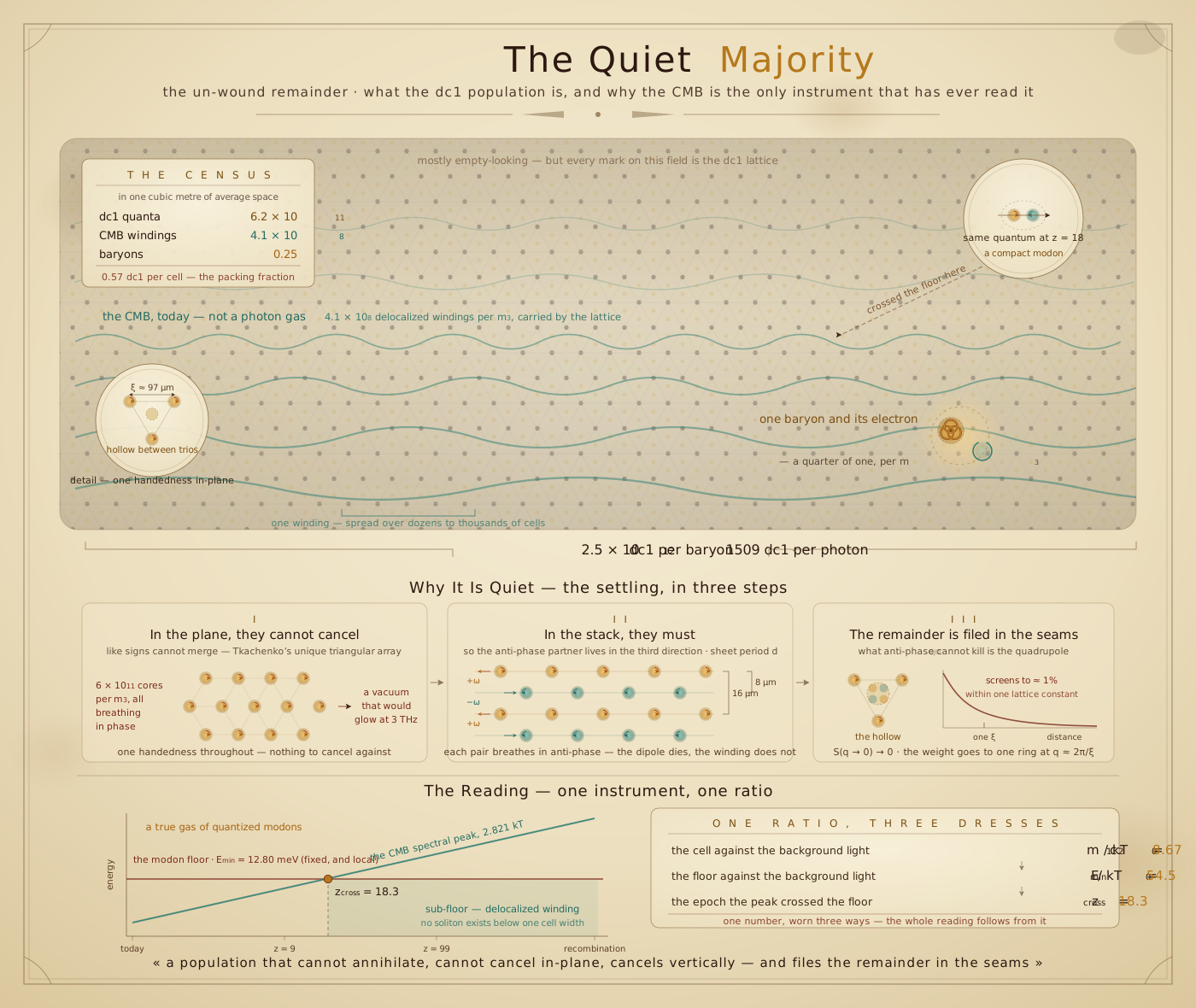
The three chapters before this one are about the winners. Why Matter Won counts the one-in-a-billion knot that survived the annihilation. The Two Ledgers balances its charge against the electron that came with it. The Forge takes those survivors and builds the periodic table. Every one of them is a chapter about 6\times10^{-10} of the boil’s output.
This chapter is about the rest.
The two-ledgers chapter named three players and then walked away from the largest one:
The dc1 background — the winding that was never wound up at all. The vast unorganized remainder.
That remainder is the substrate. It is the dark matter, the lattice, the medium light travels in, the thing every other chapter in this paper stands on. It outnumbers baryons by two and a half trillion to one. It is hard to see because it does not react, does not radiate, and does not change. Understanding dc1 shows the vacuum’s fine-grained texture.
Four points are made: 1) What one dc1 quanta means in physical terms. 2) What the huge condensation number \nu\approx8.3\times10^8 means physically (it is not a size, and it carries no units). 3) How it settled into the paired, honeycombed, self-cancelling structure the stealth vacuum chapter describes, and why the settling had to happen in the stacking direction. And what we can tell about dc1 from the cosmic microwave background, made in the same instant from the same medium. This is the only instrument that has ever taken a measurement of the dc1 lattice, and the two populations are locked together by a single ratio. 4) Where the CMB’s energy has gone — which of matter, other light, black holes, or the vacuum has been taking it, with each candidate priced — and the family tree that the two populations, and the survivors, all hang from.
All numbers below are machine-checked in scripts/dc1_population_cmb_fingerprint.py and scripts/cmb_energy_ledger.py.
The census
| Quantity | Value | What it is |
|---|---|---|
| m_1c^2 | 2.04 meV | dc1 rest energy, =\hbar c/\xi |
| n_1 | 6.20\times10^{11} m^{-3} | dc1 number density, =\rho_\text{DM}/m_1 |
| 1/\xi^3 | 1.10\times10^{12} m^{-3} | lattice cells |
| n_1\xi^3 | 0.5666 | dc1 per cell — the cell occupancy |
| n_\gamma | 4.11\times10^{8} m^{-3} | CMB photons |
| n_b | 0.25 m^{-3} | baryons |
The last three lines show that in one cubic metre of average space, there are about six hundred billion dc1 quanta, four hundred million CMB photons, and — at the cosmic mean baryon density — a quarter of one proton. Per baryon: 1.6\times10^9 photons and 2.5\times10^{12} dc1. The entire visible universe is a rounding error in the third population’s ledger, and the second population is a rounding error in the first’s.
From the cell occupancy, there are more lattice cells than dc1 particles. This does not mean the cell is half empty. The dc1 population is a Bose–Einstein condensate: it is one wavefunction with phase coherence running out to the outer-reach ceiling \ell_L\approx3.9 cm — some 400 cells across, \sim10^8 cells to a coherence volume. So “0.56 per cell” is a bookkeeping density, not a headcount of little balls sitting in little boxes. The lattice is a pattern in one continuous wavefunction, not an arrangement of objects. (This is the ordinary BEC condition n\lambda_{dB}^3\sim1 met the way the strong-coupling limit meets it — for dc1 the Compton wavelength is the coherence length, so “one wavefunction per cell” and “the cell is \xi” are the same statement, not two.)
What the condensation number counts
The framework’s most conspicuous large number is the condensation number
\nu \;=\; \frac{m_\text{eff}}{m_1} \;\approx\; 8.3\times10^{8},
the nine-decade lift from the electroweak scale to the lattice cell. It is the last un-derived quantity in the bridge equation, and it is easy to be uneasy about it because it is enormous.
Two answers:
\nu carries no units. Every reading of it is a ratio of two like quantities:
| Reading | Form | Value | What it is a ratio of |
|---|---|---|---|
| Mass | m_\text{eff}/m_1 | 8.35\times10^8 | two masses |
| Length | \xi/\bar\lambda_C(m_\text{eff}) | 8.35\times10^8 | two lengths (97\;\mum / 116 fm) |
| Clock | \omega_\text{eff}/\omega_1 | 8.35\times10^8 | two frequencies |
| VEV | v^2/(8\pi\,m_\text{eff}^2c^4) | 8.36\times10^8 | already dimensionless |
| Speed | 4\pi\,(c/v_L)^3 | 7.98\times10^8 | two speeds, cubed |
| Multipole | 4\pi/\beta_L^{\,2\ell+1} at \ell=1, \beta_L=v_L/c | 7.98\times10^8 | an inverse dipole coupling efficiency |
Meters, seconds and kilograms cancel in every line. The table shows six ways the number appears from three determinations: the first three rows are one number (the cell, sourced from \rho_\text{DM} through the geometric cell occupancy) written as a mass, a length, and a clock; the fourth is the measured collider VEV; the fifth the measured fast solar wind. The sixth is the fifth again — not a new determination but a new meaning, developed in § The dipole rung below. Three genuinely independent measured inputs, landing within 5\% — and the two tightest within 0.04\%.
The speed reading is the most physical of the five. The substrate has two speeds: c, at which excitations run along the lattice, and the Landau critical velocity v_L\approx751 km/s, past which bulk flow shreds the lattice instead of sliding through it. Their ratio is c/v_L\approx399, and
\nu \;=\; 4\pi\left(\frac{c}{v_L}\right)^{3}.
So \nu is, up to the Gauss 4\pi, the volume ratio of the two speeds — how much room the vacuum gives flow before it tears. That is not a mysterious quantity at all, and the number that fixes it is measured in the solar wind (Outer Rim Onset).
The dipole rung
The speed reading can be carried one step further, and the step lands on machinery the framework already uses. The information-architecture chapter evaluates the standard small-source multipole efficiency — the Chu-limit scaling P_\text{rad}/P_\text{kept} \sim \beta^{\,2\ell+1}, with \beta the source compactness and \ell the radiating multipole order — at the substrate’s inner compactness, \beta_c = v_\text{rot,inner}/c = 0.776, at \ell=2, and gets the modon’s radiation-port ratio \kappa/g = (2\alpha_{mf})^{5/2} = 0.281. Evaluate the same ladder at the substrate’s outer compactness, \beta_L = v_L/c = 1/399, at \ell=1, and the rung is
\beta_L^{\,3} \;=\; \left(\frac{v_L}{c}\right)^{3} \;=\; \frac{4\pi}{\nu}
— identically the speed reading, inverted. So 1/\nu is, up to the same Gauss 4\pi that heads the cell occupancy, the dipole radiation efficiency of a single quantum moving at the lattice’s speed limit. The framework’s two conspicuous dimensionless numbers are one ladder read at its two rims: the dissipative inner end at \ell=2 giving 0.281, the reactive outer end at \ell=1 giving 4\pi/\nu.
Why this is the right rung for a single quantum is the settling story of the next section run in reverse. The anti-phase stack exists to cancel the collective dipole — that cancellation is the quiet. A lone dc1 quantum joining an excitation must therefore re-open the very channel the pairing closed, and it can only do so by exchanging momentum with the lattice — which is what mutual friction is — at the dipole’s price, \beta_L^{\,3}. A unit-coupled excitation must then gather 4\pi/\beta_L^{\,3} = \nu quanta acting in concert, and that collective is the effective quantum: m_\text{eff} = \nu\,m_1. Read this way, “condensation number” is literal — it is the head-count needed to amortize a dipole deficit, the same kind of number as the Cooper-pair count the litre made physical above — and the stealth of the vacuum and the size of \nu are the same fact, read from the two sides of the ledger: the vacuum’s silence is the excitation’s price.
The rung assignment is not tunable. \ell=2 would give \beta_L^{\,5}\sim10^{-13}, five decades from \nu^{-1}; \ell=0 is barred by number conservation everywhere in the framework. The one candidate that lands on \nu is the dipole. The distinction from the information-architecture ladder — which bars \ell=0 and \ell=1 for a self-contained spinning node and skips to the quadrupole — is that a node radiating into open substrate has nowhere to send momentum, while a quantum coupling to the lattice does; the dipole is the first rung open to a single quantum, and the last one the pairing closes collectively. That distinction is an argument, not a calculation.
The identity 4\pi/\nu = (v_L/c)^3 is the outer rim’s clean-units law, and deriving it — explaining why the lattice selects exactly this \omega_0 — remains open (WIP-16), with a no-go showing the vortex sector alone cannot make the selection. What the dipole rung adds is a physical referent: it converts an unexplained cubic into the \ell=1 rung of a ladder already in use at the inner rim, and it converts \nu from “a large number” into a coupling efficiency — which is exactly the shape of answer WIP-30’s “restate the residue as a pure number” program calls for. It must not be cited as a derivation of v_L.
The liter
What \nu means in space forms an interesting picture.
The effective quantum — the substrate’s universal vortex excitation, m_\text{eff} = 1.70 MeV/c^2, the same object inside an electron and inside a nucleon — weighs \nu dc1 rest-masses. Where is that mass? Divide:
V_\nu \;=\; \frac{\nu}{n_1} \;=\; 1.34\;\text{litres},
a cube about 11 cm on a side, spanning \sim1100 lattice cells in each direction. (Cross-check from the energy side: m_\text{eff}c^2/\rho_\text{DM}c^2 = 1.35 litres.)
So: the electron’s inner vortex is a 150 fm phase singularity whose mass-share is drawn from about a litre of vacuum. The 150 fm is where the phase winds; the litre is the volume of substrate whose mass fully balances it. The vortex is not breathing out to macroscopic scale on each cycle; what the picture shows is that \nu is a collective occupation number — the count of quanta that must act in concert to make that one unit. It is the same kind of number as the Cooper-pair count in a superconducting grain, scaled to the vacuum. It shows the scale difference between the mass of the electron and the dc1 substrate, and how smooth tapering ripples balance it out over a large volume.
The largest stretch for a dc1 quanta is shown in the outer reach chapter that puts the substrate’s coherence ceiling — the largest still-structured mode it will hold — at \ell_L\approx3.9 cm. That is a different read on the same statement: \ell_L=(c/v_L)\,\xi and \nu=4\pi(c/v_L)^3 together give V_\nu=4\pi\ell_L^3/f identically, so the 11 cm and the 3.9 cm are one number a fixed factor (4\pi/f)^{1/3}=2.8 apart.
The coefficient supports this independently. The count produces a volume, choosing the Gauss solid angle reading V_\text{eff}=4\pi\ell_L^3 predicting 407. The solar wind measures c/v_L\approx400, which picks Gauss — the same 4\pi that heads the cell occupancy and \nabla^2\Phi=4\pi G\rho, here with no G anywhere in the expression. There is a size discrepancy between 4\pi and 4\pi/3; covered in the (Outer Reach).
How the quiet ones settled
The why-matter-won chapter ends with the annihilation done: the knots that found partners burst into modons, one lonely knot in a billion survived, and the counter-rotating population is gone. What it does not follow is the far larger population that was never in the fight — the circulation that never wound up into anything, and therefore had no antipartner to find.
Those vortices could not annihilate. They had only one thing left to do: arrange. And the arranging is tightly constrained, because it has to satisfy two demands at once that pull opposite ways.
Interactive: watch the quiet ones settle — the un-wound quanta drift, space themselves into the triangular array (in the plane they can only orbit and spread), then alternate into the anti-phase stack (out of the plane they cancel), and the CMB rides across the finished lattice as delocalized winding; the HUD carries the three-children census below.
In the plane, they cannot cancel. Like-signed vortices in two dimensions cannot merge and cannot destroy each other; they can only orbit and space themselves. The stable configuration is the one Tkachenko proved unique — the triangular array, the same lattice photographed in rotating helium and in laboratory BECs (Substrate Particles § Seen in the laboratory). The sheet is therefore chirality-coherent: one handedness throughout.
Two things follow, and they have to be kept apart because the paper uses the word anti-phase for both. Same-handed neighbours can breathe against each other in the plane: two vortices of one handedness a cell apart, \pi out of step in their breath, are the promenading pair of the walking-droplet bath and the Cooper pair of the conductors chapter — and at spacing \xi such a pair orbits at \kappa/(\pi\xi^2), which for the paired circulation quantum h/2m_1 is exactly \omega_1. But a triangular lattice is not bipartite: no assignment of breath phases makes every nearest neighbour anti-phase, for the same reason a triangular antiferromagnet is frustrated. The best the plane can do is three sublattices at 0^\circ, 120^\circ, 240^\circ, whose trio around each hollow sums to zero — a three-phase cancellation, not the octave. And a counter-circulating partner cannot be in the plane at all. An opposite-sign pair does not orbit; it translates, at \kappa/(2\pi d), which at d=\xi is c (or c/2 for the paired quantum). That object is the photon, and a vacuum built of them would not be at rest. With any mutual friction the pair spirals in and annihilates instead — the known fate of a vortex–antivortex checkerboard.
Out of the plane, they must. Be precise about what needs cancelling: a static energy density does not radiate, and \rho_\text{DM} on its own is no embarrassment. What would radiate is the breath — every cell carries a core oscillation at the dc1 hum \omega_1\approx3\times10^{12} rad/s, and 6\times10^{11} unpaired oscillating sources per cubic metre, all in phase by chirality coherence, is a coherent source filling the universe. That vacuum would not be dark; it would glow at 3 THz. So the cancellation has to be found somewhere, and by the previous paragraph it cannot be found in the plane. It is found in the stacking direction, and the stack can do what the plane cannot because it alternates along a single axis and is bipartite: the sheets alternate, a +\omega sheet at 0, a chirality-reversed layer at d_\text{GJO}/2\approx8\;\mum, a +\omega sheet at d_\text{GJO}\approx16\;\mum, and each pair breathes in anti-phase — one core expanding as its partner contracts, trading energy across the shared seam at the dc1 hum \omega_1\approx3\times10^{12} rad/s without ever leaking it (The Lattice Breathes in Pairs). The clean period-2 cancellation the time crystal needs has its only unfrustrated home here.
What alternates from layer to layer is the chirality of the pair orbital — the \ell-vector of the paired order parameter, e^{+i\phi} in one layer and e^{-i\phi} in the next, the same reversal the vertical-cone selection rule acts on — and not the circulation of the vortex lines that thread the stack. A vortex line cannot reverse its circulation along its length, and the layers are not decoupled (the vertical period is smaller than the core), so the threading lines carry one sign throughout. This is exactly how the vortex sheet of ^3He-A is built: a stack of equidistant walls between \ell-reversed domains, whose merons alternate in orientation while every one carries a single quantum of the same sign.
This is worth stating as a structural claim rather than a description, because the paper has carried the two facts separately and they are one fact: the chirality stack exists because the plane is committed to a single sign. Once handedness survives the boil — the why-matter-won result — an in-plane lattice can never be self-cancelling — the octave has no unfrustrated home on a triangular array, and a counter-circulating partner in the plane is a photon, not a piece of the vacuum — so the counter-chiral partner has nowhere to live except the third direction, and the vertical period is then fixed with no free parameters by the Glaberson–Johnson–Ostermeier instability of the threading vortex lines. One should be careful about what the counter-rotating layer is, though: it is not surviving antimatter. It is the paired condensate’s own anti-phase partner, the structure half-integer winding forces on the medium regardless. That distinction is why the layer cancels energy without touching the winding ledger — the books balanced in the previous chapter stay balanced.
And the cancellation is not quite perfect, which is the last piece and the reason any of this is discoverable. The anti-phase breath kills the dipole; what it cannot kill is the quadrupole, and that residue is bottled in the honeycomb of hollows dual to the triangular array — one interstitial gap between each trio of cells. It self-screens to \sim1\% within a single lattice constant, so a probe standing one envelope away sees nothing. In momentum language this is the same statement as S(\mathbf q\to0)\to0 with the surviving weight pushed to a single diffuse ring at q\approx2\pi/\xi — the stealth vacuum, reached from the multipole side instead of the geometric one. The quiet majority is quiet by construction, at the deepest level the framework can currently reach: it is a population that cannot annihilate, cannot cancel in-plane, cancels vertically, and files the remainder in the seams.
One ratio ties the background light to the cell
Now the reading. There is exactly one instrument that has ever been pointed at the dc1 lattice for long enough to matter, and it is not a torsion balance or a terahertz bench. It is the CMB — and the reason it works is that the two populations were made in the same instant, out of the same medium, and are locked together by a single measured ratio:
\boxed{\;\frac{m_1c^2}{kT_0} \;=\; \frac{2.036\;\text{meV}}{0.2349\;\text{meV}} \;=\; 8.67\;}
The vacuum’s own quantum is 8.7 times the temperature of the light left over from its making. Everything in the rest of this section is that one number in a different dress.
Dress one: the floor. The lattice’s infrared floor — the smallest modon it can hold — is E_\text{min}=hc/\xi=2\pi m_1c^2 = 12.80 meV (3.09 THz). Against today’s CMB, E_\text{min}/kT_0 = 54.5.
Dress two: the crossing. The CMB’s spectral peak today sits at 2.821\,kT_0 = 0.663 meV. Because the floor is a fixed local energy while photons blueshift into the past, the peak sat exactly on the floor at
1+z_\text{cross} \;=\; \frac{2\pi\,m_1c^2}{2.821\,kT_0} \;=\; 19.3, \qquad z_\text{cross} \;=\; 18.3 .
At recombination the CMB peak sat 57\times above the floor — comfortably a gas of true, quantized modons. It has been below it since z\approx18.
The CMB is not made of light any more
That last sentence is not a figure of speech, and it is the framework’s most under-advertised claim about the most-measured signal in cosmology.
In this framework a photon is a modon — a topologically protected counter-rotating dipole-vortex soliton, and the Bessel boundary-matching that lets it exist has no solution below one cell width (Photon as Modon). Below E_\text{min} there is no soliton. What carries the energy instead is the modon’s conserved circulation delocalized over many cells — a stretched winding riding the lattice, travelling at the same c but no longer a compact quantum (Modon Floor).
Compute the fraction of today’s CMB photons still above the floor: \sim3\times10^{-21}. Which is to say all of it. The cosmic microwave background, right now, is not a photon gas in the framework’s strict sense. It is 4\times10^8 delocalized windings per cubic metre being carried by the dc1 lattice, each spread across dozens to thousands of cells depending on where in the spectrum you look. The thing we point horns at is the substrate, doing the carrying.
This is why the CMB is a fingerprint of the dc1 and not merely a contemporary of it. Every FIRAS channel is a different epoch’s crossing: a photon observed today at \nu_\text{obs} crossed the floor at 1+z=\nu_\text{floor}/\nu_\text{obs}, so 600 GHz reads z\approx4.2 and 60 GHz reads z\approx50.6. The FIRAS frequency axis is a crossing-epoch map (Open Problems, WIP-12), and its 50-ppm blackbody says that the soliton-to-collective handoff was non-dissipative at every one of those epochs. The framework predicts exactly that: the crossing is adiabatic by \mathcal{A}=\nu_\text{floor}/H(z_\text{cross})\sim10^{28}, so any scar is \sim10^{-28}, twenty-three orders below what FIRAS could see. The CMB has already run a transparency test on the dc1 lattice across an order of magnitude in redshift, and the lattice passed.
z_\text{cross}=18.3 lands inside cosmic dawn — the epoch of the first stars, and of the contested EDGES 21 cm absorption trough at z\approx17.2 (unconfirmed; SARAS 3 reports a non-detection). It is tempting, and it would be wrong. The crossing is adiabatic to one part in 10^{28}; it cannot drive anything. The two epochs coincide because m_1c^2/kT_0 happens to be 8.7, in the same way that \rho_\Lambda^{1/4}\sim m_1c^2 is a coincidence the framework reads as one identity without claiming a mechanism. Recorded as numerology, not offered as a prediction.
What the light stopped being able to do, and when
The racetrack on the boil plate invites one more reading of the crossing, and it should be met head-on because it is the natural one: that the modons were blasting the orbitals apart until z\approx18, that afterwards they could only bounce, and that this is when structure got its chance. The numbers say no, and the reason is worth a table, because the CMB did stop being able to do things — four things, at four different epochs — and the crossing is the one that changed nothing for matter.
| Epoch | z | CMB peak vs. Rydberg | What the light stopped doing | What that released |
|---|---|---|---|---|
| Matter–radiation equality | 3400 | 1/6 | setting H — the modon gas’s pressure stopped holding the substrate’s clumping in check | the tachyonic engine grows freely; dc1 structure begins |
| Recombination | 1100 | 1/19 | ionizing hydrogen — the Wien tail ran out of 13.6 eV photons | atoms hold; baryons drop out of the photon drag and fall into the wells |
| Thermal decoupling | \sim150 | 1/140 | heating the gas by Compton exchange through the residual free electrons | gas cools below the CMB; the Jeans mass falls; 21 cm absorption becomes possible |
| Floor crossing | 18 | 1/1060 | being a modon gas | nothing, for matter |
The blasting-apart was real, and it ended at recombination, two hundred million years before the crossing, when the peak already sat nineteen times below the Rydberg and only the far Wien tail could still take an atom apart — the famous delay of recombination to 3000 K is the 10^9 photons per baryon keeping that tail populated as long as it did. By z=18 the peak was a thousand times below the Rydberg; an atom had been safe for as long as there had been atoms. Structure got its chance twice, and both times earlier: the substrate’s at equality, the baryons’ at recombination.
What the crossing changed is what the CMB is, not what it can do to matter. The channels matter uses are unchanged across it. The Rydberg gap (below) is four decades wide on both sides of the floor. The Thomson cross-section is frequency-independent, so a sub-floor winding scatters off a free electron exactly as a compact modon does — and this is not a hope: the Sunyaev–Zel’dovich effect is measured at z<1, long after the crossing, which is the direct demonstration that the light–electron coupling survived the handoff. And the crossing is adiabatic to one part in 10^{28}. A transition that changes the carrier of the energy without changing its coupling to anything else cannot drive structure, and does not. The coincidence with cosmic dawn stays what the callout above says it is.
Where the energy went
The CMB’s spectral peak sat at 0.72 eV when the light was released and sits at 0.66 meV now. Every photon has given up 99.9\% of its starting energy, so where did it go? The short answer is that each one stretched with the expansion. Some of it could have gone elsewhere along the way, so here are the numbers showing that it is essentially all the stretch:
| Candidate sink | Fraction of the CMB’s energy, per Hubble time | Sign |
|---|---|---|
| Photon–photon scattering (Euler–Heisenberg, \sigma\propto(h\nu/m_ec^2)^6) | 3\times10^{-54} | — |
| Matter: Compton exchange with free electrons since reionization (\tau=0.054, 4y) | \sim10^{-6} | a gain |
| Black-hole capture (\sigma=27\pi(GM/c^2)^2, all holes at 10\,M_\odot … 10^6\,M_\odot) | 10^{-23} … 10^{-18} | loss |
| The vacuum, dissipatively: the floor crossing (1/\mathcal{A}) | 10^{-28} | loss |
| The vacuum, adiabatically: stretching with the expanding substrate | 1-1/(1+z), all of it | loss |
Matter is not a sink; it is a negligible source. The Rydberg gap closes the atomic channel — a meV photon cannot move an electron between orbitals, so it cannot “charge up” an atom in any essential way. The only channel left is Compton scattering off free electrons, and Planck’s \tau=0.054 says about one photon in twenty has been scattered once since the universe reionized. But the energy exchanged in such a scattering is set by the electron’s temperature, not the photon’s, and the electrons in the ionized gas and in cluster atmospheres are hotter than the CMB by four to seven decades. The exchange therefore heats the light — this is the Sunyaev–Zel’dovich effect, measured — and its size, the Compton y, is a few parts in a million. Matter has been handing the CMB a millionth of its energy, not taking any.
Light does not fragment on light. Below the electron mass the photon–photon cross-section falls as the sixth power of energy. At the CMB peak it is 10^{-89} m², and a photon would need 10^{54} Hubble times to meet another one. The picture of photons slamming into each other and shattering is right for gamma rays and wrong by every order of magnitude there is for microwaves.
Black holes swallow it, and the trickle is nothing. The hourglass argument already found that every permitted hole is a net absorber of background light. The capture rate is what it is: even weighting all the black-hole mass in the universe toward supermassive holes, the CMB loses \sim10^{-18} of itself per Hubble time. The hole “fills up with CMB” at a rate that could not be measured in the lifetime of the bubble.
The vacuum does it — but by stretching, not by eating. What is left is the substrate, and the substrate has two ways to take energy from light. The dissipative way is the floor crossing, the soliton-to-winding handoff, and its price is 1/\mathcal{A}\sim10^{-28}: the CMB’s 50-ppm blackbody is the direct measurement that this channel is closed. The adiabatic way is the one that matters, and it is worth saying in the framework’s own words rather than the textbook’s.
A photon is a quantum of circulation — the modon’s \kappa above the floor, the same \kappa delocalized across many cells below it. Circulation is conserved (Kelvin’s theorem; the emergent U(1) of London electrodynamics), so nothing about the winding can change in flight. What can change is the span the winding is stretched over, and its energy is hc/\lambda — set by the span. The lattice carrying the two ends of that span is in Hubble flow. As the substrate the light rides on separates, the span grows with a, the winding count stays fixed, and E\propto1/a follows with no free parameter. The photon does not decay into anything. It is pulled longer by the medium it lives in.
And the energy it gives up is booked, not lost. A gas of windings has pressure P=u/3 — in this framework, the kinetic energy of the cell vortices bouncing off one another (Spacetime Dynamics) — and expanding against a pressure is work: dE=-P\,dV with P=E/3V gives E\propto V^{-1/3}=a^{-1}, the same law read from the other side. The light pushes the lattice apart and pays with its own wavelength. That work goes onto the expansion ledger, the one the Friedmann equations balance, and it is the reason radiation pressure doubles the deceleration in the second Friedmann equation. Nothing is charged up, and nothing is stored: the 99.9\% went into pushing the vacuum apart, reversibly. A contracting substrate would hand every joule back as blueshift.
The decay rate of a CMB photon is \dot E/E=-H(t). The framework’s marginal point reads the vacuum’s own incomplete relaxation as a frozen photon mass, m_\gamma c^2\sim\hbar H_0. These are the same number, and not by accident: the rate at which the vacuum falls toward its Lorentz-invariant density and the rate at which its light cools are both the expansion. The CMB decays at the rate the vacuum relaxes. This is the sense in which the two populations remain twins long after the boil — they share one clock, and the next section says who has been holding it.
Did they shape each other?
Yes, in three concrete ways, and the genealogy plate below draws all three.
The fog held the clock first. Radiation dominated the expansion until matter–radiation equality at z\approx3400. For those first fifty thousand years it was the annihilation fog — the wound-and-paired child of the boil — that set H(t), and therefore set how fast the un-wound remainder diluted toward its marginal density n_\text{tr}. The CMB ran the vacuum’s settling clock. Then the roles swapped: from z\approx3400 to z\approx0.3 the dc1 lattice set H, so every one of the floor crossings FIRAS samples — z=50 down to z=4 — happened on the dark matter’s clock, and the 6.7 of the CMB’s 7.0 e-folds of cooling since recombination were paid to the lattice’s expansion. Since z\approx0.3 the residue \Lambda holds it. Three children of one boil, taking turns holding the one clock.
The lattice fixed the fog’s temperature — as a ratio. m_1c^2/kT_0=8.67 is a today-number, because T dilutes and m_1 does not, and it is recorded above as a coincidence. But it is the coincidence that makes the CMB legible as a lattice instrument at all: had the ratio been 10^3, the crossing would have happened before recombination and FIRAS would be reading an ordinary modon gas; had it been 10^{-1}, the crossing would lie in our future. That the peak crossed the floor at z\approx18, inside the clean matter era, is what turned the FIRAS axis into a crossing-epoch map.
They reunited. This is the one the intuition of a shared origin is really reaching for. At the boil the circulation split into the wound and the un-wound, and for the first hundred million years the two were distinct things: compact solitons travelling through a lattice at rest. Since z\approx18 they are not. Every CMB photon is now a winding of the lattice — a stretched phase pattern in the same single wavefunction that the dc1 census counts, spread over dozens to thousands of its cells. The two populations that diverged at the first fork are riding together again, and the ratio that binds them, n_1/n_\gamma=1509, is the ratio they were born with.
Two things it is not. The CMB’s energy today is 5\times10^{-5} of the critical density; it cannot shape the vacuum’s present state, and its lost energy did not go into \rho_\text{DM} (a conserved rest-mass count) or into \rho_\Lambda (an un-relaxed residue, not a reservoir). And the CMB is not feeding the substrate: the why-matter-won chapter said it plainly — the fog is where the boil’s coherence went, the bath the lattice relaxes toward, not a store it draws from. The stretch is the whole story, and the stretch is reversible.
The boil invariant
There is one more number the two populations share, and unlike the ratio above it is conserved.
Photon number and dc1 number both dilute as a^{-3}. Their ratio is therefore fixed at the boil and has not moved since:
\frac{n_1}{n_\gamma} \;=\; 1509 .
Per CMB photon — per annihilation event, roughly — the substrate carries about fifteen hundred dc1 rest-masses of circulation that never wound up into anything. That is a boil-bookkeeping number in the same ledger as \eta_B, and it is surprisingly modest: the winding was not a rare accident on a featureless sea; it was a process that engaged something like one part in a thousand of what was available.
It also reorganizes a coincidence cosmology has never explained. Why is dark matter about five times baryons? Write it out:
\frac{\Omega_\text{DM}}{\Omega_b} \;=\; \underbrace{\frac{1}{\eta_B}}_{1.6\times10^{9}} \;\times\; \underbrace{\frac{m_1}{m_p}}_{2.2\times10^{-12}} \;\times\; \underbrace{\frac{n_1}{n_\gamma}}_{1509} \;=\; 5.37 ,
against a measured 5.365. The first two factors are enormous, run in opposite directions, and nearly cancel; what is left of order unity is set by the third. And the framework already owns two of the three — \eta_B = \varepsilon_\text{chirality}^{\,9} = 5.8\times10^{-10} from the chirality ledger (measured 6.1\times10^{-10}, -5\%), and m_p/m_1 from \xi on one side and the junction ledger on the other.
n_1 is built from \rho_\text{DM}, so the relation closes on itself and cannot predict \Omega_\text{DM}/\Omega_b. What it does is convert an unexplained cosmological coincidence into one boil-bookkeeping number — how many dc1 stayed un-wound per photon — which sits in the same ledger the framework already computes \eta_B in. That is a relocation of the problem onto ground where the framework has machinery, exactly as WIP-30 relocated the Route-2 question from an illegal length to a legal pure number. Whether the boil’s dynamics fix 1509 is open, and it is the sharpest new target this chapter leaves.
Why matter is blind to both
The last thing the two populations share is the reason neither has ever shown up in a laboratory that was not looking for it.
| Energy | Ratio to the Rydberg | |
|---|---|---|
| Rydberg — cheapest atomic transition | 13.61 eV | 1 |
| dc1 rest energy m_1c^2 | 2.04 meV | 1/6.7\times10^{3} |
| CMB photon (spectral peak) | 0.66 meV | 1/2.0\times10^{4} |
Both sit about four decades below the cheapest thing an atom can do. Neither can move an electron between orbitals; neither can be absorbed by ordinary matter through the channel ordinary matter actually uses. Chemistry is deaf to both, and it is deaf for the same reason.
This is the substrate’s stealth stated in its most ordinary form. The stealth vacuum chapter gets there through the structure factor and hyperuniformity; the magnetism chapter gets there through anti-phase multipole screening. But the flat-footed version matters too: even if the lattice were a perfectly ordinary gas with no clever texture at all, its quanta would still be four decades too soft to talk to an atom. The texture explains why the vacuum does not scatter light; the Rydberg gap explains why it does not interact with matter. Two independent reasons for one invisibility, and the CMB sits in the same blind spot — which is precisely why it survived intact for thirteen billion years to be read.
The quark and the little guy
One question deserves a direct answer, because the picture invites it: is a quark related to a dc1?
In this framework they are not related — they are the same medium in two states. The two-ledgers chapter already says it: baryons and leptons are the two ways the substrate organizes net winding, and dark matter is the substrate that stayed un-wound. There is no second species anywhere in this framework — the “dag” scaffold was retired and the bridge equation actively prefers its absence.
What the census adds is the size of the step between the two states:
| Mass | In units of m_\text{eff} | |
|---|---|---|
| dc1 | 2.04 meV | 1/\nu = 1.2\times10^{-9} |
| Effective quantum m_\text{eff} | 1.70 MeV | 1 |
| Up quark | 2.16 MeV | 1.27 |
| Down quark | 4.67 MeV | 2.75 |
| Electron | 0.511 MeV | 0.301\;(=\alpha_{mf}) |
The lightest quarks are one effective quantum, within a factor of a few — and the effective quantum is exactly \nu dc1. So the intuition that the quarks are “dc1 roll-ups that climbed a ladder” is right, and the ladder has one rung, whose height is the condensation number. Above that rung the states differ by how many seams they present rather than by how leaky each seam is — the leak is the universal \alpha_{mf}=0.3008, capped at \tfrac12, everywhere. The electron sits at one seam, the quarks at a few, the proton at \sim1836 (visible product \alpha_{mf}^{(N)}\approx552) — the whole visibility spectrum of the Standard Model laid on one horizontal line at m_\text{eff}.
Two honest limits on that reading. The quark masses are the loosest numbers in the PDG and are scheme-dependent (\overline{\text{MS}} at 2 GeV), so “within a factor of a few” is the correct strength of the claim and no more. And the framework does not currently derive the light-quark absolute scale — what it derives is the ratio m_d/m_u=2 from the arm ledger. The rung is a placement, not yet a prediction.
The zero-seam row
Put the seam reading beside the census and the whole mass ledger assembles into one chain, gathered from three chapters:
m \;=\; \underbrace{N}_{\substack{\text{unpaired}\\\text{seams}}} \times \underbrace{\alpha_{mf}}_{\substack{\text{per-seam}\\\text{leak}}} \times \underbrace{\nu}_{\substack{\text{quanta}\\\text{per unit}}} \times\; m_1 ,
a topology count (Mass as Rotational Energy), the universal leak (Weinberg Angle), the condensation count (this chapter), and the bare quantum. Every mass in the framework is three dimensionless factors on m_1.
The chain asks where the lattice itself sits, and the answer closes the visibility spectrum at its far end: the lattice cell is the N=0 object. Not because it is seamless — a cell carries six counter-rotating layers per cell width (Substrate Particles § Six sheets to a cell), and every one of them is a seam. But they are paired seams: each faces its anti-phase partner rather than open substrate, and the framework’s own mass-defect rule — a seam that has become internal faces inward; it no longer leaks (Mass as Rotational Energy § The mass defect) — zeroes them out of the mass ledger. The leak each seam would emit is handed to its partner every breath cycle and handed back the next; the energy circulates reactively and never registers on a scale. The seam count that enters the mass chain counts unpaired seams, and pairing takes the cell’s from six to zero.
The consequence is one this chapter’s census has been relying on silently: the vacuum weighs exactly its rest-mass count. \rho_\text{DM} = n_1 m_1 closes with no boundary surcharge because a fully paired medium has nothing on the leak ledger — dark matter is what a zero-external-seam configuration weighs. If paired seams leaked at any rate, dark matter would outweigh its own census and the bridge equation’s two legs would not meet. The lattice is also, by the same token, the one tier whose mass is not rotational energy: a particle’s mass is 100\% leaked rotation, while the cell’s rotational budget at v_L is a negligible \tfrac12\beta_L^2 \sim 3\times10^{-6} of its rest energy. Two ledgers, cleanly split: the rest-mass ledger is dark matter; the leak ledger is everything ever weighed in a laboratory.
The visibility spectrum then has three regimes rather than two. At N=0, fully paired, sit the lattice and the lightest neutrino — bare quanta at the floor m_\text{eff}/\nu = m_1, no boundary leak added on top. Between 0 and 1 seam the axis measures a leak — the neutrinos up through the electron, the heaviest object one boundary can contain. Above the Kopnin ceiling it counts seams — the quarks upward. And N acquires a geometric meaning against the lattice: it measures how transversally an object’s topology cuts the layering. The electron borrows its single boundary from a chirality sheet (Proton Core § Why one boundary suffices); the Borromean junction admits no globally tangent surface and must patch together \sim1836 of its own; the vacuum sits at zero because it is the layering.
This also rereads the settling. An unpaired primordial cell vortex is a single leaking seam — ledger-indistinguishable from a sub-electron fermion. The un-wound population was born on the leak side of the spectrum, and the settling of the earlier section is its migration to N=0; the wound survivors are the fermions that stayed behind. The residue is a falsifier in principle: any unpaired cells surviving today are a defect density that would emit at the floor, 3.09 THz — just past FIRAS’s \sim2.9 THz band edge, in the same terahertz-gap window prediction 1 below already targets. Bounding it needs an emission model the framework has not built; recorded as a target, not a score.
The genealogy of vortices
Everything the Big Bubble section has counted came out of one soup, and the chapters have handed the counts around in pieces: \eta_B here, 1509 there, the survivors’ neutrality in one place and the CMB’s sub-floor character in another. What has been missing is the family tree — one plate on which every major player has a parent, a branching ratio, and a fate. This is it.
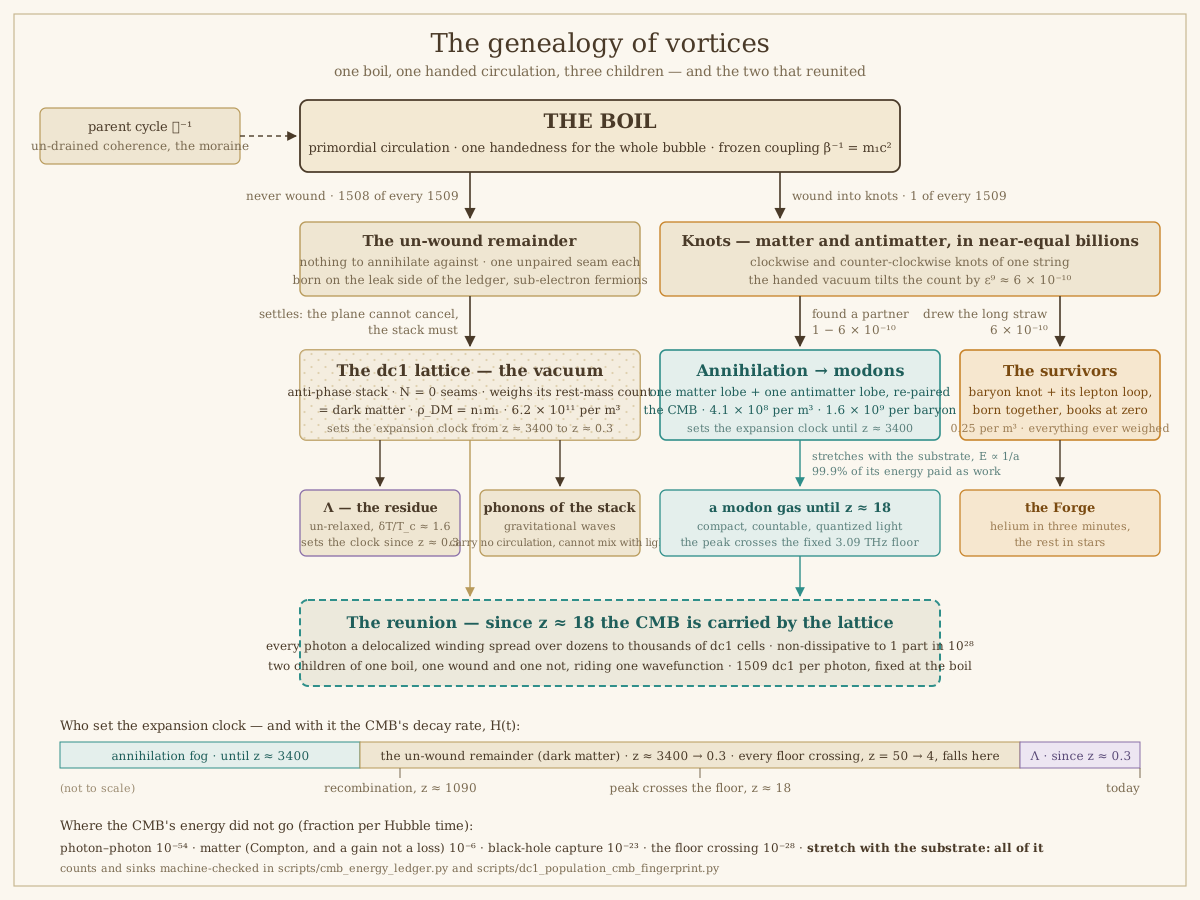
Three children, two forks
The tree has exactly two branching ratios, and both are numbers the framework already carries.
| Fork | Ratio | What decided it | Where the paper computes it |
|---|---|---|---|
| Wound or not | 1:1508 | the boil’s dynamics (open) | The boil invariant, n_1/n_\gamma=1509 |
| Paired or not | 1-\eta_B:\eta_B | the handed vacuum, \varepsilon_\text{chirality}^{\,9} | Why Matter Won |
The leaves are the census:
| Child | Born as | Fate | Today, per m³ |
|---|---|---|---|
| The un-wound | one unpaired seam each — ledger-indistinguishable from a sub-electron fermion | settles to N=0: the anti-phase stack, the lattice, the vacuum, dark matter | 6.2\times10^{11} |
| The paired knots | a matter knot and its mirror | annihilate into modons — one matter lobe, one antimatter lobe, set travelling; a photon gas until z\approx18, lattice-borne winding since | 4.1\times10^{8} |
| The unpaired knots | the one-in-a-billion with no partner, each with its lepton loop attached | the periodic table | 0.25 |
Read down the rightmost column and the whole visible universe is the last row. Read across the middle column and the three fates are three answers to one question — what does a quantum of circulation do when the boil ends? — settle, re-pair, or lock.
Where the quark and the electron sit on it
The intuition that “primordial quarks linked up and spun out an electron at the same time” has a precise home on the tree, and it is one node, not two. The winding ledger says the survivors were born neutral — a baryon knot is a knot with its lepton loop already attached, because a wound-and-locked circulation of fractional arms cannot exist without the whole-quantum counter-charge that closes its books. So the electron is not a second child of the boil that later found a proton; it is the free half of the same knot. The zero-seam row then places the pieces on the mass ladder: the quark is one effective quantum with a few seams open, the electron is one effective quantum with one seam open leaking \alpha_{mf}, the proton is \sim1836 seams patched around a junction, and the dc1 is the same quantum with every seam paired shut. They are siblings by mass — all one rung \nu above the bare quantum — and differ only in how many seams face open substrate. The lattice is what a quark would be if it had never climbed the rung.
The photon sits on the tree in a way that is easy to miss: it is the only child with both a matter and an antimatter parent. A modon’s two lobes are one clockwise knot and one counter-clockwise knot, re-paired rather than erased (Why Matter Won § Where the antimatter went). The antimatter is not gone from the genealogy; it is the second lobe of every CMB photon, and it has been counter-rotating against its partner across the whole thirteen billion years.
What the tree makes visible
Three things that were true before the plate was drawn but were not seen.
The eras of cosmology are the children taking turns. Radiation-dominated, matter-dominated, \Lambda-dominated — in the framework these are not three substances but the three descendants of one circulation, each holding the expansion clock in turn: the paired knots until z\approx3400, the un-wound until z\approx0.3, the un-wound’s own un-relaxed residue since. The energy section above is the payoff: the CMB’s decay rate has always been whichever sibling held the clock.
The reunion is a real event, not a metaphor. The dashed box at the bottom of the tree is the only place two branches rejoin. Above the floor the CMB was a gas of solitons in the lattice; below it, every photon is a delocalized winding of the lattice, one pattern in the same wavefunction the census counts. The two populations that separated at the first fork now propagate as one medium, and the boil invariant 1509 is, read this way, the number of dc1 cells each CMB winding has to spread across on average to rejoin it.
The genealogy has one open number. The second fork, \eta_B, the framework derives. The first, 1509, it does not — it is the sharpest target this chapter leaves, and the tree shows exactly what a derivation would have to deliver: the fraction of the boil’s circulation that wound at all. That fraction is what \Omega_\text{DM}/\Omega_b is made of, once the two enormous factors in the identity above cancel.
Every number on the plate is already in this paper; the plate adds no new measurement and no new derivation. What it adds is lineage — a parent for each population, a branching ratio at each fork, and the observation that two of the three children have rejoined. Neutrinos are omitted for legibility; they belong on the wound branch as relics of the same annihilation era, and the lightest of them sits at the N=0 end of the ledger beside the lattice (Neutrino Mass Scale).
Predictions and falsification
- The entire CMB is sub-floor light, and has been since z\approx18. This is a statement about the character of the radiation, not its speed — sub-floor propagation is at c to \varepsilon<6.5\times10^{-16} from the CHIME/FRB refit. The falsifier is the shape of the in-band dispersion at 0.1–3 THz: the protected reading gives essentially nothing and then a sharp exponential rise \propto\exp(-\nu_\text{floor}/\nu), with no \nu^2 term at all. A smoothly growing \nu^2 advance would falsify the modon reading and with it this chapter’s claim that the CMB stopped being quantized light (Modon Floor).
- The crossing is non-dissipative at every epoch FIRAS samples. Predicted scar \sim10^{-28} with shape \propto\nu^{-3/2}. Any spectral distortion correlated with \nu_\text{floor}/\nu_\text{obs} — a feature that moves when you change your assumed \xi — would be a detection of the lattice, and its position would measure \xi directly. Its absence at FIRAS sensitivity is already recorded as confirmation of transparency, not of the lattice.
- n_1/n_\gamma is comoving-conserved. Any observation implying the dc1-to-photon number ratio evolved after the boil — e.g. a dark-matter density evolving differently from a^{-3} beyond the moraine-crust correction the framework already carries — would break the “un-wound remainder” identification, because a population that is topologically un-wound has nothing to decay into. The one true sink the CMB has — black-hole capture, the only trap that works on sub-Rydberg light — has now been checked and drains only \sim10^{-21} of it per Hubble time (Black Holes § The hourglass), so the conservation this prediction leans on is safe by twenty orders of magnitude.
- No second dark species, at the sub-percent level. The census leans on \rho_\text{DM}=n_1m_1 with nothing else in the budget — the second species was retired and the bridge actively prefers its absence. Give a second dark component a mass fraction f_d and only (1-f_d)\rho_\text{DM} is left for dc1, so the cosmology leg of \nu moves by (1-f_d)^{-1/4} while the electroweak leg does not move at all. The two legs currently agree to 0.04–0.08\% (the agreement); a second component at f_d=1\% shifts the cosmology leg by 0.25\% and degrades that agreement severalfold. The honest bound is set by Planck’s own \sim1\% on \rho_\text{DM} rather than by the framework’s residual, which is an order of magnitude tighter — but a confirmed percent-level second dark component would falsify the single-species census this chapter is built on.
- The collective scale is centimetres, and the coefficient is Gauss’s. \nu dc1 quanta occupy 1.34 litres — a cube 11 cm on a side — which is the outer reach ceiling \ell_L\approx3.9 cm rewritten, not a second result. The falsifiable content is the coefficient: as \nu and v_L tighten, Q\equiv\nu/[4\pi(c/v_L)^3] must converge on exactly 1 (it sits at 1.03 today). A convergence on 3/4\pi (a solid ball) or on 1/4\pi (a bare close-packed radius) would falsify the Gauss reading and with it the identification of this 4\pi with the one in \nabla^2\Phi=4\pi G\rho. Separately, a demonstrated coherent substrate structure at metres would break the ceiling from the other side.
- The CMB cools as exactly T_0(1+z), and its only sink is the stretch. The energy ledger leaves no room for a dissipative term: the vacuum takes the light’s energy adiabatically, as work against radiation pressure, and every other channel is below 10^{-6} per Hubble time (and the matter channel runs the other way). Write the temperature law as T(z)=T_0(1+z)^{1-\beta}; the framework predicts \beta=0 identically and a chemical-potential distortion \mu\sim10^{-28} from the floor. Sunyaev–Zel’dovich thermometry of clusters to z\sim1 and molecular absorption lines to z\sim3 currently bound |\beta|\lesssim0.01. A confirmed \beta\neq0 — light losing energy to the medium at a rate other than H — or a \mu distortion not traceable to an astrophysical source would falsify the adiabatic-stretch reading and reopen the question of what the substrate does to the light it carries.
Honest assessment
What is solid is the census and the arithmetic on it. n_1, n_\gamma, n_b and their ratios are three measured densities and one adopted \xi; nothing is fitted, and the numbers can be re-run in one script. The unit-invariant readings of \nu are algebra on quantities the framework already carries, and they settle the dimensional worry cleanly: the recipe had units, the number does not — which is why the recipe could be retired without losing anything.
What is genuinely new here and worth the chapter is the reframing, in three places. The litre makes the condensation number physical for the first time — it is a collective occupation number, and \sim1100 cells on a side is what “collective” means. (It is a picture, not evidence: it is the outer-reach \ell_L in different clothes, as the section above says outright.) The claim that the chirality stack exists because the plane is committed to a single sign ties why-matter-won to the vertical geometry that the framework had been carrying as an independent result; it is an argument, not a calculation, and should be read at that strength. And the observation that essentially the entire CMB is sub-floor light was implicit in the modon floor from the day it was written but had never been stated — it changes what one thinks the CMB is in this framework, without changing a single prediction, which is exactly the signature of a reading rather than a result.
Two later additions carry their own labels. The zero-seam row is a reframing: it computes nothing new, but it makes \rho_\text{DM}=n_1m_1 a consequence (paired seams leak nothing) rather than an assumption, and it closes the visibility ladder at both ends. The dipole rung is a reading of an existing identity: 4\pi/\nu = (v_L/c)^3 was already the speed reading, and identifying it as the \ell=1 rung of the Chu ladder gives the number a physical referent — a single-quantum coupling efficiency — but the mechanism argument (why the momentum-exchange channel sits at \ell=1 where the self-contained node’s skips to \ell=2) is qualitative, and neither may be cited as a derivation of the clean-units law, which remains open (WIP-16).
The energy ledger is arithmetic on measured cross-sections and one framework adiabaticity, and its conclusion — the CMB’s energy went into work against the expanding substrate and nowhere else — is the standard cosmological one restated in the framework’s mechanism (a conserved winding pulled longer by the medium it rides). Its value is that the three intuitive sinks are now priced rather than dismissed, and that the sign of the matter channel is recorded. The “one clock” identification of the photon’s decay rate with the marginal point’s frozen photon mass is a reading of two things that are both H, not a derivation of either. The genealogy is a plate, not a calculation: every number on it is already in the paper, and the tree’s one open number — the first fork, 1509 — is the same open number the boil invariant already flagged. The claim that “the eras of cosmology are the children taking turns” is a restatement of \Omega_r, \Omega_m, \Omega_\Lambda in the framework’s identifications, and should be quoted at that strength.
What is weakest is the \Omega_\text{DM}/\Omega_b relation, and the callout above says so in the text where a reader meets it. It is an identity. It cannot predict. Its only value is that it isolates n_1/n_\gamma=1509 as a single boil-bookkeeping number and puts it beside \eta_B, which the framework does compute. Whether that proximity turns into a derivation is unknown; it is offered as a target, not a score.
The z_\text{cross}=18.3 / cosmic-dawn coincidence is numerology and is labelled numerology. The crossing is adiabatic to 10^{-28} and cannot drive the 21 cm signal. The framework’s actual cosmic-dawn prediction is a separate and unrelated one — enhanced early collapse from the evolving MOND scale (early structure formation) — and the two must not be quoted as if they reinforced each other.
The quark rung is a placement within a factor of a few against the PDG’s loosest masses. It answers “are quarks and dc1 the same stuff?” — yes, and the step between them is \nu — but it does not derive the light-quark scale, and it should not be cited as if it did.
Finally, the chapter inherits every open item its ingredients carry: \nu is not derived bottom-up (WIP-30), the close-packing↔︎marginal-point identification is still owed a Bogoliubov–de Gennes calculation (WIP-15), and the in-band terahertz detection that would turn the modon floor from a bound into a measurement has not been run.
Putting the section in context
The Big Bubble section now follows the boil’s output down all three of its channels. Why Matter Won tracks the sliver that survived annihilation. The Two Ledgers shows that sliver had to come out neutral. The Forge builds the elements from it. This chapter follows the other 84\% of the matter budget — and, by count, the other 2.5\times10^{12}-to-one — the circulation that never wound up, settling into the paired, honeycombed lattice that every later chapter treats as given, and carrying, still, the background light that was made alongside it.
That is the shape of the whole paper in one section. The winners get the periodic table, the chemistry, the biology, the mind. The quiet majority gets everything else: the metric, the speed of light, the gravitational scale, the vacuum energy, and the boundary layers this framework spends most of its pages reading. It has been the scaffold all along — and the finer we can resolve its texture, the further the lens sees.