The Two Ledgers of the Boil
Charge balance as conserved winding — the exact-neutrality companion to the matter–antimatter tilt, and why the proton knots while the electron floats free
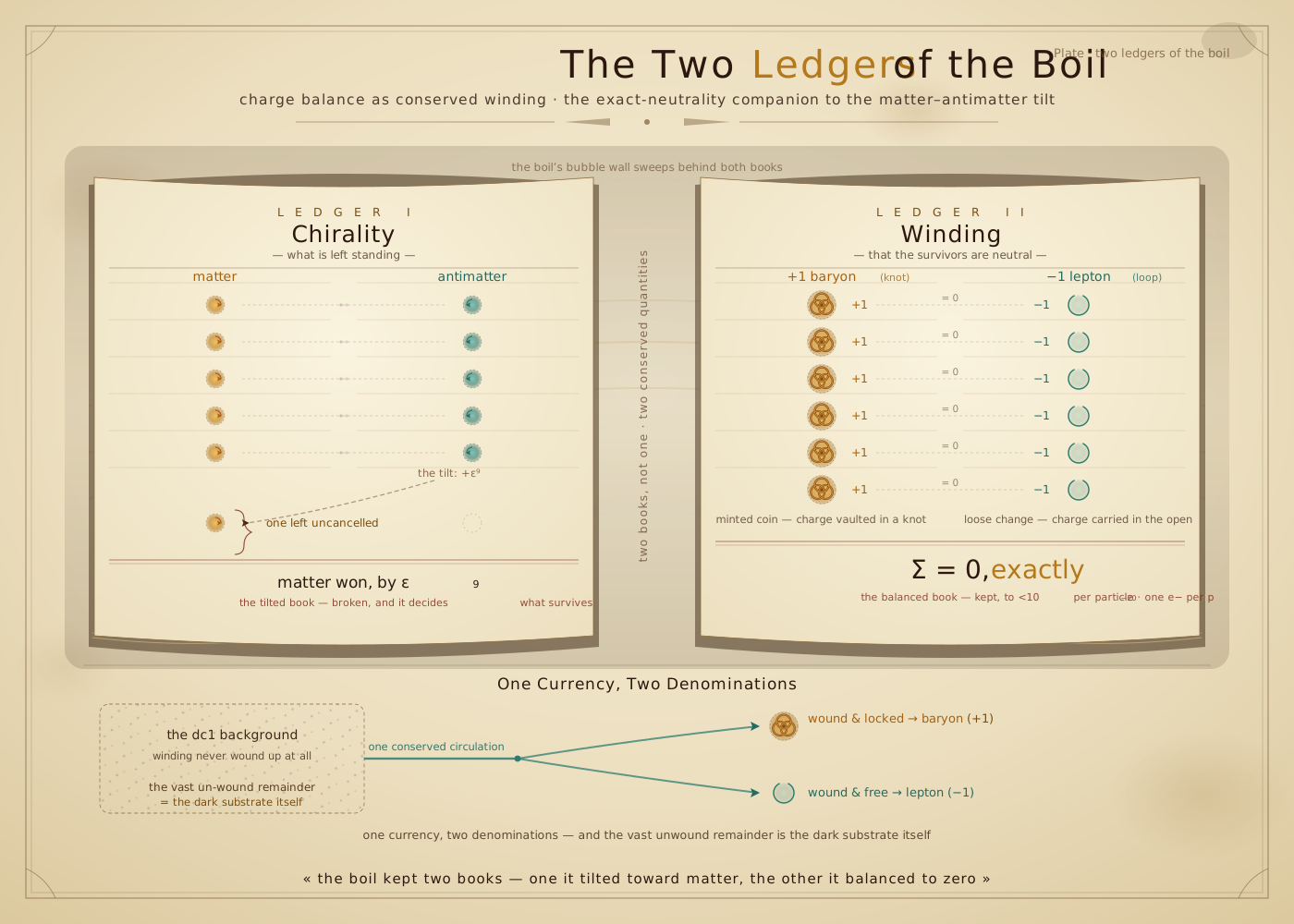
Interactive: open the boil simulation — the two ledgers, closed in sequence. In The boil, the wall sweeps out and the knots it mints race to attrition: every clockwise knot that finds a counter-clockwise one re-pairs into a two-lobe modon (the fog is the CMB), and the handful with no partner left are the survivors, each shown with its electron already attached. The lock follows one of them to the femtometre: three same-chirality loops reconnect into the Borromean knot, the whole unit of counter-winding the lock sheds rolls off as the electron, and the wave train from the reconnection cusps folds the bath into the 1836 seams. Two loops only shows why a meson does not lock.
Two books, not one
The previous chapter balanced one of the boil’s books. It asked why matter survived at all, and found the answer in the vacuum’s handedness: matter and antimatter are a co-rotating knot and a counter-rotating knot of the same string, and a handed vacuum does not treat them as equals. The tilt is tiny — \varepsilon_\text{chirality}^{\,9} — but it is enough. Matter won.
That is the chirality ledger, and it decides what is left standing. But a surviving population of matter knots raises a second, entirely different question that the chirality story never touches: why is the matter that survived electrically neutral, to the last decimal place we can measure? Every proton in the universe is matched by exactly one electron. The cosmic charge sums to zero so precisely that experiment bounds any residual per particle to better than one part in 10^{20} ([R135]). Nobody tuned that. Standard cosmology takes it as a boundary condition — the universe started neutral, and gauge symmetry keeps it so.
The substrate does better than assume it. In this framework, charge is not an abstract label pinned to a particle; it is a reading of circulation — the net winding of substrate flow, the same quantity whose sign flips a knot into its antiknot (why-matter-won), the same fractional winding that the proton core reads off a three-armed junction. And circulation, in a medium like this, is a conserved, bookkept thing. This chapter balances that second book — the winding ledger — and it turns out to explain not one fact but three: why the universe is neutral, why the proton is a heavy knot while the electron is a light free breath, and where the antimatter’s charge partner went.
What charge is here: winding you cannot fake
Start with the mechanical picture the rest of the paper already uses. A particle is a knot of substrate flow — a spinning core wrapped in counter-rotating boundary shells. Its charge is the net circulation that flow carries out to the world: the co-rotating flow reaching the confinement boundary, decomposed to its monopole, is the electric charge (proton core). This is not a metaphor the framework can take or leave. It is measured one domain over: in the fractional quantum Hall effect the Laughlin quasiparticle is literally a vortex in an electron fluid carrying exactly e/3 of charge. Charge is winding. The paper has committed to that.
Now the consequence your accountant already knows. Circulation in an ideal fluid is not something you can create from nothing. Wind up a vortex here and the medium must unwind an equal and opposite amount somewhere else — Kelvin’s circulation theorem in an ordinary fluid, and in a superfluid something even sharper: circulation is quantized, and total winding is a topological invariant. Vortices are born in canceling pairs; the net winding of an irrotational background stays zero no matter how violently you stir it. You have seen the principle in a coffee cup — stir clockwise at the center and a counter-rotating sheet forms at the wall — and in a superfluid it is not a tendency but a law.
Put those two facts together and the neutrality of the universe stops being a coincidence:
The substrate began the boil with zero net winding, and no process at the boil could change that total. Every unit of positive winding it wound into a matter knot forced an equal unit of negative winding into being. The universe is neutral because charge is conserved circulation, and the vacuum it condensed from was not spinning to begin with.
The electron is not an independent accident that happens to cancel the proton. It is the counter-winding the substrate had to shed the instant it wound up a proton.
The two denominations: why one knots and one floats
Look at what the winding has to be deposited as. The substrate’s circulation is quantized, and a free excitation must carry a whole quantum of it. But the proton is built from quarks whose charges are fractional — +\tfrac23, -\tfrac13 — and a fraction of a quantized winding cannot stand alone. It is topologically illegal as a free object. The only way the substrate can carry fractional winding is to lock three of them together at a three-armed Borromean junction whose arms sum to a whole number. That is why the proton is a knot. Confinement is not an extra force bolted on; it is the winding ledger refusing to let a third of a quantum walk around loose.
The electron carries -1 — a whole quantum. It is legal on its own. It has no partner it must lock to, no fraction it must complete, so it does not knot. It settles as a single seam around the framework’s universal effective quantum, m_\text{eff}\approx 1.70 MeV/c^2, showing the seam’s \alpha_{mf} share of it as m_e = 0.511 MeV/c^2 — one loop of substrate, floating free. The electron does not tie knots to balance itself because it has nothing to balance: it is already a whole, legal, minimal unit of counter-charge. The knotting is a symptom of the quarks’ fractional charge, and the electron simply does not share the disease.
So the two particles are the substrate’s two denominations of one conserved currency:
| Proton (baryon) | Electron (lepton) | |
|---|---|---|
| Winding it carries | +1 (from +\tfrac23,+\tfrac23,-\tfrac13) | -1 |
| Constituent charge | fractional → illegal free | integer → legal free |
| Consequence | must knot (Borromean lock) | floats (single quantum) |
| Seam count N (leak \alpha_{mf}=0.3 each) | \approx 1836, at \sim 1 fm | 1, at \sim 150 fm |
| Rest energy | 938 MeV | 0.511 MeV |
One is a minted coin — a whole charge stamped into a locked, high-tension vault you can never break open. The other is loose change — the same magnitude of charge, carried in the open at a fraction of the energy. They are made of the same brick: the universal effective quantum is identical in both (proton core shows the proton is \sim 1836 of them and the electron is one, each leaking the same 30\%). The difference is never what they are made of, nor how leaky each seam is. It is only how the winding ledger forced each denomination to be packaged — and therefore how many seams the packaging takes.
The 1836 is a packaging cost, not a brick count
This reframes the mass ratio. The charges balance exactly 1{:}1 — that is forced. The masses stand at 1836{:}1 — and now that number has a one-line reading:
\frac{m_p}{m_e}=\frac{N_p\,\alpha_{mf}}{N_e\,\alpha_{mf}}=\frac{N_p}{N_e}\approx 1836 .
The proton buries its unit of charge inside a violently confined nuclear junction; the electron carries an identical-magnitude unit in the open. The mass ratio is the price of hiding the same conserved charge two different ways — the confinement cost of the coin over the change. The paper already had this identity (proton core); the winding ledger tells you why the two objects it relates carry equal and opposite charge in the first place, which the mass identity alone never explained.
The exception that proves the rule: why FQHE quasiparticles walk free
There is an objection sitting right on top of this, and following it is what turns the selection rule from an assertion into an argument. The chapter’s own headline evidence that charge is winding — the fractional quantum Hall effect — is a case where a fractional charge is emphatically not confined. The Laughlin quasiparticle carries e/3 and moves around freely. If a third of a quantum cannot walk around loose, how does it manage it there?
Because it is not loose. It is embedded in a medium that already carries the complementary winding. The Laughlin state is a condensate with flux attached to every electron; the quasiparticle’s missing two-thirds is supplied, continuously and locally, by the fluid it swims in. The books balance — they are just not balanced by the quasiparticle.
That is the whole selection rule, and it comes free from a premise this chapter has already paid for. The dc1 background is irrotational — that is the same assumption that gives exact neutrality, the assumption that the vacuum was not spinning to begin with. An irrotational medium has no complementary winding to lend. So a fractional excitation in the vacuum has nowhere to put its remainder and must lock into a junction that sums to an integer, while a fractional excitation inside a wound medium has a lender and does not. One premise — the background does not spin — and two consequences: the universe is neutral, and quarks are confined.
So the FQHE is not a loose analogy the chapter borrows for credibility. It is the control experiment: put fractional winding in a medium that carries winding and it floats; put it in the irrotational vacuum and it knots. Same excitation, two media, opposite verdicts, and the framework predicts which is which.
The ledger balances live: beta decay
You do not have to reach back to the boil to watch the winding ledger settle. A free neutron does it every fifteen minutes:
n\;(\text{udd},\,0)\;\longrightarrow\;p\;(\text{uud},\,+1)\;+\;e^-\;(-1)\;+\;\bar\nu .
Read it in the substrate. The neutron is a neutral knot. One of its Type-B arms (-\tfrac13) re-winds into a Type-A arm (+\tfrac23) — a net change of +1 in the knot’s winding. Circulation conservation permits this only if the substrate simultaneously buds off a whole quantum of -1 counter-winding. That bud is the electron. The antineutrino carries away the leftover chirality bookkeeping — the handedness entry from the other ledger — which is why neutrinos are the substrate’s one-handed messengers.
Interactive: watch it balance — the neutron knot with its arm ledger drawn, one Type B arm re-winding to Type A, the shed unit of counter-winding rolling off as the electron and the antineutrino streaking away with the handedness entry.
This is the balancing at the single-particle level. The electron is not summoned from elsewhere; it is the counter-winding shed when a knot’s arm re-winds. “Does the proton pull out the aroma of the electron?” — in beta decay the two are literally the same event: the arm’s re-winding is the electron’s creation. Essence and emergence are not two things here. They are one act of bookkeeping read from opposite sides.
The nuclear face: why nuclei want N \approx Z
The same principle sharpens a term the binding-energy curve flags as its least-developed: the asymmetry energy a_\text{sym}(N-Z)^2/A\approx 28 MeV, the cost a nucleus pays when its neutron and proton counts drift apart. In the liquid-drop formula it is fitted; the proton chapter labels its substrate mechanism “Type-A/Type-B junction chirality imbalance (least developed).”
The winding ledger is that mechanism. Protons and neutrons differ by exactly the Type-A/Type-B (up/down) winding count of their arms. A nucleus that is lopsided in N-Z is lopsided in its internal winding tally, and — just as the free neutron does — it can lower its energy by re-winding arms and shedding electrons (or positrons) until the tally balances. The valley of beta-stability is the winding ledger seeking zero at nuclear scale, and a_\text{sym} is the energy penalty for being off the balance point.
And this one does turn into a number. The strong force between nucleons is a shared counter-rotating seam — a boundary that binds by cancelling circulation across the interface. So ask what each kind of contact has to cancel. A proton against a neutron presents opposite Type-A/Type-B arm excess: the seam cancels it, and binds. A neutron against a neutron presents the same winding on both sides: there is nothing to cancel, and the seam does not bind. One sentence — the seam binds only what it can cancel — and the seam energy splits in two, \epsilon_{np} for unlike contacts and \epsilon_\text{like}=0 for like ones.
Count the contacts on a close-packed nucleus (twelve neighbours, six shared seams per interior nucleon) and the liquid-drop coefficients fall out together, with the absolute seam energy — the framework’s hard open piece — cancelling exactly in the ratio. What is left is a_\text{sym}^\text{int}=a_V, plus the exclusion cost E_F/3 that any Fermi gas pays:
a_\text{sym} \;=\; a_V + \frac{E_F}{3} \;=\; 15.68 + 12.28 \;=\; 27.96\ \text{MeV},
against a measured 28.06 MeV, with no free parameters — the derivation is in Proton Core § the asymmetry term, the numbers in scripts/nuclear_asymmetry_seam.py. Honestly sized, the nuclear saturation density carries this to about 2%, not to the quarter-percent the central values suggest; and the exclusion half is textbook physics, so what the ledger contributes is specifically why the like-nucleon seam is empty.
The same sentence pays for four more facts on the way past. The deuteron is bound while the dineutron and diproton are not. Pure neutron matter does not bind at all — set every contact to like-like and the binding goes to zero, which is why a neutron star is held together by gravity and not by the force that holds a nucleus. The valley of beta-stability sits at N\approx Z. And like nucleons pair, which is the pairing term. Five nuclear facts, one conservation law, no parameters — the triangulation this opens is tracked in Open Problems WIP-32.
The three players, and where the antimatter’s charge went
There are three players including the dc1 background, and the ledger sorts them cleanly:
- Baryon knots — winding wound up and locked (fractional arms, a vaulted three-strand coil). Topologically frozen, hence stable matter.
- Lepton quanta — winding wound up but free (a whole quantum, a single loop). The mobile counter-charge that keeps the books level.
- The dc1 background — the winding that was never wound up at all. The vast unorganized remainder.
That third player is already the paper’s dark matter: \rho_\text{DM}=n_1 m_1, “the substrate itself” (early structure formation). So the lens says something quietly strong: baryons and leptons are the two ways the substrate organizes net winding; dark matter is the substrate that stayed un-wound. The enormous dark-to-baryonic ratio and the exact baryon–lepton charge balance are the same statement twice — almost none of the substrate ever wound up, and the sliver that did had to keep its books at zero.
And the winding ledger closes the antimatter story from the charge side, where why-matter-won closed it from the chirality side. Every annihilating pair — a +1 matter knot meeting its -1 antimatter mirror — took both a unit of positive and a unit of negative winding out of the ledger together, summing to zero, and left the balance untouched as they burst into modons. Annihilation is winding-neutral by construction. So the surviving matter excess, whatever its size, was born neutral and stayed neutral: the one-in-a-billion knots that drew the long straw of the chirality tilt came with their electrons already attached, because they had to. The chirality ledger decided how many knots survive; the winding ledger guaranteed that the survivors are neutral. Two books, closed in sequence, at one boil.
The two ledgers side by side
This is the symmetry worth carrying away — the boil keeps two independent books, governed by two different conserved quantities, and the paper now has a chapter for each:
| Chirality ledger (why-matter-won) | Winding ledger (this chapter) | |
|---|---|---|
| Conserved quantity | net chirality vs. the handed vacuum | net circulation (electric charge) |
| The symmetry it breaks / keeps | broken — vacuum is handed | kept exactly — background is irrotational |
| Size of the imbalance | tilted by \varepsilon_\text{chirality}^{\,9}\approx 6\times10^{-10} | zero, to <10^{-20} per particle |
| What it decides | what survives — matter over antimatter | that the survivors are neutral — one e^- per p |
| Its fingerprint | the baryon-to-photon ratio \eta_B | the exact charge neutrality of the cosmos |
| Where the balance lives afterward | frozen by the topological lock | enforced forever by charge conservation |
They are orthogonal. A proton is +1 and matter; an antiproton is -1 and antimatter; an electron is -1 and matter; a positron is +1 and antimatter. Charge sign and matter-ness are independent axes, which is exactly why it takes two ledgers to specify what came out of the boil. The chirality ledger is tilted and famous. The winding ledger is exact and was hiding in plain sight.
Predictions and falsification
- Neutrality is structural, not tuned. The framework predicts |q_p+q_e|=0 exactly — not as a fine-tuned near-cancellation but as conserved winding in an irrotational background. Any measured residual charge on the neutron or a proton–electron mismatch above the topological-quantization floor would break the identification. Current bounds (<10^{-21}\,e) are consistent with exact zero; the prediction is that they will stay that way at any precision.
- Charge is co-produced locally at the boil. Because winding conservation is causal, matter knots and their counter-charge leptons must be minted within each causal patch — there is no epoch in which net charge separates at super-horizon scale. This forbids primordial large-scale charge asymmetries and the primordial magnetic fields such a separation would seed, distinguishing the substrate from any scenario where charges neutralize only later, after independent production.
- The valley of beta-stability is a winding balance — banked. a_\text{sym} is the penalty for an unbalanced Type-A/Type-B winding tally, and because the seam binds only what it can cancel (\epsilon_\text{like}=0), the interaction half of that penalty equals the volume coefficient: a_\text{sym}=a_V+E_F/3=27.96 MeV against 28.06 measured, no free parameters. The falsifier is sharp and sits in the same rule: any measurement showing like-nucleon contacts contribute net binding inside a nucleus would break it. The forward test is neutron-rich matter — the ledger says the binding must vanish as Z\to0, so a bound pure-neutron system at any density below the gravitational regime would falsify the identification.
- The arm ledger fixes the quark mass ratio. Each junction arm’s circulation either escapes as charge or is retained as mass, so m\propto(1-|q|) and m_d/m_u=2 — against a measured 2.18, PDG range [1.89,2.50], with the naive boundary-area estimate (1.5) excluded. A tightened determination of m_u/m_d landing outside [1.9, 2.1] would strain the reading; landing near 1.5 would break it.
- No fractional free charge — in an irrotational medium. Fractional winding cannot stand alone unless the surrounding medium already carries the complementary winding, so the substrate forbids isolated fractional charges in the vacuum — precisely the (never-observed) free quark. A confirmed free fractional charge in vacuum would falsify the “integer-floats, fraction-must-knot” selection rule this chapter rests on. The fractional quantum Hall fluid is the control: it is a medium that does carry the complementary winding, and there fractional charge is free (above).
Honest assessment
What is solid is the qualitative structure, and it is genuinely strong: charge is already committed to being conserved winding elsewhere in the paper (quantum Hall, the junction-flow charge derivation), and given that commitment, exact neutrality, the knot/float split, and the beta-decay reading are forced, not fitted. The chapter adds no new ingredient; it reads a conservation law the framework had already signed for. The reframing of the 1836 mass ratio as a packaging cost is interpretive but lands on structure already in the proton chapter.
What has moved from bet to banked is a_\text{sym}. The earlier version of this chapter called it a target awaiting the three-fold vortex-junction calculation; that was the wrong home for it. a_\text{sym} is not a moment of the intra-nucleon junction flow at all — it lives one tier up, at the internucleon seam, and it is a ratio of two seam energies rather than an absolute one. That is what made it tractable: the absolute seam energy \epsilon, which remains the framework’s hard open piece, cancels identically, exactly as it did for a_S/a_V. With \epsilon_\text{like}=0 the interaction half equals a_V, and a_V+E_F/3=27.96 MeV lands the measured 28.06. Two caveats keep this honest: the saturation density carries it to $$2%, not to the quarter-percent the central values imply; and the exclusion half is textbook Fermi-gas physics that any model with fermions gets for free. The framework’s specific contribution is the vanishing like-nucleon seam — and that claim earns its keep by also delivering the unbound dineutron, unbound neutron matter, the N\approx Z valley, and the pairing term, none of which were fitted.
The arm ledger (prediction 4) is newer and correspondingly less settled. It is a one-line consequence of conservation — an arm’s circulation escapes as charge or stays as mass — and it lands m_d/m_u=2 inside the PDG interval while excluding the boundary-area estimate the proton chapter previously carried. But it has been tested against exactly one ratio, and the light-quark masses are the loosest in the PDG. The per-arm quantum it implies (M\approx6.8 MeV, suspiciously close to 4\,m_\text{eff}) is not vetted and should not be leaned on.
The selection rule (prediction 5) is now argued rather than asserted. Resolving the FQHE objection — fractional charge floats there because the medium lends it the complementary winding — reduces confinement and exact neutrality to the same premise, that the dc1 background is irrotational. That is a real tightening, though it is a physical argument, not yet the topological proof WIP-32 asks for.
The neutrality claim (1) is a secure consequence of the topological picture; the co-production claim (2) is secure in principle but still needs the bubble-wall causal-patch argument made explicit against the nucleation dynamics.