Reading the Periodic Table
An on-ramp to the section — the table as an accounting of surfaces; the six patterns that keep coming back; why one geometric limit at the ångström scale decides what a planet can farm, what a battery can be made of, and how long a clock can run; and a map of the regions nobody has read yet
The table is a picture of something
Most people meet the periodic table as a filing cabinet. Elements sorted by weight, columns that behave alike, a few blocks of colour, and a note that the pattern comes from how electrons stack into shells. That is true, and it is where the story usually stops.
This section asks a different question. If the vacuum is a dense superfluid of vortices — the substrate this paper has been building for many chapters — then an atom is not a point with electrons orbiting it. It is a set of surfaces: places where the substrate’s flow reverses direction, wrapped around each other in nested layers. A chemical bond is not an abstract sharing of electrons; it is two of those surfaces merging into one, and the energy you get back is the surface area you no longer have to maintain. Chemistry, in this vocabulary, is bookkeeping about surfaces.
That reframing sounds like a translation exercise, and for most of the table it is. What makes it worth nine chapters is that the bookkeeping turns out to be portable. The same handful of moves — count the surfaces, ask which ones can reach each other, ask which ones are buried, ask what happens when two opposing trends cross — keep producing the right answer in places that have nothing to do with each other. They explain why the genetic backbone is phosphate and why the world mines phosphate rock instead of pulling phosphorus out of the sky. They explain why every rechargeable battery in your pocket is lithium and why sodium, the obvious cheap substitute, fails in a way nobody would have guessed from its position in the column. They explain why essentially every industrial catalyst on Earth sits in three adjacent columns of the table, why your blood is cooperative, why a leaf can count to four, why every nerve in your body fires on potassium and carries its messages in calcium, why every chip ever fabricated is silicon rather than the germanium the first transistor was made of, why a zircon crystal can tell you the age of the planet to four significant figures, why every organic molecule in your body is capped with hydrogen and never with anything else, and — in the one corner where the counting stops working — why gold is yellow, why mercury is a liquid, and why ten of the twelve volts on a car battery terminal are there because of special relativity. In the eighth chapter the accounting turns around and reads the paper that contains it: the reason every load-bearing number in this framework had to be measured in a beaker of liquid helium is a window in one column of the periodic table with exactly one occupant. And in the ninth it turns on the table itself, because the oldest unsettled question in the whole chart — which column hydrogen belongs in — turns out to be a question about what lies behind a shell rather than what is in it.
Here is the honest framing up front, because it is the only way to read the chapters that follow without either over- or under-crediting them. Almost none of the chemistry in this section is new. Lone-pair repulsion, the first-row anomaly, Hückel’s rule, Sabatier’s principle, the lanthanide contraction, the fissility parameter — all of it is textbook, most of it is a century old, and every piece of it has a quantitative account that needs no substrate at all. The framework does not overturn any of it and cannot currently compute a single bond energy from first principles.
What it claims instead is unification: that a long list of facts taught in a dozen unconnected places are one fact, seen from different angles, and that the angle is geometric. Occasionally that reframing pays a dividend the standard account does not obviously offer — a non-monotonic prediction, or a window with exactly one occupant, or a near-miss that fails on precisely the axis the framework says decides. Those are the moments worth your attention, and each chapter flags them. The rest is translation, and the chapters say so.
Three tokens and three exits
The whole section runs on one small vocabulary. It is worth ten minutes because everything else is built from it.
Interactive: open the valence shell simulation — one atom at a time from hydrogen to neon, its sealed core and its four slots filled one electron each before pairing, so that a participant (an open face, a rim hunting for a partner, a tail leaking out) and a spectator (a sealed grey surface with no phase colour) and a vacancy (a dashed ghost) are things you have watched form, and the palindrome draws itself as Z steps. A second view brings two atoms together on a slider — independent, then the tails overlapping, then the two open skins closing into one surface round both raceways — with the drawn surface ledger beside the measured bond energy; set it to lithium and fluorine and the shared channel tips until one side has abandoned its shell, or to two neons and nothing merges at all. A third puts a row of one element in a line and asks it to bond with two neighbours: carbon merges pairwise, lithium dissolves into one raceway under one sheath.
A boundary is a closed surface in the substrate where the flow on one side runs opposite to the flow on the other. Think of two counter-rotating gears meshing: along the line where they touch, the surfaces move together smoothly, and that shared face costs nothing. Everywhere the flow has to reverse across an exposed face — a face with nothing on the other side — the substrate pays. Surface area is the currency.
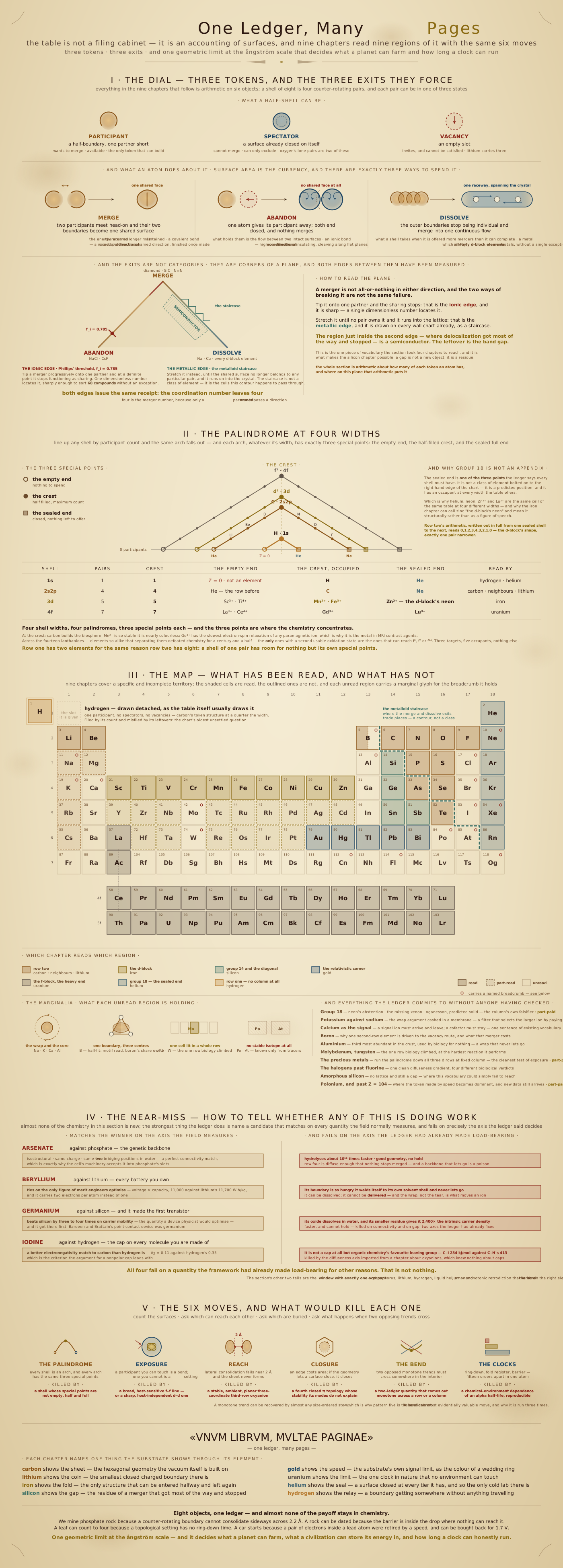
An electron shell, in this reading, is a set of such boundaries wrapped around the atom. A shell of eight is four counter-rotating pairs. Each pair can be in one of three states, and these are the three tokens the whole section uses:
| Token | What it is | What it does |
|---|---|---|
| Participant | a half-boundary, one partner short | wants to merge; available |
| Spectator | a surface already closed on itself | cannot merge; can only exclude |
| Vacancy | an empty slot | invites, and cannot be satisfied |
Carbon has four participants, no spectators, no vacancies. Oxygen has two participants and two spectators — the spectators are its lone pairs, the things that point. Lithium has one participant and three vacancies. Hydrogen has one participant and nothing else whatsoever, which turns out to be a different condition from either of its neighbours and is its own chapter. That is the entire dial, and the carbon chapter reads it rightward while the lithium chapter reads it left.
Three tokens — and, for five rows of the table, all three made the same way, by counting electrons into shells. The sixth row makes one of them a fourth way, and that turns out to be where the section connects back to the rest of the paper: at the bottom of the table an atom’s innermost boundary is moving fast enough that velocity retires a participant without changing any count. Three tokens, four ways to arrive at one (gold).
The tokens are only half of it. The other half is what an atom actually does about its shell, and there are exactly three exits:
Merge. Two participants meet head-on and their two separate boundaries become one shared surface. Less area, less stored energy, and the two atoms are now held together by the fact that pulling them apart would have to re-create the surface. That is a covalent bond (the hydrogen flywheel works the case in detail). A merger is exact and directional — it happens between two specific partners, in a specific direction, and once made it is finished.
Abandon. One atom gives its participant away entirely. Both partners end up with complete, closed shells, and nothing merges at all; what holds them together is the substrate flow running between two intact surfaces. That is an ionic bond, and the lithium chapter argues that every familiar property of a salt — non-directional binding, high coordination numbers, insulating behaviour, cleavage along flat planes — follows from no surface being shared.
Dissolve. The outer boundaries stop being individual and merge into one continuous raceway spanning the whole crystal. That is a metal (conductors), and it is what a shell takes when it is offered more mergers than it can complete.
Three tokens, three exits. From here on, everything is arithmetic about how many of each an atom has and which exit that arithmetic forces.
With one addition the section took four chapters to reach: the exits are corners of a plane, not categories, and both edges between them have been measured. A merger is not all-or-nothing in either direction. Tip it progressively onto one partner and at a definite point it stops functioning as sharing — that is the covalent-to-ionic edge, and Phillips’ ionicity threshold f_i = 0.785 locates it sharply enough to sort sixty-eight compounds without an exception. Stretch it instead, until the shared surface no longer belongs to any particular pair, and it runs on into the crystal — that is the covalent-to-metallic edge, and it is the metalloid staircase drawn on the table. Both edges issue the same receipt, which is that the coordination number leaves four: four is the merger number, because only a named partner imposes a direction. And the region just inside the second edge, where delocalization got most of the way and stopped, is a semiconductor — the leftover being the band gap. The silicon chapter is that map.
Pattern one: every shell is a palindrome with three special points
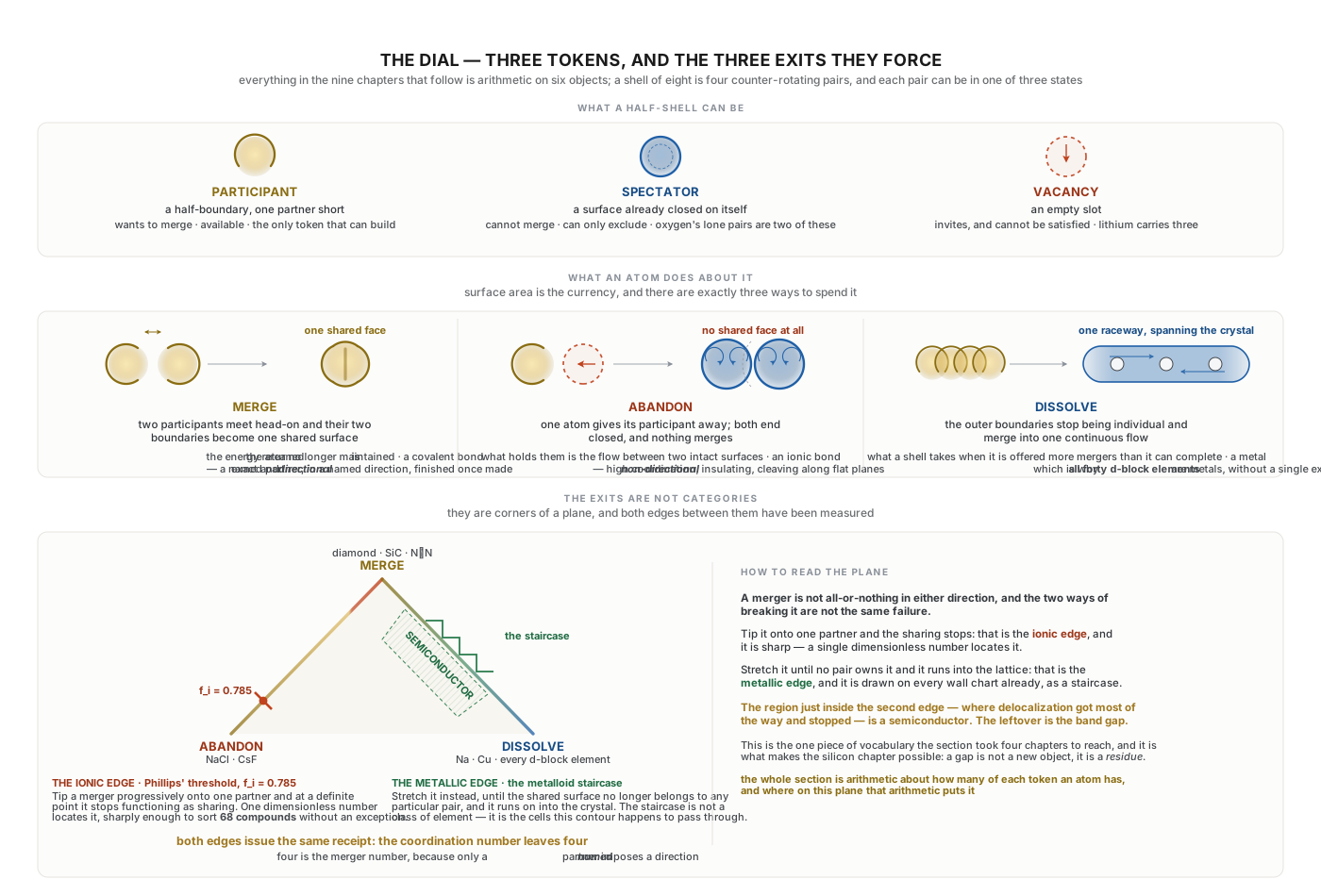
Line up the second row by participant count and something falls out that no one usually draws:
\text{Li } 1,\;\text{Be } 2,\;\text{B } 3,\;\textbf{C } \mathbf{4},\;\text{N } 3,\;\text{O } 2,\;\text{F } 1
A palindrome, cresting at carbon. Walk right from the crest and the shortfall is made of spectators — closed surfaces that get in the way. Walk left and the shortfall is made of vacancies — empty slots that cannot be filled. Carbon is the only cell where both are zero at once: the row’s double zero, and the reason the carbon chapter can call it the element with nothing to say.
Now do the same thing to a shell that is not eight. The d-shell has five lobes instead of four slots, and the iron chapter runs the identical count:
0,1,2,3,4,\mathbf{5},4,3,2,1,0
Same shape, one step longer, cresting at d^5 — occupied by Mn²⁺ and Fe³⁺. And the f-shell, at fourteen, does it again, cresting at f^7 (the uranium chapter).
Then run it at the width the section left until last. A 1s shell holds two electrons, which is one counter-rotating pair — one slot, not four — so its palindrome has exactly three positions, and they are the three special points with nothing between them:
\text{(empty)}\;0,\quad \textbf{H } \mathbf{1},\quad \text{He } 0
The empty end is Z=0 and is not an element. The sealed end is helium. The crest is hydrogen, and hydrogen has no spectators and no vacancies — carbon’s exact token structure at a quarter the width, which is why the hydrogen chapter can argue that the table’s oldest filing dispute is a case of an element being sorted by its participant count and decided by its shortfall. Row one has two elements because a shell of one pair has room for nothing but its own special points, and that is the same sentence that makes row two eight wide.
Four shell widths, four palindromes, and each of them has the same three special points: the empty end, the half-filled crest, and the sealed full end.
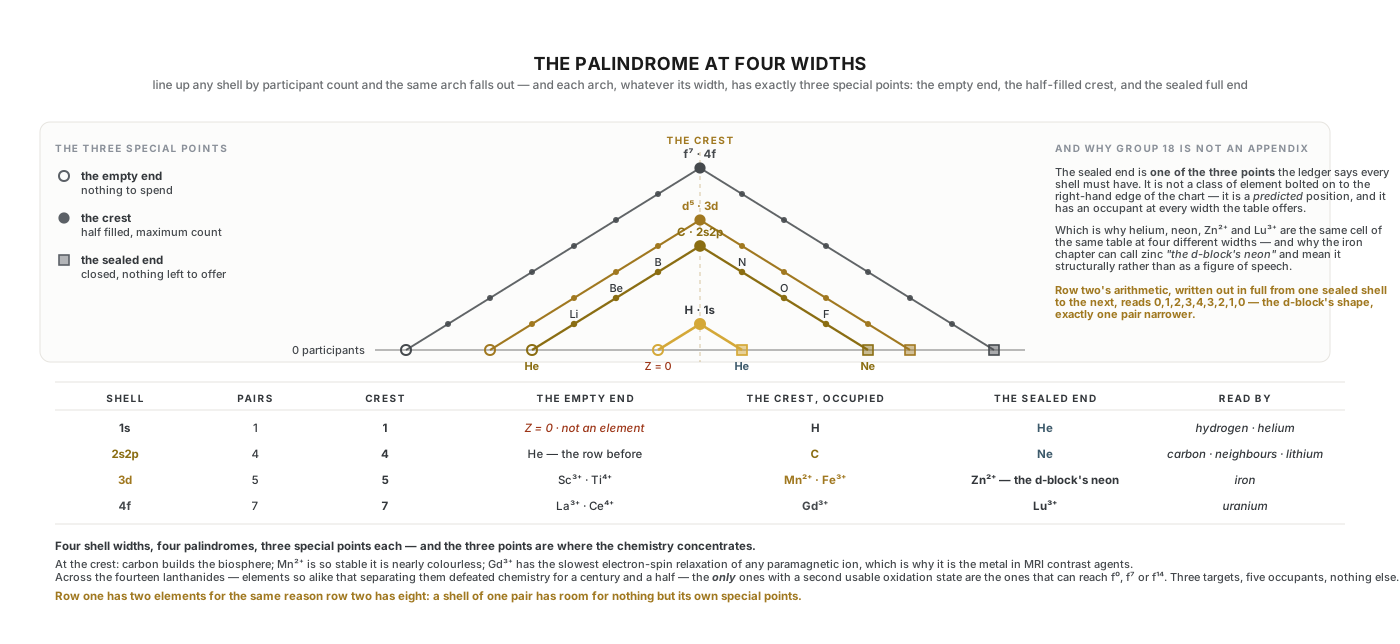
The three points are where the chemistry concentrates. At the crest: carbon builds everything; Mn²⁺ is so stable it is nearly colourless; Gd³⁺ has the slowest electron-spin relaxation of any paramagnetic ion, which is why it is the metal in MRI contrast agents. At the sealed end: Zn²⁺ does no redox chemistry at all, and Lu³⁺ has nothing left to offer. And the empty end gives Sc³⁺, Ti⁴⁺, Ce⁴⁺. Across the fourteen lanthanides — elements so alike that separating them defeated chemistry for a century and a half — the only ones with a second usable oxidation state are the ones that can reach f^0, f^7 or f^{14}. Three targets, five occupants, nothing else.
Worth stating explicitly, because the pattern is incomplete without it: the sealed end of the row-two palindrome is the noble gases. Write the second row’s arithmetic out in full, from one sealed shell to the next, and it reads 0,1,2,3,4,3,2,1,0 — helium’s closed shell, then lithium through fluorine, then neon. It is exactly the d-block’s shape, one pair narrower. Helium, neon, Zn²⁺ and Lu³⁺ are the same cell of the same table at four shell widths, which is why the iron chapter can call zinc “the d-block’s neon” and mean it structurally rather than as a figure of speech. Group 18 is not an appendix to the table; it is one of the three points that the ledger says every shell must have, and the helium chapter reads it — finding, among other things, that the reason this framework’s own measurements can only be made in liquid helium is a window in that column with exactly one occupant.
Pattern two: exposure decides what the crest does
Here is where the arithmetic stops being merely tidy.
Carbon’s crest and d^5’s crest are the same count and behave in opposite ways. Carbon’s four participants are on the outside of the atom, where anything can reach them, so every one of them finds a partner and carbon builds the biosphere. The d-shell’s five participants sit inside the atom’s outermost surface, behind the 4s shell, where no approaching partner can reach them. Nothing merges. So instead of maximum building capacity, d^5 is maximum stability without building — the finished, terminal, unreactive state of its elements.
Same arithmetic, opposite expression, and the variable is exposure. A participant you can touch is a bond waiting to happen. A participant you cannot touch is a setting.
That single word carries an enormous amount. A d-shell that cannot pair off has to take the third exit — it dissolves, which is why all forty d-block elements are metals, without exception, across three rows: no d-block semiconductor, no d-block insulator, no d-block gas. But dissolving the outer shell does not empty the buried one, and what stays behind is a boundary with two folds crossing at a defect that cannot be smoothed away. A boundary that cannot relax continuously is a boundary that holds its configuration until something arrives to change it, which is the definition of a register.
Everything the middle of the table is famous for is that register seen from a different side. Variable oxidation state is the register being written. Colour is the register being pressed on by its surroundings. Catalysis is the register accepting a merger halfway and giving it back. Haemoglobin’s cooperativity is the register changing state and pulling — the iron contracts on binding oxygen, drops into the porphyrin plane, and drags a helix behind it.
And because the mechanism is depth, depth should be measurable. It is, and in the most direct way available: as the width of a spectral line. A transition that rearranges buried lobes moves the folds, so anything pressing from outside broadens it. A transition deeper in does not broaden. The table supplies a clean ladder — 3d shells sit at the surface and give bands thousands of wavenumbers wide that change colour completely with their host, while 4f shells sit buried under filled 5s and 5p and give hairlines that are the same colour in every host, which is why europium is in every phosphor.
The controlled experiment sits inside one ion. Ruby and emerald are both Cr³⁺ — the same element in the same oxidation state, red in corundum and green in beryl, because the broad bands that move the folds shift by thousands of wavenumbers between hosts. Yet both crystals emit a sharp line near 694 and 683 nm from a transition that only flips a spin without rearranging which lobes are occupied, and that line barely moves. One ion, two transitions, and the one that touches the folds is host-dependent by hundreds of nanometres while the one that does not is host-independent to about ten.
Then push the burial further and the register goes dark altogether. The fourteen lanthanides are the section’s control experiment: four chapters argue that adding one boundary changes what an atom can do, and here you add fourteen and almost nothing happens. That is not the ledger failing — it is the depth gauge working. A register buried past the interface cannot be read by chemistry either. The same sentence that predicted the spectroscopy predicts the chemistry, unchanged.
Pattern three: how far a boundary reaches
The third pattern is a single number with an absurd reach of consequences.
A head-on merger between two participants is easy: they meet between the nuclei and fuse. A sideways merger is harder. For the \pi system that makes benzene aromatic, the lobes above the plane have to fuse into one continuous counter-rotating sheet running along the whole ring, and the lobes below likewise. That requires the lobes to reach laterally across the bond distance.
At carbon’s 1.54 Å they reach. At silicon’s 2.35 Å they do not — the lobes pass each other without merging, and the sheet never forms. Somewhere around 2 Å, lateral consolidation fails, and that failure is the reach law read on chemistry.
Watch how far that propagates:
- There is no silicon benzene, no silicon graphite, no silicon nanotube, and no silicon biochemistry — not because silicon lacks valence electrons, but because it cannot build a sheet (carbon).
- Second-row oxyanions are flat and third-row ones are tetrahedral — every time, without exception. Carbonate and nitrate delocalize across three oxygens; silicate, phosphate, sulfate and perchlorate cannot, and take a fourth oxygen and pack instead (neighbors). Carbonate is a fragment of the substrate’s own sheet; silicate is what you get when the sheet is unavailable.
- Therefore phosphorus is the genetic backbone. A four-line piece of arithmetic on tetrahedral oxyanions says how many chain positions each element can offer in water: silicon four (a rock — and silicates are ~90% of the crust), phosphorus two, sulfur one (a terminal tag, which is exactly how biology spends it), chlorine zero (a free ion). Two is the unique connectivity from which an unbranched chain of indefinite length — which is to say, information — can be built. The window has exactly one occupant (neighbors).
- Therefore we mine phosphate rock. Nitrogen’s lateral merger succeeds, so N≡N is the strongest bond in ordinary chemistry and the atmosphere holds 4\times10^{18} kg of nitrogen overhead. Phosphorus’s fails, so elemental phosphorus is a waxy solid rather than a gas, there is no atmospheric reservoir, and there is no fixation route at any energy price. Nitrogen is locked away but everywhere; phosphorus is available but finite (neighbors).
One geometric limit, at the scale of an orbital lobe, and it decides which of the biosphere’s two great nutrients can be taken from the air.
Reach has a second face, which is diffuseness down a group. A boundary lower in a column is larger, softer and more polarizable — it reaches further and holds less tightly. Biology walks that gradient deliberately: oxygen holds, sulfur switches (which is why every biological latch is a disulfide or a thiol), selenium catalyses (in exactly the enzymes where turnover speed is the constraint), and then it stops, because tellurium is loose enough that it holds nothing at all. The identical gradient turns up in solid-state batteries with no knowledge of the biology: oxide electrolytes conduct slowly and survive, sulfides conduct an order of magnitude faster, selenides faster still — and the selenides are unusable, because the same diffuseness that lowers the hopping barrier also makes them too easily oxidized. Looser conducts better and holds worse, in a leaf and in a battery.
And reach has a third face: pressure substitutes for it. The framework’s standing claim is that wherever a material has both an open, substrate-templated hexagonal phase and a dense close-packed one, the hexagonal phase is the low-pressure member — graphite below diamond, hexagonal boron nitride below cubic, ice Ih below ice II, quartz below coesite. And squeezing a second-row oxyanion hard enough converts it: carbonate’s flat CO₃ becomes tetrahedral CO₄ in the lower mantle above roughly 80–100 GPa. The row axis and the pressure axis are the same axis — graphite→diamond and carbonate→orthocarbonate are one transition read on two chemistries.
Pattern four: a closed surface has no edge
A sheet with an edge pays for the edge. All the way around the perimeter are dangling half-boundaries that never found a partner, and each one costs area. A sheet with no edge pays nothing. So the substrate’s standing preference is simple: if the geometry allows a surface to close, it closes.
Carbon’s sheet can close exactly three ways — into a ring, a cage, or a tube — and each closure imposes the same physical condition, that the flow must return to itself in phase after one circuit. But the surface decides which modes are available, and the counting rules that come out are three separate empirical laws that chemists learned independently:
| Closure | The known rule | Closed shells at |
|---|---|---|
| Ring (benzene, porphyrin, chlorophyll) | Hückel | 4n+2 |
| Cage (fullerene) | Hirsch | 2(N+1)^2 |
| Tube (nanotube) | metallic vs. semiconducting | (n-m) \bmod 3 = 0 |
One argument, three topologies, three rules. And the cage pays out a sign the naive reading gets wrong: C₆₀ looks like it should be the ultimate aromatic — sixty carbons, perfectly closed, no edge anywhere — and it is not, because sixty falls between Hirsch shells. It behaves as an electron-poor alkene, not a benzene. Strip it down to fifty electrons and it becomes aromatic. A framework that predicted superaromaticity from symmetry alone would be wrong; counting modes on the correct surface gets it right (carbon).
The same preference runs one structural tier down, in the nucleus. Helium-4 is a closed topology — the small cluster whose surface is already fully paid for, carrying 28.3 MeV of pre-assembled binding. That single fact is why the entire heavy end of the periodic table decays by emitting alpha particles rather than protons, neutrons, or anything else: only for the alpha is the departing piece’s own binding large enough to make the move worth it. Three consequences follow, and all three are observed — alpha emission starts well below the actinides (there is, it turns out, no stable element above lead); decay chains are indexed modulo four, because an alpha removes exactly four mass units and nothing else does; and all of them drain to ²⁰⁸Pb, the heaviest doubly-sealed shell there is (uranium).
Closure even decides how a nucleus tears. Uranium does not split down the middle; the fragment distribution is double-humped, because one fragment is trying to be doubly-magic ¹³²Sn. The drop tears where tearing leaves one piece on a sealed boundary — and heat it hot enough and the asymmetry washes out, exactly as it should when the drop stops being able to see the shell structure.
Pattern five: two straight lines make a bend
This one is the section’s most evidentially valuable move, and it is worth understanding why.
Suppose a real-world outcome depends on two requirements that pull in opposite directions, and suppose each requirement varies monotonically — steadily in one direction — as you walk along a row or down a column. Then the outcome cannot be monotonic. Their difference, or their product, must have an extremum somewhere in the interior. You get a V or a volcano, and the framework’s job is to say where the bottom or the top lands.
That matters because a monotone trend can be recovered by almost any size-ordered story, and a bend cannot. If a framework predicts that a curve turns around at a specific element, and it does, that is much harder to get by accident.
The section runs this argument three times.
The V at sodium. A galvanic cell performs one boundary operation along two paths: it tears an atom apart and then wraps the naked core in solvent. Tearing gets cheaper down the alkali column (a bigger, looser atom gives up its electron more easily) and wrapping pays less (a bigger core earns less for being enclosed). Both monotone, opposite in sign, so their difference must be worst somewhere in the middle — and it is worst at sodium. That is why lithium has the most negative electrode potential in the table despite having the highest ionization energy of its column, which is the fact the usual “lithium gives up its electron most easily” explanation gets flatly backwards.
Then the same V shows up in a measurement that shares no solvent, no phase, and no experimental technique. Lithium intercalates graphite superbly — that reaction is every phone battery. Potassium, rubidium and caesium all form stage-1 compounds too. Sodium does not, and gives graphite about a tenth of lithium’s capacity. Potassium and caesium park by dilating the galleries, which they can afford because their tear is nearly free. Lithium parks by fitting, and pays for its expensive tear with enormous coupling to the sheet. Sodium is too big to fit and too expensive to strip, so it does neither. One trade, two independent readouts, both bending at the same element (lithium).
The volcano in groups 8–10. Essentially every heterogeneous catalyst in the world is a d-block metal — iron for ammonia, platinum and rhodium in every catalytic converter, nickel for hydrogenation, cobalt for Fischer–Tropsch. Not a main-group element in sight, and the reason is exposure again: a catalyst must hold a boundary halfway, deep enough to break the reactant’s bond and shallow enough to give the product back. Carbon’s mergers are exact and permanent; an ionic solid never merges at all; only a buried, partially occupied fold can be entered partway and talked back out. Then adsorption strength rises leftward across the d row and release ability rises rightward, so the rate has to peak in the interior — Sabatier’s principle, drawn as a volcano, maximum in groups 8 through 10 (iron).
The peak at copper. The Irving–Williams series — how tightly divalent first-row metals bind almost any ligand — rises Mn < Fe < Co < Ni < Cu and then falls to Zn, universally. A cell with free copper in it would find copper displacing every other metal from every other site. So copper is never free: it is handed atom-to-atom by dedicated chaperone proteins and buffered below one free ion per cell. The palindrome’s peak in binding strength is a hazard, and the machinery built around copper is the hazard being managed.
And then the pattern has a two-dimensional relative, which is worth stating because the conclusion is different in kind. Run two opposed monotone trends along different axes of the table instead of the same one and the crossover is not a point — it is a line. Metallic character rises down a column, because the merger lengthens and each shared surface is worth less; it rises leftward across a row, because there are fewer named partners to commit to. Two axes, opposed, and their zero contour is a diagonal — which, drawn on a grid of integers, is a staircase. Boron, silicon, germanium, arsenic, antimony and tellurium are not a class of element with a shared property; they are the cells the contour passes through. The dividend that comes free is that the diagonal relationships every first-year chemist learns — lithium with magnesium, beryllium with aluminium, boron with silicon — are steps along that contour: one down and one right moves both trends by one unit in opposite senses and leaves the balance where it was. Two facts taught in different chapters, one line (silicon).
Because it is a line on two axes, it has a continuous knob on each, and the two turn out to be pressure and charge. Pressure is the column knob: squeeze silicon and it adopts tin’s structure, tin’s coordination and tin’s electrical verdict, and the literature calls the phase β-tin because that is what it is. Charge transfer is the row knob, and it runs the other way: hand thallium one electron and it stops being a twelve-coordinate metal and builds a diamond lattice, because Tl⁻ has carbon’s count. That is the Zintl–Klemm concept, and it means the contour is reachable from either side without ever changing element (silicon). The receipt in both directions is the same one — the coordination number — and the second knob shows that the ladder the section had been drawing from four upward also runs downward to zero, which puts all three exits on one integer axis: abandon at no neighbours, merge at four, dissolve at twelve. It also produces the section’s one live disagreement with a textbook: the locus where charge transfer stops opening a gap is conventionally drawn as a vertical line between groups 13 and 14, and the ledger says it has to be a diagonal, because a knob on the row axis cannot make the column axis stop mattering.
Pattern six: what a boundary remembers
The last pattern is about time, and it is the one that reaches furthest outside chemistry.
The paper elsewhere builds a ladder of ring-down times — how long an excited boundary keeps its state before damping returns it to smooth. Copper’s conduction channel forgets in about 25 femtoseconds; quartz’s polariton in tens to hundreds; DNA’s aromatic stack in something like ten (channel with memory). Everything on that ladder is a wave dying in a medium.
The periodic table section adds two more kinds of memory, and they are not on that ladder at all:
| Clock | What sets it | Range | What can change it |
|---|---|---|---|
| Ring-down | lattice damping | 10^{-15}–10^{-13} s | cooling, damping — it just decays |
| Fold register | topology | indefinite | arrival of a transfer partner |
| Barrier crossing | \exp(\text{barrier width}) | 10^{-7}–10^{27} s | nothing at all |
The fold register is an oxidation state. It has no ring-down time to quote, because nothing in it is ringing — it is a topological setting, and it changes only when a partner arrives to take a lobe. The same copper atom whose conduction boundary forgets in 25 femtoseconds holds its oxidation state indefinitely: fifteen orders of magnitude apart, in one atom, because they are different kinds of thing.
Biology needs exactly that. The oxygen-evolving complex in Photosystem II must absorb four separate photons and hold the accumulated state between them before it releases one molecule of O₂ — flashes seconds apart. No femtosecond memory can do that. A four-state register held in a cluster of manganese can, and does, in every leaf on the planet.
The barrier clock is nuclear decay, and its third column is the remarkable one. Alpha-decay half-lives run from microseconds to 10^{19} years, and a factor of 2.9 in the decay energy buys 33 orders of magnitude in the time — the signature of an exponential in a barrier width. A ring-down time can be lengthened by cooling. A fold register can be flipped by presenting a ligand. A barrier clock responds to neither: uranium’s half-life is the same in a star, in a crystal, at any temperature or pressure, in any oxidation state, bonded to anything, because the barrier is interior to the nucleus and screened by the drop itself.
Which is why radiometric dating exists and nothing else like it does. Every other clock in nature is a rate that depends on its surroundings, so reading it backwards requires knowing the history of those surroundings. A barrier clock requires knowing nothing. The heavy end of the periodic table is the only object in the universe that keeps time honestly — and the same fact keeps the planet warm, since about 20 of Earth’s 46 TW of surface heat flow comes from ²³⁸U, ²³²Th and ⁴⁰K, all three with half-lives within a factor of a few of the age of the Earth. Anything faster was gone before the crust formed; anything slower delivers no power. Plate tectonics is, in a real accounting sense, the alpha barrier being crossed slowly (uranium).
How to tell whether any of this is doing work
Because the underlying chemistry is standard, a reader is entitled to ask what would distinguish a genuine insight here from a well-dressed restatement. The section has three answers, and they are worth naming so you can look for them.
The near-miss. The strongest argument the framework makes is a candidate that matches on every quantity the field normally measures and fails on precisely the axis the ledger says decides.
- Arsenate is isostructural with phosphate, same charge, same two bridging positions — a perfect connectivity match. It is lethal for exactly that reason: it substitutes into phosphate’s slots and then hydrolyses about sixteen orders of magnitude faster. Good geometry, no hold. Row four is diffuse enough that nothing stays merged.
- Beryllium ties lithium on the two quantities battery engineers actually optimize — voltage times capacity, 11,000 against 11,700 — and is hopeless, because its boundary is so hungry it welds itself to its solvent shell and never lets go. It can be dissolved; it cannot be delivered.
- Germanium beats silicon by a factor of three to four on carrier mobility, which is the quantity a device physicist would optimize, and made the first transistor. It lost the entire industry on two things the ledger had already made load-bearing: its oxide dissolves in water (silicon’s four bridging positions make a network, and a network is a rock), and its smaller residue gives it 2,400 times the intrinsic carrier density, so it leaks. Faster, and cannot hold.
- Iodine is a better electronegativity match to carbon than hydrogen is — \Delta\chi = 0.11 against hydrogen’s 0.35 — which is the criterion the argument for a nonpolar cap leads with. It is not a cap at all but organic chemistry’s favourite leaving group, because C–I comes out at 234 kJ/mol against C–H’s 413. Killed by the diffuseness axis imported from a chapter about oxyanions.
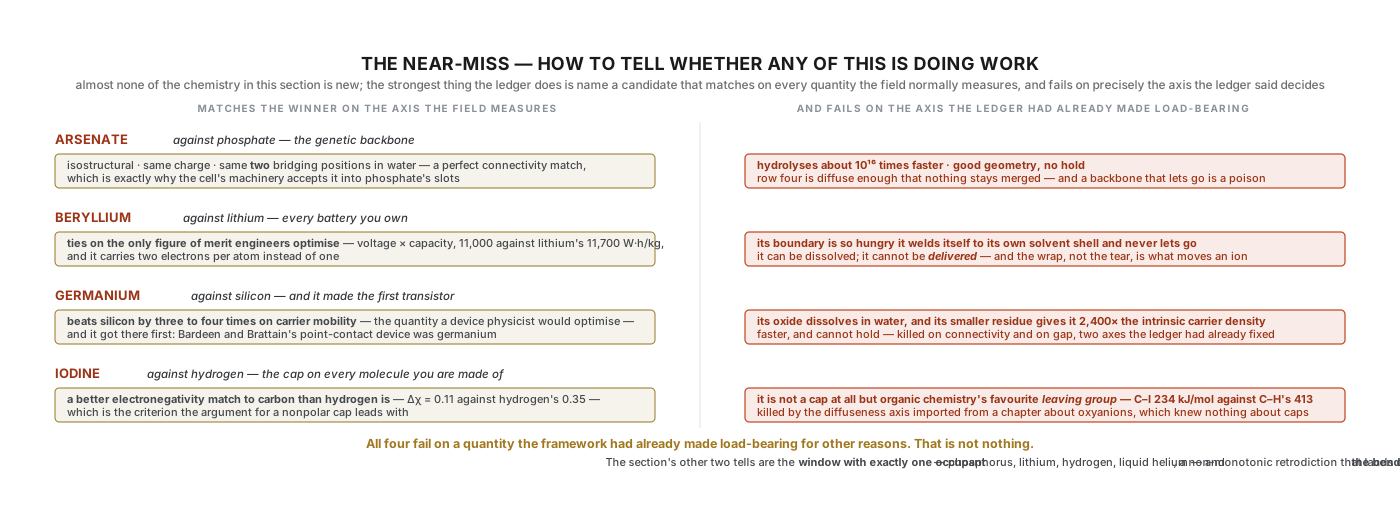
All four fail on a quantity the framework had already made load-bearing for other reasons. That is not nothing.
The window with one occupant. Several times the section stacks independent constraints and finds the periodic table admits exactly one solution. Phosphorus is the only element with aqueous connectivity two and retained charge and a bridge tight enough to hold for millions of years. Lithium is the only element at the voltage maximum and the mass minimum and with a solvent shell that turns over fast enough to release. Hydrogen is the only cap a carbon frame can take that has one participant and no spectators to point with and an electronegativity close enough to carry no dipole and a merger inert at 310 K — which is why the biosphere is hydrocarbon. Westheimer famously asked why nature chose phosphates and answered with a list of four reasonable properties. On the ledger they are not a list — they are one condition, and it has one solution. Nature did not choose phosphate; it was the only thing on the shelf.
The bend. Pattern five, above. A non-monotonic retrodiction that lands on the right element in two unrelated measurements is worth considerably more than a monotone trend that any size-ordered story recovers.
And the section is disciplined about saying when it has none of these. Every chapter carries callout boxes labelled Strength of this claim or What this is and is not evidence for, and they concede real ground: that two materials above the Tkachenko line is an observation and not a trend; that the standard hydration-radius explanation gets lithium’s mobility right with no substrate at all; that the framework cannot compute a single catalytic binding energy, a single f-orbital extent, or the absolute nuclear seam energy that would make its own best number quantitative. Reading those boxes is the fastest way to calibrate the section.
What the ledger buys outside chemistry
The reason this section sits in a physics paper rather than a chemistry one is that the same six patterns keep cashing out in domains that have nothing to do with each other. A compressed tour:
| Fact about the world | Which pattern | The one-line reason |
|---|---|---|
| We mine phosphate rock instead of fixing P from air | reach | a boundary cannot consolidate sideways across 2.2 Å, so phosphorus has no gas phase |
| ~90% of the crust is silicate | reach + connectivity | four bridging positions is a three-dimensional network, and a network is a rock |
| The genetic backbone is phosphate | window of one | two bridges, retained charge, kinetic stability — one cell in the table |
| Protein folding has a two-dimensional Ramachandran plane | the routing bit | one nitrogen lone pair joins a sheet and freezes a rotation |
| ATP is worth -30 kJ/mol, not more or less | spectator penalty at a tuned distance | too hot to hold, too cool to drive — the anhydride is the middle |
| Every phone battery is lithium | the bend + window of one | cheapest tear, lightest mass, a wrap that lets go |
| Graphite anodes last thousands of cycles and silicon does not | median vs. merger | insertion onto an unmerged gallery breaks nothing |
| Every chip is silicon, not the germanium that came first | reach + connectivity | b = 8-n = 4 is a network, and a network is the only native oxide an element ever grew on itself that holds |
| A transistor can be programmed at all | the dial, diluted | inside a host that screens, a spare participant or a vacancy costs 45 meV instead of 5 eV |
| Tin crumbles in the cold | the staircase | one element sitting on the merge/dissolve contour, at 13.2 °C |
| The best high-temperature thermoelectrics are one structure type | both knobs at once | give a metal electrons and it builds a covalent framework with the spent cations rattling in the voids — the merger conducts and the abandoned ion scatters the phonons |
| Every industrial catalyst is in three columns | the volcano | only a buried fold can be entered halfway and left again |
| Your blood is cooperative | the latch | a spin change pulls an iron 0.4 Å and drags a helix |
| A leaf can count to four | fold register | oxidation state has no ring-down time |
| Copper enzymes are evolutionarily young | palindrome on a voltage axis | copper became soluble only after the ocean oxygenated |
| Zircon dates the Earth to four figures | barrier clock | two isotopes, two independent chains, environment-blind |
| Earth still has plate tectonics | barrier clock | 20 of 46 TW radiogenic, half-lives tuned to a planet’s lifetime |
| Gold is yellow and mercury is liquid | the token made by speed | gold’s innermost boundary runs at 0.58\,c, so its 6s falls and its 5d rises until the gap lands in the visible |
| Ten of a car battery’s twelve volts | the token made by speed | a spectator made by closure is a wall; one made by velocity is a price, and lead’s is 1.7 V |
| Lithium treats bipolar disorder | flux density | it fits a magnesium socket to 6% and under-drives it by half |
| Your nerves run on potassium and not on sodium | the bend, in a membrane | the wrap ledger changes sign exactly once in the column, and life built its gradient across the crossing |
| A channel selects a thousandfold on 0.36 Å | the wrap is the mover | a bilayer has nothing to recruit from, so the filter is the wrap, and selectivity is the bill for swapping |
| Calcium carries the message and magnesium holds the tool | flux density, read twice | the same number is geometric fidelity and release speed, so no ion is both a template and a signal |
| Liquid helium is the only lab in which this framework’s numbers can be measured | the seal + the bend | a sealed shell gives the shallowest well matter has, so zero-point motion beats cohesion exactly once in the table |
| Argon is 0.93% of the air and every atom of it is a decay product | the seal | a crust that could not bond what it made, exhaling it for four billion years |
| An anaesthetist can switch you off with a gas that does no chemistry | one dial | potency is polarizability, and nothing merges |
| Every silicon wafer is printed at 193 nm | the rented participant | promote a sealed shell and it becomes caesium, for as long as the photon takes to leave |
| Life is made of carbon and hydrogen, everywhere, always | window of one | the only cap with one participant, no spectators, and no dipole against carbon |
| The fastest ion in water is the one that never moves | the relay | strip hydrogen and there is no core to wrap, so the defect travels and the atoms do not |
| Every fuel cell on Earth has a water-management system | the relay | the membrane is the chain, and a dry chain has nothing to hand a defect along |
| Heavy water is poisonous and heavy carbon is not | the mass on the boundary | hydrogen is the only element whose mass is not hidden behind a core |
| Jupiter has a magnetic field larger than the Sun’s disc | pressure substitutes for reach | hydrogen forced across an exit boundary it cannot reach by count |
The last one is worth pausing on, because it is the shape of the whole section in miniature. Lithium’s therapeutic targets are magnesium-dependent enzymes; Li⁺ and Mg²⁺ are the same size to within 6%, so a site built for magnesium accepts lithium geometrically — and lithium delivers less than half the surface flux. It fits the socket and under-drives it. That is not blockade and not allostery; it is partial occupancy that leaves the geometry intact and halves the drive, which is a decent description of a drug whose effect is a damping of excursions rather than a switch. And it predicts where lithium should be inert: calcium sites are 30% too large, and lithium leaves them alone.
The map: what has been read
Nine chapters, and between them they cover a specific and incomplete territory:
| Region | Chapter | What it establishes |
|---|---|---|
| Carbon | Carbon in the Substrate | the double zero; the sheet is the substrate’s own; three closures; the shear ceiling |
| Row two, rightward (N, O, F, and P below) | The Neighbors of Carbon | the spectator dial; nitrogen’s one routable bit; the reach law on oxyanions; b = 8-n-z |
| Row two, leftward (Li, Be, B), the alkalis and the alkaline earths | Lithium in the Substrate | vacancies vs. spectators; the wrap is the mover; two ledgers and the V at sodium; the salt that never merged; the wrap cashed in a membrane, and four filters on one column |
| The d-block | Iron in the Substrate | the palindrome at ten; the fold as register; linewidth as a depth gauge; the volcano |
| Group 14 and the metalloid diagonal | Silicon in the Substrate | the gap as residue; two edges between the three exits; the staircase as a contour, with a knob on each of its axes; coordination as the receipt, running both ways from four; the dial installed in a crystal |
| The relativistic corner (groups 11–15, row six) | Gold in the Substrate | the fourth way to make a token; the spectator you can buy back; the gold maximum; a metal taking the abandon exit as the anion |
| The f-block and past the crest | Uranium in the Substrate | one ratio, two thresholds; the pre-paid seam; the barrier clock; the register goes dark, and what burial is worth in the two places chemistry cannot look; two walls |
| Group 18 — the sealed end | Helium in the Substrate | the palindrome’s third point; the column with one dial; the crossing that keeps helium fluid; closed at three tiers; the rented participant; the only honest tracer |
| Row one — the cell with no column | Hydrogen in the Substrate | the palindrome at width one; the missing core; the relay is the mover; one boundary among three centres; the mass on the boundary; the terminator window |
Which leaves a great deal unread — and several of the gaps are places where the ledger already commits to an answer without anyone having gone and checked.
Where the table is still unread
These are breadcrumbs, not results. Each is a region the ledger’s existing vocabulary reaches into, with a stated expectation, marked as unwritten.
Group 18 — the sealed shell — redeemed. The helium chapter reads the column, and the thing it found was not in the breadcrumb. Reactivity does run as pure diffuseness, zero at the top and rising monotonically down — but that is a calibration, not evidence, because group 18 is the one column with no second ledger to bend the curve. What the column does pay is one row up from chemistry: whether a substance freezes is a contest between a well that deepens with polarizability and a zero-point excursion that weakens with mass, two opposed monotone trends whose ratio crosses unity between helium and neon — and it can only cross in a column where nothing merges, because a chemical bond makes the well one to two orders of magnitude too deep for zero-point motion to be in the contest at all. Two conditions, one occupant, and the occupant is the only laboratory in which this framework’s own numbers can be measured (superfluid helium). The near-miss is molecular hydrogen, which is half the mass and freezes anyway because it is not sealed. Also redeemed: xenon anaesthesia as the section’s cleanest non-chemical coupling probe for the Brain section, potency ordering by polarizability alone with helium as a sign-reversed control; the excimer, a participant rented for eight nanoseconds at 8.32 eV, whose 193 nm line prints the silicon chapter’s gap; and noble gas geochemistry as the readable hand on the barrier clock. Three things remain: neon’s total abstention — the one element that forms nothing under any condition anyone has tried, including pressure; the missing xenon problem, {\sim}90\% of atmospheric xenon unaccounted for, recorded against the framework rather than for it; and oganesson, where the token made by speed is calculated to dissolve the seal outright — a group 18 element predicted to be a solid with no closed-shell character, which would make the bottom of this column the falsifier of its own top.
Potassium against sodium, and calcium against magnesium — redeemed. The section had read the alkali column for batteries and never for biology, which was a striking omission, because “the wrap is the mover” is what every cell in your body runs on. The lithium chapter now reads both pairs, and the thing it found was larger than either breadcrumb. The mobility table’s recruited thickness changes sign between sodium and potassium — Na⁺ at +0.82 Å is the last alkali that drags a shell, K⁺ at -0.13 the first that drags none — so the pair biology built its electrochemistry on is the pair that straddles the column’s one crossover, and a membrane distinguishing them is distinguishing whether the ion is carrying anything rather than resolving 0.36 Å against its own thermal noise. A selectivity filter is then not a hole but a prosthetic wrap: the interior of a bilayer offers nothing to recruit from, so the channel supplies the shell itself out of backbone carbonyls and charges each ion the difference. That reading is falsifiable in the right direction — permeability must follow the strip ledger rather than the cage radius, and the two ions matched to K⁺ on hydration enthalpy and on nothing else, Tl⁺ (-326 against -322) and NH₄⁺ (-307), are the channel’s best non-alkali permeants while chemically-adjacent Na⁺ is excluded a thousandfold.
And the second pair turned the first into a pattern. Flux density is read twice — once as geometric fidelity, once as speed — and being the same number both times, no ion gets both: magnesium is rigidly octahedral at 2.07 Å and turns over its shell at 7\times10^5 s⁻¹, calcium coordinates six, seven or eight at 2.3–2.6 Å and turns over near 10^8. A signal must arrive and leave inside the event it reports; a cofactor must be there and hold still. Line all four biological ions up by flux and their channels’ architectures come out ordered — counterfeit the wrap where it is marginal (K⁺, neutral carbonyl cages), outbid it where it is moderate and therefore need a multi-ion knock-on to let go again (Ca²⁺, the EEEE glutamate ring), and where it cannot be stripped on the conduction timescale, stop trying and recognize the hydrated ion (Mg²⁺, CorA/MgtE’s GMN motif). Four ions, four filters, one column of numbers — the column computed three sections earlier to sort battery anodes. What remains owed is the aluminium breadcrumb below, and an honest accounting of how much of the calcium story belongs to Williams and Kretsinger’s prior solubility argument, which the chapter’s callout gives.
Boron and the three-centre bond — part-paid. The motif itself has been read: the hydrogen chapter argues that sharing one boundary among three centres is what any participant does when a two-centre merger is unavailable, and that the condition is reached three ways — through a vacancy (boron’s B–H–B bridges), through having only spectators and no slot for a fourth electron (xenon’s XeF₂, and the polyhalides), and through having no interior to anchor a second merger to (every hydrogen bond there is). Three shortages, one geometry, with the symmetric limit at bifluoride and at Ice X. What is still owed is boron’s own share: why exactly one element in the second row is driven to the vacancy route, and what a three-centre merger costs relative to the two-centre one it replaces. Boron is also essential to vascular plants and to almost nothing else, cross-linking pectin in the cell wall through borate diesters — a structural role for the element that cannot finish a two-centre bond, and still unexplained here.
What is left of the relativistic corner. This breadcrumb has been redeemed — the gold chapter writes down the fourth way to make a token and runs it across groups 11 to 15 of the sixth row. Two pieces of that corner remain untouched. Polonium and astatine are the only elements in the main group with no stable isotope at all, so their chemistry is known almost entirely from tracer quantities and calculation; polonium is the one element with a simple cubic elemental structure, which on the ledger ought to mean something about a merger geometry with no directions left in it, and nobody here has looked. And the superheavies past Z=104 are where the token becomes the dominant term rather than a correction — copernicium and flerovium have been measured as gas-phase atoms adsorbing on gold and both are far more weakly bound than mercury, which is the extrapolation working, and oganesson is predicted to be a solid rather than a gas. That region is the framework’s own falsifier running forward at (Z\alpha)^2, and it is the only part of the periodic table where new data still arrives.
Where the count stops predicting. Two cases, and they belong together because both are places the ledger’s vocabulary may simply fail to reach.
The first is dissolution without periodicity. Every argument in this section about metals, gaps and raceways assumes a lattice. Amorphous silicon has no lattice and still has a gap — a mobility gap rather than a band gap, with localized states in the tail and a sharp mobility edge separating them from extended ones, and a dangling-bond density that must be passivated with hydrogen before the material is usable at all. On the ledger that should be exactly what an incomplete delocalization looks like when the merger arithmetic comes out even on average and not locally. Anderson localization is the standard account and it is quantitative; whether the boundary reading adds anything to it is genuinely unknown.
The second is sharper and it is the one the section should be least comfortable about. The iron chapter’s hardest claim is that a shell offered more mergers than it can complete has no choice but to dissolve, and its evidence is that all forty d-block elements are metals. The prediction is worded to say element, and it survives — but NiO, CoO, MnO and La₂CuO₄ have partially filled d shells and are insulators, and the reason is on-site repulsion beating bandwidth, which is not a quantity this section owns. That also punches a hole in the silicon chapter’s residue ladder, which has a rung for nothing ever merged (LiF) and a rung for the merger stayed local (diamond) and none at all for the raceway exists and the flow refuses to get onto it. A Mott gap is a third mechanism, the ledger currently reads it as a second, and the honest position is that the section names the case and concedes the vocabulary does not reach it rather than stretching “residue” to cover something it was not built for.
The f-block’s other verdict — redeemed. The breadcrumb was that the uranium chapter reads the lanthanides purely as the section’s control experiment — bury a register deeply enough and fourteen elements become one element with fourteen masses — and treats burial as a liability, when it is an asset twice over. Both halves are now written, and between them they found something the breadcrumb did not promise.
Magnetism supplies the mechanism, and it fills a hole that chapter already had: the domain-wall width has two constants in it and only the exchange stiffness had ever been given a substrate reading. The other one is the easy axis, and it exists because the lattice presses on a folded shell — which means anisotropy needs a circulation with a shape and a lattice pressing hard enough to feel it, and those two requirements fight, because pressing hard enough destroys the shape. A 3d shell is pressed flat and quenched, leaving pure spin with no lobes to grip. A 4f shell screened under filled 5s and 5p is barely pressed at all, keeps its aspherical cloud, and yields anisotropies one to two orders larger. So anisotropy and exchange are one depth parameter with opposite signs — exchange needs a shell that leaks, anisotropy needs a shell the lattice cannot reach in to flatten — and a rare-earth magnet is not a fortunate alloy but the only available resolution of a real conflict: the buried shell says which way, the exposed shell says how much and how hot.
Uranium supplies the correction and one thing of its own. Burial now has three readouts measured by three communities who do not read each other — chemical invisibility, spectral hairlines, magnetic anisotropy — and the signs disagree, which is the load-bearing part rather than a complication. And the chapter’s own palindrome sorts the last two: f^7 is L=0 and spherical, so the crest is the one cell of fourteen with no anisotropy to sell, which is why Gd³⁺ is in every MRI agent and in no permanent magnet, while Nd³⁺, Sm³⁺ and Dy³⁺ one step off it are in all of them. The crest sells relaxation and everywhere else sells direction, and that falls out of a palindrome the section drew four chapters earlier for something else.
Two salts and a skeleton. The section has carbonate’s flatness and phosphate’s connectivity from the neighbors chapter, and calcium’s flux density and fast wrap turnover from the lithium chapter. Nobody has put them together and asked why every hard tissue on Earth is built from exactly two calcium salts — carbonate in shell and coral, phosphate in bone and tooth — and never from a third. The ledger has the pieces for a window-of-few argument and has not assembled it, which is conspicuous in a section that spent four lines of arithmetic on why the backbone is phosphate.
The halogens past fluorine. Fluorine got a full treatment as carbon’s mirror; chlorine, bromine and iodine did not. Iodine is the largest atom biology uses covalently, and it uses it in exactly one place — thyroid hormone, four iodines on two rings. Bromine was shown only in 2012 to be genuinely essential, forming a single sulfilimine cross-link in collagen IV. Against thousands of natural organochlorines and organobromines there are roughly five natural organofluorines. The column is a clean diffuseness gradient with four different biological verdicts, and it should read the same way group 16 did.
Aluminium’s abstention. Aluminium is the third most abundant element in the crust and biology uses it for nothing — no enzyme, no cofactor, no structural role, in any organism. The lithium chapter has the beginning of an answer: aluminium’s hydration shell turns over about once per second, some nine orders of magnitude slower than lithium’s, which is also why aluminium batteries remain the hardest metal-anode chemistry despite excellent capacity. A boundary that never releases its wrap cannot be handed from one site to another, and biology’s entire metal economy is handing. That is a real prediction about a conspicuous absence and it deserves more than a footnote.
Molybdenum, tungsten, and the one row biology climbed. Biology’s metals are almost entirely first-row, for the abundance reason the iron chapter gives — the platinum group is better at nearly everything and roughly half a million times rarer. There is essentially one exception: molybdenum, the only second-row metal in widespread biological use, and it sits at the heart of nitrogenase, the enzyme that cracks the triple bond the neighbors chapter spent a section on. Tungsten, one row further down, appears only in hyperthermophilic archaea. Why the ledger permits exactly this exception, and why the exception is at the hardest reaction biology performs, is unwritten.
The precious-metal counterfactual — part-paid. The iron chapter states that ruthenium is a better ammonia catalyst than iron and osmium, iridium and platinum are better at nearly everything, and that life did not select iron on the merits — iron is what the nuclear ledger left on the beach in bulk. That is the right shape of argument and it is asserted rather than worked. The gold chapter supplies half the mechanism: relativistic expansion of a 5d shell is why a sixth-row fold reaches further and binds deeper than its third-row counterpart at the same position in the palindrome. What is still owed is the survey — a chapter that ran the palindrome down all three d rows, holding column fixed and varying only row, as the cleanest available test of exposure as the variable. That is entirely checkable against the catalysis literature and nobody here has done it.
Hydrogen, which belongs nowhere — redeemed. The hydrogen chapter reads the cell, and the thing it found was not quite the thing the breadcrumb promised. The breadcrumb’s line was right — strip hydrogen’s participant and nothing is left, so there is no core to wrap — but the placement question turned out to have a sharper answer than “hydrogen is odd.” Lithium, fluorine and hydrogen all have one participant; they agree on the quantity the columns are drawn by and disagree on the shortfall, which is what pattern two says decides everything. Lithium’s participant comes with three vacancies, so it abandons; fluorine’s comes with three spectators, so it terminates and excludes; hydrogen’s comes with neither, so it does what carbon does and fills exactly. Hydrogen is filed by its count and misfiled by its leftovers, and its numbers say so — ionization energy and electronegativity both put it nearer carbon than either column it is assigned to. Also redeemed: the relay, which is the lithium chapter’s “wrap is the mover” law meeting the one cell where its subject does not exist, tested the same way by removing the chain instead of the wrap; the three-centre bond as what any participant does when a two-centre merger is unavailable; the isotope effect, since hydrogen is the only element whose mass sits on the boundary rather than behind it; metallic hydrogen as the pressure axis forcing an exit open rather than reshaping a merger; and the terminator window, with iodine as the near-miss that beats hydrogen on electronegativity and loses on diffuseness. Hydrogen’s atomic-tier chapters are in Atomic Structure; this is its place on the ledger.
Six patterns and a token, nine ways to be wrong
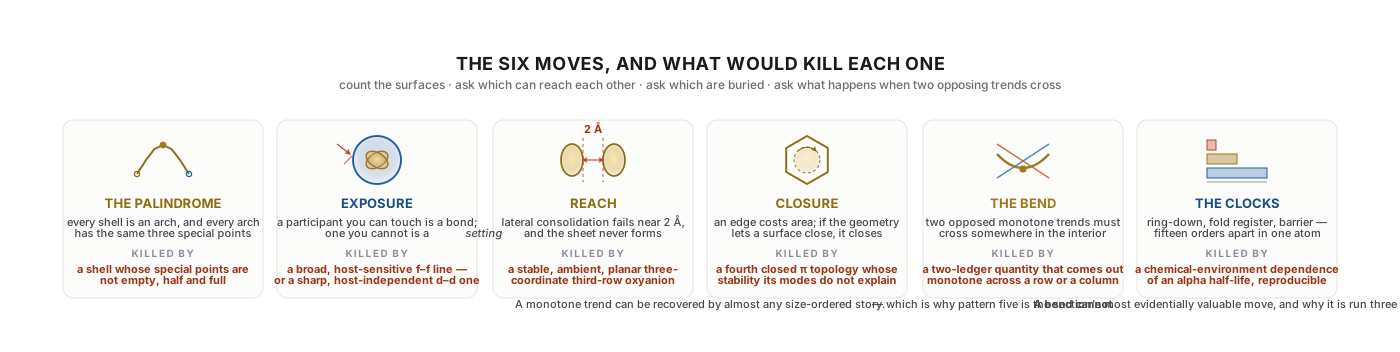
The section’s falsifiers are scattered across seven chapters’ prediction lists. Compressed to their portable core:
| Pattern | What would kill it |
|---|---|
| The palindrome | a shell whose special points are not empty / half / full — e.g. a lanthanide with robust second-state chemistry that is not adjacent to f^0, f^7 or f^{14} |
| Exposure | a sharp, host-independent transition that rearranges lobe occupancy, or a broad, host-sensitive f–f line in an ordered crystal |
| Reach | a stable, ambient, planar three-coordinate third-row oxyanion; or a stable open-hexagonal phase sitting above its denser polymorph on the pressure axis |
| Closure | a fourth closed \pi topology whose stability pattern does not follow from the mode structure of its surface |
| The bend | a genuinely two-ledger quantity that comes out monotone across a row or column — e.g. a stiff-gallery host in which sodium intercalates as readily as potassium; or an ion-channel permeability series that peaks at its filter’s own cage radius rather than displaced to the cheap-to-strip side of it; or, in the two-axis form, a d\rho/dT sign-flip locus and a diagonal-relationship locus that trace visibly different lines, or a Zintl border that comes out vertical rather than diagonal once it is surveyed across all five rows |
| The clocks | a reproducible chemical-environment dependence of an alpha half-life; or an electron-capture nuclide showing none |
| The token made by speed | a relativistically-attributed anomaly of comparable size in a 4d/5s congener at matched configuration; or a heavy-element anomaly explained with only one sign of shell displacement, when the mechanism requires s contracting while d expands; or a 6s^2 element whose high oxidation state is more accessible than its 5s^2 congener’s |
| The seal | an interior extremum anywhere in group 18 at fixed phase and pressure, in the one column the ledger says has no second trend to bend it; or an element outside group 18 that stays fluid to 0 K at ambient pressure; or a chemically-bonded solid with a de Boer parameter above two |
| The relay | anomalous proton mobility in a rigorously aprotic medium, or an ion with a genuine core moving by structural rather than vehicular diffusion; or a chemical quantity on which hydrogen falls cleanly between Li and Na, or between F and Cl, rather than near carbon; or a kinetic isotope effect at any other element exceeding what its reduced-mass ratio permits |
This is an index, not an argument. Every claim summarized above is made, qualified and given its falsifier in one of the nine chapters that follow, and each of those chapters carries caveats this summary flattens. In particular: the framework produces no new numbers anywhere in this section. It cannot compute a bond enthalpy, a catalytic binding energy, an f-orbital radial extent, a band gap, graphene’s Fermi velocity, a relativistic orbital contraction, or the absolute nuclear seam energy that would make its own best ratio quantitative. Every one of those is named as an open problem in its own chapter. What is offered here is that a great many separately-taught facts turn out to be one accounting problem — and that the accounting occasionally predicts a bend, a window, or a near-miss that the separate accounts do not obviously reach for.
Conclusion
The periodic table’s usual explanation is electron configuration, and this section does not dispute it. What it adds is a reading of why configuration matters, and the reading is geometric: an atom is a set of surfaces, a bond is a merger that saves surface area, and everything else is what an atom does with the surfaces it cannot use.
Row two spends its leftovers on voice. Zero spectators is a builder, one is a decision, two is a gradient, three only terminates — and the elements around carbon are useful in exact proportion to how much they have to say. The d-block spends its leftovers on state, because its lobes sit behind an interface no partner can reach through, and a boundary that cannot resolve is a boundary that holds a setting. Group 14 has no leftovers at all — the double zero repeated five times down a column — so nothing about its arithmetic can vary, and what varies instead is the distance: the merger itself gets weaker until it stops owning anything, and the residue of that failure is a band gap. The sixth row’s leftovers are taken away before the chemistry starts, retired not by any count but by a velocity, which is why the bottom right of the main group behaves as though it had two fewer participants than it has. The f-block cannot spend its leftovers on chemistry at all — bury the register far enough and fourteen elements become one element with fourteen masses — and then sells that same unreachability twice, as a line no host can shift and an axis no lattice can bend. Past the crest there are no leftovers, only a drop that has grown larger than its own seam can span, giving pieces back on a clock that nothing in the universe can hurry. And group 18 never had leftovers, because nothing was left over: the shell closed exactly, and what an atom does with no surfaces at all turns out to be the reason there is a beaker cold enough to measure the vacuum in. Row one has no leftovers either, for the opposite reason and at a quarter the width — one pair, half spent, nothing else in the atom — which leaves hydrogen with the same double zero carbon has and none of the interior every other element in the table is built around.
Each chapter names one thing the substrate shows through its element. Carbon shows the sheet — the hexagonal geometry the vacuum itself is built on, borrowed by chemistry wherever biology needs to move energy without losing it. Lithium shows the coin — the smallest closed charged boundary there is, and what it takes to move a fragile thing somewhere it survives. Iron shows the fold — the only structure in the table that can be entered halfway and left again, which is why it catalyses, why it remembers, and why it carries your oxygen. Silicon shows the gap — the residue of a merger that got most of the way and stopped, and the only place in matter where a boundary can be told what to do. Gold shows the speed — the substrate’s own signal limit, ordinarily reachable only by cosmology and accelerators, turning up as the colour of a wedding ring. Uranium shows the limit — where both ledgers run out, and the one clock in nature that no environment can touch. Helium shows the seal — a surface closed at every tier it has, which is why it will not freeze, and why the only laboratory in which this framework can be measured is a cell of the periodic table rather than a piece of luck. Hydrogen shows the relay — the one cell where a boundary gets from one place to another without anything travelling, because there is nothing behind the participant to travel.
Eight objects, one ledger. And the thing that keeps surprising me about it is how little of the payoff stays in chemistry. The reason we mine phosphate rock rather than pulling phosphorus from the sky is not agronomy and not geology; it is that a counter-rotating boundary cannot consolidate sideways across 2.2 Å. The reason a rock can be dated is that the barrier is inside the drop where nothing can reach it. The reason a leaf can count to four is that a topological setting has no ring-down time. The reason a car starts is that a pair of electrons inside a lead atom were retired by a speed and can be bought back for 1.7 V. The reason every molecule you are made of is capped with hydrogen is that a cap must have nothing to say, and there is one element in the table with nothing behind it to say anything with. One geometric limit at the ångström scale, and it decides what a planet can farm, what a civilization can store its energy in, and how long a clock can honestly run.