Hydrogen in the Substrate
The cell nobody can place — why the table’s oldest filing error is a real physical statement, why the smallest ion is the fastest when every other small ion is the slowest, what it costs to have no interior, why the one element whose mass sits on its own boundary is the only one whose isotopes change the chemistry, and why the biosphere is capped with the only terminator that has nothing to add
The cell nobody can place
Every element in the periodic table has an address. Hydrogen has an argument.
Open six textbooks and you will find it in four different places: at the head of group 1, because it has one valence electron; at the head of group 17, because it is one electron short of a closed shell; floating unattached above the whole table, because neither fits; and, in a minority of modern layouts, over group 14, on the grounds that it is half-filled and its electronegativity says so. The IUPAC table declines to decide. This is not a controversy about a rare element in an unread corner — it is the most abundant substance in the universe, the first entry on the chart, and the table cannot say where it goes.
That is a strange thing for a classification scheme to admit about its own first cell, and the usual explanation is a shrug dressed as a fact: hydrogen is unique because it has only a 1s electron, so no rule applies. True, and it explains nothing, because “only a 1s electron” is the observation, restated.
This section has spent eight chapters arguing that the table is not a filing cabinet but a picture of surfaces, and that what an element does is decided by what it has left over after its participants are spent. That reading has something specific to say here, and it is one line:
Every other element in the table is a participant count plus a core. Hydrogen is a participant count with nothing behind it.
The rest of this chapter is that sentence being cashed — in a mobility measurement that inverts the section’s own law, in a bond shared among three centres, in the only isotope effect in chemistry large enough to kill an animal, and in the reason the biosphere is capped with hydrogen and not with anything else.
The palindrome at width one
Start where the section always starts, with the tokens.
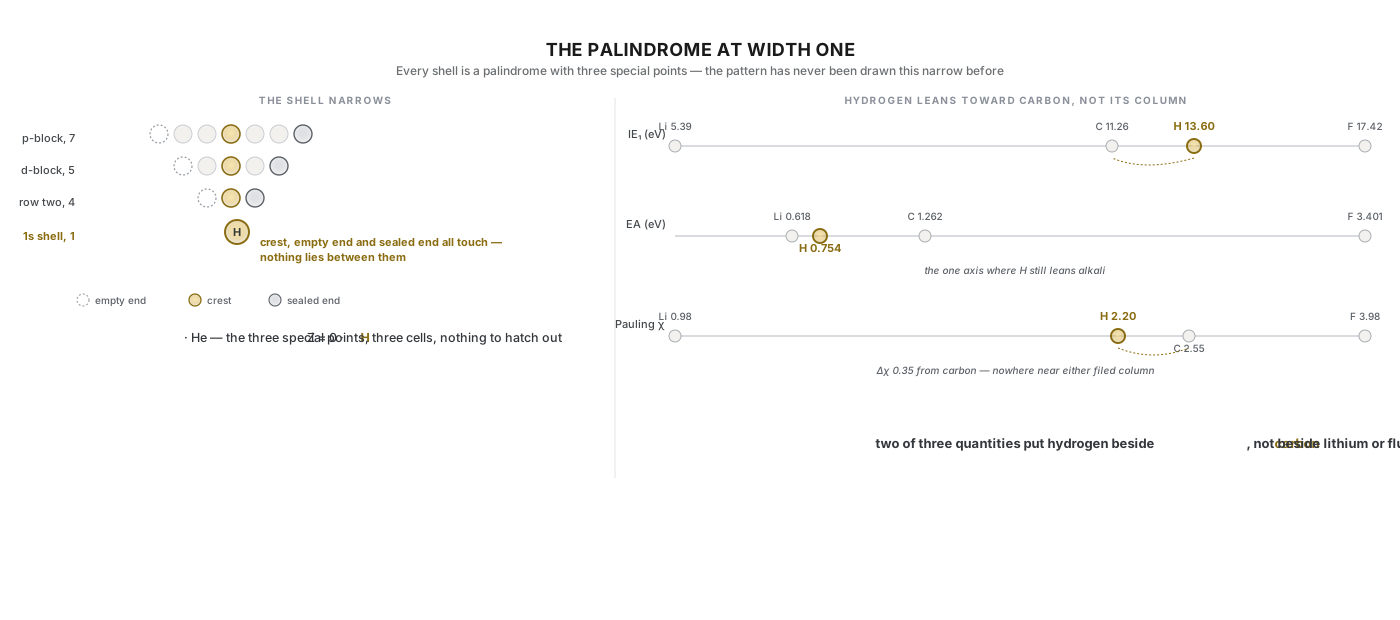
Pattern one says every shell is a palindrome with three special points — the empty end, the half-filled crest, and the sealed end — and that the pattern runs at three widths: four slots in row two, five lobes in the d-block, seven in the f-block. It runs at a fourth width, and the section has never drawn it.
A 1s shell holds two electrons. That is one counter-rotating pair — one slot, not four. So the palindrome at width one has exactly three positions, and they are the three special points with nothing between them:
\text{(empty)}\;0,\quad \textbf{H } \mathbf{1},\quad \text{He } 0
The empty end is not an element — it is Z=0, off the table. The sealed end is helium, and the previous chapter read it. The crest is hydrogen. Row one has two elements because a shell of one pair has room for nothing but its own special points, and the reason the first row is short has never needed a different explanation than the reason the second row is eight wide.
Now run the ledger on that cell the way the lithium chapter ran it on row two:
| Participants | Spectators | Vacancies | The cheapest resolution | |
|---|---|---|---|---|
| Hydrogen | 1 | 0 | 0 | fill exactly |
| Helium | 0 | 1 | 0 | nothing to do |
| Lithium | 1 | 0 | 3 | abandon the shell |
| Carbon | 4 | 0 | 0 | fill exactly |
| Fluorine | 1 | 3 | 0 | terminate |
Look at the two rows in bold. Hydrogen and carbon have the same token structure — every slot a participant, no spectators, no vacancies — differing only in the width of the shell they are counted in. Hydrogen is the double zero of row one, the same cell the carbon chapter calls “the element with nothing to say,” at one pair instead of four.
And that is the placement problem solved, in the section’s own vocabulary. Lithium and fluorine both have one participant. So does hydrogen. The three of them agree on the quantity the columns are drawn by, and disagree on the quantity that decides everything. Lithium’s one participant comes with three vacancies, so its resolution is to abandon. Fluorine’s comes with three spectators, so its resolution is to terminate and exclude. Hydrogen’s comes with neither, so it does what carbon does: it fills exactly, once, and stops.
Hydrogen is filed by its participant count and misfiled by its shortfall — which is precisely the failure mode this section has been warning about since pattern two, where carbon and d^5 share an arithmetic and behave in opposite ways.
That reading makes a checkable commitment, and it is not a soft one: if hydrogen belongs with carbon rather than with either column it is filed under, its numbers should say so.
| IE₁ (eV) | Electron affinity (eV) | Pauling \chi | |
|---|---|---|---|
| Hydrogen | \mathbf{13.60} | \mathbf{0.754} | \mathbf{2.20} |
| Lithium | 5.39 | 0.618 | 0.98 |
| Carbon | 11.26 | 1.262 | 2.55 |
| Fluorine | 17.42 | 3.401 | 3.98 |
On ionization energy hydrogen is two and a half times lithium and four fifths of fluorine — nearest carbon. On electronegativity it is nowhere near either column and sits 0.35 from carbon. Only on electron affinity does it lean toward the alkali it is usually filed with, and even there it is closer to carbon than fluorine is to anything. Two of three quantities put hydrogen next to carbon, and the third points at the column opposite the one the table files it in. A cell that is genuinely group 1 does not have an ionization energy 2.5 times lithium’s; a cell that is genuinely group 17 does not have an electron affinity a fifth of fluorine’s.
The payoff of that identification is the last section of this chapter, and it is the whole biosphere.
Nothing here is new chemistry. That hydrogen fits neither column is universally known; that its 1s shell is one pair wide is the first thing anyone learns; and the diagonal-ish resemblance between hydrogen and carbon shows up in any electronegativity table.
What the framework contributes is that the anomaly is not an exception to the pattern but an instance of it — the section’s own distinction between participant count (which the columns are drawn by) and shortfall (which decides the chemistry), applied at a shell width the section had not yet counted. The standard account says hydrogen is unique because 1s is special. This one says hydrogen is unique for the same reason carbon is, and it is testable in the ordinary way: hydrogen’s chemical quantities should cluster near carbon’s rather than falling between Li and Na or between F and Cl. They do. That is a retrodiction of a known pattern, not a new number, and it is worth exactly as much as retrodictions of known patterns are worth.
The core that isn’t there
Now the part where hydrogen stops resembling carbon.
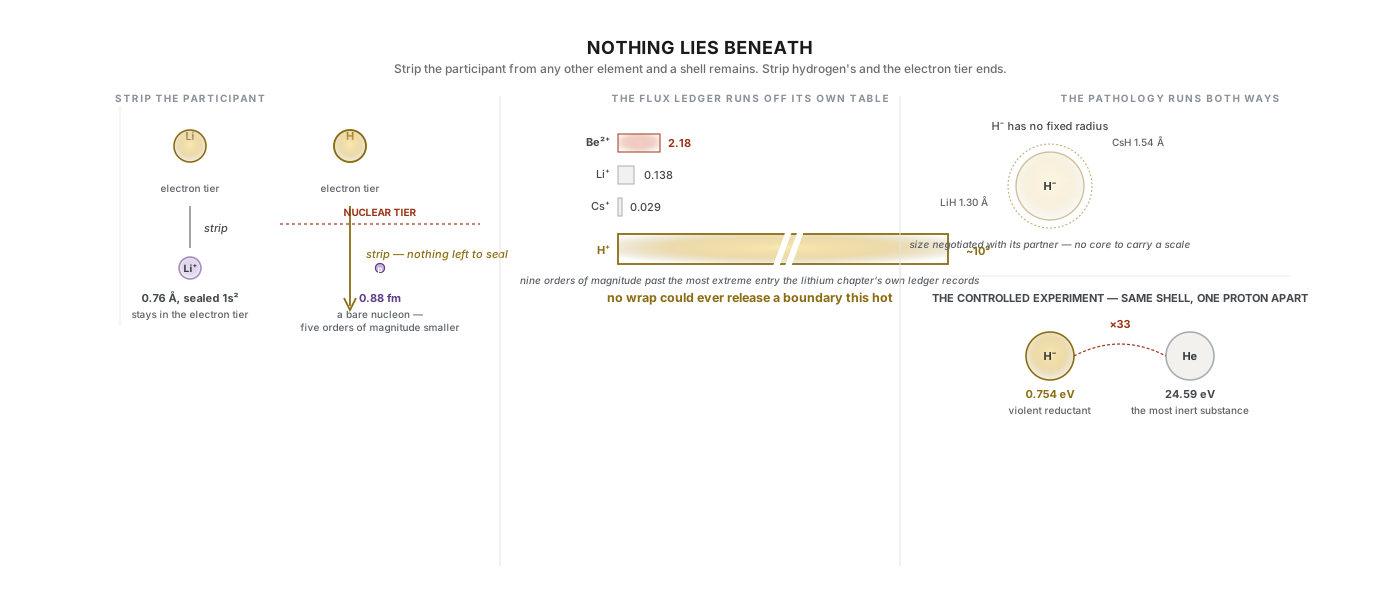
Carbon’s four participants sit on the outside of a 1s^2 core. Lithium’s one sits on the outside of the same core. Every element in the table, without exception, is an arrangement of participants around something — and the whole of the lithium chapter is about what that something does after the participants are gone. Strip lithium and you get Li⁺: a sealed helium shell at 0.76 Å, radiating 0.138 units of surface flux, recruiting a wrap of solvent and moving as a composite.
Strip hydrogen and you do not get a smaller shell. You fall out of the electron tier entirely and land on a nucleon — the object the proton core chapter describes, one tier down, at 0.88 fm instead of 0.76 Å.
That is five orders of magnitude, and the lithium chapter’s flux ledger does not merely rank hydrogen highest. It breaks:
| Cation | r | Surface flux e/4\pi r^2 (e Å⁻²) |
|---|---|---|
| H⁺ | 0.88 fm | \sim\mathbf{10^{9}} |
| Be²⁺ | 0.27 Å | 2.18 |
| Li⁺ | 0.76 Å | 0.138 |
| Cs⁺ | 1.67 Å | 0.029 |
Nearly ten orders of magnitude above the most extreme entry in the lithium chapter’s table. And that number is not a curiosity — it is the ledger predicting its own exception. The lithium chapter argued that a metal-anode chemistry is decided by wrap turnover: the shell must be strong enough to dissolve the core and loose enough to release it, and beryllium at 2.18 units of flux is already so hungry that it welds itself to its solvent and never lets go. A boundary at 10^9 is not a hungry version of beryllium. It is a boundary for which no release is conceivable at any temperature.
So the framework’s prediction, read off its own table, is that hydrogen cannot be transported as a wrapped core at all. The observation is stronger than the prediction: a free proton does not exist in condensed matter. Not rarely, not transiently — the bare H⁺ is not a species in solution chemistry, and never has been. What the textbook writes as H⁺ is H₃O⁺ at minimum, and in fact the Eigen cation H₉O₄⁺ or the Zundel cation H₅O₂⁺, delocalized across several molecules. The wrap is not recruited by a core, the way lithium’s is. There is no core, so the wrap is constitutive: it is not something the proton acquires, it is the only form in which the proton exists.
And the pathology runs both ways, which is the tell. Add an electron instead of removing one and you get the hydride ion, H⁻ — two electrons around a single unit of nuclear charge, and the only monatomic anion in the table with no fixed size:
| LiH | NaH | KH | RbH | CsH | |
|---|---|---|---|---|---|
| Apparent H⁻ radius (Å) | 1.30 | 1.42 | 1.52 | 1.53 | 1.54 |
Chloride is 1.81 Å in every chloride there is. Hydride varies by nearly 20\% depending on what it is sitting next to, because there is no core underneath to set the scale — the anion’s size is negotiated with its partner rather than carried in.
Which sets up a controlled experiment in the format the helium chapter rates above almost anything else. H⁻ and He are the same shell. Both are 1s^2, both are closed, both are the sealed end of the width-one palindrome. They differ in exactly one variable — one unit of nuclear charge — and the seal’s binding energy moves by a factor of thirty-three:
| 1s^2 around Z=1 | 1s^2 around Z=2 | |
|---|---|---|
| H⁻ | He | |
| Binding of the outer electron | 0.754 eV | \mathbf{24.59} eV |
| Chemistry | violent reductant | none |
The tightest closed shell in the periodic table and one of the loosest are the same shell, one proton apart. The helium chapter’s argument was that a spectator is a real object whose grip is set by how tightly it is held; here the grip is varied directly, by the only means available, and the verdict swings from the most inert substance in chemistry to a reagent that reduces almost anything. Hydrogen has too little core to hold its own seal on.
The ion that isn’t the mover either
Here is the chapter’s centrepiece, and it begins as a flat contradiction of the section’s best-worked result.
The lithium chapter establishes a law and tests it in three regimes: the wrap is the mover. A small, high-flux boundary cannot present a smooth face to the medium, so it recruits a shell, and the composite is what diffuses. Therefore the smaller the bare ion, the slower it goes — and the aqueous conductivities invert the size order exactly as they should, Li⁺ slowest at 38.7 and Cs⁺ fastest at 77.3.
Then put hydrogen on that table.
| Ion | Bare radius | \lambda^\circ (S cm² mol⁻¹) |
|---|---|---|
| H⁺ | 0.88 fm | \mathbf{349.8} |
| OH⁻ | — | \mathbf{198.0} |
| Cs⁺ | 1.67 Å | 77.3 |
| Cl⁻ | 1.81 Å | 76.3 |
| K⁺ | 1.38 Å | 73.5 |
| Na⁺ | 1.02 Å | 50.1 |
| Li⁺ | 0.76 Å | 38.7 |
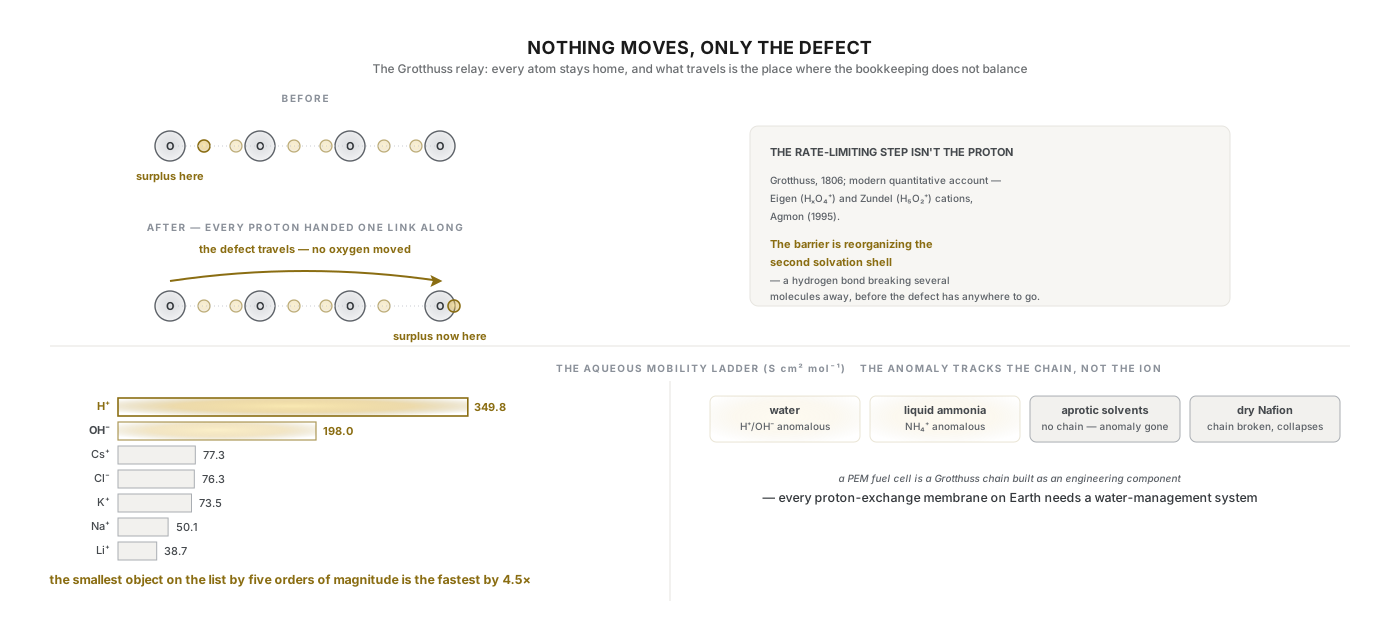
Every other ion in aqueous chemistry lands between 30 and 80. The proton is at 350 — four and a half times the fastest alkali, nine times lithium. The smallest object on the list, by five orders of magnitude, is the fastest by a factor of four and a half. If the wrap is the mover, and the flux ledger says hydrogen’s wrap is the most tightly held boundary that could exist, then hydrogen should be immovable. It is the quickest thing in the beaker.
The resolution is that nothing is being moved.
The proton does not traverse the solution. It sits in a hydrogen-bond chain — O–H···O–H···O — and the bond it belongs to is handed one link along: the covalent O–H becomes the hydrogen bond and the hydrogen bond becomes the covalent O–H. Every nucleus in the chain ends within a fraction of an ångström of where it started. What has translated is the defect: the position in the network where the ledger does not balance. This is the Grotthuss mechanism, proposed in 1806 and worked in modern form by Agmon (1995), and its rate-limiting step is not any motion of the proton at all — it is the reorganization of the second solvation shell, the breaking of a hydrogen bond several molecules away, which has to happen before the defect has anywhere to go.
That is a proposition about the medium rather than about the carrier, and it makes the same falsification test the lithium chapter made, with the sign fixed in advance and the opposite conclusion. Lithium’s law was proved by taking the wrap away: remove the solvent and the mobility inversion inverts back, in molten salts and in solid electrolytes. Hydrogen’s is proved by taking the chain away:
- In water, and only in water-like media. The two anomalous ions in the table above are the two that are the water network — H₃O⁺ and OH⁻, a surplus and a deficit in the same chain. OH⁻ is slower than H⁺ by a factor of 1.8, which is what a defect that must be relayed through a differently-shaped local structure should cost, and it is still two and a half times the next-fastest anion.
- In liquid ammonia, which supports its own hydrogen-bond network, NH₄⁺ shows the same anomalous excess mobility. Different solvent, different chemistry, same relay.
- In aprotic solvents — acetonitrile, dimethyl sulfoxide, propylene carbonate — the anomaly is gone. There is no donor–acceptor chain to hand a defect along, so a solvated proton is just another cation dragging a shell, and it behaves like one.
- In a dried polymer membrane the anomaly collapses, and this one is worth a billion dollars a year. Nafion conducts protons at around 0.1 S/cm when hydrated and falls by orders of magnitude when it dries out, which is why every proton-exchange-membrane fuel cell on Earth has a water-management system and why they fail above about 100 °C. A PEM is a Grotthuss chain built as an engineering component, and the engineering problem is keeping the chain wet.
One statement — the relay is the mover — covers all four, and it is the lithium chapter’s statement with its subject removed. For every other element, transport means moving a boundary through a medium, and the ledger is about what the boundary costs to drag. For hydrogen there is no boundary to drag, so transport means propagating a defect through a network that does not itself move, and the ledger is about what the network costs to reorganize.
The Grotthuss mechanism is from 1806, and the modern quantitative account — the Eigen and Zundel cations, the second-shell reorganization as the rate-limiting step, the ab initio molecular dynamics that reproduce the barrier — is established physical chemistry that needs no substrate. The framework computes no mobility and could not have predicted 349.8.
The claim is about where the anomaly sits in the section’s own bookkeeping. The lithium chapter’s law is not merely violated here; it is violated at exactly the cell where the ledger says its subject ceases to exist, and the violation takes the form the ledger’s own extrapolation demands — a flux density at which no wrap could ever release, resolved by there being nothing to release. A law that identifies its own boundary condition, and finds the boundary condition occupied by exactly one element, is doing more work than a law with an exception. The honest caveat is that this is a reading of a known mechanism, not an independent derivation of it, and that “the proton is small and hops” gets the same answer with no substrate at all.
One boundary, three centres
The relay’s individual step deserves its own name, because it is a structure the section has now met three times from three different directions.
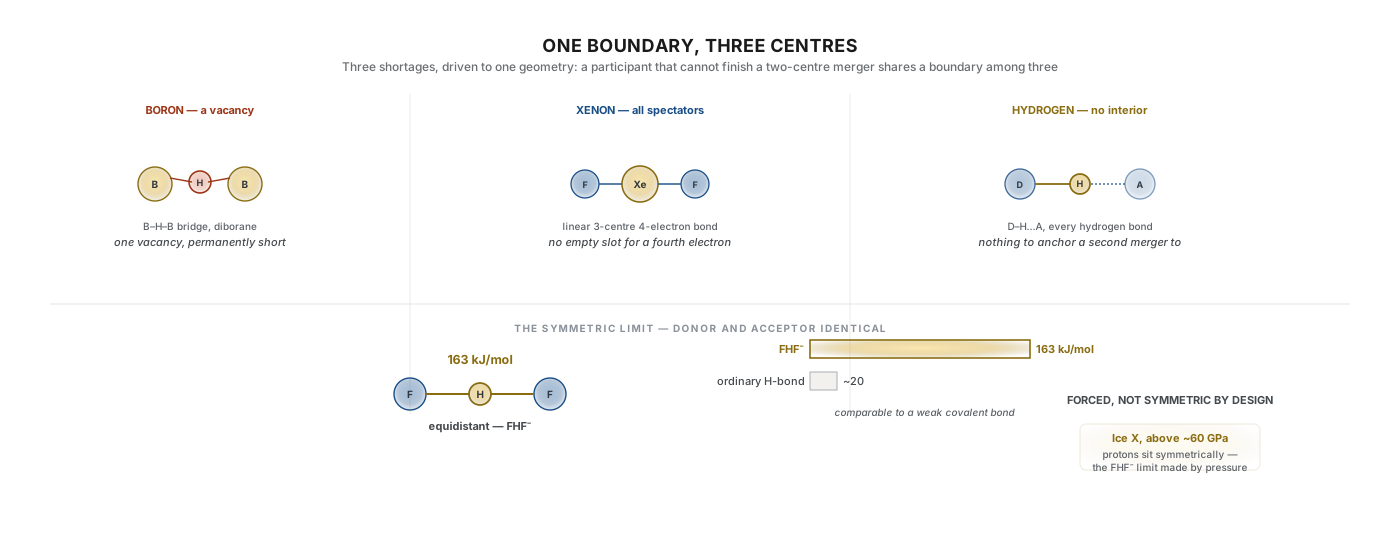
A hydrogen bond, D–H···A, is not a merger in the sense pattern one’s three exits uses. A merger is exact and directional: two participants meet, two boundaries become one, and the transaction is finished. Here one participant is shared among three centres — the donor it is covalently merged with, the hydrogen itself, and the acceptor whose spectator boundary it is leaning on. The section has a name for that geometry and has bumped into it twice already:
| Element | Why it cannot complete a two-centre merger | The structure |
|---|---|---|
| Boron | one vacancy — permanently a half-boundary short | B–H–B bridge in diborane; the borane cages |
| Xenon | all spectators — no empty slot for a fourth electron | the linear three-centre four-electron bond in XeF₂ |
| Hydrogen | no interior — nothing to anchor a second merger to | D–H···A, and every hydrogen bond there is |
Three elements at three different places on the dial, driven to one geometry by three different shortages. The helium chapter noticed the first two were the same motif approached from opposite poles and left it as a breadcrumb. The third is the one that matters industrially and biologically, and it is the one where the shortage is not a count at all.
That is the section’s usual shape: a geometry that looks like a special case in three unconnected literatures turns out to be one response to one condition — a participant that cannot finish a two-centre merger shares a boundary among three centres instead — with the condition arrived at by deficiency, by excess, or by having no interior.
And the motif has a limit, which is where it becomes a real bond rather than an interaction. Make the donor and the acceptor identical and the asymmetry that keeps the proton on one side disappears. The bifluoride ion FHF⁻ is the result: the proton sits at the centre, equidistant from both fluorines, in a symmetric three-centre bond worth about 163 kJ/mol — the strongest hydrogen bond known, comparable to a weak covalent bond and an order of magnitude above the 20 kJ/mol of the ones holding a protein together.
Then the section’s third face of reach arrives, on schedule. Pressure substitutes for reach, and the framework’s standing claim is that squeezing a system hard enough moves it along the same axis chemistry does — flat carbonate to tetrahedral orthocarbonate above {\sim}80 GPa, graphite to diamond at 1.6 GPa, unreactive helium into Na₂He at 113 GPa. Squeeze ordinary hydrogen-bonded ice and the same thing happens to the relay: above roughly 60 GPa the protons in Ice X sit symmetrically between the oxygens, the distinction between the covalent bond and the hydrogen bond vanishes, and the molecular identity of water dissolves into a lattice of three-centre bonds. The ice chapter records that phase as the end of the pressure sequence without naming what it is. It is bifluoride, made by force instead of by symmetry — the relay compressed until every step is the FHF⁻ limit at once.
The mass on the boundary
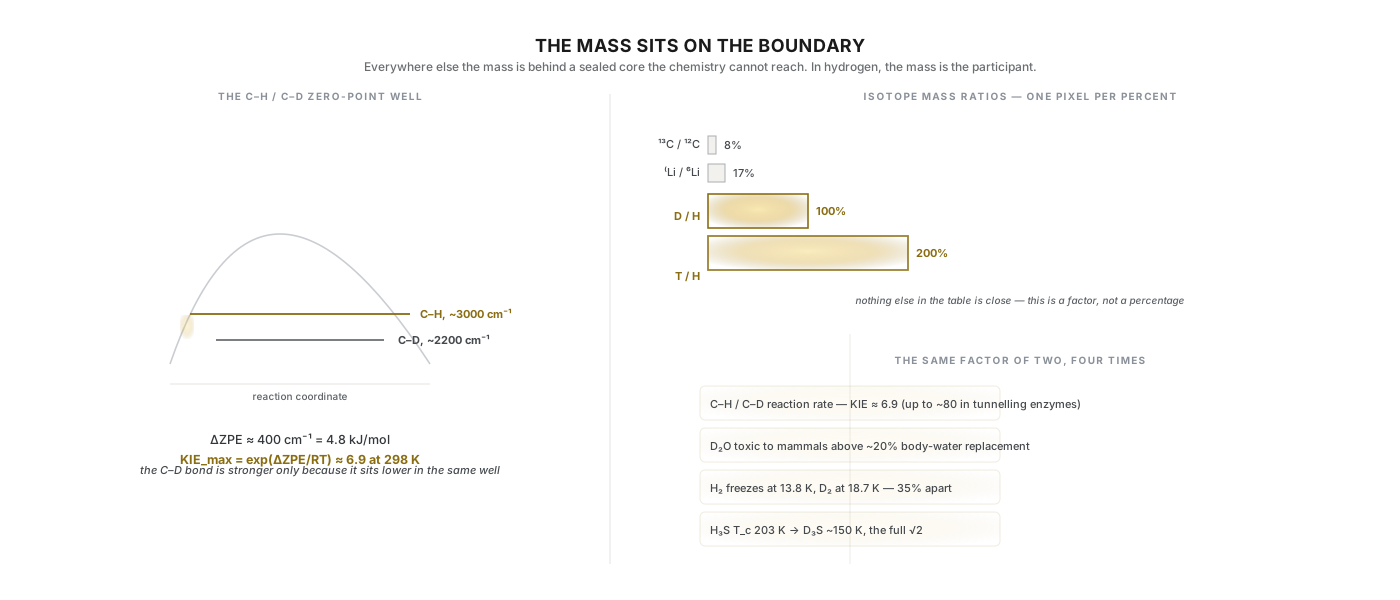
Every other element in the table keeps its mass somewhere the chemistry cannot see. Carbon’s twelve nucleons sit inside a sealed core; the four participants on the outside are what react, and swapping ¹²C for ¹³C changes their behaviour by a fraction of a percent. That is why isotope effects are, everywhere else in chemistry, a precision technique rather than a phenomenon.
Hydrogen has no inside. The mass is the participant, and it is the only element for which substituting an isotope is a factor rather than a percentage:
\frac{m_\text{D}}{m_\text{H}} = 2, \qquad \frac{m_\text{T}}{m_\text{H}} = 3
Against ⁷Li/⁶Li at 17\% — the largest anywhere else in the table — and ¹³C/¹²C at 8\%. Nothing else is close, and the arithmetic that follows is short enough to write out. A bond’s zero-point energy is \tfrac12 h\nu with \nu \propto \sqrt{k/\mu}, so doubling the reduced mass drops the frequency by \sqrt{2}: a C–H stretch at {\sim}3000 cm⁻¹ becomes a C–D stretch at {\sim}2200. The zero-point levels differ by about 400 cm⁻¹, which is 4.8 kJ/mol, and if that whole difference has to be supplied at the transition state,
\text{KIE}_\text{max} = \exp\!\left(\frac{4.8\ \text{kJ mol}^{-1}}{RT}\right) \approx 6.9 \quad\text{at } 298\ \text{K}
which is the observed semiclassical ceiling for C–H versus C–D. The C–D bond is stronger than the C–H bond only because it sits lower in the same well, and that is visible as a factor of seven in reaction rate because in hydrogen — uniquely — the thing sitting in the well is the whole atom.
Three consequences, in ascending order of strangeness.
Enzymes exceed the ceiling. Where the transfer proceeds by tunnelling rather than over the barrier, the isotope effect is no longer bounded by zero-point energy at all, and soybean lipoxygenase-1 shows a KIE near 80 at room temperature. A rate ratio of that size, from one neutron, is the sharpest available demonstration that the hydrogen in an enzymatic transfer is behaving as a wave rather than as a ball — which is the exterior region of the flywheel doing its usual exponential work, with the barrier width held fixed and only \sqrt{m} varied.
Heavy water is poisonous. Mammals given D₂O become ill above roughly 20\% replacement of body water and die near 35\% — mitosis fails, and the failure is kinetic rather than chemical. There is no other element in the periodic table whose isotope substitution is toxic to a mammal. Uranium’s isotopes are chemically indistinguishable; so are carbon’s, oxygen’s, and lead’s. Hydrogen’s are different substances at the rate level, and the reason is one line of the ledger.
And it is the mirror of the helium chapter’s control experiment. That chapter isolated a variable chemistry cannot see — ³He against ⁴He, identical shells, identical polarizability, identical nothing-chemistry, differing only in nuclear closure, and the superfluid transition moves by three orders of magnitude. This chapter isolates the same kind of variable and chemistry sees it enormously, for the reason the ledger gives: helium’s neutron is behind a sealed shell that the chemistry is blind to, and hydrogen has no shell to hide it behind. The two elements of row one are the two halves of the same experiment, and which half you get is decided by whether there is anything between the nucleus and the world.
The near-miss the helium chapter already recorded is now readable in the same terms. H₂ is half helium’s mass and freezes anyway, at 13.8 K, because it is not sealed — de Boer \Lambda = 1.73 against helium’s 2.64. D₂, at \Lambda = 1.22, freezes higher still at 18.7 K. That is the same factor of two in the same place, showing up in a phase diagram instead of a rate constant, and it is the only column of the table where a phase transition temperature moves 35\% on an isotope substitution.
No core, no inside path
The lithium chapter identified the three constraints a battery imposes and found the table admits one occupant. Hydrogen is the line in that table that beats everything on the quantity everyone optimizes and fails on the one the ledger says decides:
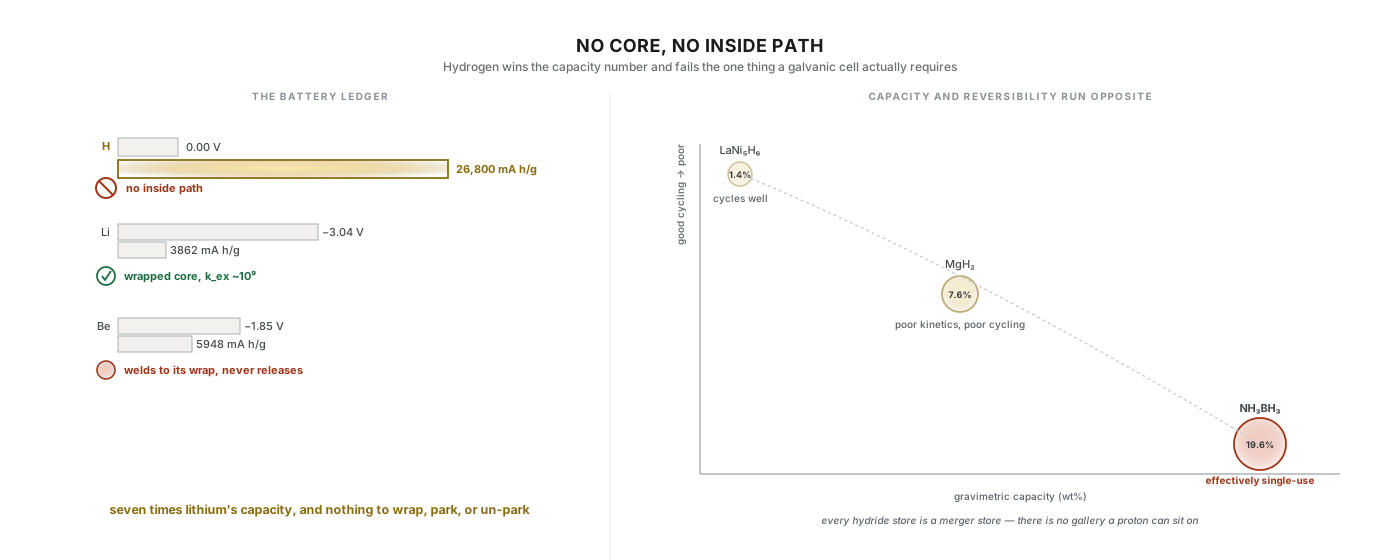
| E^\circ (V) | Capacity (mA h/g) | \lvert E^\circ\rvert\times capacity | Inside path? | |
|---|---|---|---|---|
| H | 0.00 | \mathbf{26{,}800} | — | none |
| Li | -3.04 | 3862 | 11{,}700 | wrapped core, k_\text{ex}\sim10^9 |
| Be | -1.85 | 5948 | 11{,}000 | welds to its wrap |
Seven times lithium’s capacity, the best number in the periodic table, and it cannot be built into a battery — not because of engineering, but because the architecture the lithium chapter describes has no place to put it. A galvanic cell is one boundary torn on the outside and rewrapped on the inside, with the participant leaving through the wire and the core leaving through the electrolyte. Hydrogen has no core to send down the inside path. There is nothing to wrap, nothing to park, and nothing to un-park.
So hydrogen is stored the only two ways a coreless participant can be: as a gas, in an open system, which is a fuel cell; or as a merger, chemically bonded into a host, which is a metal hydride. And the second of those inherits a prediction the lithium chapter made about something else entirely.
That chapter’s fifth prediction is that reversibility tracks median versus merger: a guest that inserts onto an unmerged gallery breaks nothing and cycles thousands of times (graphite, layered oxides), while a guest that must break and rebuild host–host mergers cycles hundreds or tens (silicon anodes, conversion cathodes). Hydrogen storage was not in that chapter’s scope, and it is a pure test case, because every hydride store is a merger store — there is no gallery a proton can sit on, since sitting requires a core.
The field’s experience is the merger column exactly. LaNi₅H₆ cycles reasonably at a miserable 1.4 wt% because it barely disturbs its lattice. MgH₂ offers 7.6 wt% and demands a full reconstruction of the magnesium lattice on every charge, with the kinetics and the cycle life that implies. Ammonia borane reaches 19.6 wt% and is effectively single-use. Capacity and reversibility run in opposite directions across the whole family, which is what the median/merger reading requires and which no account based on binding enthalpy alone predicts.
The fuel cell is the other exit taken cleanly: don’t store the boundary, relay it. The membrane is the chain, the chain is the mover, and the whole architecture is a consequence of the fact that the carrier cannot be carried.
The bond with nothing to say
Now the payoff of the identification made at the top of this chapter, and it is the largest single fact this section has tried to explain.
The carbon chapter argues that carbon builds the biosphere because it has no opinion — four participants, no spectators, no vacancies, no dipole, nothing of its own to say, so the substrate’s geometry fills the silence. That argument has a hole in it that the chapter does not address. A carbon frame is not made of carbon. It is made of carbon and a terminator, and a terminator with an opinion would put the opinion back.
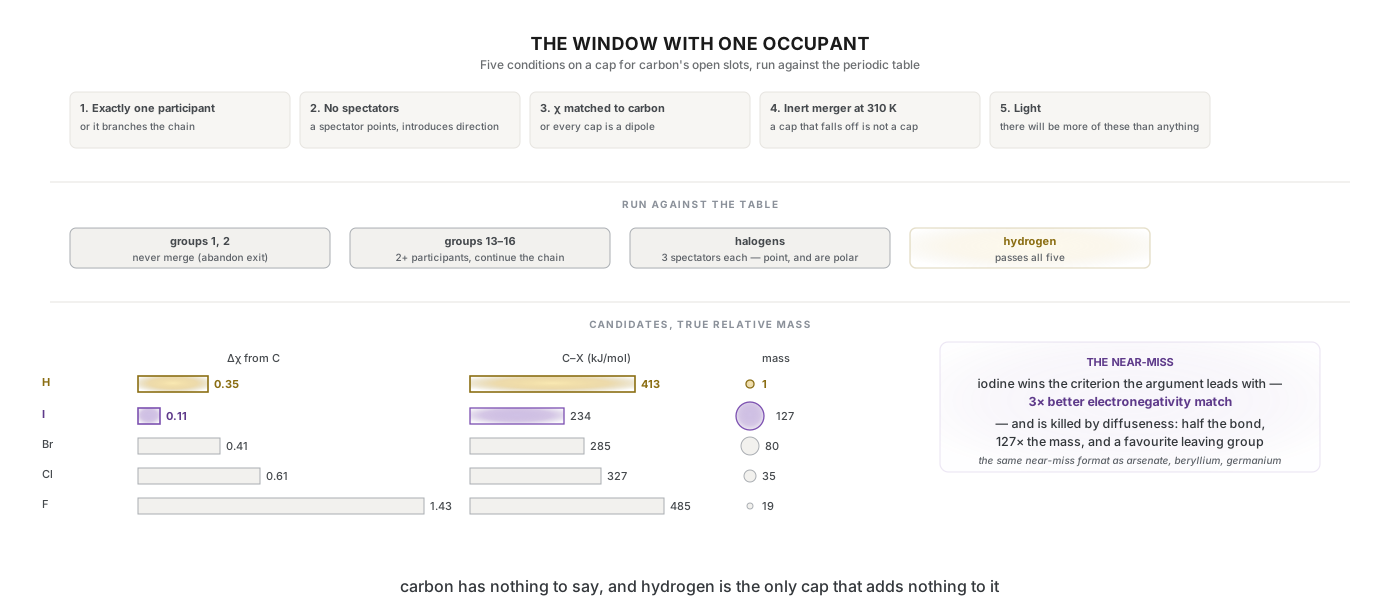
So what does a carbon skeleton need at its open slots? Five conditions, and they are independent:
- Exactly one participant — more than one and it branches the chain instead of ending it.
- No spectators — a spectator points, and a pointing terminator introduces a direction the frame did not ask for.
- Electronegativity matched to carbon’s — otherwise every cap is a dipole, and a hydrocarbon chain becomes a row of charges.
- A merger strong enough to be inert at 310 K — a cap that falls off is not a cap.
- Light, because there will be more of them than of anything else.
Run the table against that list. Everything in groups 1 and 2 fails on condition 1 or takes the abandon exit and never merges at all. Everything from group 13 to 16 fails on condition 1 — they have two or more participants and continue the chain rather than ending it. That leaves group 17 and hydrogen.
And the halogens fail on condition 2 by construction: three spectators each. They point, and they are polar. C–F at \Delta\chi = 1.43 is the most polar bond in organic chemistry.
Which leaves the near-miss, and it is a good one — it beats hydrogen on the quantity you would have optimized:
| Cap | \Delta\chi from carbon | Bond to C (kJ/mol) | Mass |
|---|---|---|---|
| H | 0.35 | \mathbf{413} | \mathbf{1} |
| I | \mathbf{0.11} | 234 | 127 |
| Br | 0.41 | 285 | 80 |
| Cl | 0.61 | 327 | 35 |
| F | 1.43 | 485 | 19 |
Iodine is three times better matched to carbon’s electronegativity than hydrogen is. On condition 3 — the one the argument leads with, the one that says a cap must carry no dipole — iodine wins outright, 0.11 against 0.35. And it loses everything else on the axis this section has made load-bearing twice already: iodine’s boundary is the most diffuse in the halogen column, so C–I comes out at 234 kJ/mol against C–H’s 413, and the C–I bond is not a cap at all but organic chemistry’s favourite leaving group. It is also 127 times heavier, which for a molecule that is half caps by atom count is not a detail.
That is the section’s near-miss format in its cleanest instance: a candidate that matches on the quantity the argument is built from, and fails on the axis the framework had already made decisive for unrelated reasons. Arsenate had perfect connectivity and no hold. Beryllium had the voltage and the capacity and could not let go. Germanium had the mobility and could not hold a gap. Iodine has the electronegativity and cannot hold on.
So the window has one occupant, and the occupant is the crest of the width-one palindrome. Carbon is the element with nothing to say, and hydrogen is the only cap that adds nothing to it — which is why the biosphere is hydrocarbon and not, at any point in four billion years and on any branch of the tree, anything else.
Two consequences fall out that are usually taught as unrelated facts. A hydrocarbon chain is nonpolar because every one of its caps is nonpolar, which is why fats exclude water, why lipid bilayers exist, and why the plasma membrane can be a boundary at all. And a C–H bond is the biosphere’s fuel: 413 kJ/mol of merger, kinetically inert at body temperature but thermodynamically loaded against oxygen, which is what every calorie you have ever eaten is stored in.
This is a constraint-stacking argument of the kind the section runs on, and it inherits the weaknesses of the format. Pauling electronegativity is an empirical scale fitted to bond energies; the framework does not compute \chi for hydrogen or for anything else, so condition 3 is an appeal to a tabulated number rather than a derivation. The five conditions are not orthogonal — mass and bond strength both track down a column, so counting them as independent constraints overstates how narrow the window is.
What survives the discount is the shape. The conditions were not chosen to select hydrogen; four of the five are conditions the carbon chapter already needed for carbon itself, restated for the cap, and the fifth is the diffuseness axis the neighbors and lithium chapters had already spent. Iodine’s near-miss is the load-bearing part, because iodine was not put on the list to be knocked off it — it wins on the criterion the argument leads with, and is killed by an axis imported from a chapter about oxyanions. The standard account of why life is hydrocarbon is that C–H bonds are strong and nonpolar, which is true and which this does not improve on. The contribution is that “strong and nonpolar” is not two facts about hydrogen but one fact about a shell with no leftovers.
The exit it can only reach by force
One thing remains owed. The section names three exits from a shell — merge, abandon, dissolve — and hydrogen has been shown taking the first and shown unable to take the second in any ordinary sense. What about the third?
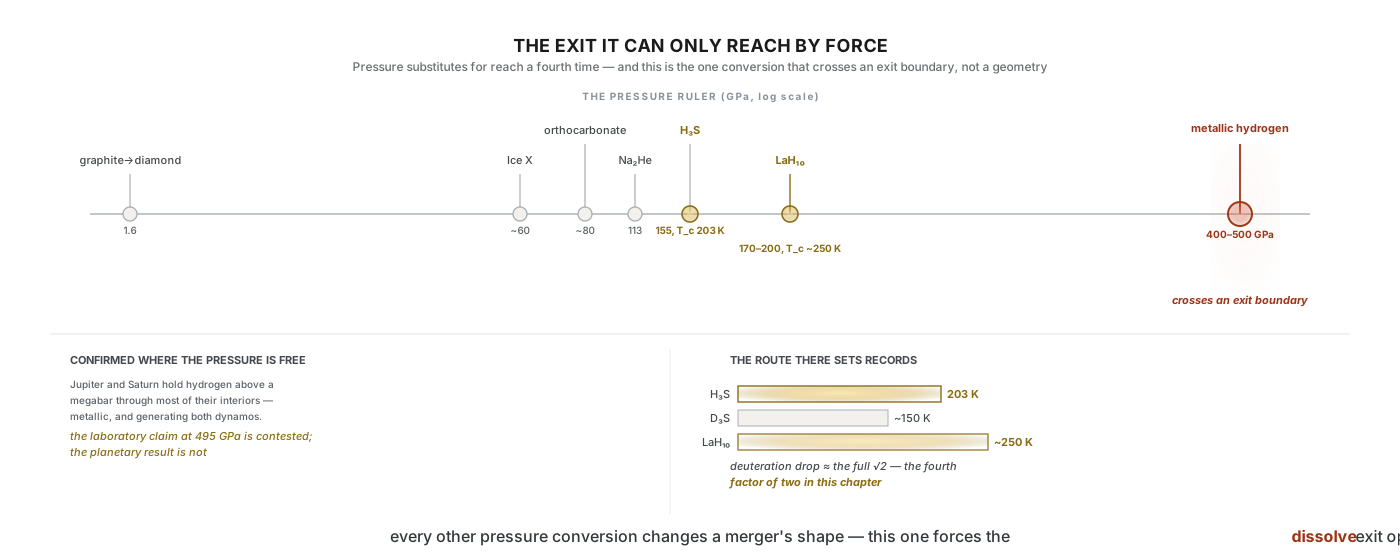
Metallic hydrogen is the oldest outstanding prediction in condensed-matter physics: Wigner and Huntington argued in 1935 that squeezing solid hydrogen hard enough must dissolve its molecular boundaries into a raceway and produce an alkali metal, as its position at the head of group 1 has always implied. Ninety years later it has still not been unambiguously made in a laboratory. The claimed observation at 495 GPa (Dias & Silvera 2017) has not been reproduced, the estimates run from 400 to 500 GPa, and the experiment sits at the very limit of diamond-anvil technique.
The framework’s reading is that this is pressure substituting for reach a fourth time, and that it is the sharpest instance the section has, because it is the only one that moves an element across an exit boundary rather than between two geometries of the same exit. Carbonate to orthocarbonate is a merger changing shape. Graphite to diamond is a merger changing shape. Na₂He is a spectator getting in the way. Hydrogen to metal is the dissolve exit being forced open for an element that cannot reach it by count — because dissolving an outer shell requires something for the raceway to run around, and hydrogen has to be compressed until the protons themselves serve as the lattice.
Two things are worth putting on the record beside it.
The prediction is confirmed where the pressure is free. Jupiter and Saturn hold hydrogen above a megabar through most of their interiors, that region is metallic, and it is the dynamo generating both planets’ magnetic fields — Jupiter’s being the largest structure in the solar system after the heliosphere. The laboratory result is contested; the planetary one is not, and it is the same physics with the anvil supplied by gravity (solar system boundaries).
And the route there passes through the highest superconducting temperatures ever measured. H₃S superconducts at 203 K at 155 GPa (Drozdov et al. 2015) and LaH₁₀ at {\sim}250 K at 170–200 GPa (Drozdov et al. 2019; Somayazulu et al. 2019) — hydrogen’s participant lent into a metal lattice under compression. The mechanism is ordinary phonon-mediated BCS, where T_c \propto M^{-1/2}, and that is exactly the mass on the boundary again: the pairing frequency is set by the vibration of the lightest possible atom, and no other element can supply it. The measurement that closes the loop has been made — deuterating H₃S drops T_c from 203 K to roughly 150 K, close to the full \sqrt{2}, which is both the confirmation that the mechanism is phononic and the fourth appearance in this chapter of the same factor of two.
Predictions
The relay is the mover, so removing the chain must remove the anomaly. Anomalous ionic mobility must appear in exactly those media supporting a continuous donor–acceptor network and must vanish where the network is absent — a regime dependence with the sign fixed in advance, mirroring the lithium chapter’s wrap test. Retrodicted by H⁺ at 349.8 and OH⁻ at 198.0 against 30–80 for every other aqueous ion; by anomalous NH₄⁺ mobility in liquid ammonia; by the anomaly’s absence in acetonitrile, DMSO and propylene carbonate; and by Nafion’s conductivity collapsing on dehydration. The sharp form: across a mixed-solvent series of decreasing hydrogen-bond connectivity, the proton’s excess mobility must fall continuously with the percolation of the network rather than switching at a composition threshold. Falsified by anomalous proton mobility in a rigorously aprotic medium, or by an ion with a genuine core showing structural rather than vehicular diffusion.
Hydrogen is filed by participant count and decided by shortfall, so its chemistry must track carbon rather than either column it is assigned to. Both are zero-spectator, zero-vacancy crests differing only in shell width. Retrodicted by ionization energy (13.60 eV, nearest carbon’s 11.26 among Li/C/F), electronegativity (2.20 against carbon’s 2.55, lithium’s 0.98, fluorine’s 3.98), and the existence of a stable, nonpolar, kinetically inert C–H bond at all. Falsified by a chemical quantity on which hydrogen falls cleanly between lithium and sodium, or between fluorine and chlorine, rather than near carbon — or by a class of hydrogen chemistry that follows the alkali or halogen pattern in its resolution rather than only in its count.
The mass sits on the boundary, so hydrogen must be the only element with factor-scale isotope effects. Everywhere else the mass is behind a core the chemistry cannot reach. Retrodicted by the C–H/C–D semiclassical ceiling of 6.9 at 298 K derived from a 400 cm⁻¹ zero-point difference; by tunnelling-regime KIEs near 80 in soybean lipoxygenase; by D₂O’s toxicity to mammals above {\sim}20\% body-water replacement, with no analogue at any other element; by H₂ and D₂ freezing 35\% apart; and by the full \sqrt{2} isotope shift in H₃S superconductivity. Falsified by a kinetic isotope effect at any other element exceeding what its reduced-mass ratio permits, or by a hydrogen-transfer reaction showing no isotope effect where the transfer is rate-limiting.
Three-centre bonding is what a participant does when a two-centre merger is unavailable, so it must occur at the poles of the dial and not in its interior. Boron reaches it through a vacancy, xenon and the polyhalides through having only spectators, hydrogen through having no interior — three shortages, one geometry. Retrodicted by diborane’s B–H–B bridges, XeF₂’s linear three-centre four-electron bond, and the hydrogen bond itself, with the symmetric limit at FHF⁻ (163 kJ/mol) and at Ice X above {\sim}60 GPa. Falsified by a stable, ambient three-centre bond at a double-zero element with an unobstructed two-centre alternative available.
No core means no inside path, and capacity cannot rescue it. Hydrogen holds the largest gravimetric capacity in the table at 26{,}800 mA h/g and cannot be a battery, because a galvanic cell requires a core that can be wrapped, delivered and released. Every hydrogen store must therefore be a merger store, and must inherit the lithium chapter’s median/merger prediction: capacity and cycle life must run in opposite directions across the hydride family, with no median-type exception. Retrodicted by LaNi₅H₆ (1.4 wt%, good cycling), MgH₂ (7.6 wt%, poor kinetics and cycling) and ammonia borane (19.6 wt%, effectively single-use). Falsified by a reversible high-capacity hydrogen store that inserts without breaking host–host mergers, or by a practical closed-system proton battery with a confined inside path.
Pressure must move hydrogen across an exit boundary, not merely between geometries. The other three pressure conversions the section records change the shape of a merger or the packing of spectators; this one forces the dissolve exit open for an element that cannot reach it by count. Retrodicted by metallic hydrogen in Jupiter’s and Saturn’s interiors generating both dynamos, and by the pressure-stabilized superhydride superconductors as the approach to it. Falsified by a reproducible metallization of solid hydrogen at a pressure far below the 400–500 GPa range, which would mean the count and not the geometry was the barrier — or by a superhydride whose T_c shows no hydrogen isotope effect at matched pressure and structure.
The terminator window has one occupant. A cap on a carbon frame must have one participant, no spectators, electronegativity matched to carbon, a merger inert at 310 K, and low mass. Retrodicted: the halogens fail on spectators and polarity, the alkalis never merge, groups 13–16 continue the chain instead of ending it, and iodine is the near-miss — better matched than hydrogen on electronegativity (\Delta\chi = 0.11 against 0.35) and killed by diffuseness, at 234 kJ/mol against C–H’s 413. Falsified by an element satisfying all five conditions simultaneously, or by a biopolymer at scale in any organism whose backbone is capped by something other than hydrogen for structural rather than functional reasons.
Conclusion
Eight chapters have read the periodic table by asking what an element does with the surfaces it cannot use. The helium chapter asked what happens when there are no surfaces to use at all. This one asks the remaining question, which is what happens when there is nothing underneath them.
Row one turns out to be the section’s whole vocabulary shown twice, each token by itself. Helium is a spectator alone: one closed pair and nothing else, and the answer is exclusion, and exclusion buys a laboratory cold enough to measure the vacuum. Hydrogen is a participant alone: one half-boundary and nothing else, no spectators to point with, no vacancies to beg with, and — this is the part with all the consequences — no core to stand on.
Take the consequences in order. Because there is no shortfall, hydrogen is the crest of its palindrome and behaves like the other exposed crest in the table, which is carbon: same token structure, adjacent numbers, and the C–H bond as the joint. Because there is no core, stripping the participant drops out of the electron tier onto a nucleon, the flux ledger runs off its own table at 10^9, and no wrap can ever be released — so the proton is never carried, only handed, and the fastest ion in water is the one that never moves. Because there is nothing to anchor a second merger to, the participant is shared among three centres instead of two, which is the hydrogen bond, and which puts hydrogen in the same geometry as boron’s vacancy and xenon’s excess by a third route. Because the mass is on the boundary rather than behind it, one neutron changes reaction rates by a factor of seven, enzyme rates by eighty, and the freezing point of the substance by a third — the only element in the table where an isotope is a different reagent. And because there is no core to send down an inside path, the best capacity in the periodic table cannot be a battery, and hydrogen’s engineering is a membrane that relays and a lattice that must be broken and rebuilt.
If carbon shows the substrate’s sheet, lithium its coin, iron its fold, silicon its gap, gold its speed, uranium its limit, and helium its seal, then hydrogen shows its relay — the one case in the table where a boundary gets from one place to another without anything travelling.
That is worth stating plainly, because it is the distinction this chapter turned out to be about and the section had no occasion to draw before. Everywhere else, moving something means dragging a boundary through a medium, and the ledger is a bill for the dragging: what the wrap costs, how fast it turns over, whether it lets go at the interface. The lithium chapter is that bill, itemized, and its conclusion was that civilization stores its energy in the one element for which the tear is worth the most and the wrap knows when to release. Hydrogen presents no such bill, because there is no boundary to drag. What propagates is the place in the network where the accounting does not balance — and a defect can cross a medium the medium itself never crosses.
The table put hydrogen in group 1 because it has one electron, and in group 17 because it needs one, and above everything because neither worked. All three readings are counting the same participant. What none of them counts is the emptiness behind it, and the emptiness is the element.