Laser Cooling and the Atomic BEC
The eighth reading of light is momentum: the modon as courier, a drag made of headlights, and three floors on the way down — the linewidth, the recoil, and the breath that cannot be cooled. At the bottom of the ramp, matter does what the vacuum did — condenses — and the bench then photographs the closest thing physics owns to a picture of the medium this paper describes: a triangular lattice of quantized vortices, ringing with Tkachenko waves, under an emergent sound cone with a horizon that glows

One Observable Left
The Light section has read the substrate off its brightest excitation seven ways — frequency, wavevector, mechanism, phase at one boundary, phase at N boundaries, occupation, phase across a spectrum — and three chapters running have deferred the same door: laser cooling, the modon as momentum courier. This chapter walks through it, and it is the right door to end on, because the eighth observable is the one light spends. Every other reading left the light intact to be read again. Momentum is different: to read it, matter must take it, and the transaction consumes the photon. So this chapter is the section’s exit — light does one last job and leaves — and what it leaves behind, at the end of a twenty-year experimental ramp, is the payoff the whole section has been circling: matter cold enough to do what this paper says the vacuum did. Condense.
The courier itself was described long ago. The framework’s photon is a modon — a counter-rotating vortex pair whose internal angular momenta cancel, leaving pure translational energy E = h\nu moving at c — and a Lamb–Chaplygin dipole’s signature property is that it carries momentum with no net transport of medium. Nothing is delivered but the push. The push is small: p = E/c = \hbar k, about 10^{-27} kg·m/s for a visible photon, the momentum of a snail parked on a molecule. And it is exact — so exact that atom interferometers now measure the recoil from single photon kicks as the anchor of the most precise determinations of the fine-structure constant, \alpha to about 10^{-10} (Parker et al., Science 360, 191, 2018; Morel et al., Nature 588, 61, 2020). The courier’s kick is not approximately \hbar k; it is the tenth-decimal-place definition of it. Whatever else this chapter claims, the exchange it is built on is among the best-certified transactions in physics.
A Drag Made of Light
One kick does nothing. A sodium atom leaves an oven near 1000 m/s, and one photon’s recoil changes that by 3 cm/s. The 1975 insight (Hänsch & Schawlow for atoms; Wineland & Dehmelt for trapped ions) was that the kicks can be rectified, and the rectifier is the Doppler shift. Tune a laser slightly below the atom’s absorption line and a moving atom sees the beam it is driving into shifted up, toward resonance, and the beam chasing it shifted further away. The atom preferentially eats light from in front. Each absorption is a kick against the motion; each re-emission — and here the spectrum-free chapter’s machinery earns a second salary — goes in a random direction, boundary’s choice, summing to zero over many events. Directed capture, isotropic re-shed: momentum flows in from wherever the atom is headed and out to nowhere in particular. Run the numbers and the gentlest force in optics becomes violent: at saturation an atom scatters \sim10^7 photons per second, a deceleration near 10^5\,g. A thermal sodium atom is stopped by about thirty thousand kicks, in a millisecond, over roughly a metre — which is the length of the Zeeman slower bolted to the front of every BEC machine. Surround the atom with six such beams and it moves as through honey — optical molasses (Chu et al. 1985), matter at microkelvin, sitting in the brightest light in the room.
That sentence should bother a careful reader, and resolving it is the framework’s favourite part. Cooling means removing entropy, and a laser — one mode, one phase — carries almost none in. Where does the atom’s disorder go? Into the light on the way out. The scattered photons leave in random directions, at randomized times, and — averaged over the Doppler asymmetry — slightly blue-shifted: each scattering event exports a sliver of kinetic energy and a full ration of randomness. The fluorescence glow around a magneto-optical trap is the atoms’ temperature, leaving at c. In the one-coupling table’s terms, laser cooling is capture-and-re-shed run as a rectifier: the capture leg inherits the laser’s direction, the re-shed leg inherits the boundary’s indifference, and the difference between those two legs is a current — of momentum out of the atom, and of entropy into the light. The coldest matter in the universe is manufactured by shining light on it, and the trick is not that light is cold; it is that light is the one courier that can carry disorder away at c and never bring it back.
The rectifier has a floor, and the floor is its own noise. Each re-shed kicks the atom 3 cm/s in a random direction — the drag and the jitter come from the same events — and the balance point is the Doppler limit, T_D = \hbar\Gamma/2k_B: about 146\;\muK for rubidium, 240\;\muK for sodium. Read what sets it: \Gamma, the linewidth — the ring-down rate of the atom’s own boundary. The first floor on the ramp is not a property of the light or of the substrate; it is the thermal price of trading with a boundary that forgets.
Below the Limit, Twice
In 1988 Phillips’ group measured their sodium molasses carefully and found 40\;\muK — six times below the Doppler limit (Lett et al., PRL 61, 169). Experiments do not usually outperform their own theory, and the resolution (Dalibard & Cohen-Tannoudji: Sisyphus cooling, the atom forever climbing polarization-gradient hills and paying at each crest) took the field to a few microkelvin and took Chu, Cohen-Tannoudji and Phillips to Stockholm in 1997. But the mechanism matters less here than the floor it exposed underneath, because that floor belongs in this paper.
The recoil limit. However clever the scheme, the last event is one photon leaving, and the atom keeps its kick: one courier’s momentum, \hbar k, an energy E_r = \hbar^2k^2/2m \approx k_B\times180 nK for rubidium. You cannot trade with light in units smaller than the courier, so you cannot end colder than the last courier’s change. The section has met this shape before, in frequency: the modon floor is the smallest compact quantum the lattice can hand over. The recoil limit is the same sentence read in momentum — the quantum of the exchange sets the floor of the exchange — with the honest difference flagged now: the recoil floor is set by the photon and the atom (\hbar k, m), not by the lattice, and it moves when you change either. It is the bench’s structural rhyme of the floor, not an instance of it.
And the escape from it is the part the framework cannot resist, because the escape is its own vacuum’s trick. Sub-recoil cooling works by arranging that the coldest atoms stop trading. In velocity-selective coherent population trapping (Aspect et al., PRL 61, 826, 1988) the atom is steered into a superposition of states whose couplings to the light interfere destructively — a dark state — and the interference is exactly velocity-selective: only atoms near v = 0 stay dark. Everything still moving keeps scattering, keeps getting randomized, and keeps re-rolling the dice until it happens to land dark and still; the cold accumulate in the silence. Raman cooling (Kasevich & Chu 1992) plays the same trick with different machinery. Read that against the superradiance chapter: the framework’s vacuum is dark for precisely this reason — anti-phase pairing, amplitudes cancelling, a medium that has arranged its own couplings to sum to zero. The coldest atoms ever prepared and the quietest medium there is use the same mechanism, deliberately in one case and constitutionally in the other. Below every floor, the way down is to go dark.
There is a third floor, and it is the bottom. In an ion trap the ladder can be run to its last rung: resolved-sideband cooling takes a single trapped ion to the quantum ground state of its motion (Diedrich, Bergquist, Itano & Wineland, PRL 62, 403, 1989 — \sim95\% in the ground state; unity to within measurement since). What remains is zero-point motion — and it does not leave, because it is not heat. It is the motion the uncertainty principle requires of anything bound, the same irreducible oscillation the framework installs in every lattice cell as the breath, running forever, undamped, at \omega_1. The photon BEC chapter’s breadcrumb promised this destination in one phrase — sideband cooling down to only the boundary breath left — and the bench delivers it literally: strip away every removable quantum and what is left is a boundary, breathing, because being is oscillating. The ramp down from 300 K ends not at stillness but at the substrate’s kind of motion — the kind with no entropy in it.
The Matter Column
Molasses is cold but not crowded, and condensation needs both: the criterion is phase-space density — atoms packed within a thermal de Broglie wavelength of each other, n\lambda_{dB}^3 \geq 2.612. Laser cooling stalls five orders of magnitude short (the light that cools also, eventually, reheats: photons scattered by one atom are absorbed by another). The last stage abandons light entirely for the oldest cooling there is — the coffee-cup mechanism. Evaporative cooling: confine the cloud in a magnetic bowl, repeatedly skim off the most energetic atoms, let the rest re-thermalize colder. Throw away half the coffee to cool what remains.
In June 1995 it worked. Two thousand rubidium atoms at 170 nK condensed at JILA (Anderson et al., Science 269, 198); months later half a million sodium atoms at MIT (Davis et al., PRL 75, 3969); the 2001 Nobel followed (Cornell, Wieman, Ketterle). Seventy years after Einstein wrote it down for atoms — and fifteen years before Bonn achieved it for photons — a gas of massive, conserved bosons was cooled through its transition and its ground mode filled by arithmetic.
The occupation table gains the column it has been missing, and the ledger should be read closely:
| System | Grain | Coherent unit | Occupation | Reached by |
|---|---|---|---|---|
| dye-microcavity photon BEC | photon | trap ground mode at the cutoff | \sim8\times10^4 | equilibrium |
| mW He-Ne laser | photon | one cavity mode | \sim6\times10^8 | pumping |
| atomic BEC | atom | trap ground mode | 10^3–10^7 | equilibrium |
| substrate | dc1 quantum | one effective quantum | \nu\approx8.3\times10^8 | equilibrium |
| superfluid ^4He / ^3He | atom / Cooper pair | condensate mode | macroscopic | equilibrium |
The photon BEC matched the substrate’s mechanism and had to engineer its grain — a cutoff to fake a mass, a dye to fake a conserved number. The atomic BEC needs neither fake: an atom’s mass is native and its number cannot leak, which are exactly the two properties the photon BEC chapter argued the substrate’s own quanta possess by construction. So the atomic BEC is the unengineered member of the family — the demonstration, with nothing up either sleeve, that a gas of massive, conserved, mutually thermalizing bosons condenses the moment it is cold and crowded enough. That is not an analogy to the framework’s founding claim about the boil; it is the same sentence with a different noun.
The Substrate in a Bottle
What was made in 1995 was not just a cold cloud; it was a new medium, and everything the framework asserts about its own medium can be read against it, one property at a time.
One phase, held stiffly. Cut a condensate in two, let the halves fall and overlap, and they draw matter-wave interference fringes across each other (Andrews et al., Science 275, 637, 1997) — half a million atoms behaving as one wave with one phase, the Ginzburg phase-rigidity the framework leans on, photographed in matter.
The framework’s own equation, exact for once. A dilute condensate obeys the Gross–Pitaevskii equation quantitatively — in helium GP is a cartoon; in a dilute gas it is precise — and GP is the mathematics this paper runs for the substrate itself, from the bridge equation’s energy functional to the \xi^2 = 2\xi_{GP}^2 bookkeeping. The atomic BEC is the one laboratory system where the framework’s governing equation holds without apology, with every coefficient measured.
An emergent cone. Sound in a condensate moves at a few mm/s (Andrews et al., PRL 79, 553, 1997), and Bragg spectroscopy has traced the full Bogoliubov dispersion (Steinhauer et al., PRL 88, 120407, 2002): a clean linear cone at long wavelength, bending to a free-particle parabola at the healing length. For the condensate’s own excitations, that sound speed is the speed limit and the cone is the kinematics — which is the emergent-c claim, demonstrated in a medium where we can see both tiers at once. And the measured curve is monotonic — no roton — which is the shape this paper claims for the substrate parked at its marginal point, the shape helium conspicuously does not have. The bench now holds all three members: helium, off-critical, wearing the full roton dip; the dilute condensate, wearing the smooth cone; and the vacuum, argued to sit at marginality with the smooth cone one tier down. (The honest note is paid in the accounting: the dilute gas’s smoothness comes from weak interactions, not from criticality — a rhyme of shape, not a shared cause.)
The Photograph
Then rotate the bottle, and the framework’s own portrait develops.
Spin a condensate and its circulation quantizes — h/M, inherited single-valuedness, the same condition that makes \hbar the substrate’s circulation quantum — and the vortices that enter do not scatter randomly. They crystallize. Abo-Shaeer, Raman, Vogels & Ketterle (Science 292, 476, 2001) stirred sodium condensates of fifty million atoms with a rotating pair of laser beams and photographed triangular lattices of up to 130 vortices — cores 5\;\mum apart, the cloud carrying up to 60\hbar of angular momentum per atom, and, in the paper’s own words, lattices of “extreme regularity, free of any major distortions, even near the boundary.” The two names the discoverers reach for in their second paragraph are the two this paper’s bridge equation is built from: Abrikosov, whose flux lattices these are the neutral twin of, and Tkachenko, who proved the triangular arrangement is the energy’s choice — the same packing the Sandier–Serfaty theorem later made rigorous and the substrate is argued to adopt wholesale.
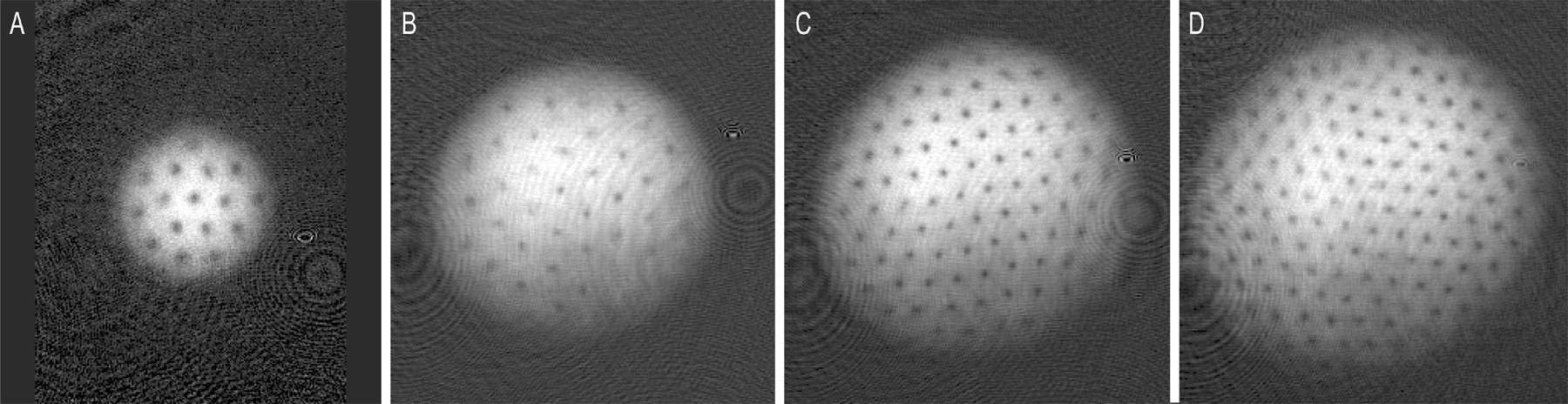
Read the geometry the way the framework reads its own. A superfluid cannot rotate the way a bucket of water does — continuous rotation is forbidden to a single-valued phase — so it counterfeits rigid rotation: it admits discrete vortex lines at uniform area density, n_v = 2\Omega/\kappa, and when coarse-grained over several lines its velocity field matches a rigid body’s exactly. One phase-locked medium, discrete quantized circulation, smooth effective rotation above the lattice scale — that is precisely the construction this paper’s vacuum runs at \xi\approx100\;\mum, where the self-pinned lattice’s coarse-grained vorticity is the background field modons ride on. The photograph is also, quietly, one more phase certificate: it is taken after the trap is switched off and the cloud explodes to twenty times its size, and the lattice comes through the explosion undistorted — order held by phase, not by confinement.
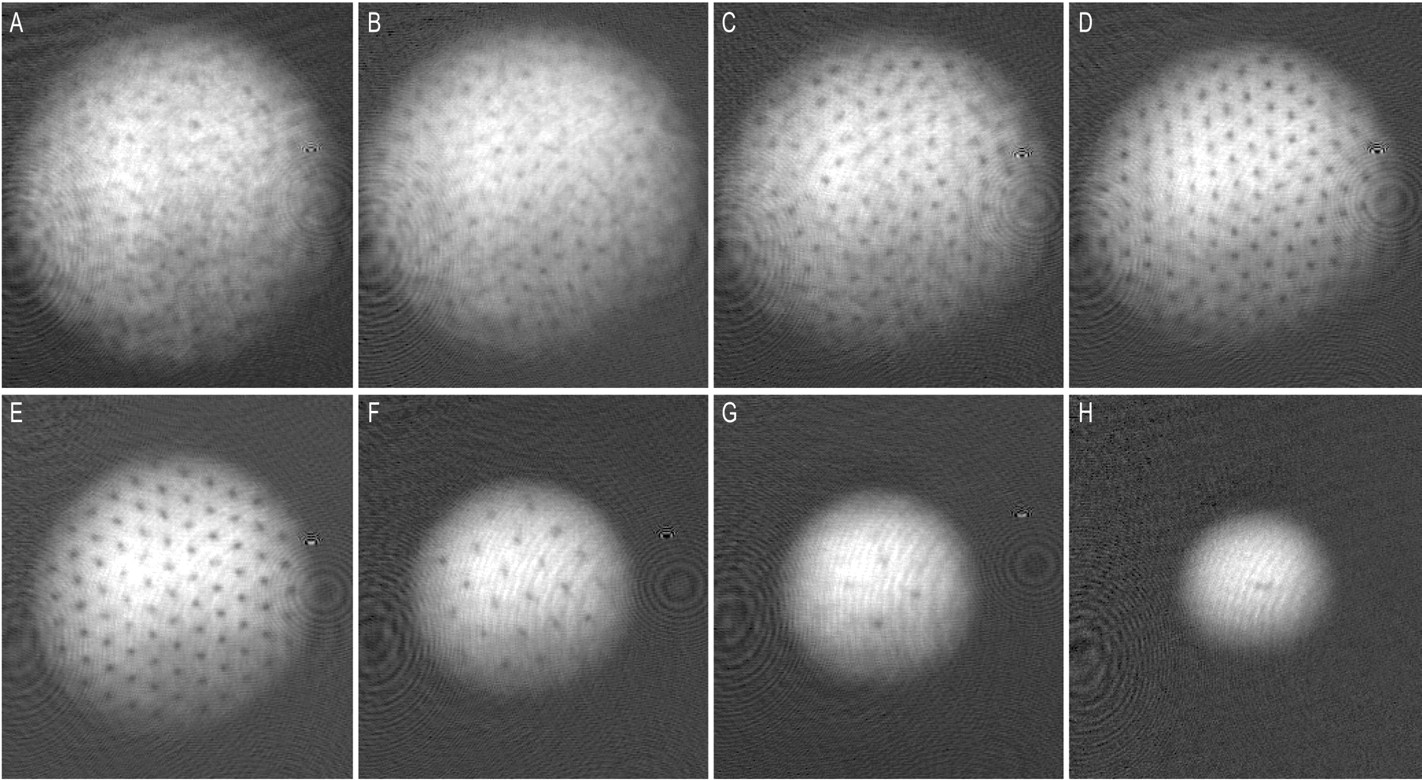
And the order is nobody’s doing. Drive the condensate for less than half a second and watch it settle (below): at 25 ms the vorticity is in but the arrangement is a disordered tangle; within a few hundred milliseconds it has crystallized — no conductor, no template, no instruction, just energy minimization finding Tkachenko’s answer. The lattice then outlives much of the matter carrying it: lattices persist for seconds, and individual vortices to 40 s, while the cloud shrinks around them by atom loss. The entry threshold carries a familiar lesson too: vortices appeared only near 0.3\,\omega_r, far above the 0.08\,\omega_r where a vortex is already thermodynamically welcome — what admits vorticity is the surface tearing threshold, not the energy ledger, which is the same two-velocity lesson helium taught and the substrate’s outer rim repeats.
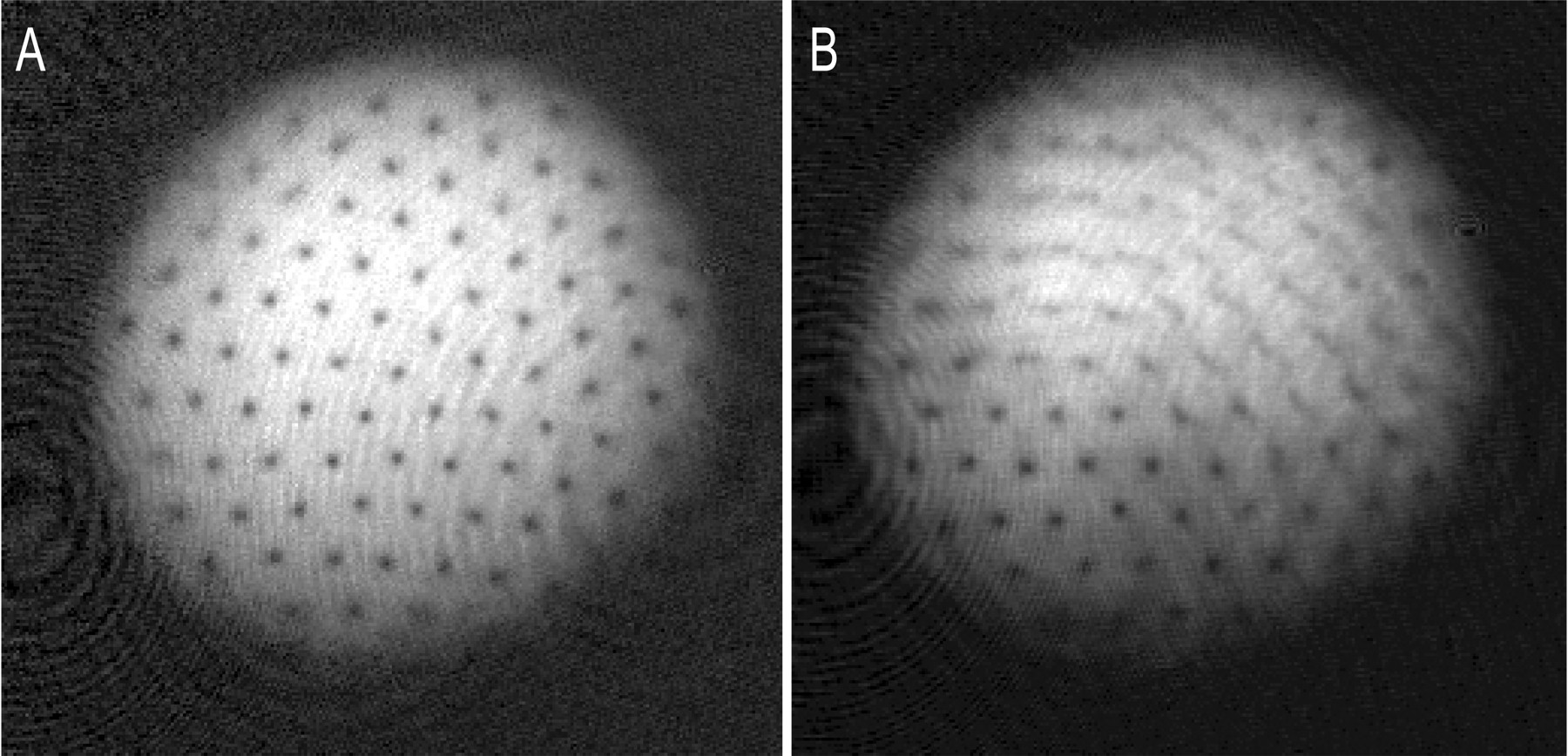
Grow the crystal imperfectly and it shows exactly the flaws a crystal should: the paper’s last figure catches a dislocation in one lattice and a grain boundary in another — patches of perfect triangular order meeting at a seam. That texture is worth staring at, because it is the texture this paper attributes to the vacuum itself: not a single crystal but a domain glass of triangular crystallites — locally six-fold, globally frameless, the same morphology the YBCO vortex glass shows frozen. A condensate given time anneals toward the single crystal; a medium quenched once at its own formation and never reheated keeps its grain boundaries forever. The bench grows both textures on demand, seconds apart, in one apparatus.
Two years later the lattice was heard as well as seen: Coddington, Engels, Schweikhard & Cornell (PRL 91, 100402, 2003) excited and imaged Tkachenko waves — the slow elastic shear ripples of the vortex crystal, spiralling across the photographs at frequencies matching vortex-lattice hydrodynamics.
Stand back and note what this platform has done for this paper. The framework’s vacuum is a rotating triangular lattice of quantized vortices whose shear elasticity — the Tkachenko term, the 8\pi in the bridge algebra — carries its gravity sector. Every element of that description has now been watched in one apparatus: quantized vortices, entering one by one; the triangular lattice, self-assembling because it is the energy minimizer; Tkachenko oscillations, rippling through it on camera. Helium withheld the photograph — its vortices are ångström-thin lines in a transparent bath, imaged only in arrays of eleven or fewer — and the superconductor supplied a frozen glass. The rotating condensate supplies the motion picture: the substrate’s claimed texture, forming, equilibrating, ringing, and fraying, in the images above. No number transfers — the spacing is set by the stirring, not by any substrate scale — but the mechanism list transfers whole, and there is no other object in the laboratory inventory about which that can be said. The discoverers themselves close by passing the picture up the ladder: the paper’s final paragraph attributes pulsar rotation glitches to the dynamics of exactly this lattice in a neutron star’s superfluid interior — the bench’s own authors reading their bottle at stellar scale, one tier below where the framework’s neutron-star chapter picks the same thread up.
The Fermi-gas sequel prints one more of the paper’s recurring numbers. Pair fermionic atoms and condense the pairs, and the vortex lattice persists across the whole BEC–BCS crossover (Zwierlein et al., Nature 435, 1047, 2005) — with circulation quantum h/2m. The factor of two is the pairing count: the same two helium-3 wears on its face, the same two the framework finds in the lattice’s paired breath and the bridge equation’s 1/\sqrt2 — here installed on a bench with a knob, tunable continuously from molecule-like pairs to arm’s-length Cooper pairs, condensing either way.
The Horizon That Glows
The last exhibit is the one that reaches furthest up the paper. In 1981 Unruh noticed that sound in a moving fluid obeys exactly the equation of a field on a curved spacetime: the flow supplies an effective metric, and where the flow outruns its own sound speed, the surface is a genuine horizon — phonons inside cannot get out, for precisely the reason light cannot leave a black hole. If Hawking’s argument is right about horizons rather than about gravity in particular, such a surface should radiate.
It does. Steinhauer’s group accelerated a condensate over a sonic waterfall and observed phonon pairs straddling the horizon — correlated, with the entanglement signature (Nature Physics 12, 959, 2016) — and then resolved the emission spectrum and found it thermal, at the temperature set by the horizon’s surface gravity, T_H \approx 0.35 nK as predicted (Muñoz de Nova et al., Nature 569, 688, 2019). A medium with an emergent signal speed hands its excitations a metric so faithfully that the metric’s most exotic quantum consequence — Hawking radiation — arrives on schedule, in a puddle of rubidium, at a third of a nanokelvin.
Two readings, and the discipline is to keep them apart. What this certifies for the framework is the kinematic half of its whole wager: that “spacetime as a medium’s effective geometry” is not a metaphor but a laboratory fact — excitations of a medium genuinely cannot tell they live in a lab; they experience flow as geometry, horizons included. It even answers, on the bench, the sharpest standing objection to that picture: Hawking’s derivation invokes arbitrarily short wavelengths, and a granular medium has a shortest one — yet the measured spectrum is thermal anyway, because dispersion at the healing length regularizes the derivation instead of wrecking it (the trans-Planckian problem, dissolved by experiment). A vacuum granular at \xi\approx100\;\mum faces the same objection and can now cite the same answer. What this does not certify is the dynamic half: nothing about a flowing condensate makes its effective metric obey Einstein’s equations — the analog metric is dragged about by external hardware, not self-consistently sourced by the phonons’ energy. That half of the wager rests entirely on the framework’s own gravity sector, and no bench result yet stands behind it. The bottle demonstrates that a medium can be a spacetime; it is silent on whether a medium must gravitate correctly, and the accounting below says so again.
Honest Accounting
Five debts, in the house discipline.
First, nothing here corrects AMO physics. Doppler cooling, Sisyphus, sub-recoil dark states, evaporation, GP dynamics, vortex lattices, and analog Hawking radiation are standard, quantitative, and belong to the field that earned two Nobel Prizes building them. Every number above is theirs. The contribution is identification: the courier reading of radiation pressure, the three floors sorted against the framework’s own floors, and the condensate read as the vacuum’s bench twin.
Second, no number transfers. The condensate’s sound speed is mm/s against c; its healing length is sub-micron against \xi\approx100\;\mum; its vortex spacing is set by a stirring beam, not by any substrate constant. Every comparison in this chapter rides the mechanism column and none rides a magnitude — the same division of labour the helium chapter codified: the substrate supplies the mechanism, the matter supplies the number.
Third, the marginal-shape rhyme is a rhyme. The dilute condensate’s Bogoliubov curve is monotonic because its interactions are weak, not because it sits at a critical point; crank the interactions (helium) and the roton dip returns. The coincidence of shape with the substrate’s claimed marginal dispersion is suggestive scenery, not evidence, and the framework’s marginality argument must stand on its own derivation.
Fourth, analog gravity certifies kinematics only. Fields on an effective curved metric: demonstrated, thermal Hawking spectrum included. Metrics that gravitate — that are sourced by their own excitations according to Einstein’s equations — are nowhere on any bench, and the framework’s gravity sector receives no support from this chapter beyond the dissolution of the trans-Planckian objection. Overclaiming here is the standard failure mode of medium-based pictures, and the chapter declines it by name.
Fifth, the recoil floor is not the modon floor. One is set by \hbar k and the atomic mass and moves when either changes; the other is claimed fixed at 3 THz by the lattice. They share a sentence — the quantum of the exchange sets the floor of the exchange — not a mechanism, and the chapter uses the rhyme to teach the shape, never as a second data point.
Place in the Framework
The Light section closes at eight readings. The modon floor read the lattice as a frequency; the scattering ring as a wavevector; Spectrum-Free Light read the emission mechanism; the laser read phase at one boundary, superradiance at N; the photon BEC read occupation; the comb read phase across a spectrum. This chapter reads momentum — and momentum, alone among the eight, is the observable that ends the section by construction, because reading it uses the light up. The courier delivers its kick, dumps its direction, carries the entropy off at c, and is gone.
What it leaves behind closes a loop the section opened on its first page. Twenty years of rectified kicks and skimmed coffee end in a magnetic bowl holding the coldest matter in the universe — and the moment it is cold enough, the matter stops being a gas of couriers’ targets and becomes the other thing this paper talks about: a condensed medium with one phase, an emergent sound cone, quantized vortices that crystallize into Tkachenko’s triangle, and horizons that glow at the temperature Hawking’s argument assigns them. Every structural claim this paper makes about the vacuum — condensation at a transition, phase rigidity, marginal dispersion, the triangular vortex lattice, elastic Tkachenko shear, even the horizon thermodynamics — has now been watched in that bowl, at scales a laboratory can afford, with no number in common and no mechanism out of place. The universe, this paper argues, did all of it once, on the way down through its own transition — and light, which the substrate has been using as its courier all along, turns out to be the tool with which matter is escorted back to the substrate’s own state. The section ends where the paper began: with a superfluid full of vortices, holding one phase, breathing at its zero point — except this one has a photograph.