How a Moving Charge Makes Light
A charge carries a dress of winding through the medium. Steady motion carries the dress along in silence; acceleration leaves the far dress behind, and the kink between old and new is the light. The motion, not the charge, sets the frequency.
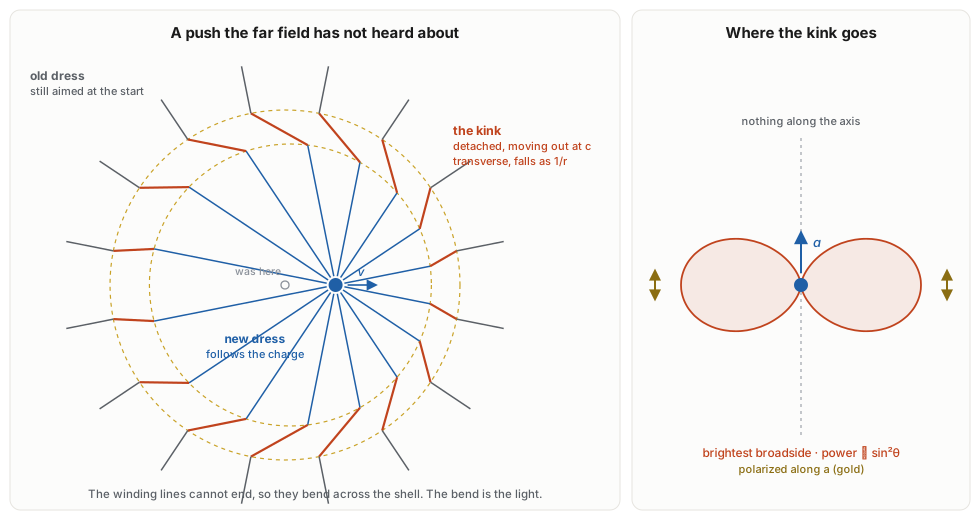
This chapter shows what happens when an electron is pushed - accelerating in the substrate. In a nutshell, at a steady speed, it forms a wrapping layer - a dress that hides the leaking charge. When you accelerate one, the dynamics of the dress create the radiation. I’ll go into the details of these dynamics and show how it is seen in a radio antenna, X-ray tube, a synchroton, and the glow of a hot stove.
Interactive: open the moving-charge simulation. Every line and every glow in it is the exact retarded field of a point charge, computed from the charge’s own past. The push is the figure above, live: the charge is kicked, the shell runs outward at c, and the panel measures the bend off the drawn lines beside Purcell’s \Delta v\,t\sin\theta/c\tau. Silent glide carries the dress along at any steady speed with nothing shed; change the speed and a kink peels off, and in water past c/n the medium’s news ripples pile into a Cherenkov cone. The motion sets the color runs an antenna, a synchrotron, a sudden stop and random jostling, with the waveform and spectrum a detector receives.
The Dress of a Charge
Charge is the net winding a vortex leaves visible to the outside world (Mass and Rotational Energy, Charge is what escapes; mass is what is kept). Winding is topological, so it comes in whole units. That is why the proton and the electron carry exactly equal and opposite charge despite an 1836-fold mass difference, and why the neutron, whose arms escape +\tfrac23-\tfrac13-\tfrac13 = 0, carries none.
That escaping winding organizes the medium around it. Call the organized pattern the charge’s dress. Its defining property is a conservation law: the winding a charge presents is fixed, so the flux of its dress through any closed surface around it is the same no matter how large the surface. Spread a fixed flux over a sphere of area 4\pi r^2 and the dress thins as 1/r^2. That is Coulomb’s law, and its integral form is Gauss’s law,
\oint \mathbf{E}\cdot d\mathbf{S} = \frac{q}{\varepsilon_0},
read in the substrate as winding in, winding out. The Maxwell table identifies \mathbf{E} with the pressure gradient of the organized co-rotating dc1 flow and \mathbf{A} with the medium’s share of a charge’s phase gradient (Aharonov-Bohm § Mead’s Route). The dress is the static part of that flow.
It helps to picture the dress as lines of winding running outward from the charge, the way iron filings show the organized leak around a magnet. In empty space these lines cannot start or stop; they can only begin and end on charges. Everything below follows from that one rule plus the fact that the medium has a finite signal speed.
Why Steady Motion Is Silent
A charge moving at constant velocity carries its dress along. The medium re-forms the same pattern around the new position, contracted along the motion exactly as Special Relativity contracts every light-clock, and no energy is left behind. Nothing radiates. In standard physics this is a consequence of the principle of relativity: a steadily moving charge is a resting charge seen from another frame.
The substrate has superfluid properties that provide a mechanical explanation. A body moving steadily through a superfluid feels no drag unless it is fast enough to create a real excitation of the medium: an excitation of frequency \omega and wavenumber k can be emitted only if the body’s speed matches its phase speed, v = \omega/k. This is the Landau criterion. For the light branch \omega/k = c, so in vacuum no subluminal charge can satisfy it, and steady motion is silent at every speed. In a material medium light’s phase speed drops to c/n, and a charge that outruns it does meet the criterion. It then radiates at constant velocity in a cone at \cos\theta = 1/(n\beta). That is Cherenkov radiation, which therefore marks the boundary of this section: it is the one case in which uniform motion radiates, and it is the Landau criterion met on the light branch.
(The Landau critical velocity v_L \approx 750 km/s the paper uses elsewhere is the same criterion applied to a different branch of the medium’s excitations, the tearing of the lattice’s cell vortices. Each branch of the medium has its own threshold. Light’s threshold is c.)
The Kink: Larmor From Three Substrate Facts
Now push the charge. Suppose it sits at rest, is accelerated for a brief time \tau to a small speed \Delta v, and coasts from then on. Look at the dress a time t later (the figure above).
- Near the charge, inside radius c(t-\tau), the medium has heard about the whole push. The dress there is the dress of a charge moving at \Delta v, aimed at the charge’s present position.
- Far from the charge, beyond radius ct, the news has not arrived. The dress there is still the dress of a charge at rest at the starting point.
- In between, in a shell of thickness c\tau, the two patterns must be joined. The winding lines cannot end in the shell, so they bend across it.
That bend is the radiation. Purcell’s construction (Electricity and Magnetism, after an argument of J. J. Thomson) turns it into a number with nothing but geometry. A line leaving at angle \theta to the push is displaced sideways by \Delta v\,t\,\sin\theta between the inner and outer patterns, and it makes up that displacement across a shell only c\tau thick. The ratio of the bend’s transverse field to the ordinary radial field is therefore
\frac{E_\perp}{E_r} = \frac{\Delta v\,t\,\sin\theta}{c\,\tau}.
With E_r = q/(4\pi\varepsilon_0 r^2), r = ct, and a = \Delta v/\tau,
\boxed{E_\perp = \frac{q\,a\sin\theta}{4\pi\varepsilon_0\,c^2\,r}}
Everything characteristic of radiation is in this one line:
- It falls as 1/r, not 1/r^2. The radial dress thins with area, but the sideways displacement of a line grows with the distance the news has traveled. The product decays only as 1/r, so the bend’s energy, \propto E_\perp^2 \cdot 4\pi r^2, does not thin at all. It detaches and travels.
- It is transverse. The bend lies across the line of sight, which is the self-propulsion geometry of a vortex dipole: a pair can only travel broadside to the line joining its cores.
- It is strongest broadside to the push and vanishes along it, the \sin\theta factor. A line pointing along the acceleration is not displaced sideways at all.
- It is proportional to a, not to v. Steady motion produces no bend, as the previous section required.
Integrating the energy flux \varepsilon_0 c E_\perp^2 over a sphere gives the total radiated power, the Larmor formula:
P = \frac{q^2 a^2}{6\pi\varepsilon_0 c^3}.
For an electron, using e^2/4\pi\varepsilon_0 = \alpha\hbar c, this becomes
\boxed{P = \frac{2}{3}\,\frac{\alpha\hbar\,a^2}{c^2}}
The power an accelerated electron radiates is set by the fine-structure constant, and the fine-structure chapter reads \alpha as the modon–boundary coupling of the substrate. The radiated power and the strength of the electromagnetic coupling are the same number.
The derivation used exactly three ingredients, and each is a property the framework already claims for the medium:
- Conserved winding flux (Gauss’s law): the lines cannot end in empty space, so they must bend. In the substrate this is the topological conservation of circulation, the same protection that holds sub-floor light at c.
- A finite signal speed c = \hbar/(m_1\xi) (Emergent Speed of Light): the far dress has not heard.
- Continuity of the dress across the shell.
No other property of the medium enters. So the substrate inherits Larmor’s law, with its coefficient, its angular pattern, and its 1/r, provided the Maxwell mapping holds as the framework claims. What the substrate adds is the picture: radiation is the part of a charge’s dress that the medium could not update in time, cut loose.
Near Field and Far Field: Attached Dress, Detached Wake
A charge that oscillates, rather than being pushed once, makes a fresh bend every half cycle, and the bends stream outward as a wave of wavelength \lambda = c/f. But close to the charge, most of the oscillating dress never leaves. The field of an oscillating dipole has three parts, falling as 1/r^3, 1/r^2, and 1/r. The first two are the dress itself being dragged back and forth. They store energy and hand it back every cycle; this is the capacitance and inductance of the source, the medium’s elastic back-pressure. Only the 1/r part, the bend, escapes.
The crossover is at r \approx \lambda/2\pi. Inside it the dress is attached; outside it the wake has detached. This explains a basic engineering fact. A source much smaller than its wavelength barely radiates, because nearly all of its dress stays attached: an ideal short dipole’s radiation resistance is R_\text{rad} = 80\pi^2 (L/\lambda)^2\;\Omega, so a 1 m wire at the 60 Hz of a power line (\lambda = 5000 km) radiates almost nothing, while the same wire at 150 MHz (\lambda = 2 m) is an efficient antenna. An antenna is a structure built to make its dress detach.
What Sets the Frequency
The bend reproduces the acceleration’s own time history, E_\perp(t) \propto a(t - r/c). So the spectrum of the radiation is simply the frequency content of the acceleration. There is no wavelength intrinsic to the charge. An electron does not have a color; its motion does.
| Motion of the charge | What comes out | Example |
|---|---|---|
| Oscillating at f | a line at f | radio and TV antennas; the 2.45 GHz magnetron |
| Circling in a magnetic field | the orbit frequency f_c = eB/2\pi m | 28 GHz for an electron in 1 T (cyclotron) |
| Circling near c | harmonics up to \sim\gamma^3 f_c, a smooth continuum | synchrotron light, from radio to hard X-ray |
| Wiggled by a periodic magnet | a tunable line set by beam energy and magnet period | undulators; the free-electron laser |
| Stopped suddenly | a broad continuum with a sharp high-energy edge | X-ray tube bremsstrahlung |
| Jostled at random | a Planck curve | a hot filament, a stove (Thermal Light) |
| Outrunning c/n | a continuum in a cone | Cherenkov glow |
| Beating between two orbital standing waves | a sharp line at \Delta E/h | atomic spectra (see below) |
This is the sung/shed fork seen from the source. Every row but the last is shed light, whose frequencies are set by the mechanics of the motion and carry no fingerprint of what the charge is. Only the last row is sung, because only there is the motion itself pinned to an orbital ladder. Spectrum-Free Light listed the shed sources that need a threshold (Cherenkov, the inner rim, sonoluminescence). This chapter supplies the base case beneath them: any acceleration sheds, at any speed, at the Larmor rate. The threshold sources are special because they add channels on top of it, not because they are the only way to shed.
Quanta and the Floor
Each quantum of the radiated wave carries h\nu. Two consequences follow, and both are visible in the laboratory.
A hard edge. Shed light from a decelerated electron cannot contain any quantum more energetic than the electron’s kinetic energy. An X-ray tube at 30 kV produces nothing shorter than \lambda_\text{min} = hc/eV = 41 pm, a sharp cutoff (the Duane–Hunt limit, 1915) that no classical continuum would have. In the substrate the edge is the all-or-nothing delivery of a topologically protected quantum: a winding cannot be shed in fractions, so the electron sheds whole quanta it can pay for or none.
A change of character at 3 THz. Above the modon floor, \nu > 3 THz, each quantum is a compact, countable modon. Below it, each quantum is a stretched winding spread across many lattice cells. The ratio is exact: h\nu/E_\text{min} = \xi/\lambda, so a 100 MHz quantum (h\nu = 0.41\;\mueV, \lambda = 3 m) is 3\times10^4 times below the floor and spans 3\times10^4 cell lengths.
Every antenna ever built works below the floor. And it never emits one quantum at a time. A 1 W transmitter at 100 MHz releases P/h\nu \approx 1.5\times10^{25} stretched quanta per second, because its electrons move in step, so their bends add in phase. This is the chorus axis of the laser chapter: an antenna is shed light in chorus, the radio cousin of the free-electron laser. With that many quanta per mode the field is a classical wave for every practical purpose, which is why Maxwell’s equations describe radio perfectly without mentioning photons. The maser check already shows that sub-floor quanta are cloned and phase-locked like optical ones; antennas are the everyday version of that fact.
The two regimes meet near the floor. Below it, light is made by moving many electrons together in a circuit. Above it, light is made almost entirely by single electrons in atoms (sung) or by relativistic beams (shed). The handoff between electronics and photonics happens in the terahertz band the floor chapter calls the substrate’s hiding place. That coincidence is suggestive, but it is not evidence. The terahertz gap has ordinary engineering causes (transit-time and RC limits from below; room temperature’s k_BT \approx 6 THz from above), and photoconductive antennas and quantum-cascade lasers both work straight through 3 THz. The substrate requires exactly that: the floor changes how light is quantized, not whether it can be emitted or how much.
Why a Bound Electron Does Not Radiate
This is the question that ended the vortex atom in the nineteenth century. An electron circling a nucleus is always accelerating, so by Larmor it should spiral in within about 10^{-11} s. The kink picture says exactly which motions radiate, and that answers it: only a change in the far-field winding pattern radiates. A dress that changes in a way the far field cannot see sheds nothing.
The heartbeat is a breath, not a push. The electron’s Compton heartbeat is a radial pulsation, the core breathing between 150 fm and 386 fm. A spherically symmetric breath does not move the charge’s center and does not change its winding, so by Gauss’s law the flux through every sphere outside it is unchanged. There is no bend, and therefore no light. (This is the electromagnetic analogue of Birkhoff’s theorem: a pulsating sphere of charge has no monopole radiation.) The ripples the heartbeat pumps into the medium are pressure ripples of the condensate. They carry no change of transverse winding. They build the standing pilot-wave dress instead of leaving as light.
A bound orbital is a standing pattern, not a point going around. In the hydrogen atom the electron and its pilot wave form a standing groove whose shape does not change in time. Its time-averaged charge distribution is static, so the far dress never has to be updated, and nothing is shed. Quantum mechanics says the same thing in its own language: a stationary state has a time-independent charge density |\psi|^2.
A transition is a dress beating between two grooves. When the atom is between levels, the pattern is a mix of two standing waves, and its charge distribution sloshes back and forth at the beat frequency \nu = (E_2 - E_1)/h. That sloshing is an oscillating dipole, and it radiates by exactly the kink mechanism at exactly the line frequency. Larmor applied to the transition’s dipole gives the spontaneous-emission rate, A_{21} = \omega^3|d_{21}|^2/3\pi\varepsilon_0\hbar c^3, which is Einstein’s coefficient (the hydrogen 2p state’s 1.6 ns lifetime follows from it). So sung light and shed light are one mechanism after all. Both are a dress that the medium cannot update in time. In sung light an orbital ladder fixes the frequency of the motion; in shed light the mechanics does. The ejection mechanism, a boundary reorganizing between levels and releasing one modon, describes the same event from the boundary’s side: the beating is the reorganization in progress, and the energy it radiates adds up to one quantum.
Radiation Reaction: the Wake Pulls Back
A bend that carries energy away must take it from somewhere. The detaching wake pulls back on the dress still attached to the charge, and the charge feels a recoil force, the Abraham–Lorentz force:
\mathbf{F}_\text{rad} = m\,\tau_e\,\dot{\mathbf{a}}, \qquad \tau_e = \frac{2}{3}\frac{r_e}{c} = 6.3\times10^{-24}\;\text{s},
where r_e = \alpha\bar\lambda_C = 2.82 fm is the classical electron radius. Magnetism § Inductance reads inductance as the vacuum’s back-pressure against changing current. Radiation reaction is the same back-pressure in the part of the dress that has already let go. In Wheeler–Feynman absorber theory the recoil is the rest of the universe answering the charge; here the rest of the universe is the medium the charge is already embedded in (Aharonov-Bohm § A transaction without a handshake).
The Abraham–Lorentz equation is famous for its pathologies: runaway solutions and acceleration that begins before the force does. They come from treating the electron as a point, and they show up on timescales of order \tau_e. The substrate electron is not a point. Its structure sits at 150–386 fm, a hundred times larger than r_e, and its heartbeat period is T_c = 8.1\times10^{-21} s, about 1300\,\tau_e. The pathological regime lies inside a single heartbeat, where the classical point-charge equation was never going to apply.
Electricity: What Flows in a Wire
The same pieces explain an ordinary circuit, and they correct a picture most people carry from school.
The electrons crawl. In a copper wire of 1\;\text{mm}^2 cross-section carrying 1 A, the conduction electrons drift at about 0.07 mm/s. They ride the dissolved boundary channels of the metal and are scattered every 25 fs or so. A single electron takes hours to cross a room.
The signal does not. Flip a switch and the lamp lights within nanoseconds, because the push is not carried electron to electron. It is carried by the dress. A voltage is a pressure difference in the organized co-rotating flow, and a change in it propagates through the medium at nearly c, guided by the wire.
The energy flows outside the wire. The Poynting vector \mathbf{S} = \mathbf{E}\times\mathbf{B}/\mu_0 of a battery-and-bulb circuit runs through the space around the wires, from the battery to the bulb, and enters the filament through its sides. Standard physics treats this as a curious bookkeeping fact. In the substrate it is literal: the space around the wire is a medium, its organized flow carries the energy, and the wire is a guide that shapes the flow. A coaxial cable makes the point visible: the energy travels in the dielectric between the conductors, not in the copper.
Ordinary circuits barely radiate for the near-field reason above. At 60 Hz the dress of a household circuit is attached everywhere within 800 km. Radiation becomes important only when a circuit’s size approaches \lambda/2\pi, which is why high-speed electronics needs shielding and why antennas are a quarter or half a wavelength long.
Where the Classical Picture Ends
The kink picture assumes the medium can re-form the dress smoothly behind the charge. The substrate names three places where it cannot, and each is a known boundary of classical electrodynamics.
- A charge outrunning c/n. The Landau criterion is met on the light branch and the charge radiates at constant speed: Cherenkov.
- A charge driven past its own circulation speed, 0.776\,c. The paired handoff inside the electron fails and it sheds gamma modons. The paper reads this as the switch-on of the dipole-forbidden electron–electron bremsstrahlung channel (Inner Rim § Two Bremsstrahlungs, One Forbidden), with a predicted extra channel in lightning.
- An acceleration that changes the speed by c within one heartbeat. The dress can be re-formed at most once per Compton period. The acceleration at which a charge’s speed would change by c in one reduced Compton period is a_S = c\,\omega_c = m c^3/\hbar \approx 2.3\times10^{29}\;\text{m/s}^2, which is exactly the acceleration an electron feels in the Schwinger critical field E_S = m^2c^3/e\hbar. Strong-field QED uses this threshold, \chi \sim 1, as the point where classical radiation reaction gives way to quantum radiation reaction, and laser–electron-beam experiments have begun to see the crossover (Cole et al. and Poder et al., 2018). The substrate gives the threshold a mechanical meaning: it is where the medium can no longer update the dress between two heartbeats.
The third point is a reading of a known threshold, not a new number. It is still a useful consistency check: the substrate’s Compton heartbeat lands exactly where QED says the classical picture fails.
Honest Accounting
First, this chapter is recovery, not prediction. Larmor’s formula, the dipole pattern, the near/far crossover, the Duane–Hunt edge, Einstein’s A coefficient and the Poynting picture are all standard physics. The chapter shows that the substrate reproduces them, and what in the medium each one corresponds to. It does not change any measured number.
Second, the derivation is conditional on the Maxwell mapping. Purcell’s argument needs only conserved flux, a finite signal speed, and continuity, and the framework claims all three. But the identification of \mathbf{E}, \mathbf{B} and \mathbf{A} with the dc1 flow is itself still qualitative (Magnetism § Maxwell; the open AB derivation in Aharonov-Bohm). If that mapping is exact, Larmor follows. If it fails somewhere, the failure would show up first as a deviation from Larmor’s coefficient or pattern. None has ever been seen.
Third, the polarization assignment is a consistency check still owed. The modon’s linear polarization is the orientation of its core-to-core axis (Spin and Orbit). The kink is polarized along the acceleration’s transverse projection. The paper has not yet fixed whether the \mathbf{E} direction of a modon lies along its core-to-core axis or across it. Whichever it is, it must be the same for an atom’s photon and an antenna’s wave, since both are dipole radiation.
Fourth, the heartbeat ripple needs one sentence of care. The Electron describes each Compton cycle as pumping a ripple into the medium at c. This chapter’s claim is that those ripples are spherically symmetric pressure ripples that change no winding and therefore are not light. That is consistent with Gauss’s law, but the paper has not yet shown from the substrate’s dynamics that the heartbeat has no dipole component. An electron whose heartbeat had a small dipole part would radiate at the Compton frequency at rest, which it does not.
Place in the Framework
The framework had light sung from orbital ladders and shed by boundaries driven past a limit, and it had Maxwell’s equations as the substrate’s flow. It had not said what happens in the commonest case of all, a charge that is simply pushed. The answer is a single picture that runs through the whole electromagnetic spectrum. A charge’s winding organizes the medium into a dress. The medium updates the dress at c. Any change it cannot finish in time is left behind as a bend that detaches and travels: radio from a wire, X-rays from a target, synchrotron light from a ring, and the spectral line of an atom whose dress is beating between two grooves. The motion sets the frequency, the floor sets whether the quanta are compact or stretched, and the fine-structure constant sets how bright it all is.